President Yoweri Kaguta Museveni has urged European investors to finance Uganda’s electricity generation, railway transport, manufacturing and agro-processing industries, saying increased investment in production would create jobs, expand markets and accelerate economic growth.
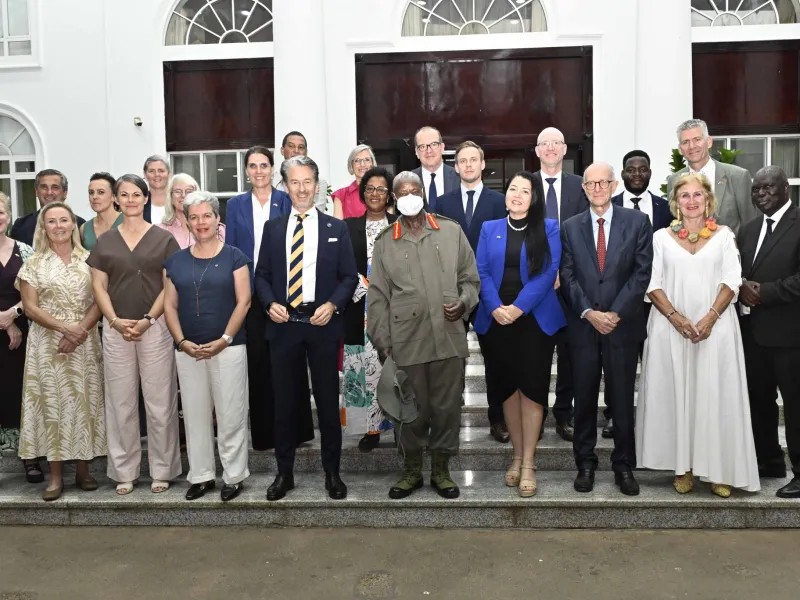
Museveni made the call during a meeting with European Union ambassadors and investors at State House Entebbe, where he argued that Africa’s growing population presents European businesses with an expanding market for goods, services and investment.

He urged European companies to look beyond existing opportunities in Uganda and take advantage of the wider African market, which he said could support increased production and stronger commercial ties between the two continents.
“This is what we have been advising our European friends to look at, because Africa is a big potential market with its fast-growing population,” Museveni said.
The President attributed instability in some African countries partly to tribalism, religious divisions, ideological confusion and a failure to recognise the private sector as a central driver of economic development.

He said Uganda’s experience had demonstrated the importance of maintaining political stability and creating an environment in which businesses could invest, expand operations and generate employment.
Museveni welcomed European-backed infrastructure projects and other proposed investments, saying they would improve connectivity and strengthen trade between Uganda and European markets.
“All these projects are music to my ears. By constructing these projects here, you are linking the market of Uganda to that of Europe. Why can’t anyone see that?” he said.
He identified the cost of electricity as one of the major factors affecting Uganda’s industrial competitiveness, arguing that manufacturers need affordable power to produce goods at prices that can compete in local and international markets.
While welcoming private investment in hydropower generation, Museveni said attention should also be given to electricity tariffs, railway transport and access to affordable financing for businesses engaged in production.
He urged the European Investment Bank to increase support for railway development, electricity generation and distribution, as well as selected road projects that could improve the movement of goods and reduce the cost of doing business.
On road infrastructure, he encouraged European investors to explore financing and construction arrangements, including toll roads where commercially and economically viable.
Museveni also defended government incentives intended to attract manufacturers, including a 10-year tax holiday for eligible businesses, saying the priority was to encourage investors to establish industries, employ Ugandans and expand domestic production.
“We are not interested in direct tax. What we want from you is jobs and production, and I will get taxes indirectly through consumer tax and income tax,” he said.
He pointed to the Uganda Development Bank as an important institution for financing businesses that contribute to production and employment, saying government had maintained its role to support investments that might struggle to obtain suitable financing through conventional commercial lending.
The President further identified agriculture as an area with considerable investment potential, particularly in irrigation, fish farming, animal-feed production and agro-processing.
He cited maize and soya beans among the locally available raw materials that investors could use to establish processing industries, including factories producing animal feeds to support the livestock sector.
Museveni said expanding agro-processing would enable Uganda to add value to its agricultural products, create markets for farmers and strengthen the country’s industrial base instead of relying heavily on the sale of unprocessed commodities.
He also said government was preparing to expand irrigation and fish farming to increase agricultural output, improve household incomes and provide alternative livelihoods for communities living near wetlands.
On environmental protection, Museveni welcomed investments that would help address risks associated with oil development, emphasising the need to safeguard Uganda’s freshwater resources and protect forests and other natural ecosystems.
He said sustainable economic development required the country to balance investment and industrial growth with the conservation of its natural resources.
Museveni’s appeal reflects the government’s continued push to attract foreign capital into productive sectors, with infrastructure, affordable energy, industrialisation and agricultural value addition identified as key areas for expanding Uganda’s economy and creating employment.