Stanbic Bank
Stanbic Bank
25.8 C
Kampala
Stanbic Bank
Stanbic Bank
Home Blog Page 2041

‘Emikolo N’Embagga’ presenter Sharitah Mutawe divorces

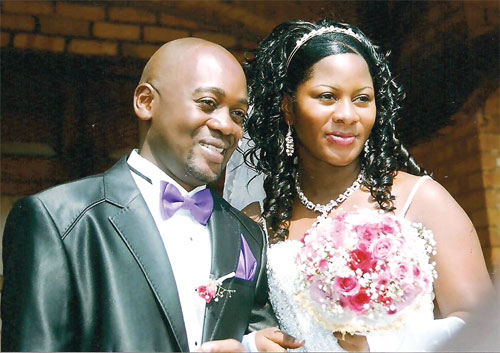
DIVORCED: Sharitah and Richard Mutawe on their wedding day. The two have since parted ways.

Sharitah Mutawe, the former Bukedde TV host of the ‘Emikolo N’Embagga’ fame, has finally brought her six-year old marriage to an end.
We have learnt the bootylicious presenter, now with Delta TV, has successfully divorced her husband, Richard Mutawe.
Sharitah and Richard got married in 2011 with the former, a Muslim, changing her name to Charlotte. The couple became husband and wife in 2011 at Namirembe Cathedral, before Rev Wilson Kakooza.

However, their marriage hit the rocks early this year when she reportedly found her husband having sex with another lady in a car that was parked a few meters from their marital home.
Apparently, she had long suspected Richard of cheating on her, and the subsequent events led her to quit their marital home and also seek divorce, which was granted last week by court.

Sharitah got to know her now divorced husband through her big sister, Sophie and initially planned to ‘just detooth’ Richard but ended up falling in love – she told the media.

Sharitah now says that she is to concentrate on raising her kids and ‘giving them a bright future’.

Stories Continues after ad

Bank of Uganda reduces CBR rates

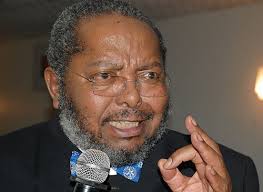
CALLED FOR EFFECTIVE CHECKS ON MONEY LAUNDERING IN EAC: BoU Governor Prof Emmanuel Tumusiime Mutebile.

For the fourth time this year, the Bank of Uganda has reduced the Central Bank Rate (CBR), with latest reduction from 14% to 13%, aimed at stimulating demand in the economy, announced today.

Releasing the Monetary Policy Statement for October 2016, Central Bank Governor Prof. Emmanuel Tumusiime Mutebile said the reduction of CBR would also spur domestic economic growth.

The move is also expected to make commercial banks slash their lending rates, (now standing at over 20 per cent), and Prof Mutebile also said the BOU is concerned that there is still a risk to inflation rising due to the exchange rate movements.

“Given that core inflation is forecast to remain around the medium term target of 5 percent over the next 12 months, there is room to support the domestic economic growth momentum especially against the ongoing global economic slowdown. Therefore, the BOU believes that there is scope to ease monetary policy,” Prof. Mutebile said in the statement.

According to the statement, the impact of less than normal rains in the current season has frustrated the Ugandan agricultural economy leading to drought in some areas like Soroti in Eastern Uganda. It has also affected the Karamoja region, a predominantly semi-desert area that has been infested by tsetse fly.

Neighboring Kenya has also had a fair share of the drought, while the influx of South Sudan refugees fleeing war in their country has worsened inflation, the BOU says.

Following the February 2016 general elections the country experienced near crunch due to the liquidity in the election period.

“For some reason, most Ugandans are still in that economic crunch, a reason why some parents failed to complete school fees for their children in candidate classes and they are being advised to wait till next year if the school authorities insist on not letting the students have exams with pending fees payments,” a parent lamented.

Indeed, even the most popular and perhaps the only locally-owned commercial bank, Crane Bank, is also experiencing financial constraints, he added.

Stories Continues after ad

Cricket legend Ligyalingi loses parents in accident

RIP: The late Mzee Ligyalingi and wife, and a relative.

Uganda Cricket Association (UCA) supremo and cricket legend Justine Ligyalingi has lost both his parents in a car accident that occurred yesterday at Magamaga along the Jinja-Iganga Highway.

According to eyewitness accounts the parents, Justine Ligyalingi (Senior)  and his wife were involved in a head-on collision involving a speeding Toyota Super Custom and a lorry carrying sugar cane.
‘The driver wanted to overtake a sugar cane lorry and was driving at terrible speed, he realised that another vehicle was coming from but could not control the car and he instead knocked the truck,’ the eyewitness was quoted as saying.

FRIENDLY: The late Ligyalingi poses for a photo with fellow sports enthusiasts including Cricket legend Sam Walusimbi.
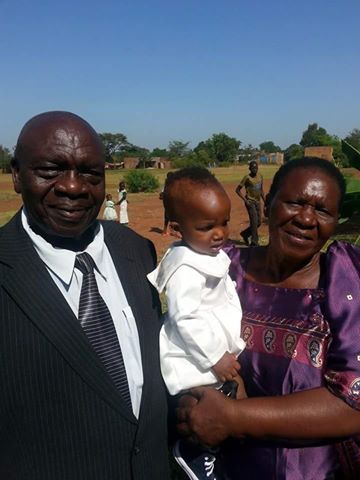
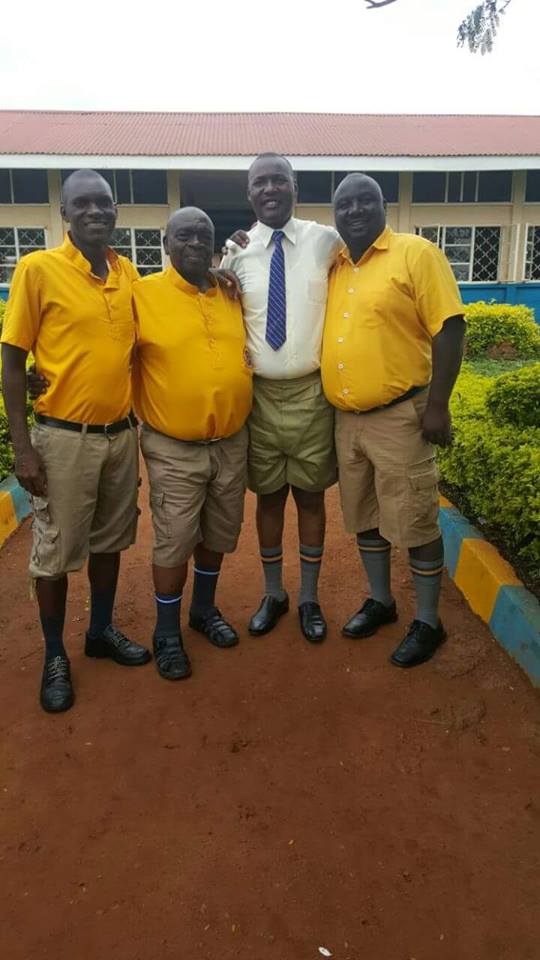
FRIENDLY: The late Justine Ligyalingi Sr (centre) poses for a photo with fellow sports enthusiasts including Cricket legend Sam Walusimbi (left).

‘Mzee Justine Ligyalingi was a renowned Sports Tutor, very loyal Cricketer, Athlete, Footballer, Netball Coach, Referee and Administrator,’ the Old Boys of Busoga College Mwiri wrote, while eulogizing the deceased father of Justine, the Chief Executive Officer (CEO) of Uganda Cricket Association (UCA), who is also an OB of the school.

MENTOR: He lalways mentored the young and old.
MENTOR: He always mentored the young and old.

‘His dedication to sports and gentleman game (Cricket) was very incredible, he was always on the field grooming new talent and passing on knowledge to the young generation. We pray to the God will grant his family and our nation the strength to bear the loss,’ the Mwiri OBs added.

There will be a vigil at the Ligyalingi family home in Wanyange, Jinja, followed by a memorial service at St James Church Jinja tomorrow at 12pm. Thereafter, the remains will be transported to Magoola village -Bugiri for over night vigil, followed by a funeral service at 12pm on Thursday.  Burial will take place at 2pm.

The elder Ligyalingis are survived by four sons: Justine (Jr), Dan Ligyalingi, Peter Mukisa and Geoffrey Luyoyo; and daughter Eleanor Luyoyo.


Stories Continues after ad

Fille apologies to Kats as Dembe FM’s ‘Kasuku’ mocks him

BATTERED! MC Kats after being thumped by the mother of one of his kids.

Dembe FM’s Isaac Katende popularly known as Kasuku became the first media personality to be thumped publicly when he was reduced to a punching bag by singer Eddy Kenzo.

This was at a press conference where Kasuku made comments that didn’t go down well with the musician.

Two years down the road another presenter, NBS TV’s MC Kats is beaten to pulp by his fiancé, singer Fille Mutoni. The beating deformed his face and among the first people to troll him was Kasuku.

“Naye oba Kenzo is Fille’s bro….?” Kasuku posted on Facebook Monday. The post attracted a barrage of comments trolling Kats.
“Who did this to Kats? Who made his lips resemble those of Salaamu Musumba and Miria Matembe?”

Despite being beaten and allegedly run over by Fille, the former NTV Xposed presenter says he has forgiven the mother of one of his children.
According to Fille, they had a misunderstanding. “Yes, we had a verbal misunderstanding. My friend in the car got scared because she had never seen us this way. So in fear she started the car to run off with me. The car hit Katamba accidentally.”

She has apologised to Kats and her fans.
“Am sorry about what happened. Tho didnt roll him over….Listen people I didnt drive the car over him.”


Stories Continues after ad

Social injustices fuelling terrorism – African Parliament

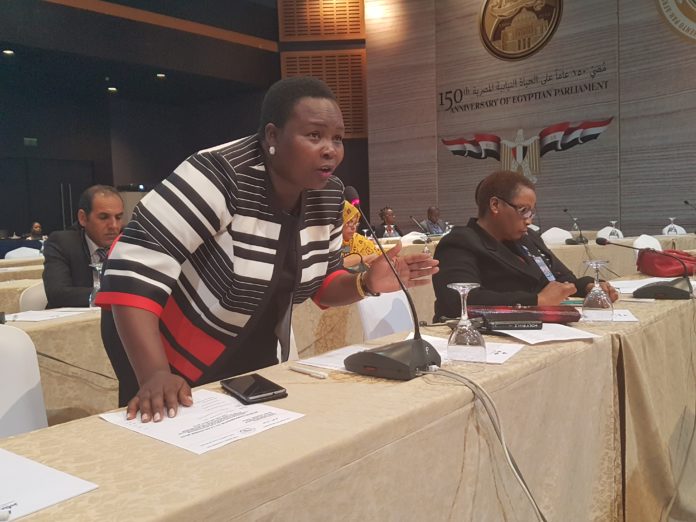
LEADER OF UGANDA DELEGATION: Jacquiline Amongin

Discrimination based on social, economic, religious and political grounds have been highlighted as one of the leading causes in triggering terrorism on the African continent.

Pan African Parliament (PAP) President Roger Nkodo Dang, said Parliaments should therefore, ensure good governance, accountability and respect for law in their countries and use their positions to foster dialogue between warring parties.

The PAP MPs were deliberating on the Role of the Pan African Parliament in Combating Terrorism, on Monday, 17 October, 2016 in Sharm El Sheikh, Egypt.

President Nkodo noted that the discussions were coming at a time when the world was experiencing a surge in terrorist attacks of which the African continent had not been spared.

“Terrorism has become very sophisticated as the continent has witnessed in Algeria, Cameroon, Egypt, Kenya, Mali, Nigeria, Somalia and Uganda,” he said.

He noted that the attacks exposed the weak position of the African continent with regards to strategies of combating terrorism.

“Terrorism is a regional issue that requires coordination between countries with a common perception of what must be done. We have to recognise the underlying factors that predispose countries to instability,” Prof. Morris Ogenga Latigo said, adding that: “it is out of instability that terrorists find fertile ground to blossom.”

Hunadi Mateme (South Africa) said the arms industry was the root cause of terrorism. She said PAP should pronounce itself on who has the right to manufacture arms and that the continent should embrace the African way of life of Ubuntu, if it is to address the scourge of terrorism.

Jacquiline Amongin, the leader of the Uganda delegation said African MPs need to ensure that their governments ratify conventions on terrorism and the Malabo Protocol among others so that together they can rid the continent of such extremism.

The legislators noted that a number of states had not ratified the continental instruments and as a result, their strategies and laws on combating terrorism were not aligned to continental and international conventions.

In 1992, the then OAU Meeting in Dakar passed a resolution for Cooperation and Coordination among African states in the fight against terrorism.  The 1998 attacks in Kenya and Tanzania gave impetus to the 1999 OAU Convention on the Prevention and Combating of Terrorism.

Following the September 2001 bombings in the United States, the UN was prompted to come up with an instrument, the UN Security Council Resolution 1373, to address terrorism internationally.

The OAU convention eventually came into force in 2002 after being ratified by 30 member states.

The Third Ordinary Session of PAP is sitting from 10 – 19 October 2016. Uganda’s delegation to the continental body includes Jacquiline Amongin (NRM, Ngora), who is the leader of the delegation; Prof. Ogenga Latigo (FDC, Agago North); Anifa Bangirana Kawooya (NRM, Ssembabule); Felix Okot Ogong (NRM, Dokolo South) and Babirye Kadogo (Independent, Buyende).

Stories Continues after ad

‘Poisoned’ tycoon flies out for treatment

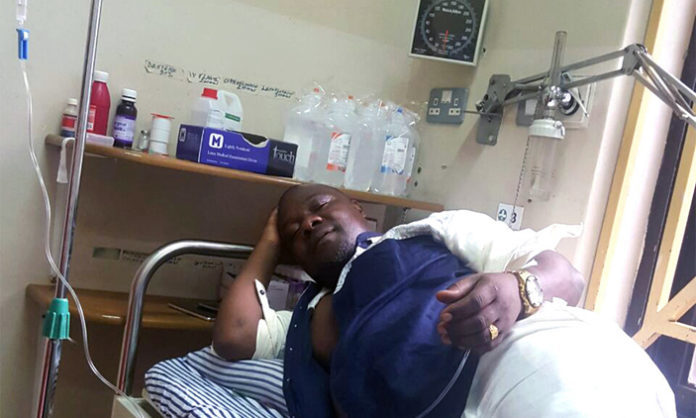
HOSPITALISED: Lwasa in hospital

City tycoon Emmanuel Kaweesa Lwasa, popularly known as Lwasa Events, has left for treatment abroad after he reportedly ate a poisoned meal in his hometown, Masaka.

FLEET: Part of the fleet Lwasa owns
FLEET: The ‘Pad’ and part of the fleet Lwasa owns

We have learnt that Lwasa left the country for Dubai over the weekend.

MONSTER: Lwasa's Toyota Land Cruiser aka 'Mkenkoni'.
MONSTER: Lwasa’s Toyota Land Cruiser aka ‘Mpenkoni’.

Last week the flamboyant businessman was rushed to Case Hospital in critical condition, with many worried he couldn’t live to see another day.

Lwasa, the proprietor of Lwasa Gardens, Tervern Kicks Club and Lwasa Events, is also linked singer Desire Luzinda.


Stories Continues after ad

Atheists want ‘God’ expunged from Kenyan National Anthem

ATHEIST: Harrison Mumia, the man the crusade to have the word 'God' expunged from the Kenyan National Anthem.

Atheists in Kenya are demanding that the word ‘God’ in the National Anthem be expunged.

They argued that having the word ‘God’ in the first stanza of the anthem does not promote the spirit of inclusivity since “not all Kenyans believe in God”.

They argued that Kenya is a secular state and therefore singing the national anthem with the word God is in contravention of the Constitution.

“As non-believers, we feel that the National Anthem is not representative of us, and goes against the spirit of the Kenyan Constitution. Removing ‘God’ from the National Anthem will make it inclusive,” Harrison Mumia, President of Atheists in Kenya, said in a statement.

The National Anthem starts with ‘Oh, God of all creation’ and is recited as a national prayer for prosperity, love and unity.

It is a song taught to every child in each school and is considered to be the unifying factor in the country.

The anthem is sang in numerous occasions for instance before the opening of any official function.

Nonetheless, Atheists in Kenya complained saying they feel left out when the anthem is recited.

“Atheists want to feel proud when we sing or listen to the national anthem. This pride must arise from a sense of unity with shared values and ideals. The word ‘God’ disenfranchises atheists from this unified ideal,” Mr Mumia said.

He said the petition will be presented to Parliament, which ironically has its own prayer that mentions God severally.

“Almighty God, who in Your wisdom and goodness have appointed the offices of leaders and parliaments for the welfare of society and the just government of the people, we beseech You to behold with Your abundant favour, us Your servants, whom You have been pleased to call to the performance of important trusts in this Republic,” the Parliamentary prayer reads in part.

The group has in the past engaged in bouts with the government from the issue of its registration to admitting members.

It was registered in February 18, only for the certificate to be suspended by Attorney-General Githu Muigai in May following opposition from religious groups.

In a statement then, Prof Muigai said the organisation’s fate will be determined by the Supreme Court.


Stories Continues after ad

Ethiopia restricts foreign diplomats’ travel

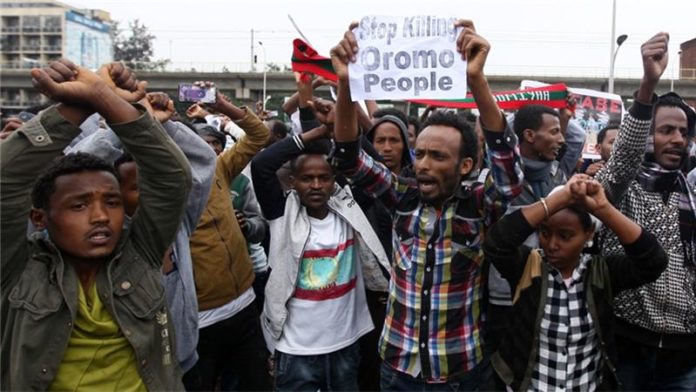
PROTESTS: Oromo and Amhara demonstrators are calling for more rights. Photo credit/Reuters

Ethiopia has restricted foreign diplomats’ travel in new provisions of a state of emergency as part of its response to an unprecedented wave of anti-government protests.

New restrictions published in local media state that foreign dipmlomats are forbidden from travelling more than 40km outside the capital, Addis Ababa, ‘for their own security’.

“But we also expect an opening of the political space for the opposition as stated by the president in front of the parliament. This is not what seems to be happening,” the diplomat added.”This is a state of emergency and we expect repressive measures,” a Western diplomat said on condition of anonymity on Monday.

UN Secretary-General Ban Ki-moon is following developments in Ethiopia “with concern”, his spokesman said.

The UN chief urged Ethiopian authorities to uphold human rights and called for calm and ‘inclusive dialogue to resolve all grievances’.

The new measures include a 6pm-to-6am curfew around factories, farms and government institutions, which have come under attack from protesters in recent weeks.

They also include a 50km ‘red zone’ adjacent to the country’s borders in which it is illegal to carry firearms. The areas around several key roads have also been declared red zones.

Security forces are banned from going on holiday or resigning from their jobs.Political parties are ‘banned from giving press statements that incite violence’ and religious leaders are forbidden from making political statements.

The measures also make it illegal to watch television stations set up by the diaspora, such as Ethiopian Satellite Television and the US-based Oromia Media Network.

Posting links from these organisations’ websites on to social media has also been declared a ‘criminal activity’.

Cellphone internet access has been cut for almost three weeks in most parts of the country, including the capital.

“There is a pressing concern that the Ethiopian authorities will need even less of a pretext to prevent foreign journalists from doing their work during the state of emergency,” said Will Davison, head of the Foreign Press Association, an informal gathering of foreign correspondents in Ethiopia.

The death toll from unrest and clashes between police and demonstrators over the past year or more runs into several hundred, according to opposition and rights group estimates. At least 500 people have been killed by security forces since anti-government protests began in November, New York-based Human Rights Watch group said in August.

The government says such figures are inflated and has denied that violence from the security forces is systemic. In August, it rejected a United Nations request to send in observers, saying it alone was responsible for the security of its citizens.

The anti-government demonstrations started in November among the Oromo, Ethiopia’s biggest ethnic group, and later spread to the Amhara, the second most populous group.

Though they initially began over land rights, they later broadened into calls for more political, economic and cultural rights.

Both groups say that a multi-ethnic ruling coalition and the security forces are dominated by the Tigray ethnic group, which makes up only about 6 percent of the population.

The government, though, blames rebel groups and foreign-based dissidents for stoking the violence.


Stories Continues after ad

Immigration in crack down against illegals

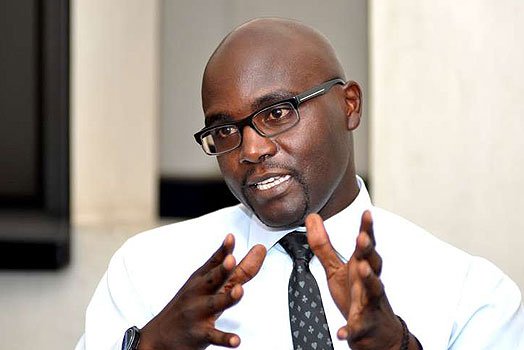
TOUGHENS: Immigration Directorate spokesperson Jacob Siminyu. Photo/nbs.com

The Immigration Directorate has intensified the crackdown against illegal immigrants, boosting its officer corps in charge of issuing work permits from 19 to 79.

According to Immigration spokesperson Jacob Siminyu, the increased number will help streamline immigration matters in the country. He also said the process of acquiring a work permit has been eased, with applicants now being able to apply online.

Without giving details, Mr Siminyu also said the number of illegal immigrants arrested and deported had risen. “They come from all over the world,” Mr Siminyu said while appearing on the NBS Morning Breeze talkshow.

He also said that in a bid to streamline their operations, the department had eradicated ‘middlemen’ who previously minted millions getting passports for ‘absentee’ applicants.

“We have done away with middle men. The process of acquiring a passport is more streamlined and hassle free,” Mr Siminyu said, adding: “We’ve eradicated issuing passports to foreigners. Every applicant must appear in person. Whether a child or an adult.”

He also said that as a directorate, the immigration is supposed to facilitate and control immigrants. “It’s not only about controlling,” he said.

Uganda is home to thousands of immigrants including the Indians and Chinese, some of who have been accused of denying Ugandans employment opportunities by engaging in petty trade.

Stories Continues after ad
Machar vows to return to South Sudan

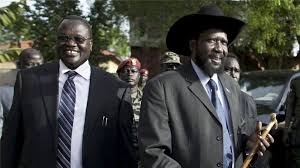
DURING HAPPIER TIMES: President Salva Kiir and then Vice President Riek Machar.

South Sudan’s sacked Vice-President Riek Machar – who fled the country in August – has vowed to return, saying his credibility is intact.

Speaking from South Africa, Mr Machar told the BBC that his rebel faction could still negotiate a peace deal with President Salva Kiir.

His statement comes despite last week’s heavy fighting in the city of Malakal.

Mr Machar, who first fled to the Democratic Republic of Congo, is now being treated in Johannesburg.

In July, Mr Machar’s bodyguards and President Salva Kiir’s presidential guards fought each other, sparking days of violence.

Hundreds of people died and more than 100,000 fled across the border.

The fighting erupted less than a year after a peace deal was signed to form a unity government and end the civil war.

Speaking to the BBC’s HARDtalk programme, Mr Machar said: “I’m going to return to South Sudan.”

“Because President Salva Kiir doesn’t want democratic and transparent and fair elections to be conducted, he attacked us, he has restarted the war.

“But I am hoping that wise leaders in the region and in Africa and the rest of the world will throw up a political process which will bring about peace again, and the resuscitation of the peace agreement, and the reconstitution of the transitional government of national unity.”

Mr Machar also denied that claims that he was a warmonger, saying that his troops were simply defending themselves against government attacks.

President Kiir’s officials accuse Mr Machar’s forces of starting the attacks.

Both sides in the bitter conflict have been accused of perpetrating atrocities.


Stories Continues after ad