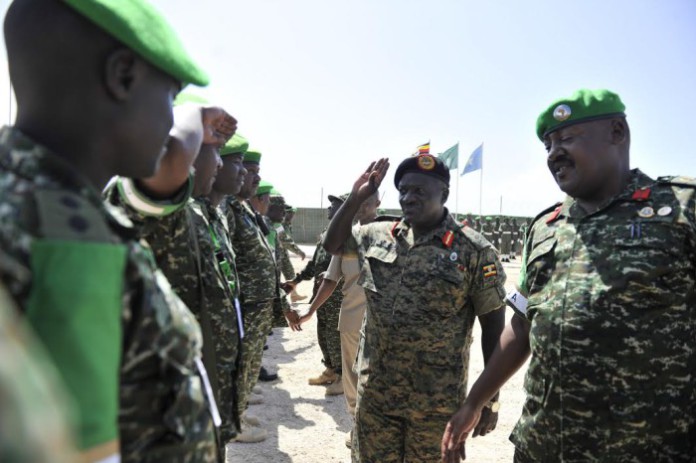
CDF Gen. Katumba Wamala (c) and commander of Ugandan contingent in somalia, Brig. Sam Kavuma (R) in Barawe, 220km south of Mogadishu
CDF Gen. Katumba Wamala (c) and commander of Ugandan contingent in somalia, Brig. Sam Kavuma (R) in Barawe, 220km south of mogadish
The Chief of Defence Forces, General Edward Katumba Wamala, is in Somalia to visit Ugandan troops who form the biggest chunk of the 22,000 African Union force in Somalia.
Gen Katumba visited the seaport town of Barawe, 220kms south of the capital Mogadishu. This is the first time the army chief is visiting Barawe, which was the headquarters of al shabaab. It was captured last year in October by Ugandans.
Other countries with soldiers in Somalia include; Kenya, Burundi, Djibouti and Sierra Leon
According to a statement issued by the office of the army spokesperson, Gen Katumba is on a four-day tour in Somalia is also expected to meet Somali government officials including the president.
“Gen. Wamala is in Somalia for a four day official visit, during which he will also visit and interact with troops in Ceeljaale, Aribska and Mogadishu, as well as hold talks with the senior leadership of the Federal Government of Somalia,” the statement says
The Somali insurgents have lost sizeable ground to African Union troops, forcing them to resort to asymmetrical war tactics like suicide bombings.
The opposition Forum for Democratic Change Secretary General, Ms Alice Alaso, has chided party members she claims want to cause disunity in the party.
“Some ill -guided individuals want to disorganize our party but we will do everything in our powers to defend it. It’s not time for the rats to eat the ropes that anchor the ark”, she said.
Ms Alaso was speaking at the party’s annual National Council meeting in Kampala on Monday that would decide when to hold its delegates’ conference.
Speaking at the same event, the party President Gen (rtd) Mugisha Muntu s called for cooperation between the opposition political parties as Ugandans prepare to vote in 2016. He says the NRM government can only “be kicked out of power” if the opposition works together.
Mr. Muntu said the joint tabling of the proposed electoral reforms before parliament last week, was a success. The opposition wants an Independent Electoral commission whose senior commissioners are not appointed by the incumbent president.
“As the opposition, we want to create a common front. If used effectively, it can work against Museveni,” he said.
The FDC president emphasised the need to give Ugandans hope, saying many people want change but don’t know to make it happen.
“The population is largely in favor of change, it is on us as leaders to keep that hope alive,” said Mr. Muntu.
Kampala-Former Coordinator of Security and Intelligence Agencies, and now Platform to Rescue Uganda National Coordinator and Free Uganda Chairman has met religious leaders, calling on them to support the coming changes by piling pressure on President Yoweri Museveni to step down voluntarily
Gen. David Sejusa briefed the Bishops, the Pastors of born again Churches, as well as Sheiks from different Mosques on on-going activities by PRU and FU together with many other activist groups and individuals meant to dismantle the National Resistance Movement government.
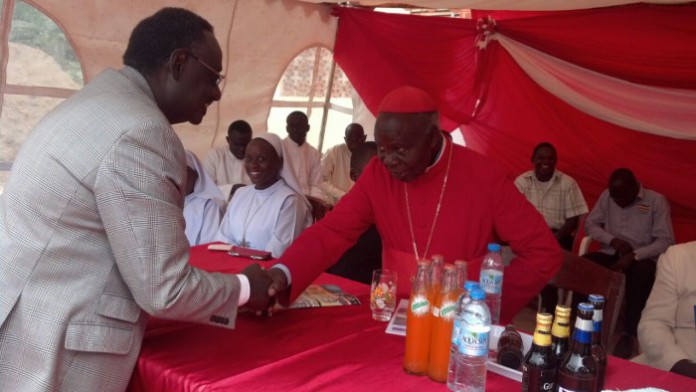
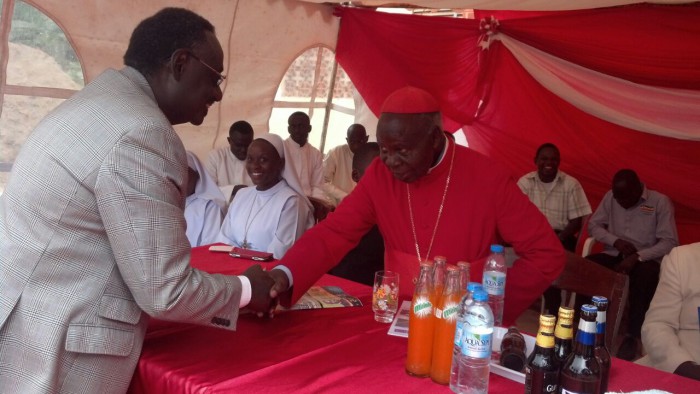
In the meeting, it was agreed that the Church cannot be kept away from political activities. Both his Eminence Cardinal Emmanuel Wamala and Gen. David Sejusa stressed the importance of Church activism and religious leadership in general, particularly in troubled times, as is the case in Uganda, when the citizens of a nation are in so much need of effective leadership, guidance, and even solace as they travel along the road to a better society.
It was noted that the church, from time immemorial, was part of the secular governance processes. At renaissance and later during reformation, we see the leaders of the new nation states try to separate state and church mainly to protect trade and investment and so called integrity of the new states.
But with the centrality of morality, fairness and issues of human rights and the critical need of uplifting people’s conditions, the church cannot be kept out of politics.
Gen.Sejusa told religious leaders that Uganda today is more than ever before, ready for people’s struggle for a better society that is free of repression, human rights’ violations, corruption and bad governance and that religious leaders should be true leaders to their flock in their greatest time of need.
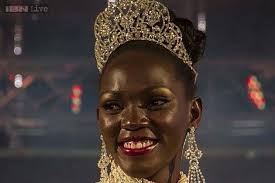
Kampala-The search for the 2015 Miss Uganda has been launched with Crown Beverages Limited under its Mirinda brand as the main sponsor.
Mirinda also increased its sponsorship by more than Shs10 million from Shs30m (2014) to Shs40 million.
The search starts on May 30 with a tour to the Northern Region with the crowning ceremony set forJuly 10, 2015 at the Kampala Serena Hotel.
This year’s contest, just like the 2014 pageant, will run under an agricultural and entrepreneurship theme targeting the youth.
Mr Timothy Luzinda, the Mirinda Brand Manager, said at the evening launch on Sunday May 24: “Like we promised last year, we are sponsoring the 2015 Miss Uganda to a tune of Shs40 million to make it a memorable one, one that befits the standards of Mirinda. We believe the investment is worthy because Miss Uganda has such a long and memorable history. Our strategic objective is thus, to elevate Miss Uganda pageant to new heights.”
Ms Brenda Nanyonjo of Kezzi Entertainment, the Miss Uganda franchise holder, said in Uganda, Beauty with a Purpose is gaining momentum with community services, and projects like the Education Fund, the fight against teenage pregnancy and early marriages, the fight against HIV/Aids and now the promotion of agriculture among the youth.
“Miss Uganda has grown from strength to strength over the years with a starting audience of 800 in 2011 to 8,000 in 2014, inclusive of the regional searches. The 2014 contest was such a success in every respect. The quality of girls and their ability to exhibit intelligence was amazing. We are grateful that Mirinda has once again sponsored the pageant. Part of the proceedings from the Miss Uganda pageant will go to the Miss Uganda Foundation to purchase land to set-up a demonstration farm,” Nanyonjo said.
“The 5th annual Miss Uganda search campaign is to celebrate all the beauty Uganda has to offer. We are celebrating five years since we took on the franchise and we are massively planning a grand finale that will make jaws drop,” she added. The reigning Miss Uganda is Leah Kalanguka.
FUFA competition committee has confirmed Kyamate Sports ground in Ntungamo Municipality ground will be the venue for this year’s’ Uganda Cup final slotted for 6th June.
Ntungamo beat Mbarara in a western bid and the former will now host SC Villa and KCC as the two city rivals contest for this year’s’ Cup glory for the last silverware this season.
“It’s a FUFA project to spread football competition upcountry, lets gather in Ntungamo and support the west to organize a successful and colorful finale,” Ali Mwebe, the FUFA director of competition said.
KCC FC eliminated Lweza FC 2-0 on aggregate to qualify for the second consecutive final, having lost last year’s Cup edition to URA FC in Mbale, while SC Villa overcame Jinja side Bul-BIDCO 2-0 on aggregate to setup a grand finale.
The winner of the Cup will represent Uganda in next year’s’ CAF Confederation Cup.
Meanwhile; Uganda U-23, Kobs will return to training tomorrow (Tuesday) at the Africa Bible University in Lubowa.
Head coach Milutin ‘Micho’ Sredojevic has confirmed that his players will have double training sessions.
‘I want to rectify mistakes that happened in Kigali. The training sessions will help us a lot’ said Micho.
Uganda is carrying a 2-1 first leg advantage after seeing off Rwanda at the Amahoro stadium in Kigali over the weekend.
KCCA’s Nsibambi (Yellow) Shields the ball from SC Villa players
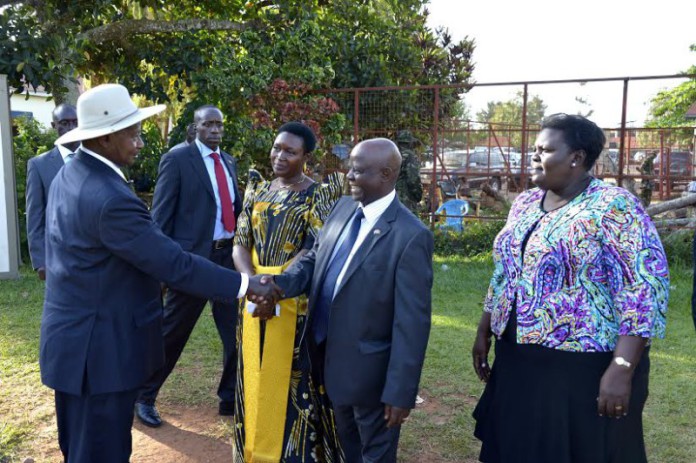
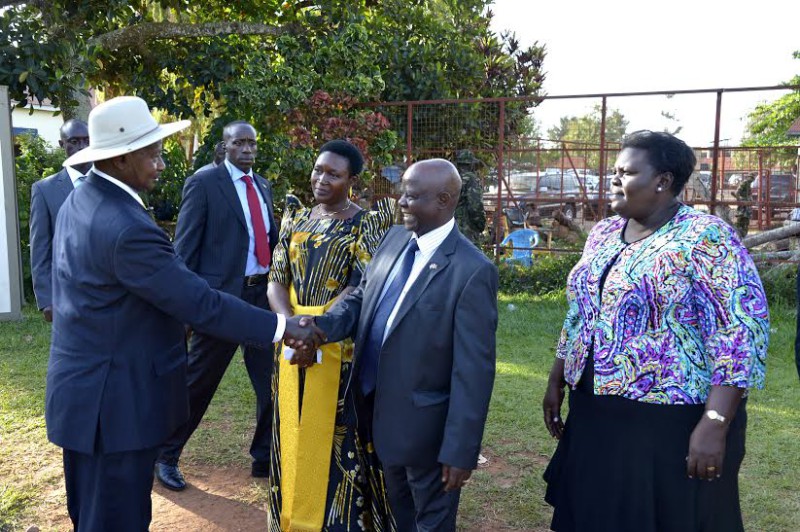
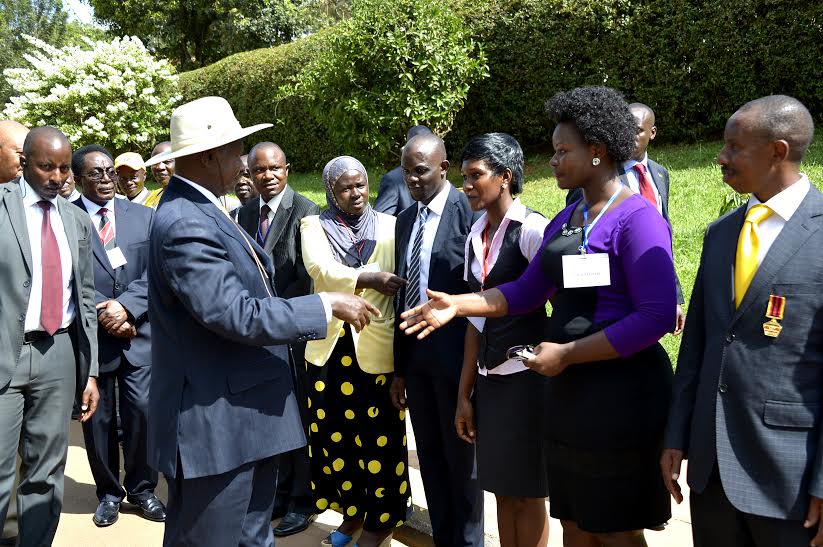
Museveni welcomed by the leardership of Nkumba University
Museveni welcomed by the leardership of Nkumba University
President Yoweri Museveni has said that Patriotism, Nationalism, Pan-Africanism and Modernization are the key factors that will help in maintaining peace and stability in Uganda. Mr. Museveni was yesterday giving the Inaugural Annual National Liberation Struggle Memorial Public Lecture on Peace and Stability in Uganda to students and guests at Nkumba University.
The ceremony was organized by the National Secretariat of the National Crime Preventers Forum in conjunction with Peace and National Solidarity Initiative and Nkumba University. Mr. Museveni said Ugandans should learn to avoid pseudo ideology that confuses identity with interests which is also the main cause of conflicts in many countries.
Mr. Museveni told the attentive audience that NRM believes in the principles of Patriotism, Nationalism and Pan-Africanism, factors that enabled it to usher in peace to Uganda and also build other institutions like the army.
He explained that Ugandans need each other as well as regional countries and beyond for prosperity that is brought about through trade.
Mr. Museveni stressed the need for people to produce wealth through modern commercial farming in-order to benefit from the internal, regional and international markets. “In Uganda and Africa, there is a lot of under-development. Land and labor are under-utilized. That is why NRM is pushing for social and economic transformation so that we no longer live in a traditional society but in a modern one,” he said.
Mr. Museveni added that social economic transformation can be achieved through education, modern commercial farming, industralisation, services as well as Information and Communications Technology (ICT).
The Chancellor of Nkumba University Gordon Wavamunno thanked Mr. Museveni for honoring their invitation, while the Vice Chancellor Professor Wilson Mandy thanked the president and the government for supporting the 21 year-old university.
The Guild President of Nkumba University Ms. Ronah Kemirembe commended Mr. Museveni and the NRM government for the peace and stability in the country noting that it is very crucial for the transformation of society.
Youth showing Museveni the Plane they madeMuseveni showing the youth his football skills
President Yoweri Museveni has expressed his concern over the reported cases of insecurity at Makerere University, reportedly caused by failure to erect a perimeter fence. He assured the Makerere University community that the Government would solve the problem of the fence by having it constructed through the Ministry of Education.
The President was addressing the Makerere NRM Sub County Conference at the Freedom Square, Makerere University in Kampala. His comments follow reports of mysterious student deaths and attacks around the university.
During the meeting he received a copy of a book “The Fruits of the Mustard Seed” from the author Mr. Muhanguzi Rwigyema, who is a student at the University. He also received a copy of “The Power of Optimism”, written by a lecturer, Dr. Moses Lukwago.
The President in his remarks, said that education is a prerequisite to living modern lives and that the NRM introduced UPE with the aim of enlightening the people, adding that “we cannot remain peasants forever”.
“Education is a factor towards generating income and managing modern life. The NRM Government has practiced its leadership along four major principles namely the fight against sectarianism, Pan-Africanism, social economic transformation and democracy,” he said.
He said that NRM differs from the other political parties because it fights against sectarianism, adding that the colonialists added another problem of religious sectarianism in Uganda. He observed that at the time of Uganda’s independence in 1962 sectarianism was rife.
He stressed that a tribal identity is good for the promotion of languages and culture and observed that through the principle of Pan Africanism uganda was able to expand the market for its products.
He called on Ugandans to work for political and economic transformation of Uganda. He said that in order to have prosperity we must believe in Uganda and avoid tribal and religious
President Museveni observed that the NRM and majority of Ugandans fought for democracy and that Uganda helps other regional countries to restore order because `we have got internal strength’.
President Museveni called on the Makerere NRM branch to avoid cheap popularity and reminded the gathering that in 1986, government was generating revenue of only Ush 5 billion as compared to a collection of Ush 12 trillion in 2015.
The Chancellor of Makerere University Prof. Mondo Kagonyera urged the University community to give the Government a chance to serve, while the Chairman of Makerere NRM Sub County Prof. Peter Baguma said the President had uplifted the social economic status of Ugandans. He also thanked President Museveni for restructuring the Ministry of Education and for introducing the Department of Technology.
The Makerere University Guild President David Bala Bwiruka said that the government had facilitated the lecturers with better remuneration, and thanked the president for the initiative.
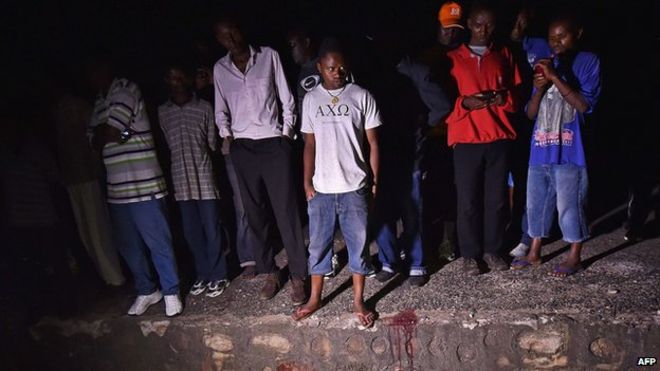
Crowds gathered outside Feruzi's house, inspecting his body
Crowds gathered outside Feruzi’s house, inspecting his body
The leader of a small Burundian opposition party has been shot dead in the capital Bujumbura, witnesses said, as tensions continue in the country.
The body of Zedi Feruzi, the head of the Union for Peace and Development, was seen lying outside his home.
Burundi has seen weeks of protest against President Pierre Nkurunziza’s decision to run for a third term.
Demonstrators are holding a two-day truce, to allow residents to stock up on supplies and bury the dead.
On Friday, at least two people were killed in a grenade attack in Bujumbura.
The unrest has also seen more than 100,000 people flee to neighbouring countries and a failed coup attempt against Mr Nkurunziza.
Volatile Burundi seeks a new politics
Protesters came on to the streets to voice their opposition to a third term for the president
“There are politics and politics, different kinds of politics.” So goes the chorus to one of the Burundian protesters’ favourite songs.
They say it was invented on the first day of demonstrations against President Pierre Nkurunziza’s bid for a third term in office, and quickly spread to various parts of the capital.
“There is a kind of politics that involves killing, and dividing the people: the kind of politics we don’t want anymore. And then there is another kind of politics, the good kind,” one protester explained.
Burundians know a good deal about the politics of dividing and killing.
The country only emerged 10 years ago from an ethnic conflict in which 300,000 people were killed.
The war pitted the majority Hutus against minority Tutsis, with each side appealing to ethnic identity to rally its followers.
The protesters’ song is their paean to a different form of struggle: a struggle for principles, not for power.
“There are Hutus and Tutsis in the movement,” goes one of the song’s verses. “This is not about political parties,” goes another.
Deadly clashes
The protesters say they want to defend their constitution and the Arusha peace agreement, which ended the country’s conflict.
They say both texts bar the president from running again.
The song means: we can fight for democracy, without descending into war.
President Pierre Nkurunziza is seeking a third term which opponents say is unconstitutional
But can they, really?
After two weeks of mostly peaceful demonstrations, a military putsch initially celebrated by many protesters quickly led to clashes between rival factions of the army, in which at least nine soldiers died.
Some were killed in a reprisal attack at a hospital.
At least 20 people have died and more than 400 have been arrested during the demonstrations.
More than 100,000 people have fled Burundi since mid-April, fearing that the unrest caused by the president’s bid for office could turn into a civil conflict.
There has been violence from all sides: policemen, soldiers and, perhaps more worryingly, armed civilians both for and against the president’s bid for office.
There are persistent and specific reports suggesting some members of the Imbonerakure, the ruling party’s youth wing, are armed and have carried out attacks in neighbourhoods where there were protests.
Several protesters have been seen with hand grenades.
Volatile situation
The situation is volatile at best and the government has remained uncompromising.
Political leaders have once again found use in stoking ethnic tensions.
Several members of the ruling party have been repeating to whoever will listen that those protesting are “mainly of Tutsi ethnicity”, adding they are “people who want to bring us back to the dark days of war”.
The party’s vice-president accused the popular private radio RPA, ordered to shut by the government, of broadcasting messages of hate, like the infamous Radio Mille Collines during the Rwandan genocide.
There is fear on both sides and rumours are spreading fast.
“They are reshuffling the army, arresting ethnic Tutsi officers,” one protester said, “we are worried about mass killings.”
Some supporters of the president believe an “extermination plan” is being drawn up in neighbouring Kigali, where a Tutsi is president, targeting Burundi’s Hutus.
So far, protesters are still holding the line against the intrusion of ethnic hatred, but the line is fraying.
Clamour for democracy
It’s not only in Burundi that a sitting president is accused of bending the rules to stay in office.
More people have sought shelter at refugee camps outside the country
Young people across the continent have been raising their voices to ask for rulers to renounce the idea of a lifetime in power.
They say that time is over.
Burundi today is seen as something of a test for Sub-Saharan Africa’s democratic credentials.
As hundreds are still chanting on the streets of the country’s capital, raising their arms in surrender when the security forces approach, the struggle isn’t over.
But in a country so marked by its violent past, achieving a different kind of politics is easier said than done.
Burundi: Key facts
The country is facing its worst turmoil since the 12-year civil war ended in 2005
President Yoweri Kaguta Museveni, has called upon Ugandans to budget and prioritize if they are to achieve sustainable development. He said that while the economy has grown and the taxes have increased, it is important that Ugandans understand how this money is distributed before asking for benefits such as salary increment.
Museveni added that government has prioritized infrastructure development such as roads, railways, electricity, education and health, because they are important for income generation and economic growth.
MUK NRM suporters chanting praises for the President
Museveni made the remarks during a visit to Makerere University on Saturday May 23, for the first-ever Makerere NRM sub county conference held at the Freedom Square. The conference brought together NRM party supprters from around Makerere and Kawempe division.
Makerere Chancellor Prof. George Mondo Kagonyera, who is also an NRM cadre, the president attended the function in the capacity of president, Visitor of Makerere University and as the NRM chairperson. He urged the president not to be “stampeded” into making any decisions but be guided by the interests of the people but not “those who want power”.
The president also reminded the guests about the NRM principles of patriotism, pan Africanism, socio- economic transformation and democracy, and discouraged Ugandans against sectarianism based on religion and tribes. ” These identities are alright for culture and language, but for prosperity, Uganda is the solution,” he said.
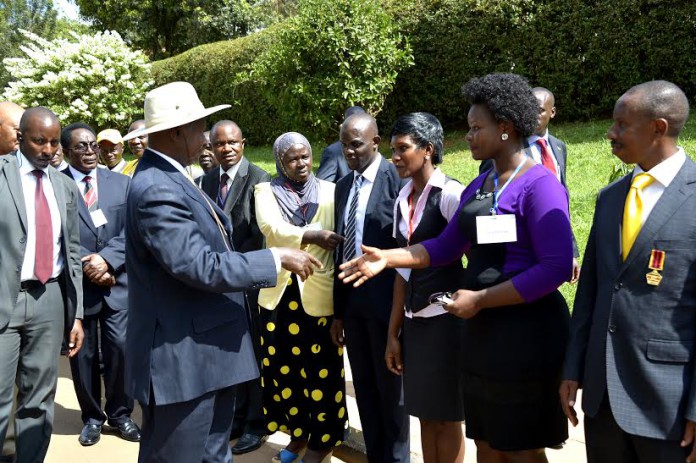
President Museveni inspects entertainers at Makerere University
Africa U23/Olympic qualifiers Saturday Results
Rwanda 1-2 Uganda
Return leg:
30th May, 2015 @Nakivubo Stadium
Uganda v Rwanda
Uganda Kobs team took a giant step in their bid for an Africa Under-23 and Olympic qualification slot, after picking 2-1 victory over Rwanda’s’ Junior Wasps in Kigali yesterday (Saturday).
Kobs’ captain Farouk Miya and substitute Muzamiru Mutyaba scored in each half to give Serbian Milutin ‘Micho’ Sredojevic a happy return to Rwanda.
“It’s a huge result for these boys, a result that will help us play without pressure at home (return leg) in Kampala,” said Micho.
A perfectly curled free kick from Farouk Miya in the 9th minute was the lone goal scored to give the Kobs a deserved lead at first half.
However Dominique Savio Nsuti leveled matters in the 60th minute for Rwanda, which forced the Serbian to make a telling substitution as Erisa Sekisambu made way for SC Victoria midfielder, Mutyaba.
Super Sub Mutyaba
Mutyaba made an immediate impact as he restored the Kobs lead that turned out to be the winner for the visitors at Amahoro stadium in Kigali, Rwanda.
“We showed the potential especially in the opening 25 minutes of the second half, for Rwanda its about rebuilding and building for the future but we have the ability to overturn the result” Rwanda coach Johnny McKinstry said.
Seven teams will emerge from the knockout rounds to join hosts Senegal for the African U-23 Championship from 28 November to 12 December 2015, where the top three teams will qualify for the Olympic Games in Rio de Janeiro, Brazil.
Uganda Kobs XI: Starting XI: Jamal Salim(G.K), Joseph Nsubuga, Bakaki Shafiq, Ibrahim Kiyemba, Brian Ochwo, Derrick Tekkwo, Tom Masiko, Keziron Kizito, Farouk Miya, John Semazi and Erisa Sekisambu