The Frying Pun is a parody column
New Vision management explains salary disparities
Walusimbi future at Gor Mahia in doubt

Godfrey Walusimbi’s days in Gor Mahia might be coming to an end after he was left out of traveling squad for the match against Muhoroni Youth at Moi Stadium in Kisumu on Sunday.
The Uganda Cranes international last featured for the thirteen times Kenyan Premier League champions on May 2 in a 2-0 triumph over Ulinzi Stars at City Stadium.
Since then, the defender come winger has missed matches against Sony Sugar, Western Stima, Nakuru All Stars and now Muhoroni Youth.
When reached for comment, K’Ogalo Organizing Secretary David Kilo revealed to Goal that the player was left behind in order to accommodate the number of foreigners in the match day squad.
“It is all about team balancing, nothing is wrong between us and Walusimbi. You know if the coach feels that he does not need your services for the particular match then that is it.
“Walusimbi is a good player and we are keen to work with him for the longest time possible.”
AFCON qualifiers close
With the Cranes’ first 2017AFCON qualifier game in three weeks’ time, Walusimbi is focusing on getting some playing time ahead of the qualification campaign.
However, sources within the club have revealed that the Cranes left back decided to stay away until his demands are met.
Reports indicate that he is not happy with payments made in portions and has asked to be paid his salary and allowances in full before deciding to take the pitch again in the green army jersey.
This comes amid reports that Gor Mahia is contemplating dropping several foreigners in the team in order to abide by rules of the league which allows a team to have a maximum of five foreigners.
Gor Mahia currently have eight players with Ugandan striker Dan Sserunkuma expected to rejoin the champions in June.

Renard quits as Ivory Coast coach ahead of Lille move

Herve Renard has quit as Ivory Coast coach three months after leading the team to the African Nations Cup title.
The Ivory Coast Football Federation said on Friday it had agreed to end the Frenchman’s contract early.
Renard has been linked with the head coach role at Lille with current boss Rene Girard set to leave at the end of the season.
Renard was appointed Ivory Coast coach in July last year and ended the West African nation’s long title drought by winning the African Cup in Equatorial Guinea in February, beating Ghana in a penalty shootout. It was Ivory Coast’s second continental title and first in 23 years.
Evoked Zambian memories
The victory was also Renard’s second Cup of Nations success as a coach after leading Zambia to victory over Ivory Coast in the 2012 final.
With the Ivory Coast in Equatorial Guinea made him the first coach to win the African title with two different countries.
In a statement released by the Ivorian federation, Renard said he was looking to take his career in a “new direction.”
Renard has coached in the French league before, when he was briefly in charge of Sochaux from 2013-14 but couldn’t save them from being relegated from Ligue 1.
The Ivorian federation said Renard was expected to join Lille. Renard’s regular assistant coach, Patrice Beaumelle, was also leaving Ivory Coast and was expected to join Renard at Lille, the Ivorian federation said.

Masaka doctors go without water over Shs6m debt

Water is life, so goes the adage. But doctors and nurses at Masaka Regional Referral Hospital might have to begin thinking otherwise after the National Water and Sewerage Corporation disconnected their water over a Shs6 million bill.
At a meeting held in convened to review that thorny matter, the biggest blame was apportioned on the hospital administration led by Dr Florence Tugumisirize.
The meeting brought together officials from the hospital led by Senior Hospital Administrator Patrick Ekomera, NWSC and the Masaka Resident District Commissioner’s (RDC) offices.
The disconnection was carried out two weeks ago and Joseph Mugenyi, the Masaka NWSC said the hospital administration had failed to clear the bill even after being given reprieve.
He revealed that the Hospital Administrator (Ms Tugumisirize) had promised to pay the money by April 19, to no avail, prompting the drastic action that has affected over 50 nurses and doctors at the referral hospital.
He also threatened to carry out similar action (disconnection) at Dr Tugumisirize’s residence in Kimanya, on the outskirts of Masaka town.
Mugenyi’s sentiments were shared by both the hospital representatives and the Masaka Deputy Resident District Commissioner (DRDC) Joseph Ssekasamba, who expressed reservations about the hospital administration’s commitment to resolving the issue, even when, he said, the affected medical staff had paid Shs 20.000 as monthly utility charges to have water running in the staff quarters.
Mr Ssekasamba urged the hospital to clear the debt by next week and also promised to negotiate for a reduction on service charges, which the staff had claimed were exorbitant.
Musisi ardent on players’ welfare

Kampala City Capital Authority (KCCA) Executive Director, Jennifer Semakula Musisi has stated that the Authority will launch a Shs100m players’ savings credit scheme.
The scheme to be called the ‘KCC FC Players’, is SACCO meant to improve on the players’ welfare ahead of life outside football.
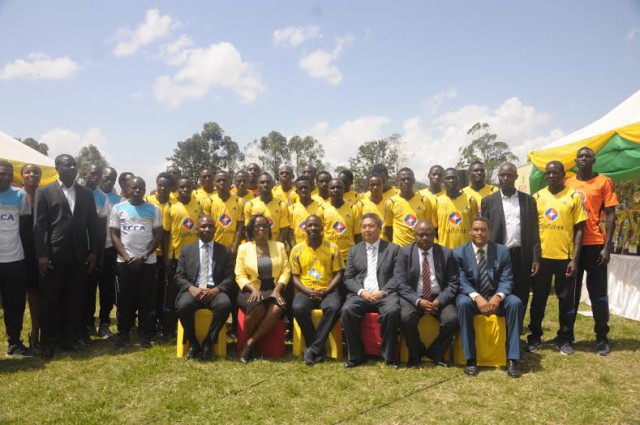
Ms Musisi was hosting the players, club officials, fans, FUFA officials and the media at a season-ending luncheon at the KCCA Phillip Omondi stadium in Lugogo on Friday.
“As the Authority, we have started a players’ savings scheme; our players (and legends) need to have a focused future financially” Musisi echoed.
“We shall teach players and officials on how best to manage and benefit from this project,” she noted.
KCCA FC failed to defend the league title but have a second chance at silver-ware this year, when they play SC Villa in the Uganda Cup finals.
“We lost the league title to Vipers but we shall work hard to reclaim the League title,” she added.
New Executive team
At the same function, Ms Musisi officially blessed the new board for the next two-years to the fans and players, new board members were introduced one by one by the chairman, Julius Kabugo.
“We want to keep the legacy of the club burning since 1963; we shall invest in new players to challenge for titles next season,” Kabugo said.
The new board has Julius Kabugo (Chairman), Godfrey Kisekka (Vice chairman), George Opio (Human Resource), Edgar Padulide (finance), David Tamale (CEO), Edison Masereka, Counsel Isaac Sempembwa (lawyer), Collins Njeye, Brenda Nsiimbe and Paul Agaba (PRO).

Roaring cars back in Fort Portal

NRC STANDINGS
Arthur Blick Jr 260 pts
Duncan Mubiru 175
Ronald Ssebuguzi 110
Pole Pole 105
Uganda Motorsport Club (UMC) has opted to have the rally in western Uganda for the first time in 39 years.
Fort Portal will host the fourth round of National Rally Championship (NRC) scheduled for July 3-5th, Clerk of Course Jeff Kabagambe confirmed this developed to the press.
“As motor clubs and the federation, we need to create competition in different territory just like we did in the Mbale Rally. It is one way of promoting the sport” Kabagambe noted.
Safety a penetrating issue was another concern cited in the Fort Portal move.
“The beauty about racing in upcountry areas, there are more closed routes compared to the ones in the central and this comes in handy to help us handle safety throughout the event better” he added.
The event will run on two days weekend with a Super Special at the Boma Grounds on July 4th.
NRC leader Arthur Blick Jnr will continue to peruse his dream of winning the NRC maiden title at the attempt in Subaru Impreza N10, after winning the last series (CMC Challenge Rally) in Mukono.
The victory, the second in a row after his triumph in the Jinja Rally in March, helped Blick stretch his NRC lead to 85 points after three events.

Balaam to sue Moze Radio for shs 300m
Top Muslim cleric assassinated in Mbale

Mbale-A top Muslim cleric in Mbale town, Eastern Uganda has been murdered.
Sheikh Rashid Wafula, the Imam of Bilal Mosque in Mbale town, was killed last night as he entered his home at Nakaloke, on the outskirts of the town.
Sheikh Wafula, who is the third Muslim leader to be assassinated in recent days, was also one of the founding directors of Nakaloke Islamic Primary and Secondary schools.
Other Muslim leaders that have been killed in a similar manner include Sheikh Mustafa Bahiga and Sheikh Abdul Kadir Muwaya, who was killed on December 25 last year.
Investigations into their death are ongoing but the Police boss, Gen. Kale Kayihura has come out to pin the Allied Democratic Forces (ADF) as the group behind this ongoing murder of Muslim leaders.
Imam Wafula’s killing comes in the wake of murders of prominent persons in the country, the most pronounced being that of Joan Kagenzi, a former Assistant Director of Public Prosecutions.
At the time of her death Ms Kagenzi was prosecuting the case of thirteen terror suspects charged with killing over seventy people who were watching the World Cup finals in 2010.
The Prosecutor, who was with two of her children, was killed by assassins moving on a boda boda as she drove home to Najjera, a city suburb.

Teachers vow to continue with strike

It is now custom; teachers go on strike just before the opening of a new school term. Reason? Government has reneged on its promise to pay them increased salaries.
And today Thursday May 21, in a closed door meeting with the Prime Minister Dr Ruhakana Rugunda that lasted two and a half hours, the teachers’ representatives from public schools once again made good their resolve.
Under their umbrella organization, the Uganda National Teachers Union (UNATU), the teachers said they would not teach until their demands for full payment are met by government. “Regrettably, Government has not shown willingness to make any budgetary readjustments to cater for the teachers’ increment in FY 2015/16. Instead, all proposals being offered are deferring the increment to FY 2016/17; a position that is contrary to that of the teachers.
As UNATU, our position remains that an increment should be paid in FY 2015/16. In the spirit of Give and Take, we proposed that an increment of 5% be paid in FY 2015/16 and then 15% be paid in FY 2016/17 if Government is unable to honour the full commitment of 10% salary increment in FY 2015/16.
No consensus was reached over these proposals and we await feedback from government, since it was communicated that Cabinet was to discuss the above proposals further.
In the meantime the Industrial Action continues and we urge all teachers to remain home and await official communication from the General Secretary …”, reads part of a statement issued by the UNATU Secretary General Teopista Birungi.
“We have attended the meeting but haven’t agreed on anything at all, the status quo remains,” said a one Mr.Kisekka, who is reportedly a former senior official of UNATU.
But contrary to what the teachers said, the State Minister for Primary Education Dr.John Chrysostom Muyingo said both parties had agreed that the teachers to go back to class.
“We have partially agreed with them and I hope they can call off the strike,’ Dr Muyingo said, adding: “their salaries will be increased in the next financial year and we have informed them.”
During the meeting, the teachers had reportedly informed the government officials about the availability of 200 billion shillings saved from paying ghost teachers in the previous financial year, saying that they needed only 126 billion of this money.

But the First Deputy Prime Minister Henry Kajura, who chaired the stormy meeting told the teachers that the money was used to offset other arrears, information that contradicted with a report later read by the State Minister for Finance and Economic Planning which indicated that only 26 billion shillings was spent on the said arrears.
This scenario later prompted the teachers to seek for immediate 5% increment as they await the rest of the percentage. Government declined, emphasizing that there was ‘no money’.
This sent the meeting into stalemate, with both parties saying they need to make more consultations.
“We are going to sit with our colleagues and see what we can do after here but our stand still remains, we are not calling off the strike,” said a Ms Nakanjako, a UNATU representative.

But this was not before Minister Muyingo pleaded with the teachers to respect their profession’
“I am a teacher too and what that means is forgetting everything and doing your work; I urge all teachers to consider the innocent children before thinking about money and head back to classes as we settle this matter,” Muyingo implored the seeming defiant teachers.
Teachers in Uganda earn about just over two hundred and fifty thousand shillings, and this has been a point of contention that has always pitted the classroom gurus against bureaucrats in government.
Of late the teachers have been staging ‘wage bargaining strikes’ just before a new school term begins, sending government into panic and, subsequently leading to arbitration meetings, which have proved futile, at least for now.

Digital Migration: which way Uganda?

Kampala-In a small tent located in downtown Kampala, you find two middle aged ladies seated in the tent and, on a table there are decoders are displayed alongside a plasma screen showing crystal clear pictures on one of the local channels. People are lining up, some have inquiries and some want to buy the decoders. They know time is running out, they won’t be able to watch their favourite shows on analog; they have to switch to digital broadcasting.
Digital migration was made mandatory at the Regional Radio Communication Conference of 2006 and the Geneva 2006 Agreement of the International Telecommunication Union (ITU) resolved that all countries signatory to the agreement must migrate from analogue to digital broadcasting services by the end of 2015.
In Uganda, in July 2011 the Ministry of Information and Communications Technology (MoICT) formulated a Digital Migration Policy to serve as a guide for a smooth transition from Analogue to Digital broadcasting. The policy is based on principles of access to public information, transparency and accountability, environment protection, competitiveness and productivity, economic and trade infrastructure, access to quality social services, good governance.
The preparatory stage started in July 2009 where digital broadcasting services was delivered ‘on pilot’ basis. And, in July 2011 digital broadcasting was officially launched in the country. Though the switch off date for analogue broadcasting and switch on date of digital broadcasting was December 2012, it wasn’t effected; it was decided that the switch of and switch on date be 17 June 2015, the global deadline. “We want to know what to do since we are late, the funds are not available and technical capacity is not in place,” UCC Executive Director, Godfrey Mutabazi said at the time
Only two members in the East African Community have fully switched to digital broadcasting: Rwanda’s switch-off took place in July 2014, a year ahead of the June 2015 global deadline. Tanzania went all digital in March 2015. Uganda, Kenya and Burundi haven’t switched to digital and it’s not yet clear if the three countries will beat the International Telecommunications Union (ITU) deadline. Uganda and Kenya are set to go fully digital on 17 June 2015 but Burundi’s stand remains uncertain since most structures have not been set up, the ongoing uprisings in the country complicate the process more.
In a country with an estimated 7 million television sets, UCC says about 300,000 use Pay TV stations. This means 95% are watching Free-to-air channels, only 5% are watching Pay per view stations. With the 17 June ITU deadline approaching, is the country ready for the switch-off?
Uganda Communications Commission Acting Director for Broadcasting Mr Otunnu Fred is optimistic that the country will beat the ITU deadline; he says they are in the final stages of the process and that most of the urban areas have been covered. “We are remaining with some few parts of the country but the biggest percentage (of areas) is covered,” he says. The Digital TV signal covers a radius of 60 Km from Kololo, some of the areas listed include; Central, Kawempe, Rubaga, Busega, Wakiso, Bombo, Wobulenzi, Luwero, Mawagga, Mityana, Nakawa, Makindye, Mukono, Lugazi, Lugalambo, Entebbe, Kigungu, Kamengo, Mpigi and Mbizzinya among others.
When asked whether she is ready for the Digital migration, Ms Robinah Namutebi, a resident of Church Zone, Najjanankumbi says she knows nothing about the digital migration. Namutebi claims it’s only for the rich since much emphasis has been put on urban areas. “My relatives are deep in the village and there’s no signal,” she says. But Mr Ottunu says they are in the process of extending the signals to all remote places in the country. “We have so far covered 70%; we hope to extend the digital signal to all areas of the country soon,” he says.
With Uganda Broadcasting Corporation (UBC) mandated as the sole signal distributor, one would ask why the extension of signals nationwide has moved at a slow pace. UBC distributes the content and a service private provider, Signet is responsible for signal distribution. Some digital providers wanted UCC to give them rights to distribute the signals but it decided to give the task to UBC. There are 10 licensed Free to Air providers and a total of 5 digital television providers and if all these were given distribution rights, the country would be fully covered by 17 June, the deadline date.
For a poor woman that sells fried cassava in Kibuye, digital migration sounds like a dream to her. Her daily income is not even enough to cater for the needs of a family of four. Although some providers have cut prices of decoders, Ms. Ruth Ssebugwawo, a resident of Kibuye says the initial prices are too high and so are the monthly charges. ”I earn so little, how can I afford to pay for television yet am struggling to look for what to eat,” asks Ms. Sebugwaawo.
Her views are shared by Mr. David Magara who argues that when buying television sets they pay taxes. He terms the digital migration process as a ‘rushed’ decision. His sentiments are based on the reason that there hasn’t been much sensitisation of the public about digital migration. “Not many of us know about the digital migration, they should have educated us more,’ argued Magara.
For the traders in downtown Kampala, some have hope that the deadline will be extended. They say they shipped in antennas recently and if UCC was to implement the deadline, that would drive them out of business.
But UCC’s Fred Otunnu advises those still thinking of an extension to reconsider and buy the decorders. ‘They have to adapt, technology is evolving and they should embrace it,” he says.
Mr. William Sevirri, an electronics shop owner at Jesco Beauty Centre says that they will still sell the antennas to the unsuspecting masses since they haven’t been sensitized. “Most people don’t know when the deadline is, we will use that chance to sell them the antennas,” he says.He however, acknowledges that in the end they will make losses.
Although there are still challenges in the digital migration process, there’s hope that all Ugandans will finally embrace it.
Seated in his shop is Mr. Pascal Tumusiime’s Lasonic digital television set displays clear crystal images from a local television program. The television lures customers to his shop. Mr. Tumusiime reveals he decided to buy a decoder because he was fed up with watching unclear pictures. “After watching digital television, I don’t think I can switch back to watching analog, these pictures are so clear,’ declares Mr. Tumusiime.
Another ardent TV watcher Abdul Muwanika, a resident of Kawempe, says he too decided to join digital television because of the clear pictures it offers.
Clear images is definitely one of the reasons why many Ugandans have switched to digital migration but Margaret Nakyagaba says she enjoys digital television because of the reliable signal and that many channels are shown at a cheaper price. She says that although the prices are a bit high, technology changes and its part of progress. “Change is not easy and we must hold onto change, we must get used to that,” she comments about the high prices.
As the ITU deadline nears, the country looks set for the migration; most of the crucial issues have been completed, more Free-to-air companies have been approved and more Pay-per-view digital providers are selling more decoders each day that goes by. Unlike Rwanda that completed the migration without upgrading most of its decoders, Uganda will enter the new digital era with high definition DVB-Terrestrial decoders.
But the big question remains: will Uganda go fully digital on 17 June?
Anyway, if the country fails to switch off analog and switch on digital broadcasting, the repercussions will be unbearable since Uganda will not be able to lodge any complaints against analogue broadcasting to the ITU.