Stanbic Bank
Stanbic Bank
28.4 C
Kampala
Stanbic Bank
Stanbic Bank
Home Blog Page 621

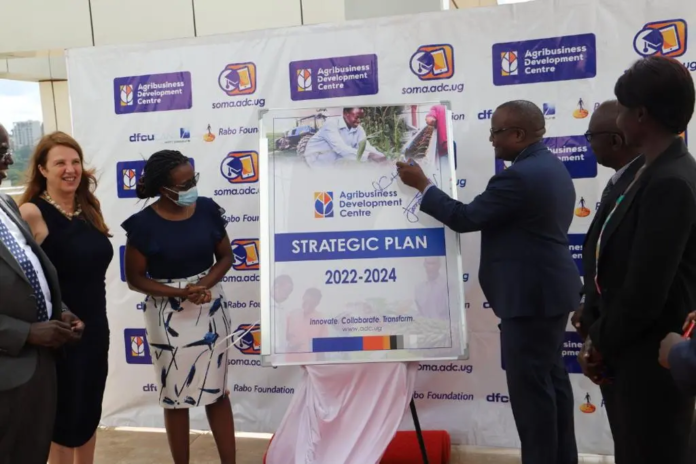
Agribusiness Development Centre launches new strategic plan

Agribusiness Development Centre launches new strategic plan

The Agribusiness Development Centre (ADC), a financial literacy training centre for Farmer Based Organisations (FBOs) has put together a 3-year work-plan that seeks to improve social entrepreneurship.

The strategic plan launched on Thursday June 2, according to Ms. Josephine Mukumbya, the ADC Executive Director, will be a big boost in the area of job creation and increased income generation, while enhancing the much sought-after social economic transformation.

“We plan increase our investment in the whole agricultural value chain by supporting groups and farmers on the best financial management, agronomy, price risk management, value addition and export procedures while addressing their financial needs,” she said, emphasizing that ADC’s capacity building interventions in the agricultural sector was necessary given the current high levels of unemployment.

The Agribusiness Development Centre was initiated in 2017 and is powered by the Rabo Foundation and Dfcu Bank.

“If we give the knowledge in areas of record keeping, financial literacy, especially financial management in areas of agronomic practices, we should be able to see more of youth engaged in this area. We should even give them the information, guidance and incentives that actually pull them to be engaged in this sector. We are looking at having a quarter of a million in terms of beneficiaries by the end of the strategic plan and we are looking at over 1000 direct jobs right from the enterprises themselves,” Ms. Mukumbya said.

In the 2022 – 2024 strategic investment plan, ADC plans to support business in Cocoa and Coffee, Banana, cereals and oilseeds, Dairy and Livestock in areas of value addition, mixed cropping, export and market changing dynamics.

“We want to increase income and we are targeting to see a 10% increase over the next three years,” Mukumbya said.

 “For at least 50% of the trained parties, we will want to see women and youth well included. We want to see that there are more women in leadership; a percentage of 30% is what we’re looking at. We are currently showing baselines that are under 10%. In that regard, we want to introduce green financing. We are starting humbly but we believe this is an area that has so much potential for growth. A number of enterprises that would want to link through our business accelerator programs are identified. And in terms of self-sufficiency, if 50% of the trained enterprises are self-sufficient, we envisage leveraging over 10 fold and want to look at about USD 30 million in funding towards them, ” Ms. Mukumbya said, noting that the agricultural sector in Uganda can only be transformed through innovation and collaboration.

Mr. James Ssemwanga, an agronomist and a board member of ADC, said the three-year strategic plan is designed to leverage the funding from current funders to mobilize some more to scale and sustain operations for deeper impact.

“ADC’s ambition is to achieve a growth trajectory in the medium and long term by continuing to build capacity that delivers financial, social and environmental benefits to its target customer segment,” Mr. Ssemwanga said.

On his part, Mr. Mathias Katamba, the managing director and chief executive officer of Dfcu Bank said: “We are responding to government calls to the private sector to support agriculture. One of the ways we are doing it is through our partnership with Rabo Bank and ADC aimed at transforming the agricultural sector”.

Katamba said Agriculture is one of the leading employers of Ugandans and that there’s a need for collective effort to support it.

“By facilitating ADC in its operations, dfcu Bank and Rabo bank are building capacity for the farmers to access much needed financial services,” he added.

“Dfcu Bank will continue to provide tailor-made products for the farmers and with the capacity building delivered through ADC, the small holder farmers will be more eligible for financing from commercial banks. They will also be better placed to increase productivity and possibly embrace commercial farming which is more profitable at household and national level,” he added.

ADC envisions promoting self-sufficiency as an effective tool to transform the agricultural sector in Uganda. This can be achieved by strengthening Farmer Based Organizations in respect of efficiency and creating economies of scale, in order to make them profitable, sustainable and bankable enterprises that are able to provide efficient and effective services to their farmers.


Stories Continues after ad

Martyrs’ Day celebrations: Over 30 arrested for theft in Namugongo

Handcuffs

Police have so far arrested 34 suspected thieves and another person accused of issuing counterfeit currency.

The Kampala metropolitan deputy police spokesperson Luke Owoyesigyire said the suspects are current detained at Kira Division Police Station.

“As the joint task teams continue to safeguard pilgrims at Namugongo for today’s Martyrs Day celebrations, we are also registering more people arriving at the Anglican and Catholic shrines,” Owoyesigyire said.

“However, some of these are wrong elements. At the Catholic shrine, we have registered 36 cases (35 thefts and one of issuing counterfeit currency),” he said.

At the Anglican Shrine, they registered four cases of theft of phones, one of stealing from a motor vehicle and one of indecent assault.

Owoyesigyire assured the members of the public that Police will continue to safeguard them as they celebrate Martyrs Day.

Stories Continues after ad

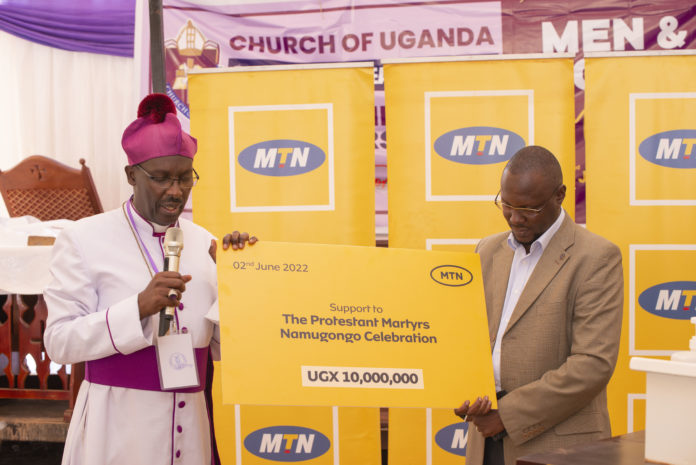
MTN donates Shs10m to Namugongo Anglican Shrine for Martyrs’ Day Celebrations

Bishop Dr Sheldon Mwesigwa, the chairperson for Greater Ankole Dioceses (l) prays for blessings for MTN Uganda while Kenneth Kiddu, MTN GM Business Intelligence(r) hands over the Shs10million contribution

MTN Uganda has supported the Anglican Shrine in Namugongo with Shs 10 million contribution towards the martyrs’ day celebration slated for today 3rd June.

Uganda Martyrs Day is celebrated in commemoration of the martyrdom of 23 Anglican and 22 Catholic men for their faith at the orders of KabakaMwanga of Buganda between 1885 and 1887.

This year, Martyrs’ Day is held under the theme: “Baptized and Sent to Witness Christ with Love and Hope”.

While handing over a cheque at the Anglican Shrine in Namugongo, Kenneth Kiddu, the MTN Uganda General Manager Business Intelligence said the contribution is meant to support the shrine with its preparation for the martyrs’ day celebration.

“Supporting the religious fraternity in Uganda is very important to MTN Uganda because of our shared vision in the power of togetherness. As a corporate company, MTN believes that businesses can only thrive when the communities within which they operate are equally thriving, because we believe that we are good together,” he noted.

Kiddu also lauded the Anglican Church for its continuous dedication to fostering a spirit of peace, love and kindness amongst the public.

Bishop Dr Sheldon Mwesigwa, the chairperson for Greater Ankole Dioceses appreciated MTN Uganda for its contribution and prayed for blessings for the telecom’s operations.

“I would like to thank MTN who have extended assistance to us towards this great event. This event is so big that we who are involved in it testify that support such as this deserves a big appreciation,” Bishop DrMwesigwa noted.

The contribution to the Anglican Shrine comes weeks after MTN equally supported the Catholic Shrine’s preparations ahead of the martyrs’ day celebration in Namugongo.

Stories Continues after ad

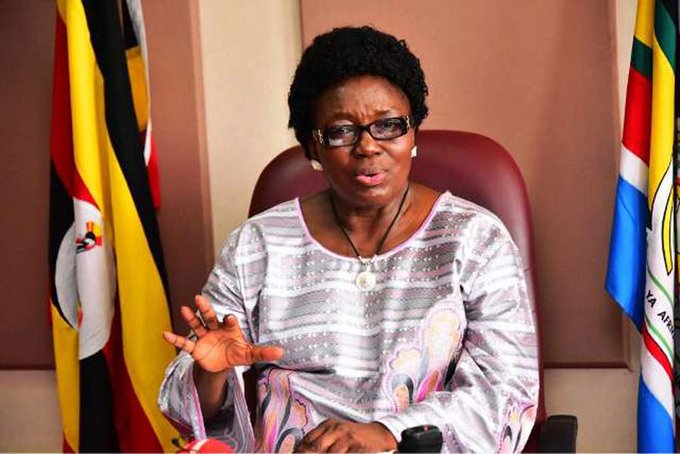
EAC will have single currency by 2024 – Kadaga

Minister for East African Community Affairs, Rebecca Kadaga

First Deputy Prime Minister and Minister for East African Community (EAC) Affairs, Rebecca Kadaga has revealed that the EAC will have a regional currency by 2024 if everything goes according to plan.

The former Speaker revealed this while speaking during the Uganda-DR Congo Business Summit in Kinshasa. She said that member states are now working on the finer details to choose a country to host the East African Monetary Institute, which will later become the East Africa Central Bank.

“By the end of this year, we should know which country is hosting the monetary institute. The institute will be the East African Central Bank. We expect that if we move according to plan, by 2024, we shall have a single currency,” Kadaga said.

Kadaga noted that Uganda, Tanzania, Burundi, and Kenya have submitted requests to host the institute, and the four countries are being reviewed for a decision.

The EAC now has five member states, including Uganda, Tanzania, Rwanda, Burundi, and DR Congo, which formally joined the bloc in April. However, only four, apart from DR Congo, have so far ratified the Single Currency Protocol.

South Sudan remains an observer state because it has not yet harmonized internal laws and still has laws that prevent the free movement of people.

Stories Continues after ad

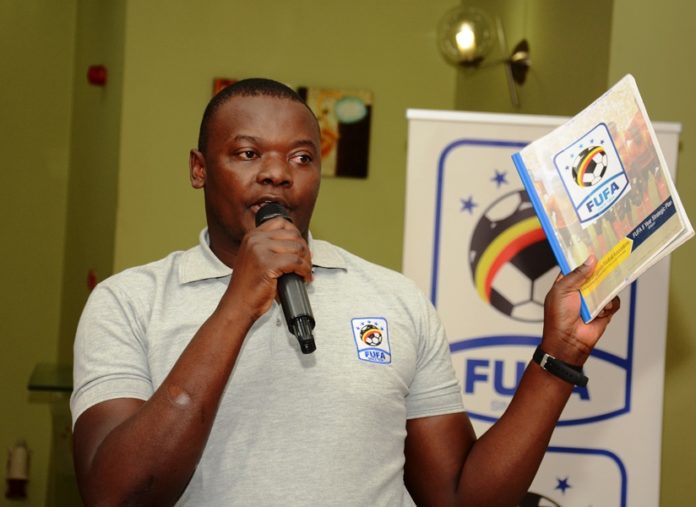
Uganda to host two CAF C Coaching Courses in July

FUFA Football Development Director Ali Mwebe

The Confederation of African Football (CAF) has approved FUFA to hold two CAF C Coaching Courses in Uganda.

The courses start on July 4, 2022 and will run for a period of 30 days.

The Football Development Director Ali Mwebe revealed to the Fufa website that the organisers of both courses have been cleared to go ahead and start receiving applications.

The two courses will be held in Kampala (Kampala Region FA) and Kabale (Western region FA). The organisers met the requirements of hosting these courses.

Kampala Region FA will handle the course in Kampala while HAM Sports Marketing Agency- a private sports agency have been cleared to manage the one in Kabale.

“We are happy that the courses have been cleared to resume after a long period. CAF is happy with the Capacity building courses conducted in Uganda. We have just completed the CAF B course in Njeru. We are now focused on organizing courses for coaches who are willing to enroll for CAF C courses,” said the FUFA Football Director Ali Mwebe.

“The links have been sent to the organisers to start registration for the fully paid up coaches. We also encourage coaches around the region to enroll but the football federations where they are coming from should write to FUFA directly for recommendation. CAF D (formerly FUFA Level One coaches, former National Team players are allowed to enroll. The FUFA Development Department will clear every participant after submission of the lists by the organisers,” added Mwebe.

The CEO of Kampala Region Isaac Ssengendo is delighted that the region will finally have a CAF C course again.

“We understand the hard times but education is key in football. The registration of participants is in progress. We want to be the best in organizing such courses so that the coaches could get better offers around in the market. We have limited slots left,” noted Ssengendo.

From Western region FA, the mood is growing day by day as the potential participants are looking forward to the first ever CAF C course in Western Uganda.

“We have never had a CAF C course in Western Uganda. The coaches are excited, ready for the course and want to be history makers. We have already registered some coaches but we must make a list of 30. We are glad that FUFA cleared the course and we are sure to get the required number of 30 to conduct this course,” said Andrew Amanya-the Coordinator of the Course to be held in Kabale.

The course in Kabale will cost Shs700,000 while in Kampala Shs850,000.

Stories Continues after ad

Primah Kwagala wins EU Human Rights Defenders’ Award 2022

Primah Kwagala with the EU Human Rights Defenders' Award 2022

Ms. Primah Kwagala was chosen as the winner of the EU Human Rights Defenders’ Award 2022 in recognition of her outstanding recent work to advance human rights, and particularly the rights of women.

The founder of the Women Pro Bono Initiative, an NGO, Ms. Kwagala’s work has advanced the rights of women and addressed human rights challenges in a number of key areas.

During the Covid-19 lockdown, Ms. Kwagala worked tirelessly to ensure the release of women unjustly incarcerated for curfew violations, including mothers who were taking babies to hospital for treatment.

Her work has ensured that legal aid has reached many indigent women and she has also succeeded in providing sexual and reproductive health services to women with psychosocial challenges. In 2019, Ms. Kwagala heled to secure the repatriation of several women who had been trafficked to the Middle East and were trapped there in difficult conditions.

Speaking during the award ceremony, Ambassador of Belgium to Uganda His Excellency Rudi Veestraeten said “Woman in Uganda face numerous challenges, including gender and sexual related violence, violation of land and property rights, and equal access of girls to education. The Covid pandemic has further exacerbated this situation. The State and its authorities need to take part in the collective effort to respect and defend human rights for all Ugandans. More action by the Government is needed to tackle persisting human rights abuses and hold all perpetrators of human rights violations to account.”

Receiving the award, Ms. Kwagala paid tribute to her fellow nominees and called for everyone to imagine a gender equal Uganda. She said: “I strongly believe the world can be diverse, equitable, and inclusive. We can achieve a world where difference is valued and celebrated. Together we can forge women’s equality. Collectively we can all #BreakTheBias”.

Once again, this year the EU and Norway received an overwhelming response to the call for nominations for the HRD Award, highlighting both the range of human rights issues but also the vibrancy of activism in the country. Ms. Kwagala was chosen as the 2022 winner following a thorough review and shortlisting process involving a panel comprised of representatives of the EU Delegation, EU Member States and Norway. 

Also shortlisted for this year’s award were human rights lawyer Mr. Eron Kiiza and community leader Mr. Kayinga Muddu Yisito.

Mr. Kiiza was shortlisted for his courageous defence of victims of human rights abuses including unlawful detention and torture. His legal work has also focused heavily on the defence of the environment, including a legal case to challenge the destruction of Bugoma Forest.

Mr Muddu Yisito is the Executive Director of Community Foundation Transformation Network (COTFONE), an NGO based in Masaka. Their work seeks to empower local communities in the greater Masaka region. Much of Mr. Muddu Yisito’s work in recent years has focused on addressing concerns related to environmental destruction and access to compensation related to the planned oil developments in the region. Because of this work, he has faced a number of threats and the theft of devices from COTFONE offices earlier in 2022.

Ms. Anna Merrifield, Chargé d’Affaires a.i. of the EU to Uganda said “Once again, the HRD Award has highlighted the immense contribution being made to the advancement of human rights by courageous human rights defenders. In particular, the work of the three HRDs shortlisted for the 2022 award reminds us of the importance of advancing women’s rights, combatting torture and defending environmental rights in Uganda.”

Human Rights Defenders (HRDs) are individuals who, individually or with others, act to promote and protect universally recognised human rights and fundamental freedoms. These include civil and political rights as well as economic, social and cultural rights. The work of HRDs has a positive impact on a country’s development and is essential for encouraging the respect for human rights as recognised by international human rights standards and agreements. HRDs need to be protected from interference and reprisals while executing their work.

The HRDs’ rights to freedom of expression, association and assembly need to be safeguarded to enable them to defend others. An individual eligible for the EU HRD Award is nominated by another individual or organisation. Human Rights organisations active in Uganda were invited to nominate candidates for the award. Candidates were assessed by a panel composed of human rights experts of different European Embassies and the EU Heads of Mission.

Past winners of the EU HRD Award include Mr Gerald Kankya (2012) of Twerwaneho Listeners Club,  Mr Geoffrey Wokulira Ssebaggala (2013) former Coordinator of Human Rights Network for Journalists (HRNJ), the three joint winners (2014) Ms Gladys Canogura of Kitgum Women Peace Initiative, Assistant Commissioner of Police Christine Alalo, Head of the Uganda Police Family and Child Protection Unit, and Mr Mohammed Ndifuna, Director of the Human Rights Network Uganda, Dr. Livingstone Sewanyana (2015), Founder & Executive Director of the Foundation for Human Rights Initiative (FHRI) and Robert Sempala (2016) of the Human Rights Network of Journalists (HRNJ), Ms. Pamela Angwech (2017) Founder & Executive Director of the Gulu Women’s Economic Development & Globalization (GWED-G); two joint winners, Ms. Margaret Arach Orech, Founder and Director of the Uganda Landmine Survivors Association (ULSA) and Mr. Peter Sewakiryanga, a pastor with Kyampisi Childcare Ministries (KCM) in 2018; Mr William Amanzuru (2019), an environmental rights defender and founder of Friends of Zoka; Mr Aimé Moninga (2020), Founder of Men of Hope and an advocate for the rights of male survivors of sexual violence in conflict; and Ms. Rita Aciro (2021), Women’s Rights Defender and Executive Director of the Uganda Women’s Network (UWONET).

Stories Continues after ad

UPDF extends Shujaa Operation in DRC

UPDF in DR Congo

Uganda has extended its joint military operation with the Democratic Republic of Congo (DRC) to hunt down the Allied Democratic Forces (ADF) rebels in eastern Congo for another six months.

The joint operation between the Congolese army, FADRC and the Uganda Peoples Ddefence Forces-UPDF, known as “Operation Shujaa” started late last year and it was supposed to last for 6 months.

Two weeks ago, the Commander of Land Forces of UPDF Gen Muhoozi Kainerugaba had announced that they would withdraw the troops from the area unless they got further instructions from the Commander-in-Chief, President Museveni or Chief of Defence Forces (CDF) General Wilson Mbadi.

In November last year, 1,700 Ugandan troops were sent to the provinces of North Kivu and Ituri in eastern DR Congo to overthrow the ADF.

Several ADF terrorists including commanders have been killed and others captured since the start of the operation as both Forces conduct intelligence-led operations to neutralize the group and their allied international supporters.

More to follow…

Stories Continues after ad

Prof Katunguka defends his re-appointment as Kyambogo Vice-Chancellor

Prof Eli Katunguka-Photo by Ronard Shabomwe

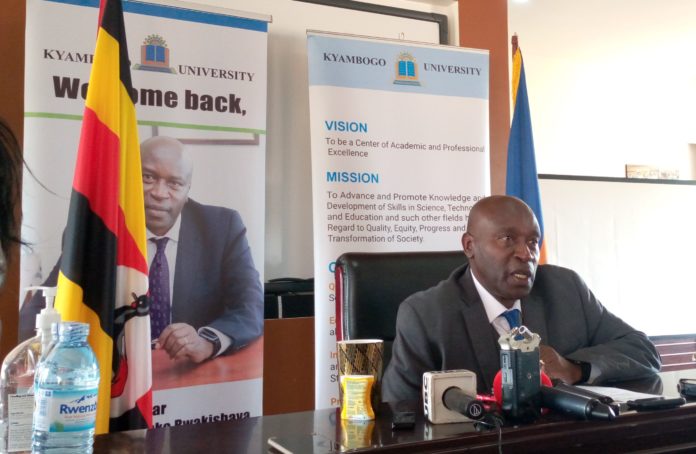
Professor Eli Katunguka Rwakishaya, the Kyambogo University’s Vice-Chancellor has defended his re-appointment by the University Fifth Council for the second term, saying it was lawful.

According to Vice-Chancellor Katunguka, his reappointment went through the right procedures and when the university council appreciated his achievements, they had to appraise and reappoint him.

“I showed my interest in being reappointed to the University Council, which is chaired by Dr. Mary Gorreti Nakabugo, seeking reappointment for a second term. When the Council sat and discussed, they found it worth having me as a Vice-Chancellor for a second time, and my request was granted,” VC Katunguka explains.

Professor Katunguka said, that it is his show of interest in serving the university for a second term, and presentation of a report of the achievements registered by the university during the period of 2017 to 2022, the challenges, and what he intends to do once reappointed, that convinced the council to bring him back.

“Upon the impending expiry of my term, I submitted my interest for renewal following the provisions of the Kyambogo Human Resources Manual. I submitted a report of the achievements registered by the university during the period of 2017 to 2022, the challenges, and my proposals for the next term,” he adds.

According to the Kyambogo University Human Resource Manual, section 2.7.10, a contract of employment may be renewed by the appointment board upon satisfactory performance following a formal performance appraisal.  Prof Katunguka argues that it is on this that the council based after finding him suitable.

Vice-Chancellor Katunguka noted that those who are spreading rumors that he changed the university constitution and enabled himself to the second term should understand well that it is the university council that reappointed him.

The Universities and Other Tertiary Institutions Act provides that there shall be a vice chancellor for each public university who shall be responsible for the academic, administrative, and financial affairs of the university.

It further states that the Vice-chancellor shall be appointed on terms and conditions determined by the University Council for five years and shall be eligible for re-appointment for one more term.

It should be noted that Prof Katunguka’s first term in office was not an easy go since it registered some violent strikes like the one 12th Week Policy strike among others that were staged by students to challenge a number of his policies although many people attribute the Institution growth and development of the Institution to his tireless and well-coordinated work.

According to the vice-chancellor, his achievements, which range from teaching and learning, research, innovation and knowledge generation, physical infrastructure, facilities, ICT, and institutional development among others, were enough to secure him a second term.

In this new term, the vice-chancellor will be working with a new university chancellor, Professor John Okedi, who has just been appointed the President of the Republic of Uganda, as a third chancellor of Kyambogo University for a period of four years.

Prof Eli Katunguka joined Kyambogo University as a Deputy Vice-Chancellor in charge of Academic Affairs-DVCA, and when the position of Vice-Chancellor became vacant, he was appointed as the acting Vice-Chancellor in 2014, until 2017 when he was fully appointed as Vice-Chancellor.

Stories Continues after ad

Dr Lugalambi named new ACME boss

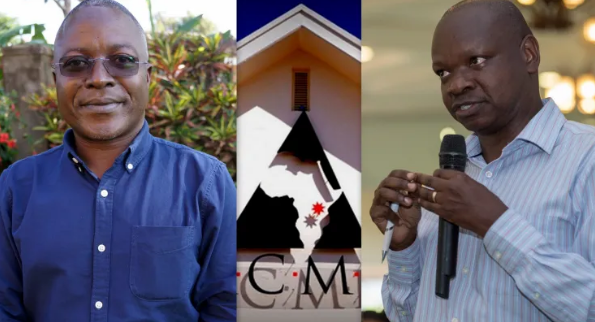
Outgoing boss Dr Peter G. Mwesige (Left) and Dr George W. Lugalambi (right)

Dr George W. Lugalambi has been appointed as the next Executive Director of African Centre for Media Excellence (ACME).

The Board of Directors of ACME announced that Dr Peter G. Mwesige is stepping down as executive director after more than a decade of dedicated leadership. His last day at work will be June 30, 2022.

Lugalambi, who was interviewed for the position at the end of last year, will report on 13 June and work with Dr Mwesige and the management team to ensure a smooth transition.

Dr Mwesige, a co-founder of ACME, has served as executive director of the Kampala-based media support organisation since its incorporation in August 2009. Before that he worked as group training editor of Nation Media Group, head of the Department of Journalism and Communication at Makerere University, and executive editor at Monitor Publications Ltd.

“It’s been a great privilege to work with the amazing team at ACME to support excellence in our journalism,” Dr Mwesige said. “Now is the time to pass the baton to another person who shares our passion for quality journalism and vision for media support to take ACME to the next level.”

ACME’s board chair, Ms Susan Nsibirwa, lauded the outgoing executive director. “It’s no secret that Dr Peter Mwesige has been at the forefront of the organisation’s establishment, growth and influence,” she said. “He leaves behind a well-run and very productive organisation, healthy donor relations and a culture primed to promote media excellence across the region. The results of his tenure speak for themselves.”

Ms Nsibirwa added that the board is retaining Dr Mwesige as an advisor because members did “not want to lose the institutional memory and his experience”.

Under Dr Mwesige’s leadership, ACME has grown into a leading brand in the region’s media support sector, delivering high quality mid-career training for journalists, media monitoring and research, commentary on journalism and media performance, excellence awards, media literacy training for civil society and the broader population, as well as press freedom and freedom of expression advocacy. ACME is steadily expanding its reach through implementing a range of new media development projects in East Africa. One of the centre’s strategic priorities for 2022-2026 is to expand its footprint on the continent. Incoming Executive Director Lugalambi has promised to grow ACME’s continental presence.

Dr Lugalambi, who is also a former head of the Department of Journalism and Communication at Makerere University, has worked in academia, journalism, the NGO sector, and communication consulting. He is a consultant at Hamwe Uganda Ltd, and previously worked with the Natural Resource Governance Institute (NRGI) as Media Capacity Development Officer. Dr Lugalambi coordinates the Uganda Media Sector Working Group (UMSWG), a multi-stakeholder forum that was established last year to “support the development of the media through effective regulation that is democratic, transparent, and responsive to the changing policy, legal, social and technological environments”.

Commenting on his appointment, Dr Lugalambi said he was “entirely sold on ACME’s mission of inspiring African journalists and media practitioners to seek and achieve professional excellence”.

“I look forward to consolidating and advancing the work ACME has done over the years to facilitate the continuous professional development of journalists and media practitioners in Africa,” he said.

Ms Nsibirwa said Dr Lugalambi was more than qualified to take over at the helm of ACME. “He comes in at the time when a new five-year strategic plan has been approved by the board, and his evaluation will be based on how well he executes its implementation,” she said. “We are confident that the board made the right selection and ACME can only rise higher.”

ACME, which commenced formal operations in December 2009, has over the years trained more than 1,000 journalists from Botswana, DR Congo, Eritrea, Ethiopia, Ghana, Kenya, Madagascar, Malawi, Nigeria, Rwanda, South Sudan, Tanzania, Tunisia, Uganda, Zambia, and Zimbabwe. The centre has also trained hundreds of civil society actors and government officials on media relations.

Stories Continues after ad

Over 3000 benefit from Green Jobs and Fair Labour Market Programme

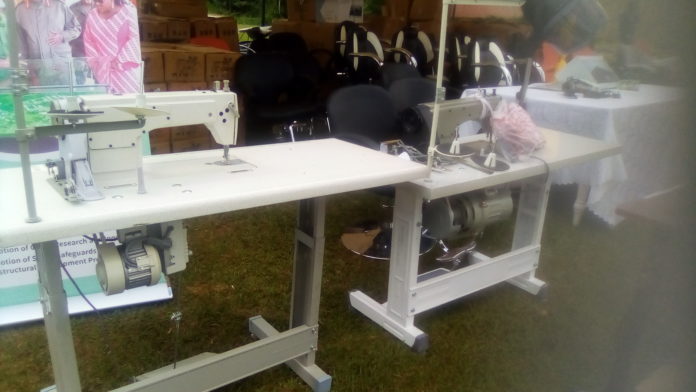
Tailoring and sewing machines

The State Minister for Labour, Charles Okello Engola has handed over business tool kits and equipment to 3,364 beneficiaries in the Country. 

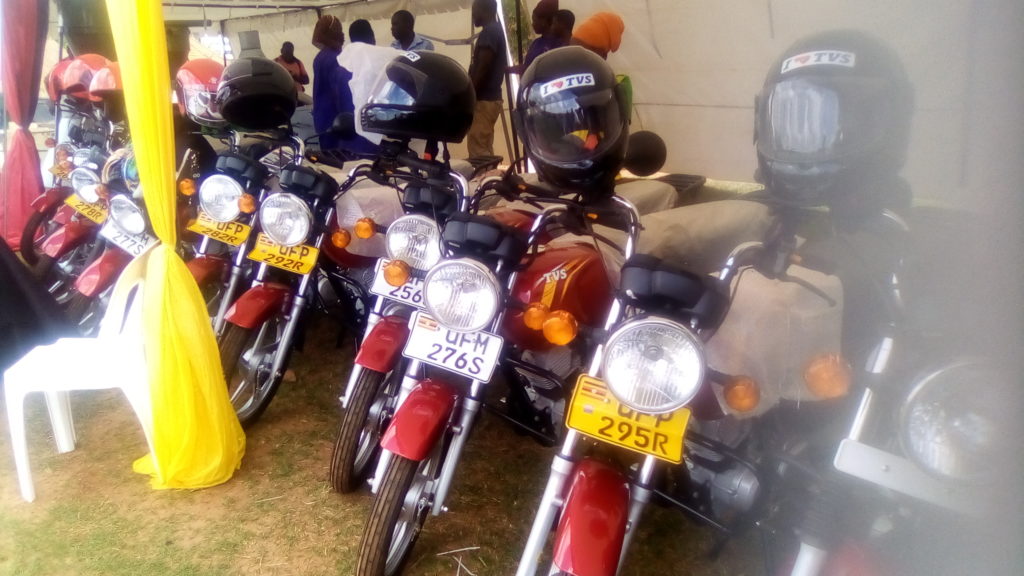
The equipment included tailoring and sewing machines, motorcycles, salon equipment, tents and chairs, oven and mixing machines, generators, maize milling machines and others.

The beneficiaries have been drawn from 22 Districts which comprised Kampala, Busia, Kasese, Tororo, Kayunga and sundry.

Since 2017, the Government of Uganda through the Green Jobs and Fair Labour Market Programme targets the Informal Sector has distributed business tool kits and equipment to Jua-kali groups. So far, 289 Jua Kali groups, in 3 cohorts, comprising 6,412 members have received tool kits and equipment. During this event, another 93 groups (with 3,364 beneficiaries of which 1,258 are male and 2,106 female) received the equipment.

Motorcycles

Speaking at the handover and Uganda Museum, Mr. Okello said the majority of Ugandans are aged 18-30 years and most of them are either unemployed, underemployed or if employed, they are working in the informal sector. Less than 15% of our young people have formal jobs. As such, programmes such Green Jobs and Fair Labour Market Programme specifically target informal sector workers are helping us reach the most underserved, and have potential to drive the majority of the population out of poverty.

He said the past efforts have improved standards of living, increased employment, and accelerated economic development; many people still remain outside the money economy, largely involved in subsistence production.

“We are aware that this situation is largely being driven by the high skills mismatch, lack of access to credit, inadequate skills, low productivity, and use of poor and inappropriate technologies among others. This programme is therefore tackling some of the issues that continue to challenge our people in their quest for producing for the market. By supporting Jua-kali groups, we are giving them the needed push to take advantage of the opportunities Government is creating through the different programmes and policies,” he said.

“We are investing very heavily in infrastructure development especially roads and transport, energy with a major focus on bringing down the power tariffs, security, and expanding markets for our goods and services. By bringing down the cost of doing business, we are increasing opportunities for people to engage in production hence bringing more people into the money economy,” he added.

The Minister urged the beneficiaries to use the equipment to improve production, create more jobs, get more revenue and secure your future. This equipment is not for individuals or group leaders. He said the equipment will be used in line with the Memorandum of Understanding they signed with the Government and the technical teams will follow up on the groups to ensure that you are using it for the purposes for which it has been given.

The government plans to expand this programme to reach more Jua-kalis, targeting all Constituencies in the Country. The minister called upon Members of Parliament to continue working with the government to mobilise communities to participate in this and other Government programmes.

Stories Continues after ad