Premier Recruitment Limited has announced 100 jobs for Ugandan youths in Dubai. The job, according to the poster, will see them earn Shs2 million per month.
The recruitment agency says 100 bike riders are needed in Dubai with the requirements for applying for the job include; CV, registration fee, passport, driving license, age (24-40 years), medical fitness, and fluency in English.
Successful applicants will get a 2-year contract that will see them enjoy free accommodation, transportation, air ticket after, medical care, and overtime allowance.
One of its uniquenesses, Premier Recruitment, says that it prioritizes the safety of its workers.
“The main objective of our welfare team is to make sure all the candidates feel safe and get adjusted to the new environment. Our team continuously follows up with the candidates through different modes of communication and confirms that candidates are happy and settled comfortably. The candidates can also communicate with our team in case of any discomfort,” says the company.
Premier Recruitment is a recruitment company that provides job opportunities for Ugandans in both domestic and non-domestic areas and the industries. They focus on but not limited to security services, hospitality, accountants, marketing, legal, construction, and oil and gas.
They are team committed to reducing the rate of unemployment in Uganda by empowering opportunities with reputable employers in Uganda and internationally, provide an exceptional customer service by understanding the needs of both clients and candidates.
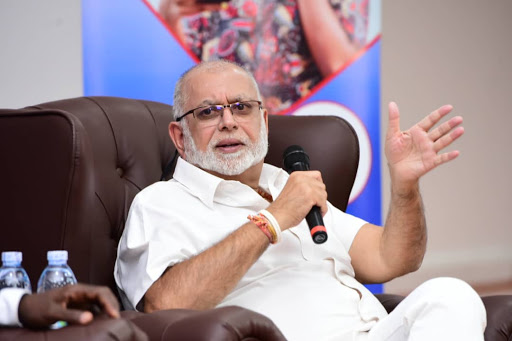
Group chairman, Ruparelia group of companies. Sudhir Ruparelia. One of the sponsors of the Expo
Ugandan businessman and billionaire Sudhir Ruparelia City tycoon shares an inspirational and motivational quote to youth and entrepreneurs on doing business the right way and working smart as a strategy to creating sustainable business ventures in Uganda and creating wealth.
Uganda is a country with numerous opportunities and resources if fully utilized creating wealth is simple for everybody to enjoy the country.
“We all have obstacles thrown at us. Sometimes it feels like it’s more than you can take, but it is your ability to overcome these challenges that define your true potential.
“Life is filled with difficulties and trials. But if reaching the stars were easy, then everyone would be there. This is how you can set yourself apart from the pack; by fighting past the hardships of life, the constant barriers that you find, and take use of them to build even stronger than your former self.”
Sudhir, born 17 January 1956 is a Ugandan business magnate and investor of Indian origin. He is the chairman and majority shareholder in the companies of the Ruparelia Group.
His investments are mainly in the areas of banking, insurance, education, broadcasting, real estate, floriculture, hotels, and resorts.
In February 2020, Ruparelia was appointed as honorary Consul of the Republic of Nepal to Uganda, by Bidhya Devi Bhandari, the president of Nepal.
He started building his empire in Uganda in 1985 after returning from the United Kingdom, when he went after being expelled from Uganda by then President Idi Amin in 1972 along with the other Asians in the country.
Last month, he kicked off the construction of the multibillion-swanky Pearl Business Park.
The mega project with an estimated 15 months scheduled timeline from the onset of construction to completion will encompass office premises, a shopping centre, health and leisure amenities, a 5-star hotel, modern hospital, among other things.
Ruparelia Group, through Meera Investments Limited, is building the 18-acre mixed-use facility on the premises of the former Chieftaincy of Military Intelligence (CMI) headquarters on Yusuf Lule Road in Kampala.
Ruparelia Group will divide the project into different phases. The first phase completion estimate is 2023, including office spaces, 16 lettable floors and two floors for parking.
The plan is to equip the facility with modern amenities such as a fully automated fire detection system on all floors and approximately 170 CCTV cameras in all public areas. In addition, the building will include internet access, a fitness centre and other health, safety and productivity utilities.
Meanwhile, on top of Pearl Business Park, Sudhir is also expanding Kabira Country Club, which is going to have a shopping mall complex attached to the hotel.
As if the above is not enough, mogul is also planning to build a 200-room Kingdom Kampala Hotel.
The Kingdom Kampala Hotel is estimated to be completed by 2026. This is another project by Meera Investments Limited, the real estate arm of the Ruparelia Group that owns a series of hotels, country clubs and over 300 commercial properties in and around Kampala.
Together with the government of Uganda, they will also build a modern Convention Centre at Commonwealth Speke Resort Munonyo. The centre will host 3,000 delegates and its first conference will be the Non-Aligned Movement (NAM) scheduled for next year. The construction is estimated to cost $40 million (Shs140 billion).
Some of the companies he owns are; Premier Recruitment Limited, Crane Management Services Limited, Goldstar Insurance Company Limited, Kabira Country Club, Kampala International School Uganda, Kampala Parents’ School, Kampala Speke Hotel, Meera Investments Limited – Kampala, Munyonyo Commonwealth Resort, Speke Resort and Conference Center – Munyonyo and Victoria University.
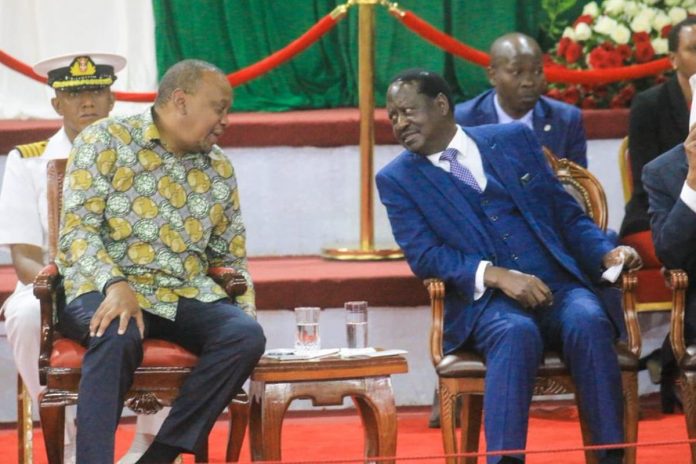
President Uhuru and ODM Principal Ralia Amollo Odinga who championed the proposed changes.
The International Monetary Fund (IMF) and the Kenyan authorities have reached a staff-level agreement on economic policies to conclude the third reviews of the 38-month EFF/ECF financed program. Kenya would have access to about US$244 million in financing once the review is formally completed by the IMF Executive Board.
The economic rebound is underway although global shocks are presenting new challenges in the form of rising global energy, fertilizer, and food prices, which will pressure inflation and create new spending needs.
Kenya’s robust program performance is delivering resilience that is helping the country navigate these global shocks while remaining within the authorities’ targets and continuing to make progress in addressing debt vulnerabilities, IMF says.
IMF staff led by Mary Goodman, conducted a hybrid mission to Kenya and in Washington DC to discuss progress on reforms and the authorities’ policy priorities in the context of the third review of Kenya’s economic program supported by the IMF’s Extended Fund Facility (EFF) and Extended Credit Facility (ECF). The arrangements were approved by the IMF Executive Board on April 2, 2021 , for a total amount of SDR 1.655 billion (US$ 2.34 billion at that time).
Goodman said: “The IMF staff team and the Kenyan authorities have reached a staff-level agreement on the third review of Kenya’s economic program under the EFF and ECF arrangements. The agreement is subject to approval of IMF management and the Executive Board in the coming weeks. Upon completion of the Executive Board review, Kenya would have access to SDR 179.13 million (equivalent to about US$ 244 million), bringing the total IMF financial support under these arrangements to SDR 865.77 million (equivalent to about US$ 1,178 million).”
The Kenyan economy has been staging a robust recovery as the effects of the pandemic wane, and the authorities remain vigilant. Spillovers from the war in Ukraine are expected to have a modest impact on growth in the near term, as Kenya’s direct exposure to Russia and Ukraine is relatively limited. IMF Staff projects growth at 5.7 percent in 2022, reflecting a pickup in agriculture and continued recovery in services and other sectors.
By mid-April 2022, 30 percent of adults had been fully vaccinated against COVID-19, up from 5 percent at end-2021. The medium-term outlook remains favorable, supported by Kenya’s proactive reform efforts, although the outlook is subject to uncertainty.
Spillovers from the war in Ukraine are expected to temporarily push up inflation as domestic retail fuel prices gradually rise to global levels. The Central Bank of Kenya (CBK) has stated that it stands ready to take appropriate action to contain second-round effects of higher global prices on inflation. Exchange rate flexibility has served Kenya well and should continue to be a shock absorber that will help mitigate the impact of these external shocks.
Kenya is on track to meet its fiscal objectives and put debt as a share of GDP firmly on a downward path. Kenya’s fiscal position has been underpinned by strong tax revenue performance this year, buoyed by a robust economic recovery and the important tax policy measures already undertaken as part of Kenya’s multi-year plan to reduce debt-related vulnerabilities.
These resources bring resilience that will allow cushioning part of the impact of the sharp increase in global energy and fertilizer prices on households and businesses while still remaining within the authorities’ fiscal targets for FY2021/22.
“The FY2022/23 budget carries forward the authorities’ efforts to broaden tax revenue mobilization and maintain careful expenditure control while protecting social priority spending. Revenue targets for FY22/23 will be supported by tax policy changes, including planned custom interventions in the context of the East African Community, and improvements in tax administration. In this regard, the authorities will take into account the need to protect vulnerable groups in light of the recently-increased cost of living. A medium-term revenue strategy which is under development and tight spending control will help anchor deficit reduction in the years ahead.”
The banking sector has remained resilient, supported by steps taken by the CBK to sustain the economy and help households and businesses navigate the challenging environment. The CBK is also making progress in strengthening its monetary policy framework.
It will be important to maintain the momentum of reforms to tackle difficulties at financially-troubled state-owned enterprises (SOEs)—including Kenya Airways (KQ) and the Kenya Power and Lighting Company (KPLC). At KQ, which had already benefitted from a government guarantee on a large portion of its debt liabilities, steady progress on the ongoing restructuring effort will be important to minimize costs to the Exchequer.
At KPLC, crystallizing an action plan to restore KPLC’s medium-term profitability and fully cover any financing gaps through end-2023 will likewise be critical to minimize calls on the budget. The authorities’ plans to implement their Blueprint for Governance Reforms at the State Corporations will provide a welcome framework to strengthen the governance of SOEs.
Kenya is moving forward on its governance and anticorruption agenda. Revised documents for government tenders, introduced on April 21, 2022, will enable publication of beneficial ownership information for successful bidders in government tenders, which will be a requirement going forward.
The special audits being undertaken of COVID-19 vaccination spending up to end-June 2021 and plans to include a chapter on COVID-19-related spending in the Auditor General’s comprehensive audit of financial year 2020/21 expenditure should provide important transparency in the coming months on the government’s pandemic response.”
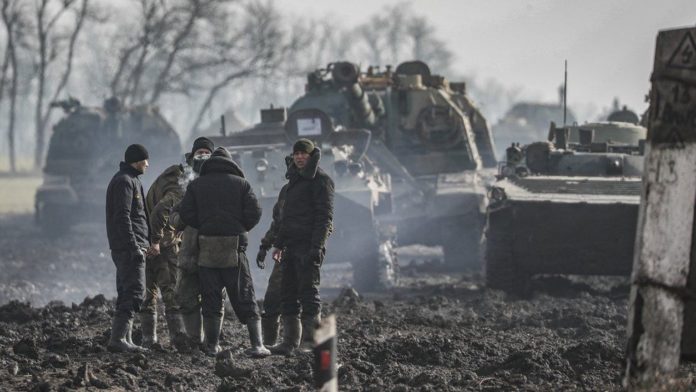
The war in Ukraine has dealt a major shock to commodity markets, altering global patterns of trade, production, and consumption in ways that will keep prices at historically high levels through the end of 2024, according to the World Bank’s latest Commodity Markets Outlook report.
The increase in energy prices over the past two years has been the largest since the 1973 oil crisis. Price increases for food commodities—of which Russia and Ukraine are large producers—and fertilizers, which rely on natural gas as a production input, have been the largest since 2008.
“Overall, this amounts to the largest commodity shock we’ve experienced since the 1970s. As was the case then, the shock is being aggravated by a surge in restrictions in trade of food, fuel and fertilizers,” said Indermit Gill, the World Bank’s Vice President for Equitable Growth, Finance, and Institutions. “These developments have started to raise the specter of stagflation. Policymakers should take every opportunity to increase economic growth at home and avoid actions that will bring harm to the global economy.”
Energy prices are expected to rise more than 50 percent in 2022 before easing in 2023 and 2024. Non-energy prices, including agriculture and metals, are projected to increase almost 20 percent in 2022 and will also moderate in the following years. Nevertheless, commodity prices are expected to remain well above the most recent five-year average. In the event of a prolonged war, or additional sanctions on Russia, prices could be even higher and more volatile than currently projected.
Because of war-related trade and production disruptions, the price of Brent crude oil is expected to average $100 a barrel in 2022, its highest level since 2013 and an increase of more than 40 percent compared to 2021. Prices are expected to moderate to $92 in 2023—well above the five-year average of $60 a barrel. Natural-gas prices (European) are expected to be twice as high in 2022 as they were in 2021, while coal prices are expected to be 80 percent higher, with both prices at all-time highs.
“Commodity markets are experiencing one of the largest supply shocks in decades because of the war in Ukraine,” said Ayhan Kose, Director of the World Bank’s Prospects Group, which produces the Outlook report. “The resulting increase in food and energy prices is taking a significant human and economic toll—and it will likely stall progress in reducing poverty. Higher commodity prices exacerbate already elevated inflationary pressures around the world.”
Wheat prices are forecast to increase more than 40 percent, reaching an all-time high in nominal terms this year. That will put pressure on developing economies that rely on wheat imports, especially from Russia and Ukraine. Metal prices are projected to increase by 16 percent in 2022 before easing in 2023 but will remain at elevated levels.
“Commodity markets are under tremendous pressure, with some commodity prices reaching all-time highs in nominal terms,” said John Baffes, Senior Economist in the World Bank’s Prospects Group. “This will have lasting knock-on effects. The sharp rise in input prices, such as energy and fertilizers, could lead to a reduction in food production particularly in developing economies. Lower input use will weigh on food production and quality, affecting food availability, rural incomes, and the livelihoods of the poor.”
Special Focus: The Impact of the war in Ukraine on commodity markets
The report’s Special Focus section offers an in-depth exploration of the war’s impact on commodity markets. It also examines how commodity markets responded to similar shocks in the past. The analysis finds that the war’s impact could be longer-lasting than previous shocks for at least two reasons.
First, there is less room now to substitute the most affected energy commodities for other fossil fuels—because price increases have been broad-based across all fuels. Second, the increase in prices of some commodities is also driving up prices of other commodities—high natural-gas prices have raised fertilizer prices, putting upward pressure on agricultural prices. In addition, policy responses so far have focused more on tax cuts and subsidies—which often exacerbate supply shortfalls and price pressures—than on long-term measures to reduce demand and encourage alternative sources of supply.
The war is also leading to more costly patterns of trade that could result in longer-lasting inflation. It is expected to cause a major diversion of trade in energy. For example, some countries are now seeking coal supplies from more remote locations. At the same time, some major coal importers could step up imports from Russia while reducing demand from other large exporters. This diversion will likely be more costly, the report notes, because it involves greater transportation distances—and coal is bulky and expensive to transport. Similar diversions are occurring with natural gas and oil.
In the near-term, higher prices threaten to disrupt or delay the transition to cleaner forms of energy. Several countries have announced plans to increase production of fossil fuels. High metal prices are also driving up the cost of renewable energy, which depends on metals such as aluminum and battery-grade nickel.
The report urges policymakers to act promptly to minimize harm to their citizens—and to the global economy. It calls for targeted safety-net programs such as cash transfers, school feeding programs, and public work programs—rather than food and fuel subsidies. A key priority should be to invest in energy efficiency, including weatherization of buildings. It also calls on countries to accelerate the development of zero-carbon sources of energy such as renewables.
The National Unity Platform (NUP) has fronted Former FDC member Tolit Akecha Simon as its flag-bearer in the upcoming Omoro County by-election.
The NUP Election Management Committee yesterday vetted candidates who expressed interest in carrying the Party’s flag for the Omoro County by-election. The candidates who were vetted are; Alison Ramto Flavia, Kizza Oscar, Ochola Charles, Simon Tolit Akecha, and Secondo Okoth Abok.
Akecha previously contested for the same seat in the 2016 elections on the Forum for Democratic Change (FDC) ticket but lost to Oulanyah.
Last week, the ruling party National Resistance Movement-NRM declared the son of late Jacob Oulanyah, Mr Andrew Ojok as the party’s sole candidate.
Others who have declared interest in the seat are; Godwin Okello (Independent), Julius Okello Opira (ANT), and Hillary Olweny (Independent).
The seat fell vacant on March 20 following the death of former Speaker of Parliament Jacob Oulanyah in Seattle, USA. Oulanyah was the Omoro County MP from 2001 to 2005 and then from 2011 until his death.
The Electoral Commission has since set May 26, as the date for the by-election.
Fitch, the international credit rating agency has affirmed Stanbic Bank Uganda Limited’s (SBU) Long-Term Issuer Default Rating (IDR) at ‘B+’ while it also maintains its ‘AAA’ rating in Uganda.
According to Fitch, SBU’s National Ratings reflect its creditworthiness relative to other issuers in Uganda. SBU’s ‘AAA (uga)’ National Long-Term Rating is the highest possible on Uganda’s national scale and considers potential support available from Standard Bank Group. SBU’s Long-Term IDR is one notch below that of SBG, reflecting SBU’s strategically important role in the group’s regional operations.
SBU is Uganda’s largest bank accounting for 22% of banking sector assets as at the end of December 2021.
Its leading domestic franchise is underpinned on a strong corporate and investment banking (CIB) business, relationships with the leading corporate companies operating in Uganda and other benefits derived from being part of the Standard Bank Group (SBG), which is Africa’s biggest lender by assets.
Fitch regularly generates IDRs for a range of business sectors. An ‘issuer’ may be a financial or nonfinancial corporation, a sovereign company, or an insurance company. A ‘Default Rating’ is the measure of an institution’s credit risk.
Risk is defined by a company’s threat of becoming defunct or entering into bankruptcy, administration, receivership, liquidation, or other formal winding-up procedures. Fitch relies on independent auditors and other experts to produce IDRs.
Fitch states that SBU’s regulatory capital ratios have healthy buffers above the new minimum requirements. ‘The Stable Outlook reflects our view that SBU’s creditworthiness compared to other domestic issuers is unlikely to change over a one- to two-year period.SBU’s profitability is expected to further recover in 2022 resulting from a likely rise in Uganda’s interest rates and stronger loan growth’.
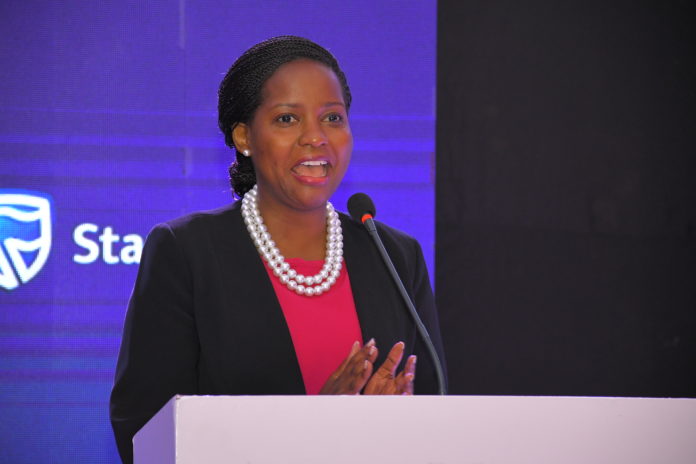
“We welcome the positive rating by Fitch which speaks to the stability of our business and ability to support Uganda’s economic growth in a challenging operating environment,” said Anne Juuko, Stanbic Bank Chief Executive.
Caution
However, Fitch cautions that this projection could be partially offset by a rise in write offs of non-performing loans and the expiry of debt relief measures first announced by Bank of Uganda during 2020 to help soften the impact of the Covid-19 pandemic on both borrowers and the banks.
Loans under repayment moratoria, mainly in the real estate, education, and industrial sectors, increased to 8% of gross loans at end-2021 and may pressure asset quality when remaining credit relief measures expire at end-September 2022.
Another factor relates to the effects from the Russia-Ukraine conflict and lingering pandemic risks that could negatively impact the economic recovery given Uganda’s small and undiversified economy, low vaccination rates and oil import reliance.
However, the Bank’s funding profile, Fitch noted, is dominated by current and savings accounts (end-2021: 96% of deposits), supporting an inexpensive and stable deposit base. SBU’s balance sheet is structurally liquid, helping to mitigate high single-depositor concentration.
President Yoweri Museveni yesterday told his ministers that the Coffee deal signed between the government and Uganda Vinci Coffee Company Limited (UVCC) is good for the development of coffee and capable of expanding the economy as it will widen the coffee market in Europe and other western capitals.
According to sources that attended cabinet and couldn’t speak freely as they lack authority to do so, a combative Museveni said he was briefing his minister on the deal for the first time and therefore, he expected no minister to oppose it.
“I want you to know that this is a good deal as it will increase our coffee export to the European markets but also it will increase its consumption here locally to about 30%,” the source quoted the president.
In the same meeting, the president is said to have turned to Evelyn Anite, the State Minister for Finance in charge of Investment and Privatization accusing of usurping his powers and asking “Do you know the value of that factory to Uganda and who told you that the agreement has been recalled?”
The president is said to have warned Ms Anite further that he would crush her before she went on knees apologizing.
“I will crush you, I will crush you, I will crush you and your Monitor newspaper.”
The revelation about his brief to cabinet about the deal coincided with the ongoing meeting with Members of Parliament at Kololo this afternoon. A section of legislators across party inclinations are opposed to the deal and have since teamed up with lawyers in dragging the government to court over the deal.
The Parliamentary Committee on Trade, Tourism and Industry on Monday, April 25 2022 commenced investigations into the controversial coffee deal signed between the Government and UVCC.
Chaired by Mr Mwine Mpaka, the committee interrogated officials from UVCC led by the company secretary, Moses Matovu where they unearthed several irregularities regarding the coffee deal.
During the meeting, MPs on the committee were dismayed to learn how the Italian investor, Enrica Pinetti, the director, UVCC reportedly mortgaged 25 acres of government land in Namanve given to them to secure a loan from a commercial bank in order to set up the coffee processing plant.
Ms Pinetti is also reported to have signed as a witness instead of a director during the signing of the agreement between her on behalf of UVCC and government.
PostBank Uganda Chief Executive Officer/Managing Director Julius Kakeeto
PostBank Uganda Limited, the Government of Uganda owned bank has announced its 2021 financials posting yet another year of healthy growth.
In the results released on 25th April 2022, the bank reported, that customer deposits, the lifeblood of every bank, had grown by Shs58.3 billion – a growth of 13% from Shs449 billion in 2020 to Shs507.2 billion.
The double-digit growth in customer deposits enabled the bank to boost its lending book by an impressive 35.9% – from Shs334.7 billion to Shs454.9 billion – a growth of Shs120.2 billion.
Burgeoning lending saw a 20.9% growth in total income – from Shs119.5 billion to Shs144.5 billion.
Despite increased investment especially into new technology, that pushed expenditure, upwards from Shs104.3 billion to Shs126.9 billion, the bank still reported a healthy 21.5% growth in net profit – from Shs10.1 billion to Shs12.2 billion.
Shareholder Funds also grew by 15.5% from Shs101.4 billion to Shs117.1 billion.
The 2021 results are Julius Kakeeto’s second full-year results since he joined the bank in October 2019 and the first since the bank got a Tier One Commercial banking licence in December 2021. The impact of the licence is however expected to start bearing fruits in 2022.
Commenting on the results, Mr. Kakeeto said that the 2021 strong performance was underpinned by the continued steady execution of the bank’s transformation agenda – which seeks to shape the bank into a market leader in financial inclusion and a pacesetter in economically transforming the lives and livelihoods of its customers.
“2021 was a tough year owing to the COVID-19 pandemic. Many customers were still suffering from the effects of the 2020 lockdown and then they had to deal with another lockdown in 2021. At PostBank, we focused on supporting the adversely affected businesses to survive and recover through restructuring of facilities and providing working capital support,” he said, adding: “The Bank continued with its strategy of revamping and widening its distribution channels to enable access to its products and services while improving customer experience.”
He also said that the bank, in line with its strategic intent of being a people’s bank focused more on impact lending to key sectors of the economy.
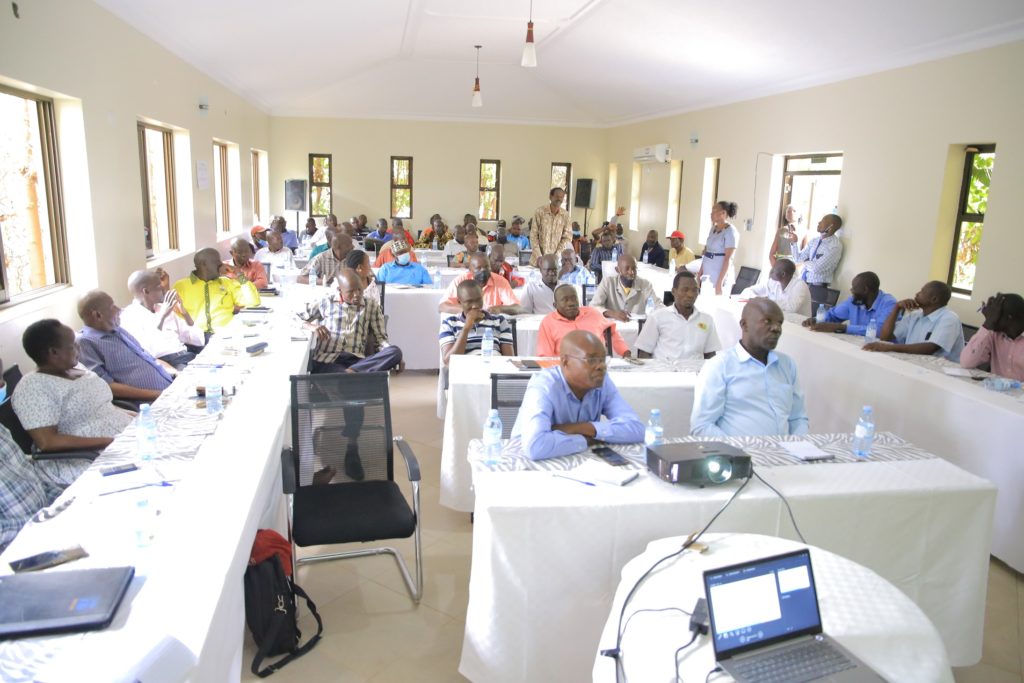
Over 70 farmers dealing in crop production, poultry and cattle fattening pose for a picture, at the close of a PostBank organized agriculture forum. The bank which a leading agriculture lender, by number of loans, uses the forums to empower and upskill farmers for the growth of their agribusinesses.
“PostBank prides itself in offering affordable and sustainable financial services to the masses. Last year’s earnings underpin our commitment to supporting Micro Small and Medium-Sized Enterprises (MSMEs) with agriculture being one of our core areas. Considering most of these MSMEs are involved in the agriculture value chain – production, trade, processing, distribution, storage, and logistics, PostBank will remain an MSME bank,” he said.
“We shall continue to innovate tailor-made products that support the entire value chain and deepen our coverage and outreach using our robust financial literacy programs,” he said.
Leveraging the tier-one licence for mutual bank and customer growth
Kakeeto said that the acquisition of the Tier One operating licence in December 2021, would enable the bank to unlock opportunities that would fully optimize PostBank’s potential.
“We are in a stronger position to mobilize deposits which are the heartbeat of a bank. Our customers are also set to enjoy a new and wider variety of products and services that come with being a fully-fledged commercial bank,” he said, adding: “The Bank will ensure that it continues to improve the customer experience for its target market – the masses, MSMEs and agro-businesses on a wider scale. We also intend to scale up our existing partnerships with both Government and Development Partners to extend financial services to Ugandans, especially the underserved.”
Over the last two years, the bank has been undergoing transformation, heavily investing in new technologies, revamping its digital banking platforms, revamping the branch network as well as opening new outlets.
To take services to the people, the bank opened new branches in 2021 starting with Mukono, Kamdini, Rushere, Butogota and Kyazanga. The bank also opened a Corporate Branch at Forest Mall, Kampala to cater for the high net worth and corporate customers.
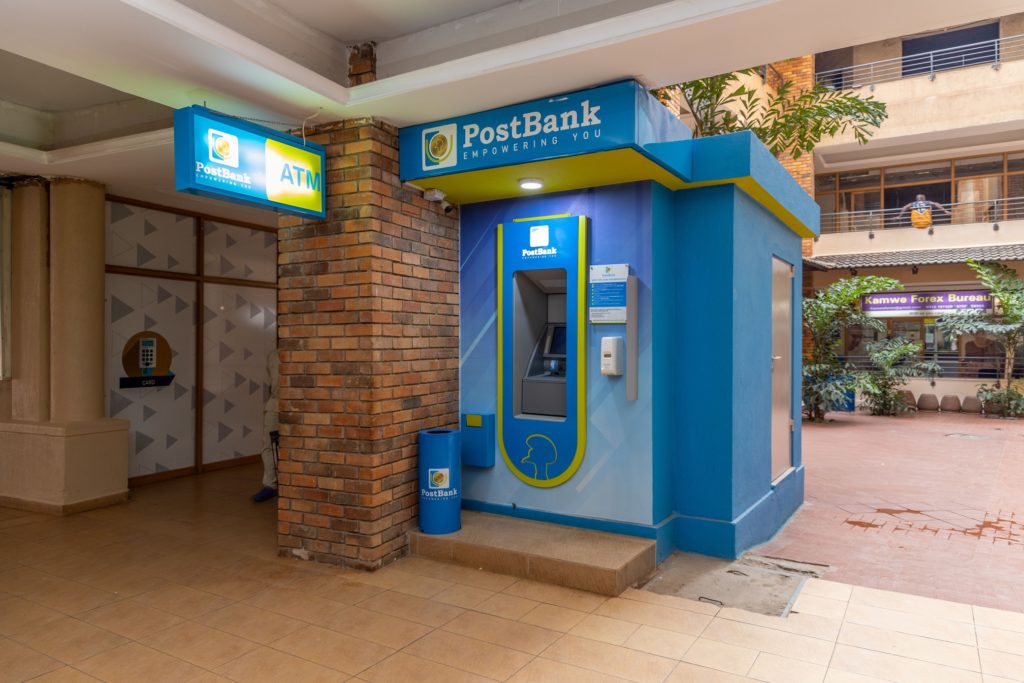
The bank also upgraded its PostApp and PostMobile *263# to ease transactions, as well as replaced half of its fleet of ATM dispensers with recycler/intelligent ATMs that support instant cash deposits, and cardless transactions, and a wide range of other services.
One of PostBank’s intelligent ATMs at the Forest Mall Branch. In 2021, the bank replaced half of its fleet of ATM dispensers with recycler/intelligent ATMs that support instant cash deposits, cardless transactions, and a wide range of other services. The rest of the ATM fleet will be replaced this 2022.
“We are planning on replacing the rest of the ATM fleet during this year, 2022. Last year, we also embarked on upgrading our core banking system which has been completed,” Kakeeto said.
He also noted that the bank continues to support its clients recover from the effects of the pandemic.
“We are the people’s bank, providing opportunities for financial growth to Ugandans countrywide. Through our competent staff, we are in constant engagement with borrowers to support them to pay back their debts,” Kakeeto emphasized.
“We also set in motion the Small Business Recovery Loan which is complemented by the Uganda Development Bank-PBU partnership low-rate loan for value addition to further support financially distressed businesses and individuals. The goal is to avail capital that borrowers can be able to pay back under flexible repayment terms,” he added.
“This year, we shall continue to provide affordable and sustainable banking services that drive the social and economic transformation of our customers. We also plan on continuing with our digital journey that will further improve the customer experience at all touchpoints of interaction with the Bank,” Kakeeto concluded.
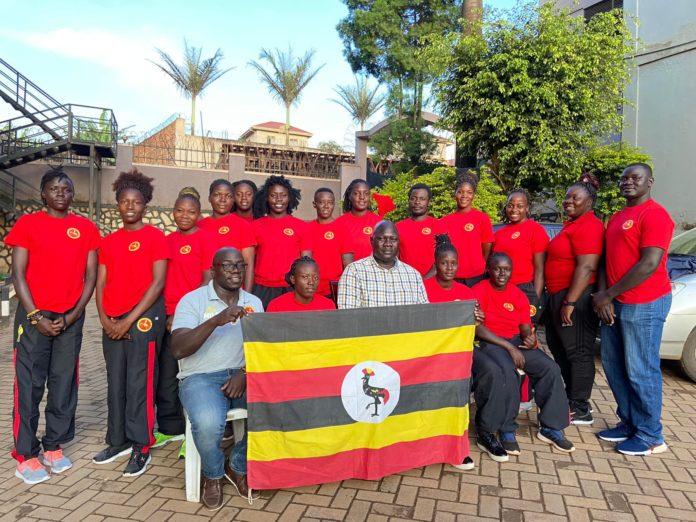
The Uganda’s Women national rugby Sevens team, the Lady Cranes 7s, has been flagged off to Tunisia by the General Secretary of the Uganda Rugby Union Peter Odong.
The team will be participating in the Rugby Africa Women’s 7s tournament scheduled for 29th-30th April.
The tournament will also act as qualifiers for the World Cup and Commonwealth.
Uganda is grouped in Pool B alongside neighbors Kenya and Zambia.
Pool A has South Africa, Senegal and Zimbabwe while C has hosts Tunisia, Madagascar and Ghana.
Besides South Africa who qualified as hosts, the other eight teams will compete for the only spot at the 2022 Rugby Women World Cup.
The Lady Cranes are targeting a return to the Women Rugby 7s World Cup after their maiden appearance in 2009 in New Zealand and Australia.
The Directorate of Criminal Investigations has intensified its operations against acts of sabotage, vandalism and theft of electric wires and cables, with successful raids at two locations in Namugongo and Katwe that led to the arrest of 3 UMEME workers and an assortment of exhibits.
According to the police spokesperson, Fred Enanga, the task team arrested two suspected vandals identified as Kalumba James, aged 33 and Semuyaba Joseph, aged 28 in Namugongo. Both suspects are electrical engineers at the UMEME, Banda branch and residents of Nsawo LCI in Namugongo.
Upon a search at their known premises, drums of black cables, power connectors and UMEME equipment were recovered.
The task team conducted another operation at Ndejje-Mirimu zone, and arrested Ezra Kimiah Mudhimbwa, a 36year old, electrician, and a sub-contractor of Komolo Co. Ltd. The search led to the recovery of 3 drums of electric wire cables and electricity connectors.
“Such criminal acts do negatively impact our economy through vandalism of critical infrastructure, loss of electricity which affects businesses and communities within the affected areas.” Enanga said.
Enanga added that due to the collaborative efforts by CID, other stakeholders and the local community, several suspects involved in cable theft and vandalism have been arrested and recoveries of exhibits made. “The operations aimed at solving this senseless and destructive type of crime are continuing.”
“We also call upon the public to share any information that will assist our officers in fighting this crime and bring those who destroy critical infrastructure to book,” Enanga said.