Stanbic Bank
Stanbic Bank
26.6 C
Kampala
Stanbic Bank
Stanbic Bank
Home Blog Page 653

Gov’t halts controversial agreement with Uganda Vinci Coffee Company

coffee-in-uganda

The Government of Uganda has halted the controversial $80million coffee agreement with Uganda Vinci coffee company.

On February 10, Finance Minister Matia Kasaija signed the Shs 284 billion Coffee processing deal with Ms Enrica Pinetti to process and export Uganda’s coffee in Europe and Middle East.

The deal attracted criticism from various players in the agricultural sector. The Finance Ministry was blamed for failure to consult all the stakeholders in the coffee sector and going on to sign on their behalf.

Kasaija signed on behalf of Uganda Government in the presence of Secretary to the Treasury, Ramathan Ggoobi as witness.

However, it emerged that Pinetti, who is the purported owner of Uganda Vinci Coffee Company Limited (UVCC), signed the Coffee processing contract as a witness raising a lot more questions on who could be the rightful owner of the firm.

Government has now set up a ministerial committee comprising of the Energy Ministry, Agriculture, Finance, Works ministry and the Attorney General to review the agreement on Tuesday.

The State Minister of Finance for Investment and Privatization Eveln Anite said that she just saw the agreement from the media.

The Speaker of Parliament Anita Among also directed the Committee Chairperson Mwine Mpaka to investigate the signed coffee deal.

The Parliamentary Committee on Tourism Trade and Industry summoned Matia Kasaija, Enrica Pinetti, Permanent Secretary to the Ministry of Finance Ramathan Ggoobi, Attorney General Kiryowa Kiwanuka, Minister for Trade Industry and Cooperatives Francis Mwebesa, Minister for Agriculture Frank Tumwebaze and the Solicitor General.

Other are; Uganda Coffee Development Authority (UCDA), Uganda Coffee Federation (UCF), Uganda Coffee Quality Trader’s Association, Uganda Coffee Trader’s Alliance, Rwenzori Coffee Trust, Bugisu Cooperative Union, Ankole Coffee Cooperative Union, UNZO Coffee, Uganda Large Scale Farmers Association, BUCADEF, UGACOF, KAWACOM, ESCO (U) LTD, and OLAM (U) LTD.

The Minister for Agriculture Frank Tumwebaze denied any involvement in the signing of the coffee deal. He said his ministry was not involved and asked everyone to pose their questions to the Finance ministry.

Ggoobi said the coffee agreement will support the government in achieving its coffee production target from the current 7 million bags per year to 20 million bags by 2030.

Stories Continues after ad

Muyembe-Nakapiripirit road: Court orders DFCU to pay UNRA Shs60bn following contract termination

Muyembe – Nakapiripirit Rd

A Turkish construction firm, M/s Polat Yol Yapi Sanayi Ve Ticaret, signed a contract with the Uganda National Roads Authority (UNRA) in November 2019 to tarmac the 92.2km route of Muyembe to Nakapiripirit. The company had already been advanced Shs 60 billion to kick start the works.

According to UNRA, the road was be completed within the 36 months as agreed in the contract terms but complaints were raised pinning the Turkish contractor for being too slow and its shoddy performance thus failing to perform and the authority decided to terminate the contract.

UNRA team led by Eng Samuel Muhoozi, the Director for Roads and Bridges Development, inspected the progress of the works on the project last year in August. During the inspection, local leaders raised a number of issues such as slow progress after engineers rated the completed works at about only three per cent as of July 2021.

Eng Mugoozi assured Ugandans no money would be lost since an advance payment worth 20 per cent of the contract sum was secured by bank guarantee so that in case of a default, the bank cashes UNRA. “So, even today if we say we are terminating this contractor, the bank will pay us that money tomorrow, So that money is secure, it’s not a loss,” he said in August.

In a ruling by the Commercial Court on 19th April 2022, Hon Lady Justice Jeanne Rwakakooko ordered DFCU bank to pay Shs 14,259,362,014 and USD 12,413,382 (approx. 44 billion) under the suit Guarantees to UNRA.

Mr. Timothy Lugayizi represented DFCU Bank Limited, Mr. Ferdinand Tumuhasie represented the 1st respondent [Turkish contractor M/s Polat Yol Yapi Sanayi Ve Ticaret] and Mr. Kenneth Mwebembazi represented the 2nd respondent [UNRA].

“The interim orders issued by this Court on 27th January, 2022 and extended on 28th February 2022 restraining the 2nd respondent from enforcing, collecting or calling on the advance payment guarantees issued by the applicant to the 2nd respondent are hereby set aside and vacated,” Justice Jeanne Rwakakooko said.

“The applicant is directed to immediately execute payment of the sums secured under the suit Guarantees, i.e. UGX 14,259,362,014 and USD 12,413,382 to the 2nd respondent as earlier directed and pursuant to the Demand Letter dated 18th January 2022,” she ruled.

“Each party shall bear its own coast of this application.”

Muyembe – Nakapiripirit is a national road located in the North-Eastern part of Uganda, commonly known as Karamoja region and traverses the districts of Bulambuli, Kween and Nakapiripirit.

Stories Continues after ad

E-hailing App offering affordable prices for Ugandans

Moses Mugerwa, Operations Manager Bolt Uganda

The Public transport sector in Uganda is currently experiencing a hike in transport fares due to high fuel prices. We talked to Bolt’s Head of Operations about the advantages of using ride hailing apps to access transport means. Here are exceptions

1. Tell us about Bolt

Bolt is one of the fastest-growing startups in the world with over 100M happy customers in 45+ countries, in Europe and Africa. We are on a mission to have cities move in more affordable and sustainable ways.

2. How does the app work and which kind of drivers and customers do you attract

Our app is an on-demand platform. Clients who need to move from pick up point to destination, request for a ride which is accepted and completed by the driver closest to them. Our services cater for all our clients’ needs.

As for the drivers, who are our biggest partners, our platform is open to all drivers that meet the set criteria which includes; having a valid driver’s licence, a national ID,  a duly inspected car at our verified inspection centres, and holding a certificate of good conduct. When drivers present these, we equip them by taking them through training, to ensure quality of service.

3. How is the cost of each ride determined?

We have a pricing team that comprises both local and international experts that continuously review our prices to ensure that our partners get to enjoy the most favourable earnings while using our platform. We also ensure our prices offer the best options for our customers, thus motivating them to choose Bolt as preferred platform.

That said, a number of factors are considered when setting prices. These include but are not limited to; GDP rates across the continent, cost of living, cost of purchasing/leasing a car, cost of fuel, car maintenance costs among others.

For example, on the cost of fuel, a huge percentage of cars have 1,000 cc – 2,000 cc and this ideally means that these cars consume approximately 25 litres per 100KM, bearing in mind the infrastructure of Ugandan roads. Such factors are put into consideration when setting our prices.

4. A few drivers I have been able to talk to say apps charge customers very low prices hence the drivers carry all the heavy burden? Is this a challenge you have experienced with your customers? What explains price frustration and drivers abandoning apps? We also have some who say you give customers discounts at their expense.

Rider discounts do not lower driver earnings. Drivers always get the full value of the ride because Bolt covers the cost of the discounts. Drivers who get riders with discounts, still receive the full ride’s fare. Discounts actually bring in more riders onto the platform, hence more people use Bolt for their urban travels, which translates to higher earnings for Bolt drivers.

The concept of ride-hailing is making accumulated profit. Unlike with street-hailing where a driver may make relatively very highly abnormal profits after negotiating highly with clients, with ride-hailing the concept is to accumulate even bigger profit through more clients. This we can only do by charging prices that entice people to consider moving with the app.

That said, there are additional tricks that we always advise our drivers to employ. For example, have the right car, preferably not over 2,000 cc. Another good example is for them to maintain good quality of rides as drivers with better quality get more trips than their counterparts which in return fosters them to have better earnings.

5. Where is the comparative advantage to those using apps and those who don’t?

Eliminating “idle time” – The Bolt app will guarantee clients to a driver by the hour, hence eliminating idle time and increasing earnings in the long run.

Secondly and similarly, the ride-hailing apps will allow one to eliminate dead mileage. For example, in a traditional scenario, if one drives a client to Natete, there is no guarantee that they will get a client while driving back. This is not the case for drivers using the Bolt app, as there are always clients going in most directions.

Additionally, there is relatively fair compensation. One of the things we barely value is our time worth. Imagine you take a client who makes you wait long enough. The app in this case would help you easily have your time fare computed.

Furthermore, with the app you get to work smart. The app gives you the ability to track your earnings by day or over time. It will also allow you to have a desired financial report. We have seen our drivers use some of these to get financial facilities from banks.

Last but not least, the safety that comes with using the app. With the data on trips recorded, we are able to track the trip for both drivers and clients, therefore, ensuring their safety while using the Bolt app.

Stories Continues after ad

Ugandan, foreign mafias behind controversial coffee deal

Signing of the coffee deal

Ugandans across the country continue to castigate the government for signing a coffee agreement that promises to give new company Uganda Vinci Coffee Company Limited (UVCCL) 10 years of tax holiday, even though the deal also makes UVCCL a monopoly of procuring coffee and exporting it to Europe.

The controversial agreement, the first of its kind in Uganda’s coffee industry comes at the time when the country has pulled out of the International Coffee Organisation (ICO), with government claiming ICO was mistreating Uganda businesswise.

There is also a coffee law that was recently passed and disfavours poor Ugandan farmers and other small businesses involved in the coffee value chain. The unpopular law requires that all those involved in the coffee value chain must be licensed. It stipulates punitive measures for those caught involved in the business without a valid license.

The law, according to analysts, is aimed at pushing poor farmers out of the coffee industry so that the rich can take over the production and exportation of Uganda’s leading crop as far as foreign exchange is concerned. Analysts say that law was sponsored by mafias who want to take over Uganda’s coffee industry as soon as possible.

Further, economic analysts who have watched government sign dubious agreements in the recent years, say the coffee deal is the latest among other agreements that Ugandan and foreign mafias have brought on the table to cheat Ugandans and leave them in poverty.

The analysts who work in the private and government departments claim the coffee deal did not just happen. They say the owners of UVCCL have been pushing for it over the last few years, having noticed the steady increase in the production of coffee in the country.

“The Coffee Roadmap that was launched by President Yoweri Museveni continues to yield positive results as the country targets to produce 20 million bags of coffee by 2025-2030,” a government worker in the ministry of agriculture told Eagle Online, adding that modern day mafias are strategists who are educated.

“The mafias are so rich that they employ economists who advise them on where to invest the money. “The economists can forecast the business that will be lucrative in the next five to 10 years,” another economist in the finance ministry told this reporter, even though he preferred to remain anonymous because of the sensitivity of the matter.

He added: “Mafias know that the market for Uganda’s coffee is still virgin, especially with the Asian countries getting interested. Don’t forget about China,” he said, urging parliament to review the new coffee law as they scrutinize UVCCL agreement.

Uganda produces both Arabica and Robusta coffee. The country’s prides itself of being the birthplace of Robusta as well as producing the best Arabica coffee known for its sweet aroma.

Another government worker says mafias-both local and foreign have paraded Enrica Penetti as the face of UVCCL. “The lady doesn’t have the US$ 10 million. It will come from mafias who have already secured free land at Namanve.   You have seen that a principal signatory was missing on the side of UVCCL. It was intentional because dubious people fear due diligence to be carried against them,” he said, adding, “I have tried to search for the profile UVCCL on the internet, but no information about that company. Government must be careful.”

Other deals where mafias had a hand

“Mafias have taken advantage of the liberalization policy in Uganda to steal our resources. This mainly started as government embarked on the journey of structural adjustment policies (SAPS). Some of us still cry of why Uganda Commercial Bank (UCB) was given away just like that. “SAPS were used as a scapegoat but the real pushers were the mafias who reaped billions of shillings.”

The dubious Umeme deal

President Yoweri Museveni has of recent gotten frustrated with power distributor Umeme as he thinks the company has failed to deliver power to Ugandans. He at one time threatened to cancel the contract Umeme signed with government in 2005. But to do that, taxpayers would lose over Shs250 billion as compensation. That was the work of mafias. “The mafias use economists and lawyers who outplay government appointees in signing the contracts,” a lawyer in Kampala said, adding that the Umeme contract that is supposed to end in 2025 is one of the worst he has seen. “You wonder whether government officials were sleeping. But mafias can do anything to appease government officials.”

Renovation of Entebbe Airport

When government needed money to fix Entebbe International Airport, it went to  China Eximbank for USD 200 million and the money was availed. However, the bank required that all revenues generated by the airport be used to repay the loan on a priority basis for 20 years. “This condition, which was previously undisclosed, is extraordinary given that the airport—a public infrastructure asset—existed and generated substantial government revenue for 42 years before the loan was issued,” it was reported. Remember that China Eximbank demanded the right to reject or approve the annual operating budgets of the Uganda Civil Aviation Authority (UCAA), which is the government entity responsible for Entebbe International Airport. Only mafias can advise entities to put in place such conditions on borrowing.

Mining sector

As those in the coffee sector complain, local Ugandans earning their living in the mining sector are also crying. Artisan gold miners in Mubende and other areas are under pressure to vacate the mining areas. This is the work of mafia, who influence law making in the country. “There are big people who want us out of the mines,” said a minor. They bribe government officials to chase even us some of us have mining licenses. The mafias and big businesspersons who don’t want small dealers in the mines have set up mining companies in the names of their friends, children and other relatives. Uganda Registration Services Bureau (URSB) has that information but you have to pay for you to access it.

There is a school of thought that some Karimojong are not happy with the mining activities. They believe mafias want to take their mineral wealth. Politicians from the region are not happy either. “We would want that we participate in the mining processes, but we are not allowed. We don’t want people we don’t know to take away our wealth which we have guarded for centuries,” a politician who administers one of the districts in the region said, adding that some people they don’t know have acquired chunks of land through clandestine means.

Oil and gas

The mafias are also readying themselves to earn big in the Oil and gas sector. If when there is a provision by government to have small companies participate in the sector, this kind of companies find it hard due to conditions that they have to meet. “If they can invade the coffee sector, it means they are able to go for the oil and gas sector. Wait you will see people,” an economist in the oil sector said, adding that lack of money is a big disadvantage to Ugandan small businesses.

Construction of roads

Sources say the mafia have also earned big in road construction projects. Uganda has one of the most expensive roads, yet they get destroyed within a short period of time. “The reason is that mafias who front the contractors take some of the money as commission,” a Kampala politician said.

All in all mafias in Uganda have pushed for business laws that disadvantage the masses. What makes matters worse is that they money they make unfairly is taken out of the country, leaving nationals poor.

Stories Continues after ad

MPs query beneficiary of prime Naguru land

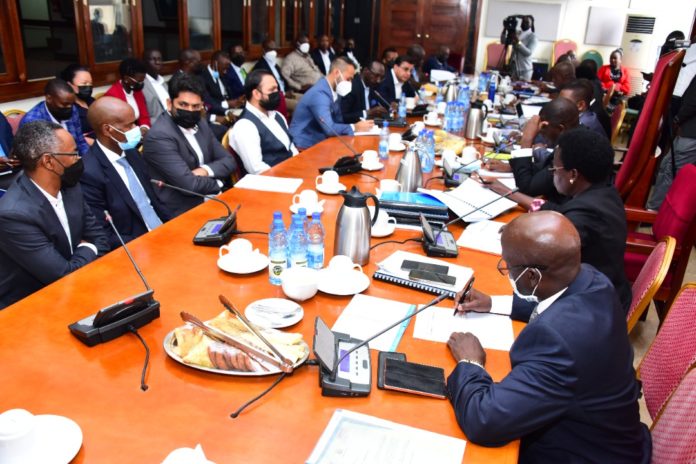
Parliament’s Adhoc committee investigating the Naguru-Nakawa land row is probing the manner in which some companies and individuals acquired land.

The committee interacted with some of the companies and individuals of interest, on Thursday, 21 April 2022, including Anil Damani, a private investor.

Damani told the committee chaired by Hon. Dan Atwijukiire that he acquired three acres of land in Naguru, an upscale Kampala city suburb to establish residential houses.

“The initial application was for five acres but we were informed that there were many other applicants and therefore, they reduced them to three acres – which is why our building plan was for three acres,” he said.

He said he came to know of the notice by the Uganda Land Commission (ULC) for sale of the land through his lawyers.

Damani said that in an interface with ULC, he submitted a concept plan, tax clearance certificate and proof of funds to show capability of purchasing the land and developing it.

“They told us that they did not want briefcase companies. I gave them a letter from Standard Chartered Bank showing the amount of funds I had already deposited to start the project,” said Damani.

He added that final set of costing for the project he applied for, was estimated at US$3.4 million (Shs10 billion).

“I had deposited Shs7 billion into a fixed deposit account at Standard Chartered Bank and furnished the Uganda Land Commission with certificates of deposit confirmation from the bank. This was to convince them that I was capable of taking on the project,” Damani said.

MPs, however, were unsatisfied with the explanation by Damani and his lawyers, noting that the only notice by ULC was to companies and individuals who had already expressed interest in buying the land, on which requirements to present.

Hon. Sarah Opendi (NRM, Tororo District) presented a letter to the committee which said was allegedly written and signed by Damani on 27 September 2019.

“It was addressed to the President through then State Minister for Lands, Hon. Persis Namuganza, requesting for five acres of land at Naguru,” said Opendi.

She presented another letter she said was written by Namuganza to the Chairperson of the Uganda Land Commission, directing that Damani be given five acres to construct affordable condominium units.

Damani, however, disowned the letter saying the signature thereon was not his and that he had not held any meeting with Namuganza.

The committee chairperson faulted Damani’s lawyers for giving information to the committee without documented proof, and tasked them to return with documented evidence of the process through which the land was acquired.

Asked about the amount of money he paid for the three acres of land, Damani told MPs that he paid about Shs1.001 billion and revealed that his title was processed within a week after the payment.

Stories Continues after ad
Former Kenyan President Mwai Kibaki is dead

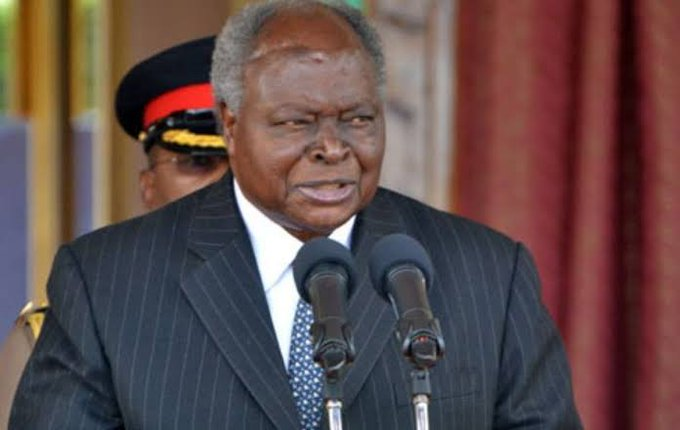
Kibaki

Former President of Kenya Mwai Kibaki has passed on aged 90. His death was confirmed by President Uhuru Kenyatta.

President Uhuru Kenyatta lauded his predecessor for his leadership. “Mwai Kibaki will forever be remembered as a gentleman in Kenyan politics, a brilliant debater.” Kenyatta said.

Kenyatta said Kibaki spearheaded transformation in major sectors in Kenya. In crucial sectors such as education through the globally loaded free primary education program, infrastructure programs, in transport, Energy and increasing the availability and access to health care for fellow Kenyans.

“In honor of this great states man, Kenya remains committed to maintaining policies that promote social and economic empowerment, democracy, Rule of law and respect for human rights,” he said.

“The late president Kibaki championed the realization of objectives of the East African community trade market of trade liberalization for the citizens of partner states, his inclusion spirit and conviction of economic empowerment, transited the territory of Kenya towards the board of Economic stability,” he said.

Kibaki served as the third President of Kenya from December 2002 until April 2013.

He had previously served as the fourth Vice-President of Kenya for ten years from 1978 to 1988 under President Daniel Arap Moi.

He also held cabinet ministerial positions in the Kenyatta and Moi governments, including time as minister for Finance (1969–1981) under Kenyatta, and Minister for Home Affairs (1982–1988) and Minister for Health (1988–1991) under Moi.

Kibaki served as an opposition Member of Parliament from 1992 to 2002. He unsuccessfully vied for the presidency in 1992 and 1997. He served as the Leader of the Official Opposition in Parliament from 1998 to 2002. In the 2002 presidential election, he was elected as President of Kenya.

Stories Continues after ad
Ugandan Lawyer named in 2022 Arch Desmond Tutu Leadership cohort

Lydia Winyi Kembabazi

A Ugandan lawyer Ms. Lydia Winyi Kembabazi, who is also an Advocacy Officer at the Institute for Human Rights and Development in Africa (IHRDA), has been named among the 22 young and promising leaders from the rest of Africa who have emerged winners following a rigorous vetting exercise that left out over 300 nominees for this year’s prestigious Archbishop Desmond Tutu Leadership Programme cohort.  

“The African Leadership Institute is pleased to announce the Associates who have been selected for the 2022 Class of the Tutu Fellowship programme. As has been the case with previous cohorts, the people selected are exceptional emerging African leaders,” announced Dr. Jackie Chimhanzi, the AFLI Executive Director.

She revealed that AFLI received more than 330 nominations of outstanding quality from across Africa, from which the cohort was selected. They are from the following countries: Cameroon, Congo, Ghana, Kenya, Malawi, Mauritania, Nigeria, South Africa, Uganda and Zimbabwe.

“A few candidates are included this year who were selected in 2020 but who could not attend that cohort due to COVID restrictions. The selected candidates demonstrate the incredible wealth and breadth of leadership talent that exists in Africa’s young people, which bodes well for Africa’s future,” she added.

The announcement comes barely a year after the death of the archbishop who was the programme’s patron.

“As you know, on 26 December 2021, we lost our founding patron, Archbishop Desmond Tutu. We remember a life of service well-lived and the values and ideals he espoused and bequeathed to us — Ubuntu, servant leadership, integrity, humility, compassion, and moral courage,” Dr Chmhanzi wrote on the institute’s website.

The African Leadership Institute and its flagship programme, the Archbishop Tutu Leadership Programme, granted legacy status by the Desmond and Leah Tutu Legacy Foundation remains resolute in its mission to nurture a new generation of African leaders who will uphold the legacy and values of Archbishop Tutu, as they lead in their various spheres. In some way, we have always been prepared for his passing because it was our very raison d’etre from inception—to shine a light on his example to always inspire the kind of leadership that is sorely lacking but much needed in Africa specifically, but the world, more broadly.

“With his passing, our work has a newfound importance and significance. We are grateful to the Skoll Foundation – a funder of our work – for their support and also for giving us the platform for Fellows to articulate what the Arch meant to them,” Dr. Chimuhanzi added.

Who is Lydia Winyi Kembabazi?

Ms Kembabazi is an Advocacy Officer at the Institute for Human Rights and Development in Africa (IHRDA). At IHRDA, she leads legal reform advocacy projects across Africa. Lydia engages government law reform commissions and think-tanks to leverage expertise to do legal audits of laws and compile research on discriminatory laws.

With the data and research she can then identify litigation opportunities to remedy abuses and effect systemic change. The African Protection Mechanisms in the African Charter provide grounds for these actions, but even with that in place, she organises information campaigns on why landmark cases must not slip through the cracks.

She joins a few other Ugandan Tutu Fellows who have made it to the institute before. They are: Rt Hon Dan Kidega, Andrew Mwenda, Vincent Bagiire, Arinaitwe Rugyendo, Carol Kembabazi, Nathan Nasolo, Victor Ochen and Alice Namuli Blazevic.

Stories Continues after ad

Absa Bank treats Muslims to a splendid Iftar dinner

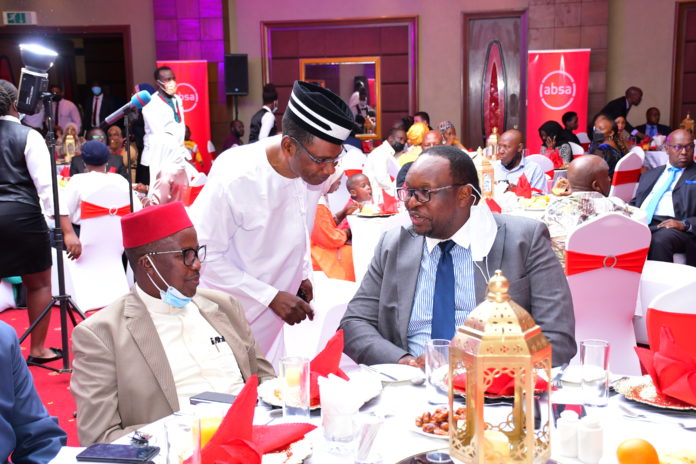
ABSA MD interacts with one of the bank clients as Dr Ssali Ebraheem looks on

Absa Bank Uganda has hosted Muslim customers and staff observing the holy month of Ramadan to a dinner at Sheraton Hotel in Kampala. The annual observance of Ramadan is one of the five pillars of Islam.

The Absa Bank Uganda Managing Director Mumba Kalifungwa said the iftar dinner is part of a long-time tradition that the bank organizes to honor and celebrate the holy month of Ramadan.

He also said that it’s a testament to building an African continent where sharing a meal is key in strengthening relationships.

“We organize this dinner on an annual basis as a sign of gratitude for your continued trust as the bank of your choice, not only today but throughout the years. We are here to retaliate our promise to you that we shall continue to present your best business and personal interests and bring your possibilities to life,” said Kalifungwa.

He added: “This will be done through providing not only tailored products, digital innovations but also by offering world class customer services to help meet your needs whether at personal or business level.”

Kalifungwa said that it is critical to foster the culture of collaboration to achieve a shared dream of growth between Absa Bank and customers.

“It is through an engagement such as this one that we should achieve our shared dream. As part of the spirit of charity in the holy month of Ramadan, we shall be donating the Quran and prayer mats to Muslims,” he stated.  

Dr. Ebraheem Ssali, a lecturer at Makerere University and the event’s keynote speaker said the holy month of Ramadan is in its final days, which compels Muslims to double their efforts in doing good deeds.

He applauded Absa Bank Uganda for the dinner, saying that the Muslim community feels appreciated, recognized, and respected.

“Such gestures bring us closer; I believe that for the few minutes I have been with the Absa Managing Director, he has learnt a few things in Islam,” said Ssali.  

Stories Continues after ad

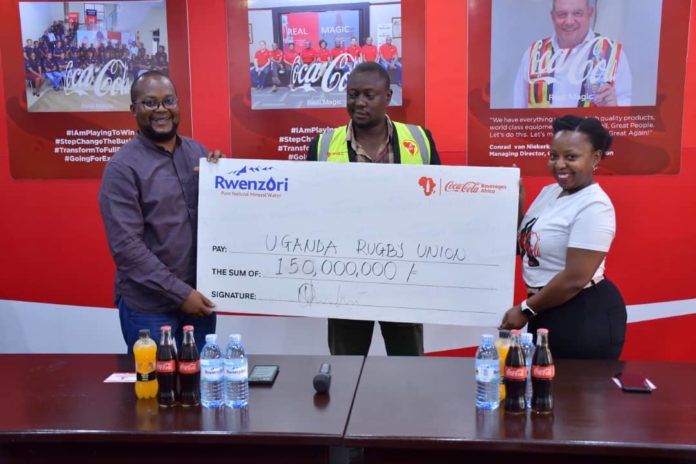
Rwenzori Water named Uganda Rugby Union hydration partner

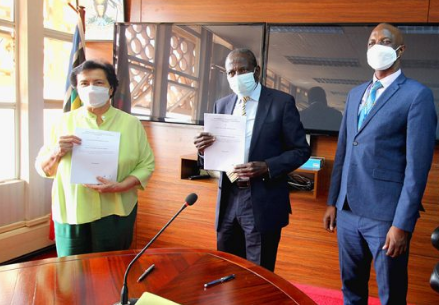
Partnership signing

Coca-Cola Beverages through Rwenzori Bottling Company has sealed a new partnership agreement with the Uganda Rugby Union to become their official hydration partner for the next two years, from April 2022 to April 2024.

The agreement, signed at the Coca-Cola Beverages Africa plant in Namanve, will see the Union receive a cash plus hydration support to the sum of 75 million shillings for each of the two years, amongst other benefits such as refreshment support for all Rugby Union.

Speaking at the agreement-signing ceremony today, Godwin Kayangwe, the Uganda Rugby Union President, applauded Coca-Cola Beverages Africa for the ability to recognize and sponsor entities that unite Ugandans from different walks of life through fun, sportsmanship, and talent development.

“I am for this partnership and to be part of the Coca-Cola system. We have worked with Coca-Cola for a long time, and we appreciate the fact that they come to our rescue even at short notice when we have such events. The nature of our sport is full contact and thus requires a lot of hydration, the support we have received is key in safeguarding the welfare and safety of our athletes. It goes a long way in helping our players and ensuring that we meet the international requirements as guided by the world body,” he said.

“We also appreciate the support we received during the lockdown. Rugby was the only sport able to host an international tournament within the lockdown. Coca-Cola was onboard and supported us fully providing water for the tournament including the visiting countries. Today’s engagement is to cement our long-term relationship and to push forward our vision and targets of where we want to be as a country. On behalf of Rugby Union and the National Council of Sports, we do appreciate you taking on this component of the game which is very important,” he reiterated.

Lee Newton Ogong, the Trade Marketing Manager, of Coca-Cola Beverages Africa in Uganda expressed excitement at the opportunity to bring sports and refreshments together in this new partnership agreement.

“Rwenzori water is the perfect hydration partner for the Rugby union because of its very refreshing qualities and ability to transcend cultural, religious or social beliefs to unite Ugandans,” he said.

“Our heritage in Uganda is not just pegged to being a symbol of hydration and refreshment; we have shown continued commitment to the development of sports talent across different sports and age groups through similar partnerships across the country,” he added.

Lee also noted that used Rwenzori bottles collected at the games and training sessions will be recycled at the Plastic Recycling Industries, the recycling arm of Coca Cola Beverages Africa in Uganda.

Stories Continues after ad

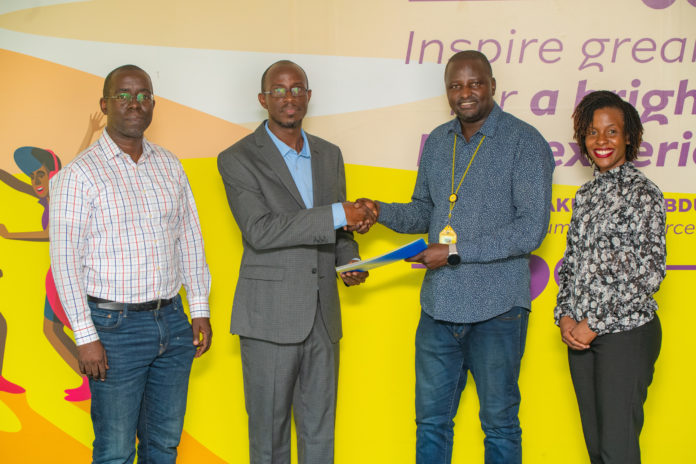
MTN Mobile Money, JUMO partner to grow mobile lending in Uganda

JUMO's Country Manager, Wilfred Wabwire (2L) shakes hands with MTN MoMo Uganda's Managing Director, Richard Yego (3L) upon launching MoSente at the MTN MoMo Uganda Offices in Kololo

JUMO, a technology company building next-generation financial services for emerging markets, has partnered with MTN Mobile Money Uganda Limited to launch MoSente, a new credit service that will afford the people of Uganda more choice when it comes to mobile lending services.

MoSente is a convenient way for MTN customers to access credit facilities. Customers can borrow from UGX 10 000 at a variable term that fits their personal circumstances or earning cycles. MoSente is easily accessible, in real-time, and available to registered MTN subscribers and mobile money users when they dial *165*5*5# and follow the prompts.

MTN currently represents more than half (53%) of all mobile subscribers in the country, which means 15 million people, roughly a third of Uganda’s population, will have the opportunity to access tailored lending products to suit their business and living requirements. According to Financial Sector Deepening Uganda (FSDU), 22% of Ugandans are financially excluded and 56% use informal financial services. Financial inclusion is significantly skewed towards adults in urban areas (86%), making access to mobile banking anywhere, anytime a significant milestone.

“In a market where large segments of the population are still unbanked, in large part due to lack of access to easy and convenient credit, our partnership with JUMO is an important milestone for advancing financial inclusion for the people of Uganda,”says Richard Yego, Managing Director, MTN Mobile Money Uganda.

JUMO’s Africa CEO, Buhle Goslar, said: “Our work with MTN is focused on supporting entrepreneurs who need simple, quick access to working capital to grow their businesses. We offer them the opportunity to increase their access to credit in the long-term, through ongoing responsible loan management.”

Both MTN Mobile Money Uganda and JUMO are familiar with the financial needs of the Ugandan market. MTN has operated a similar credit service called MoKash on their Mobile Financial Services Platform since 2017.  JUMO has operated a similar mobile lending product delivered in partnership with other mobile network providers for the last five years.

JUMO is currently the underwriter and capital provider for both MoSente and WeWole. The company has developed a large pool of capital to reach new customers and serve digital financial products to the financially excluded market segments.

“Partnerships between financial technology companies like JUMO and mobile money providers are essential to creating more opportunities for the people of Uganda to borrow and save conveniently using their mobile phones,”says Wilfred Wabwire, Country Manager for JUMO Uganda.

JUMO’s intelligent banking technology reduces the unit economics on the delivery and administration of financial products so that customers can access high-value products at low prices and partners such as telcos, impact investors and banks can reach new markets. The launch of MoSente in Uganda forms part of JUMO’s long-term growth plan for Africa. The company is launching new products and expanding into new markets, such as Nigeria and Cameroon, post their fundraise of $120 million in 2021.

Stories Continues after ad