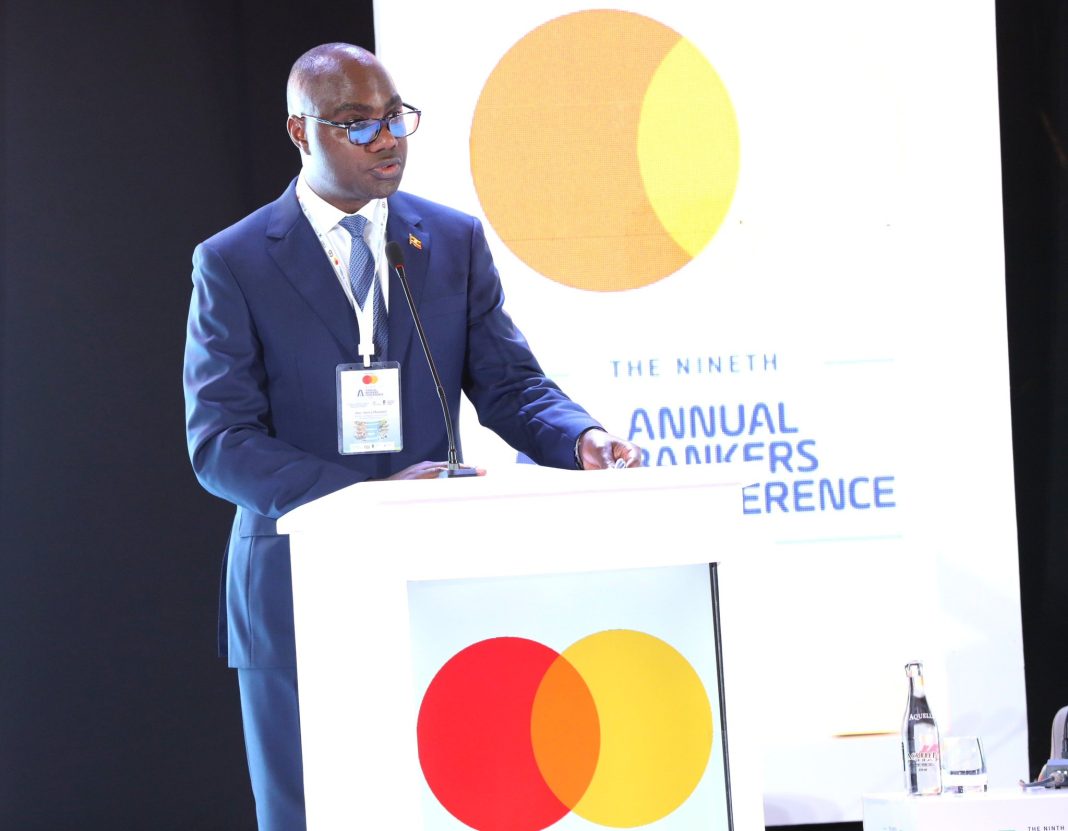
Finance Minister Henry Musasizi has called on commercial banks to lower lending rates and channel more financing into productive sectors, saying affordable credit will be critical if Uganda is to achieve its ambitious target of growing the economy from about $50 billion to $500 billion by 2040.
Speaking at the 9th Annual Bankers Conference at the Marriott Hotel in Nsambya, Kampala, Musasizi said government alone cannot deliver the country’s Tenfold Growth Strategy and challenged the banking sector to play a more active role in financing investment and job creation.

“Government cannot deliver Uganda’s transformation alone. We need you and indeed, the banking and financial sector is central to the tenfold growth strategy,” Musasizi said.
The conference brought together senior government officials, Bank of Uganda executives, commercial bank leaders and financial sector stakeholders to discuss how the financial industry can mobilise capital to support Uganda’s long term development agenda.
Musasizi said one of the biggest barriers to investment remains the high cost of borrowing, noting that commercial lending rates averaging between 18 and 20 percent make it difficult for businesses to expand.

“We need affordable and long term financing if we are to unlock investment across the economy,” he said.
He urged banks to improve credit assessment systems, make better use of available data within the legal framework and expand risk sharing and credit guarantee mechanisms to reduce the risk premium that pushes up borrowing costs.
The minister also challenged banks to direct more financing towards the ATMS priority sectors of Agro industrialisation, Tourism, Minerals including Oil and Gas, and Science, Technology and Innovation, saying these sectors have been identified as the main drivers of Uganda’s economic transformation.
Rather than concentrating lending mainly in trade and consumption, he said financial institutions should back enterprises capable of creating value, exports and employment.
Musasizi further called for stronger collaboration between banks and the Capital Markets Authority to deepen long term financing through infrastructure bonds, project bonds, green bonds and equity financing.
He said Uganda’s financial system must evolve to provide patient capital for major investments that cannot be financed through short term commercial lending alone.
The minister also placed renewed emphasis on financial inclusion, particularly for the eight million farmers expected to transition into commercial production under the Parish Development Model.
He said these farmers should be able to save, borrow, insure, receive digital payments and invest through accessible financial services.
According to Musasizi, private sector credit will need to increase from about Shs28 trillion today to approximately Shs490 trillion by 2040 if Uganda is to reach its growth ambitions.
He added that capital markets mobilisation must expand from around Shs1.5 trillion to Shs440 trillion over the same period.
Government, he said, will continue maintaining macroeconomic stability, implementing financial sector reforms and strengthening institutions such as the Uganda Development Bank through increased capitalisation.
Bank of Uganda Governor Michael Atingi Ego said economic stability remains the foundation upon which Uganda’s transformation must be built.
He said the country’s economy has continued to show resilience, with real GDP growth of 6.4 percent, inflation averaging 3.3 percent over the 12 months to July and non performing loans declining to 2.67 percent.
“Stability is the foundation for transformation,” Atingi Ego said.
He urged banks to ensure that credit expansion is matched by adequate deposits, long term funding and stronger capital buffers.
He also called for pension funds, insurance companies, development finance institutions and capital markets to complement commercial banks in financing large scale investments.
Atingi Ego challenged financial institutions to develop measurable financing strategies aligned with the ATMS agenda.
“What matters now is turning commitments into funded and executable plans,” he said.
Uganda Bankers’ Association Chairperson and Housing Finance Bank Managing Director Michael Mugabi said achieving a $500 billion economy would require far more than traditional bank lending.
“Bank credit alone cannot deliver the scale of financing required,” Mugabi said.
He called for greater use of equity financing, diaspora investment, blended finance, impact funds, sustainability finance and risk mitigation instruments to unlock larger pools of capital.
“Our mission without execution is merely an aspiration,” he said.
The conference comes as Uganda pursues its Tenfold Growth Strategy, which seeks to expand the economy to approximately Shs1.8 quadrillion by 2040 through increased productivity, industrialisation, exports and private sector led investment.
The banking sector has increasingly been identified as a key partner in mobilising domestic savings, expanding access to finance and supporting businesses that can drive the country’s long term economic transformation.