
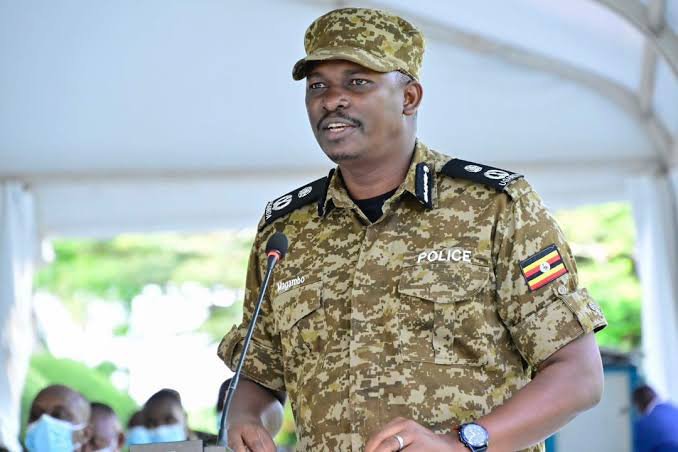
Chief of Defence Forces (CDF) Gen Muhoozi Kainerugaba has promoted Uganda Police Criminal Investigations Directorate (CID) Director Tom Rwabudongo Magambo to the rank of Acting Lieutenant Colonel, recognising his service in the security sector and leadership of the country’s principal criminal investigations department.
The promotion was announced on Thursday, November 12, 2026, in a statement issued by Col Chris Magezi, the Acting Director of Defence Public Information at the Ministry of Defence and Veteran Affairs.

Magezi said the UPDF fraternity had congratulated Magambo on his elevation and wished him continued success in his duties.
“The Chief of Defence Forces (CDF) and Senior Presidential Advisor for Special Operations, General Muhoozi Kainerugaba, has promoted the Director of the Police Criminal Investigations Directorate (CID), AIGP Maj Tom Rwabudongo Magambo, to the rank of Acting Lieutenant Colonel,” Magezi said.
“The UPDF fraternity congratulates Lieutenant Colonel Magambo for his well-deserved promotion and wishes him continued success in his duties,” he added.

Magambo has headed CID since January 25, 2022, when President Yoweri Museveni appointed him to replace Grace Akullo, making him the first person from outside the traditional police career structure to head the directorate.
His appointment initially attracted questions within the Police Force because he came from the Internal Security Organisation (ISO) rather than rising through the police ranks. However, he brought nearly two decades of intelligence experience, having joined ISO after completing his studies at Makerere University, where he obtained a degree in Development Studies.
During his intelligence career, Magambo rose to become a Chief Intelligence Officer and served as Director of Analysis, Head of Regional Affairs and Head of Counterintelligence and Policy Analysis.
He also coordinated the Eastern Africa Fusion and Liaison Unit (EA-FLU), established in Entebbe in 2018 as a regional intelligence-sharing centre involving Uganda, Burundi, Djibouti, Ethiopia, Kenya, Rwanda, Somalia, South Sudan, Sudan and Tanzania.
The centre worked with regional security agencies to gather and share intelligence on terrorism, organised crime and other cross-border security threats.
Magambo’s work at the centre involved intelligence gathering on the Allied Democratic Forces (ADF), al-Shabaab and other armed groups operating in the region.
In October 2021, then ISO Director General Charles Oluka credited Magambo and his team with helping security agencies prevent 47 planned bomb attacks, although the public only became aware of attacks that had actually taken place.
Oluka said the intelligence gathered from the Democratic Republic of Congo and other sources had helped security agencies understand the operations of terrorist groups and prevent attacks.
Magambo also undertook security and intelligence training in Israel, the United States, the United Kingdom and Canada. His academic qualifications include a Master’s degree in Business Administration from the Eastern and Southern African Management Institute, a Master’s degree in Peace and Conflict Studies from Makerere University and a postgraduate diploma in Peace and Security Studies from Uppsala University in Sweden. He has also been pursuing a PhD in Mediation and Conflict Resolution.
When Magambo took over CID, he found a directorate facing complaints over corruption, delayed investigations, poor working conditions and detectives who had spent many years at the same police stations.
He introduced major changes in personnel management, training, investigations and the administration of CID headquarters in Kibuli.
One of his first major interventions was the transfer of detectives who had overstayed in particular stations, especially in Kampala, Wakiso and Mukono.
In October 2022, he transferred 402 detectives from the Kampala Metropolitan Police area, including 47 officers at inspectorate level and 355 other detectives. Officers from upcountry stations were brought to replace them.
The transfers were intended to address corruption, improve professionalism and break relationships between investigators and people they were supposed to investigate.
By early 2024, more than 4,000 of approximately 5,600 detectives countrywide had been transferred or rotated as part of the wider restructuring exercise.
Magambo also introduced refresher training for CID officers, including deputy directors, heads of departments, regional CID commanders and other investigators.
More than 450 officers had undergone refresher training by September 2024. The programme focused on improving investigative skills, professional conduct, evidence gathering and the handling of modern criminal cases.
He also pushed for prosecution-led investigations, bringing detectives and prosecutors closer together from the early stages of criminal investigations to ensure that evidence collected could withstand scrutiny in court.
Director of Public Prosecutions Jane Frances Abodo publicly acknowledged improvements in the way detectives were conducting investigations, citing the Karamoja iron sheets scandal as an example of better coordination between investigators and prosecutors.
Magambo also addressed the welfare of detectives by restoring plain-clothes allowances to facilitate field investigations and improving staff welfare at CID headquarters.
At Kibuli, he introduced changes in the command structure, including separate complaints, legal and inspection desks, whose responsibilities had previously been concentrated under fewer officers.
He also improved the physical environment at the headquarters through fencing, upgrading the entrance, constructing a cafeteria for staff and clearing impounded vehicles and motorcycles that had occupied the premises.
One of the biggest investigations under Magambo’s leadership was the diversion of iron sheets meant for vulnerable communities in the Karamoja sub-region.
The iron sheets had been procured under the Karamoja Community Empowerment Programme but were allegedly diverted to ministers, government officials and other individuals instead of reaching the intended beneficiaries.
The investigation implicated several senior government officials, including former Minister for Karamoja Affairs Mary Goretti Kitutu, her deputy Agnes Nandutu and State Minister for Finance Amos Lugoloobi.
CID detectives collected evidence, recorded statements, traced the distribution of the iron sheets and visited locations where the materials had allegedly been diverted.
Several suspects were subsequently charged, with Kitutu and Nandutu among those who faced prosecution.
Abodo praised the investigation, explaining that prosecutors had been able to move quickly because detectives had collected sufficient evidence and prepared witnesses.
Magambo later described the investigation as one of his first major tests after taking over CID.
“That iron sheets case was my first challenging case as CID director, but I thank God and the President that we stood our ground. All those big people came here and visited us. We would write their statements here. You can imagine the pressure that came with that case,” Magambo said.
Magambo has also overseen efforts to establish the people behind the murder of senior state prosecutor Joan Kagezi, who was shot dead on March 30, 2015, in Kampala while prosecuting terrorism-related cases.
The murder attracted national attention because Kagezi was handling sensitive terrorism prosecutions at the time of her death.
In April 2024, Magambo told President Museveni that investigators had obtained leads pointing to people suspected of financing and organising the killing.
Speaking at the seventh Joan Kagezi Memorial Lecture at Kololo, he said investigators were pursuing not only those who carried out the shooting but also the people who allegedly financed and directed the operation.
“Your Excellency, since you were the chief investigator in the Kagezi case, I was the ground operator. I want to assure you that we have very good leads on the people who paid these people and sent them,” Magambo said.
The remarks showed that investigators were pursuing the financial and organisational networks behind the murder.
Before joining CID, Magambo had built his reputation through intelligence operations targeting terrorism and organised criminal networks.
His work at the Eastern Africa Fusion and Liaison Unit involved intelligence sharing among regional security agencies on threats linked to ADF and al-Shabaab activities.
The intelligence centre also supported investigations into cross-border security threats and helped regional countries exchange information on suspected terrorist networks.
His experience in intelligence gathering and analysis became important when he took over CID, particularly as investigators increasingly dealt with organised crime, terrorism-related cases, financial crimes and offences involving networks operating across national borders.
His previous involvement in security operations also included intelligence work around the 2021 general elections and investigations into violent criminal groups.
Magambo has also cited the number of convictions secured during his tenure as an indication of progress in investigations and prosecution.
In April 2026, he revealed that approximately 89,000 convictions had been secured during his four years as CID director.
“In the last four years I have been Director CID, we have achieved about 89,000 convictions,” Magambo said.
He attributed the results to improved investigations, cooperation between detectives and prosecutors, and better preparation of criminal files before cases are taken to court.
Uganda’s annual crime report for 2025 showed that reported crimes had fallen by 10.2 per cent, from 218,715 cases in 2024 to 196,405 in 2025.
Magambo attributed the reduction to the combined efforts of police officers, investigators, forensic experts, intelligence personnel and community policing structures.
However, he has said the directorate still needs more investigators and better equipment to deal with the growing number and complexity of criminal cases.
He previously disclosed that some detectives were handling an average of 54 cases each, compared with an international benchmark of 12 cases per investigator.
Another major project pursued under Magambo is the establishment of a Crime Data Analysis Centre at CID headquarters in Kibuli.
The facility is intended to improve the collection, processing and analysis of crime information to help detectives identify crime patterns, connect related cases and make decisions based on reliable information.
Magambo asked President Museveni to support the project during a September 2024 meeting between CID and the Office of the Director of Public Prosecutions.
Museveni pledged support for the centre and a forensic facility to strengthen the technical capacity of investigators.
Construction of the Crime Data Analysis Centre was launched in April 2025, and Magambo later reported that its building had been completed, although additional work was required before it could become fully operational.
He has also called for better integration of government databases to help detectives access information needed to trace suspects, investigate financial transactions and gather digital evidence.
In August 2026, he told Parliament’s Committee on Defence and Internal Affairs that criminals were increasingly exploiting artificial intelligence and online platforms, requiring Police to strengthen its digital investigation capacity and recruit more specialised personnel.
He has also identified land-related crimes, financial fraud, corruption and cybercrime among the offences requiring stronger investigative systems.
In April 2026, he called for institutional reforms and a stronger value system, arguing that preventing crime also required addressing the attitudes and behaviour that encourage criminal activity.