
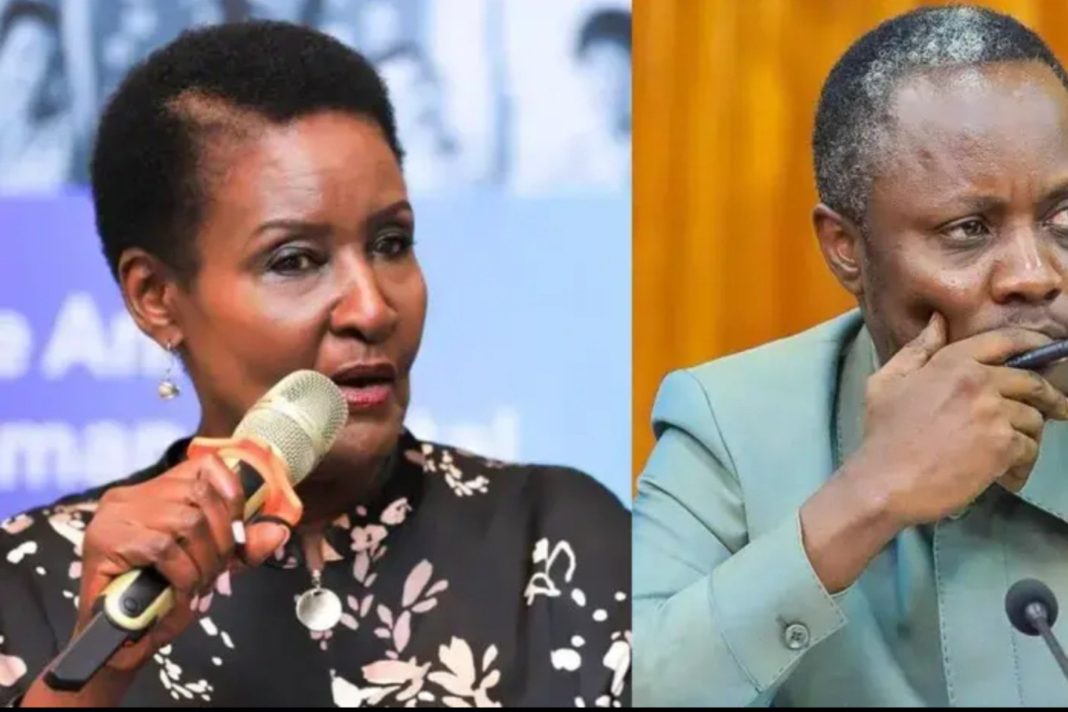
The High Court in Mpigi has upheld Amelia Anne Kyambadde’s election as Mawokota North Member of Parliament, dismissing a petition by her challenger, Hillary Innocent Kiyaga, popularly known as Hilderman, who accused election officials of altering declaration of results forms to manipulate the January 2026 parliamentary election outcome.
In a judgment delivered on Friday, November 13, 2026, Justice Jamson Karemani ruled that discrepancies and alterations on Declaration of Results (DR) forms cannot, on their own, establish electoral fraud, unless a petitioner demonstrates that the changes were deliberately made to manipulate the results.

The judge held that identifying differences in figures appearing on election documents was not enough to invalidate an election, stressing the need for evidence establishing that the alterations were intentional and affected the integrity of the declared results.
The decision followed a contested election petition in which Kiyaga challenged the results announced by the Electoral Commission, arguing that forms used by the returning officer to declare Kyambadde the winner differed from copies issued to candidates’ polling agents at the respective polling stations.
Kyambadde was declared winner with 27,075 votes against Kiyaga’s 24,801, giving her a majority of 2,274 votes.

Kiyaga alleged that election officials had manipulated results at more than 25 polling stations, claiming that the disputed alterations reduced his votes by 923 while increasing Kyambadde’s tally by 9,133 votes.
His legal team also questioned discrepancies in figures written in words and numerals, signatures, barcodes and other details appearing on different copies of the DR forms.
The petitioner argued that the documents presented by the Electoral Commission were not identical to those retained by his polling agents, raising questions about the manner in which results were recorded, corrected and transmitted to the district tally centre.
A central part of the proceedings involved former Mpigi District returning officer Evarist Twinomujuni, who was questioned by Kiyaga’s lawyers over alleged changes to results forms from about 40 polling stations.
Twinomujuni acknowledged that some forms contained alterations but maintained that the corrections were made by presiding officers to rectify mistakes committed while completing the documents.
He rejected allegations that he had colluded with other election officials to change the results in favour of Kyambadde.
During the proceedings, he also presented forms from different polling stations, including one associated with Kiyaga, arguing that the corrections were not exclusively beneficial to the incumbent MP.
He further defended the Electoral Commission’s certified copies, saying that he was responsible for the official documents held by the Commission and could not account for the origin of the other copies presented by the petitioner.
Twinomujuni also disputed the argument that polling agents’ failure to sign some of the certified forms automatically invalidated the results, maintaining that their signatures were not a mandatory condition for the validity of the declarations.
Kyambadde, who testified during the hearing, acknowledged that some of the DR forms before court contained alterations but said she had been informed that the changes were corrections of errors made by election officials at polling stations.
She rejected suggestions that the corrections were intended to increase her votes or influence her victory, arguing that she was not the official responsible for conducting the election or completing the declaration forms.
Her lawyers, led by Anthony Bazira, challenged Kiyaga to demonstrate how the alleged alterations were connected to Kyambadde and how they translated into an unlawful advantage during the election.
The defence also questioned the petitioner’s evidence concerning the alleged involvement of the district returning officer, arguing that the changes appearing on the documents had been made by individual presiding officers rather than by Twinomujuni.
Apart from the disputed election forms, Kiyaga also challenged Kyambadde’s eligibility to contest for the parliamentary seat, arguing that she had not properly resigned from her position as Senior Presidential Advisor on Trade and Industry before seeking nomination.
During cross-examination, his lawyers questioned whether she had formally submitted a resignation letter and whether the Office of the President had accepted it.
They also questioned why she continued to have security personnel attached to her, arguing that this raised questions about whether she had completely left the public office before contesting.
Kyambadde maintained that she had resigned from the advisory position and that the Permanent Secretary in the Office of the President had written to her accepting her resignation.
She also told court that the security personnel had been attached to her for approximately 35 years and were not assigned to her because of her appointment as a presidential advisor.
Another witness, Sam Akol, an NRM member who contested as an independent candidate after losing the party primaries to Kyambadde, was questioned about allegations contained in his affidavit.
During cross-examination by Kyambadde’s lawyer, Akol acknowledged that he had not personally seen all the disputed forms and had learnt about the alleged alterations through social media.
“My Lord, I only learnt about the altered DR forms on social media but personally, I have not seen them all given any altered declaration of result forms by the Electoral Commission,” Akol told court.
His testimony became part of the wider contest over the authenticity and evidential value of the documents relied upon by the petitioner.
The main petition was also preceded by unsuccessful applications by Kiyaga seeking access to additional election materials.
On September 16, 2026, Justice Karemani dismissed an application seeking to compel the Electoral Commission to release election materials, including ballot boxes and other documents that Kiyaga wanted examined in support of his allegations.
On September 30, the court dismissed another application seeking to compel Kyambadde to produce copies of DR forms allegedly issued to her polling agents at 37 polling stations.
In the latter ruling, the judge found that Kiyaga had failed to establish that the particular documents were in Kyambadde’s possession and faulted the delay in seeking their production.
The court also observed that election petitions require urgency and that parties should pursue the necessary evidence without unnecessary delay.
The main petition subsequently proceeded to the hearing of witnesses, including Kiyaga, Kyambadde, Akol and Twinomujuni, before the parties were directed to file their final written submissions.