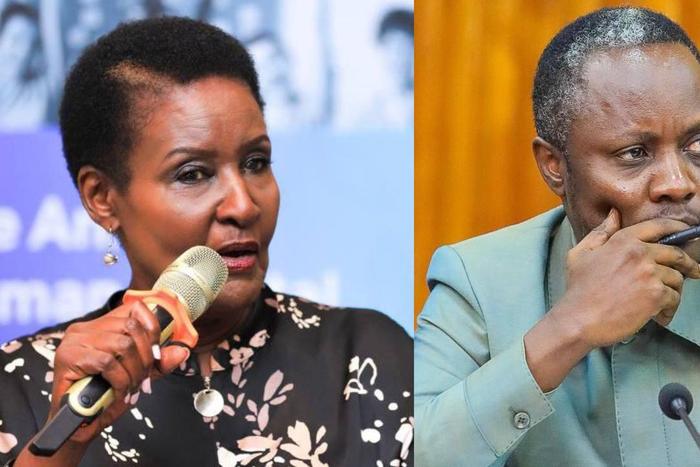
The High Court in Mpigi has dismissed an application by National Unity Platform (NUP) politician Hillary Innocent Kiyaga alias Hilderman seeking to compel his election rival, Amelia Anne Kyambadde, to produce uncertified Declaration of Results (DR) forms allegedly issued to polling agents at several polling stations during the January 15, 2026 parliamentary elections.
Justice Jamson Karemani dismissed the application in a ruling delivered on Wednesday, September 30, 2026, holding that although the documents sought were relevant to the election dispute, Kiyaga had failed to establish that the particular DR forms were in Kyambadde’s possession.

The application, registered as Election Petition Application No. 3 of 2026, arose from Kiyaga’s petition challenging Kyambadde’s election as Mawokota County Member of Parliament.
Kyambadde, who previously served as Minister of Trade, Industry and Cooperatives, contested the election on the National Resistance Movement (NRM) ticket, while Kiyaga, popularly known as Dr Hilderman, stood on the NUP ticket.
Official results showed Kyambadde won the election with 27,075 votes against Kiyaga’s 24,801 votes. Kiyaga subsequently went to court seeking to overturn the result, alleging irregularities in the conduct of the election and the handling and alteration of Declaration of Results forms.

The latest application was specifically aimed at obtaining uncertified DR forms which Kiyaga said had been given to polling agents at specified polling stations.
He asked court to order Kyambadde to produce the documents and allow their inspection, relying on Order 10 Rules 14, 15 and 18 of the Civil Procedure Rules and Section 69(1)(d) of the Parliamentary Elections Act.
Kiyaga’s position was that the documents were relevant and material to the matters raised in his election petition and could assist court in determining the dispute over the results.
Kyambadde opposed the application, describing the request as a fishing expedition. Her lawyers argued that the documents had not been specifically referred to in the pleadings and that Kiyaga already had certified copies of the relevant election forms obtained from the Electoral Commission.
The court considered the different provisions governing discovery, production and inspection of documents and drew a distinction between Order 10 Rule 14 and Rule 15 of the Civil Procedure Rules.
Under Rule 14, the court has discretion to order production of documents relating to matters in issue even where those documents have not specifically been referred to in the pleadings.
Rule 15, on the other hand, deals with inspection of documents that have been expressly referred to in pleadings or affidavits.
The judge found that the DR forms sought by Kiyaga were relevant and material to the issues in the election petition.
The court also found that the documents were not privileged and that there was, in principle, a proper basis for considering their production.
However, the judge said relevance alone was not enough to compel a party to produce documents where possession of the documents had not been established.
A major issue before court was whether the uncertified DR forms allegedly given to polling agents were actually in Kyambadde’s possession.
Section 69(1)(d) of the Parliamentary Elections Act requires presiding officers to deliver copies of the Declaration of Results forms to polling agents at polling stations.
The court, however, held that the fact that polling agents may have received copies of the forms did not automatically establish that the documents were subsequently in the possession of the candidate.
The judge therefore found that Kiyaga had not provided sufficient evidence to show that Kyambadde possessed the specific uncertified forms he wanted court to order her to produce.
The court also considered the timing of the application.
The application was filed about five months after the election petition had been lodged, a delay the judge considered particularly important because election petitions are required to be dealt with expeditiously.
The court observed that the special nature of election petitions requires parties to raise and pursue their evidentiary needs within the timelines provided by the law rather than wait until proceedings have substantially progressed before seeking additional documents.
In this case, the judge found that the delay weakened Kiyaga’s request for the exercise of the court’s discretion in his favour.
The court further considered the fact that Kiyaga already had certified DR forms obtained from the Electoral Commission.
The applicant had not sufficiently demonstrated that the uncertified forms allegedly held by polling agents were different from the certified copies already available to him, or that Kyambadde was in possession of alternative forms containing different results.
The judge consequently found that the application risked turning into a search for evidence rather than a targeted request for specific documents known to be in the possession of the respondent.
The court’s concern was particularly important because discovery and production of documents in election litigation cannot be used simply to allow a party to search through another party’s documents in the hope of finding evidence that may support the petition.
Although the court accepted that the requested DR forms were relevant to the dispute in principle, it held that Kiyaga had failed to satisfy the requirements necessary for an order compelling their production.
The court therefore exercised its discretion against the applicant and dismissed the application.
“All in all, this application lacks merit and it is hereby dismissed. Each party shall bear its costs of this application,” the court ruled.
The dismissal does not, however, determine the main election petition in which Kiyaga is challenging Kyambadde’s victory. The substantive petition remains before the High Court in Mpigi.
The latest ruling follows an earlier application in which Kiyaga sought to compel the Electoral Commission to provide a wider range of election materials, including official report books, lists of presiding officers, ballot paper accountability forms and original Declaration of Results forms.
That application was dismissed by Justice Karemani on September 16 after the court found the request insufficiently specific and held that the discovery sought risked becoming a fishing expedition.
In that earlier ruling, the court stressed the importance of specificity when a party asks for discovery of electoral materials and also considered whether reasonable attempts had first been made to obtain the documents voluntarily.
The latest application against Kyambadde was therefore considered against the background of an election petition in which the court had already dealt with an application for access to electoral materials.
The court has since directed the parties to prepare the necessary documents ahead of the substantive hearing of Kiyaga’s petition.
Justice Karemani also recently directed journalists covering the case to report accurately and avoid publishing information that could mislead the public as the parties prepare for the hearing. The judge asked the media to report exactly what happens in court and directed the parties to submit the relevant documents, including Declaration of Results forms.
The substantive hearing of the election petition has been scheduled for October 6 and 7, 2026.
Kiyaga’s petition remains the substantive case in which the court will consider his allegations concerning the conduct of the Mawokota County parliamentary election and determine whether the evidence presented is sufficient to affect the declared result.
The September 30 ruling therefore deals only with the application for production and inspection of the particular uncertified DR forms and does not amount to a final determination of the allegations contained in the main election petition.