President Yoweri Museveni has backed the construction of the US$16 billion Dangote East Africa Petroleum Refinery in Kenya and revealed that East Africa needs several refineries as countries seek to add value to their natural resources and reduce dependence on imported petroleum products.
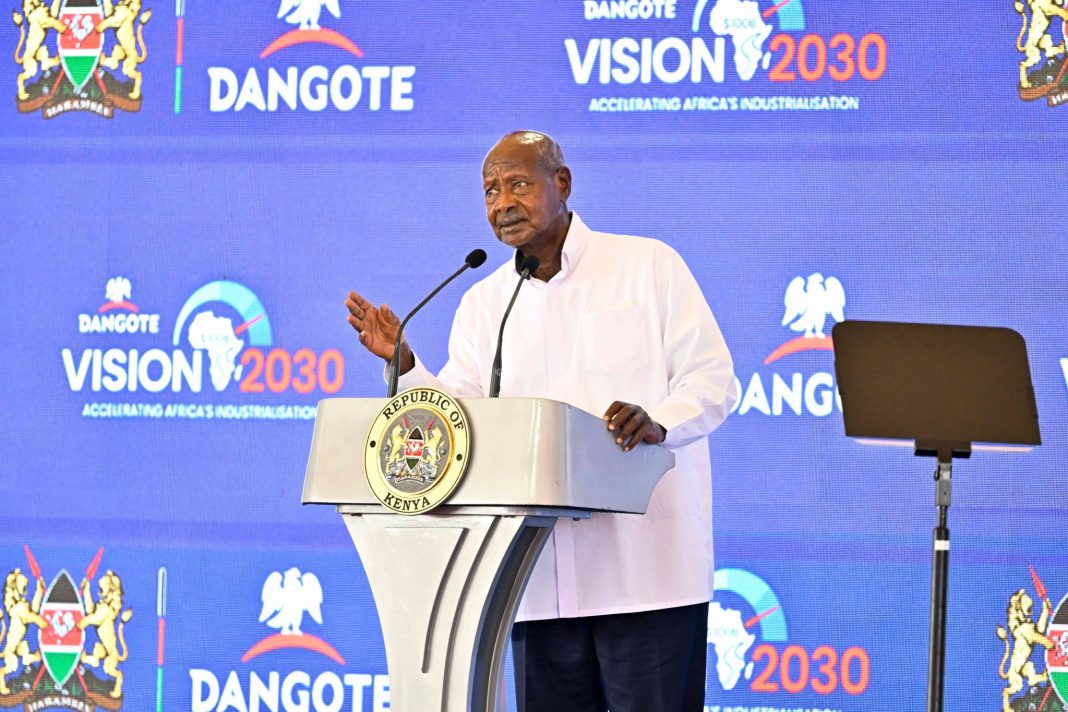
Museveni made the remarks on Wednesday, September 30, 2026, in Mokowe, Lamu County, where he joined Kenyan President William Ruto, Nigerian industrialist Aliko Dangote and other African leaders for the groundbreaking ceremony of the 700,000 barrels per day refinery.

The project is expected to cost about KSh2.2 trillion, equivalent to roughly Shs62 trillion, and is planned as a major regional refinery and petrochemicals complex serving Kenya and other East African markets. Dangote has set a 40-month construction timeline, meaning the facility is expected to be ready for commissioning around 2030.
Museveni thanked Ruto for inviting him to the ceremony and said the development demonstrated the need for African countries to stop relying on the export of raw materials while importing finished products.
“I am happy to see Africa waking up and moving away from the 70-year betrayal of exporting raw materials. Mr Dangote, who started as an importer and has become a national and continental asset, is a good example of the transformation we need,” Museveni said.

He said Uganda would continue with plans to establish its own refinery despite the much larger regional project being developed by Dangote in Kenya.
“Uganda’s refinery will be built, and our cooperation with Tanzania on Tanga stands. There is no harm in having more refineries in the region. What Africa needs is value addition, industrialisation and bigger integrated markets,” he said.
Museveni also linked the development of refineries to the wider push for economic integration in East Africa, arguing that countries in the region should treat political and economic integration as a strategic priority.
“East African political integration must ultimately be treated as a matter of strategic survival,” he said.
The Lamu refinery was initially discussed for Tanzania’s Tanga before Dangote settled on Kenya. The project is expected to benefit from Lamu Port and the wider LAPSSET corridor, giving the refinery access to maritime trade routes and potential markets across East and Central Africa.
Ruto said the Lamu project would strengthen Kenya’s energy security while creating opportunities for industrialisation and regional trade. He also pressed Dangote to keep his 40-month completion pledge.
“We have heard you, Aliko Dangote, that you have said we will be back here in 40 months to come and open this refinery,” Ruto said during the ceremony.
Dangote said the project would help Africa process more of its own resources instead of exporting crude and importing refined petroleum products. He said the refinery would be commissioned within 40 months of the groundbreaking.
The facility is designed to process up to 700,000 barrels of crude oil a day and is expected to produce petroleum and petrochemical products, including jet fuel and polypropylene. The project also includes plans for up to 1,000 megawatts of power generation.
Uganda’s refinery plans
Museveni’s statement does not mean Uganda is planning a Dangote-owned refinery in Hoima. Uganda’s separate refinery project is the 60,000 barrels per day Kabaale refinery in Hoima District, for which the government signed implementation agreements with UAE-based Alpha MBM Investments.
Under the agreement announced in 2025, Alpha MBM is to hold a 60 per cent stake while the Uganda National Oil Company retains 40 per cent. The project is estimated at about US$4 billion and includes the refinery complex, a multi-products pipeline and a storage terminal at Namwabula in Mpigi District.
Uganda’s refinery is intended to reduce the country’s dependence on imported petroleum products while supporting fuel security, regional exports, petrochemicals, fertiliser production and other downstream industries.
Museveni has previously said Uganda could support a larger regional refinery while maintaining its own facility. In May, he said Uganda was ready to buy shares in a proposed regional refinery involving Dangote, arguing that regional cooperation could coexist with Uganda’s domestic refining plans.
Uganda and Tanzania have also continued developing their own petroleum infrastructure partnership. In August, Museveni and Tanzanian President Samia Suluhu Hassan witnessed an agreement involving Uganda National Oil Company, Tanzania Petroleum Development Corporation and Vitol Bahrain for development of the Tanga Regional Energy Hub, which is intended to support petroleum storage, refining, logistics, trading and distribution.
The developments leave East Africa with several interconnected refinery and petroleum infrastructure plans, including Uganda’s Kabaale refinery, the Tanga energy hub and the new Dangote refinery at Lamu.
For Museveni, the projects should not be viewed as mutually exclusive. He argued that a growing regional market can accommodate several refineries if East African countries coordinate their infrastructure and trade policies.
The Lamu project is also expected to benefit from its connection to Lamu Port and the wider LAPSSET corridor, giving the refinery access to maritime trade routes and potential markets across East and Central Africa.
The groundbreaking comes amid continuing legal and local concerns over the Lamu project. A Kenyan court case over land rights has raised questions about some site activities, while residents and environmental campaigners have raised concerns over compensation and possible effects on the coastal environment. Dangote said the legal challenge would not stop the groundbreaking, although it could affect some activities at the site.
For Museveni, however, the wider issue goes beyond the individual refinery projects. His message in Lamu was that East African countries need to process their resources locally, build industries around them, and expand the regional market so that oil and other natural resources generate greater value within Africa.