Stanbic Bank
Stanbic Bank
18.9 C
Kampala
Stanbic Bank
Stanbic Bank
Home Blog Page 1211

An Update on how many fatalities AMISOM has suffered, about 1800 killed

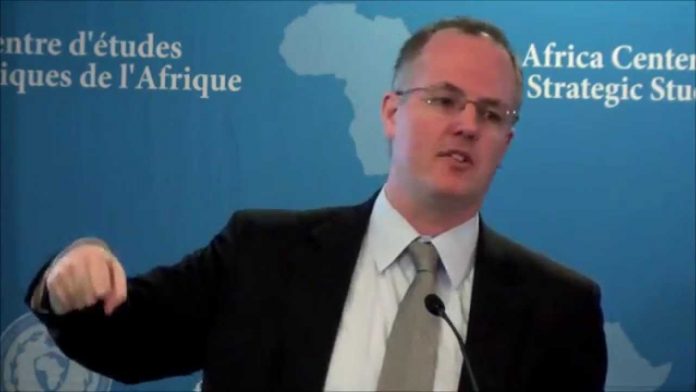
Paul D. Williams


By Paul D. Williams


New evidence has made possible a more accurate estimate of how many African Union Mission in Somalia (AMISOM) personnel have died since the mission deployed in March 2007. My previous report in 2015 made clear that neither of the most widely utilized armed conflict databases—the Uppsala Conflict Data Program or the Armed Conflict Event and Location Data (ACLED) project­—provided plausible numbers, and that it was unlikely that AMISOM had lost “up to 3,000” or “perhaps over 4,000” peacekeepers as some reports suggested.

This new evidence comes from my research into the mission, newly-released financial statements from the African Union (AU) from 2014 to 2018, a new dataset listing attacks on peacekeepers, and the erection of a “Memorial Wall of Our Heroes” in the AU’s Peace and Security building, which lists names of peacekeepers who died during AU-led and AU-authorized peace operations.

The costs of don’t ask, don’t tell

Four years after my initial investigation, there is still no comprehensive public record of AMISOM’s fatalities. In my book—Fighting for Peace in Somalia—I estimate that the number of AMISOM fatalities between March 2007 and mid-2017 was “probably more than 1,500,” but due to incomplete information, it was impossible to provide a definitive figure. The AU continues to leave the decision on whether or not to release information about casualties to the respective troop-contributing countries (TCCs). To date, no AMISOM TCC has publicly released a comprehensive list of their personnel killed in Somalia.

I maintain that this is not a good policy for two main reasons. First, all peacekeepers who make the ultimate sacrifice should have their service publicly recognized. Not doing so is not only immoral, but it is likely to have a negative effect on morale and could put their next of kin in a difficult position when it comes to claiming the financial compensation they are entitled to. This is presumably part of the reason why the AU recently erected the memorial wall (see below).

Second, not releasing full details about peacekeeper deaths in Somalia plays into al-Shabaab’s hands, who are often able to dominate the media terrain in the absence of an authoritative and trusted AU or AMISOM voice. Optimal strategic communications for a peace operation like AMISOM would involve the mission’s representatives becoming authoritative voices in the Somali media ecosystem which, in turn, would require AMISOM to be taken seriously on this topic. A mission that doesn’t provide the whole truth about its own dead cannot be surprised if Somalis think it lacks credibility when trying to pronounce on other issues.

New financial evidence

In March 2017, the AU released financial statements that contain detailed breakdowns of how the organization spent its money between 2014 and 2017, and in May 2019, released the report for 2018. The AU is to be commended for deciding to release this information, which represents an important step towards achieving financial transparency and accountability. These financial reports also reveal some important details about AMISOM by providing some information about the death and disability grants paid by the AU to the governments of its TCCs.

From information in the AU’s financial statements on AMISOM’s death and disability compensation payments between August 2009 and September 2012, it can be gleaned that AMISOM suffered 439 fatalities: 22 in 2009, 59 in 2010, 298 in 2011, and 60 in 2012.

The Memorandums of Understanding (MOUs) signed between the AU and the TCC governments stated that $50,000 should be paid as death compensation to the deceased soldier’s government. The compensation amount for disability would depend on the degree of injury or disabilities suffered as determined by the joint AU/TCC medical board. The money for these payments came from the European Union, which provided significant financial assistance through its African Peace Facility.

The AU financial records from August 2009 to September 2012 show that death compensation payments of $50,000 were made for these 439 fatalities. But there was also an additional $5,779,000 paid out in disability compensation, almost always in payments of $10,000 for each of the approximately 575 injured soldiers. For the 37 months from August 2009 to September 2012, therefore, the AU spent $27,729,000 on death and disability compensation. Of this total, 79 percent was spent on death compensation and 21 percent on disability compensation.

It is in light of these insights that we should assess the death and disability compensation data provided in the newly released AU financial statements for 2014 through 2018. These public reports reveal that the AU paid $74,624,000 in death and disability compensation between 2014 and 2018 (see Figure 2).

If we assume a similar proportion of death and disability compensation in these payments as were evident in those made between August 2009 and September 2012, this would mean 79 percent was spent on death compensation ($58,952,960) and 21 percent on disability compensation ($15,671,040). This would equate to approximately 1,179 payments of $50,000 for deceased personnel and 1,567 payments of $10,000 for injured personnel. In contrast, if we assumed a 50:50 split between fatality and injury payments, this would suggest 746 fatalities and 3,731 injured peacekeeper payments.

Given AMISOM’s numerous remote forward operating bases, the mission’s limited capacity for rapid casualty evacuation (partly owing to a lack of rapid response forces and appropriate helicopters), and the relatively poor state of its medical facilities, a ratio of approximately 3 killed for every 4 wounded peacekeepers is plausible (the 79:21 ratio). It is also very close to the actual killed to wounded ratio that occurred between August 2009 and September 2012. In contrast, the 50:50 spending ratio would suggest approximately 1 killed for every 5 wounded peacekeepers, which seems rather high and is considerably higher than the actual ratio that occurred between August 2009 and September 2012.

Following the money is a plausible but not foolproof way to estimate the number of casualties suffered because it is in the interest of each TCC government to claim the compensation to which it is entitled. Indeed, if they did not claim financial compensation for all their dead this would raise some deeply uncomfortable questions as to why not. It is also possible, however, that compensation payments were made to the TCC governments other than via the AU.

But before providing any estimate of AMISOM’s fatality numbers for the period 2014 to 2018, we must recall that during 2014, AMISOM was not the only AU peace support operation.[1] The AU also deployed the African-led International Support Mission in Central Africa (MISCA). MISCA deployed to the Central African Republic in late December 2013 and by the time it was transitioned into a new United Nations peacekeeping operation (MINUSCA) in September 2014, it had suffered a total of 31 fatalities.

If we apply the 79:21 breakdown for 2014, this would mean a total of 217 fatalities. Subtracting the 31 fatalities suffered by MISCA leaves an estimated 186 AMISOM fatalities. Applying the same 79:21 spending ratio to the years 2015-2018 produces the following estimate of 1,148 AMISOM fatalities; whereas assuming a 50:50 spending ratio suggests an estimate of 747 AMISOM fatalities over the same period.

The Politics of Peacekeeper Memorials
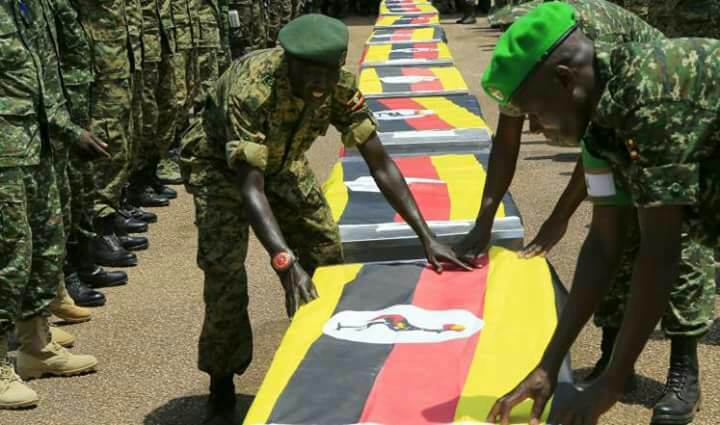
UPDF has had its soldiers killed in Somalia

The erection of the “Memorial Wall of Our Heroes” in the AU’s headquarters in 2018 was an interesting development. It lists the names and ranks (but no dates) of peacekeepers who have died on AU-mandated peace support operations (such as AMIB, AMIS, AMISOM, MISCA) and AU-authorized peace operations (such as the MNJTF and G5 Sahel Joint Force). However, shortly after its erection, the wall was covered in black drapes that concealed the names of the fallen heroes. The drapes were removed the following year when the memorial wall was officially inaugurated on May 25, 2019. As of August 2019, there were 1,108 names listed on the wall in nineteen columns.

As for AMISOM, it too has a memorial for its fallen personnel just outside its force headquarters in Mogadishu. However, it lists no names or numbers. Rather, its dedication reads: “In memory of the officers, men and women of the African Union Mission in Somalia (AMISOM), and the Somali National Security Forces (SNSF), who lost their lives in pursuit of peace and stability in Somalia.”

So what?

What does this new information mean for an attempt to provide an overall estimate of AMISOM’s fatalities? In sum, there is now a reasonably plausible set of estimates for almost the entire period of AMISOM’s deployment between March 2007 and December 2018 derived from five sources.

First, in my book, I cite an internal AMISOM briefing presentation given to bilateral partners on February 25, 2009 which stated that AMISOM had suffered 12 fatalities and 25 injured peacekeepers as of December 10, 2008. I assume this is accurate since it was provided discretely by the AU to AMISOM’s bilateral partners; the numbers are low enough that at that stage the issue was not considered especially controversial; and it reflects the fact that AMISOM engaged in relatively little fighting during 2007 and 2008.

A second relevant source is the new Peacemakers at Risk dataset produced out of the Uppsala Conflict Data Program. For 2009, this estimates 40 AMISOM peacekeepers were killed in violent attacks. My research suggests that another six AMISOM peacekeepers died in 2009 (four from illness and two from motor vehicle accidents), making a total of 46.

A third source is the financial records between August 2009 and September 2012 discussed above, which revealed 439 AMISOM fatalities. Twenty-two of those occurred between August and December 2009. This leaves 417 between January 2010 and September 2012.

Fourth, the publicly released AU financial reports provide information about compensation payments that could plausibly suggest that AMISOM suffered approximately 1,148 or 747 fatalities between 2014 and 2018 (depending on whether one assumes a 79:21 or 50:50 ratio of death and disability compensation payments).

Fifth, the SIPRI database on multilateral peace operations—which collected data on AMISOM’s fatalities between 2009 and 2014—received a figure of 261 fatalities from AMISOM officials for the 2013 calendar year.

Taken together, these sources cover most of AMISOM’s timeline, although they leave some periods unaccounted for, namely, December 11–31, 2008 and October to December 2012. However, these periods represent only 3.5 months out of the 141 months from March 2007 to December 2018, or 2.5 percent of AMISOM’s deployment time.

In sum, previous research combined with the newly released AU financial data and the Peacemakers at Risk dataset suggest that a plausible estimate of AMISOM’s fatalities between March 2007 and December 2018 could be between 1,483 and 1,884. Based on the above analysis, it is likely that the real number is closer to the higher end of this range than the lower end. Finally, there is a high likelihood that AMISOM suffered additional fatalities during the 3.5 months currently missing from the data.

Paul D. Williams is Professor in the Elliott School of International Affairs at the George Washington University. He tweets @PDWilliamsGWU.


Stories Continues after ad

Proline docked six points, fined Shs5m for not honouring SC Villa game

Proline FC


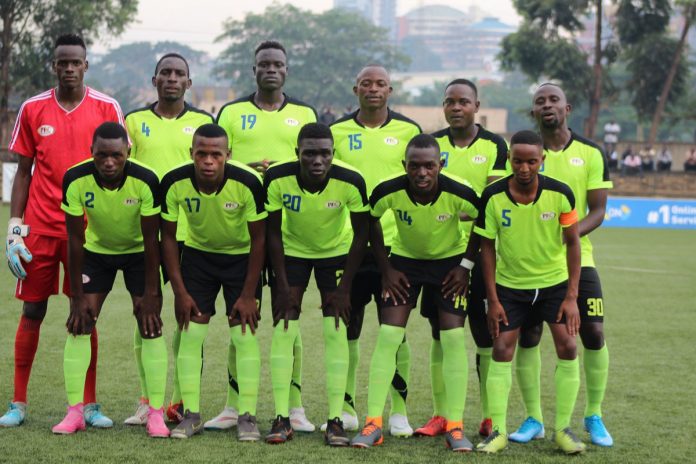
Proline FC have been docked six points and six goals by the FUFA Competitions Disciplinary Panel after forfeiting their match day three fixture against SC Villa Jogoo at StarTimes stadium, Lugogo.

In a letter from the disciplinary panel, the newly promoted league side has been found guilty of violating FUFA Competition rules and it orders that the Proline loses the match against SC Villa by forfeiture.

The panel further ruled that; “1. SC Villa get three points and three goals.

“2. Proline, being the home team, will be docked a further SIX points and six goals from the ones they will accumulate.

“3. Proline will pay a fine of Shs5 million for bringing the game of football into disrepute.

“4. Proline have an option of appealing to the Fufa Appeals committee.”

The fine of five million shillings has been ordered to be paid by September 18, 2019.

Proline had earlier written to FUFA confirming that they were not honouring the fixture because two of their players in Mustafa Mujuzi and Bright Anukani were on National team duty and that according to FIFA rules on International break, all domestic leagues must take a break.

However the Fufa rules say the minimum is three players and other league games were played that day.

For now, SC Villa has been given three points and three goals and move to seven points.

Proline becomes the second club to be docked points this season after Police didn’t show up for their game against Onduparaka on match day one while they were out of the country for military games without notifying the Uganda Premier League committee.

Proline are currently preparing for thir CAF Confederation second Round Preliminary game first leg against AS Kigali FC in Rwanda on Saturday September 14.

Stories Continues after ad

Ministers differ on taxation of NSSF members’ benefits

Gabriel Ajedra


The Minister of State for Finance, Gabriel Ajedra, has opposed a proposal in the National Social Security Fund (NSSF) Amendment Bill, 2019 seeking to exempt workers’ contributions from taxation.

The National Social Security Fund (NSSF) Amendment Bill, 2019, which seeks to provide for mandatory contributions of all workers regardless of the size of the enterprise or number of employees; and to provide for voluntary contributions to the Fund; proposes a tax on members’ retirement benefits.

Minister Ajedra, who was jointly appearing with the Minister of Gender, Labour and Social Development, Janat Mukwaya, before the committees of Gender and said the proposal does not address the issue of equity in the pensions sector.

“If NSSF is exempted, then what happens to other pension schemes? As the Ministry of Finance, that is one of the issues we do not agree with,” Ajedra said.

The two committees are currently scrutinizing the NSSF Bill.

Ajedra said that NSSF is the biggest contributor to capital markets and yet this has been affected by low taxes realized from the pensions sector.

“Uganda has no long-term capital investments. This is caused by the monopoly by NSSF. It is the only company that buys government treasury and bonds and it has no competition,” said Ajedra.

Mukwaya however, said that the proposal aims at promoting social security of Ugandans and enhance coverage of saving and retirement income.

“The Bill allows the Ministry of Finance to be responsible for investing the money. Let [Ministry of Finance] have it but they should respect policy on social security,” Mukwaya said.

Pian County MP, Remigio Achia, said that the income tax law should be amended to exempt taxation of members’ contributions of all pension schemes. “The law should not be selective. It should apply to all for purposes of equality,” Achia said.

The Chairperson of the Finance Committee, Henry Musasizi wondered what rationale would be used to tax members’ benefits. “We want to understand how this is going to be done,” said Musasizi, adding that, “We also need to hear about possibilities to have mid-term access to benefits”.

Bulamogi County MP, Kenneth Lubogo, advised government to consider making provisions allowing members to access their savings before the retirement age.

“People lose jobs and remain unemployed for long. They end up living miserably because they have to wait until they are 55 years to access their savings,” Lubogo said.

The Director of Labour at Gender Ministry, Martin Wandera, explained that the objective of social security is in respect of old age and advised that another fund be set up to cater for the unemployed.

He added that mid-term access was not considered after research was carried out and findings indicated that majority of members preferred to withdraw their funds upon retirement.

Stories Continues after ad

Morley Byekwaso named Uganda Hippos head coach

Morley Byekwaso


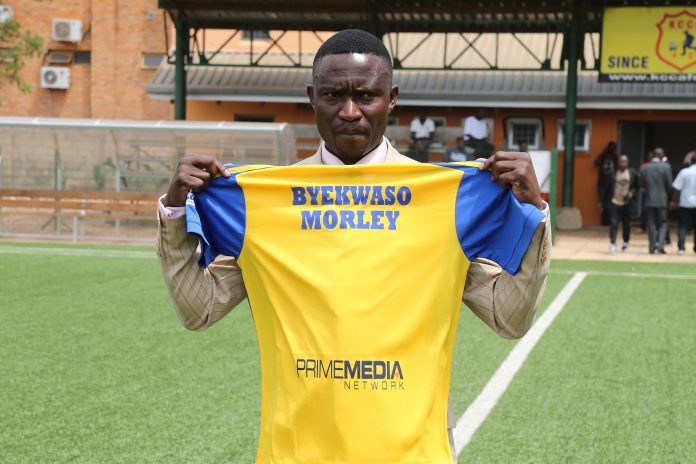
KCCA FC assistant manager Morley Byekwaso has been named the head coach of the national U-20 football team, known as The Hippos for the forthcoming Cecafa U20 championship.

Byekwaso will be assisted by U17 coach Hamza Lutalo and Stephen Kiggundu as the goalkeeping coach while FUFA Youth Development officer Bashir Mutyaba is the team manager (coordinator).

Morley and his staff will help guide the team in the CECAFA championships that will be hosted by Uganda starting September 21st to 5th October 2019.

The summoned players have today started their residential training at FUFA Technical Centre, Njeru.

Most of the players summoned featured in the U17 Africa Cup of Nations 2019 in Dar es Salaam, as well as players who featured in the previous campaign of the CAF U20 AFCON qualification while others play in the Uganda Premier League.


Summoned team:

Goal keepers: Komakech Jack (Football For Good Academy), Otim Dennis (Mbarara FC), Magolofa Mutwalib (Vipers SC Junior Team).

Defenders: Ssekimbegga Kevin (Express FC Junior Team), Justine Opiro (KCCA FC Soccer Academy), Kayondo Aziz Abdu (Vipers SC), Kitabalwa Robert (St Mary Kitende), Kizito Gavin Mugweri (Sports Club Villa Jogoo), Kigundu Derrick (Buddo S.S), Musa Ramathan (KCCA FC), Ssemakula Keneth (Busoga United FC).

Midfielders: Ssekajja Davis (Bright Stars FC), Mayanja Saidi (Edgars Youth Programme), Sseguya William (Kampala Junior Team), Kafumbe Joseph (KCCA FC), Kawooya Andrew (Vipers SC Junior Team), Anukani Bright (Proline FC), Kakaire Thomas (Alanya Spor-Turkey), Watambala Karim (St Mary’s Kitende), Ssenyonjo Hassan (Wakiso Giants), Zzizinga Ashiraf (Kampala Junior Team), Sserwadda Steven (KCCA FC)

Forwards: Ssebufu Frank (Buddo S.S), Mugulusi Isma (Busoga United FC), Yiga Najib (Vipers SC Junior Team), Lwanga Charles (SC Villa Jogoo), Asaba Ivan (Vipers SC Junior Team), Maseruka Sadam (BUL FC) Sadat Anaku (KCCA FC), Bogere Ivan (Proline FC).

Stories Continues after ad

Shawn Mubiru named SC Villa CEO, vows to take the club back to the top

Shawn Mubiru


Uganda Premier League side Sports Club Villa Jogoo have appointed Shawn Mubiru as the new club’s Chief Executive Officer.

He replaces David Sserebe who has been serving as the interim CEO for more than a year.

In a lengthy facebook post after his appointment, Shawn promised to take back the great club to its rightful place under his leadership not only in Uganda, but alos on the continent.

“I accept to serve a great club that I have supported since childhood. SC Villa is a club you cannot turn down when they come knocking.

“SC Villa’s rich history, and a great fan base are assets for the club. We shall work hard and smart to position them in order to create revenue for the club.

“We at a critical time as a club, and I want to pledge that I will lead a team that will do everything to ensure that we are strongly and strategically placed to take on any challenge. This includes having a good team in every sector that understands and appreciates the core values of the club, including of course, the coaching and playing staff whom I have faith in and together we will get the job done.

“While it is a challenging course for me, I am determined and excited about what is ahead for this great club. My job is to restore SC Villa to its rightful place in the game football in Uganda and on the continent.

“Football just like any trade calls for dedicating time, hard work and commitment. In order for us to be successful, discipline is key, we will need to be fair in all our dealings and that will bring honor to our badge.

“Let take this great appointment to thank the board for giving me this opportunity to reposition our great club.

“I would like to thank all SC Villa Jogoo fans wherever they are, my promise to you; we will reach you and listen to you. We are taking this great club back to the top together.

“We are going to let all of you know of our plans for the club.”

Mubiru’s appointment comes at a time when the club indicated that permanent leadership at the club will be elected in February 2020.

Stories Continues after ad

CAF Champions League: KCCA name squad to face Angola’s Petro de Luanda

KCCA team

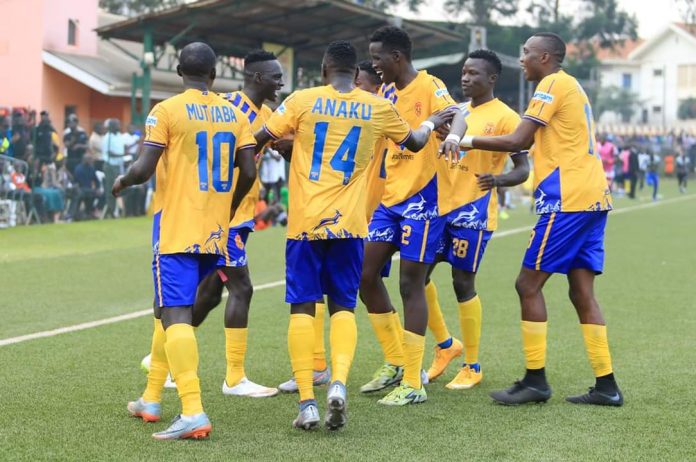
Uganda Premier League champions KCCA FC have named the squad to travel to Luanda, Angola for the first leg of the 1/16 preliminary Caf Champions League round game against Petro de Luanda.

New signing Simon Serunkuma makes his debut CAF Champions League trip for the club while Erisa Sekisambu, Revita John and John Egbuonu Odumegwu or Keziron Kizito will have to wait until the team makes the group stages for them to feature.

Defensive midfielder Nicholas Kasozi also misses out on the travelling squad.

The contingent will be headed by Rogers Byamukama from FUFA and the team departs from Entebbe International Airport aboard Ethiopian Airlines on Thursday today am and shall have a stopover at Bole Airport, Addis Ababa before arriving in Angola.

KCCA FC will take on Atletico Petroleos de Luanda in the first leg of the first round 1/16 CAF Champions League preliminary game on Saturday 14th September 2019 at Estadio 11 de Novembro in Luanda. The second leg will be played between September 27 and 29 in Kampala.

KCCA qualified for the final preliminary round with a 4-3 aggregate over Namibia’s African Stars while Petro Launda eliminated Lesotho’s Matlama FC 3-0 on aggregate.

The Kasasiro Boys have good memories of their last match against Angolan opponents, after they knocked out CD Primeiro de Agosto in 2017.

The 16 winners of the first round advance to the group stage, while the 16 losers of the first round enter the Confederation Cup play-off round.

Traveling squad

Goal Keepers; Charles Lukwago (Captain) and Jamil Malyamungu.

Defenders; Samuel Kato, Peter Magambo, Hassan Musana, Mustafa Kizza, Fillbert Obenchan, Eric Ssenjobe

Midfielders; Muzamiru Mutyaba, Gift Ali Abubakar, Allan Okello, Herbert Achai, Simon Serunkuma, Steven Sserwadda.

Strikers; Sadat Anaku, Mike Mutyaba, Jackson Nunda.

Stories Continues after ad

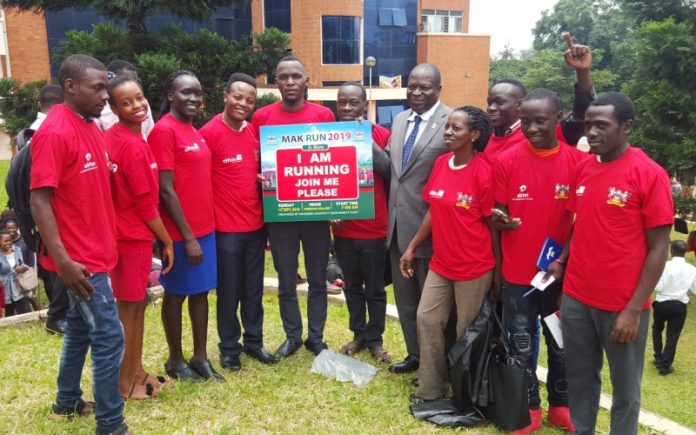
Thousands to participate in Third Edition of MakRun 2019

College of Computing and Information students ready for the run


The Third Edition of the Makerere University Endowment Fund Run 2019 (MakRun 2019) is to be held on September 15, 2019 where thousands of people and corporate companies are expected to participate and raise funds for construction of students’ centre.

MakRun 2019 is part of Makerere University’s efforts to continuously engage with its stakeholders and appeal for the financial help aimed constricting the students’ centre, officials say.

The university needs Shs7.5 billion to construct the Centre through the university’s Endowment Fund.

The initial prioritized multipurpose students centre project will include a student job search facility state of the art auditorium/ performing arts theatre, commercial space for restaurants, banks, student support services, shopping areas, food courts and cafeterias, bookshops among others.

Meanwhile, the third edition will cover a 5km fun run and a 15km leg for the more spirited runners. Flag off will be preceded by a warm up and aerobics session at the Freedom Square starting at 6:00am on D-day.

The university’s acting manager Communication public relations, Dr Muhammad Musoke Kiggundu has urged all alumnae and well-wishers to come and participate in the run.

The principal of College of Computing and Information, Prof. Tony Oyana has outlined his college intentions to produce the best athletes by sponsoring 100 students and 20 staff members. Other departments are expected to do the same.

Last year the run raised over Shs130 million in cash and kind while in 2017 Shs190 million was raised. However over Shs400 million has been raised since the fundraising campaign started.

The tickets are on sale at Makerere University guest house, Makerere University Printery, Main library and Main building, at Shs15,000 for students, Shs25,00 for silver and Shs50,000 for gold.


Stories Continues after ad

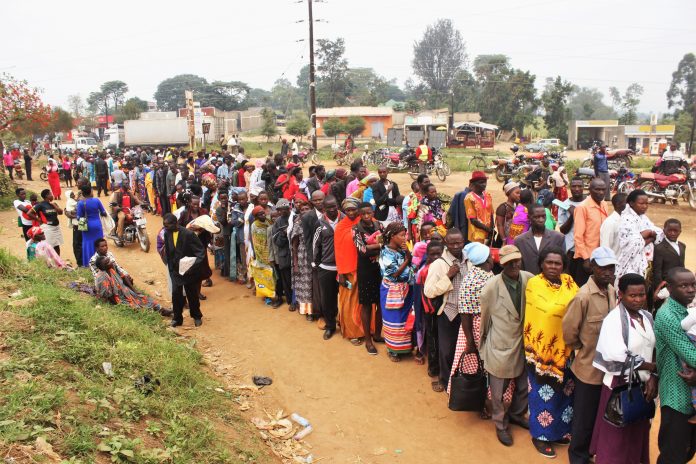
Bulamu Healthcare treats over 15000 patients in Kyegegwa district

Residents lining up to get treated


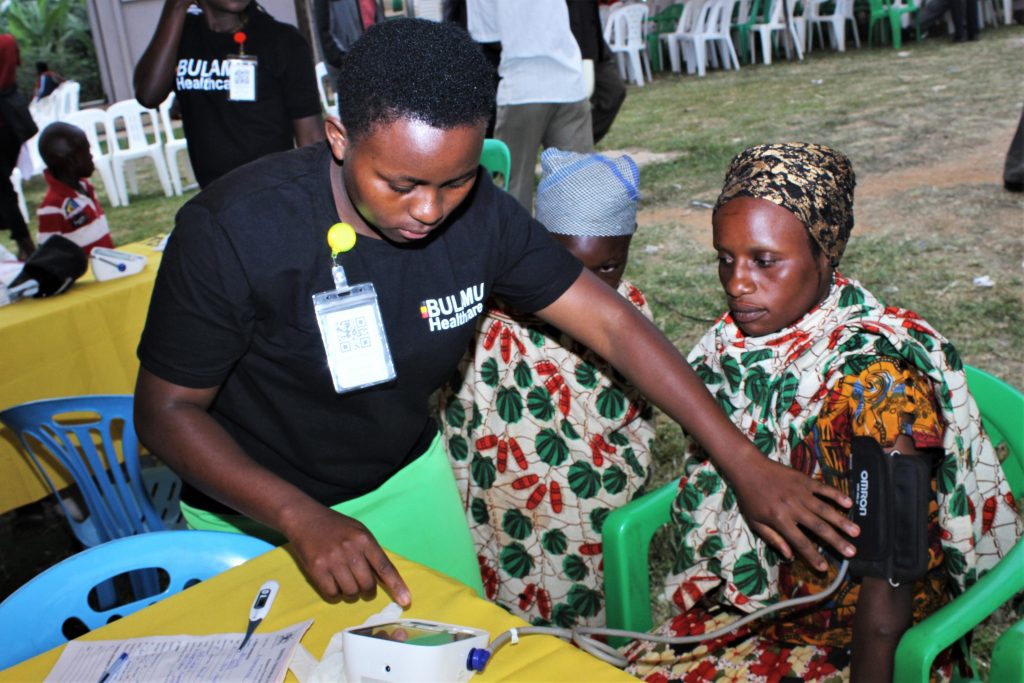
Bulamu Healthcare recently completed its 15th medical supercamp in Kyegegwa district, where the organisation and its partners treated 15,625 patients in less than one week, helping to boost the health of the residents.

Established in 2015 in the U.S. and active in Uganda since 2016, Bulamu Healthcare is a non-governmental organisation that has been organising and running mobile healthcare camps in partnership with Uganda’s Ministry of Health, local districts, and health facilities.

Each Bulamu Healthcare medical supercamp is staffed exclusively by Ugandan doctors and nurses, who make up more than 150 of the 240 total Ugandan staff and volunteers who make such work possible. As a result of Bulamu’s support and partnership, since 2016 has helped more than 125,000 rural Ugandans to receive healthcare free of charge, with an average of more than 11,000 patients benefiting from each of the 4 camps that have taken place thus far in 2019.

Bulamu official attends to a patient

“We are very grateful for the great work and services that Bulamu has brought to us here in Kyegegwa district,” said Stella Kiiza, Kyegegwa district Woman Member of Parliament. “I want to make sure that we also see how we as government can synergize with the Bulamu team, so we can continue to better the healthcare system here in our home district and all of Uganda.”

Bulamu Healthcare’s medical organisation identifies partner districts based on their level of support for the mobile hospital camp model, then works with the host district to organize the staff and resources necessary to provide healthcare to the more than 10,000 patients who attend each medical supercamp. This approach in turn supports patients who suffer from a myriad of health issues, including cancer, goiters, hernia and cataracts.

“I am so grateful to the people of Bulamu for the work they are doing. Some of the services like ear, nose and throat specialists or SCAN we have never had before. My only wish is that it can be an annual event because a lot of the people of Kyegegwa have greatly benefited from it,” said Dr Martin Yefta, the In- Charge, Kyegegwa Medical Health Centre IV.

A hospital on wheels, the Bulamu Healthcare organisation has managed to reach parts of Uganda that were in dire need of medical attention due to various factors such as development and poverty that have hindered many of the residents from attaining the right medical services or drugs for their particular ailments. Resigned to a life of suffering; many had given up hope until they came across Bulamu Healthcare that offers free medical services to the locals and in so doing it not only restores the health of its patients but also saves and restores the lives of hundreds who couldn’t find work nor help due to various medical complications such as: Hydrocephalus and Spina Bifida.

“I was born with cataracts & this deteriorated as I grew older but I did what I could to endure this hardship and study. This has allowed me to get a job although it is hard to carry out other activities that could allow me to live a normal life like other people with sight,” Richard Turyomurugyendo, 26 is a primary school teacher despite the odds. Through our the organization’s Angel programme he will be qualified to have surgery that would restore his eyesight free of charge.

In addition to the free healthcare services such as surgery, dentistry and optics (eye exams and free eye glasses) that would otherwise have been too expensive for some of the locals to afford, Bulamu Healthcare also endeavors to sensitize the communities where they operate supercamps through health education classes, in order to reduce the risks of residents contracting diseases. This is also very key in fighting health inequalities since “preventative measures are always better than curative,” Gerald Atwiine, founder of Bulamu. It is also more cost efficient for those living below the poverty margin.

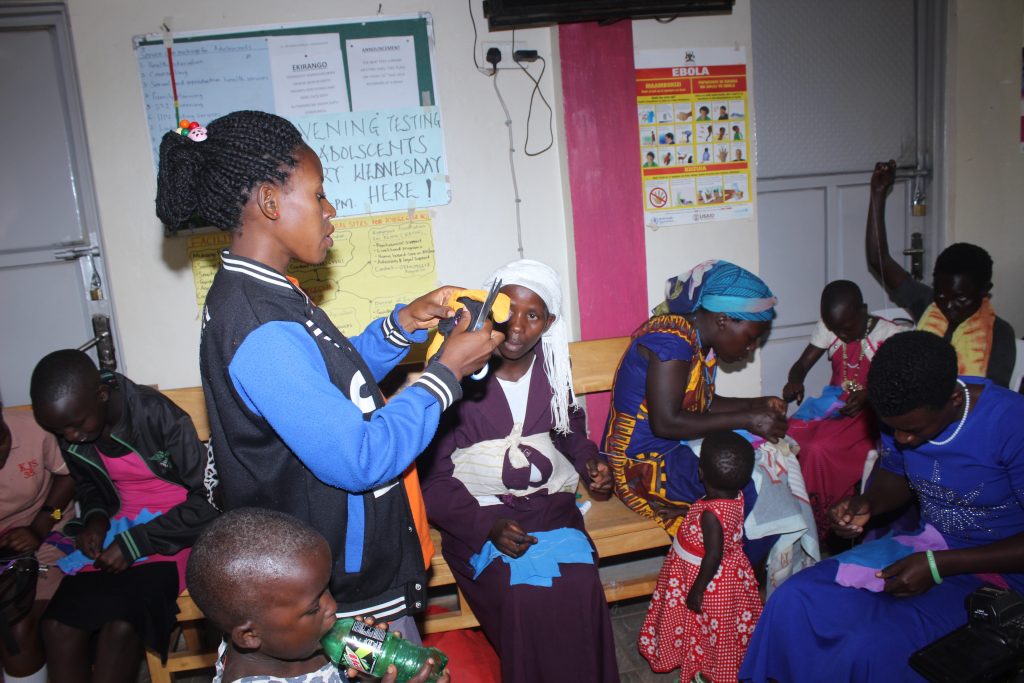
Bulamu officials teaching women how to make re-usable sanitary pads

Bulamu’s Angel Program Director, William Masereka noted that a lot of the patients lived in pain due to their use of herbal medicines. A cultural epidemic, the preference of herbal medicine over qualified drugs is still strong amongst many societies and this has also led to sabotage of health promotion efforts by both the government and health workers.

“The swelling kept growing bigger and more painful despite the herbal drugs that we administered,“ narrates Olivia kabasinguzi, mother to John Isingoma , a patient admitted under Bulamu Healthcare’s Angel Program with Lymphoma.

Despite the various medical services offered during the Bulamu super camps, the angel programme was an initiative that was introduced to cater for complicated cases that would need outside intervention like corrective surgeries and some congenital diseases such as hydrocephalus. Annually, the Bulamu organization caters for over 500 surgeries through the Bulamu programme and partnerships with other medical institutions such as Cure hospital and Mulago Hospital.

Although the government has embarked on several Health promotion efforts in the past, it is clear that such non-governmental organizations play a key role in bridging the wide gap that exists in the health sector. By offering free medical services to those in the rural communities of Uganda, Bulamu not only ensures that the Health inequalities are reduced but also tackles the various factors that hinder healthy lifestyles such as the use of herbs and poverty.

Stories Continues after ad

KIU hold research dissemination and innovation conference

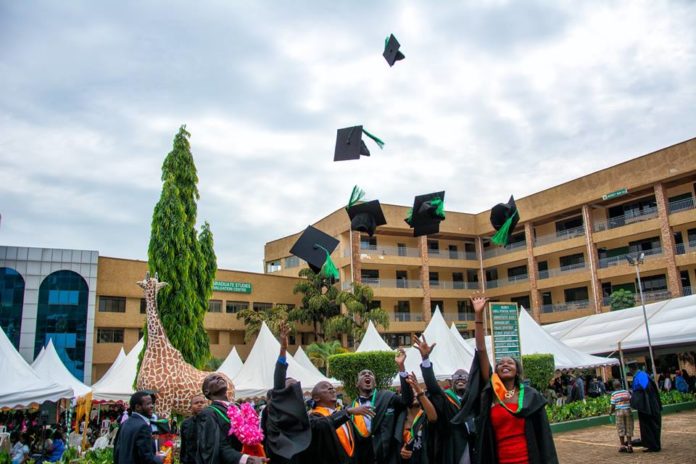
HURRAY! Graduates of KIU after receiving their degrees


Kampala International University Western Campus (KIU-WC) is  to hold three days research dissemination and innovation conference dubbed multi-sectoral collaboration towards the prevention and management of non-communicable diseases.

According to organisers, the conference will avail a multidisciplinary platform for knowledge dissemination on non-communicable diseases (NCDs) to around 20,000 students in various universities within and outside Uganda.

The event is scheduled to take place from  September 11-13, 2019, at new biomedical block, 3rd floor, KIU western campus in Ishaka-Bushenyi, Uganda.

It will also provide a platform for researchers to share the outputs of their research, stimulate young scientist to develop new interventions to manage non-communicable diseases and create awareness on non-communicable diseases that will in turn promote healthy lifestyles that are essential towards the fight against these diseases

It is also scheduled to Increase the investment in research and development through public funding and encouraging the investments of the business sector in research and innovation in non-communicable diseases and advocate for the inclusion of health promotion and public health approaches to the global burden of non-communicable diseases in health science school curricula.

Africa has previously been challenged by infectious diseases; however, the continent is now currently facing a new challenge of non-communicable diseases. In Uganda for example, according to the 2018 WHO report on non-communicable diseases, a death rate of 33 per cent was accounted for due to the prevalence of non-communicable diseases. Consequently, there is an urgent need for Africa to start addressing this challenge and develop interventions towards these diseases that are suitable for resource limited settings.

The key note speakers include Prof. Andre Renzaho of Western Sydney University, Australia, Dr. Gerald Mutungi; Commissioner Non-Communicable Diseases Uganda, and Prof. Fred Wabwire Mangen of the College of Health Sciences, Makerere University. Also, gracing the occasion are delegates from the Ministry of Science Technology and Innovation, Uganda, among other notable personalities to mention but a few.

Over time, students have been involved in scientific research and innovation on various local and international platforms. However, only a few students have been able to share their innovations on these platforms owing to lack of enough publicity and access to the media.

Two outstanding innovations have been shared extensively with the science community, the Petograph App; an application and software that can be used by health practitioners to improve diagnosis, management and follow up of pregnant mothers with pre-eclampsia and the HDA App; an offline application that helps patients to verify drugs, medical personnel and health centres.

It will be held under sub themes of Nutrition based Interventions, Community initiatives in prevention of non-communicable diseases, Workplace Initiatives in prevention of non-communicable diseases, Alternative Medicine for Non communicable Diseases, Access to Health Information and Health Care Delivery, Environmental Health in Mitigating Non-Communicable diseases, Lifestyle and Non-communicable disease and Drug and substance abuse and mental health.

The conference will be packed with Pre, Main, and Post Conference activities that will challenge the thinking of all participants as well as enable them explore the heights. Side attractions like KRIC Run, Hub of Science Tour, Game Drive, among others, have been enshrined in the programme to make the event rewarding and memorable.

Stories Continues after ad

Justice Duncan Gaswaga named new Principal Judge

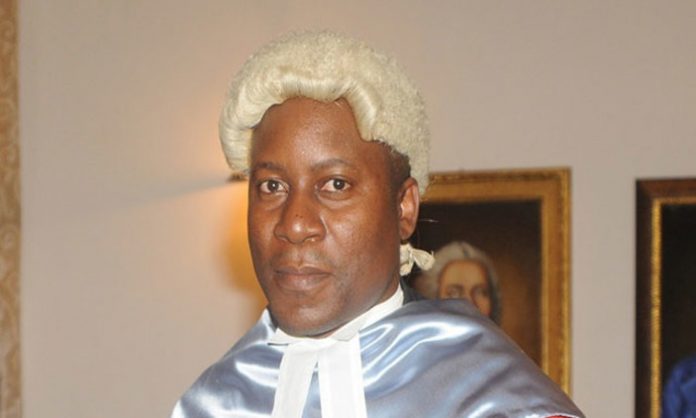
Justice Duncan Gaswaga

Justice Duncan Gaswaga has been appointed new Principal Judge to replace Yorakamu Bamwine who is retiring, sources say.

When contacted for a comment, the Minister of Justice and Constitutional Affairs, Gen. Kahinda Otafiire was non-committal to say anything on the latest development in the judiciary.

Justice Gaswaga has been serving as judge of High Court since 2014.

He also served as head of the criminal division of the Supreme Court in Seychelles and the International Criminal Court (ICC).

Stories Continues after ad