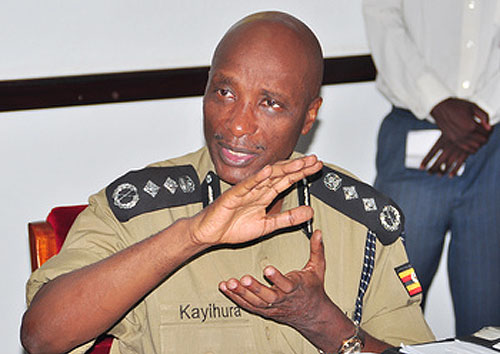
Former Inspector General of Police Gen. Kale Kayihura
Hundreds of people have turned up at the Makindye Magistrate’s court to express their solidarity with the Inspector General of Police General Kale Kayihura.
According to our reporter on the ground, some of the placards-holding supporters of the IGP have turned rowdy, chasing away perceived opponents of the police chief.
Already, Lord Mayor Erias Lukwago and city lawyer and president of opposition JEEMA party are at Makindye, where the security has been tightened ahead of the expected arrival of the IGP and his co-accused. General Kale Kayihura, was dragged to court by a group of 20 lawyers, for allegedly failing to superintend his subordinates who were involved in beating the opposition Dr Besigye’s supporters and bystanders, on July 12 and 13.
This was after Dr Besigye had been released on bail from Luzira prison, where he was held for two months on treason charges.
Two days ago, while addressing a presser at his Kasangati home Besigye said that time has caught-up with Gen Kayihura and others who have been traumatizing him, his supporters and innocent civilians, as witnessed by the indictment of the General.
“Things have changed; I am out of court and Kayihura is in,” the retired army colonel said.
Meanwhile, yesterday afternoon another group of placard-holding supporters of the IGP staged a demonstration around Parliament, temporarily paralyzing activities around the house.
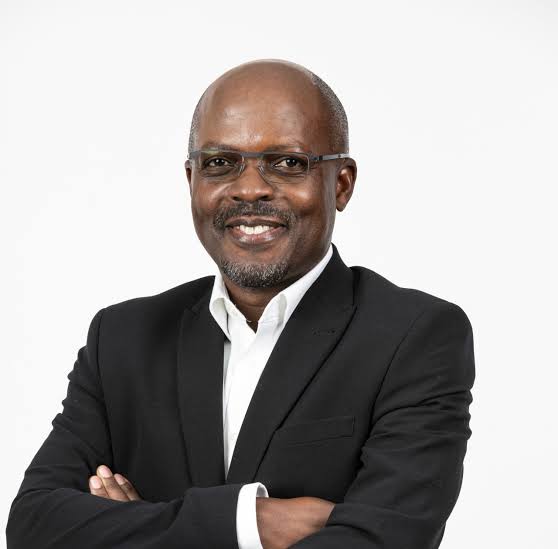
MTN Mobile Money Uganda has appointed Phrase Lubega as its new Managing Director, subject to approval by the Bank of Uganda, in a leadership change aimed at strengthening its operations and accelerating digital financial inclusion across Uganda.
The appointment was announced on Thursday by the Board of Directors of MTN Mobile Money Uganda, which said Lubega brings extensive experience in telecommunications, information technology and financial services that will guide the company’s next phase of growth.
He takes over from Sarah Bateta Okwi, who has been serving in an acting capacity. The board praised her for maintaining stability and continuity during the transition period.
In its statement, the company said Lubega comes with more than 30 years of leadership experience across multiple markets and sectors, including mobile financial services, digital banking and technology.
Before his appointment, he served as Interim Managing Director of MoMo Payment Service Bank in Nigeria, part of the MTN Group fintech portfolio, where he was responsible for strategy development, strengthening digital banking systems and expanding access to financial services.
The company noted that his leadership in Nigeria contributed to revenue growth, improved operational efficiency and the rollout of new digital products that boosted competitiveness in the market.
Lubega is also well known within Uganda’s telecommunications sector, having previously worked with MTN Uganda in senior leadership roles.
He once served as General Manager for Mobile Financial Services, a position in which he helped expand MTN Mobile Money operations and supported the introduction of new financial products that widened access to financial services for millions of Ugandans.
During his tenure, MTN launched MoKash, a mobile savings and loans product that played a key role in connecting underserved communities to formal financial services.
He also served as Chief Information Officer at MTN Uganda, where he led major digital transformation projects that supported the rapid expansion of mobile money services and strengthened the company’s technological infrastructure.
Beyond Uganda, Lubega has held senior positions within MTN Group, including Group Executive for Fintech Commercial Operations and General Manager for Commercial and Go To Market operations, roles in which he helped scale mobile financial services across several African markets.
His appointment comes at a time when mobile money remains a critical driver of Uganda’s economy, enabling millions of people to access payments, savings, credit and other financial services through digital platforms regulated by the Bank of Uganda.
Commenting on the appointment, Serigne Dioum, MTN Group Fintech Chief Executive Officer, said Lubega’s experience makes him well suited for the role.
“We are delighted to appoint Phrase Lubega as Managing Director of MTN Mobile Money Uganda. He brings deep market expertise, strong execution capability and a proven track record of scaling mobile financial services across diverse markets,” Dioum said.
He added that Lubega’s leadership would be key in strengthening the company’s position in Uganda and expanding access to secure and inclusive digital financial solutions.
The Chairperson of the Board of MTN Mobile Money Uganda, Sylvia Mulinge, said the board was confident in his ability to drive the company’s long term strategy.
“On behalf of the Board, we are pleased to appoint Phrase Lubega to lead MTN Mobile Money Uganda into its next phase of growth. His deep understanding of the business, strong governance experience and proven leadership across the MTN footprint position him well to drive sustainable value for all stakeholders,” Mulinge said.
She also expressed appreciation to Sarah Bateta Okwi for her service during the interim period.
Lubega described his appointment as an honour and responsibility at a time when digital financial services continue to transform economies across Africa.
“It is an honour to lead MTN Mobile Money Uganda at such an exciting time in the evolution of digital financial services,” he said.
“I look forward to working with the team and stakeholders to expand access to financial solutions, improve customer experience and support the continued growth of Uganda’s digital economy,” he added.
Lubega, a Ugandan national, also brings extensive corporate governance experience, having served on several boards within MTN mobile money operations across Africa.
He holds a Master of Business Administration from York University in the United Kingdom, an Executive MBA from the Quantic School of Business and Technology in the United States, and a Bachelor of Science degree in Physics from Makerere University.
MTN said the appointment marks a key milestone in strengthening leadership within its fintech division as it continues to expand financial inclusion, innovation and digital empowerment across Uganda.
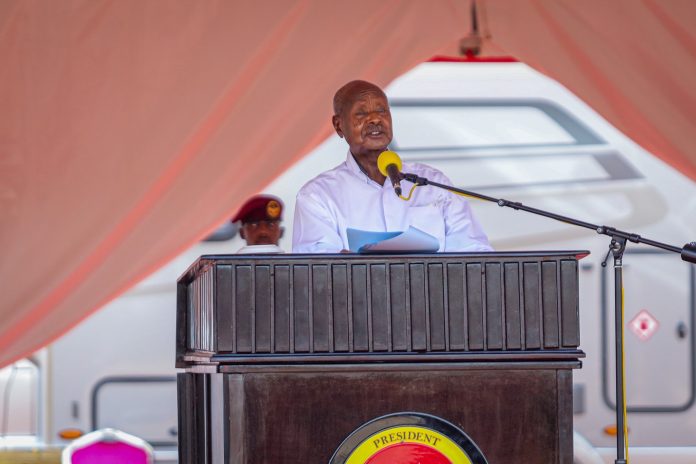
President Yoweri Museveni during the State of the Nation address 2026.
President Yoweri Kaguta Museveni has unveiled a comprehensive legislative programme for the 2026/27 financial year, presenting 38 bills and policy instruments aimed at deepening Uganda’s economic transformation, strengthening governance systems and accelerating wealth creation across key sectors of the economy.
The legislative agenda, presented during his State of the Nation Address (SONA) to Parliament, spans ministries including energy, education, health, agriculture, security, infrastructure, labour, lands, ICT and finance. It also includes major tax reform proposals, financial accountability reports, and institutional amendments intended to support long term development goals.
Museveni said Uganda has continued to register strong economic recovery and growth, driven by increased production, infrastructure expansion, and a shift of more households into the money economy.
“The facts of the matter are that with the limited waking up, where 67% of the homesteads as compared to 9% in 1962 are now in the money economy, Uganda has graduated from the Least Developed Countries to a Lower Middle Income Country,” he said.
He noted that Uganda’s economic progress has been anchored on peace, infrastructure development, and deliberate government programmes designed to move citizens from subsistence production into commercial agriculture, manufacturing, services, and ICT.
“The NRM has identified all the requirements for building a prosperous Uganda. The NRM has also provided for the means for individuals, families or companies that want to be part of the social economic transformation story,” Museveni said.
He highlighted major achievements in agriculture, especially dairy production, pointing to the transformation of the cattle corridor from subsistence livestock keeping to commercial production linked to national and export markets.
He said milk production has grown from about 200 million litres in 1986 to 5.4 billion litres today, contributing to import substitution and export earnings. He also pointed to increased production of coffee, maize, bananas, cassava, sugar and other commodities as evidence of structural change in the economy.
Museveni said the government continues to promote the four sector model of commercial agriculture, manufacturing, services and ICT as the backbone of Uganda’s economic transformation, arguing that growth in these areas is key to job creation and wealth expansion.
He also emphasized the importance of financial inclusion programmes such as the Parish Development Model, Emyooga, Operation Wealth Creation and NAADS, saying these interventions are designed to support households transitioning into the money economy.
“We are always creating other funds for the ghettoes, for the musicians and others. The question is how do we ensure all Ugandans participate in wealth creation,” he said.
The President used the address to reinforce his long standing message on productivity and discipline, urging leaders and citizens to eliminate practices he said undermine development.
“We must ensure that there is no more sleep; no more kukongola; no more corruption; no more kugumaaza; and no more politeness towards non performers,” he said.
He further stressed that Uganda’s development model depends on integrating all citizens into productive economic activities, including smallholder farmers, artisans, traders and ICT operators, especially as land becomes more limited due to population growth.
Museveni also highlighted major infrastructure developments, including expansion of national roads, regional transport corridors, railway rehabilitation, and pipeline projects with neighbouring countries. He said these investments are designed to reduce transport costs and improve competitiveness in regional markets.
He added that Uganda is strengthening peace and security institutions, noting that the Uganda People’s Defence Forces, Police and Judiciary play a critical role in maintaining stability, which he described as essential for economic growth.
Museveni also pointed to macroeconomic stability, noting improvements in GDP growth, reduction in poverty levels, increased life expectancy and expansion of exports. He said Uganda’s GDP has grown significantly over the past four decades, supported by diversification and value addition.
He further said Uganda is preparing for a major expansion in energy production, including hydro, solar, gas, wind, nuclear and geothermal sources, targeting up to 50,000 megawatts in future capacity to support industrialisation.
On the legislative side, Museveni’s 38 bills include reforms in education to revise university and curriculum frameworks, health sector amendments covering pharmaceuticals and professional regulation, agriculture laws to strengthen food systems, and transport reforms including a new Uganda Railways Bill.
Other key proposals include tax amendment bills under the Ministry of Finance, land and real estate regulation reforms, ICT legal updates, labour law amendments and new frameworks for national security coordination.
He said these reforms are intended to support long term stability, efficiency and accountability in government systems while ensuring that Uganda remains competitive in the regional and global economy.
Museveni called on leaders to ensure implementation of government programmes at all levels of leadership, insisting that transformation depends on action at the grassroots.
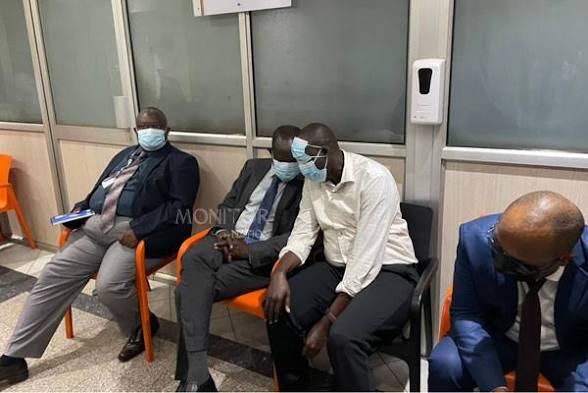
The arrested officials, Commissioner Patrick Okello, Assistant Commissioner Douglas Asiimwe, and two other officials. Photo credit: Daily Monitor.
Thursday, June 4, 2026 | KAMPALA — The Inspectorate of Government (IGG) has arrested two senior officials from the Office of the Prime Minister (OPM) in a widening investigation into alleged corruption in Uganda’s refugee registration system.
The arrested officials, Commissioner Patrick Okello and Assistant Commissioner Douglas Asiimwe, are attached to the Department of Refugees under OPM. They are accused of soliciting bribes from asylum seekers in exchange for processing and approving refugee status applications. Their arrest follows a series of complaints from refugee communities and partner organisations alleging systemic extortion and administrative abuse targeting vulnerable asylum seekers. Investigators say asylum seekers escaping conflict and persecution were allegedly required to pay illegal fees to expedite registration procedures. In some cases, applicants were reportedly told to produce passports and other formal documents—requirements critics say are unrealistic for individuals fleeing war-torn regions. The allegations have also drawn attention to the treatment of asylum seekers from Somalia, Pakistan, Iran, and Syria, particularly those whose immigration status had lapsed after their visas expired while awaiting asylum decisions. Humanitarian agencies operating in Uganda have previously raised concerns about inefficiencies and corruption risks within refugee processing structures, warning that such practices could undermine trust in one of Africa’s most established asylum systems. Uganda is currently hosting more than 1.7 million refugees and asylum seekers, maintaining a policy widely recognised for its openness and integration approach. However, recurring corruption allegations within administrative units have continued to prompt calls for stronger oversight and institutional reform. The IGG has not yet released a full statement on the arrests, but sources indicate that further interrogations are ongoing and additional suspects may be implicated as the investigation expands.
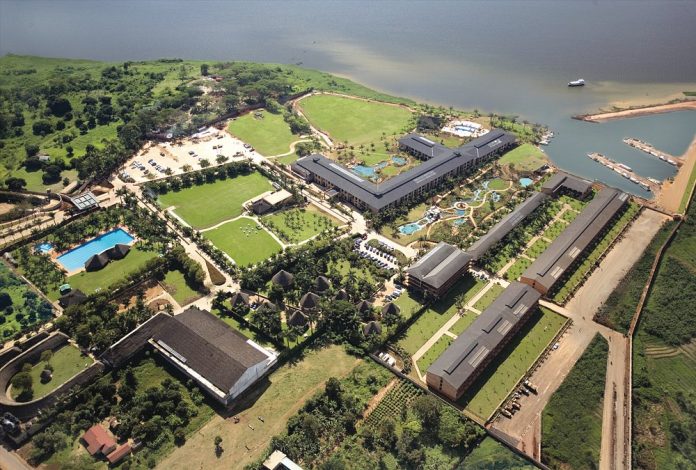
On the calm shoreline of Lake Victoria, where Kampala meets water and history meets modern architecture, stands a destination that has redefined Uganda’s place in global hospitality and diplomacy. Once part of the Kabaka’s royal hunting grounds, the area has been transformed into one of Africa’s most influential conferencing and luxury hubs.
Today, Speke Resort Munyonyo represents more than a hotel. It is a diplomatic stage, a tourism landmark, and a symbol of how Uganda has positioned itself within the global meetings and incentives industry.
The transformation is linked to city tycoon Sudhir Ruparelia, whose investment vision under the Ruparelia Group turned Munyonyo into a fully integrated hospitality and conference complex. His development strategy focused on scale, exclusivity, and functionality, combining luxury accommodation with one of the largest conference facilities in East and Central Africa.
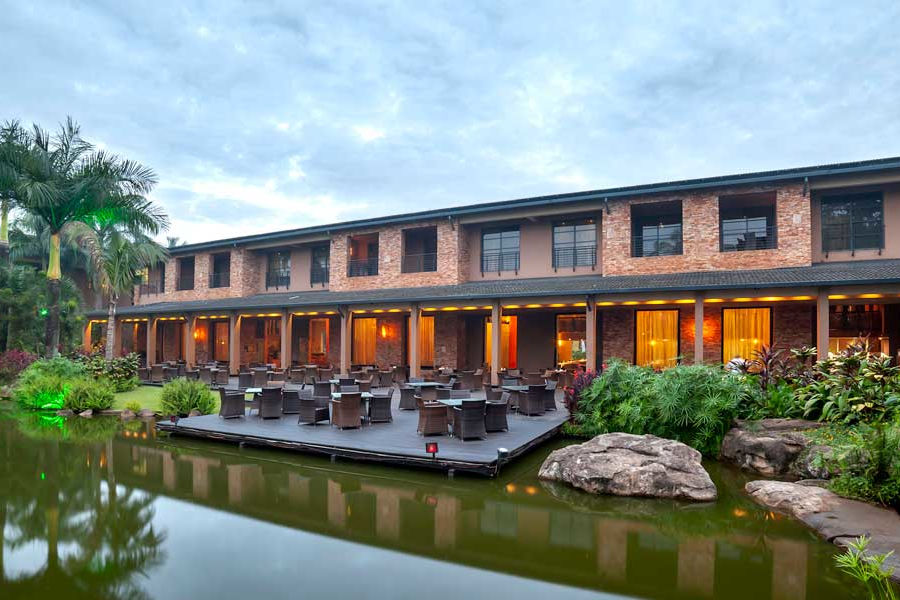
Built on expansive lakeside land, the resort sits within a carefully planned environment that blends natural scenery with modern infrastructure. Its location along Lake Victoria gives it both strategic and aesthetic value, with direct access to water-based activities and uninterrupted views across the world’s largest tropical lake.
Nominated for the Ekkula award, Speke Resort Munyonyo.
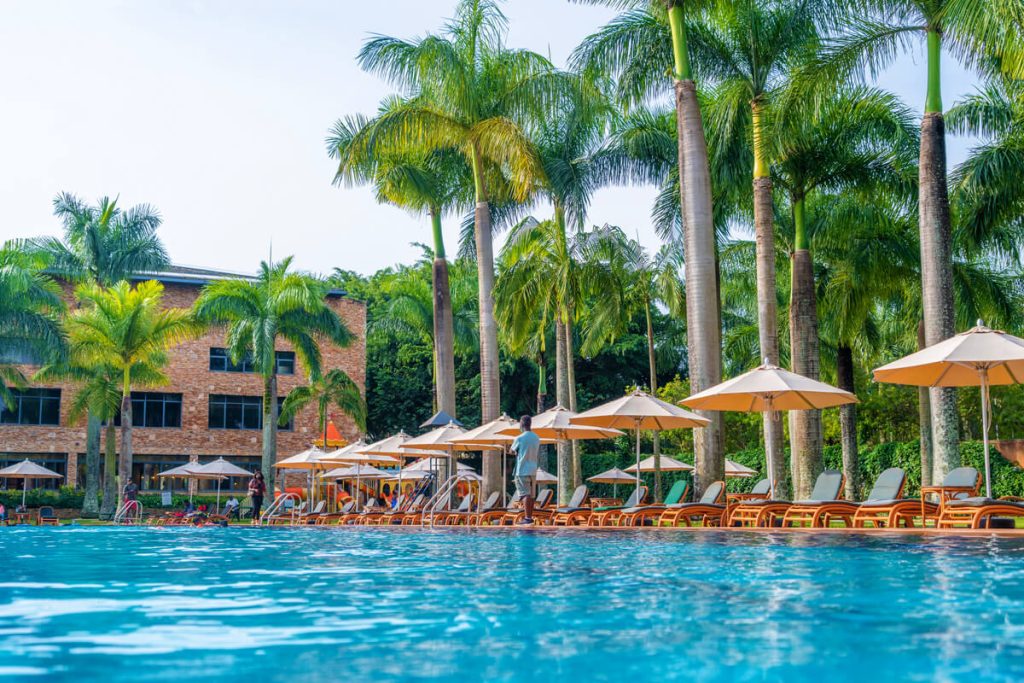
The resort complex includes presidential villas, high-end suites, multiple conference halls, gardens, a marina, and equestrian facilities. It also operates as a combined hospitality ecosystem that can host thousands of guests at a time without compromising privacy or security.
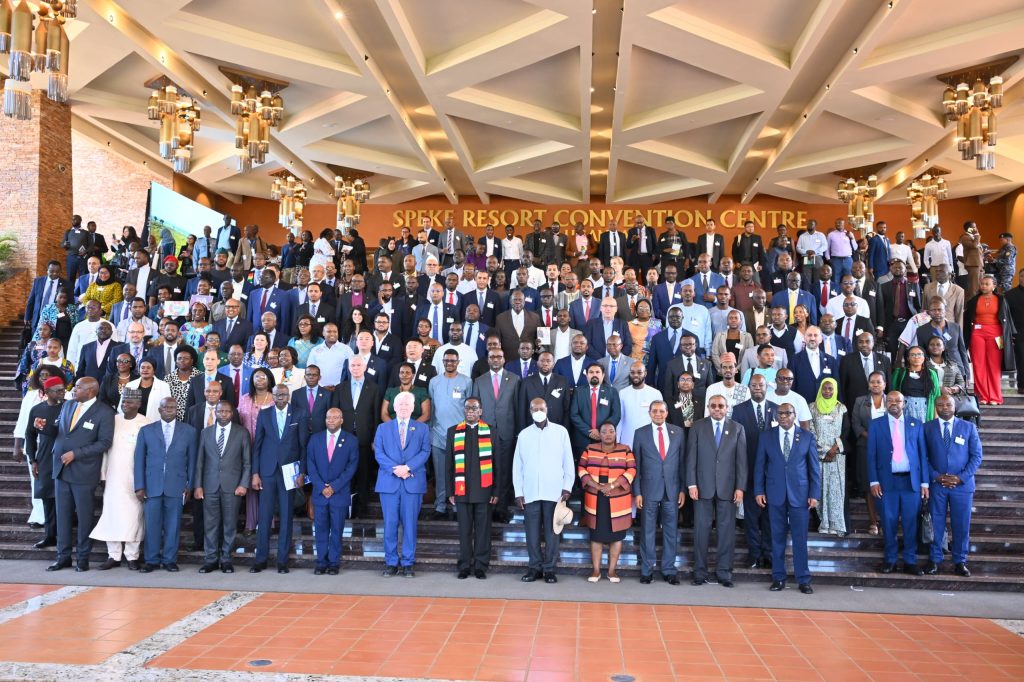
One of its defining strengths is its conferencing capacity. Over the years, Speke Resort Munyonyo has hosted some of the most important gatherings in Uganda’s modern diplomatic history.
In 2007, it hosted the Commonwealth Heads of Government Meeting (CHOGM), an event that placed Uganda at the center of global diplomacy. Heads of state, prime ministers, and international delegates gathered in Kampala, with Munyonyo serving as the main venue for discussions that shaped Commonwealth cooperation.
Speke Resort Munyonyo.
The success of CHOGM 2007 cemented the resort’s reputation as a trusted international meeting point. Since then, it has hosted numerous East African Community summits, African Union related ministerial meetings, security conferences, and investment forums involving both public and private sector leaders.
It has also hosted Uganda’s major national events, including economic summits, ruling party conferences, and high level government retreats where national development strategies are discussed.
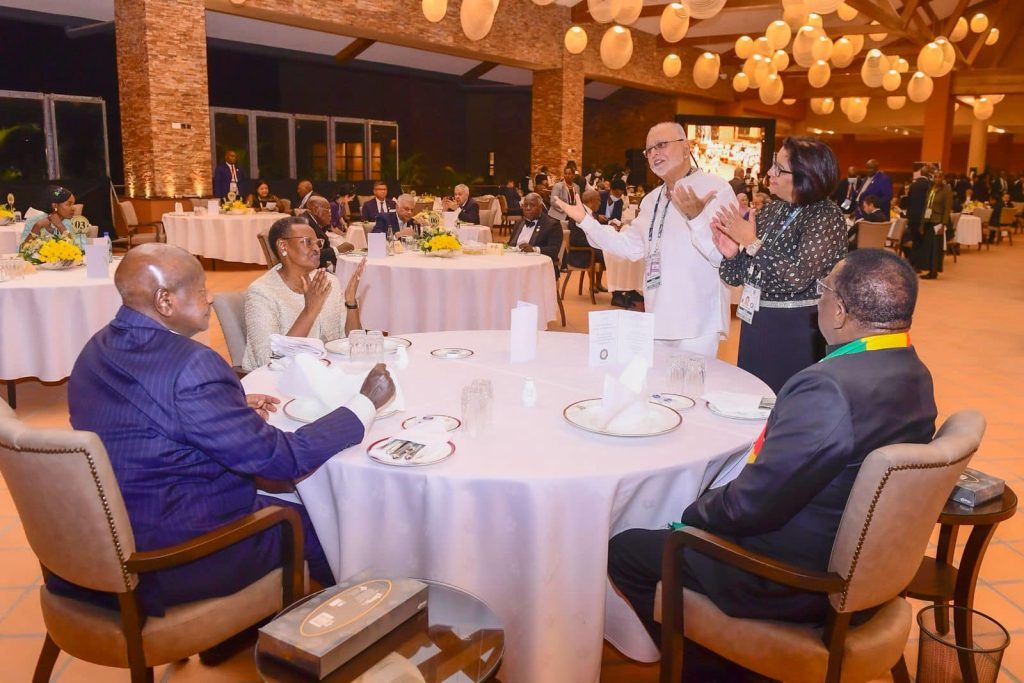
In 2024, the resort once again took center stage when Uganda hosted the Non-Aligned Movement (NAM) Summit. Delegations from across Asia, Africa, and Latin America gathered at Munyonyo, reinforcing its capacity to manage global-scale diplomacy with complex security and logistical requirements.
Other recurring events include regional trade negotiations, central bank meetings, health conferences, and international development forums involving multilateral institutions. The venue has become a consistent choice for East Africa’s most sensitive and high level engagements.
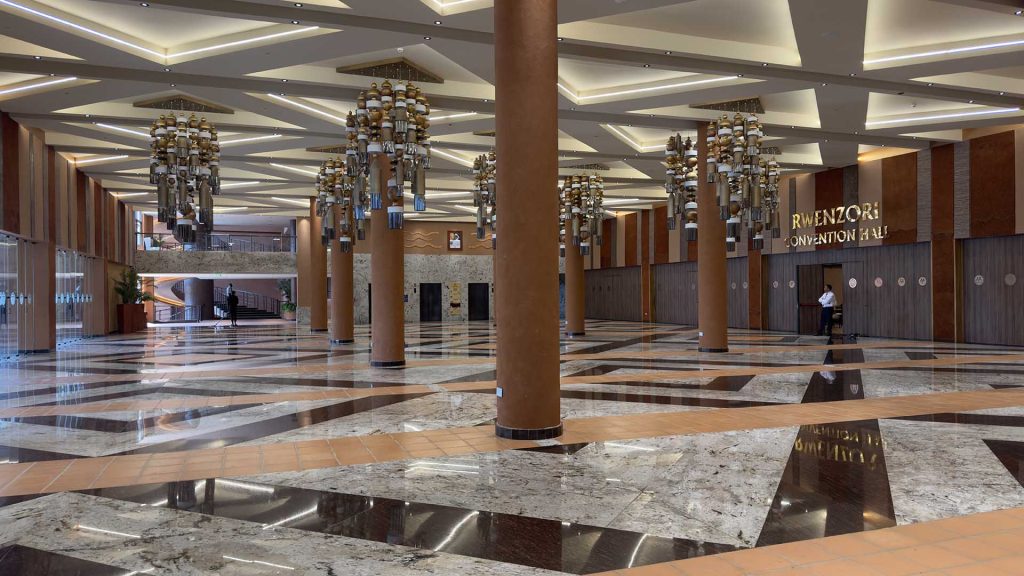
The infrastructure behind these events is extensive. The resort features large convention halls capable of hosting thousands of delegates, smaller breakout rooms for technical discussions, and outdoor spaces used for cultural exhibitions and official receptions. Advanced translation systems, digital conferencing tools, and live broadcast capabilities support international standards.
At peak international summits, the resort has the capacity to host as many as 20 heads of state at once, a rare capability in Africa, made possible by its expansive presidential suites, layered security systems, and purpose-built conference infrastructure.
Its accommodation capacity is equally significant, with hundreds of rooms and suites designed to meet varying levels of delegation needs. The most secure section includes presidential suites built for heads of state, offering private meeting rooms, reinforced security systems, and direct access to secured movement corridors.
Security planning is coordinated at the highest national level whenever major summits are held, allowing simultaneous presence of multiple world leaders in one controlled environment.
The resort’s physical features add to its appeal. A fully developed marina allows boats to operate on Lake Victoria, providing water transport, leisure cruises, and private diplomatic transfers. The equestrian center offers horse riding experiences within designated trails, adding a recreational layer to the hospitality experience.
The lakeside setting, within approximately thirty kilometers of key islands and water routes, enhances its tourism value. Guests are able to combine conferencing with leisure activities on Uganda’s largest natural water body.
Employment generated by the resort remains a major economic contribution. More than a thousand staff members work across hospitality, security, maintenance, catering, and event management departments. Many have received professional training in international hospitality standards, making the resort a key skills development center.
The resort’s reputation has also grown through recognition by international visitors. Among the most notable endorsements came from former Kenyan President Uhuru Kenyatta, who praised the facility during regional engagements in Uganda.
He described the resort as a model for African conferencing infrastructure and emphasized its suitability for regional integration meetings. In his remarks, he noted that such a facility could serve as a permanent venue for East African Community gatherings due to its scale, security, and conferencing capacity.
He added that Africa’s integration agenda required neutral, well equipped venues where leaders could meet consistently, and he identified Munyonyo as a strong candidate for that role. His remarks elevated the resort’s profile in discussions about regional institutional infrastructure.
In 2019, during the Africa Now Conference held at the venue, Zimbabwean billionaire businessman Strive Masiyiwa delivered one of the strongest endorsements of the facility’s conferencing quality.
Masiyiwa, who is the founder and chairman of Econet Wireless and one of Africa’s leading entrepreneurs, expressed admiration for the resort’s design and capacity. He compared it to several venues across the continent and highlighted its uniqueness.
He stated that African conferences often take place in constrained environments, but Munyonyo offered something different.
“I go all over Africa to conferences… and we come to this amazing venue,”he said in remarks delivered at the event.
He further praised the organization of the event, adding,“Thank you very much for organizing it. I will come every year if you want.”
He also made a strong suggestion regarding its continental role noting that it should be declared the African conference centre
“Why don’t we declare this venue the official African conference centre?”he asked.
His remarks were met with applause from delegates attending the conference, which was opened and closed by President Yoweri Museveni. The statement positioned Munyonyo as a serious contender for continental conferencing leadership.
The same conference highlighted the resort’s ability to host high level global conversations involving governments, private sector leaders, and development partners in one coordinated space.
Across its operations, the resort has also hosted international trade exhibitions, agricultural forums, legal conferences, technology summits, and tourism investment meetings. These events attract participants from across Africa, Europe, Asia, and the Americas.
Its design allows for parallel events to take place without disruption, making it suitable for multi-track conferences where political, economic, and technical sessions run simultaneously.
Recognition has also come through industry awards. The resort has previously been honored in international hospitality rankings, including World Luxury Hotel Awards, reflecting its performance in service delivery and guest experience.
At the center of its identity is consistency. Whether hosting a continental summit or a private corporate retreat, the resort maintains uniform standards in service, security, and presentation.
The expansion strategy of the Ruparelia Group continues to build on this foundation. Plans for additional five-star convention infrastructure, including expansion projects in Entebbe, are intended to strengthen Uganda’s position in the regional meetings industry.
From royal hunting grounds to global diplomatic space, Speke Resort Munyonyo has undergone a transformation that reflects both national ambition and private sector investment. It now stands as one of Africa’s most important venues for diplomacy, tourism and international conferencing.
Its story is one of scale, purpose and positioning. And as regional and global meetings continue to grow in Africa, Munyonyo remains firmly at the center of that shift.
The Uganda Law Society (ULS) has cautioned Dr. Lawrence Muganga against saying that constitutional scrutiny surrounding ministerial appointments is ethnic or racial hostility following the debate over his failed vetting for appointment as Minister of State for Internal Affairs.
In a statement issued on June 4, 2026, at ULS House in Kololo, the legal body emphasized that questions of eligibility for public office must be treated strictly as matters of constitutional and statutory compliance rather than personal or politically motivated attacks.
“Questions of eligibility for high public office are not personal attacks, but issues of constitutional and statutory compliance,”the statement reads
ULS anchored its position on Article 15(7) of the Constitution of Uganda, together with Section 23 of the Uganda Citizenship and Immigration Control Act (Cap. 313) and the Fifth Schedule, which restrict holders of dual citizenship from occupying certain state offices, including Cabinet and ministerial positions unless Parliament amends the law.
“Citizenship is fundamentally a personal matter. It becomes one of legitimate public interest, however, when an individual seeks appointment to a high public office with national security responsibilities,”the statement reads.
The Law Society noted that while citizenship is ordinarily private, it becomes a constitutional issue when linked to eligibility for senior public office, particularly positions connected to national security.
“Pursuant to Section 3(d) of the ULS Act, we strongly caution Dr. Muganga and his supporters against framing legitimate legal scrutiny as anti-Rwanda hatred, tribalism, or racism.”the statement further reads.
“Such statements, made without verification, risk polarizing public debate, weakening respect for the rule of law, and shifting focus from the constitutional requirements at stake,”it adds.
ULS further clarified that the matter should not be interpreted as xenophobia against dual citizens, noting that they remain valued members of Ugandan society in their private capacities.
“This matter does not reflect general xenophobia toward holders of dual citizenship. Dual citizens remain valued members of Ugandan society in their private capacities,”the statement reads.
However, the Law Society maintained that constitutional restrictions on certain offices exist to safeguard sovereignty and undivided allegiance.
Dr. Lawrence Muganga had been nominated for appointment as Minister of State for Internal Affairs, a senior position under the Ministry responsible for internal security, citizenship, immigration, and law enforcement coordination.
However, the Appointments Committee of Parliament reportedly declined to clear his appointment after raising concerns related to dual citizenship and constitutional eligibility requirements for ministerial office.
ULS has also called for greater transparency in parliamentary vetting processes, arguing that Rule 171(2) of Parliament’s Rules of Procedure limits public participation and should be reviewed.
The Law Society further confirmed that its Governing Council will formally request a report from the Parliamentary Appointments Committee to assess compliance with constitutional and statutory requirements in ministerial vetting.
The statement was signed by ULS President Isaac Ssemakadde, Vice President Asimwe Anthony, Treasurer Isiko Arthur, Acting Secretary Ssali Babu, and council members representing all regions of Uganda.
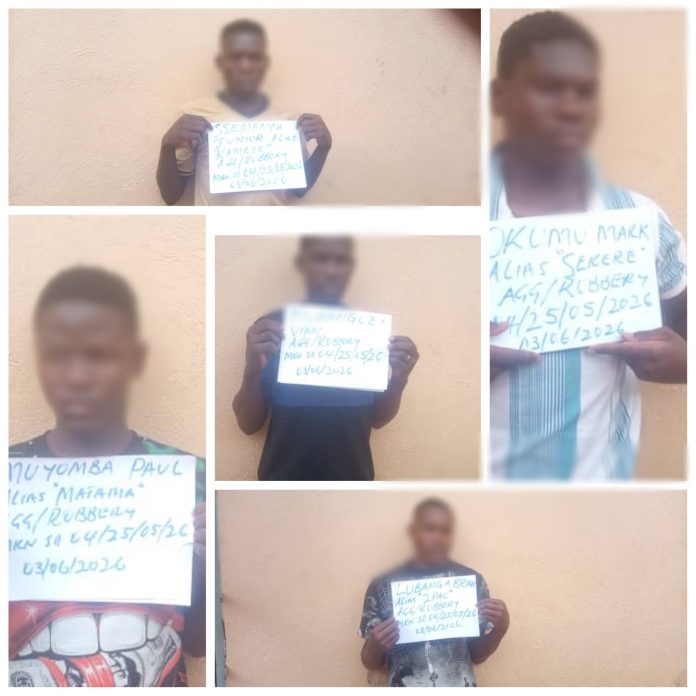
The Kampala Metropolitan Police East has dismantled a violent robbery syndicate that has been terrorising residents of Mukono Municipality and nearby areas following a coordinated intelligence-led operation that led to the arrest of several suspects and recovery of key exhibits.
Police said the gang, locally known as the Eggaali group, had been attacking residents along Kayunga Road, Kusatu, Nasuuti and Wantoni areas, targeting victims with weapons including knives, pangas and pavers before robbing them of mobile phones, cash, laptops, bags and wristwatches.
The breakthrough followed multiple reports of aggravated robberies, including a case registered on May 25, 2026 at Mukono Central Police Station under SD Reference Number 04/25/05/2026, in which a technician was attacked and robbed while returning home.
Acting on intelligence leads, police conducted an operation on May 31, 2026 and arrested Muhanguzi Vian, aged 25, who reportedly confessed to involvement in several robberies and implicated his accomplices.
He later guided officers to a hideout in Kigombya Cell, where the gang is alleged to have been operating from during the day before embarking on night robberies. At the location, police arrested Mubiru David alias City aged 20, Kizito Solomon alias Kitama aged 18, Ssemanda Junior alias Kamese aged 17, Muyomba Paul alias Matama aged 17, and Okumu Mark alias Sekere aged 18.
The suspects reportedly admitted during interrogation that they had carried out numerous robberies across Mukono Municipality.
A search at the hideout led to the recovery of several items, including a burdizzo, pruning machine, hammer, scissors, six wristwatches, suspected opium, counterfeit currency in denominations of 20,000 and 50,000 shillings, 18 SIM cards, a torch, two face masks, two heavy-duty door cutters, eight knives including a butterfly knife, and six phone chargers.
Police further arrested the alleged ringleader, Lubanga Brian alias 2PAC, as investigations continue to dismantle the wider network.
Kampala Metropolitan Police spokesperson Rachael Kawala said the operation was part of ongoing efforts to rid communities of violent criminals.
“We remain committed to intelligence-led policing and will continue pursuing all individuals involved in organised criminal activity until they are brought to justice,” Kawala said.
Police added that the operation is ongoing as efforts continue to track down remaining suspects linked to the gang.
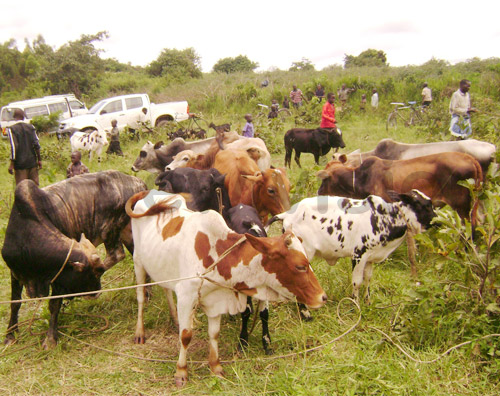
Some of the cows meant for restocking the Teso sub-region.
The government has disbursed funds to only 559 households out of the targeted 16,000 under the Shs80 billion cattle restocking programme covering Acholi, Lango and Teso sub regions as the financial year comes to an end.
According to the Office of the Prime Minister, this represents a very small fraction of the intended rollout, with only Shs2.8 billion released so far, equivalent to about 3.5 percent of the total budget. Each beneficiary is expected to receive Shs5 million to purchase five cattle, consisting of three heifers and two bulls.
In a statement issued on June 1, 2026, the government attributed the slow progress to delays by four districts that have not uploaded beneficiary information into the Parish Development Management Information System. The affected districts are Lamwo, Nwoya, Pader and Agago.
The statement indicated that 11,504 beneficiaries have so far been captured in the system, representing 71.9 percent progress toward the target.
However, the absence of data from the four districts has disrupted verification and payment processes.
The Office of the Prime Minister warned that implementation is being held back by the incomplete data submission, urging district leaders and technical teams to speed up the process in order to avoid further delays.
To prevent misuse of funds, government emphasized that no money will be channeled through parish chiefs or parish development committees. Beneficiaries were also cautioned against signing or providing confirmation of receipt before funds are deposited directly into their registered bank accounts or mobile money wallets.
Payments are being processed through the PearlBank Wendi mobile wallet system, which government says is intended to reduce cases of ghost beneficiaries and leakage that have affected past agricultural support programmes.
The restocking initiative, which targets 33 districts across the three sub-regions, was adopted following a presidential directive issued in November 2025 aimed at restoring livestock lost to cattle rustling and prolonged insecurity.
Despite the system being in place, the Office of the Prime Minister did not explain why only 559 households have received payments so far.
Government has urged local leaders to remain vigilant during beneficiary selection and verification, warning that weak controls could open space for fraud and exclusion errors.
As the 30 June 2026 deadline approaches, authorities are racing to complete the initial phase of disbursements. However, unless the outstanding districts submit their data promptly, the programme is unlikely to meet its target within the planned timeline.
The Office of the Prime Minister maintains that it remains committed to ensuring all eligible households benefit from the programme in a transparent and accountable manner, although thousands of intended beneficiaries are still waiting for support.
Today (Monday), I travelled from Kampala to Mbale, a journey I have made many times before. Yet this trip was different. It left me reflecting deeply on how much Uganda has changed over the last decade.
The last time I spent significant time in Mbale was nearly ten years ago. I was then a young, busy lawyer handling several matters before the High Court in Mbale. At the time, Mbale was a typical old provincial town—dusty, poorly maintained, and lacking the dynamism one would expect from a major regional centre.
Returning today, I could hardly believe what I was seeing.
Mbale has undergone a remarkable transformation. The streets are cleaner, the town is busier, and commercial activity appears to be thriving. Well-lit roads, numerous commercial banks, financial institutions, modern buildings, and a vibrant business community have given the town an entirely new character. The impressive Sino-Mbale Industrial Park stands as a visible symbol of industrialisation and economic ambition.
Even the Mbale Golf Club, which I intend to visit for a game, appears remarkably well-maintained and active. It is difficult to reconcile the Mbale of today with the town I knew a decade ago.
The transformation, however, is not confined to Mbale itself.
Driving along the Tirinyi-Mbale road, I was struck by the scale of development taking place throughout the region. Roads that once felt lonely now carry heavy traffic. Trading centres have expanded into bustling townships. New administrative units and districts have accelerated urbanisation and service delivery. Areas that were once quiet and underdeveloped are now characterised by construction, commerce, and growing populations.
Perhaps most striking was the transformation in agriculture.
The traditional sight of cassava spread along the roadside for drying—a familiar feature of the Eastern Uganda landscape—has become far less common. In its place are vast stretches of productive farmland. Maize plantations, rice fields, and sugarcane farms dominate the landscape. Land that was once idle or bush-covered is now actively cultivated.
What I witnessed today challenges many of the narratives frequently heard in urban discussions.
There remains a tendency among some Ugandans, particularly those whose perspective is shaped primarily by life in Kampala, to believe that little is changing in the country. Yet the reality on the ground suggests something very different. Significant economic and social transformation is occurring beyond the capital, often away from media headlines and public debate.
Those who continue to view rural Uganda through the lens of the past may be in for a surprise. The distinction between “town” and “village” is becoming increasingly blurred. Across much of the country, communities are becoming more connected, more productive, and more commercially active.
As a researcher and academic, I recognise the limitations of relying solely on personal observation. Anecdotes are not data. More rigorous research is needed to understand the drivers of these changes and to measure their true impact. Nevertheless, the evidence visible from the roadside is difficult to ignore.
One area that deserves serious consideration is the revival of the cooperative movement and the establishment of a strong cooperative banking system.
My doctoral research focused on financial access, and I remain convinced that affordable and accessible credit can fundamentally transform communities. Around the world, cooperative institutions have demonstrated their ability to mobilise savings, extend credit, and support local enterprise. Uganda has a rich history of successful cooperatives, and there is a strong case for reinvigorating that tradition.
Government programmes such as the Parish Development Model (PDM), Emyooga, and related initiatives are often discussed alongside Uganda’s politics, which many people find frustrating and, at times, deeply discouraging. Indeed, there are Ugandans who have become so disillusioned with politics that they have lost hope and simply given up. Yet giving up comes with its own risks. My journey from Kampala to Mbale reminded me that while political debates often dominate public attention, profound changes are taking place on the ground. The earlier we wake up and engage constructively rather than merely lamenting, the better, because some individuals, communities, and institutions have already moved into a fully transformative mode.
This is not a uniquely Ugandan phenomenon. I know many people who are equally disgusted with the state of politics in the United States and in several parts of Europe. Politics can be better, and it should be better. However, it would be unfortunate if dissatisfaction with politics prevented us from recognising genuine progress or participating in shaping a better future. These programmes may well have contributed to some of the progress now visible in many parts of the country. Their precise impact requires careful evaluation. However, one persistent challenge remains the perception among some beneficiaries that such programmes are merely handouts.
A cooperative-based lending model could help address this challenge. When communities borrow through cooperatives or cooperative banks, there is often greater accountability, stronger peer monitoring, and a clearer appreciation that loans must be repaid and invested productively. This creates a culture of ownership and responsibility that can accelerate development.
My journey to Mbale was more than a road trip. It was a reminder that Uganda is changing, often in ways that are not immediately visible to those who remain within the confines of the capital city. The transformation may not be uniform, and many challenges remain. Yet it would be a mistake to overlook the progress taking place across the country.
The Uganda of today is not the Uganda of ten years ago. Anyone who doubts that should take a drive from Kampala to Mbale and see for themselves.
Dr. Moses Byaruhanga is a Lecturer of Business and Law at Makerere University. He can be reached at mgbyaruhanga@gmail.com.
Dr Lawrence Muganga at Parliament before interfacing with the Appointments Committee.
The Parliamentary Appointments Committee, in assessing the eligibility and suitability of Dr. Lawrence Coreta Muganga for appointment as Minister of State for Internal Affairs, based on key issues, arrived at its conclusion on whether the nominee for State Minister for Internal Affairs merited the post.
The central issue is whether a person with a documented history of foreign citizenship, multiple passports, delayed regularisation of dual citizenship, unresolved Rwanda-related nationality questions, and possible dual-citizenship disqualification can lawfully and credibly serve as a Minister supervising immigration, citizenship, passports, national identification, and internal security.
Legal Framework
Section 19D of the Uganda Citizenship and Immigration Control Act, as amended in 2009, provides a Fifth Schedule of offices that a person holding dual citizenship is not qualified to hold. The Fifth Schedule includes:
“Cabinet Minister and other Ministers.”
This is directly relevant because the nominee is proposed for appointment as Minister of State for Internal Affairs, which falls within the category of “other Ministers.” The Directorate of Citizenship and Immigration Control also lists the 2009 Amendment Act as the operative legal framework on dual citizenship.
Therefore, the Committee must first determine whether the nominee currently holds dual citizenship. If he does, the legal question is not merely suitability; it becomes statutory disqualification under Section 19D and the Fifth Schedule.
Sept 01, 2005 Rwandan Passport PC033309. Nationality shown as Rwandan; was Ugandan citizenship renounced, lost, retained, or concealed? November 16, 2009 Rwandan Passport PC099993. Nationality shown as Rwandan. Second Rwandan passport confirms continuity of Rwandan citizenship documentation Jan, 22, 2016 Canadian Passport HG689873. Nationality shown as Canadian, confirming Canadian citizenship by 2016. The year 2021 Ugandan National ID. Nationality shown as Ugandan. Issued before Uganda dual citizenship certificate of 2024. On Nov, 8, 2024, the Uganda dual citizenship certificate and Canada do not mention Rwanda. On Feb, 19, 2026, Uganda diplomatic passport D00003506; nationality shown as Ugandan and was issued despite dual citizenship and Rwanda questions
Principal Anomalies
4.1 How did Dr Muganga acquire Rwandan citizenship while he claims he was born in Uganda?
The Rwandan passports show:
Name: Lawrence Muganga.
Nationality: Rwandan.
Place of birth: Mukono, Uganda.
Issue dates: 2005 and 2009.
This raises critical questions:
a. On what basis did Rwanda issue passports to a person born in Mukono, Uganda? b. Did he acquire Rwandan citizenship by registration, naturalisation, descent, adoption, or another process? c. Did Muganga renounce Ugandan citizenship before becoming Rwandan? d. Did he notify Ugandan authorities that he had become Rwandan? e. Did he continue to present himself as Ugandan while holding Rwandan passports?
4.2 Did Muganga fail to explain or just conceal Ugandan citizenship status after Rwandan naturalisation?
If he acquired Rwandan citizenship before Uganda’s dual citizenship framework was regularised, the committee must establish whether Ugandan citizenship was lost, retained, reacquired or irregularly assumed.
The key question is:
What was his Ugandan citizenship status from 2005 to 2024?
4.3 Canadian Citizenship in 2016, but dual citizenship certificate only in 2024
The Canadian passport shows Canadian nationality from at least 2016.
The Ugandan dual citizenship certificate is dated November, 8, 2024.
This creates an eight-year gap.
Questions:
a. Did he apply to retain Ugandan citizenship immediately after becoming Canadian? b. Did he declare Canadian citizenship to Uganda between 2016 and 2024? c. What was his legal status in Uganda during this period? d. Did he hold himself out as Ugandan before regularisation?
4.4 Was the Ugandan National ID issued before the dual citizenship certificate?
However, Muganga didn’t indicate that the Ugandan National ID was obtained in 2021.
The dual citizenship certificate came in 2024.
This is a serious sequencing anomaly.
If he was already Canadian and previously Rwandan, then the committee must ask:
a. How did he qualify for a Ugandan National ID before formal dual citizenship registration? b. Did he disclose his Canadian citizenship to NIRA? c. Did he disclose his Rwandan citizenship to NIRA? d. Was the National ID issued on incomplete or inaccurate citizenship information? e. Was NIRA aware that he had held foreign passports?
Dual citizenship and ministerial disqualification
The 2024 certificate expressly states that he is registered as a dual citizen of Uganda and Canada.
Section 19D/Fifth Schedule disqualifies a person holding dual citizenship from holding the office of:
“Cabinet Minister and other Ministers.”
Therefore, unless he has formally renounced Canadian citizenship and ceased to be a dual citizen, he is not qualified to hold appointment as Minister of State for Internal Affairs.
The committee should demand:
a. Certificate of renunciation of Canadian citizenship. b. Official Canadian confirmation of loss of Canadian citizenship. c. Ugandan immigration confirmation that he is no longer a dual citizen. d. Confirmation that he does not hold Rwandan citizenship.
Possible Triple Citizenship Problem
The Ugandan dual citizenship certificate only mentions Canada.
It does not address the Rwandan passports.
This raises a major omission:
a. Was Rwandan citizenship disclosed in the 2024 dual citizenship application? b. Had Rwandan citizenship been renounced before the Uganda–Canada dual citizenship certificate was issued? c. If not, did Uganda unknowingly issue a dual citizenship certificate to a person who already held another foreign nationality? d. Was the dual citizenship certificate incomplete or obtained through non-disclosure?
Diplomatic Passport Anomaly
The Ugandan diplomatic passport was issued on Feb, 19, 2026.
This raises serious concerns:
a. How did a dual citizen obtain a Ugandan diplomatic passport? b. What security vetting was conducted? c. Did the approving authority consider Section 19D? d. Did he disclose Canadian citizenship? e. Did he disclose Rwandan citizenship history? f. Was a person with unresolved foreign citizenship questions properly eligible for diplomatic passport privileges?
Identity and Name History
Information available to you indicates that he lived with the family of the late Mzee Muganga, father of current RDF Chief of Defence Staff Gen Mubarakh Muganga.
This raises identity-vetting questions:
a. What was his birth name? b. When did he become Lawrence Muganga? c. Was the name Muganga acquired formally through legal name change? d. Was the name change declared in Rwanda, Canada and Uganda applications? e. Did all passports and identity documents rely on the same birth records? f. Did he ever use another name in Uganda, Rwanda or Canada?
Foreign association and security sensitivity
For an ordinary citizen, foreign family or social connections may not be decisive. For a proposed Minister of State for Internal Affairs, they are materially relevant.
The Ministry of Internal Affairs supervises:
a. Immigration. b. Citizenship. c. Passports. d. National IDs. e. Border control. f. Refugee and alien control systems. g. Internal security coordination.
A nominee with close Rwanda-linked identity history, foreign citizenship records and diplomatic engagement must make full disclosure before approval.
Required documents before approval
The Committee should demand:
a. Full NIRA registration file. b. Full Directorate of Citizenship and Immigration Control file. c. Dual citizenship application forms. d. All declarations submitted for dual citizenship. e. Canadian citizenship acquisition records. f. Canadian citizenship renunciation certificate, if any. g. Rwandan citizenship acquisition records. h. Rwandan citizenship renunciation certificate, if any. i. All Ugandan passport application forms. j. Diplomatic passport authorisation file. k. Security vetting report. l. Name-change records. m. Birth certificate and original identity records. n. Any Immigration Board minutes approving dual citizenship.
Questions for the Nominee
Are you currently a Canadian citizen?
Have you formally renounced Canadian citizenship?
Are you currently a Rwandan citizen?
Have you formally renounced Rwandan citizenship?
Were you issued Rwandan passport numbers PC033309 and PC099993?
Were you issued Canadian passport number HG689873?
Why did Uganda issue your dual citizenship certificate only in 2024?
What was your Ugandan citizenship status between 2016 and 2024?
Did you obtain a Ugandan National ID in 2021?
Did you disclose Canadian citizenship to NIRA in 2021?
Did you disclose Rwandan citizenship to NIRA in 2021?
Did you disclose Rwandan citizenship when applying for Uganda–Canada dual citizenship?
What is your original birth name?
Did you ever use the name Ssenyondo Kakoza?
What is the legal basis for the surname Muganga?
Did you live with the family of the late Mzee Muganga in Rwanda?
Do you have any familial, legal or political association with Gen Mubarakh Muganga?
On what basis did you obtain a Ugandan diplomatic passport in 2026?
How do you reconcile your dual citizenship certificate with Section 19D, which bars dual citizens from serving as Ministers?
Recommended Committee Position
The Committee should not approve the nominee unless and until:
a. He proves that he is not a dual citizen. b. He proves that he has renounced Canadian citizenship. c. He proves that he has renounced Rwandan citizenship, if he ever held it. d. He explains the 2021 National ID versus 2024 dual citizenship sequencing. e. He produces all relevant citizenship, passport, NIRA and immigration files. f. The Attorney General gives a formal written opinion on Section 19D disqualification.
Conclusion
The documentary record presents a serious eligibility problem.
The nominee has documented Rwandan passport history, documented Canadian nationality, a Ugandan National ID obtained before the dual citizenship certificate, a Uganda–Canada dual citizenship certificate issued in 2024, and a Ugandan diplomatic passport issued in 2026.
Most importantly, Section 19D and the Fifth Schedule of the Uganda Citizenship and Immigration Control Act disqualify a person holding dual citizenship from serving as Cabinet Minister or other Minister.
Unless Dr. Lawrence Muganga has formally and conclusively renounced all foreign citizenships, he is not suitable for approval as Minister of State for Internal Affairs.
The appointment should therefore be withheld pending full legal, citizenship, immigration, identity and security verification.
The evolution of online gaming has significantly transformed the industry. Over the years, player expectations have shifted from simply seeking exciting gameplay to prioritizing convenience, accessibility, and entertainment that complements busy lifestyles. Platforms that deliver seamless integration into daily routines now dominate, creating a demand for entertainment that doesn’t require hours of focus but still remains enjoyable.
SpinPlus has emerged as one of the most talked-about gaming hubs, offering a modern alternative for players who value streamlined gameplay and effortless access. Within SpinPlus PH communities, discussions highlight a growing preference for platforms designed to prioritize simplicity and steady player engagement. SpinPlus removes the clutter and complexity often associated with traditional gaming, giving users a more polished experience that resonates with the needs of today’s gamers.
For players who enjoy competitive card games on GameZone PH—like Tongits, Pusoy, and Pusoy Dos—SpinPlus offers an entirely new dimension to online gaming. Whether you’re exploring fresh options for the very first time or branching out from familiar titles, understanding SpinPlus opens up more gaming opportunities.
A Different Approach to Online Gaming
SpinPlus is built on accessibility and convenience, offering intuitive features that streamline every aspect of the user experience. Unlike platforms with complex systems that require learning curves, SpinPlus delivers a straightforward setup that players can grasp instantly.
First-time users often note how smoothly they can navigate the platform. Menus are simple to explore, making games easily accessible without the frustration of excessive clicks or complicated controls. Instead of getting bogged down in tutorials or complex interfaces, players can immediately enjoy the entertainment SpinPlus offers.
In an industry inundated with options, simplicity remains one of the most sought-after features. SpinPlus’s ability to prioritize this aspect is why it performs so well in a fast-paced, digitally saturated world.
Designed for The Modern Gamer
SpinPlus caters to individuals who value flexible entertainment options, offering quick, enjoyable sessions that fit effortlessly into busy routines. The platform is made for players who don’t have hours to dedicate to gaming and prefer fast-paced alternatives that keep them engaged while accommodating their schedules.
Here are some key features that make SpinPlus a natural fit:
Navigation: Streamlined menus reduce time spent figuring out how the platform works.
Mobile Accessibility: Device-friendly interfaces ensure players can enjoy games via smartphones or tablets.
Fast Gameplay: Responsiveness ensures minimal downtime, allowing sessions to flow seamlessly.
Flexible Play: Players can jump in and out of games as time permits, without strict commitments.
Easy Learning Curve: Beginners can enjoy games without the struggle of learning complex mechanics.
By focusing on these critical elements, SpinPlus makes gaming easier for users who divide their time between work, family, and personal pursuits. Entertainment becomes something players can dive into effortlessly, delivering fun without disruptions.
What Sets SpinPlus Apart?
A core reason for SpinPlus’s growing presence in the gaming community is its alignment with psychological preferences for relaxation and enjoyment. Players are drawn to platforms that deliver instant gratification, simple participation, and consistent excitement. SpinPlus achieves this balance by creating a stress-free environment that prioritizes engagement over complexity.
Games on the platform offer satisfying feedback loops, maintaining anticipation and excitement while remaining accessible. SpinPlus simplifies the gaming process, catering especially to casual players who want stress-free options during breaks or downtime.
Complementing Traditional Favorites
Competitive games such as Tongits, Pusoy, and Pusoy Dos rely on strategic thinking and mastery. While these titles are great for skill-focused sessions, SpinPlus complements them by offering gaming experiences that are lighter and faster-paced.
The platform appeals to players who enjoy variety. One session could involve intense strategy-driven tournaments, while the next could be more relaxed through the instant entertainment SpinPlus provides. It’s not a replacement for traditional titles but an addition that broadens how players interact within GameZone PH.
SpinPlus’ Role in GameZone PH
SpinPlus extends the functionality of GameZone PH, which is largely known for its collection of competitive card games. Players can cycle between strategic battles and fast-paced gameplay, ensuring their experience remains fresh and engaging.
This integration creates a comprehensive gaming ecosystem, offering simplicity alongside complexity. This variety encourages long-term engagement, drawing both new users and seasoned players into the mix.
What Keeps Players Enthralled?
Several benefits raise SpinPlus above its competition in the online gaming space:
Accessibility: Intuitive designs help first-time users jump straight into the action.
Convenience: Sessions can adapt to individual schedules, no matter the time of day.
Mobile Compatibility: Multi-device accessibility enhances flexibility for users who prefer gaming on the go.
Short Play Sessions: The platform minimizes commitment, making it perfect for users with limited time.
User-Friendly Design: Thoughtfully constructed layouts reduce frustration and boost player satisfaction.
These features help SpinPlus stand out as a fitting choice for gamers who recognize the benefits of convenience-driven options in modern life.
Responsible Gaming at SpinPlus
Responsible gameplay plays a vital role in creating sustainable enjoyment. SpinPlus’s fast-paced mechanics can sometimes lead players to lose track of time or fall into patterns of emotional decision-making, especially when chasing losses.
Players who rely on effective gaming habits, such as setting session budgets or scheduling breaks, find themselves better equipped to balance gaming with other aspects of their lives. Healthy engagement ensures SpinPlus remains a positive source of entertainment rather than a distraction.
A Platform Reshaping Playing Experiences
SpinPlus continues to evolve alongside players’ expectations. Accessibility and flexibility remain its strongest aspects, while its integration with GameZone PH further strengthens its appeal. Competition-driven sessions are balanced by the lighthearted and fast-paced nature of SpinPlus gameplay, making the platform versatile.
For gamers who dabble in skill-heavy games like Tongits or Pusoy, SpinPlus gives them a break with options for casual entertainment. Its ability to support modern habits enhances its value while creating a platform that stays relevant as player preferences evolve.
Elevating Online Gaming Standards
SpinPlus redefines what accessible, simple, and mobile-friendly gaming looks like. The platform excels by blending intuitive mechanics with seamless engagement, removing the barriers that deter casual players. Its streamlined approach resonates with those looking for quick entertainment without overwhelming distractions.
By offering a unified system within GameZone’s established ecosystem, SpinPlus adds to the rich variety available to players. The ability to switch effortlessly between both competitive and casual options enriches the overall experience, ensuring something for every player’s mood or schedule.
SpinPlus maintains its reputation as a platform driving innovation in online gaming, delivering standout experiences that reflect modern gaming lifestyles.