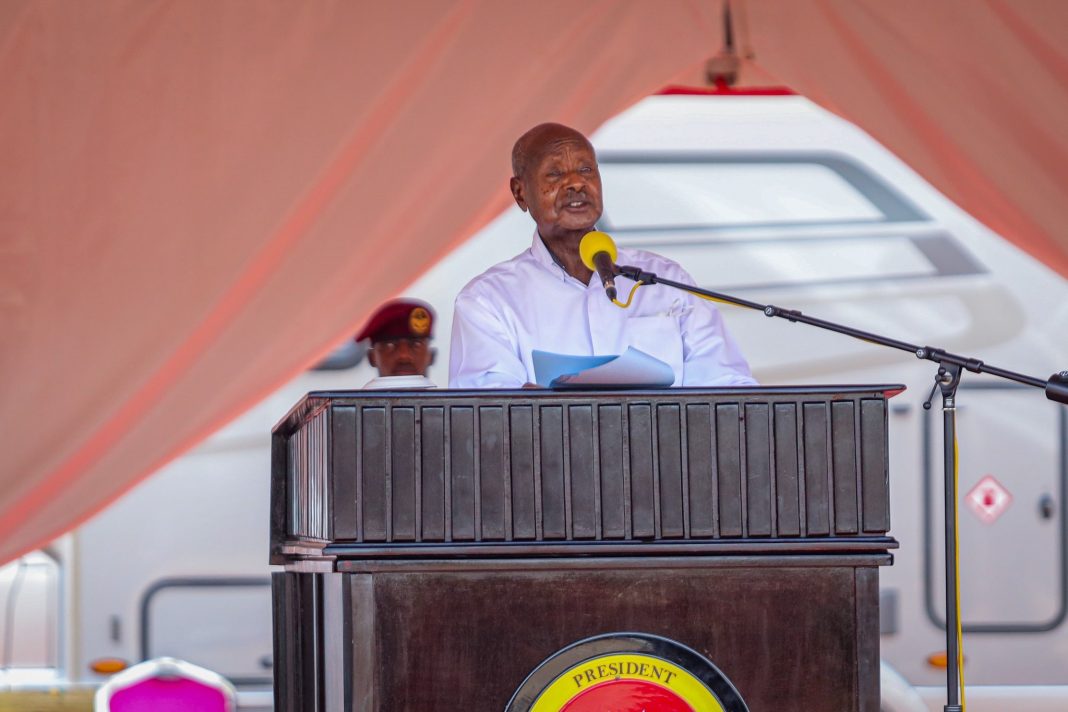
President Yoweri Kaguta Museveni has unveiled a comprehensive legislative programme for the 2026/27 financial year, presenting 38 bills and policy instruments aimed at deepening Uganda’s economic transformation, strengthening governance systems and accelerating wealth creation across key sectors of the economy.
The legislative agenda, presented during his State of the Nation Address (SONA) to Parliament, spans ministries including energy, education, health, agriculture, security, infrastructure, labour, lands, ICT and finance. It also includes major tax reform proposals, financial accountability reports, and institutional amendments intended to support long term development goals.

Museveni said Uganda has continued to register strong economic recovery and growth, driven by increased production, infrastructure expansion, and a shift of more households into the money economy.
“The facts of the matter are that with the limited waking up, where 67% of the homesteads as compared to 9% in 1962 are now in the money economy, Uganda has graduated from the Least Developed Countries to a Lower Middle Income Country,” he said.
He noted that Uganda’s economic progress has been anchored on peace, infrastructure development, and deliberate government programmes designed to move citizens from subsistence production into commercial agriculture, manufacturing, services, and ICT.

“The NRM has identified all the requirements for building a prosperous Uganda. The NRM has also provided for the means for individuals, families or companies that want to be part of the social economic transformation story,” Museveni said.
He highlighted major achievements in agriculture, especially dairy production, pointing to the transformation of the cattle corridor from subsistence livestock keeping to commercial production linked to national and export markets.
He said milk production has grown from about 200 million litres in 1986 to 5.4 billion litres today, contributing to import substitution and export earnings. He also pointed to increased production of coffee, maize, bananas, cassava, sugar and other commodities as evidence of structural change in the economy.
Museveni said the government continues to promote the four sector model of commercial agriculture, manufacturing, services and ICT as the backbone of Uganda’s economic transformation, arguing that growth in these areas is key to job creation and wealth expansion.
He also emphasized the importance of financial inclusion programmes such as the Parish Development Model, Emyooga, Operation Wealth Creation and NAADS, saying these interventions are designed to support households transitioning into the money economy.
“We are always creating other funds for the ghettoes, for the musicians and others. The question is how do we ensure all Ugandans participate in wealth creation,” he said.
The President used the address to reinforce his long standing message on productivity and discipline, urging leaders and citizens to eliminate practices he said undermine development.
“We must ensure that there is no more sleep; no more kukongola; no more corruption; no more kugumaaza; and no more politeness towards non performers,” he said.
He further stressed that Uganda’s development model depends on integrating all citizens into productive economic activities, including smallholder farmers, artisans, traders and ICT operators, especially as land becomes more limited due to population growth.
Museveni also highlighted major infrastructure developments, including expansion of national roads, regional transport corridors, railway rehabilitation, and pipeline projects with neighbouring countries. He said these investments are designed to reduce transport costs and improve competitiveness in regional markets.
He added that Uganda is strengthening peace and security institutions, noting that the Uganda People’s Defence Forces, Police and Judiciary play a critical role in maintaining stability, which he described as essential for economic growth.
Museveni also pointed to macroeconomic stability, noting improvements in GDP growth, reduction in poverty levels, increased life expectancy and expansion of exports. He said Uganda’s GDP has grown significantly over the past four decades, supported by diversification and value addition.
He further said Uganda is preparing for a major expansion in energy production, including hydro, solar, gas, wind, nuclear and geothermal sources, targeting up to 50,000 megawatts in future capacity to support industrialisation.
On the legislative side, Museveni’s 38 bills include reforms in education to revise university and curriculum frameworks, health sector amendments covering pharmaceuticals and professional regulation, agriculture laws to strengthen food systems, and transport reforms including a new Uganda Railways Bill.
Other key proposals include tax amendment bills under the Ministry of Finance, land and real estate regulation reforms, ICT legal updates, labour law amendments and new frameworks for national security coordination.
He said these reforms are intended to support long term stability, efficiency and accountability in government systems while ensuring that Uganda remains competitive in the regional and global economy.
Museveni called on leaders to ensure implementation of government programmes at all levels of leadership, insisting that transformation depends on action at the grassroots.
“Thanks, and let us work differently,” he said.