Victoria University has announced its October/November 2026 intake, inviting prospective students to apply for its four-year Bachelor of Science in Human Nutrition and Dietetics as the institution continues to expand its health sciences and technology-focused academic offerings.
The programme, advertised as part of the university’s 2026 intake, is designed for students seeking careers in nutrition, dietetics, public health, clinical care, community nutrition and food service management.

According to Victoria University, the degree combines classroom learning with practical experience and prepares graduates to work across three major areas of dietetics: therapeutic nutrition, community nutrition and foodservice management.
The university says students are trained to assess nutritional needs, develop nutrition interventions and apply evidence-based approaches to improving the health of individuals and communities.
Graduates can pursue careers as nutritionists, community nutrition officers, public health nutrition officers, nutrition educators, nutrition programme officers, nutrition researchers and food and nutrition quality assurance officers, among other roles. Employment opportunities include hospitals, health centres, government institutions, NGOs, humanitarian agencies, schools, research institutions and food processing companies.

The programme is available to both Ugandan and international students who meet the required admission qualifications. Victoria University’s official programme information lists direct-entry requirements including the relevant UCE and UACE qualifications, while holders of recognised diplomas in Human Nutrition and Dietetics or related health fields may also be considered.
The university’s current undergraduate catalogue lists the Bachelor of Science in Human Nutrition and Dietetics under the Faculty of Health Sciences, alongside programmes including Nursing Science, Public Health and Pharmacy.
The October/November intake comes at a time when Victoria University is positioning itself increasingly around technology, innovation and artificial intelligence, in addition to its traditional academic programmes.
The university has publicly announced plans to build what it describes as the largest AI Centre in Sub-Saharan Africa, signalling an ambition to make artificial intelligence a major component of its education and innovation agenda.
Victoria University has also been integrating AI into its learning environment, saying the move is intended to “future-proof” students’ education and prepare them for workplaces increasingly shaped by artificial intelligence.
In April 2025, the university announced free AI training for students alongside their regular courses, while its AI initiative has since expanded into an AI learning platform offering courses, an AI tutor and other technology-enabled learning tools.
The university’s current undergraduate catalogue also lists a Bachelor of Science in Artificial Intelligence and Data Science, alongside Computer Science, Software Engineering, Cyber Security and Digital Forensics, Business Computing and Data Analytics and Information Technology.
The development reflects a broader effort by the institution to ensure that students in different disciplines acquire skills relevant to an increasingly digital economy, rather than restricting AI training to technology students.
For students pursuing health-related programmes such as Human Nutrition and Dietetics, the growing role of digital technologies and AI could also provide opportunities to engage with data-driven approaches to health research, nutrition assessment and evidence-based practice.
Victoria University began its mission in 2013 and has since developed into a chartered higher education institution offering diploma, undergraduate, postgraduate and professional programmes.
The university says it was awarded a charter in August 2022, a milestone that recognised its development and compliance with national and international higher education standards.
The institution has built its academic identity around experiential and work-integrated learning, with its academic information stating that students are exposed to practical workplace experience alongside classroom instruction.
Its current undergraduate catalogue contains 56 programmes spread across the Faculty of Science and Technology, Faculty of Business and Management, Faculty of Humanities and Social Sciences, Faculty of Health Sciences, the School of Law and the Institute of Education and Lifelong Learning.
Beyond undergraduate studies, Victoria University also offers postgraduate training in areas including global health nutrition. Its Master of Science in Global Health Nutrition, for example, focuses on nutrition challenges in low and middle-income countries and prepares graduates for research, teaching, public health nutrition, nutrition education and policy and programme planning.
The university has also developed a Higher Education Certificate in Biological Sciences that provides an alternative pathway for students seeking to progress into health sciences programmes, including Human Nutrition and Dietetics, Public Health, Nursing and Midwifery.
For the October/November 2026 intake, the university’s Human Nutrition and Dietetics programme offers both on-campus and online delivery options, with the full-time degree taking four years to complete.
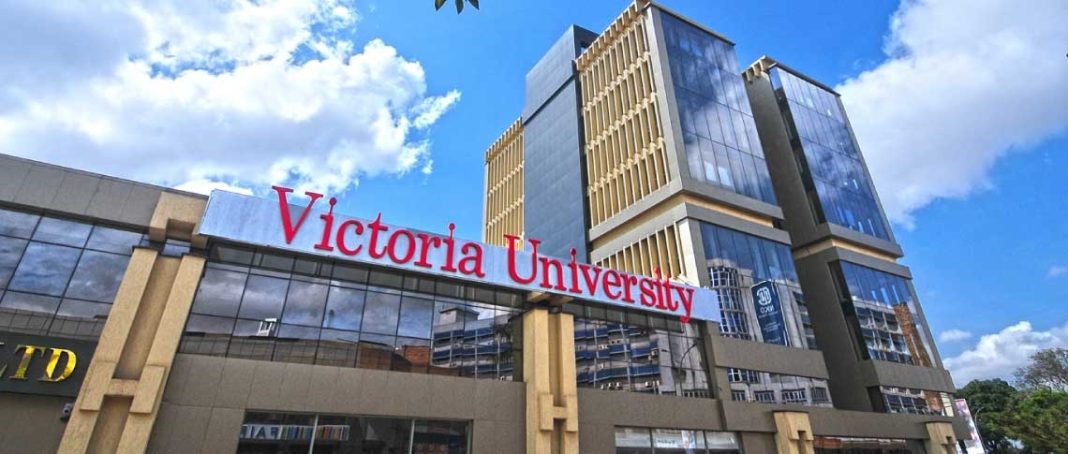
Prospective applicants can obtain admission guidance directly from Victoria University through its official admissions channels and website. The university lists its Kampala campus at Victoria Towers on Jinja Road and provides +256 782 397 699 for local enquiries