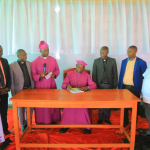
The Minister of Finance, Planning and Economic Development, Henry Musasizi, has launched Makerere University’s Strategic Plan 2025/26–2029/30 and reaffirmed the government’s commitment to supporting higher education, research, and innovation as key pillars for Uganda’s ambition to grow its economy tenfold to $500 billion by 2040.
Speaking during the launch ceremony at Makerere University, Musasizi said the country’s long-term economic transformation will be driven by knowledge, innovation, technology and the development of human capital.

“Government is aware that sustainable economic transformation is fundamentally driven by knowledge, innovation, technology and human capital,” Musasizi said.
The Finance Minister said the University’s new five-year blueprint comes at a defining moment as Uganda implements the Fourth National Development Plan (NDP IV) alongside the government’s Tenfold Growth Strategy.
He commended Makerere University for aligning its priorities with the country’s development agenda, saying the institution has a critical role to play in generating research and evidence that informs national policy.

“I would like to see Makerere increasingly support government decision-making through policy research and economic modelling. Government institutions require timely, credible and locally generated evidence to guide policy reforms and investments,” Musasizi said.
The Minister pledged continued government support through the Research and Innovations Fund, while encouraging the university to diversify research financing by strengthening partnerships with industry, promoting commercialization of innovations and expanding innovation ecosystems.
He also challenged the university leadership to take a firm stand against corruption, warning that the vice continues to undermine service delivery and national development.
“Corruption is stifling service delivery in the country and must be stamped out. Universities have a responsibility to reject corruption and instill integrity and ethical values in the students they educate,” Musasizi emphasized.
Makerere University Vice Chancellor Prof. Barnabas Nawangwe described the new Strategic Plan as a bold roadmap that will consolidate gains made over the past five years while positioning the institution among the world’s leading research universities.
“In the new Strategic Plan, we are making a bold commitment to reinforcing our identity as a research-driven, innovative and globally competitive university,” Prof. Nawangwe said.
He explained that the 2025/26–2029/30 Strategic Plan represents the second phase of Makerere University’s 10-year development agenda (2020–2030). While the first phase focused largely on building institutional foundations and infrastructure, the new phase seeks to accelerate research excellence, innovation, academic quality and global competitiveness.
According to Prof. Nawangwe, the Strategic Plan is built around four major objectives that will guide the university over the next five years.
The first objective focuses on improving the quality, innovation and responsiveness of teaching and learning. Under this pillar, Makerere aims to sustain undergraduate enrolment while doubling postgraduate student numbers from 3,874 to 7,744 by 2030. The university also plans to increase Science, Technology, Engineering and Mathematics (STEM) enrolment from 30 percent to 55 percent and improve graduate employability from 33 percent to 65 percent within two years after graduation.
The second strategic objective seeks to strengthen Makerere’s research and innovation capacity. Among its ambitious targets are increasing on-time PhD completion rates from 10 percent to 35 percent, more than doubling annual peer-reviewed journal publications from 1,365 to 3,000, increasing registered patents from 12 to 45, and expanding commercialization of innovations through Unipod and the Intellectual Property Office from 15 to 65 innovations.
The University also intends to deepen local, regional and international partnerships through enhanced academic exchanges and collaborative research under the third strategic objective. Staff participation in international mobility programmes is projected to increase from 111 to 185, while student participation is expected to rise dramatically from 117 to 617 during the implementation period.
The fourth objective focuses on strengthening governance, institutional management and financial sustainability. Makerere plans to review policies and regulations, modernize infrastructure, improve digital connectivity and expand domestic financing for practical training, internships and field placements while mainstreaming cross-cutting issues to improve service delivery.
Chairperson of the University Council Dr. Lorna Magara described the new Strategic Plan as a defining opportunity to build on the university’s achievements and accelerate institutional transformation.
“The new Strategic Plan presents a pivotal opportunity to build on the gains of the past five years and accelerate the University’s transformation,” Dr. Magara said.
She said the roadmap positions Makerere to respond more effectively to national priorities while strengthening its reputation as Africa’s premier centre of excellence in higher education, research and innovation.
Implementation of the ambitious plan will require substantial financial investment over the next five years. According to the Strategic Plan, government funding is projected to increase significantly from Shs380.08 billion in FY2025/26 to Shs639.98 billion by FY2029/30.
Wage expenditure is expected to rise from Shs221.61 billion to Shs256.54 billion as the university expands its workforce and improves staff remuneration. Non-wage recurrent expenditure is projected to increase from Shs135.08 billion to Shs240.26 billion, while development funding will grow sharply from Shs23.39 billion to Shs171.82 billion, reflecting increased investment in infrastructure and institutional development.
External financing is expected to peak at Shs115.15 billion in FY2027/28, with total combined government and external financing projected to reach Shs709.54 billion in FY2028/29.
University leaders say the investments will strengthen Makerere’s capacity to produce high-quality graduates, expand research output, commercialize innovations and provide evidence-based solutions to Uganda’s development challenges, further cementing its position as the country’s leading institution of higher learning and a key driver of national transformation.