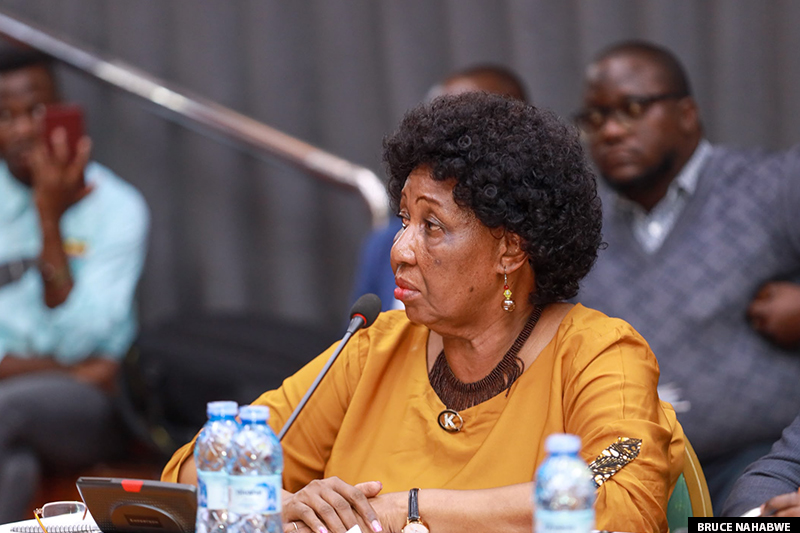
Uganda Human Rights Commission (UHRC) Chairperson Mariam Fauzat Wangadya has revealed to the Parliament Committee that President Yoweri Museveni rejected her resignation and directed her to continue serving as head of the country’s human rights body.
Wangadya made the disclosure on Tuesday while appearing before the Parliamentary Committee on Commissions, Statutory Authorities and State Enterprises (COSASE), which is investigating accountability concerns at the Commission.

The appearance came a day after COSASE Chairperson Muwada Nkunyingi threatened to have Wangadya arrested after she failed to appear before the committee for a second time to respond to queries arising from the Auditor General’s report.
At the start of Tuesday’s session, Nkunyingi sought clarification on Wangadya’s status following weeks of reports about her alleged resignation from the Commission.
“What saturates and what has been saturating in the media is an alleged resignation. Now that you are here, we want to appreciate the capacity under which you appear, either as a former or the current,” Nkunyingi said.

He asked Wangadya to clarify whether she had resigned, whether her resignation had been accepted and whether she had subsequently been reinstated so that the committee could determine the capacity in which she was appearing before it.
In response, Wangadya confirmed that she had written a resignation letter to President Museveni but said the President rejected it.
“It is true I wrote a letter of resignation to His Excellency, the President, and my resignation was rejected,” Wangadya told the committee.
She said the Attorney General, Sam Mayanja, had also already clarified her status before Parliament, stating that her resignation had not been accepted and that she remained the substantive chairperson of UHRC.
“As I conclude, the Honourable Learned Attorney General of this country addressed Parliament, and in his address, he very clearly said that my resignation had not been accepted and that I remain the substantive chairperson of the Uganda Human Rights Commission, and that is my status, Chairman,” Wangadya said.
Wangadya’s clarification means that, according to her account, she did not leave office and therefore cannot be described as having been reinstated.
She explained that her resignation only amounted to a request to leave office, which did not take effect because the appointing authority did not accept it.
The matter nevertheless generated debate among members of COSASE, with some MPs demanding documentary evidence to establish what exactly transpired between Wangadya and the President.
Nkunyingi asked Wangadya whether she had received written communication from the appointing authority confirming that she should continue serving.
Wangadya said the communication with the President was personal, but agreed to provide the committee with relevant documentation.
She was also asked to provide a copy of the resignation letter she had submitted to President Museveni. Wangadya said she did not have a copy with her at the time but had copied the Minister of Justice and Constitutional Affairs and undertook to submit it to the committee secretariat.
The committee further asked her to formally communicate the withdrawal of her resignation if she maintained that she remained in office. Wangadya agreed to provide the required communication.
Arrest threat
Wangadya’s appearance before COSASE followed a dramatic development on Monday when Nkunyingi ordered that she be arrested after she failed to appear before the committee for the second time.
The committee had summoned her to respond to questions concerning the Auditor General’s findings on UHRC, but her absence angered MPs, who questioned why the Commission’s accounting officer and chairperson had failed to honour the summons.
Nkunyingi directed that the relevant authorities take steps to ensure Wangadya was brought before the committee.
The threat followed an earlier summons that Wangadya had also failed to honour, prompting the committee to consider stronger measures to compel her attendance.
She eventually appeared before the committee on Tuesday and apologised for her earlier absence.
The committee is scrutinising the Commission’s administration and financial management following concerns contained in the Auditor General’s report for the year ended December 31, 2025.
UHRC leadership under pressure
The dispute over Wangadya’s resignation comes at a time when UHRC is facing intense scrutiny over its governance and operations.
MPs have raised concerns about the failure of the Commission to hold formal meetings since March 2026, as well as the disruption of the operations of its tribunal.
The committee has also been told that tribunal hearings stalled after the budget allocated for hearings was exhausted, with the last sessions reportedly held in December 2025.
The delays have raised concerns about the Commission’s handling of human rights complaints, including a backlog of more than 200 files awaiting action.
The developments have placed Wangadya’s leadership and the Commission’s internal administration under increased parliamentary scrutiny.
Allegations against Wangadya
The parliamentary scrutiny has also been accompanied by allegations of financial impropriety and abuse of office involving senior officials at the Commission.
Wangadya and Commissioner Crispin Kaheru have faced accusations from fellow commissioners concerning the alleged misuse of UHRC resources.
Among the allegations raised are claims that Commission vehicles and other assets were treated as personal property, as well as accusations that funds were claimed for trips that were allegedly not undertaken or that travel costs were inflated.
The commissioners have also raised allegations concerning the procurement and use of high-capacity generators, claiming that UHRC resources were used to acquire generators for private residences.
The allegations remain subject to parliamentary scrutiny and investigation and have not been established as criminal offences against Wangadya.
Wangadya has previously denied wrongdoing and has herself raised serious concerns about the conduct and competence of some commissioners at UHRC.
She has accused some commissioners of lacking the competence and credibility required to lead the institution and questioned the circumstances under which some of them were appointed.
Her criticism has contributed to an increasingly bitter dispute within the Commission, with competing accusations now being examined alongside the Auditor General’s findings.
Wangadya’s resignation controversy
Before her appearance before COSASE, Wangadya publicly announced her intention to leave office, citing what she described as a toxic working environment and disagreements over the conduct and appointment of some commissioners.
Her resignation became a subject of public debate after it emerged that she had communicated her intention to leave office but continued to occupy the position.
The Attorney General subsequently told Parliament that Wangadya had submitted a notice of resignation but remained the substantive chairperson because the resignation process had not been concluded.
Wangadya has now given her own account before COSASE, insisting that President Museveni rejected her resignation.
The revelation has effectively shifted the question from whether Wangadya resigned to whether her resignation was formally accepted and whether the appointing authority’s decision was properly documented.
However, Wangadya maintains that she remains the substantive chairperson of UHRC and has indicated that she is prepared to continue performing her constitutional mandate as the parliamentary committee proceeds with its investigation into the Commission.