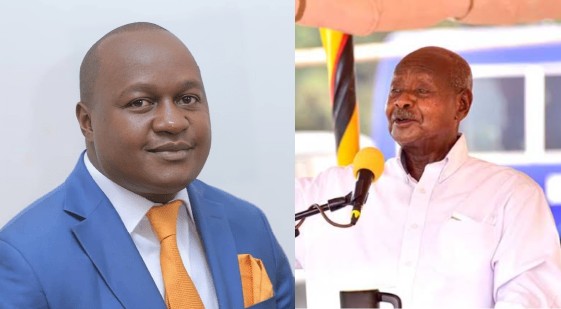
Budadiri County East MP Eng. Julius Nakiyi has questioned President Yoweri Museveni’s latest government appointments and revealed that the Bugisu sub-region feels sidelined despite its overwhelming support for the ruling National Resistance Movement (NRM).
Nakiyi said the Bagisu were unhappy with the distribution of government positions following Museveni’s recent ministerial reshuffle and changes in the senior public service, arguing that the region had not received adequate representation in influential government offices.

He said although the community appreciated the two ministerial positions allocated to Bugisu, they were insufficient compared to what the region expected, particularly in ministries and government institutions responsible for managing resources and delivering essential services.
“Changes are good, just that the Bagisu are complaining because when they look at the list, they do not see any Mugisu there. Of course, we are happy that we got two positions, but they are not enough. That is where we are as Bagisu. We feel left behind on every matter,” Nakiyi said.
The MP’s remarks follow Museveni’s November 2026 reshuffle in which he appointed 13 new senior public officers, retained 16 in their positions, redeployed 11 and retired 11 Permanent Secretaries.

The appointments affected several key ministries, departments and government institutions, including the Office of the Prime Minister, Inspectorate of Government, Ministries of Agriculture, Water and Environment, Foreign Affairs, ICT and National Guidance, Works and Transport, Defence and Veteran Affairs, Public Service and East African Community Affairs.
Among those appointed were Emmanuel Freddie Mugunga for the Office of the Prime Minister, Maureen Kasande for the Inspectorate of Government and Sheeba Kyobutungi Rujoki for the Office of the President in charge of Science, Technology and Innovation.
Kenneth Akiri was nominated for the Ministry of Water and Environment, while Barbara Namugambe was appointed to the Ministry of Agriculture, Animal Industry and Fisheries. Charles Ssentongo was named for Foreign Affairs, Prof. Stephen Akandwanaho for ICT and National Guidance, and Mark Sseremba for Public Service.
Others included Eng. Flavia Guto Bwire for Works and Transport, Edith Butuuro for Defence and Veteran Affairs, Aggrey Wunyi for East African Community Affairs, Betty Mutesa Cwinya-ai for the Public Service Commission and Edward Sengonzi Damulira as Clerk to Parliament.
However, the list did not include a representative from Bugisu among the new appointees, a development Nakiyi says has deepened the community’s feeling of exclusion from influential government positions.
The President also retired 11 senior public officers, among them former Permanent Secretaries Pius Bigirimana, Adolf Mwesige Kasaija, Maj Gen David Kasura-Kyomukama, Dr Rose Nassali Lukwago, Alex Okello, Dorcus W. Okalany, Bageya Waiswa, Edith Nsaja Mwanje, Alfred Okidi, Dr John Geoffrey Mbabazi and Rose Kafeero.
Okalany’s departure from the Ministry of Lands, Housing and Urban Development has also featured in the debate over Bugisu’s representation, with the region having no new nominee on the list to take up a Permanent Secretary position.
The nominations were submitted to the Public Service Commission for assessment of the candidates’ suitability and advice to the President before the appointments are finalised.
Nakiyi argued that Permanent Secretaries carry considerable influence in government because they oversee ministry administration, budgets and the implementation of programmes, making the positions particularly important to communities seeking a greater role in government resource allocation.
He said if given a choice between serving as a minister and holding a Permanent Secretary position, he would prefer the latter because of the administrative responsibilities attached to the office.
“If you told me to choose between those two, I would rather be a Permanent Secretary than a minister,” he said.
He added that Bugisu would prefer representation in ministries dealing with agriculture, education and health, which he described as critical to the welfare and economic development of the people.
“In the appointments, we have two ministers, but their offices are not very impactful in terms of what our community needs. Our people would prefer positions in agriculture, education and health. These are the areas that matter most to us,” Nakiyi said.
Beyond the ministerial and Permanent Secretary positions, the MP also questioned the absence of people from Bugisu heading government parastatals and agencies, saying the region had not secured the level of representation it expected across the wider public service.
He said the community was particularly disappointed that despite its strong support for the NRM during elections, it continued to feel overlooked whenever senior government appointments were made.
Nakiyi further invoked Bugisu’s historical contribution to Museveni’s political journey, arguing that the region deserved recognition for its role in the early resistance activities against the government of former President Idi Amin.
He said Bugisu was among the areas associated with Museveni’s early anti-Amin activities and the subsequent resistance struggle, arguing that the historical relationship between the region and the President should be reflected in government appointments.
Nakiyi said Bugisu deserved greater representation in government and argued that the region’s strong support for the NRM had not been matched by appointments to influential ministerial, administrative and government agency positions.,