Stanbic Bank
Stanbic Bank
20.1 C
Kampala
Stanbic Bank
Stanbic Bank
Home Blog Page 1526

Busoga King joins Jinja Scouts in Campsite Silver Jubilee celebrations

The Kyabazinga of Busoga (center) receives a gift of a Jinja scouts Scarf, a district badge and a Uganda Badge and the World scouts badge form the Jinja district commisioner Mike Baraza(right). Looking on is the district executive secretary, Richard Ssimwogerere(Left) and Chairman district council, Mr Pithy Ndiko. in black coat.

Jinja: Himself a Scout and a former camper at the same site, the Kyabazinga of Busoga, His Royal Highness William Nadiope IV spent his Saturday in a familiar crowd.

“I am a scout and I will forever be a scout,” the king told a cheerful crowd at the opening of his speech. “I used to camp here and I am happy to be back.”

Jinja Scouts Association invited the Kyabazinga to celebrate with him 25 years of BP Training and Camping Ground. The Campsite itself a got by the scouts with the help of the Kingdom was developed in 1993 with a partnership of the Jinja scouts and scouts from Avon County in the United Kingdom.

Welcome Home: The Kyabazinga being welcomed at the celebrations by the Chief Prince of Busoga, Samwiri Zirabamuzale who is also district deputy scouts commissioner Youth Programs. Looking on (in scout uniform) is the Jinja District Scouts Deputy Chief Commissioner =, Mr Isaac Imaka and District Scouts Council Chairman, Mr Pithy Ndiko(In black jacket)
Happy to be home: HRH William Nadiope IV, the Kyabazinga of Busoga, waves to the campers.

“We are grateful for the partnership and since 1993, a lot of young people have been mentored and nurtured through this place at the different camps and activities that take place here,” Mr Pithy Ndiko, the chairman of the Jinja Scouts Association Council said.

At the ceremony the king inspected a guard of honor mounted by scouts from over twenty schools from Jinja. He there after inspected different campsites where he scouts showcased their creativity in design and craftsmanship with items like dining tables, seats and showers made of only ropes and wood.


The Anthems: Scouts and Busoga Kingdom leaders join the Kyabazinga in singing the National and Busoga anthems.
Campers’ Life: The king leaving his tent to go and inspect the work scouts were doing at the during the camp.

“It is our hope and desire that we continue mentor and inspire the young people of Busoga through scouting.

“You honoring our invite is a sign to the young people that their king and inspiration appreciates the work of scouting and we ask that you continue endorsing our activities as scouts,” the Jinja district Scouts Commissioner”, Michael Baraza said in his speech.


We love scouting: A young female scout narrating her love for scouting the the Kyabazinga.
Some of the female campers during the celebrations

Earlier on, Mr Baraza had taken the King around the campsite to show him the work being done by the young scouts and the projects the district has earmarked to start.

Among these is a 100 bed Boy Scout hostel, the first of its kind in East Africa, which the Jinja scouts plan to use as an income generating project to be run and managed as an affordable hotel for tourists in Jinja.

It will run using the model of the YWCA hostels strewn around the world where card holding members of the YWCA sleep at the facilities at half price.
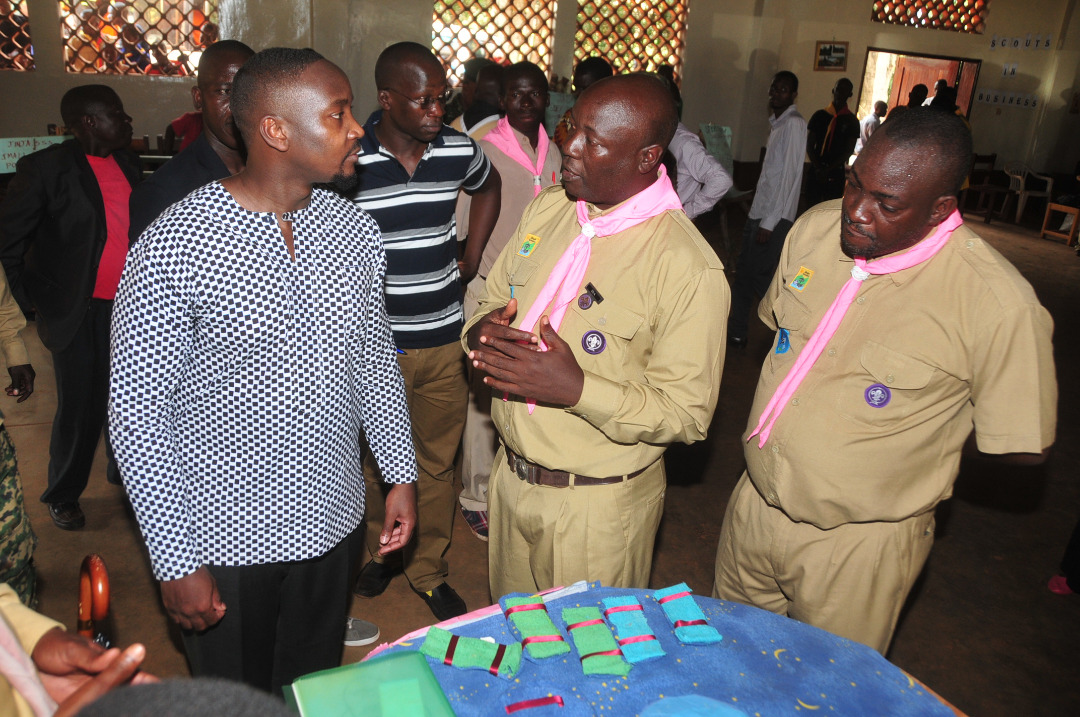
Jinja district Scouts Commissioner, Michael Baraza, explains to the Kyabazinga about the menstrual pads project. Looking on is the district deputy scouts council chairman, Joseph Waiswa

The Kyabazinga broke the ground for the hostel and it will be named Gabula Boy Scouts Hostel, after him.

Also, in honor of the Kyabazinga’s tree planting and environment protection campaign, the Jinja Scouts Association also introduced the Kyabazinga Environmental Challenge and the king launched trophy which will be competed for annually and will be won by the best scouting group in protecting the environment.

The Jinja scouts association also used the event to award Father Picavet a medal for his illustrious contribution to the development of scouting in district, especially the Buwenda Campsite.

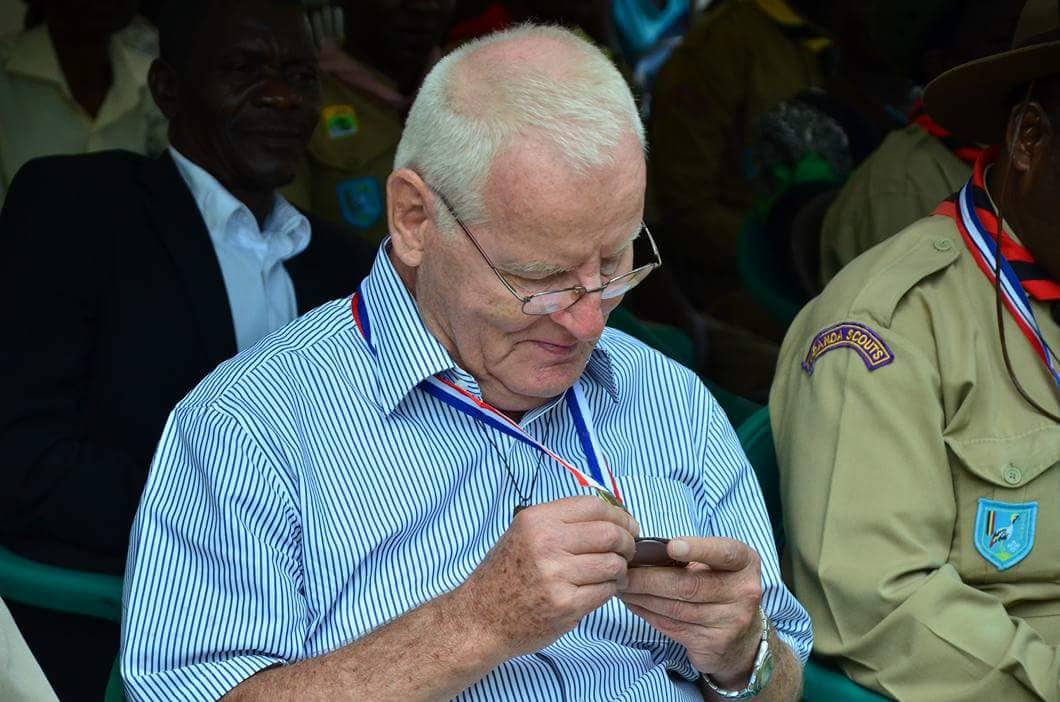
Father Gerald Picavet receiving his medal for the illustrious contribution to scouting and the development of the campsite
Nice: Father Picavet admiring his medal

The event was partly sponsored by Bigfoot Media flagship brand, Eagle Online Publication.

Stories Continues after ad

UCC pushes Telecom companies to block VPN

Outgoing UCC ED Executive Director Godfrey Mutabazi.

Kampala: The Executive Director of Uganda Communications Commission Godfrey Mutabazi has vowed to direct telecommunication companies to block virtual private networks (VPN) applications used by Ugandans to evade paying of social media tax.

With the incentive of increasing tax base in the country, this financial year, government introduced excise duty tax where customers are required pay Shs200 on a daily basis, weekly or monthly through mobile money and Airtel money for one to be granted access to social media platforms.

Following government directives, yesterday telecom companies blocked access to social media platforms however, like in 2016 general elections; Ugandans have embarked on downloading VPN to access.

Speaking at UCC headquarters, Mutabazi said the telecom companies have started blocking VPN applications that are channeling citizens from paying excise duty tax, “some VPNs consume data worthy Shs200, it is good to pay and gain unlimited access to internet,” he said.

“All those going for VPN are taking unwise direction, it is better to pay tax for construction of roads, drugs in hospitals,
diversification of the economy and improvement in service delivery,” he said at UCC offices in Bugolobi.

He acknowledged that some VPN applications are unlocked but he however, insisted that with time, those applications will be no more, “if one incites the other to evade paying of tax, he/she is committing an offence that attracts seven years sentence in prison,”
VPNs allow users to securely access a private network and share data remotely through public networks.

Stories Continues after ad

Eagle Air resumes operations to South Sudan

Eagle Air, a commercial airline has resumed its flights to South Sudan state of Yei River State starting this week after it suspended its operations more than a year ago.

According to a statement, Eagle said, “starting today we are resuming flights to Yei (South Sudan) from Entebbe twice every week, Monday and Friday. We welcome you on board.”

In May last year, Eagle Air suspended its flights to Yei River State due to harassment of its crew by security officials at Yei airstrip.

Stories Continues after ad

Ugandan Kabeho hands over leadership of regional business body

Ugandan Jim Kabeho who has been Chairman of the East African Business Council (EABC) has handed over the office to his successor, Kenyan Nicholas Nesbitt for the period 2018/19.

Kabeho handed over the office during the 19th Annual General Meeting (AGM). Mr. Nesbitt is also the Chairman of Kenya Private Sector Alliance (KEPSA) and General Manager Eastern Africa, IBM East Africa Limited.

In his remarks, Kabeho lauded the EABC Secretariat for the good work that has been done in the year under review and congratulated the incoming board of directors, urging them to continue the ongoing initiatives of the EAC Integration process.

Kabeho pledged to support his successor and the new team as they seek solutions to the challenges that face the private sector in the region.
In his acceptance speech, Nesbitt reiterated the need to increase competitiveness of East African companies and SMEs to compete at continental as well as international level.

“Let’s focus on competitiveness of our businesses to sell our goods at regional, continental, and international scale,” he said.
He urged for close collaboration with the governments of the EAC Partners States and called for the government to improve the business environment support the operations of the Private Sector to thrive.

The new chair also called for improvement of technological infrastructure to fast track free movement of goods and services in the region.
He further appreciated efforts by the former chair Mr. Jim Kabeho in steering the work done in the year 2017 together with the Executive Committee.

He urged private sector players in the region to use technology in service delivery. “Adopt technology such as block chain to solve regional challenges like counterfeits and contrabands,” he said.
“Adopt technology such as block chain to solve regional challenges like counterfeits and contrabands” said Mr. Nicholas Nesbitt, new EABC Chairperson.

Dr. Manu Chandaria, EABC Founding Chairperson in his remarks during the meeting urged the Private Sector to be committed in the EAC Integration and spearhead for full inclusion of EABC in the EAC as a constituent member of the EAC Integration process.

“As the Private Sector our interest should be one East Africa and not our country,” he said, calling for the strengthened private sector advocacy efforts at regional level.

The event also saw the appointment of vice Chairs and Members of the EABC Executive Committee who strategically guide EABC’s mission to promote sustainable Private Sector driven growth.

The (AGM is the supreme policy making organ of the EABC. The AGM meets once a year to elect the Executive Committee headed by the Chairperson, receive annual report on the initiatives undertaken by the Secretariat and give overall direction to the Secretariat in line with the Strategic Plan and interests of the business community in East Africa.

The EABC Board of Directors consists of 22 members, headed by a Chairperson, elected from the Partner States on an annual rotational basis. Each country nominates four Members to the Executive Committee.
During the 19th EABC Annual General Meeting, EABC also honored outgoing board directors for their distinguished service to the council.

Stories Continues after ad

Kampala businessman sues Standard Chartered Bank’s top officials for ‘inflated loan’

Kampala businessman Habib Kagimu has sued the Chief Executive Officer of Standard Chartered Bank Chief Executive Officer, Albert Saltson and other two top officials Winnie Ojambo and Julius Baluku who heads collections department at the bank.

The Buganda Road Magistrate has issued summons asking the three bank officials to appear at the court on July 5, 2018 without fail to defend themselves against the allegations of inflating a loan and denying the businessman information regarding his company’s dollar account. Kagimu and his company Habib Oil Ltd are represented by Muwema and Company Advocates.

The three are accused under case No.2668 of 2018. The trio is also accused of insisting to sell off Kagimu prime properties for allegedly failing to pay back a loan the businessman says it is inflated.

Habib Oil Limited. is challenging the bank’s claims in the High Court, accusing the bank of inflating the loan figures. The case is HCCNo.662/2016. Kagimu operates a US dollar account No.870401296700 with the bank at Speke Road Branch for the last seven years.

The company is also disputing unexplained debt entries that were made on August 2016 of US $3.8 million and on October 31, 2016 of US $ 394,651.57. The complainant wants the actual interest rate applicable to the loan for the whole facility period be disclosed. It also wants the bank to give it bank statements from January 2013 to June 2016.

Kagimu’s lawyers argue that the trio have used their influence at the bank to deny their auditors access to information so that they audit all the transactions on the company’s dollar account held in the bank. On May 29, 2018, Habib Oil Limited., through its lawyers and auditors asked for information and clarification regarding the inflated amount the bank said it was outstanding on the company’s balance sheet.

Kagimu says that the bank’s refusal to grant information to him and his auditors has caused ‘substantial damage and injury’ to him.
Kagimu is also suspicious of the transaction that took place on the company’s account three years preceding 2016. That was worsened when he read in the media recently that Standard Chartered Bank was advertising his assets he offered as security to obtain the said loan.

“…it been a month now and the Bank has denied the Complainant access to its financial data…as sought above and yet is seeking to sell the complainants’ securities for alleged non-payment of loan amounts, it has concealed on its computer system.,” the company’s lawyers say in a letter dated June 28, 2018.

Stories Continues after ad

UK gives heavy machinery to Amisom

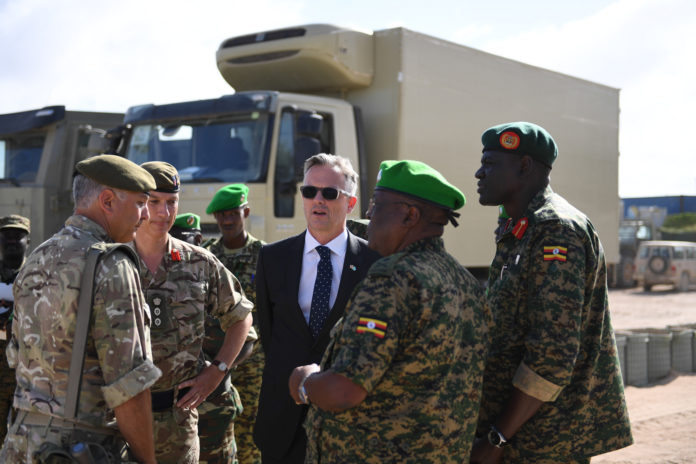
UK Ambassador to Somalia, David Concar (in suit) with Amisom top military officer

The United Kingdom has donated heavy equipment worth 5.6 million pounds to the African Union Mission in Somalia (AMISOM) to help in clearing main supply routes as the force steps up the condition-based transition process.

The equipment which includes tractor trucks, bulldozers, backhoe and front end loaders, forklifts and module dump tipper among others will be used in sectors one, two and five together with the Mission Enabling Unit based in Mogadishu.

While handing over the equipment, on Saturday, the United Kingdom Ambassador to Somalia, David Concar, said his government was proud to be associated with AMISOM in its efforts to stabilize Somalia and help secure lasting peace and security.

“What we are doing today, transferring 5.6m pounds worth of equipment is, we hope, going to make a real difference to the ability of AMISOM to clear roads, supply routes and to press ahead with stabilizing Somalia and working in partnership with Somalia’s own forces as they get stronger,” United Kingdom Ambassador to Somalia said.

Mr. Concar thanked the peacekeeping force together with the troop contributing countries for the sacrifice they have made to ensure stability in Somalia.

“We thank you AMISOM for everything you have done and the troop contributing countries and above all the troops who are out there in these dangerous environments often paying for the stability and progress we have seen with the ultimate sacrifice,” the UK Ambassador added.

Receiving the 49 heavy machinery equipment, AMISOM Force Commander, Lt Gen Jim Beesigye Owoyesigire, said the equipment will come in handy in the current period when the force is determined to kick out Al-Shabaab from the key areas they still occupy.

“We thank the government of UK for supporting us with these force enablers,” Lt. Gen. Owoyesigire said.

Sector One Commander, Brigadier Paul Lokech, who received 14 of the machines donated pledged to use the equipment wisely to make the transition process a success.

“We know with this equipment, we can improve our operations capability and also it will help us, jointly with the Somalis, meet the requirement of phase one of our transition,” Brigadier Lokech said.

Besides sector one, 12 machines will be donated to Sector two, Sector five (12) and Mission Enabling Unit (11).

Last year, the UN Security Council approved the gradual reduction of AMISOM troops and transfer of security responsibilities to Somali national security forces.

Stories Continues after ad

Five principles for driving revenue, not just user count

Martin Zwilling

By Martin Zwiling

Some analysts argue that revenue drives growth, while others say user growth drives revenue. Both have worked. Google reached $1B in revenue within five years of incorporation, and now has a market capitalization of over U$800b. Twitter showed no focus on revenue in the first five years, but was able to parlay 500M users into a US$25b public company, now growing revenue.

Every startup dreams of achieving that milestone, when they can focus more on scaling the business and enjoying their earnings, rather than fighting for another investment infusion. Most are still confused about the right priority. Should they focus on increasing revenues and profitability, or entice more and more users with “free” services, to increase their valuation.

Traditionally, it was simple. A business only achieved critical mass by becoming cash-flow positive. Revenue growth (top line) then had to be converted into profit growth (bottom line), before a business was deemed to be self-sustaining and worthy of public investment.

It’s only been in the last decade or two, that social media companies, like Facebook and Twitter, have achieved market valuations in billions of dollars (unicorn status), while clearly sacrificing revenue to gain users. In my view, the pendulum is swinging back, with investors looking more for the traditional indications of business integrity, stability, and growth:

Some element of organic growth is a good thing. The purest form of capitalism has always meant charging a fair price and making a fair profit. Re-investing profits to grow the business is organic growth. The concept of free goods and services to get you hooked, financed by deep pockets, or advertising, seems marginally ethical to many.

Long-term stability requires revenue growth and profit. Most modern investors still look for a business model that embodies a gross margin over 50%, and a net margin in the 20% range. A healthy business, ready to scale, has been doing this for a year or more, with an existing customer set generating a non-trivial and growing revenue stream.

High customer loyalty and high team passion. Startup productivity is embodied in key ratios, including low cost of customer acquisition, high retention, and high revenue per employee. High customer churn and lackluster team members are still indicators of a high-risk investment opportunity, to be avoided by both public and private investors.

Growing appreciation for the value of the solution provided. These days, you need customer evangelists who see the value and will pull in their friends through viral actions to keep the business growing. Too many of the high user growth startups have been fads, and numbers can go down as fast as they go up, as per Friendster and MySpace.

Understanding competitive early mover requirements. First movers in a new space need users more than revenue to maintain market share, so investment pitches need to highlight this priority in requests for funding resources. More complex and defensible businesses should highlight their organic drive to profitability and brand leadership.

Unfortunately, the Internet and heavily funded startups have nurtured a customer expectation of free web services and free smartphone apps. In these domains, it is now difficult to monetize at all until you have a large critical mass of users. In these cases, growth scaling is important, both before and after revenue flow begins. The business plan must reflect both growth phases.

Thus even after a startup has achieved a critical mass of users, the expectation of long-term revenue growth and profitability does not go away. Twitter is facing this challenge right now, as the large majority of public investors expect a near-term financial return on their investment, every quarter of every year.

So a higher focus on user growth may be necessary early, but is never sufficient. If you are in it for the long run, don’t forget the basic business principle that if you lose money on every customer, you can’t make it up in volume.

The Writer is a veteran startup mentor, executive, blogger, author, tech professional, and Angel investor. Published on Forbes, Entrepreneur, Inc.

Stories Continues after ad

Africa fashion designers meet to strategize for prosperity

Fashion designers in a group discussion

The third Fashionomics Africa Masterclass for textile, apparel and accessories entrepreneurs, tomorrow’s designers and startups over the weekend met in South Africa in a workshop organised by the African Development Bank (ADB) in partnership with Google Digital Skills for Africa, Nesta, Parsons School of Fashion and African Fashion International.

The class provided the tools and know-how to build a fashion brand from an idea to its execution. Nearly two-thirds of the 170 participants were women. Experts and industry insiders gave presentations and took questions on how to run a business, digital marketing, branding, online commerce, high-quality manufacturing and networking.

Presenters included South Africa’s Department of Trade and Industry; South Africa’s Department of Small Business Development; the UK-based global innovation foundation, Nesta; Google Digital Skills for Africa; Parsons School of Fashion and SiMODiSA, a Johannesburg-based industry association whose mission is to accelerate entrepreneurship by collaborating with policy makers.

Organizers carried out a needs assessment survey for sector entrepreneurs and promoted and enhanced content for the online platform. Stronger public and private stakeholder strategic partnerships included a new collaboration on knowledge sharing between New York-based Parsons School of Fashion and the African Development Bank

“With Fashionomics Africa, the Bank and its partners are looking at this sector through a value chain approach from cotton production to retail stores to see how a “Made in Africa” brand, can contribute to our economies,” said Vanessa Moungar, Director of the Bank’s Gender Women and Civil Society Department. She added, “Given the right investment and access to training and resources, African textile, apparel and accessories entrepreneurs can compete on the regional and global stage, we believe.”

Stefan Muller, the Bank’s Lead Country Coordinator in South Africa pointed out, “Our institution has been undertaking initiatives to create an enabling environment for youth employment and entrepreneurship, including the Jobs for Youth in Africa Strategy, which is designed to create 25 million jobs and positively impact about 50 million youth over the next decade. We know that manufacturing, services and agriculture hold the greatest potential to create these much-needed jobs. But we also need to look at emerging sectors and opportunities arising from new activities and economies.”

Director Moungar concluded, saying, “This is the right time to support these fashion and textile sectors that yield not only economic benefits but also contribute to the development of our shared cultural identities. We must showcase positive perceptions of African traditions internationally. Together we will demonstrate that Africa is not just a source for labor, it is a source of creativity and innovation. It is time to scale up Africa’s creative entrepreneurial talent, ensuring equal access to opportunities for women and men.”

Fashionomics Africa supports African textiles and fashion by building the capacities of micro, small and medium-sized enterprises in the textile and clothing sector, especially women and youth. It is aligned with the Bank’s High 5 strategic priorities, especially Industrialize Africa, Improve the lives of African people, and the Jobs for Youth in Africa strategy.

Stories Continues after ad

We are investigating Justine Bagyenda- IGG insists

Embattled former Executive Director in charge of Supervision at Bank of Uganda Justine Bagyenda.

The Inspectorate of Government has in the press release confirmed that it is investigating the former director of supervision at the Bank of Uganda, Justine Bagyenda who is alleged to have accumulated too much wealth through corruption.

Ms Bagyenda was sacked by her former boss, the BOU Governor Prof. Emmanuel Tumusiime Mutebile in February even as her official retirement was due this month of June. Mutebile has never given reasons as to why he sacked Ms Bagyenda.

Regarding investigation of Ms Bagyenda’s wealth, the office of the Inspector General of Government (IGG) says in a press release of June 29, 2018: “This is to inform you that the inspectorate is conducting investigations on allegation of wealth of Justine Bagyenda, and when we complete these investigations, the report will be shared with relevant authorities only.”

Meanwhile, the same office says it is investigating recruitment at the Uganda Investment Authority (UIA) whose Executive Director. Jolly Kaguhangire was days ago sacked by the board on allegations of nepotism, corruption and incompetence.

The press release says the report of the investigations at UIA will also be shared with relevant authorities, adding that the IGG Irene Mulyagonja has not met Ms Kaguhangire in person since her sacking that has turned controversial.

Stories Continues after ad

NRM SG Lumumba congratulates Butebo’s LCV chairman Keddi

The National Resistance Movement party flag bearer in the Butebo initial district LCV chairman elections, Samuel Keddi has casting his vote

The ruling National Resistance Movement Secretary General Justine Kasule Lumumba has congratulated her party’s flag bearer, Samuel Keddi upon his victory as chairman elect for the new district of Butebo.

Curved from the traditional Pallisa district, Butebo went to polls yesterday to have their first district LC V chairman. The race had two candidates; winner, Keddi and an NRM leaning independent candidate James Okurut.

Keddi polled 17,554 (64.2 per cent) votes against Okurut’s 9765 (35.7 per cent).

“I congratulate the people of Butebo for the ‘peaceful and focused electoral exercise,” the NRM communications officer, Rogers Mulindwa quotes Lumumba as saying.

Lumumba also applauded the party national chairman, Yoweri Museveni for his support to the NRM flag bearer.

Museveni was on Monday in Butebo district where he taught voters at a rally the benefits of voting for NRM.

“Thumbs up for the party chairman, Central Executive Committee members and the local leaders for the combined efforts that have yielded results,” she said.

Butebo becomes the 10th LCV seat of newly created districts NRM has won since July 2016. The other nine include Kakumiro, Kagadi, Rukiga, Rubanda, Bunyangabo, Pakwach, Namisindwa, Kalungu and Kyotera. The ruling party only lost in Omoro but to an NRM leaning independent candidate.

Stories Continues after ad