Stanbic Bank
Stanbic Bank
25.7 C
Kampala
Stanbic Bank
Stanbic Bank
Home Blog Page 1572

Host agreement for oil pipeline set for May

Uganda-Tanzania proposed crude oil pipeline.

Negotiations between the Uganda government, Total E&P, Cnooc and Tullow Oil over the Host Agreement for the East African crude oil pipeline are expected to be concluded in May, says the Deep Earth International’s monthly report, for April 2018.

The report says officials from both sides were locked up in closed-door meetings in late April at Serena hotel trying to thresh out the finer details of an agreement, which will spell out the commitments needed to have the pipeline constructed with less risks.

The same negotiations, which started in February this year, are happening in Tanzania too.

According to the report, the host agreement stipulates the obligations of both the governments and the oil companies in regards to issues such as access to land, local content, financial obligations, and the raising of debt for the project. It is not yet clear what concessions both parties have agreed to.

“The Host Agreement must be in place before the companies can shore up debt for the crude oil pipeline. A final investment decision for the pipeline is expected to be concluded in the third quarter of this year,” the report says.

The Uganda negotiation team is being led by officials from the Uganda National Oil Company, with support coming from the Petroleum Authority of Uganda and the Directorate of Petroleum.

Uganda and Tanzania have selected Gulf Interstate Engineering, a Houston-based company, to design a 1,445 km crude oil pipeline from the heavy oil fields of western Uganda near Hoima to Tanzania’s Indian Ocean seaport of Tanga.

Among the many tasks, the firm’s contract involves helping with “project construction specifications,” a plan for project execution, the implementation schedule and writing bid documents for a process to select a contractor to develop the pipeline.

Uganda estimates overall crude reserves at 6.5 billion barrels, while recoverable reserves are seen at between 1.4 billion and 1.7 billion barrels.

Stories Continues after ad

Burundi village attack leaves 26 dead ahead of referendum

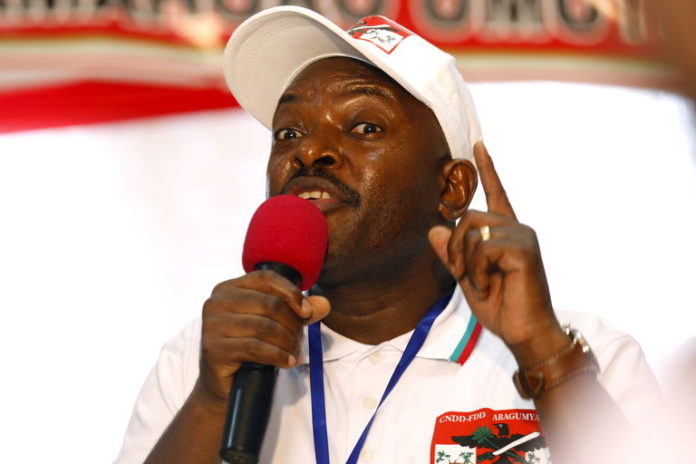
Burundi president Pierre Nkurunziza.

At least 26 people were killed after armed attackers targeted a village in north-west Burundi, amid tensions ahead of a controversial referendum.

The group crossed from the Democratic Republic of Congo into Cibitoke province, officials said.
They went house to house with guns and knives, burning homes, witnesses said.

Correspondents say the attack may have been an attempt to disrupt next week’s referendum which could extend the president’s term until 2034.
President Nkurunziza has ruled Burundi since the civil war ended there in 2005. His attempt to run for a third term in 2015 plunged the tiny central African nation into fresh turmoil.

Security Minister Alain Guillaume Bunyoni described the attackers in a statement as “terrorists coming from and returning to Congo.”
He said the victims were “shot and burned”. Twenty-six were killed and seven wounded.
Witnesses described to the AFP news agency hours of violence that began late on Friday night.

“These criminals went house to house and committed real carnage,” one local official said. “Some of the victims were stabbed, others were shot, there is even a whole family that was burned alive in their home.”
It is not known who carried out the attacks, but some are blaming exiled opposition groups who are based outside Burundi and have vowed to disrupt the May 17 referendum.

Critics say a cult of personality is developing around Mr Nkurunziza, a former Hutu rebel leader who was the first president to be chosen in democratic elections since the start of Burundi’s civil war in 1994.
A “yes” vote in the referendum would allow him to stand for a further two seven-year terms from 2020.

Stories Continues after ad

Sudhir meets Obasanjo in London, two discuss business

City tycoon Sudhir Ruparelia has met former Nigerian president Olusegun Obasanjo in London where the two discussed business.
Obasanjo is credited for turning around Nigeria from failed military junta to number one economy in Africa.
The two met at a wedding at Raju Thakrar daughters’ Sabre and Ronak wedding at Hilton Hotel park lane London.
The parents of the girl are friends to both Obasanjo and Sudhir.

Sudhir is diversifying his business and of late, as he has been scouting around for land to venture into large scale farming.

Stories Continues after ad

Ministers up in arms against Bamugemereire’s handling of Amongi

Betty-Amongi and her lawyer -appears-before-land-probe-commission.

Section of cabinet is up in arms against the manner in which their colleague was handled by the Justice Catherine Bamugemereire.

Lands Minister, Betty Amongi appeared before the commission early last week and according to the public outcry, Amongi was humiliated when Justice Bamugemereire referred to her as young lady given that fact that she is a minister and kept on shouting her down whenever she tried to answer questions.

Bamugemerereire is known for her nonsense approach to witnesses and has seen many troubling with unease in front of cameras.
According to a Whatsup group for ministers, it is said that the matter could come for discussion tomorrow during the weekly meeting. Cabinet meets every Monday. A source told Eagle Online that “It is somewhat, embarrassing for whole minister to be looked down upon by another leader and more so a judge. If we can’t respect ourselves then who will do it for us” a cabinet member said on condition of anonymity.

After establishing herself as a competent and credible judge, Lady Justice Catherine Bamugemereire was given a task to head a commission of inquiry into land matters in Uganda, which was expected to last six months but has been extended trice and consuming about Shs13 billion.
The six-man team appointed under the Commissions of Inquiry Act is tasked to, among other issues, ‘inquire into the effectiveness of law, policies and processes of land acquisition; land administration; land management and land registration in Uganda’.

Tomorrow the commission is expected to grill Presidential Private Secretary Molly Kamukama in regards to Land Fund.
Previously, Lady Justice Bamugemereire chaired KCCA Tribunal in 2013 which was tasked to probe fights at City Hall between Executive Director Jennifer Musisi and Lord Mayor Erias Lukwago, and she also chaired the Commission of Inquiry into the scams at the Uganda National Roads Authority (UNRA).

If it is true that cabinet is set to debate what transpired at the commission, then the ministers will be joining a growing queue of citizens that are agitated about the manner in which they are handled while appearing before the commission.
However, it should be noted that those very ‘powerful’ individuals in government are the ones who are heavily cited in the dubious land deals

Stories Continues after ad

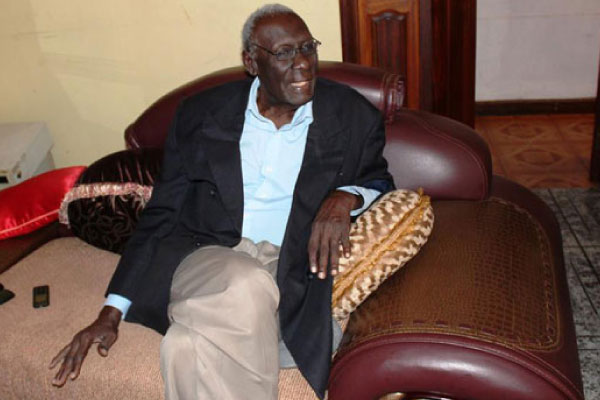
Adoko Nekyon’s family denies homicide allegations

The family of the late Hajji Akabr Adoko Nekyon has distanced themselves from the letter circulated on the social media urging police to investigate allegations that the old man’s death could have been a result of a homicide.

Nekyon died on Friday 4th May 2018 while the letter was written by Makmot, Kibwanga and Company Advocates addressed to the Director of Criminal Investigations, Grace Akulo, asking her to launch an investigation into the death of Mzee Nekyon.
In his letter, the lawyer said that before his death, Nekyon spent 6 days staying at the Sheraton Hotel, where he died from.
“The family disassociates itself from the letter and its contents and wish to inform the General Public that none of the family members instructed Makmot, Kibwanga and Company Advocates to file a complaint to Uganda Police to investigate any possible homicide in the death of Hajji Nokyen,” reads part of the letter dated Friday 11,2018.

The letter says the late Hajji Akbar Nekyon had been indisposed for some time. He suffered a stroke on March18, 2018 and was admitted at Florence Nightingale, Apac district from where he was relocated and admitted at Nsambya Hospital on March 19, 2018. He was discharged on 18th April 2018 and died on 4th May 2018 at his home in Nsambya,” reads the release.

The letter says the family is not involved in any squabbles for the property of Hajj Akbar Nekyon and that the contents of the said letter to the police smacks of malice, ill will, and derision. “It is regrettable and extremely unfortunate,” the letter reads in part.
The letter was written by Engema Maitum on belf of Nekyon family.

Stories Continues after ad

Oil & Gas: Flour, CB&I enter final stretch in fight for Tilenga EPC deal

Crude oil exploration machinery.

Flour, a global company headquartered in Texas, USA, which is leading a consortium of companies vying for the Engineering, Procurement and Construction (EPC) contract for Total E&P’s Tilenga oil project, is set to submit its second proposal for the project’s front end engineering design in the second week of May as the country prepares to make key pronouncements in the oil industry.
Chicago Bridge & Iron Company, the other US company that Flour is competing with for the Tilenga EPC contract, also plans to hand in its second proposal in early May and offer its bid price, says the latest Deep Earth International’s monthly report, for April 2018.

In the report, Flour, which has partnered Ponticelli from France and China Petroleum Engineering and Construction to bid for the Tilenga contract, says it has so far completed three project capital cost estimates over the last 16 months that it has been working on the Front End Engineering Design (FEED). The FEED will give Total E&P and its joint venture partners – Cnooc and Tullow Oil – the technical specifications, costs and timeline estimates for the development of the Tilenga project so that all the parties can make a final investment decision for the project.
It is not clear when the joint venture partners will make a decision on the EPC contract for Tilenga. There are two crucial parameters that will determine who wins the EPC contract for the Tilenga – the cost of the project and the national content strategy. The Tilenga project comprises of Exploration Area 1 and Exploration Area -2N, formerly operated by Tullow Oil, which cover much of Nwoya and Buliisa districts.

The report says the development of the Tilenga project is huge. The project includes a central processing facility (CPF) with capacity to process 190,000 barrels of oil per day, and more than 412 wells (including 189 injectors, 190 producers and 33 observers) which are planned to be drilled on 35 well pads, according to figures from the Petroleum Authority of Uganda.
The authority further says the Tilenga project plans to have 250-kilometre flow lines, which will transport crude oil within the oil fields and a 110km feeder pipeline which will transport the processed crude oil from the CPF in Buliisa to Kabaale, where the export hub and refinery will be located. It is estimated that these field activities need about 70MW of associated gas power to operate efficiently.

However, due to the excess gas in the area, Total E&P is working on developing a 130MW gas power plant. The development of the FEED for the Tilenga project is going on concurrently with the one for the Kingfisher oil field, which is operated by Cnooc. Cnooc chose its subsidiary, COOEC (China Offshore Oil Engineering Company Limited), as the lead contractor for the FEED. At group level, COOEC and Flour have a stronger bond. As early as 2015, Fluor and COOEC announced the launch of a new joint venture, COOEC-Fluor Heavy Industries Co., Ltd, which has won quite some huge contracts in China.

It is not clear at this point whether this relationship at group level favours Flour in the bid for the Tilenga EPC contract, considering Cnooc will take part in the decision process on who wins that award. The Kingfisher project will have a CPF with a capacity to process 40,000 barrels of oil per day and 31 wells. There will be 11 water injectors and 20 oil producers, drilled on four well pads. The project is planned to have 16 kilometres of flow lines and a 50km feeder pipeline from the CPF in Hoima district to the export hub and refinery in Kabaale.
COOEC’s FEED study has given the Kingfisher oil field a design life of 25 years. All the gas from the Kingfisher field will be converted into electricity. The electricity to be produced exceeds the requirement for the oil field. Some studies show that the gas at the Kingfisher is enough to produce 35MW of power.

It is estimated the field needs just about 20MW of power, according to Xin Shun, the design manager for COOEC. COOEC has undertaken 29 critical studies that identified 808 risks within its FEED study for the Kingfisher oil field. The company has made 365 suggestions on how to mitigate those risks. Perhaps the most eye-catching recommendation is the one that stops any flights around the Kingfisher’s well pads.

The company says small airplanes should not fly around the area, and says it is much safer if the nearby airfield is closed. Uganda is expected to make key pronouncements on the Tilenga and Kingfisher EPCs in the third quarter of this year, on top of the final investment decision for the crude oil pipeline.

Stories Continues after ad

New report warns on low cotton profits in Uganda

Cotton undergoing ginning in Pakwach. Currently Ugandan ginneries operate at an average of only 10 % of the established capacity.

Preliminary findings from the report titled “Developing Cotton by-products in Uganda” have revealed that cotton which faces competition from more profitable crops like ground nuts, rice, sesame and sugarcane fetches low profits for growers.

A simple profitability analysis for cotton and these competing crop enterprises in shillings earned per acre shows that cotton fares slightly with cassava in terms of financial yield to farmers and yet in terms of production costs as proportion of revenue, cotton takes 40 per cent far above the 11 to 24 per cent for competing crops.
Isaac Shinyekwa, a Senior Research Fellow at the Makerere University Economic Policy Research Centre (EPRC) revealed the discrepancies during a recent presentation delivered at the United Nations Conference on Trade and Development (UNCTAD) at the Golf Course Hotel in Kampala.
Shinyekwa said that much as farmers were responding to the call to increase cotton cultivation, it was way below the thresholds required to meet the current ginning capacity.

Quoting Cotton Development Organization (CDO) data, Shinyekwa noted that the trends in cotton seed production and value were high during the 2012/2013 period (Over 80,000 Metric tons) valued for over Shs40 billion and fell below 60,000 metric tons in the 2016/2017 period, occasioning Shs25-Shs30 billion.
The state of Ginning in Uganda
Shinyekwa added that trends in lint production and value indicate that Uganda realized 250,000 bales of lint in 2004/2005, fetching an estimated Shs50b. The same quantity drew Shs168b in 2011/2012 period. However, 2016/2017 saw a decline in lint production to about 150, 000 bales valued at Shs100b.
“Ugandan ginneries (39 in total, with an installed ginning capacity of close to one million bales per annum, an equivalent of 185,000 MT) currently operate at an average of only 10 % of the established capacity some are inoperable and others silent implying incapability to meet the country’s cotton needs,” he said.
Uganda, annually imports over 124 MT of absorbent cotton with two main buyers being National Medical Store (NMS) and the Joint Medical Store (JMS).

By-products not properly tapped
Cotton by-products can be used to make cooking oil, briquettes, and animal seedcake among others a market opportunity which has not been exhausted according to the EPRC maiden survey outcomes.
Cottonseed Oil
The unmet Uganda’s edible oil trade deficits are an opportunity for investment since demand for edible oil in Uganda stands at 120,000 MT against a production capacity of 40,000 MT, leaving a deficit of 80,000 MT annually.
Much as cotton seed oil has an unpleasant smell and a dark colour, refining, bleaching and deodorizing according to the findings would enable it meet market standards.
Cotton Stalks
According to Uganda Industrial Research Institute (UIRI), cotton stalk can be used in making Charcoal Briquettes and pressed wood briquettes as well as particle boards. Almost 105,000 MT of cotton stalk is generated in Uganda every year and this is burnt or used as firewood.
Animal Cottonseed cake
Cottonseed whose annual production has been between 25,000 to 45,000 MT in the last 4 four years is processed and consumed locally by mainly animal seedcake makers since Uganda is experiencing increasing demand for animal and poultry products.
These potential economic benefits are marred with challenges such as high cost of buying processing equipment, power shortages, seasonality of cotton stalks, poor storage and inadequate transportation, breakdown of machines and taxation burden.

To remedy this scenario, Shinyekwa calls for improvement of inputs provision to cotton farmers, development of the cotton by-products value chain, developing local capacities and skills to exploit the by-products, provision of credit, increasing both public and private investments, ensuring adequate power supply and review of taxes on cotton value chain.

Stories Continues after ad
AU and China renew commitment to advance multilateral cooperation

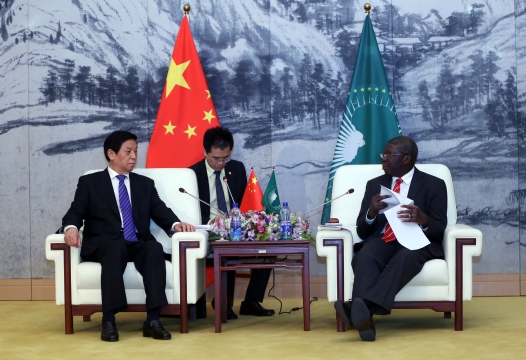
Kwesi Quartey (right) met with Li Zhanshu (left)

African Union Commission Deputy Chairperson Amb. Kwesi Quartey met with Li Zhanshu, the Chairman of the Standing Committee of National People’s Republic of China at the African Union Headquarters in Addis Ababa Ethiopia on Friday, where both leaders renewed their commitments to consolidate and deepen the longstanding African Union- China strategic partnership.

China has for long been one of Africa’s most important allies, with significant Sino-Africa history, dating back to the colonial and liberation struggles.
According to the media statement, the high level meeting and the first visit to Africa by Mr. Zhanshu, was an opportunity for the AU Commission and China to assess the implementation progress of the areas of cooperation under the Forum on China-Africa Cooperation (FOCAC) mechanism and the Belt and Road initiative.

The leaders had exchanges on the need to capitalize on the synergies between the African Union and China, to ensure the success of the joint continental projects in areas such as peace and security, infrastructure, agriculture, manufacturing, energy, health and education sectors, whose realization, they noted, would cement the win-win cooperation. These areas of cooperation were the centre of deliberations in the visit to China, by the Chairperson of the AU Commission, Moussa Faki Mahamat
Kwesi briefed on the priorities and flagship projects of the AU notably the establishment of the African Continental Free Trade Area, the protocol on Free Movement, the single air transport and further highlighted the progress in enhancing domestic resource mobilization with the implementation of the decision of financing of the Union for the self-reliance and predictable funding of the AU activities and projects.
Imposing the 0.2 per cent levy on eligible imported goods will fund 100 per cent of the operational budget, 75 per cent of the program budget and 25 per cent of the peace support operations of the African Union. Zhanshu reiterated China’s support for Africa’s development agenda noting that the cooperation would seek to advance the realization of the priorities of the needs of the African citizenry and would align to the continent’s development blueprint; Agenda 2063 underpinned by the principles of mutual interests and shared values.
In referencing to China advanced industrialisation, Kwesi observed the need for human capacity development which he noted would catapult Africa’s development agenda. He underscored the need for education and skills improvement for the African citizenry, especially the bulging youth, which he said would enhance the quest for industrialization, integration through managed migration and skills transfer, peace and security by creating an environment for meaningful engagement of the population, value addition for Africa’s rich natural resources which would provide job opportunities and the improvement of the socio-economic environment for all.
“I am glad there is this popular realization that to drive Africa’s vision, we need an educated, literate and numerate population. We must endeavour to have every child in school and to review the quality of education our institutions offer, to make it more responsive to the demands of the modern day demands and realities. We must leverage on science and technology”, he said.
In this regard, Zhanshu shared the experience and the benefits of having an educated people, which he highlighted was the backborne of China’s economic rise. He in particular noted “China has relentlessly implemented the Compulsory Education Law where everyone has to undergo nine years of government funded compulsory school attendance. We have now expanded our focus on the tertiary education because we have are reaping the benefits of education and skills training”. China’s education system is the largest state-run education system in the world.

The bilateral meeting was also attended by Mrs. Josefa Leonel Correia Sacko, the Commissioner for Rural Economy and Agriculture, Mrs Amira Elfadil Mohamed Elfadil, the Commissioner for Social Affairs, Directors and Advisors to the Deputy Chairperson, the Commission briefed on the intended establishment of an African Union representational office in Beijing to heighten the cooperation between the African Union and China.

Mr. Zhanshu also took the opportunity to restate China’s commitment to continue supporting African Common positions at the United Nations Security Council especially the sustainable financing of peace support operations in line with the UN resolutions and decisions adopted by the African Union Assembly of Heads of State and Government.

Ahead of the 4th FOCAC Summit scheduled to take place in Beijing, in September 2018, both leaders acknowledged the results achieved within FOCAC mechanism highlighting the intentions to strengthen the mechanism to further promote multilateralism

Stories Continues after ad
Protect migratory birds-UN chief urges world

As they make their global journeys, migratory birds not only set birdwatchers’ binoculars agog, they also help the planet maintain its essential ecological balance.

That’s one of the key messages from United Nations Secretary General Antonio Guterres, for World Migratory Bird Day, celebrated on Saturday, with the message: “Unifying Our Voices for Bird Conservation.”
“Migratory birds connect people, ecosystems and nations. They are symbols of peace and of an interconnected planet,” Secretary-General António Guterres said in a statement to mark the Day.
“Their epic journeys inspire people of all ages, across the globe,” he continued, adding: “World Migratory Bird Day is an opportunity to celebrate the great natural wonder of bird migration – but also a reminder that those patterns, and ecosystems worldwide, are threatened by climate change.”

The Day highlights the need to conserve migratory birds and their habitats by raising awareness of the threats they face, their ecological importance and the need for international cooperation to conserve them.
Migratory birds fly hundreds and thousands of kilometres, along historic routes, to find the best habitats available for feeding, breeding and raising their young. The perilous journeys involve a wide and diverse array of threats.
Of the 11,000-bird species on the planet, one-in-five is considered migratory. Forty per cent of them are in decline, with one-in-eight under threat of global extinction. Major threats include habitat-loss and degradation, caused by agricultural and coastal development; collision with badly placed wind turbines and powerlines; unsustainable harvesting, and illegal killing and taking.

Migratory birds are also greatly affected by poisoning, such as through ingesting lead released into the environment, through spent ammunition, or toxic weights used for fishing.
“Migratory birds are under threat from every corner: they are losing their habitats, subjected to illegal killing and suffering from the impacts of climate change,” said Erik Solheim, Executive Director of the UN Environment Programme, UNEP, adding that we all have a responsibility to “save such a precious component of the natural world.”
By protecting them, we protect our planet.
Key supporters and partners globally, are adamant that successful migratory bird conservation can only be achieved through a united effort.
“I urge Governments and people everywhere to take concerted conservation action that will help to ensure the birds’ survival – and our own,” the Secretary-General concluded.

On 26 October 2017 in the margins of the CMS COP12 in Manila, Environment for the Americas (EFTA), the Convention on Migratory Species (CMS) and the Agreement on the Conservation of African-Eurasian Migratory Waterbirds (AEWA), announced an innovative partnership to increase awareness of the plight of migratory birds around the world.
The new partnership formally unites two of the world’s largest bird education campaigns, International Migratory Bird Day (IMBD) and World Migratory Bird Day (WMBD) in a bid to strengthen global recognition and appreciation of migratory birds and highlight the urgent need for their conservation.

From 2018 onwards, the new joint campaign will adopt the single name of “World Migratory Bird Day” and major events to celebrate the day will be organized twice a year, on the Second Saturday in May and in October.

Stories Continues after ad

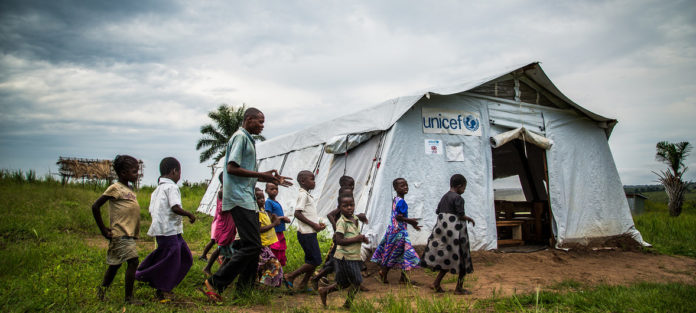
UN agency warns 400,000 children in DRC’s Kasai region ‘at risk of death’

Children attend class in a temporary tent school in Mulombela village, Kasaï region, Democratic Republic of the Congo.

About 400,000 children in the Democratic Republic of the Congo (DRC) “are at risk of death” in the Kasai’s region from food shortages caused by conflict and displacement, a senior UN official who has just returned from the area, has expressed shock following his visit to that area.

The UN Children’s Fund (UNICEF) has issued the warning on Friday, as it scales up its response to those in needs.
Before violence flared in mid-2016 between government forces and tribal militia across the vast region, the people of the Kasais had little experience of conflict, according to UNICEF Spokesperson Christophe Boulierac.
“What I saw really shocked me at a personal level…The situation there is absolutely scary, in the sense that people had to flee in the bush (with) family, children”, he said.

“They had to stay a few months because of the violence. They had no proper food, they had no proper water to drink. And now that the violence has decreased they come back.”
The UNICEF official who has worked in the field in Asia, African and the Caribbean countries said: “Often we say that children are at risk of dying; no, that’s not what we are saying in Kasai. We say that children are dying; I saw that.”
Some 3.8m people are in need of humanitarian assistance in the Kasais, including 2.3m children. At least half of all children under-5 years of age in the region – that’s 770,000 – are suffering from acute malnutrition, including 400,000 who are severely malnourished, according to a UNICEF report published this week.

UNICEF says that many families driven from their homes have been unable to plant and harvest their crops for three successive seasons. It also warns that thousands of children have been recruited into armed groups and militias and that hundreds of schools and health centres have been looted, burned or destroyed.
To support its programmes for the children of Kasai in 2018, UNICEF has appealed for $ 88m, which to date is only 25 per cent funded.

Stories Continues after ad