Stanbic Bank
Stanbic Bank
20 C
Kampala
Stanbic Bank
Stanbic Bank
Home Blog Page 1771

Airtel woos Ugandans with new campaign

Airtel Uganda Marketing Director, Indrajeet Kumar addressing the press.

Airtel Uganda has today announced a new campaign where subscribers are set to win a host of freebies.

Dubbed ‘Life is better’, the one-month campaign will see new subscribers receive 30 minutes of Airtel to Airtel calls, 200 Airtel to Airtel SMS’, 200MBs of Data and 1,000/= of Airtel Money free of charge simply by recharging with a minimum of Shs500.

Speaking about the new campaign, Airtel Uganda Marketing Director, Indrajeet Kumar, encouraged Ugandans to join the network and enjoy the affordable and reliable services.

“Airtel Uganda is known for its affordability amongst other value propositions.  We are now offering all our new subscribers an opportunity to also enjoy the best value from the Smartphone network through this robust combo proposition,” he said.

The new campaign comes just a few days after the telecommunications company revised its data bundles in a bid to remain affordable and enable subscribers to stay connected to their friends and families.


Stories Continues after ad

FIFA bans Ghanaian referee for life

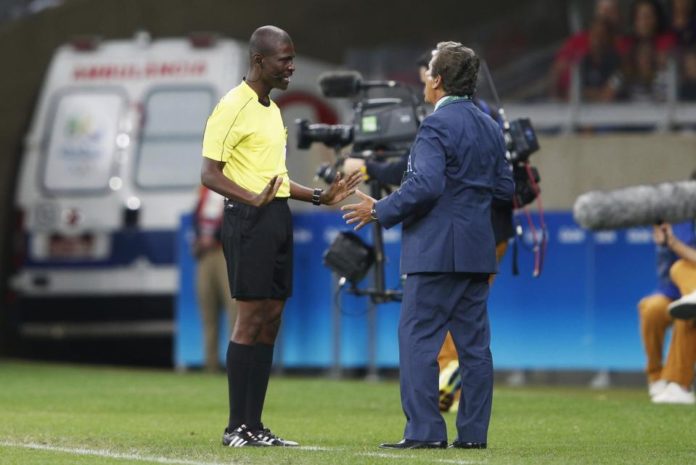
BANNED FOR LIFE: Ghanaian referee Joseph Odartei Lamptey

The Federation of International Football Associations (FIFA) has banned Ghanaian referee Joseph Odartei Lamptey for life after being found guilty of unlawfully influencing a match result. He is ordered not to take part in any kind of football-related activity.

The official was found guilty of breaching art. 69 par. 1 (unlawfully influencing match results) of the FIFA Disciplinary Code during the 2018 FIFA World Cup Russia qualifying match between South Africa and Senegal on November 12, 2016.

Lamptey was guilty of “poor performance” in the match and “awarded a wrong penalty for handball despite the fact that the ball never touched the hand of the player.”

FIFA has also ordered the World Cup qualifier between South Africa and Senegal to be replayed in November, with the exact date to be confirmed in due course.

South Africa won 2-1 over Senegal in an African qualifying Group D clash in November last year.

The referee previously served a six-month ban, imposed by CAF, for wrongly awarding a goal during a CAF Champions League semi-final in 2010.

This is a blow to South Africa’s World Cup chances, and they were already at the bottom of their group even with the only win.

The South African Football Association has denied all wrongdoing but will consider FIFA’s report before deciding whether or not to launch an appeal.

Stories Continues after ad

Museveni to deliver keynote address at Uganda oil and gas summit

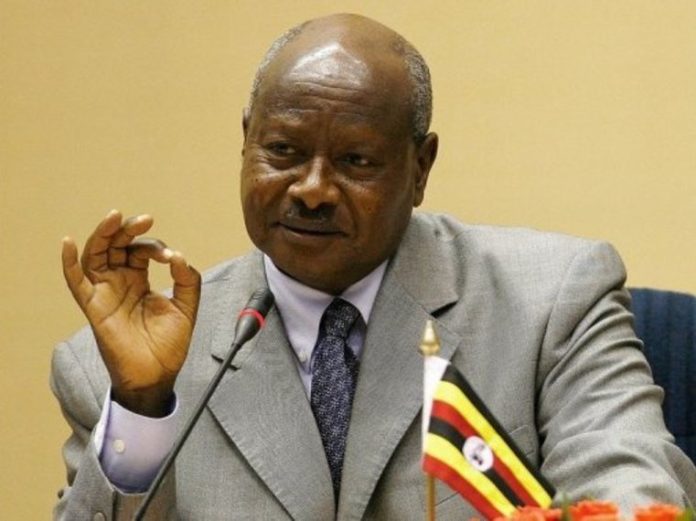
Yoweri Museveni, President of Uganda

President Yoweri Museveni will give the keynote address at the 3rd Uganda International Oil & Gas Summit (UIOGS) from September27-28, 2017 at the Hotel Serena, Kampala.

Held with the support of the Uganda National Oil Company and Petroleum Authority of Uganda, official delegations at the event are being led by host, the Minister of Energy and Minerals Development Irene Muloni, and Equatorial Guinea Minister of Mines, Industry and Energy, Gabriel Lima, alongside over 400 oil and gas industry leaders from around the world.

Building on the success of its 2nd edition in 2016 which saw over 350 attendees, UIOGS 2017 will again demonstrate the importance of Uganda’s oil and gas industry, discussing and debating the future of exploration and production in the region. It will feature presentations from industry leaders and experts from all over the world.

Further underlining its growing international significance, the event has supporting partners from all over the globe including major operators Total and CNOOC as Knowledge Partners and Principal Sponsors, joined by Siemens, Ponticelli Uganda, Fluor, OGAS Services and Freight Forwarders Kenya.

Other operators include Honeywell, UOP, Civtec Africa, Emerson Automation Solutions, Frontier Services Group, Jaihind Projects, Shawcor, AFEX, Alpha Logistics and Bawaka & Sons.

Speaking of the event’s growing global significance, Event Director, Global Event Partners, Dan Grogan said: “The Uganda International Oil & Gas Summit is continuing to build in huge international significance, attracting professionals from across all aspects of the global oil and gas sector, including all of the key players in the industry and all elements of the value chain. It will act as a platform for the industry to come together, discuss and debate the crucial next steps in the road map to production. We look forward to the participation of all global partners, suppliers and customers in support of our endeavours.”

With over 21 oil and/or gas discoveries made to date, 87 oil wells drilled and 21 fields in existence, Uganda’s long-awaited development phase is now certainly in full flow and the country is now unquestionably one of the hottest prospects and most promising areas for exploration ROI on offer.

Stories Continues after ad

Fine dining principles

By Cynthia Tumwine

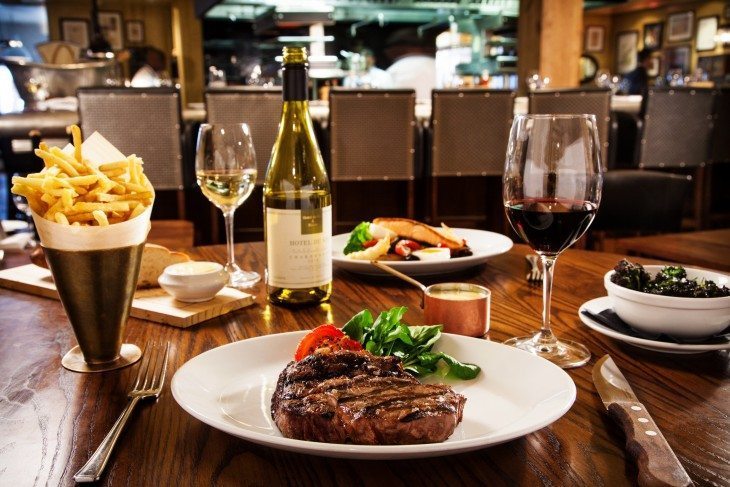
Fine Dining is an interesting experience that many people in Uganda are slowly getting more acquainted with. What does Fine Dining entail exactly you wonder? To enjoy the finest in food, service and atmosphere that is usually relaxed and set to have you forgetting all your day’s stress. Of course with fine dining the cost of a meal is usually higher than what you would normally pay at a fast food restaurant or your nearby local food bistro.

Characterised by specials of the day where a select meal is prepared by the chef and the regular options off of the menu, which consist of starters, the main course and dessert. For some people they opt to have the full three course meal but if you are a terrible eater you could just opt for two out of the three or even just one. Special shouts to you if a restaurant has held you hostage based on just its dessert menu. House wines, champagnes and the drinks menu also usually has various options catering to both alcoholic and non-alcoholic drinks.

Fine dining also incorporates high standards of dining table behavior. Once you reach these exquisite restaurants, you are seated at a set table by usually polite and well trained waiter/waitress staff. The table will have a clean crisp table cloth, a napkin and different cutlery for the different foods you are going to eat. As fine dine etiquette would have it using a fork and knife to eat is key.

Kampala has several top star restaurants which offer this experience around town and it’s outskirts including; Mediterraneo on Acacia Avenue that serves Italian Cuisine, Tamarai on the lower Kololo terrace that offers Thai cuisine, Pardis that does Middle Eastern Cuisine or Nawab Indian Restaurant at Garden City and Acacia Mall rooftop that specialize in Indian cuisine to name a few that can also be found on Jumia Food if you are in a rush and do not have enough time to sit and enjoy the meal at leisure or prefer to order in.

The writer is the PR Manager at Jumia Travel Uganda

Stories Continues after ad

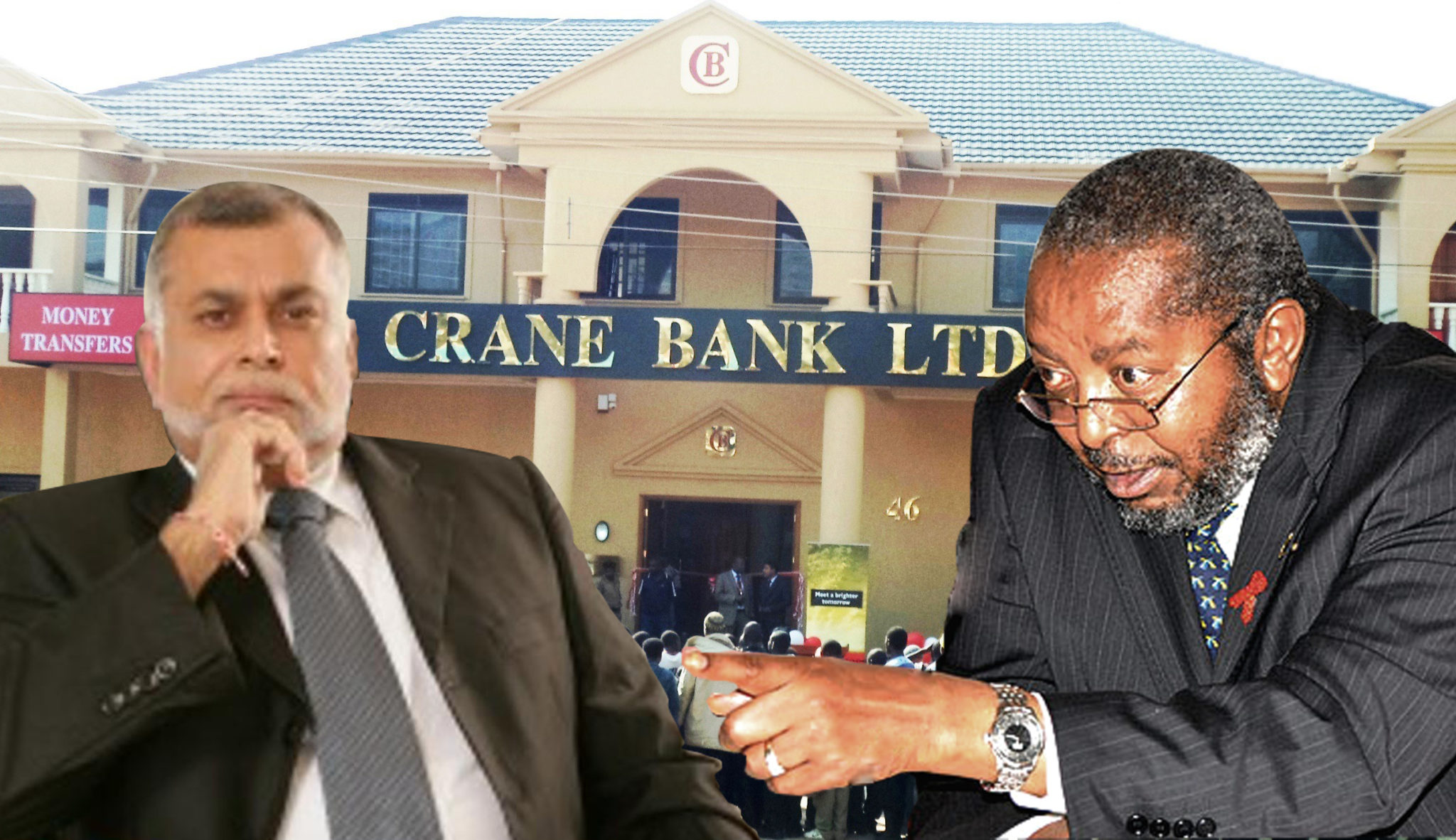
Crane Bank saga: Court sets date for hearing conflict of interest case against BoU lawyers

Following a depone by billionaire businessman Sudhir Ruparelia seeking to have the city law firms of MMAKS Advocates and AF Mpanga Advocates – Bowmans Uganda from representing the Bank of Uganda (BoU) and Crane Bank in the ongoing case that resulted from the closure of the latter, the court has set September 13 as the date of hearing.

About a month ago Mr. Ruparelia, through his lawyers Ms. Kampala Associated Advocates (KAA), petitioned court seeking it to order the BoU to pay US$8 million, after the central bank failure to file a defence in the stipulated time of 15 days, as per the Civil Procedure Rules.

Consequently, through a ‘Reply to the Written Statement of Defence’ the two law firms challenged Mr. Ruparelia’s demands, prompting the businessman to file the Notice of Motion seeking to have them barred from representing both Bank of Uganda and Crane Bank in the ongoing case.


A photo montage of BoU Governor Emmanuel Tumusiime Mutebile, businessman Sudhir Ruparelia and Crane Bank


David Mpanga


Timothy Masembe Kanyerezi

In a Notice of Motion filed yesterday, Mr. Ruparelia avers that by representing the BoU and Crane Bank, the two law firms, represented by lawyers Timothy Masembe Kanyerezi and David Mpanga, are acting in conflict of interest.

‘A declaration that the 1st and 2nd Respondents are conflicted in acting for the 3rd and 4th Respondents and in so acting are in violation of the advocate-client relationship and the Advocates (Professional Regulations) conduct’, the Notice of Motion reads in part.

According to Mr. Ruparelia, the two law firms and lawyers Masembe Kanyerezi and David Mpanga are privy to sensitive information regarding the Crane Bank, having previously been hired by 3rd Respondent (Crane Bank). He further avers that given that past client-advocate relationship with Crane Bank, the two law firms or their lawyers are potential witnesses in the ongoing case.

‘A declaration that the lawyers in the 1st and 2nd Respondents are potential witnesses in HCCS 493 of 2017 and are barred from representing the 3rd and 4th Respondents in the said suit’, the Notice of Motion states.

Further, Mr. Ruparelia wants court to permanently restrain the lawyers from representing the BoU and Crane Bank.

‘A permanent injunction and/ or restraining order be granted restraining the   1st and 2nd Respondents from appearing and or acting as Counsel for the 3rd and 4th Respondents in HCCS 493 of 2017,’ the Notice of Motion adds.


Stories Continues after ad

‘Positive dictatorship] is the way to go

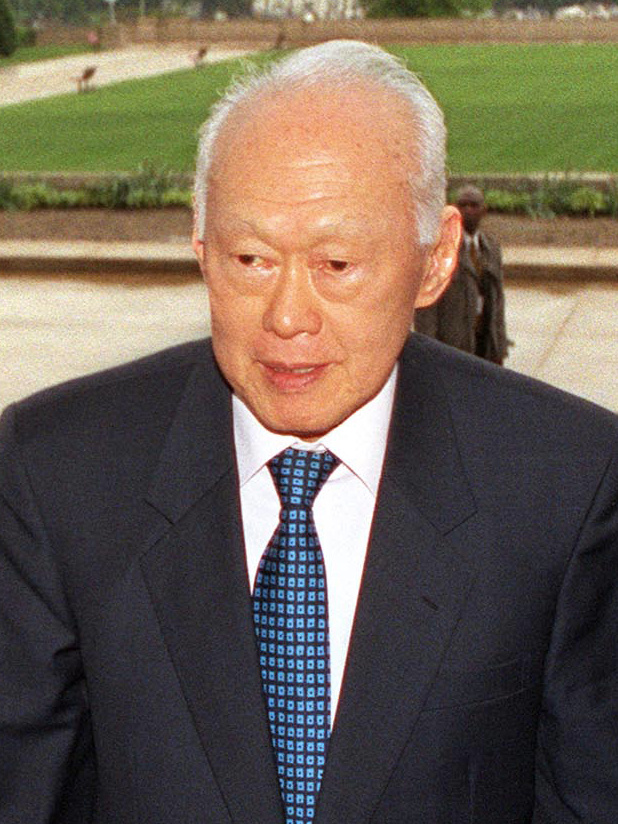
Lee_Kuan_Yew

By Natasha Mariam

First, I appreciate the government for its efforts in upholding human rights and the different freedoms especially the freedom of expression despite the few allegations and challenges from different groups of people.

I recently attended a discussion at Hotel Triangle in Kampala that was organized by Uganda for All, an organization that aims at preaching democracy where one of the discussants, Professor Nuwagaba, said a number of things but what caught my attention was how we can use positive dictatorship and patriotism to better ourselves as a country. I thought to myself, could the too much freedom that we have in Uganda be one of the causes of the problems we have.

‘Positive dictatorship’ also known as ‘benevolent dictatorship’ is a theoretical form of government in which an authoritarian leader exercises absolute political power over the state but does so for the benefit of the population as a whole. A benevolent dictator may allow for some economic liberalization or democratic decision-making to exist, such as through public referenda or elected representatives with limited power, and often makes preparations for a transition to genuine democracy during or after their term. It might be seen as a republican form of enlightened despotism.

Uganda is one of the few countries that have excess freedoms, most people may argue and say that’s not true but I think they need to travel or read more in order to appreciate this freedom. In Uganda, people find it normal to abuse or complain about everyone and everything without any compassion or respect, any other person will find this odd but in Uganda it is normal and close to acceptable. They abuse their leaders and even fellow Ugandans without any limitations.

Businesses in Uganda are run by individuals who aim at making abnormal profits; it is here where you sleep with the price of sugar at 3500 and in the morning the price has been hiked to 5000 without any justifications for the increment.  I normally travel upcountry and usually during the normal days, I go to the bus park and find over 30 buses parked but then during peak seasons say Christmas, Eid or even when students break off for holidays there are no buses to transport people. Why is it so? It is because these bus owners park them intentionally to cause artificial scarcity so that they can hike the amount of money from the passenger, which is exploitative and unfair!

Many projects and services have been delayed or not completed due to corruption, poor planning and some of the culprits are freely moving around even when we clearly know them but because they have the freedom, they seem to be untouchable. Talk about transport and rent both for home and commercial purposes, rent is very expensive that even people who can afford decent homes or work places opt for less.  There are many examples that I can exhaust but will let these do. Well am not saying people should not price their goods and services the way they want since this is a free economy but then there should be serious justification for the changes.

I believe positive dictatorship might be one of the solutions to some of these problems since it looks at the betterment of the country as a whole and probably people will get to understand that despite this freedom, they are accountable and responsible for their actions. Most of the democracies and developed states we see and admire used positive dictatorship as a strategy reach the level that they are based on now. Singapore is one of the known examples; Lee Kuan Yew used positive dictatorship and transformed Singapore from a poor agrarian society into one of Asia’s wealthiest nations.  Rwanda is the latest example in which President Kagame is using positive dictatorship to turn it into a model state on the African continent.

Ugandans need to wake up and face reality that we shall not develop if everyone does whatever they want to do and not what is good for them. Most Ugandans are lazy and are constantly saying “government etuyambe” literally meaning the government should help us. Help us until when? We need to look beyond freedom and instead look at better strategies that will move this country forward.   They say “patriotism is in-born” but I personally believe that good services for example quality education, good health, infrastructure, employment among others will automatically instill the love of one’s country in them and therefore government should employ dictatorship on certain issues especially corruption because instead of delivering services to the people, it is denying them these services hence affecting their patriotism.

DISCLAIMER: The views contained in this article are not necessarily those of the EagleOnline.

Stories Continues after ad

US issues sanctions against top Kiir allies

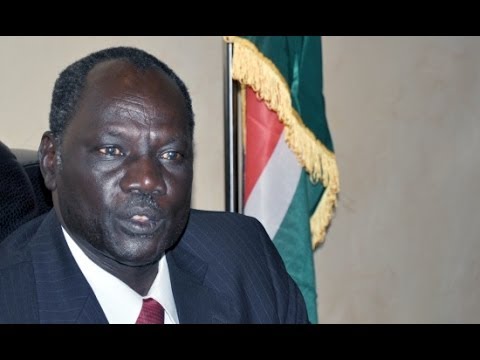
SANCTIONED: South Sudan information minister Michael Makuei. Photo credit/youtube.com

The US slapped sanctions on three current and former South Sudanese officials in President Salva Kiir’s government for their alleged roles in destabilizing the African nation and “enriching” themselves through corruption.

The US blacklisted South Sudan’s army deputy chief of staff Malek Reuben Riak and Information Minister Michael Makuei Lueth, according to a Treasury statement. The measures were also imposed on former head of the army Paul Malong, who was dismissed by Kiir in May. Three South Sudan-based companies owned or controlled by Riak were also sanctioned.

South Sudan erupted into civil war in 2013, just two years after declaring its independence from the north. The ongoing conflict has left tens of thousands of people dead and created a humanitarian crisis as more than 3.5 million people fled their homes.

“These actions send a clear message to those enriching themselves at the expense of the South Sudanese people that we will not let them exploit the US financial system to move and hide the proceeds of their corruption and malign behavior,” said Sigal Mandelker, Treasury’s undersecretary for terrorism and financial intelligence.

The sanctions block all assets of the individuals and entities and prohibit American citizens from engaging with them. The three men are also barred from entering the US.

Additionally, Treasury’s Financial Crimes Enforcement Network issued a warning about South Sudanese senior political figures who may attempt to use the US financial system for money laundering, according to the department.

Lueth dismissed the sanctions, saying they were aimed at derailing an ongoing peace process in the nation with sub-Saharan Africa’s third-biggest oil reserves.

“We will continue with the implementation of the agreement because after all,
what is it when I am economically sanctioned?” Lueth said by phone from South Sudan’s capital, Juba. “What do I have even in America, or in Europe or outside South Sudan? Whatever little I have is with me here in South Sudan.”

Three years ago, the US also imposed sanctions on rebel leader Major-General James Koang Chuol and Sudan People’s Liberation Army Major-General Santino Deng Wol.


Stories Continues after ad

South Sudan blocks Gen. Malong from going to Kenya to identify dead daughter

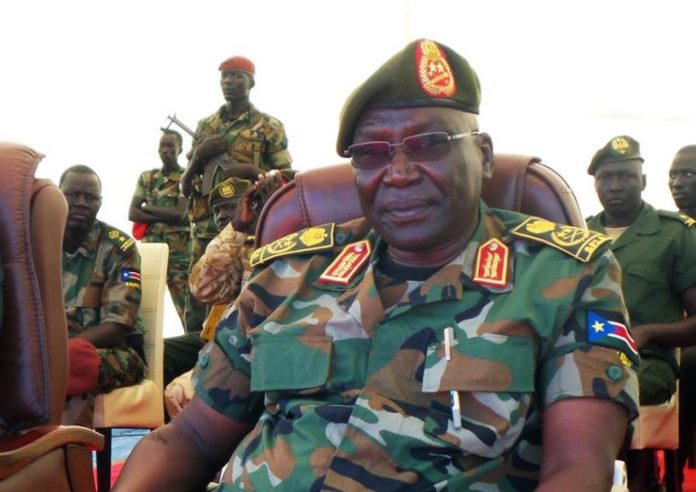
Gen. Paul Malong

South Sudan’s former army Chief Gen. Paul Malong has been denied permission to travel to Kenya’s capital, Nairobi, his wife told Amsterdam-based Radio Tamazuj today.

Gen. Pail Malong had asked President Salva Kiir to allow him to go for DNA sampling after his daughter died when a fire broke out at Moi Girls School in Nairobi last weekend.

According to Gen. Malong’s wife, his blood pressure shot up after President Kiir rejected his request to go to Nairobi.

He has been confined to his home in Juba by the government for security reasons.

The general’s wife urged the government to announce charges against him instead of restricting his movement.

Earlier today, one schoolgirl appeared in court in connection with the fire, which the government says was started deliberately, and she has been detained for seven days.


Stories Continues after ad

Investment in the industrial sector can improve Uganda’s trade deficit

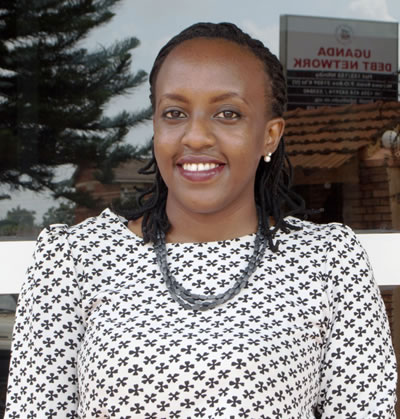
The author Ms. Peninah Mbabazi

By Penninah Mbabazi 

Expanding manufacturing production should be recognized as essential for economic growth in a country, given that manufacturing has potential for value-addition on the country’s existing resources.

Production and export of manufactures have been a leading factor in all successful and catching-up developing countries such as Kenya, Nigeria, Ethiopia and Botswana.

Indeed, manufacturing has been a key factor not only in Africa but also in many emerging Asian and Latin American countries, which have experienced rapid growth in productivity and employment creation, as well as technological upgrading.

Manufacturing and production in Uganda offers upstream/downstream manufacturing opportunities, including food and mineral processing; production of beverages; textile, clothing, and leather production; packaging material; metal fabrication; fish processing; and chemical and pharmaceutical production. Uganda’s central location in eastern and southern Africa is an advantage in terms of potential markets in bordering countries for its manufactured products.

Performance of the manufacturing subsector (both formal and informal) In 2014 Uganda was estimated to have registered a stronger growth of 6.2 percent compared to a marginal 0.6 percent growth in 2013. This growth was driven by the strong performance in processing and preservation of meat 5%, other beverages 19%, pharmaceutical products 14% and iron and steel products 5%. Currently the manufacturing sector contributes 21% to Uganda’s GDP.

However, according to the CIA World Factbook on Uganda, the country still exports more than it imports. In 2016, Uganda earned US$ 2.7bn from exports and USD 4.7bn from imports. Uganda’s trade deficits have put a block to some of the potential sectors such as agriculture from thriving. This reflects a commodity constraint faced in coffee, tea, fish which needs to be addressed and can triple export earnings from US$ 615m to US$ 1.8bn annually.

Can the manufacturing sector be a sustainable way through which Uganda can create more decent, well-paying jobs for its young and growing population?  The shift of resources towards manufacturing provides at least four linked and mutually reinforcing major benefits, namely productivity growth, development of linkages and spillovers, economies of scale, and new export opportunities. The manufacturing sector has the potential to create economies of scale and rapidly increase productivity largely due to a high rate of technical change. Labour productivity in manufacturing activities increases through the adoption, development, and mastery of new technologies.

The African Growth and Opportunity Act Trade Programme with the East African countries being signatories to the AGOA trade programme which offers them duty-free access to the United States.  Kenya, Uganda, Rwanda, Burundi, Tanzania and South Sudan decided on a ban of imported second hand clothes and shoes by 2019 in order to boost domestic clothing manufacturing.

Rwanda took a stand on banning second hand clothes regardless the threats by United States to review trade benefit to Rwanda, Tanzania and Uganda. Despite being a member of the African growth and opportunity Act (AGOA) the stand is highly recommended hence the need for other states to stand together. This will enable Uganda to strongly grow, establish her industries as well as export more of her goods within and out of the region.

Recommendation Government should invest more into agro-processing across the country which will add value to raw agricultural products. Technological upgrading will allow farmers to transform themselves into small-scale industrialists. It is through this that these proceeds will then be used to build an export-oriented manufacturing base.

The growth of the manufacturing sector is critical in generating value addition, spurring growth in employment and productivity, developing and deepening linkages with upstream and downstream activities along the value chain, and upgrading technology.

The manufacturing sector’s trends portrayed above clearly point to a critical need for a transformation of the Ugandan economy aiming at increasing the share of manufacturing in GDP if the country is to catch up and become a competitive upper middle-income country in the next three decades, in line with the country’s development goal as articulated in the Uganda Vision 2040.


Ms. Mbabazi is a Programme Assistant, Uganda Debt Network (UDN)


Stories Continues after ad

Don’t focus mainly on making profits – BOU Deputy Governor tells banks

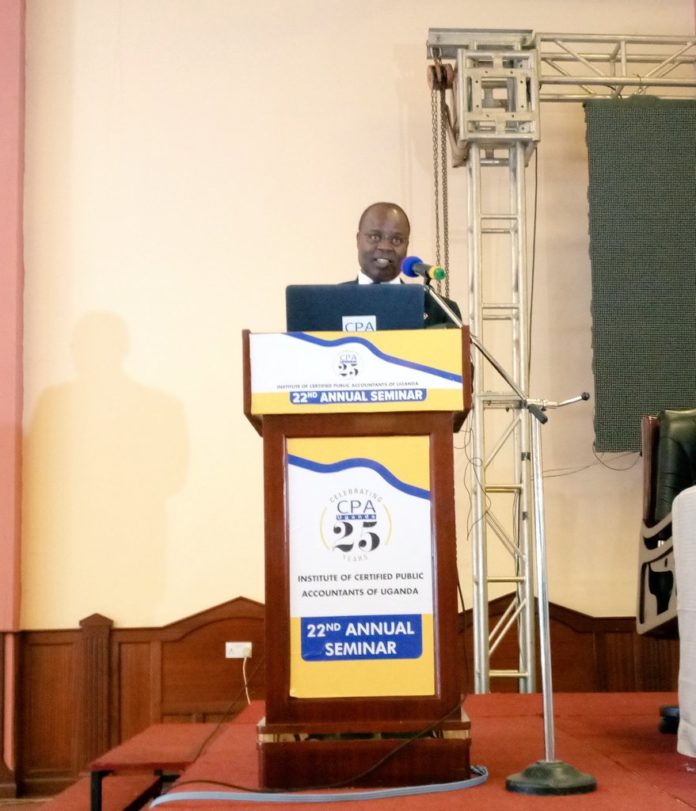
The Deputy Governor of Bank of Uganda, Dr Louis Kasekende addressing delegates at the ICPAU function

The Deputy Governor of Bank of Uganda, Dr Louis Kasekende has castigated commercial banks, saying they have deviated from their core role of facilitating financial intermediation to focusing mainly on making profits.

“Finance is a major pillar of nation building and commercial banks are supposed to facilitate financial intermediations. But because many are making a lot of profits from investing in treasury bills, they have completely ignored their core role. Banks are supposed to mediate between those who have money,” Dr. Kasekende said in his keynote address at the ongoing 22nd Annual Seminar of Certified Accountants of Uganda (ICPAU), taking place at Imperial Resort Beach Hotel, Entebbe.

However, Dr. Kasekende, who was chief guest at the function that was attended by over 1000 CPA delegates, said he is not totally against investment in treasury bills by commercial banks.

“I am not for a total ban of banks from investing in treasury bills for they need liquidity and that can only be achieved through such investments,” he said, noting that: “Investment in treasury bills is main earner of most of these banks,” he clarified when one of the delegates suggested that banks should be discouraged from such investments.

He also used the same opportunity to applaud ICPAU for its contribution towards the growth of the banking sector in the country, saying that the Bank of Uganda requires one to have an accounting qualification to be considered a director of a commercial bank.

Also present at the event, which is also celebrating the institute’s 25 years of existence were former presidents George Egaddu, David Opio Okello, professionals who went through ICPAU and leaders of other professions.

Among these were former Leader of Opposition in Parliament, Nandala Mafabi, the Managing Director of Umeme Ltd Selestino Babungi, and his deputy Sam Zzimbe. Also in attendance was the President of the Uganda Law Society, Francis Gimara, the Secretary of Pharmaceutical Society Samuel Opio and Eng. Dorothy Okello, the President of the Uganda Institute of Professional Engineers Association (UIPE) among others.

MP Nandala Mafabi at the ICPAU function

In his brief speech Nandala Mafabi called for amendments to the Accountants Act in a bid to strengthen accountancy as a profession.

Highlighting the achievements of the institute, ICPAU President Protazi Begumisa commended his predecessors for the foundation they laid for the institute.

“The Institute has grown as a member based organisation, with well-built structures over the last 25 years,” he said, adding: “Uganda represents the East African Community on the Pan African Federation of Accountants Board,” Mr. Begumisa said.

He also said that ICPAU has also been able to sign mutual recognition agreements with all East African member countries, noting that “a CPA in Uganda is a CPA in Rwanda, Kenya, Tanzania and Burundi.”


Stories Continues after ad