Stanbic Bank
Stanbic Bank
26 C
Kampala
Stanbic Bank
Stanbic Bank
Home Blog Page 188

NMS summoned over failure to collect expired drugs

The Auditor General’s report for December 2023 has revealed that Jinja Regional Referral Hospital has kept expired drugs for eight years in its stores, thus prompting Members of Parliament to demand for the reprimand of National Medical Stores (NMS) for the failure to collect expired drugs, despite notifications from hospitals.

The report established that many public hospitals are grappling with huge volumes of expired drugs, yet in some facilities, the active drugs are stored in the same rooms as the expired drugs.

“Fort portal did not provide values of the expired drugs or budget for their disposal, Mubende had 2,322kgs unvalued expiries sent to NMS for destruction, Moroto had expiries worth Shs9,063,085 kept together with live medicines in the same stands in stores same as Entebbe, Soroti and Jinja did not have records of types, expiry dates and quantities of drugs that were expired while Jinja had 16 sacks of expired medicines since 2016,” noted Muwanga Kivumbi, Chairperson PAC.

The Hospital administrations attributed the presence of expired drugs to the failure by NMS to collect expired drugs for disposal or have them returned on delivery despite the notices.

NMS was also faulted by the hospitals for the supply of incomplete combinations of reagents as for the laboratory and changes in fixed drug combinations for treatment e.g. ARVs and TB, where certain drugs are discarded in treatment regimens leading to non-use, as well as the supply of vital drugs in dire need with a short shelf life.

“It is the sole duty of the National Drug Authority to collect expired medicines and forward them to the National Drug Authority for destruction. Thus, having been notified by the hospitals to pick the medicines for disposal to no action e.g. un-picked expired stock at Jinja for 8 years shows total and intentional laxity by NMS to act. Non-valuation and separation of expired drugs from the good stock is a violation of Chapter 8.2 of the Ministry of Health of Health essential medicines and health supplies management Manual (EMHS) 2018. The practice also curtails estimation of value lost and if mixed up and consumed can lead to health hazards,” noted Muwanga.

The Public Accounts Committee recommended NMS should be held liable for the anomaly and be reprimanded by the Secretary to Treasury for failure to collect expired medicines for disposal and for being non-responsive.

 “Accounting Officers should designate separate storerooms for expired goods to avoid mix up at the time of dispensing. The Accounting Officers should consider minimizing expiry of medicines through redistribution to other needy health units.”

Stories Continues after ad

Dr Kedrace Turyagyenda named Education Ministry PS

Dr. Kedrace Turyagyenda.

Doctor Kedrace Turyagyenda has been named as the new Permanent Secretary in the Ministry of Education and Sports, replacing Ketty Lamaro.

The appointment was announced by the Minister of Education and Sports, Janet Museveni.  

“I congratulate Dr. Kedrace Turyagyenda on her appointment as the new Permanent Secretary for the Ministry of Education,” she said via her X handle formerly Twitter.

President Museveni dropped Ketty Lamaro, citing confidential information about her conduct.

Lamaro’s departure was seen as a significant move, given the importance of the Education Ministry in implementing the government’s education policies.

Janet Museveni also applauded Jane Egau Okou, the Under Secretary in the Ministry of Education stating, “I thank Dr. Jane Egau Okou, the Under Secretary in the Ministry who served in the acting position, for her contributions. I have full confidence in her collaborative efforts with Dr. Turyagyenda.”

Janet Museveni also applauded the sports department for the victories achieved both nationally and internationally and pledged to present the medalists to President Museveni for an official reception.

“We take pride in our significant sports victories, both nationally and internationally. We look forward to His Excellency the President’s official reception of the medalists at the Teryet National High-Altitude Training Centre,”

“We take pride in our significant sports victories, both nationally and internationally. We look forward to His Excellency the President’s official reception of the medalists at the Teryet National High-Altitude Training Centre,” she said.

She added, “The progress in AFCON preparations is praiseworthy. I am optimistic about the swift conclusion of the Sports Bill amendment process and the necessary sub-sector reforms.”

Dr. Kedrace Turyagyenda is an Educationist and has been serving as the Director of Education Standards in the Ministry of Education and Sports. Prior to that, she served as the Commissioner for Secondary Education Standards in the same ministry. She is a member of several governance bodies of education institutions. She has published a number of education research and presented a number of papers in international conferences.

She holds a Doctorate in Education Management from Nkumba University Uganda; a Master of Science Degree from Leicester University in UK; a Bachelor of Science Degree and a Diploma in Education from Makerere University, Uganda.

Stories Continues after ad

We don’t know him Pakistan distances self from accrediting Rugiira’s diplomatic status

Rugiirwa katatumba fake passport

The Pakistani Embassy has denied authorizing the procession of a diplomatic passport to the son of the former honorary consul to Pakistan in Uganda, Rugiirwa Katatumba.

Recently, Minister of Internal Affairs, Kahinda Otafiire said that the diplomatic passport could have been issued by the Pakistani Embassy to Rugiira Katatumba.

Hasnain Zafar, an official from the Pakistani Embassy clarified that Rugiira is not a Pakistani citizen and his government only issues passports to the citizens.

“We do not have the authority to issue passports to Ugandan citizens. The passport in question belongs to the Government of Uganda not Pakistan. We have no involvement in this matter, it is the responsibility of Uganda’s government to address it,” Zafar said.

Internal Affairs Spokesperson, Simon Mundeyi clarified that they are not involved in the procession of the passport and it is the mandate of Police to summon Rugiira and have him explain how and where he got the passport. 

Stories Continues after ad

Debt crisis is choking sub-Saharan Africa, leaving health and HIV services chronically underfunded-UNAIDS report 

Growing public debt is choking sub-Saharan African countries, leaving them with little fiscal room to finance health and critical HIV services. 

A new report by UNAIDS, Domestic revenues, debt relief and development aid: Transformative pathways for ending AIDS by 2030 Eastern and Southern Africa | Western and Central Africa, shows that the debt crisis is putting in jeopardy progress made towards ending AIDS.

Sub-Saharan Africa accounts for the largest number of people living with HIV, with more than 25.9 million people of the 39.9 million living with HIV globally. The region’s success in having reduced new HIV infections by 56% since 2010 will not be sustained if fiscal space is constrained. 

The report, released ahead of the 79th session of the United Nations General Assembly in New York, shows that the combination of growing public debt payments and spending cuts set out in International Monetary Fund agreements in the next three to five years will, if unaddressed, leave countries dangerously underresourced to fund their HIV responses.

“When countries cannot effectively look after the health care needs of their people because of debt payments, global health security is put at risk,” said UNAIDS Executive Director Winnie Byanyima. 

“Public debt needs to be urgently reduced and domestic resource mobilization strengthened to enable the fiscal space to fully fund the global HIV response and end AIDS,” she said.

“World leaders cannot let a resource crunch derail global progress to end AIDS as a public health threat by 2030,” said Byanyima.

Debt servicing now exceeds 50% of government revenues in Angola, Kenya, Malawi, Rwanda, Uganda, and Zambia.  Even after debt relief measures, Zambia will still be paying two-thirds of its budget on debt servicing between 2024 and 2026.

There has been a noted decline in HIV response spending since 2017 in Western and Central Africa, from 0.3% of GDP in 2017 to just 0.12% in 2022.

Western and Central Africa will need to mobilize $4.18 billion to fully fund the HIV response in 2024. This will climb to $7.9 billion by 2030 unless efforts are scaled up today to stop new HIV infections.

While $20.8 billion was available for the HIV response in 2022 in low and middle-income countries through both domestic and international sources, this funding was not enough to sufficiently finance the HIV response. Western and Central Africa, for example, had a funding shortfall of 32% in 2022.

In 2024 alone, Eastern and Southern Africa will need to mobilize almost $12 billion to fully fund the HIV response. This amount will climb to around $17 billion by 2030 unless new HIV infections are reduced.

To enable increased domestic resource mobilization for countries to respond effectively to their pandemics, sub-Saharan African countries will need to strengthen their tax systems, including closing tax exemptions, which currently cost countries an average of 2.6% of GDP in lost revenue across the region.  Donors also need to scale up financial assistance for health and the HIV response between now and 2030, while creditors should offer debt relief to heavily indebted countries to ease the burden.

Stories Continues after ad

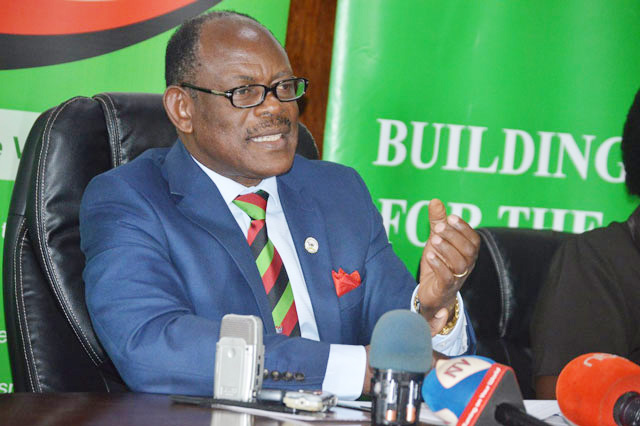
Over 190 courses offered at Makerere University are expired – Auditor General 

Prof. Nawangwe, Vice Chancellor Makerere University.

Parliament has blamed the top leadership of Makerere University over the delay to review the university courses.

According to the Auditor General, the audit review of the database of university courses revealed that 198 expired courses were being taught to students.

“The university had 347 active taught courses; which 149 are fully accredited/reviewed, whereas 198 are pending review or accreditation at both graduate and postgraduate levels,” the report indicated.  

According to the report, the university explained that the academic program review involves a comprehensive process, including departmental, stakeholder consultations, school and college reviews, Senate and Senate Committees, Quality Assurance Committee, and University Council.

“The failure to have timely review and accreditation of courses affects the university’s ranking, and the students that graduate from affected courses or programs may get challenges of admission in other international and local learning institutions,” noted Muwanga Kivumbi, Chairperson, Public Accounts Committee.

Kivumbi said the Makerere University Agricultural Research Institute in Kabanyolo (MUARIK) faces the risk of losing 650 acres in Kabanyolo, valued at Shs325 billion if the land isn’t fenced off, after one individual took a portion of the land to construct a private school.

MPs also raised concern over the low staffing levels at the institute, with the report indicating that out of the approved structure of 235 staff at the MUARIK establishment, only 37 were filled, leaving 196 (83%) positions vacant.

Parliament has asked Makerere University to recover the Shs127,059,137 paid to a contract staff member who had absconded from duty at the College of Computing & ICT Training.

“The delayed removal of staff from payroll results in payment for services not rendered to the university, thus causing financial loss to the government. The accounting officer should recover the funds from the staff within six months of the adoption of this report,” said Muwanga Kivumbi, Chairperson PAC.

Stories Continues after ad

Uganda Prisons should be removed from civil service category –Otafiire

Minister of Internal Affairs, Maj. Gen. Kahinda Otafiire has proposed that Uganda Prisons Service be removed from the civil service category, arguing that the Prisons Service operates differently from typical civil services, as its duties involve handling security and correctional services.

Otafiire made the revelation during the pass-out of seventy (70) officers who have been undertaking a Prisons Junior Command Course (JCC).

Otafiire’s stance is that treating the Prisons Service like any other civil service entity leads to operational and administrative constraints since they hold guns which are lethal.

“Ideally all officers of the armed forces are part of the reserve forces. But you know our people are very conservative. I one day told some officers to write me a paper removing the armed forces from the civil service but up to now these gentlemen haven’t done so. How can a prison or police service be part of the civil service yet the police and prison officers carry arms?” Ofiire said.

He argued, “A gun is a lethal weapon and those who carry them should be managed differently from those who do ordinary service jobs.”

Otaffire tasked the Commissioner General of Prisons to write a paper and will present it to the cabinet to distinguish those who carry weapons from those with chalk and syringes because Prison officers have the skills which if misused and are lethal.

“You have a skill if mismanaged is lethal. So you have to be handled differently from those who do benign jobs like the chaplains,” he noted.

He further not that although prisons are meant for punishments, the prisons philosophy emphasizes rehabilitation since no one is born a criminal but engagement in crime is due to the environment in which one is raised and circumstances in which one grows up.

He also noted that the Prisons authorities are trying their level best to provide opportunities for people to acquire self-supporting skills.

He congratulated Prisons general Commissioner, Johnson Byabashaija for having the least recidivism rate which has been achieved through the rehabilitation philosophy.

Speaking at the same event, Johnson Byabashaija reported that the Chief of Defence Forces (CDF) is still hesitant to admit Prisons officers, stating, “We don’t go to collect clients and there should be no hesitation on this.”

Byabashaija decried the increase in the prisoners’ population which is too high to be managed by the Prisons staff.

“I have 14097 staff, 13596 of them are uniform and 501 are non-uniformed staff. The 14097 however represent only 33% of the staff establishment. More staff is definitely needed to effectively manage all our prisons that now number at 269 prisons countrywide with a prisoners’ population of 4129,” he said.

He said that the population is composed of 4129 convicted prisoners representing 52.6% of the total population and 36400 are remand prisoners.

“The remand prisoners are the ones responsible for the congestion which we have in prisons and it is at 376%. This prison population growth which is approximately at 8% per year is the cost driver of all our expenses as far as our budget is concerned. We are struggling to deal with this congestion. Our current space is for 21126 prisoners, so we are approaching four times the number. This is a serious issue that the prison authority must give due consideration and give us strategies on how to deal with this population,” Byabashaija said.

He added that a congested prison is a recipe for health issues, contagious diseases and also transmission to the prison’s warders.

He also raised the challenge of staff accommodation, noting that 48.9% staff are decently housed although the prisons authority is putting up low cost houses for the staff.

Stories Continues after ad

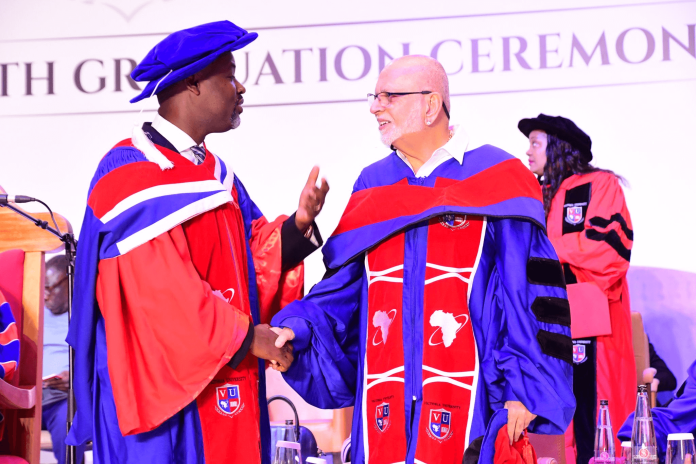
Over 2,000 happily graduate from Victoria University, ceremony at Speke Resort Convention Centre

Victoria University has hosted the 8th graduation ceremony at Speke Resort Convention Centre, with approximately 2,500 students receiving their degrees in different courses.

Vice Chancellor Dr. Lawrence Muganga said the day is a reward for the hard work and dedication of the graduates.

“We are proud of each of our graduates and look forward to celebrating together,” Dr. Muganga said.

Victoria University has established itself as a leading institution of higher learning in Uganda, offering a range of academic programs.

Speaking at the event, Deputy Speaker of Parliament, Thomas Tayebwa appreciated the University stakeholders for the job well done in emphasizing quality education based on advancing technology in the competitive world.

“Thank you Mr. Sudhir Ruparelia for investing in a sector where you don’t expect profits but only to offer service to humanity”

Tayebwa urged the institution management to invest more in groundbreaking research and innovation in order to find solutions for Uganda.

“I urge the University Chairman, Directors and its management to invest more in research and do groundbreaking research to help us get solutions for our continent and Uganda. Otherwise most of the research we have is funded by foreigners and they fund those who serve their interests. Let us invest in research that is tailor made to address our issues as Africa in order to be transformative,” Tayebwa said.

He appreciated the University for teaching courses that provide meaning to the country’s needs, citing that the courses taught are tailor made to the problems of Uganda and will be beneficial to the graduates with the soaring problems in the communities.

He added that Ugandan leaders are now focusing on addressing issues of Intra-Africa trade and intr-Africa travel, stating “It is cheaper to travel to Dubai than travel to Mombasa but if we use our education sector in an approach that serves the whole continent especially through signing the Africa Free Trade Area, we are going to be a one community. Better prepare to go beyond your villages and learn languages that are going to take you belong such as Kiswahili and French to be a global citizen and be able to survive in this competitive world.”

Stories Continues after ad

Makerere’s Nawangwe urges universities, researchers to lead in renaissance of Africa

Prof. Nawangwe in and other researchers.

The Vice Chancellor of Makerere University, Prof. Barnabas Nawangwe has urged universities, leaders, and researchers to take lead in the renaissance of Africa.

“We are the people to handle the renaissance. We must ensure that Africa leads.The renaissance of Africa should be inclusive. Women should not be left behind. Women should be part of leadership, higher education and development,” he said.

Prof. Nawangwe made the remarks at the United Nations General Assembly’s Science Summit in New York, USA in a Panel Discussion titled: AAP Dialogue Series “Advancing The Role of Women in Science for Sustainable Development in Africa: Lessons for Leadership of Higher Education Institutions.”

According to AAP, this specific panel discussion was very critical because the process of fundamental change in gender equity at African higher education institutions remains slow. Some of the significant challenges include deeply entrenched cultural norms, inadequate policy implementation, and resource constraints.

He implored participants from Africa and the world at large, to always remember the resounding question from the Beijing Convention, “Will Africa be left behind again?”

Aware of the aforementioned significant challenges, drawing from his lived experiences in Uganda and at Makerere University, and inspired by the conviction that Africans have the potential to bring about the desired change, Prof. Nawangwe stressed the power of gender inclusion and positive policies in the renaissance of Africa as well as transformation of livelihoods.

Citing statistics, studies and investigations conducted by reputable researchers, that proved that the ratio of women in leadership, science and development in African institutions was very low compared to that of men, Prof. Nawangwe rallied stakeholders to prioritize inclusion of women in education, development and all processes leading to shaping the future of the African continent.

Noting that one of the studies indicated that the enrolment of women in higher education across African countries was still below 15%, Prof. Nawangwe advocated for planned and deliberate gender inclusive strategies to be undertaken at the national, regional and continental levels to increase the percentage of women in higher education.  He also highlighted statistics from the African Research Universities Alliance (ARUA) which indicated that women are still very low in this sector.

“We need to come up with strong policies about the inclusion of women in higher education and development,” he stressed.

The Vice Chancellor shared Makerere University’s experience, which provides hope to any institution that embraces positive policy to support gender inclusion. He pointed out that when Uganda attained independence (1962), 90% of the secondary schools in Uganda were for the boys and only two (2) girls’ schools taught sciences. In 1990, the enrolment of women in universities in Uganda was less than 15%. However, when the Government of Uganda, Parliament of Uganda and Makerere University embraced the affirmative action policy, more girls and women were empowered and supported to access education.

“The policy on affirmative action for girls who qualified to enter Makerere in 1990 has led to a rise in women enrollment to 53% presently. The policy on affirmative action for women in STEM at Makerere has seen a rise in enrollment from 30% to 45% in three years” Prof. Nawangwe reported.

Prof. Nawangwe stated that Makerere University has over the years increased its staff composition by gender with women members of staff constituting 35%. He explained that Makerere University remains committed to implementing gender inclusive policies. The Vice Chancellor added that the majority of respondents in a recent study, including both men and women, recommended that there should be more enrolment of women in higher education institutions.

He disclosed to the participants that when he instituted the Vice Chancellor’s Research Excellence Awards, the second-best researcher was a woman in Science-Professor Rhoda Wanyenze, who is the Dean, Makerere University School of Public Health.

In a keynote address, Dr. Teressa Woodruff-President Emerita of Michigan State University appealed to global leaders in Africa to ensure that women are visible.

“If women are not visible, that country will not advance. Make women visible through governance, economic empowerment, end violence against women, and ensure peace and stability,” she said.

Dr. Woodruff reiterated that universities are critical in the advancement of women in Africa. She explained that women are missing at the higher ranks in the Science disciplines. She noted the need to bridge that gap and also advocated for a value proposition to maintain women in the academy. “Value proposition focuses on the individual. Higher Education institutions should invest in the individual.”

Stories Continues after ad

Uganda, Mozambique resolve to implement endorsed MOUs and bilateral air services agreement

President-Filipe-Jacinto-Nyusi-of-Mozambique-and-President-Museveni-make-a-toast-during-a-state-banquate-at-Vermelha-State-House-in-Maputo-Mozambique-on-Thursday-May-17-2018.-PPU-Photo.jpg

The joint permanent commission of Uganda and Mozambique has called for full implementation of the concluded Memorandum of Understanding and to fast-track the finalization of the exchanged Bilateral Air Services Agreement (BASA) between the two countries.

The clarion call was made during the just concluded second session of the joint permanent commission meeting, which was held in Kampala.

 The meeting resolved that the two countries fast track the signed MoUs of; Public Works and Road Infrastructure Development, Defence Cooperation, Trade Cooperation, Agriculture (Crop and Animal Husbandry), Fisheries/Aquaculture, Mineral Resources and Energy, Oil and Gas Cooperation, and ICT by December 2024.

The meetings were held following directives of President Yoweri Kaguta Museveni and President Filipe Jacinto Nyusi issued in Entebbe on April 27, 2022.

The two reaffirmed the importance of the Joint Permanent Commission as a framework for deepening bilateral relations between the two countries and directed their Ministries of Foreign Affairs to convene the next JPC in Kampala to, deepen bilateral cooperation in the areas of common interest.

Earlier today, the two nations expressed their commitment to promoting peace and security at the regional and international levels, supporting multilateral rules-based order, and promoting sustainable development.

Stories Continues after ad

Gov’t urged to pay salary arrears of Kyambogo University part-time lecturers

Artistic impression of Kyambogo University Main gate.

Legislators have demanded that the Ministry of Education and Sports pay salaries of part-time teaching staff of Kyambogo University.

The beneficiaries include those who were discontinued and others who are still teaching but have diligently pushed on for several months without pay.  

The matter that was raised by Workers’ Representative, Margaret Rwabushaija during plenary sitting on Tuesday September 17, 2024, was responded to by the Minister of State for Education and Sports (Primary Education), Joyce Moriku during plenary sitting on Wednesday, September 18, 2024.

Rwabushaija called for investigations on the non-payment of part-time teaching staff at Kyambogo University, citing that the university has a deficit of Shs5.6 billion in salary arrears.

“The university’s Department of Mechanical and Production Engineering is demanding up to 16 months of salary arrears. The Human Resource Department dismissed these part-time lecturers instead of working to ensure that they get what they are claiming for,” Rwabushaija added.

She alluded to a 2023 scenario when part-time lecturers from the same university threatened to withdraw their services by not setting examinations, which she said indicated the workforce gap and the need for remuneration.

The minister explained that payment of the arrears for all part-time teaching staff now totaling Shs6 billion has been constrained by budget cuts.

“Wages for part time lecturers are under allowances that are released quarterly and these suffer budget cuts. The budget line for allowances suffered a budget cut of Shs2.6 billion resulting in non-payment of non-teaching staff and this accumulated into arrears,” Moriku said.

She added that during the current quarter of the financial year (July to September), only Shs149 million was released to the university, which is inadequate.

Moriku further explained that the staff was discontinued because the university’s policy on recruitment was revised and involved advertising of vacant positions of part-time lecturers, saying that those who were discontinued were not successful.

Rwabushaija however responded by arguing that consideration should have been made to prioritize payment of arrears before recruitment of new staff. 

“The part-time staff was needed because of shortage of full-time staff but at the same time, the university’s Human Resources department was directed to get part-time staff and others who were not paid were laid off. This means that workers are not considered,” she said.

The Leader of the Opposition, Joel Ssenyonyi, concurred with Rwabushaija, saying that failure to pay arrears of the staff could result in a court case, subsequently costing the government more funds.

“What is clear is that we need to invest in education. All of us are products of education. It is important that we take care of this, let us pay the part-time teaching staff before throwing them out,” said Ssenyonyi. 

Workers’ Representative, Charles Bakkabulindi, said that the staff that was discontinued is entitled to their salaries.

“Whether recruited rightly or wrongly, they are entitled to payments. Before you come in with how you will deal with gaps, first correct the mistake. Let us treat them like human beings. I would expect the minister to tell us how we are going to get the Shs6 billion,” Bakkabulindi said.

Luweero District Woman MP, Brenda Nabukenya, noted that whereas Kyambogo University has good infrastructure, there is need for the government to invest in the human resource, saying that the current staffing level at 30 percent compromises the quality of education.

“We cannot get quality education without human resources, with 30 percent, there is a problem. The minister must accept this; a department must have senior lecturers, assistants and professors,” she said.

The Chairperson of the Public Accounts Committee (Central Government), Hon. Muhammad Muwanga Kivumbi, reported that the committee already conducted oversight visits to public universities, among other entities and the reports are ready for presentation, to which the Deputy Speaker, Thomas Tayebwa, guided that the reports be presented next week.

Stories Continues after ad