Stanbic Bank
Stanbic Bank
18.4 C
Kampala
Stanbic Bank
Stanbic Bank
Home Blog Page 1889

Police admit torturing Kamwenge mayor

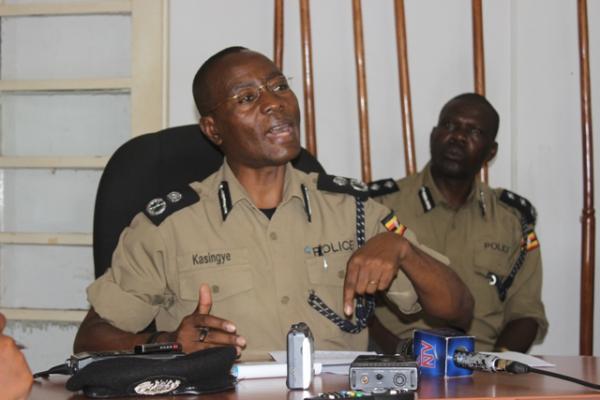
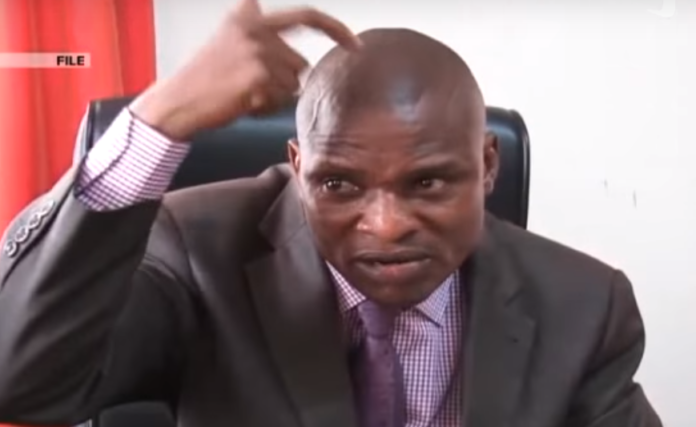
AIGP Asan Kasingye

Police has acknowledged the torture of Godfrey Byamukama, the mayor for  Kamwenge Town council saying he is one of the suspects in the murder of Assistants inspector of police Andrew Felix kaweesi his body guard Kenneth  Erau and his driver Godfrey  Mambewa.

Mr. Byamukama was arrested from the Ministry of Lands along Parliamentary Avenue on the April 5, 2017 however police Spokesperson Asan Kasingye described the situation where the suspect and the two police officers who arrested him went into a scuffle with the suspect when he realized that he was being driven to Nalufenya other than Naguru police headquarter as earlier informed at the time of arrest.

He added that he sustained injuries and the police has offered him the best medical care at Nakasero Hospital and has been discharged and will be getting a periodic review at the same hospital.

“Police officers who inflicted injuries on Mr. Byamukama have been arrested and have been subjected to professional police unit for  the investigations and promised to prosecute them for acting  outside the acceptable standards and  the law of this country’’. Kasingye said

Further he emphasized that   whoever tortures a suspect shall not hide behind various liabilities instead he will be charged individually under the Anti-Torture Act.

“’We reassured the country that the Uganda police force will ensure that its standards are followed and allow the rule of law to prevail’’. He stressed


Stories Continues after ad

Museveni holds bilateral meetings with Uhuru, Farmaajo

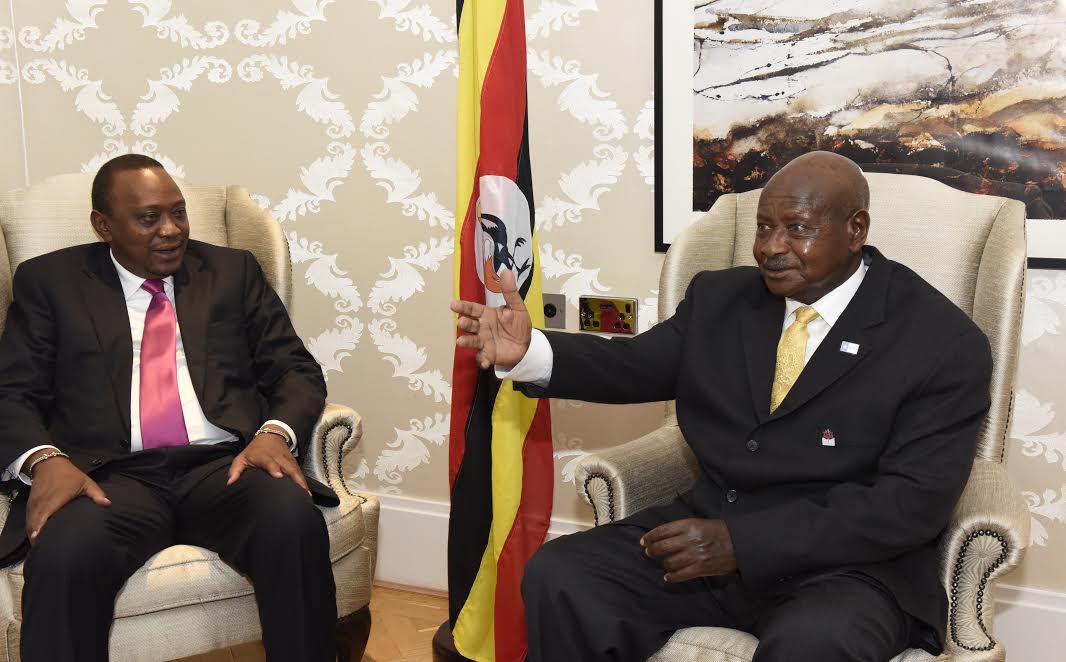
President Yoweri Museveni has met and held a meeting with President Uhuru Kenyatta of Kenya who paid a courtesy call on him at his residency at the Taj 51 Hotel, St. James Court in the United Kingdom.

The two leaders discussed various bilateral issues affecting the region.

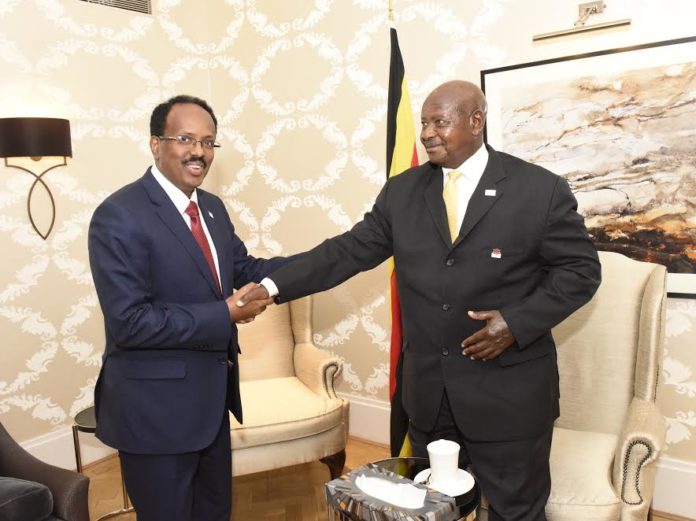
Museveni later held a meeting with Mohammed Abdullahi Farmaajo, the President of the Federal Republic of Somalia.

President Farmaajo thanked President Museveni for Uganda’s support to Somalia peace processed and urged him to support his countries need to build a strong army and security pillars in his country.

The leaders had been attending the just concluded International Conference on Somalia, at Lancaster House in London, United Kingdom.

Stories Continues after ad

Donor dependence stifling peace efforts in Africa, PAP MPs told

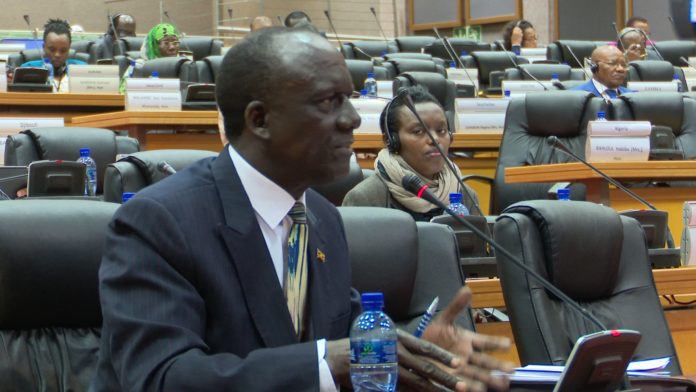
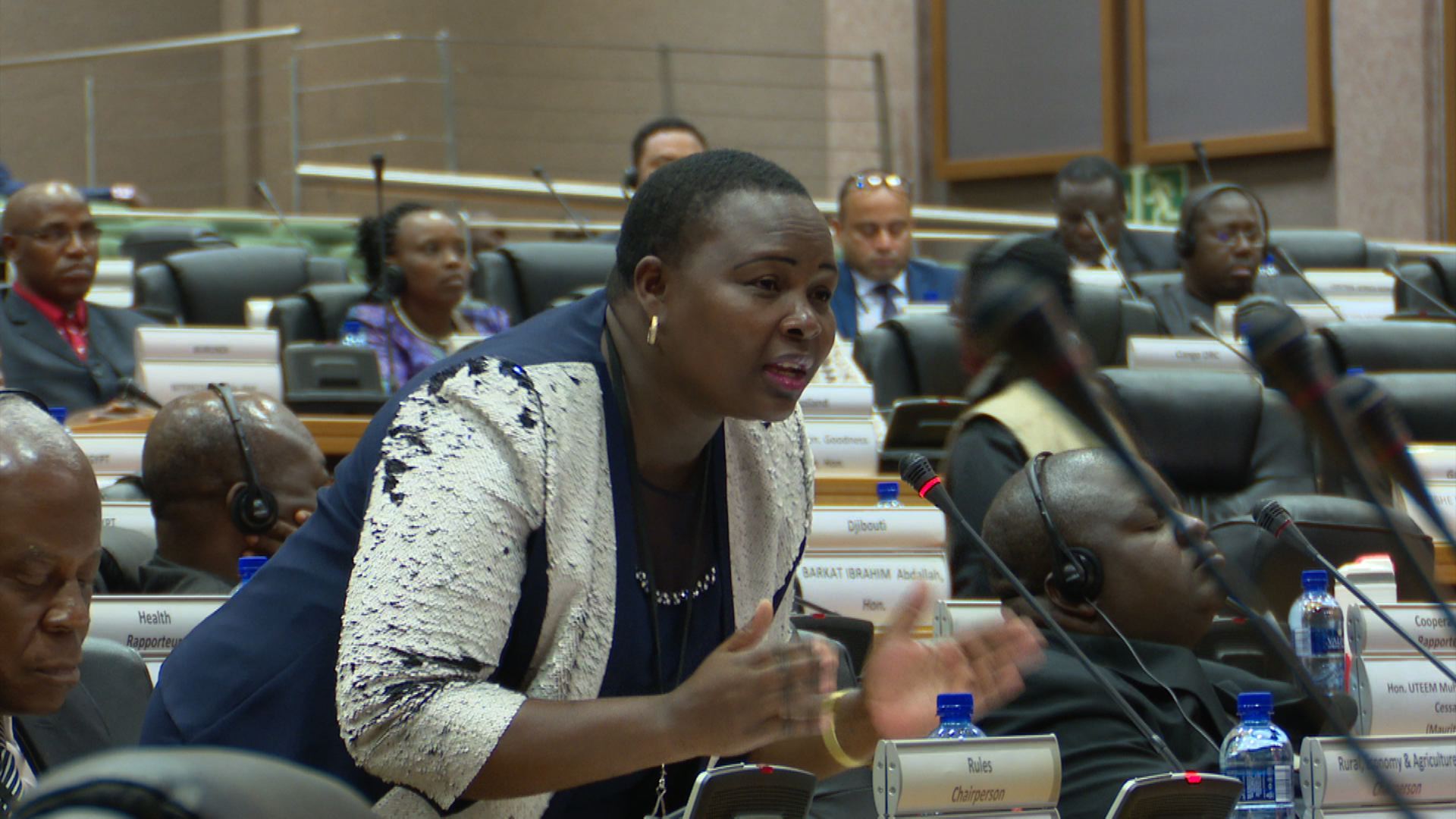
Amb. Mull Katende-addressing-PAP-MPs-in-Midrand-South-Afric

The Chairman of the Peace and Security Council of the African Union, Amb. Mull Katende, has said heavy reliance on donor funding was affecting peace efforts on the continent.

“Our major challenge is donor dependence, and this defeats the whole idea of African solutions to African problems,” Katende said adding that “the decision by the EU to reduce funding for AMISOM troops’ allowances by 20 percent, was having a negative impact on troop morale and instead boosting the resolve of Al Shabaab to continue undermining the AMISOM gains.”

Presenting a paper on the status of peace and security in Africa to Pan African Parliament MPs on Thursday, Amb. Katende urged parliamentarians to make use of the available tools for structural conflict prevention by ensuring that African governments are more transparent, accountable and responsive to the legitimate demands of the people.

The African legislators who are meeting in Midrand, South Africa were told that African people yearn for peace, security and prosperity.

Presently, there is conflict and instability in South Sudan, Somalia, Mali and the Sahel, Libya, Burundi, Sudan, Djibouti, the Gulf of Guinea, Gambia and Western Sahara among others.

Katende hopes that the implementation of the funding formula adopted by the AU in the July 2016 Summit held in Kigali, Rwanda, would improve the funding challenges.

Reacting to the report, legislators urged the Peace and Security Council of the AU to address the root causes of conflict in Africa and the supply of arms. They said economic, social and political inclusiveness was key to peace.

Prof. Morris Ogenga Latigo noted that the challenge that Africa faces is providing leadership for posterity rather than for self, corruption and self-interest.

“We should invest more in ensuring that elections are free; not repetitive but free of mischief and when you are in governance, you govern for all the country and the continent,” he said.

Mbaydoum Simeon of the Central African Republic said African states are victims of raw materials that they possess. He noted that despite more than 12,000 Blue Helmets in CAR, the security situation had not been resolved.

Honourable Okot Ogong (Uganda) was dismayed to note that PAP was talking about security and peace and yet the continent had no stand-by force to manage its own security challenges.

“In the DRC, Darfur and other conflict areas, it is the UN keeping the peace. The AU is acting on behalf of UN Security Council. We have therefore left the agenda of Africa in the hands of other people,” he said.

Other legislators opined that Africa’s target of silencing the guns by 2020 cannot be guaranteed in an atmosphere of intolerance and oppression of the minority.

“African politics has now become a business of patronage and cronyism. We have become more tribalistic and intolerant of each other’s religion,” said Mohammed Mubarak Muntaka from Ghana.

PAP President, Roger Nkodo, said the solutions to the problems bedeviling Africa lay in the Malabo Protocol and that without full powers of legislation, African voices cannot be heard.

With the myriad of challenges facing the continent in securing peace, the Peace and Security Council of the AU has now focused its energies to fight hate crimes and the ideology of genocide in Africa and strengthening the AU’s early warning systems before states slide into anarchy.

The fourth ordinary session of the Pan African Parliament is meeting in its headquarters in Midrand, South Africa, from 8th – 19th May 2017.

Hon. Jacqueline Amongin addressing the PAP

Uganda’s delegation to the PAP includes Hon. Jacqueline Amongin (NRM, Ngora), also leader of the delegation; Prof. Morris Ogenga-Latigo (FDC, Agago North); Hon. Anifa Bangirana Kawooya (NRM, Sembabule); Hon. Felix Okot Ogong (NRM, Dokolo South) and Hon. Babirye Kadogo (Ind. Buyende).

Stories Continues after ad

Intrigue in SPLA forced me to sack Gen. Malong – Salva Kiir

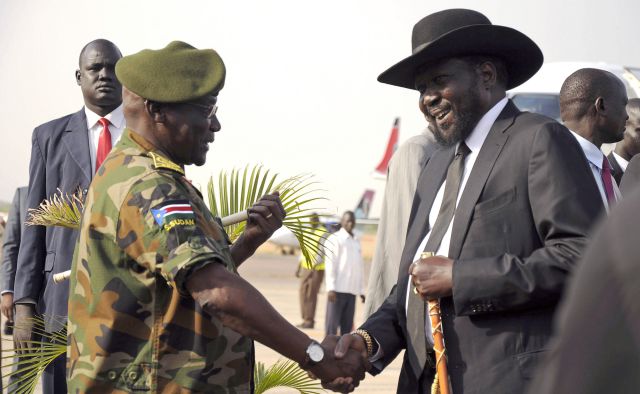
DURING HAPPIER TIMES: President Salva Kiir with former SPLA commander Gen. Paul Malong Awan

South Sudan’s President Salva Kiir said he was tired of the numerous and never-ending reports about Paul Malong, pointing out that his decision to have him removed was to avoid ‘scapegoat for inefficiencies’.

“I was tired of receiving reports about Malong almost every hour of people telling me things I knew he was not doing. This was becoming a routine talk and it was like I was not listening to them, so I decided to make changes which I informed Malong about, so he should not be surprised when the time comes,” President Kiir told members of the Dinka council of elders who paid him a courtesy call.

The President went on to tell the elders that his reasons for the change were to see what those who had been making the reports and claims would do next.

“I made the changes because I wanted to see what the people coming with reports about him will have to say again. I did this because I don’t want him to be a scapegoat for the inefficiencies of those who used to come to me,” added the President.

According to a prominent figure who attended the meeting, President Kiir called Malong to assure him of safety, protection and to contribute to playing a positive role in finding a lasting solution towards the realisation of peace and stability in the country.

“I know Malong and he knows me and this was why I was hesitant after receiving numerous reports about him, so I let him return. He will come and stay in his house under the protection of his own guards, people he wants to provide him protection. If that will not be sufficient, I will personally ensure his safety, even if it means him staying with me. So I have spoken to him and he has agreed to come,” said the President.

Earlier, speaking from Yirol town, Eastern Lakes State, Malong said he had no intention to foment a rebellion against President Kiir.

He further said he wanted to rest in his home region, Bahr El Ghazal.

“If I want to have a problem, that problem should be in Juba. I cannot leave Juba and go and do it somewhere because Juba is where I was working,” said Malong in an interview with Radio Miraya in Rumbek.

Stories Continues after ad

Kamwenge Mayor rots away after police torture

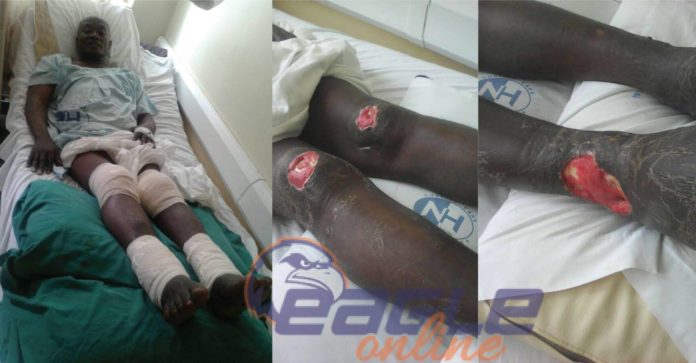
The health of Geoffrey Byamukama, the Kamwenge Town Council Mayor is deteriorating after he was allegedly tortured at the now-dreaded police Special Operations Unit at Nalufenya, Jinja.

Byamukama, who is currently hospitalized at Nakasero Hospital room 312, was allegedly tortured to near-death by police on claims that he was part of the group that murdered police spokesperson Assistant Inspector General of Police (AIGP) Andrew Felix Kaweesi together with his driver Geoffrey Mambewa and bodyguard Kenneth Erau on March 17th 2017 near his home of Kulambiro, a Kampala City suburb.

Sources say that due to his sorry state of health, Byamukama has not been produced in court.

According to Byamukama, he was picked by two men, Fred Tumuhiirwe and a one Ronnie Byenkya, from the Commissioner of Lands’ office where he had gone to meet a friend.

Tumuhiirwe is reportedly a police officer at the rank of Assistant Inspector of Police (AIP) while Byenkya is said to be a Special Police Constable, both attached to police’s most feared Special Operations Unit headed by SSP Nixon Karuhanga Agasirwe.

By press time it was not possible to get comment from the police.

Photo Credit: The Investigator.

It should be recalled that recently some of the 13 suspects linked to the killing of Muslim clerics in country complained to court that they had been tortured while in detention at the Nalufenya detention facility.

However, police spokesperson AIGP Asan Kasingye came out and denied the accusations.


Stories Continues after ad

UCC to suspend NBS license over Tamale Mirundi

PUT NBS IN TROUBLE: Senior Presidential Advisor on Media and Communication Tamale Mirundi

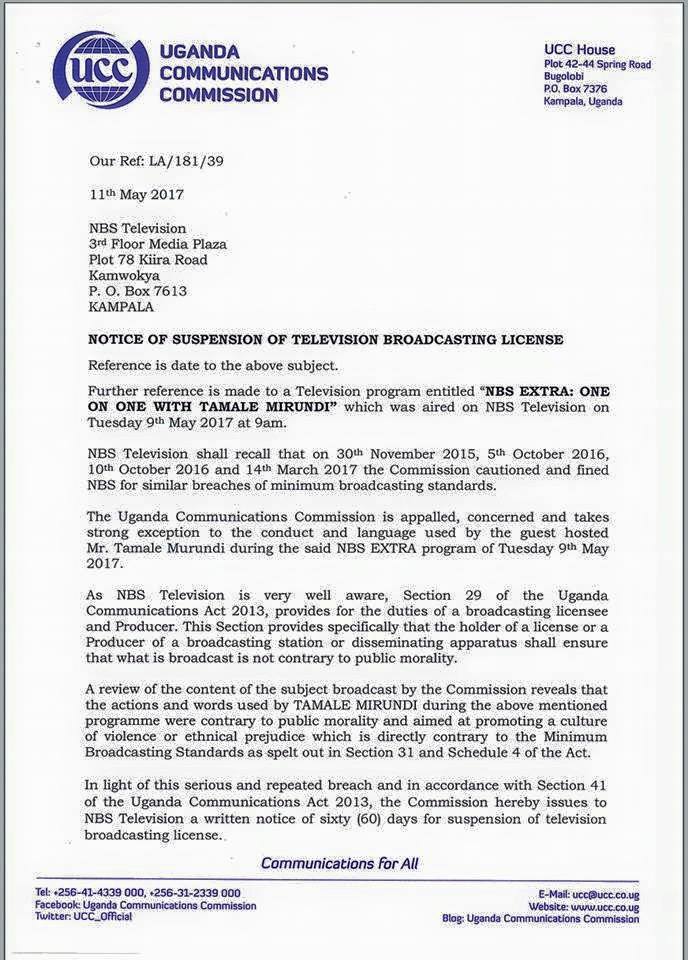
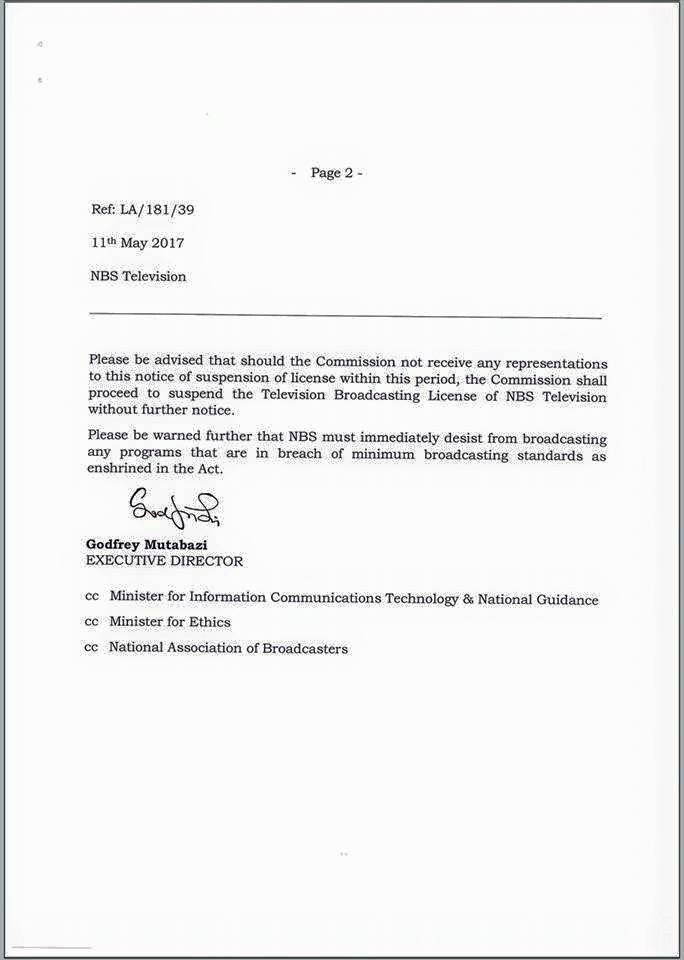
The Uganda Communications Commission (UCC) has warned the Nile Broadcasting Services television (NBS TV) of closure within 60 days, over guest Tamale Mirundi’s appearance on the station.

According to the UCC, guest Tamale Mirundi exhibited unbecoming behavior while appearing on a programme ‘NBS Extra: One on One with Tamale Mirundi’ of May 9, 2017.

In a statement issued late today by the UCC Executive Director Godfrey Mutabzi, the regulatory body indicated that during the programme Tamale Mirundi behaved in a manner that is in breach of the Communications Act.

‘The Uganda Communications Commission, is appalled, concerned and takes strong exception to the conduct and language used by guest hosted Mr. Tamale Mirundi during the said NBS Extra programme of May 9, 2017,’ the statement reads in part.


Below is the letter in full:

The UCC letter to NBS TV


Stories Continues after ad

Bad Black’s ex-Muzungu boyfriend finally finds joy in Uganda

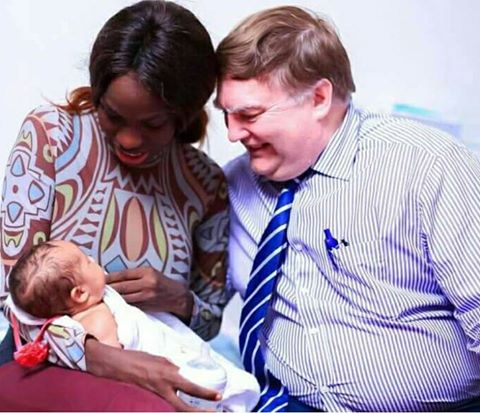
Bad Black’s former boyfriend, David Greenhalgh with his baby mama Parks Dee Laker and their new-born daughter

Bad Black’s former boyfriend, David Greenhalgh, a 60 year-old British businessman finally has something positive to remember about Uganda.

This is after he welcomed his bundle of joy with his Ugandan girlfriend, Parks Dee Laker. The couple welcomed their first child, a baby girl last week. And unlike Greenhalgh’s daughter with Bad Black who was ‘black’, Laker’s baby is as white as its father. Both the mother and baby are in good health.

For a while Greenhalgh has been cursing the day he set foot in Uganda, after he was defrauded of over Shs11billion by his first Ugandan girlfriend, city socialite, Bad Black real names Shanitah Namuyimbwa.

In addition to defrauding him of all that money, it turned out that even Bad Black’s kid didn’t belong to him yet the city socialite had claimed he was responsible for her pregnancy. But on giving birth, the kid was completely dark skinned, compelling Black to come out and confess Greenhalgh wasn’t the father of the kid.

She recently went open, announcing city fashionista, Kim Swagga as the true father of the child.


Stories Continues after ad

Museveni address on UK-Somali conference

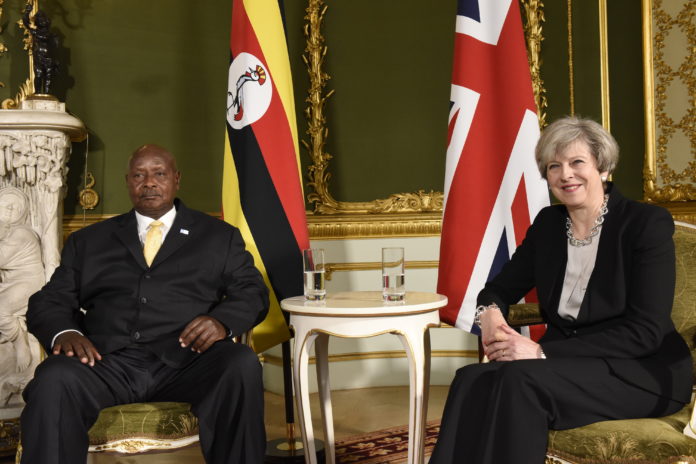
President Yoweri Museveni has met United Kingdom Prime Minister Theresa May at the sidelines of the International Conference on Somalia

President Yoweri Museveni has met United Kingdom Prime Minister Theresa May at the sidelines of the International Conference on Somalia currently taking place at Lancaster House in London.

The bilateral meeting between the two leaders focused mainly on the situation in Somalia and the conflict in South Sudan, which has generated close to a million refugees making it the second-largest refugee-hosting country in the world after Turkey.

The international conference on Somalia opened today in London and is organized under the auspices of the UK and the United Nations as part of efforts to put Somalia back on track.

The conference has brought together Heads of State and Government from across East Africa and other key partners, along with senior figures from international organisations.

Below is President Museveni’s statement on the Somalia Conference today, 11th May 2017

Excellencies Heads of State and Government;

Distinguished Heads of Delegations;

Ladies and Gentlemen.

 Uganda was the pioneer troop contributing country with the leading elements of our first contingent landing in Mogadishu on the 6th of March, 2007.

Many observers were convinced that our effort was hopeless, if not suicidal.  We were, however, confident of the correctness and feasibility of our decision.  This was due to our knowledge of the African peoples, those people that have inhabited this area for the last 4 million years.

Many of the African societies live symbiotically with one another, utilizing their diversity for mutual benefit.  Bigotry, which seems to characterize some societies in the world, is not common in African societies.  I normally tell my Moslem friends that, according to my culture my list of haram (ebihagaro) is much longer than theirs.  It is not only pigs that we regard as haram.  Our list includes: fish (ebijongoma) which we regard as snake; chicken (because it is a bird that are always flying) and if you eat it you are likely to be restless and unsettled; mutton; etc., etc.

Nevertheless, we used to rear chicken for use in divination in the traditional religions. Moreover, our people would happily donate chicken to our neighbouring communities who relish the consuming of those creatures. The same applied to fish, mutton, etc. In other-words, our philosophy was: “live and let live” ─ enjoy your rights but do not interfere with the rights of others.  Our communities specialize in skills and products and exchange ─ goods and services. That is how we were able to build a strong civilization that withstood the assaults we suffered from the slave-trade, colonialism and the local tyranny of our myopic and ego-centric chiefs.

Therefore, when we heard of the bankrupt ideology of bigotry being pushed by groups from Asia and the Middle East being imposed on the people of Somalia, we had to send a clear message to them and Somalia was one of the rendezvous points between the two diametrically opposed world outlooks: live and let live or chauvinism.

Since that time, the following have been achieved:

The Troops Contributing Countries have increased to five. These are: Uganda, Burundi, Kenya, Ethiopia and Djibouti.

The Somali Government moved from exile in Kenya where it had been based to Mogadishu since 2007.

The International Organizations also relocated to Mogadishu from Nairobi-Kenya.

Many Al-Shabaab dominated areas have been liberated. The Ugandan contingent alone stretches from Mogadishu to the Sea Port of Barawe.  This is not to talk of the areas liberated by the brother contingents from Ethiopia, Kenya, Burundi and Djibouti.

There are many noticeable reconstruction activities in many parts of Somalis, especially in Mogadishu, in the form of private buildings, roads, a modern Airport, etc.

Businesses are thriving in Mogadishu.

Indirect elections have taken place a number of times since 2000. The most recent election was the one of President Mohamed Abdullahi Mohamed (Farmajo) and the new Parliament.

The menace of piracy at Sea has been tamed.

However, our strongly held view is that it is not enough to check Al-Shabaab. Somalia must heal completely and stand on its own feet.  In our view, there are a number of bottlenecks that stop the complete healing of Somalia.

The absence of patriotic, pan-Somali political parties.

There may be individuals who have got a pan-Somalia outlook.

These individuals, however, need to form political Parties with a patriotic, national outlook, away from the bankrupt ideology of clanism being pushed by opportunists.  The recent election of the President by an overwhelming consensus seems to be a healthy seed for the future.  This patriotic idea, however, needs to be translated into political organizations.

The same patriotic ideas must then be infused in the Somali National Army recruited on a quota basis from all parts of the country.

This Army needs officers, NCOs, specialists in addition to ordinary soldiers.

The multiplicity of trainers (from different countries) of the Somali Army needs to be coordinated by the Somali Command around a Somali forces military doctrine so that it becomes a cohesive force with a clear historical mission.

The Somalis need to resolve the issue of whether they will re-build the Somali Army by pay or patriotism. If it is by pay, who will pay them? Is the Somali State able to pay a large Army on that big territory of 637,657sqkms it needs so as to pacify the whole country? The present partial pacification of the country is not good enough.

Can the international community agree to pay a large Somali Army for some years so that the wholly liberated Somali territory can be used to generate revenues to pay the public servants and also cope with other obligations?

The Somali Army and the soldiers from the TCCs could be further equipped to do more road projects in the areas of their responsibility along with the local authorities so that the country is opened up.  They can also build schools and health centres for the benefit of the people. The liberation has to resonate with the people in the countryside.

In the meantime, the TCCs should be supported sufficiently, their small numbers notwithstanding, to use force multipliers (gun-ships, attack planes, air-lift means) to further weaken Al-Shabaab, in their remote hide-outs.  Our concept of counter-insurgency is to have mobile forces to hit the enemy and zonal forces to ensure that the enemy does not re-infest the area.  It should be the Somali Army to provide these zonal forces.  If they cannot do it yet, what should we do?  That is why we propose long jump operations to eliminate them by surprise attacks. It is better than giving them extended holidays without any punishment for their mistakes and allowing them to create liberated areas by default.

There is the short term issue of the drought.  We need to provide relief so that the long-suffering people of Somalia do not die from this additional problem.

Apart from the drought, however, the international community could harness the power of the Somali business class.  Do the Somali businessmen supply the massive relief items that are delivered to Somalia?  Or is it the foreign businesses that supply these items?  Our view is that the harnessing the power of the Somali business class would not only be good for the economy of the country but would also be good for the politics of the country.

Yoweri Museveni

I thank you.


Stories Continues after ad

UNBS, South Sudan standards body sign MoU

EMPHASIS ON STANDARDS: UNBS Executive Director Dr. Ben Manyindo

The Uganda National Bureau of Standards (UNBS) and South Sudan National Bureau of Standards (SSNBS) have entered a Memorandum of Understanding (MoU) on standardization and conformity assessment on at the UNBS headquarters, Bweyogererewas signed was signed May 10 by Dr. Ben Manyindo, Executive Director Uganda National Bureau of Standards and, Dr. Mary Gordon Muortat, Executive Director South Sudan National Bureau of Standards, who represented their countries respectively.

The signing of this MoU signals a commitment by the two standards bodies to work together on issues of standardization and conformity assessment (testing, certification and inspection), metrology, calibration and training.

”South Sudan National Bureau of Standards expects to learn from UNBS because they have been here for a while; they have the technical know-how so we are ready to learn’’ Dr. Mary Gordon Muortat said.

This co-operation and mutual interest aims to enhance and strengthen technical cooperation with the aim of exchanging necessary information and expertise between the parties within the framework of the East African Community. ‘We want cooperation from each side especially the technical lines. We are all party to the EAC and to supporting each other to grow the standardization agenda to be able to help the aspects of trade and consumer protection within the region.’ Dr. Manyindo, highlighted.

The Memorandum of Understanding foresees enhanced cooperation on a number of standards related topics, from harmonization of specified standards with international standards, mutual recognition of test results, quality marks, product verification, metrological assessment and calibration of the measure instruments; to research and cooperation.

Stories Continues after ad

Tourism ministry steps up preparations for Martyrs Day

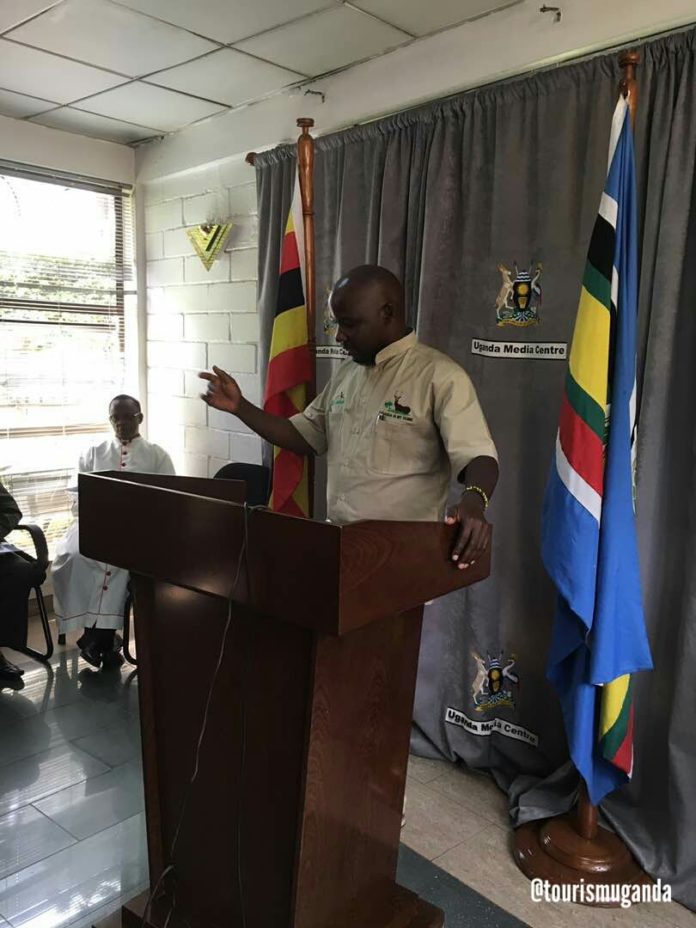
GETTING READY: State Minister for Tourism Godfrey Kiwanda Ssuubi addressing the press at the Media Centre

The Ministry of Tourism is to promote religious tourism centers and activities ahead of Martyrs’ Day on June 3.

The day is celebrated annually in commemoration of the Uganda Martyrs who were executed on the orders of Ssekabaka Mwanga II, the then King of Buganda in November 1885 and January 1887, because of their religious beliefs.

Uganda Martyrs were a group of 23 Anglican, 22 Roman Catholics and over 100 Muslims. This year the Roman Catholic Church has chosen the theme: ‘Stand firm in faith’ while Church of Uganda chose the theme: ‘Martyrs don’t die in vain’, derived from Philippians 1:21.

The Catholic Church activities to mark the day will begin with a walk on May 27, while the Anglicans will conduct outreaches for the youth and children ahead of the commemoration, and, while addressing the press at Uganda Media Centre the Minister State Minister for Tourism Godfrey Kiwanda Ssuubi said government is going to fund preparations for both denominations.

Minister Suubi noted that government had improved the facilities at Namugongo including the Basilica, sitting areas, water sources, roads and security.

Further, according to the Minister, the activities carried out there generate foreign exchange which is in turn invested in other sectors of the economy.

This year Hoima Diocese will lead the Roman Catholic Church celebrations; Namirembe Diocese will lead the Anglicans while the Uganda Muslim Supreme Council has chosen June 1 as the day to remember those who died for Islam.

The chief celebrant at the Anglican Martyrs Day commemoration will be Archbishop of the Church of Uganda His Grace Stanley Ntagali and the Bishop of Butare in Rwanda is expected to attend.


Stories Continues after ad