Stanbic Bank
Stanbic Bank
18.9 C
Kampala
Stanbic Bank
Stanbic Bank
Home Blog Page 220

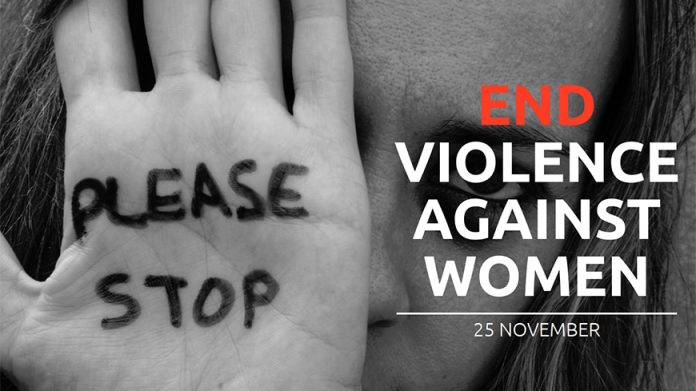
Tech boom fuels online violence against women and girls

Women and girls are disproportionately experiencing violence fueled by the increasing use of technology, with online abuse often spilling over into physical violence, an alarming new report released today finds. 

A more comprehensive understanding of technology-facilitated gender-based violence (TFGBV), its variations across contexts, and demonstrably effective responses to combat it is urgently needed, said Dutch NGO Rutgers. 

Rutgers led the seven-country study together with ABAAD, Equimundo, and Sonke Gender Justice through the global Generation G partnership with youth leaders and civil society to tackle the root causes of gender inequality. The report was launched today at the Human Rights Council (HRC) in Geneva. 

“The digital revolution has been a blessing and a curse,” said Loes Loning, a researcher at Rutgers. “It has transformed societies, reshaping daily life, culture, politics, and economics, but as digital tools evolve, and access expands so too does the potential for people to misuse them. 

“Evidence shows that women and girls are disproportionately experiencing technology-facilitated gender-based violence and that this often spills over into physical violence, with detrimental impacts on survivors’ physical, emotional, and economic well-being, as well as broader social and political repercussions.” 

The data, which involved interviews conducted with people in Indonesia, Jordan, Lebanon, Morocco, Rwanda, South Africa, and Uganda, found widespread links between online violence and the offline world – or an “online-offline continuum of violence”. 

TFGBV was broader than online violence but occurring online and in digital spaces through both old and new technology such as phones, GPS tracking devices, drones, or recording devices not connected to the internet, the report stressed.

 It was the result of various root causes, with the influence of patriarchy, social ideas of morality, and socially imposed gender roles amplifying it. Although survivors are disproportionately women and girls, boys and young men including male family members or friends of women and girls who have experienced it are also affected. 

Far from existing in isolation, online abuse was acting as a springboard for offline gender-based violence including sexual harassment, stalking, and intimate partner violence, leading to a dangerous pattern, the research found. 

“There were threats via WhatsApp but (this) then continued to physical acts such as rape – this is a combination of offline and cyberspace,” a government official from Indonesia said, according to the research.  

In South Africa, one girl was bullied on and off social media before being beaten and having a video of her filmed by school peers publicised. Two days later, after it trended, she killed herself, it said. 

In Morocco, a civil society worker described how “sometimes ex-husbands/partners might use intimate pictures or videos for revenge, to get women to give up custody, alimony, or to ask her for money, property”, the report added.

In some countries, laws against TFGBV clash with other legislation, a phenomenon that the report labelled a “double-edged sword”. They can be used against survivors to charge them for crimes that they are actually the victims of. 

“Laws that are seemingly there to protect victims actually do the opposite,” said Abishiag Wabwire, project coordinator at the Uganda Association of Women Lawyers (FIDA-U). 

“Uganda is one of the few African countries that actually has a law against TFGBV.  However, patriarchal standards and the cyber law that should protect victims are instead being evoked to oppress them and uphold patriarchal standards.” 

Key groups at risk were gender and women’s rights defenders, women in the public eye, children, young people, and LGBTQI+ people, the report found. Women in the public eye, including politicians, journalists, and celebrities, were at a more heightened risk. 

Online abuse causes them to withdraw from professional life, including public service, with appalling consequences for women’s rights, democracy, and gender equality. 

Sheila Kasabiiti, the Programs Manager at Reach A Hand Uganda, said, “Technology offers endless opportunities, but it can also be misused to cause harm. We need to raise awareness about its misuse and the gaps that enable gender-based violence. This will help us push for laws that ensure gender justice.” 

The report calls for collaborative efforts between individuals, NGOs and civil society, governmental entities, and technology companies and platforms such as 

X, TikTok, Facebook, and Meta, to combat TFGBV and to create a safe, inclusive, and equitable online environment.

Stories Continues after ad

DPP slaps new charges against Molly Katanga and her co-accused 

Prime suspect, Molly Katamba.

The Director of Public Prosecution has slapped new charges against Molly Katanga and her co-accused.

Appearing before Court, Justice Isaac Muwata, granted DDP’s request to amend the charge sheet and introduce the new charges against the accused.

Molly Katanga is accused of killing her husband, Henry Katanga. The businessman was allegedly shot dead by his wife on November 2, 2023, at their home in Mbuya, Nakawa Division, Kampala City.

Molly is charged alongside her two daughters, Martha Nkwanzi and Patricia Kakwanza; George Amanyire, a shamba boy; and Charles Otai, a health worker.

Nkwanzi and Kakwanza are accused of tampering with evidence at the crime scene, rendering it unidentifiable for judicial proceedings. Amanyire and Charles Otai, a health worker, are accused of assisting others involved in the crime.

According to the amended charge sheet, each of the four accused is leveled with charges of being accessories to the murder of Henry Katanga and conspiring to destroy evidence related to the same crime.

Yesterday, the trial of Molly Katanga, the wife and prime suspect in the shooting down of city businessman Katanga, kicked off yesterday at the Criminal Division of the High Court in Kampala. All the accused pleaded not guilty. 

Stories Continues after ad

Former Finance Ministry’s Director Budget, 4 Clerks could face CID over financial mess investigations 

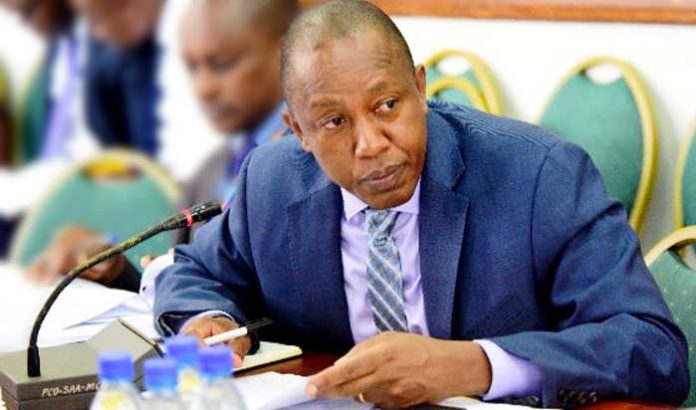
Mr Kenneth Mugambe.

Kenneth Mugambe, the former Director of Budget in the Finance Ministry could soon be called by police’s Criminal Investigations Department (CID) regarding budget mess over the years he has held that office.

Also lined up for questioning are four committee Clerks of Parliament who served on both budget and finance committees in the 10th Parliament.

During the State of the Nation Address (SONA), in early June, President Yoweri Museveni said he had credible information that officials in the ministry were conniving with Members of Parliament to distort the budget for their selfish interests, particularly stilling government money.

In fact, days ago Museveni refused to sign Appropriation Bill 2024 after finding out that Shs750 billion had been removed from critical areas, something he attributed to those managing the budget process. With Parliament having re-allocated Shs750 the money as desired by Museveni, he is now expected to assent to the Bill.

Museveni’s statement on syndicates in the Finance ministry and parliament, would later result in the arrest of MPs Paul Akamba, and Cissy Namujju on allegations of corruption, regarding the budget process.

Mugambe took an early retirement.

CID investigators this website talked say Mugambe is likely to be interrogated together with four clerks of committee in parliament for various budget anomalies.  

Mugambe has 14 years working experience in planning, public expenditure management, public sector budgeting, macroeconomic management and public administration.

He is a board member of the National Information Technology Authority (NITA) and has worked as a Principal Economist responsible for the Budget Execution and Evaluation Section of the Budget Policy and Evaluation Department.

He formerly worked as an Assistant Commissioner in the Economic Development Policy and Research Department where he was a lead member of the team that formulated the Poverty Eradication Action Plan (PEAP) 2004.

As the Commissioner of Budget Policy & Evaluation Department, Mugambe is at the forefront of drawing up the national medium-term expenditure framework that is used as a tool to determine the national expenditure priorities as well as the rationalization of resource allocation both in the short and medium term.

Stories Continues after ad

Gen. Otafiire unhappy with parliamentary police arrest of RCC Burora

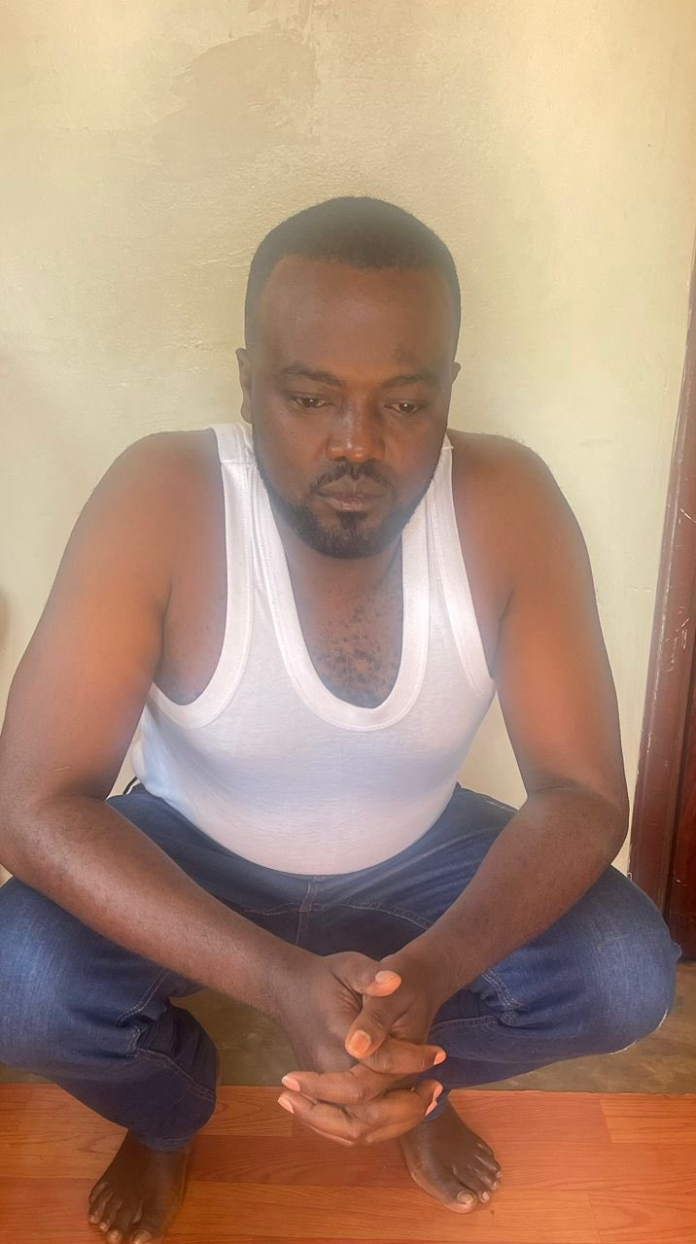
Former Rubaga Deputy RCC Herbert Burora.

Internal Affairs Minister Gen. Kahinda Otafiire is unhappy with the way Parliament pushed police to arrest the former Rubaga Resident City Commissioner Herbert Anderson Burora.

Burora was arrested on Sunday night from his home by the police attached to parliament. He was later taken to Kira Division police where he spent the night before he was transferred to Central Police Station (CPS) for grilling.

Security sources say Burora is being detained for annoying the person of the Speaker through his X handler. He been to remanded to Luzira prison until July 9.

“My home has been besieged by unknown men who claim that I should go with them,” Burora wrote on his x handle (formerly twitter).

Burora was in March this year suspended from the office over alleged violation of the Uganda Public Service standing orders 2021 because he openly criticised the Speaker of Parliament Annet Anita Among for corruption and misuse of public funds at Parliament.

Burora recently formed a National Resistance Movement (NRM) group to fight corruption.

He has resisted attempts by the RDC Secretariat under President’s Office to silence his views against corruption at Parliament and other public bodies.

Security sources told Eagle Online the of the head of police at parliament Charles Twino led the operation to arrest Burora.

The same sources say Twino is being used to trail the critics of Speaker Among in and outside parliament.

 Radio One Journalist Jude Bukenya was arrested at CPS in similar circumstances and banned from covering parliament.

No charges have been leveled against Bukenya.

Stories Continues after ad

UNOC imports first-ever fuel products in Uganda 

Today marks a significant milestone for Uganda as the first vessel under the Uganda National Oil Company’s (UNOC) new mandate as the sole importer of fuel products arrives. This historic event emphasizes the company’s commitment to ensuring the reliable supply of high-quality fuel in order to eliminate speculative price hiking.

UNOC Chief Corporate Affairs Officer Tony Otoa said, “Through our new mandate as the sole importer of fuel products to Uganda, our role will be to ensure reliable supply and price stability. By centralizing importation, we are streamlining operations and mitigating supply chain risks. This strategic move guarantees consistent, high-quality fuel for Ugandans.”

According to the company, the shipment comprises 78 million litres of petrol and 65,000 tons of diesel and will be transported to Uganda through the Kenya Pipeline and later to Uganda using trucks.

“As the sun’s rays started piercing the sky this morning, this vessel carrying 58,000 metric tons of petrol arrived at Mombasa.  It is the maiden vessel as UNOC implements the sole importation of fuel products mandate. The fuel will get into the Kenya pipeline infrastructure and later to Uganda via trucks,” Ota revealed.

Otoa added that this will continue to ensure stability in fuel supply to the country.

Uganda National Oil Company (Unoc) recently signed a deal with Vitol Bahrain to import the fuel products aimed at lowering pump prices below the current rates offered by dealers in Kenya.

President Yoweri Museveni passed the amended Petroleum Supply Amendment Act in November 2023, giving monopoly powers to UNOC to import fuel into Uganda and sell it to petroleum marketers.

Stories Continues after ad

Uganda Prisons denies claims over arrested MPs secretly meeting Museveni

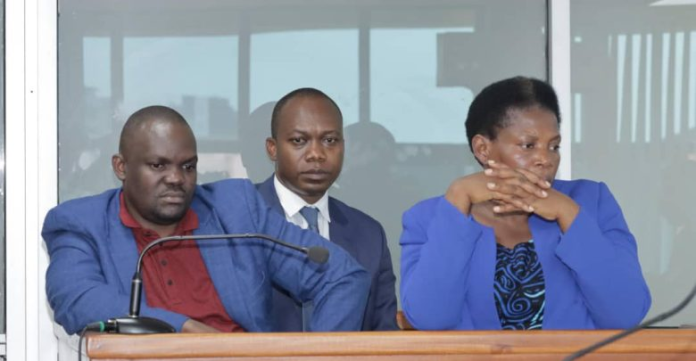
Jailed legislators in the dock.

The Uganda Prisons Service has cleared air over claims that the National Resistance Movement (NRM), MPs remanded to Luzira on corruption charges were recently secretly taken to State House to meet President Museveni.

The rumors spread from city lawyer Nicholas Opiyo alleging that two NRM MPs had met President Museveni at State House for reasons he said had been unclear.

“Two NRM MPs charged and remanded to prisons on corruption charges were, allegedly, after their detention, secretly whisked from their detention at Luzira Prisons to meet the President at State House, Entebbe,” Mr Opiyo, a human rights activist, posted on X (formerly Twitter).

He added that what the president was discussing with the two legislators was unclear but it certainly undercuts his public posture as an anti-corruption crusader.

However, Prisons spokesperson Frank Baine said in a Tuesday statement that Opiyo’s claims were false and unfounded.

“As Prisons, we categorically state that these allegations are false and unfounded,” Baine said.

Quoting the Prisons Act of 2006 Section 5(A), Baine said there is no reason to parade NRM lawmakers in the State House.

The Act requires the service to ensure that all persons lawfully detained in prisons are detained safely, securely and humanely and are tried where necessary until lawfully released or released from prison.

“Therefore, there is no reason whatsoever for prisoners to be produced at State House at any time of the day or night,” Baine said.

The Prisons mouthpiece maintained that Opiyo’s allegations are clearly intended to mislead the public for personal reasons, and that they should be totally disregarded.

It should be remembered that four NRM legislators were arrested and remanded to Luzira last month on corruption charges.

The arrested legislators included; Busiki County Member of Parliament Paul Akamba, Cissy Namujju the Lwengo Woman MP, Igara East MP Michael Mawanda and Elgon County Legislator Ignatius Mudimi.

Prosecutors accused the lawmakers of misappropriating about Shs3.4 billion for purposes unrelated to the purpose of the funds.

They are also charged with conspiring to defraud the Ugandan government, according to the indictment.

The legislators, who remain in custody, allegedly tried to persuade the chairperson of the Uganda Human Rights Commission to inflate the organization’s 2024/25 budget, in return for a 20-percent kickback.

Stories Continues after ad

Parliament reallocates shs750b after reconsidering the Appropriation Bill

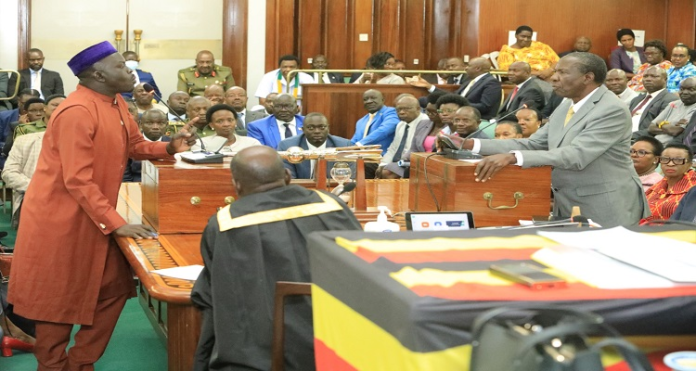
Finance Minister Matia Kasaija on right facing off with another legislator during the reallocation of the appropriation bill.

WHY ROKO CONSTRUCTION COMPANY IS A PRIORITY THAN FUNDING HOSPITALS AND BUYING AMBULENCES

Parliament has re-allocated Shs750 billion after reassessing the Appropriation Bill, 2024 which President Yoweri Kaguta Museveni objected to assent to.

In the 2024/2025 Budget passed earlier, legislators had allocated the Shs750 billion to areas that they described as critical. These included among others procurement of ambulances, maintenance of bridges, construction of sub-county headquarters and support to families with income generating projects among others.

At a sitting of the House on Tuesday, July 2, 2024, the Speaker Anita Among read the President’s letter which highlighted the reasons for his rejection of the bill.  

Museveni cited what he described as indiscipline in budgeting, sabotage of national priorities and corruption among lawmakers.

The Bill, which initially sought to authorise public expenditure from the Consolidated Fund was first passed on May 16,2024 and later, sent to the President for approval on May 31, 2024.

In his letter, the President also expressed his disapproval accusing the MPs of interfering with the constitutional mandate of the Finance Minister in budgeting.

“There are mistakes here. These are indiscipline in budgeting, sabotaging the national priorities and now the suspicion of massive corruption. I am therefore writing to request that this practice stops,” the President stated in his letter.

Museveni cited the Shs440 billion utilised to reconstruct 127 kilometers of the Kampala-Masaka Road adding diverting Shs3.71 trillion over four years is equivalent to aborting nine similar major road projects.

The Speaker ruled that the House constitutes itself into a Committee of Supply since the Budget Committee was not yet fully constituted.

Erute South MP Jonathan Odur and Butambala District Women Representative, Aisha Kabanda supported her proposal adding that the Budget Committee lacked the moral authority to investigate the issues listed by Museveni due to the corruption accusations.

However, Members of Parliament did not take the President’s accusations.

They were particularly displeased that the executive branch had piled blame on parliament for deviating on the government priorities.

Kira Municipality MP, Semujju Nganda criticised the Gen. Museveni’s proposal to prioritize Roko at the expense of other public needs.

“The President’s priority is that you move money from the ambulances and regional referral hospitals to create Shs300 billion for Roko, a private company”, he said.

However, State Minister for Finance, Henry Musasizi said that, ‘these are funds for government obligations under the share subscription agreement in servicing Roko bills of exchange, and payment of EFT bank charges of Bank of Uganda, among others’.

Napak District Woman MP Faith Nakut implored the House to search for answers to the questions raised by the president insisting that the Budget Committee had done the right thing.

This was re-echoed by the former Chairperson of the Budget Committee, Patrick Isiagi who insisted that the allocations by parliament were made to fund critical sectors for the good of the country. He later conceded to the reallocations.

“But given the guidance of the president on the priorities and commitment to stick to the budget, I concede”, he stated.

The proposal was put to a vote and was unanimously seconded by the MPs, allowing the Minister of Finance, Planning, and Economic Development, Matia Kasaija to move a motion for the House to reconsider the Bill.

The reconsidered Appropriation Bill approved an expenditure of over Shs72.136 trillion reflecting a Shs14 trillion increase from the initial estimates of Shs58.34 trillion.

The budget includes Shs18.9 trillion for recurrent expenditures and Shs34.7 trillion for development. Government acquired shares in Roko construction after the firm was declared bankrupt. However, other sources allege that top regime operatives were using Roko as a cover in the construction world in order to edge out other competitors in the construction sector.

Stories Continues after ad

Former CMI Deputy Director Brig CK Asiimwe sent DRC as Military Attaché

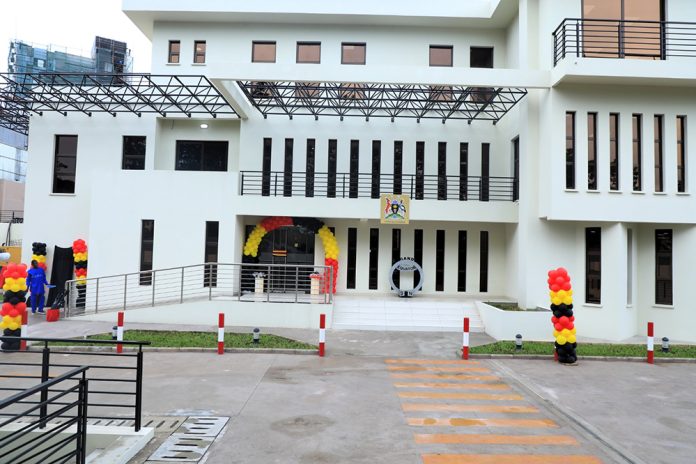
Uganda's new Chancery building in DRC.

Former Deputy CMI boss Brig CK Asiimwe has been appointed and sent to the Democratic Republic of Congo as a military attaché to Uganda’s Embassy.

 Brig. Asiimwe who was dropped from the military intelligence position in February 2022 and sent for further training will be in charge of military and intelligence operations at the mission.

Brig Asiimwe was dropped together with his boss, Maj Gen Abel Kandiho who was also removed from his position and sent to police as Chief of Joint Staff.  Kandiho has since returned to the army for redeployment.

At the moment, CMI is now under the leadership of Maj Gen James Birungi.

Stories Continues after ad

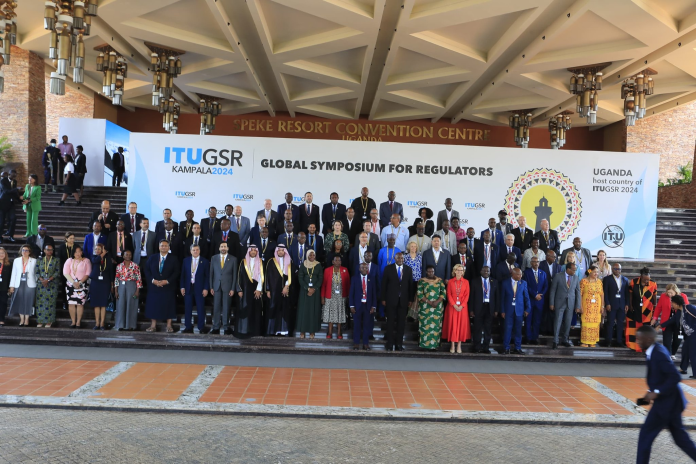
Global symposium for regulators kicks off at Speke Resort

President Yoweri Kaguta Museveni, represented by the Vice President Jessica Alupo, opened the Global Symposium for Regulators-2024 at Speke Resort and Convention Centre, Munyonyo, Kampala, on July 2, 2024.

The event, under the theme: “Regulation for Impact’ is organized by the International Telecommunication Union (ITU), bringing together regulators, policymakers, and industry stakeholders from around the world to share experiences and best practices in the ICT sector.

In his speech, Museveni welcomed delegates from outside Uganda and commended ITU for convening the symposium, which is aimed to promote effective regulation and policy-making in the rapidly evolving ICT sector.

The President highlighted the importance of regulating the ICT sector to promote economic wellbeing, innovation, safety, privacy, and the rights of digital technology users. He urged regulators to maximise the benefits of ICTs while minimizing negative consequences.

Uganda, he noted, had pioneered telecom sector reforms in Africa, establishing an independent regulatory body, the Uganda Communications Commission (UCC), in 1996. This move increased penetration and raised the standard of telecommunication services in the country.

The symposium’s theme, “Regulation for Impact,” resonated with President Museveni’s call for effective regulation. Delegates discussed topics like artificial intelligence, robotics, climate, space, and digital financial services, seeking to harness ICTs for sustainable development.

Museveni urged the ICT regulators to promote the sector’s contribution to the economic wellbeing of the people.

“The theme you have chosen is appropriate because it emphasizes the importance of implementing effective regulations that aim to positive outcomes,” Museveni said.

Museveni noted that Artificial Intelligence being a component of the 4th industrial revolution is increasingly becoming part of people’s lives in homes and workplaces with its ability to analyze vast amounts of data, identity patterns and providing accurate predictions.

“To ensure that Uganda is not a spectator in the 4th industrial revolution, the government established the National Task Force on the 4th industrial revolution to coordinate the integration of Artificial Intelligence into the country’s development agenda,” he said.

He added that Uganda has a fast-growing communication sector that is ripe for more investment, citing, “We have a robust regulatory framework, a good return on investment and a young population that is ICT savvy.”

However, he cautioned on the issue of cyber security which deserves greater attention.

“In the recent years we have witnessed technology being used as a tool for political interference and economic sabotage. Unlike traditional warfare where you can just secure your country by guarding the borders against intrusion, cyber warfare calls for collaborative efforts especially when emanating from outside your jurisdiction. Technology must not be used to undermine the peace and sovereignty of nations but rather to support development.”

The event provides a platform for regulators to share knowledge, exchange ideas, and collaborate on best practices, aligning with President Museveni’s vision for a vibrant and responsible ICT sector in Uganda and beyond.

Stories Continues after ad

Trial of Katanga murder suspects kicks off, wife and children plead not guilty

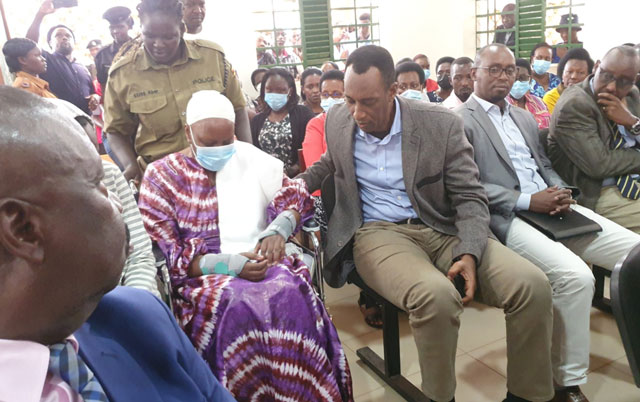
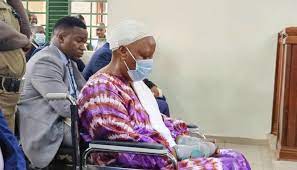
Katanga murder prime suspect Molly Katanga and her supporters in court.

The trial of Molly Katanga, the wife and prime suspect in the shooting of city businessman Henry Katanga, has kicked off at the Criminal Division of the High Court in Kampala.

Earlier today, the frail and ailing suspect, Molly, was wheeled into the courtroom ahead of the hearing of the matter.

Appearing before High Court judge Justice Isaac Muwata, Molly and her co-accused pleaded not guilty.

The matter was adjourned to tomorrow, when the judge will rule on a prosecution request to amend the charge sheet and allowed the accused (Molly) to attend court via zoom due to her medical conditions.

Molly Katanga is accused of killing her husband, Henry Katanga. The businessman was allegedly shot dead by his wife on November 2, 2023, at their home in Mbuya, Nakawa Division, Kampala City.

Molly is charged alongside her two daughters, Martha Nkwanzi and Patricia Kakwanza; George Amanyire, a shamba boy; and Charles Otai, a health worker.

Nkwanzi and Kakwanza are accused of tampering with evidence at the crime scene, rendering it unidentifiable for judicial proceedings. Amanyire and Charles Otai, a health worker, are accused of assisting others involved in the crime.

In February, the four were granted Shs2 million in cash bail, while their sureties were bonded at Shs20 million and ordered to surrender their passports.

Stories Continues after ad