Stanbic Bank
Stanbic Bank
17.4 C
Kampala
Stanbic Bank
Stanbic Bank
Home Blog Page 2280

Our soldiers did not die in vain

Early this week Al Shabaab militants attacked a Uganda Peoples Defence Forces (UPDF) camp in Janaale in Somalia, killing twelve peacekeepers serving under Amisom.

The people of Somalia are our brothers and sisters who, unfortunately, have not known peace for the last two decades since 1991, when president Mohammed Said Barre was overthrown.
Needless to mention, his ouster threw the country in turmoil, with fragmented groups fighting each other over remarkably petty tribal differences that could otherwise be resolved through dialogue.
But that was never to be and in the ensuing escalation of volatility, there emerged terror groups like the Al Shabaab, which have over the past few years distinguished themselves as a heartless group, wreaking havoc in Uganda, Kenya and Somalia, in the process killing thousands of innocent people.
Indeed, they have made the region unstable, affecting the social and economic well-being of the citizens of the countries where they carry out their heinous acts.
But we should not let them celebrate and that is the reason we should laud the Chief of Defence Forces (CDF) General Katumba Wamala for his quick response to the calamity that befell the 12 members of the Ugandan contingent.
The fact the Gen Wamala has been with the peacekeepers since the fateful day should serve to reassure them that their work is appreciated.
That said, Somalia needs to be helped out of its current predicament so that its citizens can regain their dignity and rejoin the community of nations. And, as neighbours, it is our duty to ensure that lasting peace and harmony are attained and embraced by all the Somalis.
That is why those who want to disrupt their new semblance to peace in the country should be treated with utmost contempt and fought to the hilt. Fair enough, that is what the 12 peacekeepers were doing at the time they met their death.
May their souls Rest in Peace.
Stories Continues after ad
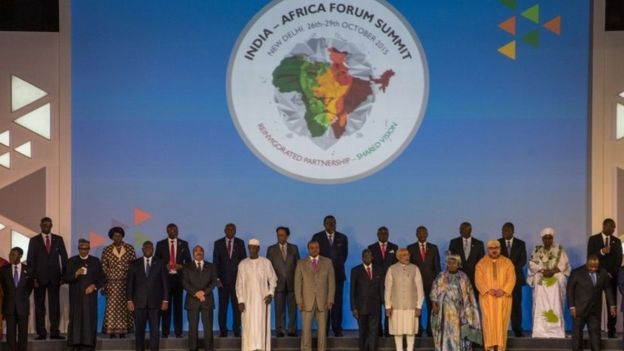
African Caucus guarantees financial support

The Group of African Ministers of Finance and Governors of African Central Banks, affiliated with the IMF and the World Bank, has reaffirmed their support for new funding initiatives.
According to a communiqué issued at the end of the two-day summit in Luanda, Angola, the African Caucus also proposed that the World Bank should support six regional transformative projects in the sectors of energy and agriculture, as well as a number of innovative solutions to reduce frequent funding gaps.
Embedded in a document dubbed the ‘Luanda Declaration’, members of the Africa Caucus noted that countries that depend on oil for their export and tax revenues face unique challenges and remain highly vulnerable to the impact of various external disturbances.
The Group also called for financial contributions from the BWIs to the Africa50 initiative of the African Development Bank (ADB) in order to meet the challenges associated with initiating infrastructure projects.
The document reveals that the illicit flow of funds associated with aggressive tax avoidance, the repatriation of profits and debt repayments are tragically depriving [African] countries of hundreds of millions of dollars every year.
Joseph Tucker of the International Monetary Fund, who presented the Luanda Declaration at the close of the African Caucus, said the Bretton Woods Institutions (BWIs) can support the challenges of financing for sustainable development, combating tax avoidance, eliminating the illicit flow of funds and strengthening Africa’s voice and representation in relation to the BWIs.
‘They are aware that the prospect of increasingly volatile financial markets means that it will be difficult to find resources to finance sustainable development goals (SDGs),’ a release by the Africa Press Organisation (APO), states in part.
 
The current Chairman of the African Group of Finance Ministers and Central Bank Governors affiliated with the International Monetary Fund and the World Bank is the Angolan Minister of Finance; its first Vice-Chair is the Minister of Finance of Benin. The position of Secretary of the organisation is held by the Egyptian Minister of Finance.
At the next meeting of the IMF and the World Bank scheduled for the 13-17 October 2015 in Lima, Peru, the Chair of the African Caucus will pass to Benin.
Stories Continues after ad

Part II: Where are they?

Paul Rutagambwa Kagame

Like President Yoweri Museveni, Paul Rutagambwa Kagame also needs little introduction; is the President of Rwanda. And like Museveni, Kagame also went to Ntare School. He was one of the ‘Original 27’ fighters who attacked Kabamba on February 6, 1981. On capturing power in 1986, then Senior Officer Kagame became the Deputy Director of Military Intelligence, serving under the SO Mugisha Muntu. In 1990, after the death of Major General Fred Gisa Rwigyema, then Major Kagame returned from a military course at the Command and General Staff College, Fort Leavenworth in the US to take command of the Rwanda Patriotic Front/Army (RPF/A), a military-politico organization formed by Rwandan refugees in Uganda.

Paul_Kagame_New_York_2010

In 1994 the RPF/A took power in Rwanda, then Major General Kagame became Vice President and Minister for Defence, positions he held till 2000, when he was made President and Commander-in-Chief after the ouster of Pasteur Bizimungu, the first post-1994 president.

Kagame was first elected president by adult suffrage in 2003 and currently, Kagame is serving his second seven-year term as President and it is likely the Parliament will amend the Constitution to allow him serve further.

Familiy: Born to Deogratias and Asteria Rutagambwa in Gitarama, Rwanda in 1957, 58-year old Kagame is married to Jeanette Nyiramongi Kagame and together they have four children.

 Lieutenant General Ivan Koreta

An officer and gentleman, Ivan Koreta is one of the most distinguished soldiers of the National Resistance Army (NRA) and its successor the Uganda People Defence Forces (UPDF).

Lieutenant-General-Ivan-Koreta

Born in 1964, Koreta joined the Front for National Salvation (Fronasa) as a teenager and participated in the overthrow of Aimn in 1979. By the time the NRA captured Kampala Koreta was a Senior Officer and, in 1987 while awarding ranks he was made Lieutenant Colonel. A highly disciplined officer, Koreta served in various command and administrative roles, becoming the first-ever Ugandan army officer to lead a UN peacekeeping mission, when he led troops to Liberia in the 1990s. He has also served as the Director General of the Internal Security Organisation (ISO) between 1998 and 2001; Commandant of the Senior Staff College at Kimaka in 2004; Chairman of the General Court Martial (C/GCM) in 2006 and Deputy Chief of Defence Forces (D/CDF) between 2005 and 2013. He is currently Ambassador-designate.

Major General James Kazini Bunanukye

Major General James Kazini Bunanukye was born in 1957, and reportedly joined the army during Idi Amin’s regime in the late 1970s. After the 1979 war, he reportedly joined the Uganda National Rescue Front (UNRF), a rebel group headed by General Moses Ali, the current Third Deputy Prime Minister.

In 1984, Kazini left the UNRF and joined the National Resistance Army (NRA), where he started off as a ‘foot soldier’. He however, rose through the ranks and by 1987 was commissioned Captain. Two years later he was promoted to Major and posted to the Military Police in Makindye as Commander. Again, after another two years Kazini was promoted to Lieutenant Colonel and posted to Masaka Mechanised Regiment as Commander.

home04pix

In 1996 Kazini was promoted to Colonel and posted to the Division 4 in Gulu as Commander, and in 1998 he was deployed to Kasese to oversee the operations against the Allied Democratic Forces (ADF) rebels.

In 1999 Kazini was promoted to Brigadier and was appointed Chief of Staff of the UPDF. He was also named Commander of Operation Safe Haven in the Democratic Republic of Congo and in 2000 Kazini was recalled from the Congo. In 2001, he was promoted to Major General and appointed Army Commander, serving in that post till 2003, when he was fired. Later that year he was committed to the General Court Martial to face charges of ‘creation of ghost soldiers’ and in 2008 the GCM under Lieutenant General Ivan Koreta sentenced him to three years in jail for causing a financial loss of Shs60 million.

After that he went into oblivion only for news to filter in on the morning of November 10 2009 that he had been killed at the home of his girlfriend Lydia Draru, who lived in the Kampala suburb of Namuwongo. At the time of his death James Kazini was 52 years old.

 Lieutenant General Henry Tumukunde (RO111)

Born in 1955, Henry Tumukunde is a highly regarded military officer who joined the National Resistance Army after completing education at Makerere University, where as a student he was involved in ant-government politics. After the bush war in 1986, then JOII Tumukunde was posted to the United Kingdom as Military Attaché. He has served in various command and administrative posts in the army and Intelligence, and has at different times headed the Chieftaincy of Military Intelligence (CMI) and the Internal Security Organisation (ISO).

In 1994 Tumukunde, a lawyer, was a Constituent Assembly Delegate (CAD) representing then Rubaabo County, and later in 1996 he was named one of the 10 Members of Parliament representing the Army. In 2003 Tumukunde was later to disagree with the establishment, after he opposed the removal of term limits.

Brig Henry Tumukunde
    Lieutenant General  Henry Tumukunde

About a year later he disagreed with his bosses in the army, after he was accused of abuse of office and spreading harmful propaganda. He resigned from Parliament in May 2005 and was later arrested and incarcerated for close to two years at the Officers Mess in Kololo, an upscale suburb of Kampala City. He was released in 2007 but continued attending Court Martial hearings up to April 18, 2013, when he cleared of the charge of spreading harmful propaganda after a grueling eight-year trial. He was however, found guilty on the charge of military misconduct and was subsequently sentenced to a severe reprimand.

Recently, in a surprising move President Yoweri Museveni promoted Tumukunde to the rank of Lieutenant General and retired him from the UPDF.

Major General Joram Mugume

One of those Uganda Peoples Defence Forces (UPDF) officers who get rare mention, Major General Joram Mugume was a Senior Officer by the capture of Kampala in 1986, and was one of only three Colonels at the commissioning of ranks in 1987. He has served as Deputy Army Commander, Senior Presidential Advisor on Defence and is currently the chairman of the UPDF Land Board.

Major General Matayo Kyaligonza (RO0034)

A military officer and diplomat, Matayo Kyaligonza was probably one of the most feared officers in the then NRA, having carried out several deadly exploits during the bush war. He was a Member of the NRA High Command and on capturing power in 1986 Kyaligonza was one of the Senior Officers who later became Brigadier alongside Tadeo Kanyakole (RIP), David Sejusa aka Tinyefuza and Eriya Kategaya (RIP). On entering Kampala Kyaligonza commanded the 7th Battalion, which went on to liberate eastern Uganda.

In 1994 he was elected Constituent Assembly Delegate (CAD) for Buhaguzi County, and in 1996 he represented the same County in Parliament after he was promoted to Major General and retired from the UPDF.

Maj Gen Kyaligonza is currently Uganda’s Ambassador to Burundi and also serves as the National Resistance Movement vice chairman for western region.

Major General Robert Rusoke

An officer and diplomat, Robert Rusoke was Joint Chief of Staff of the UPDF from 2005 to 2012. In August the same year he was appointed Uganda’s Ambassador to South Sudan.

Brigadier Charles Tusiime Rutarago

Little is said and known about Brigadier Charles Tusiime Rutarago but he is one of the ‘Original 27’ fighters who attacked Kabamba Military Training School on February 6 1981. At the capture of Kampala in 1986, Rutarago was a Junior Officer 1 (JOI) and worked with the Military Intelligence. He is currently the Head of the Royal Guards, a force in charge of protecting all cultural institutions in the country.

 Brigadier Kasirye Ggwanga

To many, Samuel Fog Kasirye Ggwanga may not need introduction but sources say he joined the army during Idi Amin’s regime in 1972, after completing S4. By the time of Amin’s ouster in 1979, Kasirye Ggwanga was a Staff Sergeant and he was arrested and kept in Luzira Prisons for about two and a half years. After prison he joined the Uganda Freedom Movement (UFM) under Dr Andrew Kayiira, and later abandoned UFM for the freedom Democratic Movement (FEDEMU), which was headed by the late Captain George Nkwanga. Kasirye Ggwanga joined the National resistance Army in 1985, rising through the ranks to become a Brigadier. Currently, he is a Presidential Advisor on Security in the Buganda region.

Stories Continues after ad
‘The Terminator’ ICC trial: Opening statements conclude

Bosco Ntaganda at the opening of his trial before Trial Chamber VI at the International Criminal Court (ICC) in The Hague, Netherlands, on 2 September 2015.

The opening statements in the trial of Bosco Ntaganda before Trial Chamber VI at the International Criminal Court (ICC) concluded with the statements of the Legal Representatives of Victims Sarah Pellet and Dmytro Suprun, and of Mr Ntaganda’s Defence team led by Defence Counsel Stéphane Bourgon.

Bosco Ntaganda, aka The Terminator, is a former Deputy Chief of the General Staff of the Force Patriotiques pour la Libération du Congo, who is accused of 13 counts of war crimes and five crimes against humanity committed in the Democratic Republic of Congo’s Ituri region between 2002 and 2003.
Bosco Ntaganda at the opening of his trial before Trial Chamber VI at the International Criminal Court (ICC) in The Hague, Netherlands, on 2 September 2015.
The Terminator’s trial opened yesterday in The Hague, Netherlands, with the statements of the Prosecution but he also delivered an unsworn statement to the Chamber today.
The trial is expected to take several months and the start of the Prosecution’s presentation of evidence is scheduled for September 15, 2015. During the first part, the Office of the Prosecutor will be presenting the evidence at the Prosecution’s disposal, submitting to the attention of the judges a large number of documents which it has compiled in the case, as well as video footage. The Prosecution will also call witnesses to testify. When the Prosecution has finished examining each witness, the Defence Counsel is given the opportunity to cross-examine the witness.
Once the Prosecution has presented all its evidence, which will take a few months, it is the turn of the accused, with the assistance of their Counsel, to present the defence’s case. The Defence may call a number of witnesses to support their case. These will be examined by the Defence and cross-examined by the Prosecution.
2149 victims have been granted the right to participate in the trial and they are represented by legal representatives Sarah Pellet and Dmytro Suprun, who will present their views and concerns in the Courtroom.
Trial Chamber VI is composed of Judge Robert Fremr, Presiding Judge, Judge Kuniko Ozaki, and Judge Chang-ho Chung.
Stories Continues after ad
Global consortium scoops US$250m timber deal in Africa

Jean-Claude Bastos De Morais, Founder, Quantum Global group)
The Forest Stewardship Council International (FSC International), the investment arm of Quantum Global recently sealed a timber deal of US$250 million, the largest dedicated to timber investments in Sub‐Saharan Africa.
According to the FSC International, it is committed to responsible forest management by supporting investments that comply with the highest environmental and social standards in forestry.
Jean-Claude Bastos De Morais, Founder, Quantum Global group)
“The FSC membership allows us to partner alongside an international group of leading organizations to maintain and improve the state of the world’s forests by preserving their biodiversity, productivity and ecological stability. This ultimately supports the achievement of long‐term, quality returns in this asset class for our clients, while at the same time respecting the social, environmental and governance requirements inherent from this type of investment. We are very pleased with this perspective,” Mr Jean‐Claude Bastos de Morais, founder of Quantum Global, said.
Still a niche market for timber plantation investors, Sub‐Saharan Africa remains an underinvested market.
‘The timber fund strategy aims at capitalizing on this opportunity to increase Sub‐Saharan Africa’s plantation value through best practice management and natural forest preservation, which should contribute to a sustainable economic development in Sub‐Saharan Africa,’ a release by Africa Press Organisation (APO), states.
Stories Continues after ad

Addis tops in hotel room prices in Africa

The most expensive place for ‘a good night’s sleep’ in Africa is in the Ethiopian capital Addis Ababa, where a hotel room goes for US$232.
According to a survey of prices of international grade hotels in selected major African cities, produced by hospitality research firm STR Global ahead of the Africa Hotel Investment Forum (AHIF) taking place at the end of September, in the first six months of this year a room in Lagos cost $215.75, while one in Nairobi cost $144.76.
Other costly cities include Cape Town ($122.30) Casablanca ($105.73) Cairo($103.54) Johannesburg ($72.90) and US$70.70 in Sharm El Sheikh.
The Sheraton Hotel Addis Ababa, Club Room)
“A great deal of the reason for the difference in rates across major African cities is simply supply and demand,” Thomas Emanuel, Director of Business Development, STR Global, says. Addis Ababa has a shortage of top quality hotels.  However, with the Ethiopian economy growing at a rapid rate of more than 10% per annum for the whole of the last decade, with more conferences coming to the city by virtue of its status as the seat of the African Union and with Ethiopian Airways on a similar growth trajectory to the country, thanks to new routes and increased passenger numbers, there is a high demand for premium hotel rooms.  By comparison, Johannesburg is a long-established, sophisticated international city, with a large number of 5* hotels and a competitive market for accommodation.
Looking at how hotel prices have changed over the past year, there have been substantial rate rises in Sharm El Sheikh, up 42.5%, Addis Ababa, up 14.9%, Johannesburg, up 11.0% Cape Town, up 10.8% and Cairo, up 10.6%.  Whereas, there has been a recovery in Lagos up 5.8% whilst Nairobi is broadly the same and Casablanca has suffered a 4.0% decline.  
The increases in Sharm El Sheikh and Cairo can be explained as a recovery in tourism to Egypt, following several years of political unrest.  Cape Town’s improvement is due predominantly to increased demand and no recent increases in supply since the 2010 World Cup.  In the face of the recent terrorism incidents in Kenya, Nairobi’s hoteliers have chosen to maintain rates but they have suffered with lower occupancy.  The rise in room rates in Lagos cannot be explained simply by supply and demand because there has been a combination of factors that would normally be expected to exert a downward pressure on price.  First, there is a hotel development boom in Lagos with 3,611 new hotel rooms in the pipeline, according to W Hospitality Group, second, there has been a collapse in the oil price, which is damaging Nigeria’s heavily oil-dependent economy and third, occupancy has fallen below 50%.  The rate decline in Casablanca is due in part to economic weakness in France, its major source market and in part to currency fluctuations.
At AHIF, Thomas will be reporting on year-on-year hotel performance in some of Africa’s key markets and adding further interpretation and analysis of the main trends. 
Matthew Weihs, Managing Director, Bench Events, which organises AHIF, which attracts all the major international hotel investors in Africa, where this information will be discussed in detail said: “The wide disparity in room rates with exceptional prices being achieved in places where there is a shortage of supply, make it clear that there are parts of Africa that offer very attractive prospects for hotel investors. The best way to gain a deeper understanding of this industry is to come to Addis and meet the people who are driving it forward.”
AHIF is the preeminent gathering of international investors in hotels in Africa.  It takes place in Addis Ababa on Sept 30 – Oct 1.
Stories Continues after ad

Miss Uganda lands Shs11m Mirinda deal

Mirinda brand executive Tracy Kakuru, Miss Uganda Zahara Nakiyaga, Crown Beverages Limited's Customer Marketing Manager Jeff Sekandi and Miss Uganda Foundation's Brenda Nanyonjo.

Mirinda, a top brand from Crown Beverages Limited, has today signed up the reigning Miss Uganda, Ms Zahara Nakiyaga, as its new brand ambassador for the next seven months.

“This is a unique initiative Mirinda has undertaken as a way of not only supporting the crowning event of Miss Uganda but also the winner of the pageant,” said Jeff Sekandi, the customer marketing manager for Crown Beverages Limited, at a brief event at Brainchild Burson-Marsteller offices in Kololo.

Mirinda brand executive Tracy Kakuru, Miss Uganda Zahara Nakiyaga, Crown Beverages Limited's Customer Marketing Manager Jeff Sekandi and Miss Uganda Foundation's Brenda Nanyonjo.
Mirinda brand executive Tracy Kakuru, Miss Uganda Zahara Nakiyaga, Crown Beverages Limited’s Customer Marketing Manager Jeff Sekandi and Miss Uganda Foundation’s Brenda Nanyonjo.


According to Mr Sekandi, the package is worth Shs10.5 million and will cater for her monthly salary and fuel allowance.
“We believe the investment is worthy because Miss Uganda has such a long and memorable history,” he said.
Ms Brenda Nanyonjo, a director at Kezzi, the franchise holders of Miss World licence in Uganda, thanked Mirinda for the kind gesture, adding that it shows the value Mirinda attaches to Miss Uganda.
“What Mirinda has done today will make the partnership Miss Uganda has with Mirinda stronger. It is one thing many brands do not do. Most focus on the event and not what happens after the crowning ceremony,” said Nanyonjo.
Mirinda has been part of the Miss Uganda journey with Kezzi Entertainment over the past three years, having started with only product offer for the 2013 boot camp.
In recognition of the excellent work done by Kezzi Entertainment, Mirinda sponsored the 2015 Miss Uganda to a tune of Shs40 million; an increment of Shs10 million from last year’s, to make it memorable and one that befits the standards of Mirinda.
“Mirinda strongly supports activities that help today’s woman to become confident, bold, outgoing, inspirational, and aspirational. We believe that the Ugandan woman has the potential to inspire and be a change-agent in society,” said Sekandi.
Mirinda is a very exciting brand that allows everyone to free their fun side. The brand’s attributes; spontaneity, provocativeness, boldness, playfulness, among others, are brought to life through its rich array of flavours; Pineapple, Green Apple, Orange, and Fruity.

Stories Continues after ad

Teachers’ numbers hit 160,000

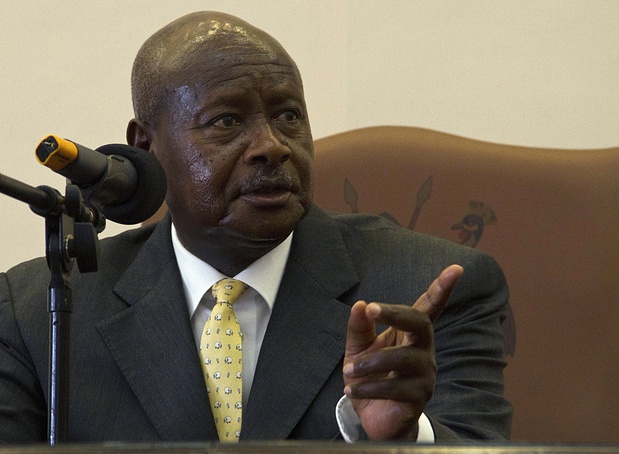
President Museveni.

President Yoweri Museveni has said that the number of teachers in the country has doubled, increasing from 80,000 to 160,000.

Museveni, who was hosting over 80 judges at State House Entebbe, said that with increased taxation that currently stands at 12 trillion, government has invested in infrastructure development in the education, health, roads and electricity sectors.

“Public service increased teachers from 80,000 to 160,000 with increased classrooms. There was load shedding which has stopped. We were spending very little of our money on infrastructure and depended on donors,” the president said and assured the Judges of improved conditions including security and retiring with full benefits. “This is a cost effective way of addressing the welfare of the judicial officers,” he said and urged them to improvise in line with housing for the courts and proposed institutional housing for judicial service officers.

The president however noted that there is lack of serious dialogue between the three arms of government; the executive, the legislature and the judiciary, to talk about strategy and ideology of the country.

“We only talk about sharing resources which is not enough. We must understand, what does the State want to do? There is a weakness of harmony and orientation of strategy,” he said. President Museveni said that the NRM Government was fully committed to providing vehicles for all judges and magistrates in the country and proposed that they establish a SACCO that government can facilitate. He also said that the government would soon fund medical check-up for them in health facilities of their choice within the country and also support the Shs 36bn five year ICT strategic plan to roll out a robust case management system providing for E-filing to reduce timelines and loss of files.

Responding to a presentation by the Chief Justice Bart Magunda Katureebe, on the transformation of the Judiciary for National Development, President Museveni cited UPE and USE that were initiated by government following a steady tax collection regime.

“We thought having these children in school was unavoidable. When the tax collection improved from 2.8billion in 1986 to 728billion in 1997, we started UPE. The number of children in school jumped from the initial 2.5million to 8.8million. The problem is that with policies and prioritization, the judiciary is not involved that is why they don’t get the logic and factors taken into account,” he said.

The President said government now spends Shs 3000bn on roads, 1700bn on electricity and quite a bit on the army.

“We spend quite a bit on the army to be able to build a strong army although soldiers get low wages. Amin soldiers were well paid but had no weapons. But we said weapons first. We brought peace cheaply with most of our soldiers sleeping in Maama ingia pole. If we did not do this, we would have our country run by the United Nations,” he said, adding that peace is enabling Uganda to get more money.

In his presentation Justice Katureebe commended President Museveni for eliminating extra judicial killings in the country. He however, pointed out that the judiciary has rental arrears of 3bn and that the Supreme Court may be up for eviction if nothing is done.

Katureebe said with a 46% growth in the budget from Shs63bn in 2012/13 toShs92bn in 2014/15, performance also increased by 49% from 102,000 cases in 2010/11 to 152,000 cases disposed of in 2014/15.

Stories Continues after ad

Katumba visits UPDF attacked base in Somalia

CDF-Gen Katumba Wamala paid a visit to Somalia after the attack on AU base.


Kampala-The Chief of Defence Forces, Gen Katumba Wamala on Thursday visited the Ugandan army camp in Somalia that was attacked by al shabaab insurgents, killing 10 soldiers.

Gen Katumba who rushed to Somalia on Wednesday to meet Ugandan army officers serving under African Union mission in Somalia.

“My visit was prompted by what happened here in Janaale, where we are now, where our base was attacked by the Al Shabaab using a vehicle bomb IED to breach the defense and where we incurred some casualties; some of our friends lost their lives. I came one, to assess how the situation was and to get a clear picture; how the whole thing happened, and also establish whether they were any flaws in terms of the response. I am convinced that the boys put up a good fight,” Gen. Katumba was quoted in a statement issued by African Union.

Meanwhile, the bodies of 10 Ugandan soldiers killed were brought back home in a brief somber ceremony at Entebbe military airbase.

Brig Leopold Kyanda, who represented the Gen Katumba said 46 Al shabaab fighters were killed and three captured in the attack.


Stories Continues after ad

Hellofood introduces Software to Improve Delivery Process and customer Experience

Joe falter CEO Hellofood Africa left, Mack Kyazze Head of operations and Ron Kawamara MD Hellofood Uganda with the hellofood Uganda Delivery team

Hellofood, Uganda’s leading online food delivery marketplace,has Introduced the V-work software now used by the company’s operations and delivery department.

The software helps to pin- point the exact location of the Delivery Riders or Bodabodas as they are commonly known, the Operations Team can see exactly where the riders are stationed. They are then able to assign riders who already have smart phones, to collect orders from restaurants while determining the amount of time it will take from pick time at the restaurants to delivery at the customer’s location and also send a softcopy of the exact order the customer placed to the riders.

Ron Kawamara, Managing Director HelloFood Uganda, said, “Customer experience is of utmost importance to us, and as such we continue to optimize and incorporate the latest technology to improve on it. And the obvious place to start is the delivery and operations systems. The software uses GPS to track the location of the riders and also furnish them with the exact orders placed by the customers which is better than calling them.”

Joe falter CEO Hellofood Africa left, Mack Kyazze Head of operations and Ron Kawamara MD Hellofood Uganda with the hellofood Uganda Delivery team

“The software also helps streamline the dispatch process for the riders and thus operation system is now more efficient. This technology also helps the company maintain a level of transparency with customers who may be anxiously waiting on their meals and would like to inquire how far a long it will be before their meal arrives either to their office or home; as we are now able to accurately communicate with customers about their arrival of their meal, with accurate follow-ups,” Ron added.

For those that would like to take advantage of this New improved customer experience, or to see what else HelloFood has to offer, orders can be placed online at www.hellofood.ugor through the hellofoodapp, which is available for free on Android, iOS, Blackberry, and Windows Phone devices.

About hellofood

Hellofood together with its affiliated brand foodpanda and Delivery Club, is the leading global online food delivery marketplace, active in more than 40 countries on five continents. The company enables restaurants to become visible in the online and mobile world and provides them with a constantly evolving online technology. For consumers, Hellofood offers the convenience to order food online and the widest gastronomic range, from which they can choose their favorite meal on the web or via the app.


Stories Continues after ad