Stanbic Bank
Stanbic Bank
25.7 C
Kampala
Stanbic Bank
Stanbic Bank
Home Blog Page 2285

Museveni, Bouteflika discuss Libya crisis

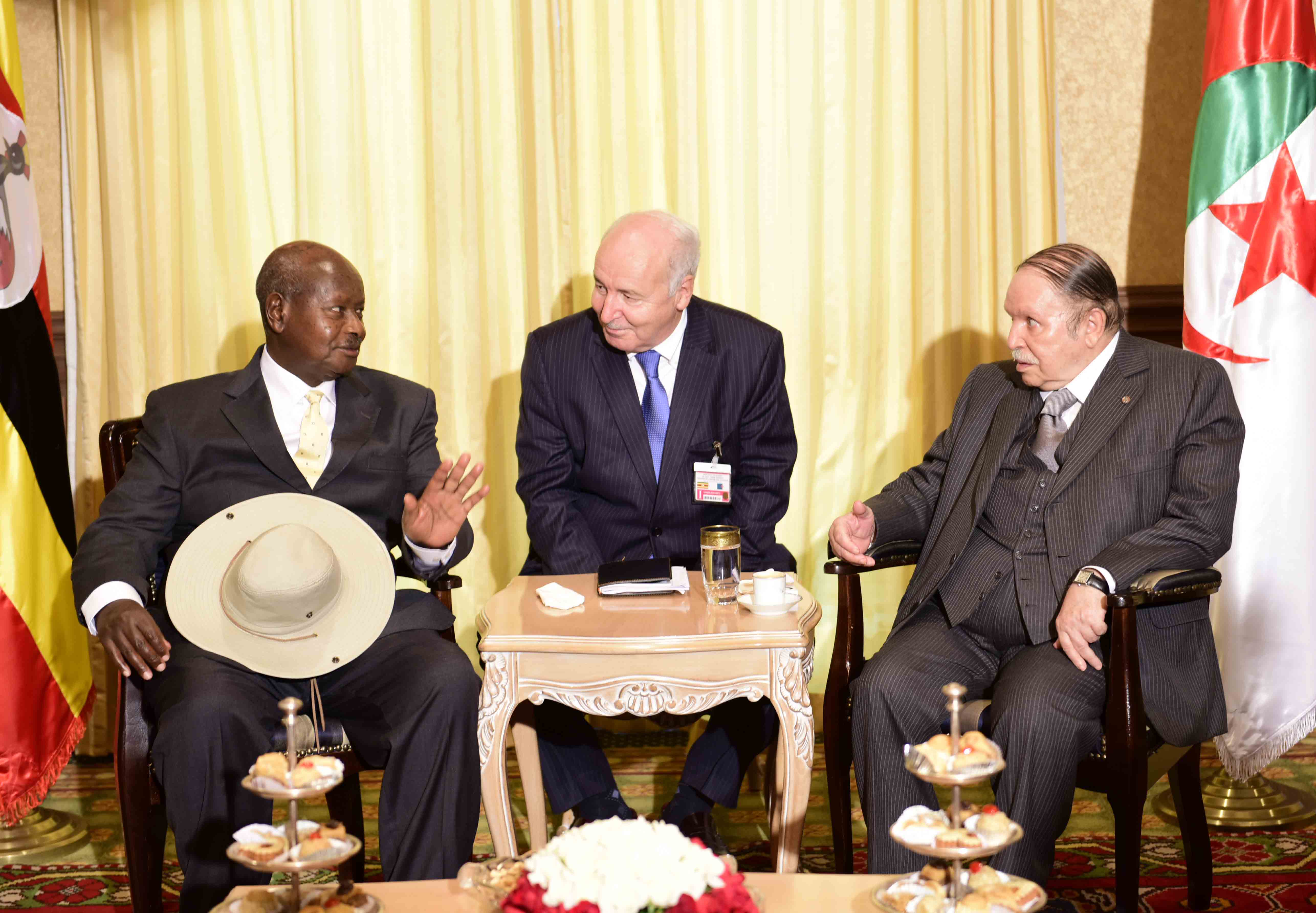
President Yoweri Museveni and his Algerian counterpart Abdelaziz Bouteflika have held a bilateral meeting during which the two discussed bilateral interests and other matters on the African continent including the crisis in Libya.
The two leaders also discussed about cooperation in education, vocational training, defense and security and in the oil and gas sector.
Speaking shortly after their meeting President Museveni, while addressing the press, referred to President Bouteflika as a freedom fighter and that the two had discussed the security situation in North Africa particularly on how to bring about lasting peace in Libya.
Mr Museveni further said that he, together with his host, had discussed ways of enhancing trade between the two countries and cooperation in the areas of energy especially in the oil and gas sector and in human resource development through exchange of scholarships and training programmes.
Presidents1
Currently trade between Uganda and Algeria is minimal and this can be attributed to the limited infrastructure connectivity between the two countries.
Uganda’s exports to Algeria are low with the major products being cocoa, coffee and tea, while Uganda’s imports from Algeria are less than US$ 1m per annum. In 2011 and 2013 the imports rose to approximately USD$ 2m as a result of sugar imports during the time when Uganda requested for stay of EAC CET application on sugar imports.
Presidents2
The major industries of Algeria are agriculture, cement, clothing, fertilizers, food processing, iron and steel, mining, machinery, oil and natural gas production and refining, petrochemicals, textiles, transport equipment and wine production.
Main exports are crude oil, dates, fruit and vegetables, natural gas, petroleum products and wine. In 2010, Algeria was named the fourth largest crude oil producer in Africa and the eighth largest global producer of natural gas.
Stories Continues after ad

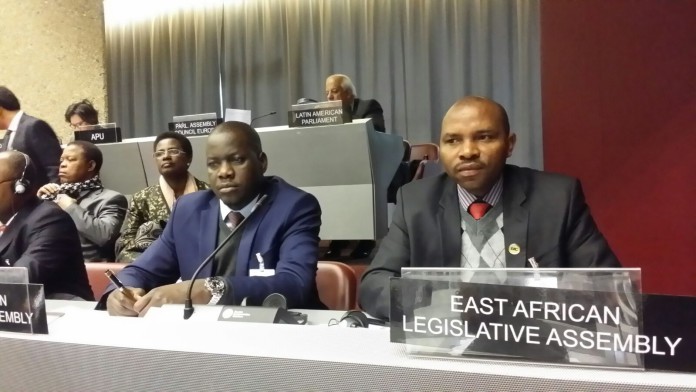
EALA Speaker in Geneva for IPU meet

The 133rd Inter-Parliamentary Union General Assembly has commenced in Geneva, Switzerland with sustained calls for fairer and more humane migration.
 
The IPU General Assembly brings together over 50 Speakers and 600 Members of Parliament from 130 Parliaments globally and over the next 5 days the delegates will discuss key thematic areas on migration under the ‘the moral and economic imperative for fairer, smarter and more human migration’.
 
Addressing the Assembly, EALA Speaker Daniel Fred Kidega said that migration was a predominant and persistent characteristic of humanity, and that it occupied a central place in human history and current affairs.
 
The Speaker pushed for the uptake of the Political Federation in the East African region saying such move would demystify the refugees’ problem.  “At worst, under the Political Federation, we can only be talking about internally displaced persons and not refugees,” he remarked.
 
He urged the delegates to push for more humane and smarter migration.
‘As Parliamentarians, we need to focus on the migration challenge by probing the root causes of international migration, particularly global processes that are unprecedented in their power to encourage the crossing of borders’, he said.
He also decried instability in EAC neighbouring countries like Somalia, South Sudan, the Democratic Republic of Congo (DRC) and Burundi, saying it had led to the escalation of the refugee problem in the region.
 
Speaker Kidega is leading a delegation of EALA consisting of Straton Ndikuryayo and two EALA staff, and the top leadership of the Parliaments of Uganda, Rwanda, Kenya and Burundi are in attendance while Parliament of Tanzania is represented by senior staff.
 
The issue of humane migration is taking central stand following the recent Syrian crisis among others.  According to the IPU, although the more than 230 million migrants, refugees and asylum seekers in the world today represent a small percentage of the global population, rising xenophobia combined with the ongoing impact of the global economic crisis continue to warp any reasoned debate and policy response on the migration phenomenon.
 
In his speech IPU President Hon Saber Chowdhury said it was necessary for IPU to consider better migration in order to impact on people’s lives. He noted that IPU and the UN were working closely together and that more collaboration was expected in the coming year.
 
The Director of ILO said that migration was a major trend given that 1 in every 7 persons globally are migrating.   He cited degradation of environment, instabilities, demand for labour and instabilities as some of the reasons for migration.  He maintained that Parliaments can also pass legislation on diaspora and ensure policies on the same are effected.
 
The 133rd Assembly has also considered and approved the re-admission of Fiji into the Inter-Parliamentary Union (IPU) in a move welcomed by the organization as a significant step forward in ongoing efforts to cement democracy in the country and in IPU’s engagement with parliaments from Pacific Ocean Island nations.
 
The readmission at Fiji today increases the Organization’s membership to 167 national parliaments. Fiji had first joined IPU in 1997. However, a military coup in 2006, the fourth since 1970, had led to the dissolution of parliament and Fiji’s formal expulsion from the Organization in 2007.
 
The 133rd Assembly will also convene several IPU bodies including the Meeting of Women Parliamentarians, IPU’s Forum of Young Parliamentarians, the Committee on Middle East Questions as well as the Committee on the Human Rights of Parliamentarians. Cases involving the violations of the human rights of nearly 120 MPs from 21 countries will be examined by the IPU Committee, which will also hold up to 12 hearings with parliamentary authorities, victims and others who could assist in investigations.
Stories Continues after ad

Machar to announce his return to Juba as UPDF pullout

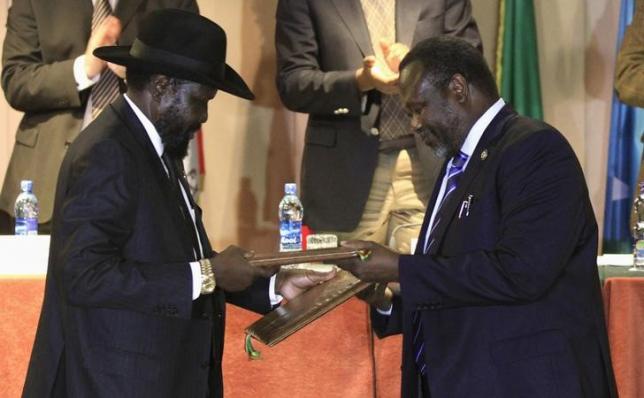
South Sudan's President Salva Kiir (L) and First Vice President Riek Machar exchange documents at a past function in Addis Ababa, Ethiopia.
KAMPALA: South Sudan rebel leader Riek Machar is on Sunday expected to announce his return to the capital Juba, one week after Ugandan troops announced they were pulling out of the war-ravaged country.
The fallout between Machar and President Salva Kiir followed accusations leveled against the former, of plotting a coup, accusations that resulted in a war that has killed thousands and left millions displaced. 
Under an agreement signed by the warring parties in Addis Ababa on August 26, 2015, Dr Machar is recognized as the First Vice President of South Sudan but it is not clear whether his planned return to is accordance with the agreement.
But according to a statement issued by the rebels’ deputy spokesperson Dickson Gatluak Jock on Saturday, Dr Machar will make the announcement on return from the United States where he attended meetings with top US officials on the sidelines of the UN General Assembly meeting.
“The briefing will be on when the first team of the chairman [Machar] will be going to Juba,” Galuak Jock said.
Mr Galuak Jock also says Dr Machar will also talk about the security arrangements in South Sudan and give his position on the proposed creation of 28 new states by President Salva Kiir.
The UPDF deployed in South Sudan in 2013 December to ostensibly protect Uganda’s interests but last week government announced the army’s withdrawal.
The UPDF withdrawal is in compliance with the Addis Ababa Agreement that directed all foreign troops in the world’s youngest nation to withdraw within 45 days.
Stories Continues after ad

Could hotels in Uganda be spying on you as you enjoy their comfort?


Kampala: There are twenty one hotels in Uganda that reportedly colluded with government to hack and spy on potential opponents through computers, phones or any communication device.
The Serena Kampala, Sheraton Hotel, Hotel Africana, Speke Resort Munyonyo, Imperial Royale, Emin Pasha, Grand Imperial, Tourist Hotel, and Fairway Hotel are some of hotels named in a just-released report titled ‘For God and My President: State Surveillance in Uganda by Privacy International. Others named include Hotel Triangle, Golf Course Hotel, Protea Hotel, Mamba Point, Equatorial Hotel, Cassia Lodge, Travellers Inn, Imperial  Resort Beach Hotel; Imperial Botanical Golf View Inn, Flight Motel and Brovad Hotel in Masaka.
In the 80-page report Privacy International says government, through an operation code-named ‘Fungua Macho’ (open eyes) reportedly carried out surveillance on opposition politicians, journalists and people deemed a threat to state security after the 2011 elections.  
According to the report, through the Fungua Macho operation, the high-end hotels in Kampala, Entebbe and Masaka were reportedly compromised as part of the spying operation. These hotels, the report says, were specifically selected because they were known to be meeting points for politicians and journalists and also as places known for hosting political events.
How it is done
To do its work, the report says, government bought a computer virus called FinFisher that it used to corrupt electronic gadgets of its targets.
FinFisher access points were reportedly installed on the Wi-Fi networks and/or business centers of these hotels and according to Privacy International, it would take less than five minutes for the FinFisher malware to be inserted directly onto a phone or computer.
For particularly security-savvy targets, FinFisher can be disguised as a PDF, word processing document or other file that the target will inadvertently download and execute; or as a fake website which, when visited by the target, will download FinFisher onto the target’s device, the report states.
A device can also be infected by connecting to a fake network access point. This can be a Wi-Fi log-in screen disguised as an ordinary hotspot portal. FinFisher is designed to activate with a simple inadvertent click by the user. It is designed to bypass most antivirus programs.
In the report, Privacy International notes that it visited all 21 hotels in 2015 and found that computers in two-thirds did not protect administrator privileges, meaning that covert installation of a program onto the desktop computers would have been a simple task.
What is worrying, the report notes, is that many hotels have collaborated either consciously (overt penetration) or unconsciously (covert penetration).
“The potential collaboration of hotels with security services has serious implications. Guests and visitors pay expensive rates for physical security, comfort and privacy that these largely high-end establishments claim to offer,” the report notes.
The Hotels respond
In letter to Privacy International, a copy of which Eagle Online has seen, Serena Hotel General Manager, Anthony Chege, describes the contents of the report as ‘allegations that are very disturbing and untrue.”
“Serena Hotels Africa is a company of integrity that values and protects that privacy, safety and security of all clients staying or visiting our properties.
“Neither the undersigned nor any of my staff is aware that the Ugandan military (UPDF) and the police were engaged in a surveillance operation specifically targeting the organizers of the walk to work protests as well as parliamentarians, intelligence officials and media house during 2011 and 2012 or at any time,” the letter reads in part.
On behalf of Speke Resort Munyonyo, Sudhir Ruparelia, in a letter to Privacy International, wrote: ‘totally false and fabricated lies that we have allowed any forms of surveillance knowingly’.
“This is not the policy of the Group nor any of its entities unless it is prescribed in the laws of Uganda which I do not have knowledge whereby government has requested any such thing.
“It looks like you and your charity is dealing in rumours and may I suggest you correct your records or give us proof and or evidence for your accusations,” Sudhir’s letter reads in part.
Stories Continues after ad

We are ready to deploy helicopters in Somalia-Air Force boss

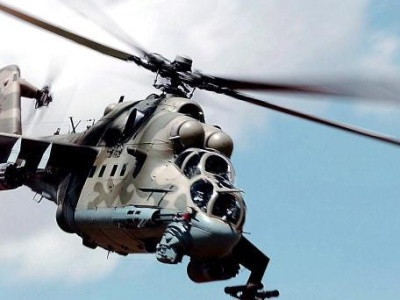
A month after Somali insurgents attacked a UPDF base in Somalia, killing 19 soldiers, the commander Air Forces, Maj Gen Samuel Turyagyenda says Uganda is ready to deploy two helicopters for transport and four for combat to augment UPDF infantry. In this interview done by UPDF’s Magazine (Tarehe Sita) and sent to Eagle Online, Maj Gen Turyagyenda talks about the history of UPDAF, the Israel attack on Entebbe airbase in 1976 that left many air assets destroyed, and the crashing of the four helicopters in Kenya,  en-route to Somalia.  

Briefly tell us how UPDAF evolved to what it is today

Air Force was established in Jan 1964 with the enactment of 1964 Armed Forces Act. The first recruitment was done in 1964 by the Israeli’s. The emphasis was on recruits with aeronautical, mechanical, electrical engineers.

By 1975, Air Force had built capacity in terms of manpower, Equipment and infrastructure. It had operational Air bases in Gulu, Nakasongola and Entebbe and was capable of executing operational missions.

However, in 1976 most of the assets were destroyed on the ground by the Israeli raid during operation “Thunder Bolt”. The political turmoil during Amin’s reign saw many qualified pilots & Engineers either killed or fled the country.

The 1979 war saw the remaining aircraft either vandalized or taken away which made the Air Force to totally collapse.

But since 1986 UPDAF has been high on government policy agenda. We acquired some Bell and Agusta Utility helicopters from America and Italy respectively.  They were not combat. But with time, it became necessary to search for multirole helicopters that could do both Utility and combat.  The MI – 17 was the preferred choice. The UPDF fraternity referred to this ‘Skyhorse’ as “SURAMBAYA”

The white paper on Defence transformation in 2004 and later UPDF Act 2005 Created Air Force as a Service thus making the UPDF a bi-service. Since then, UPDAF (Air Force) has moved to acquire new and modern platforms.

Air Force has gone on to train its personnel (Pilots, Engineers and Technicians) from both inland and abroad in different capacities.

What are the major challenges the air force faces on this road to have a strong air force?

 Generally, the major bottlenecks in professionalisation are many but the following are some of them are; limited budget to undertake the required training both new airmen as well as progressive experience building for pilots, Engineers, technicians and other support departmental personnel.

We also need trainers and operational aircraft. We also need enough fuel for training and operations. We need ground handling equipment and other logistical equipment.

It would also be better to have a well-established Aviation Academy to conduct local training which is cheaper compared to sending people abroad.

There is also limited Land to conduct training. Most of the land has been encroached.


What has been the role of UPDAF in the fight against violent extremist in the region?

 First and foremost violent extremism is a global threat and in our region, the extremists have manifested themselves through Alshabab, ADF, and LRA and others. Whenever Air Force is called on, we have done Aerial Reconnaissance in Eastern, DRC, South Sudan and Northern Uganda to provide timely intelligence information to commanders.

We also air lift or deploy troops and resupply the required logistics. In Somalia, we do Aviation security, Meteorological, Fire and Rescue Services to AMISOM at Mogadishu airport.

These and many more, Air Force in support and collaboration with other Arms of UPDF, has played a significant role in combating extremism in the region.

What are the combat challenges you faced fighting extremism?

 Fighting extremist is or asymmetrical warfare where there is no frontline. The enemy will mix with the population and identification is a problem.

Another challenge is poor coordination affecting timely response. There is need to acquire modern equipment intelligence, surveillance, and target (ISTAR) assets to provide accurate information. Difference in doctrine of different countries is another challenge. We do not have the same doctrine and therefore have different training and operational methods. As I mentioned earlier, lack of helicopters, trained personnel and other logistical requirements pose a big challenge when fighting extremism in our region.

We are aware that UPDAF has been making some preparations for the deployment of Air craft in Somalia. How prepared in Air Force for the mission?

As you are aware, following the tragic accident of 2012 when we lost helicopters in Kenya en-route to Mogadishu, we went back to the drawing board; we have been preparing and now we are in advanced stages to deploy.

The helicopters to deploy are ready, personnel have been trained both in Nairobi and in Uganda, basically all preparations have been made and very soon we shall deploy.

Who is going to fund this operation? And how many aircraft are ready for the mission?

This is an African Union Mission in collaboration with the United Nations. The UN Security Council Sanctioned the deployment of air assets to Somalia as both force multipliers and force enablers. African Union will fund the mission.

As for the number of aircraft, we are looking at initially deploying Six–two for transport, and four for combat. However, in case of necessity we hope to increase the numbers later.

Is the deployment going to be done by UPDAF only?

Absolutely it will be done by Ugandans. Uganda is a troop contributing country and will undertake the mission.

Has UPDAF got involved in such a multinational operation anywhere in the world?

No! This is the first of its kind.

What do you see as the major Air Force achievements since 1986?

There are a lot of achievements which include   but are not limited to increase in asset base. There was no Air Force to talk about in 1986. But now it is a service Force with assets, and personnel. We have also expanded in area of operation. We now have four operational bases of Gulu, Soroti, Nakasongola and Entebbe. In addition we have an Academy in Nakasongola and an Air Force Garrison.

We have increased the level of training of our personnel both in professional/technical and military aspects.

Air Force has been instrumental in the defeat of all insurgents in Uganda, LRA, Lakwena, and ADF. In additional, Air Force was instrumental in battles against cattle rustling and disarmament operations in Karamoja.

Air Force has also been instrumental in operations other than war especially natural disasters. Examples floods in Teso, Kasese and Landslides in Bududa.

What change will the deployment of air assets cause in the operations against al shabaa?

The deployment of aircraft to Somalia will be a game changer. It will entirely change the course of operations. Troops will be airlifted and to and from the frontline quickly. They may also be deployed behind enemy lines positioned.    Logistical supplies will be easy and above, all the fire power delivered from the combat helicopter will substantially help to conclude the war more quickly.

Where do we see Air Force in the next twenty years?

In the next twenty years, Air Force will be modern with enough trained and qualified Pilots, engineers, Technicians and other support personnel. Air Force will have adequate modern platforms that can appropriately respond to internal, regional and continental threats. We will expand not only in size and numbers of the equipment and personnel, but also in coverage.

Stories Continues after ad

100 UPDF for AU training in S. Africa


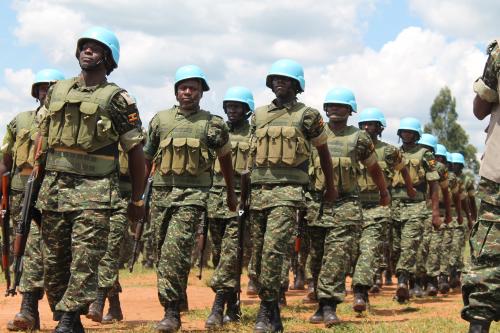
About 108 Ugandan soldiers have joined their African colleagues in South Africa for readiness of African Standby Force that is supposed to be fully-fledged by December this year.

A statement issued by the Ugandan army spokesperson, Lt Col Paddy Ankunda says the exercise is to evaluate the state of readiness of the ASF and its Rapid Deployment Capability.

Col Michael Kabango, the commanding the Ugandan Contingent said: “By the close of the exercise, our troops will be better skilled on crises response.

updf

Participating countries include; Uganda, Angola, Botswana, Democratic Republic of the Congo, Lesotho, Malawi, Mozambique, Namibia, South Africa, Swaziland, Zambia and Zimbabwe, Algeria, Burundi, Egypt, Ethiopia, Gambia, Ghana, Kenya, Nigeria and Rwanda.

African Standby Force have five armies from the five African regional economic blocs that are supposed to respond to crises and conflicts in their respective regions.

They are; Eastern African Standby Force (EASF), North African Regional Capacity, Economic Community of West African States Standby Force of West African, Economic Community of Central African States Standby Force and SADC Standby Brigade.

Stories Continues after ad
Ethiopia in El Nino funds drive


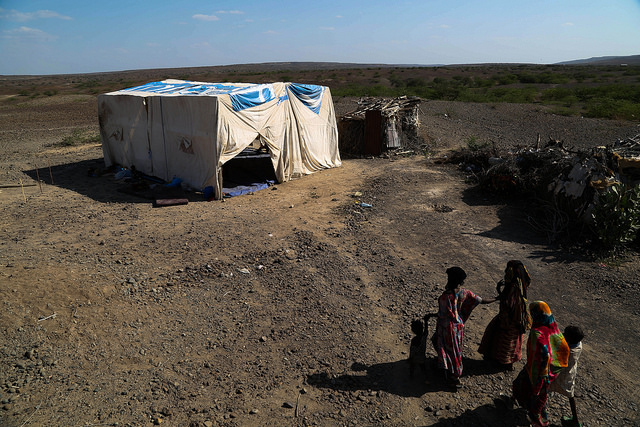
Ethiopia needs US$596 million to contain the existing threat caused by rampaging El Nino rains, which are also expected to affect nine other African countries including Uganda.

This development in Ethiopia comes in the wake of the government and the United Nations Office for the Coordination of Humanitarian Affairs (UNOCHA) Coordinator drafting a letter outlining the current situation in the Horn of Africa country.,

‘Given the deteriorating humanitarian situation outlined in the letter, the financial requirements to address urgent humanitarian needs to the end of 2015 have increased by US$164m, taking the total requirements to US$596m’, a release by UNOCHA states in part.

it further indicates that US$258m has been received to-date in donor contributions, leaving the appeal funded to 43%.

‘As much of the funds provided earlier in the year were already spent, key sectors such as Food, Targeted Supplemental Food, and livelihoods/agriculture are critically short of funds’ the release adds.

Three weeks ago the Ethiopia Humanitarian Country Team also released a forward-looking document called ‘Ethiopia Slow onset natural disaster: El Niño Driven Emergency’, as a complement to the Government-led Humanitarian Requirements Document (HRD). It concludes with needs projections for early next year based on analysis of ‘analogue’ El-Nino impacted years, along with some indicative financial requirements of US$237m – required immediately – in particular to front-load critical food and nutrition supply pipelines for the first quarter of next year.

Meanwhile, in Uganda the Kampala Capital City Authority (KCCA) has desilted several drainage channels, mostly in the slum areas like Bwaise and Kinawataka, in a bid to contain the effects of El Nino on slum dwellers.

Stories Continues after ad
Malia Obama goes ‘college hunting’

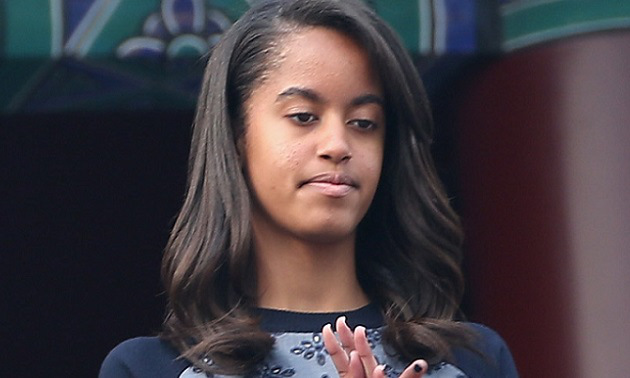
XI'AN, CHINA - MARCH 24: First Lady Michelle Obama (2nd Left) with her daughters Malia Obama (2nd Right) and Sasha Obama (Left), mother Marian Robinson (Right) visit the Xi'an City Wall on March 24, 2014 in Xi'an, China. Michelle Obama's one-week-long visit in China will be focused on educational and cultural exchanges. Michelle Obama's one-week-long visit in China will be focused on educational and cultural exchanges. (Photo by Feng Li/Getty Images)


American First Daughter Malia Obama has come of college age, visiting several Ivy League universities like Columbia and Stanford, in the East and West Coast, respectively.

Over the past months the 17-year old Malia has visited other universities that include Brown’s University, New York University, the University of California at Berkeley and, Barnard College.

XI'AN, CHINA - MARCH 24:  First Lady Michelle Obama (2nd Left) with her daughters Malia Obama (2nd Right) and Sasha Obama (Left), mother Marian Robinson (Right) visit the Xi'an City Wall on March 24, 2014 in Xi'an, China. Michelle Obama's one-week-long visit in China will be focused on educational and cultural exchanges.  Michelle Obama's one-week-long visit in China will be focused on educational and cultural exchanges.  (Photo by Feng Li/Getty Images)

Recently Malia visited Brown University but according to analysts, President Barack Obama’s eldest daughter is likely to settle for her father’s Alma Mater, Columbia University, while others speculate she will choose her father’s ‘favourite university’, Stanford. Well, if Malia goes to Stanford, she will follow in the footsteps of Chelsea Clinton, the daughter of 42nd US President Bill Clinton and wife Hilary Rodham Clinton. Malia will also become the 10th ‘First Child’ in the last 50 years, to get a college/university education while at the White House.

Other US President’s children and their schools in the last 50 years

Lynda Bird Johnson Robb – The oldest daughter of the US 36th President Lyndon B Johnson, she went to National Cathedral School in Washington D.C and University of Austin at Texas (1966).

Luci Baines Johnson – A younger sister to Lynda, Luci attended Georgetown University School of Nursing and Health Studies (1996). She didn’t graduate.

Tricia Nixon Cox – The oldest daughter of President Richard Nixon, Tricia attended Boston College and earned a degree in English (1968). Julie Nixon – the youngest daughter of Nixon attended Smith College and earned a master’s degree in education from The Catholic University of America in 1972.

Caroline Kennedy — Radcliff Class of 1980


The oldest child of President John F. Kennedy, Caroline went to Radcliffe College at Harvard University, and earned a law degree from Columbia Law School in 1988.

John F. Kennedy Jr. — Brown University Class of 1983

The younger Kennedy attended Brown University where he majored in history. He graduated with a law degree from New York University (NYU) School of Law in 1989, though he failed the bar exam twice, before passing on his third try.

Amy Carter — Brown University 1988 (didn’t graduate)


Amy Carter, the youngest daughter of President Jimmy Carter, attended Brown University but was dismissed in 1987 for falling behind in her classes.

She graduated with a bachelor of fine arts from the Memphis College of Art in 1992 and earned a master’s degree in art history from Tulane University.

Chelsea Clinton — Stanford University Class of 2001


Chelsea Clinton could be the first child with the highest educational credentials. The only daughter of President Bill Clinton, she graduated with highest honors from Stanford with a history degree.

She then attended University College of the University of Oxford, where she graduated with a master of philosophy in 2003.

Clinton earned a graduate degree from Columbia’s Mailman School of Public Health in 2010 and earned doctorate from Oxford in 2014.


Barbara Pierce Bush — Yale University Class of 2004

The older fraternal twin daughter of President George W. Bush, Barbara attended Yale University and graduated with a degree in humanities.

Jenna Bush Hager — University of Texas at Austin Class of 2004

Jenna, the younger fraternal twin, attended University of Texas at Austin where she graduated with an English degree.

Stories Continues after ad
Kenyatta addresses EALA on integration

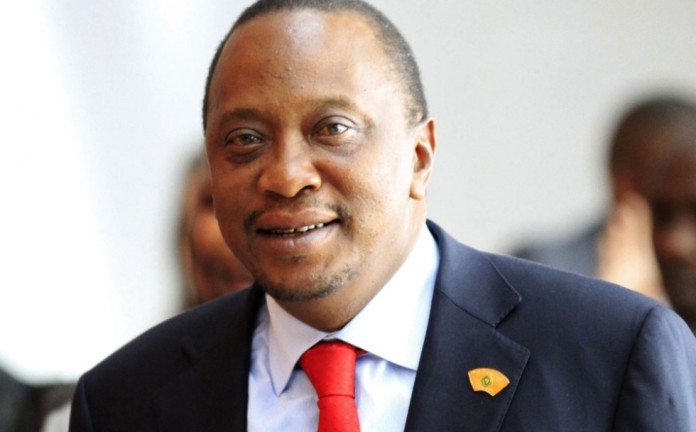
Uhuru-Kenyatta
President Uhuru Kenyatta has today addressed EALA, calling on the Assembly to consolidate its work for the furtherance of the integration process. 
According to President Kenyatta, who was addressing a Special Sitting of the 2nd Meeting of the 4th Session, the citizens of the East Africa Community (EAC) region are yearning to freely move, work and enjoy the tangible benefits of integration.
 I will begin by repeating my Government’s complete commitment to East African integrationI know that the future of each of us in the region is bound up with the fate of all the rest.  Leaders must create the laws,the institutions, and the framework that will help us face that future together.  Kenya will play its part in that great task”, President Kenyatta told the 3rdAssembly, which commenced in Nairobi last week.
 
Mr Kenyatta urged all stakeholders involved in the integration process to create awareness, saying the role should be undertaken by both politicians and the ordinary people.
 
“…we who are convinced of the imperative of integration must communicate it better to our peopleToo often, the integration of East Africa is taken to be merely a political matter – a job for politicians, not ordinary people.  True, leaders must lead.  But we have failed to spark the imaginations of East Africans when it comes to integration,” the President remarked.
 
Stories Continues after ad
‘Every Tanzanian’ to get mobile phone

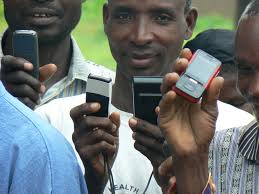
Mobile phone users in Africa have increased tremendously, hitting the 900 million mark in the first quarter of 2015.
Tanzanians have another reason to jubilate before they welcome a new president to replace Jakaya Kikwete after October 25.

This follows the announcement by mobile and internet services provider Viettel that it will ‘provide’ every Tanzanian with a mobile phone, and competitively-priced 2G and 3G services across the country.

“Viettel’s vision is to provide every Tanzanian with a mobile phone and bring communication and information technology to every corner of life of the country. Our entry into Tanzania reflects our belief that when telecommunications services are accessible to everyone, and become a part of everyday life, they can be a driving force contributing to socio-economic development for the country as a whole” Nguyen Manh Hung, General Director of Viettel Group, said at the launch of the Halotel brand name.

The launch in Tanzania reflects Viettel’s expansion in its tenth market and into the second biggest economy in East Africa, following the rollout of services in Burundi and Cameroon through Lumitel and Nexttel earlier this year, and in Mozambique through Movitel in 2014. According to the Viettel, through an initial investment of US$736 million, the company has managed to cover 1500 villages in 26 provinces in the country, and to create over 22,000 direct and indirect jobs.

Viettel also says it has provided optical cable to 150 committees, 150 public hospitals, 150 police stations and 65 post offices within the first half of the year, and that the company will also provide free internet connectivity to 450 public schools over the next three years.

‘With a strong infrastructure comprising 18,000 km of optical cable and more than 3,000 base transceivers, Viettel’s services can cover up to 81% Tanzania’s population. 1,500 villages are now connected for the first time,’ Viettel says in a release offered on its behalf by the Africa Press Organisation, (APO).

Stories Continues after ad