Schools that teach the German language in Uganda are set for an exciting week, as students descend on Kibuli Senior Secondary School for the Seventh German Language Festival, beginning June, 7.
An annual event, the Festival aims at bringing together schools that teach the German Language in Uganda and also at promoting the imaginative and creative abilities of the students as well as their cultural awareness.
Under the theme ‘German and the languages in Uganda’, this year’s festival is being organised by the German Embassy in Uganda, the Goethe-Zentrum Kampala/ Ugandan German Cultural Society and the Association of Teachers of German in Uganda.
German is currently taught at 14 schools in Uganda as a regular subject and during this year’s festival, students will have the chance to engage in several workshops and also compete for prizes.
Meanwhile, the recent translation of German author Gotthold Ephraim Lessing’s play ‘Emilia Galotti’ into Runyankore by Jane Ninsiima is one example of intercultural exchange between the two countries.
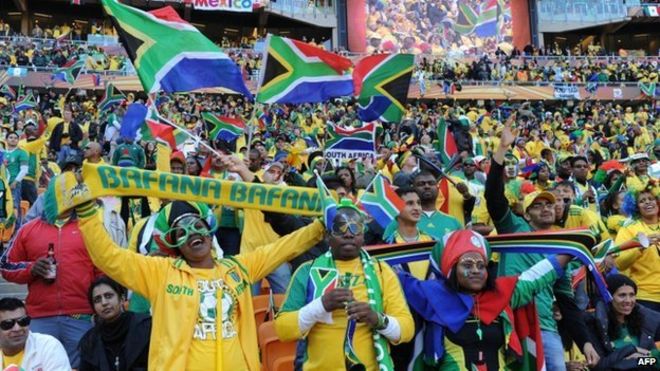
South Africa was chosen ahead of Morocco to host the 2010 World Cup
South Africa was chosen ahead of Morocco to host the 2010 World Cup
South Africa did pay $10m (£6.5m) to a football body led by Jack Warner, a figure at the centre of Fifa corruption allegations, local media say.
Danny Jordaan, head of South Africa’s FA, is quoted as confirming that the amount was deducted from a Fifa payment to the country in 2008.
A subsequent letter requested that money to be sent, instead, to the Caribbean Football Union, reports say.
South African officials deny it was a bribe to secure the 2010 World Cup.
But US prosecutors insist South Africa made an illegal payment after the government promised $10m to Mr Warner – then a Fifa vice-president – in exchange for the “Rainbow Nation” becoming the first African country to host the World Cup.
Fifa chose South Africa as host ahead of Morocco.
The Fifa crisis dominates Sunday’s South African newspapers
Danny Jordaan could not be reached for comment on Sunday, but he is quoted as insisting the money was paid to the Confederation of North, Central American and Caribbean Association Football (Concacaf) in 2008 as South Africa’s contribution towards their football development fund.
The BBC’s Andrew Harding in Johannesburg says unnamed officials have confirmed that the payment was made to support football development among members of the African diaspora – something which does make sense in the political context of the time.
The latest reports come with Fifa – the governing body of world football – in crisis. Senior Fifa officials face a string of bribery charges.
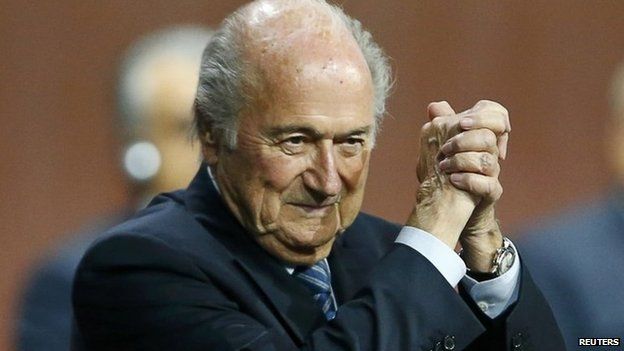
Its head, Sepp Blatter has not been implicated but has faced calls to stand down. He was re-elected as Fifa president on Friday.
Kampala-Friday June 5 all entertainers will head to Club Cyclone for the launch of the Uganda Entertainment Awards that will feature the cream of Uganda’s musicians, artistes, dramatists, actors and actresses.
According to the organisers, Cents Events Limited, the entertainers will deliberate on issues pertaining to the general performing arts in the country, with a view to spurring the entertainment industry to international standards.
They further say the awards will help change the landscape of Uganda’s entertainment industry, which many argue, has tended to primarily focus on music.
For a long time now entertainment enthusiasts have averred that Uganda’s entertainment industry has failed to tap into the panoply of arts, with focus on music and a few other performing arts, something that has left many talents unappreciated.
“Many will attest to the fact that Uganda has many extremely talented actors, comedians, sportsmen, DJ’s, MC’s yet many of them haven’t been exposed or pushed past their local theatre audience or better still, appreciated for their craft,” said one of the critiques, who sought to remain anonymous.
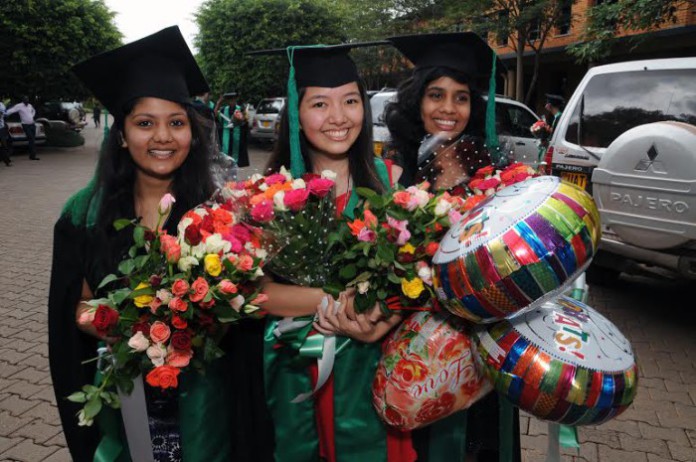
Some of the students who completed IB Diploma Programme, photos by Bruno Birakwte
Kampala-Kampala International School Uganda (KISU) on Friday May 29, held their 6th graduation ceremony in honor of students who completed the internationally acclaimed International Baccalaureate (IB) Diploma Programme.
A total of 15 students, received their completion certificates from KISU ahead of the full release of the examination results by the International Baccalaureate Organisation (IBO) in July this year. KISU was accredited by IBO in 2008.
The students are headed to a variety of universities around the world to study a variety of courses, including engineering, pre-medicine, Business Management, Management Information Systems, Music Production, Liberal Arts, International Relations, Computer Engineering.
The graduation was presided over by Samuel Paice, HM Consul, British High Commission in Uganda, assisted by Mr. Neil Wrightson, the School Director.
The IB Diploma Programme is an alternative to pre- university programmes like the local A-levels and KISU is one of only three schools in Uganda to offer the programme; that is recognized by all leading universities worldwide. To date, a total of 90 students have completed the course from KISU.
KISU is also accredited by the Council of International Schools (CIS) and the New England Association of Schools and Colleges (NEASC).
Educating today’s children for tomorrow’s world
In his keynote address to the students, Mr Paice, urged the students, to utilize the skills gained at the school to become better global citizens; saying that the IB Diploma was just the beginning of a long future ahead of them.
“The IB Diploma equips you with all the necessary skills to fit in the outside world,” he said.
On his part, Mr.Neil Wrightson encouraged the students to aim for the best in life and not to be afraid of making mistakes.
“You are going on the biggest journey of your life. Do not be afraid to make mistakes. Because the truth is that no matter how well you plan things, things will go wrong, people will let you down but some other people will move heaven and earth for you; do not forget to say thank you,” he advised.
On behalf of the Class of 2015, Ingrid Saito, praised both the IB Diploma and KISU for having given them a strong foundation on which they would place the building blocks of a great future ahead.
“We are nothing but the fruits of your labour,” she told the parents and quickly reminded her fellow students not to be afraid of failure.
“Remember, sunshine everyday causes a desert; whenever you are faced with drizzles remember always to seize the day,” she said.
To enroll for the diploma, a student needs to have scored at least five credits in five major subjects at O-level or their equivalent at the General Certificate of Secondary Education (GCSE).
“I invite parents to come and learn more about the benefits of international education,” he said.
He also said that with world class facilities, Uganda stood to benefit from attracting students within the region to come and study locally and this would have immense national benefits.
KISU- A world-class centre of excellence
KISU is a non-selective, co-educational school for 2-18 year olds, offering an enhanced English National Curriculum for 2-14 year olds, followed by 2-yearIGCSE (Cambridge) courses for 14-16 year olds, and finally the pre–university IB Diploma Programme for 16-18 year olds.
The school has over 600 students from more than 60 nationalities. Staff is drawn mainly from the UK, Canada, Australia, USA, Germany, The Netherlands, Belgium, and Uganda. This ensures a wide exposure to cultures and languages.
The school which is part of the Ruparelia Group, migrated to their purpose built 14-acre campus on September 3, 2008.
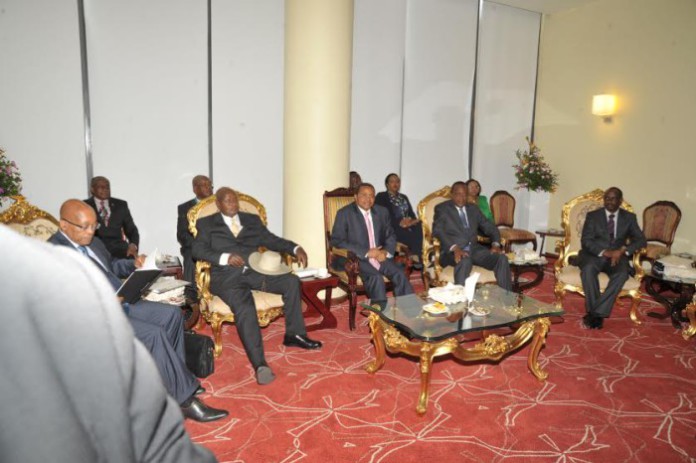
East African Heads of State in for an emergency summit
East African Heads of State in for an emergency summit
Dar es Salaam-East African Heads of State have, under their umbrella body the East African Community (EAC), called for the postponement of the elections in Burundi for a period of not less than one and half months and also appealed to institutions in Burundi including Parliament to facilitate this postponement.
In a joint communiqué issued at the end of an emergency summit on the situation in Burundi held at State House in Dar es Salaam, the leaders who included, Jakaya Kikwete of the United Republic of Tanzania, Yoweri Museveni of Uganda, Uhuru Kenyatta of Kenya, Burundi’s Minister for External and International Cooperation Alain Nyamitwe, who represented President Pierre Nkurunziza of Burundi and Rwanda’s Minister for East African Community, Valentine Rugwabiza, who represented President Paul Kagame of Rwanda, agreed that during the postponement, members led by the EAC chairperson will consult with stakeholders in Burundi on the way forward.
The summit was also attended by South African President Jacob Zuma, the Chairperson of the African Union Commission Dlamini Zuma and the United Nations Secretary General’s Special Envoy for the Great Lakes Region Saidi Djinnit among other officials.
On May 13, rebelling soldiers led by former intelligence chief Gen Godefroid Niyombare temporarily ousted the government of president Pierre Nkurunziza, while the latter was attending a similar conference on Burundi in Dar es Salaam, sparking off violent reaction by the masses.
However, the coup was reversed by loyalist troops, paving the way for Nkurunziza to return to the country on Thursday, May 14.
During the deliberations, officials called on all parties to stop the violence and exercise restraint during this period and for the urgent disarmament of all armed youth groups allied to political parties.
Meanwhile, the leaders have encouraged the government of Burundi to create a conducive environment for the return of refugees to Burundi and directed the Ministers of Foreign Affairs of the EAC partner states and the Republic of South Africa to urgently communicate these and other decisions to the government in Burundi.
The leaders at the summit also expressed sympathy for the people of Burundi following the violence that resulted in the death of many people, influx of refugees to neighbouring countries, the destruction of property and paralyzing of business in some parts of the country.
After the summit, the leaders were hosted to a luncheon by President Jakaya Kikwete.
Museveni for Madaraka Day in Nairobi
Later, President Yoweri Museveni held a bilateral meeting with the host and EAC chairman, President Kikwete.
Meanwhile, Mr Museveni this morning left for the Kenyan capital, Nairobi, to be part of celebrations to mark Madaraka Day at the invitation of President Uhuru Kenyatta. On departure President Museveni was seen off at the Julius Nyerere International Airport by Tanzanian Minister of Foreign Affairs, Bernard Membe.
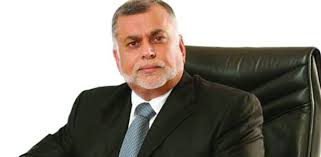
NO PROPERTY ATTACHED: City tycoon Sudhir Ruparelia
Sudhir Ruparelia
Kampala-Crane bank will tomorrowJune 2, open another branch at Gulu University.
Crane bank is a locally owned bank and it boosts of countrywide branches across all the regions of Uganda.
The branch opening will be among the 2015 goals that Ruparelia Group setup. The group last year said by close of 2015, it would have opened 50 branches countrywide.
The new branch has many counters, a spacious banking hall and parking lot to conveniently serve its clients. Ruparelia Group is owned by East African richest man Sudhir Ruparelia as ranked by Forbes.
The aggressive expansion of opening up many branches is aimed at bringing banking services closer to people in all regions of the country Crane bank is also aiming at opening branches at all universities and tertiary institution’s of learning.
Crane bank was named Bank of the Year in Uganda, for the ninth time in ten years by the influential London-based Financial Times newspaper. Since its inception, Crane Bank has won Bank of Uganda annual awards as bank of the year for several years.
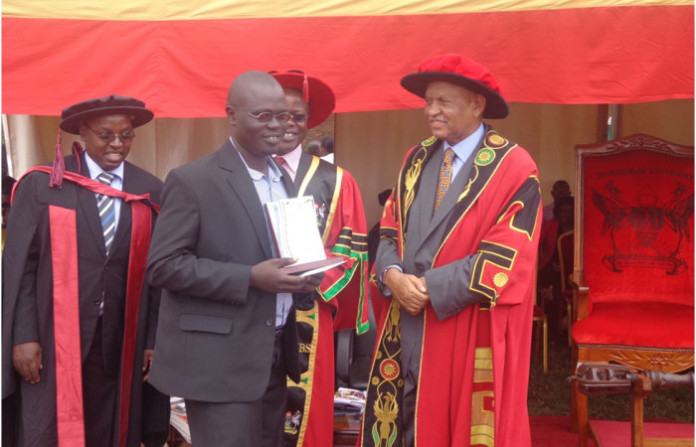
Chancellor Prof. Mondo Kagonyera, Speaking to Mubs officials
Chancellor Prof. Mondo Kagonyera, Speaking to Mubs officials
Kampala- Makerere University Chancellor Prof. Mondo Kagonyera, has called on government to adjust the current university education system.
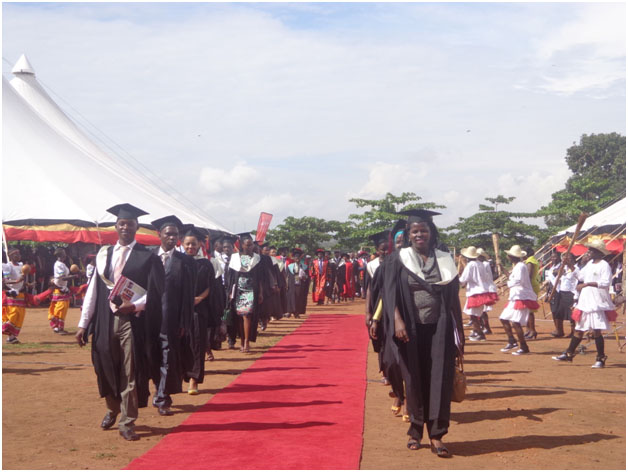
Prof. Kagonyera was speaking at the 10th Makerere University Business School (MUBS) graduation ceremony in Kampala today May 29, 2015 were the business school awarded diplomas and certificates to 1000 students.
Addressing over 1000 graduands’ and guests, Prof. Kagonyera said although the government has tried to do its best in providing resources, much effort is still needed.
“We continue to depend on donors to fund our staff development programmes. This is a clear demonstration of lack of good plans to respond to society needs.” He said.
Kagonyera said he has passed out many graduates, but many of them don’t have jobs. He says the university plays its role of educating but government has to make sure that the graduates are employed. “Universities are playing their role of educating them. It’s not the role of universities to create employment.”
The Chancellor said it’s hard to keep the good staff in the current university education system since many universities cannot pay their staffs’ remuneration. He further said that the university staff and administrators need to do research, attend conferences and publish their findings. “University professors must contribute to new knowledge that generates changes that transform society,” he said.
He said although president Yoweri Museveni promised to give professors more money little has been received.
Prof. Waswa Balunywa, MUBS Principal echoed out the Chancellor’s views. “We are trapped in poverty because we lack knowledge,” he said.
He said many promises need to be fulfilled. “We will receive Shs 6bn out of the Shs50bn promised to academic staff in public universities,”
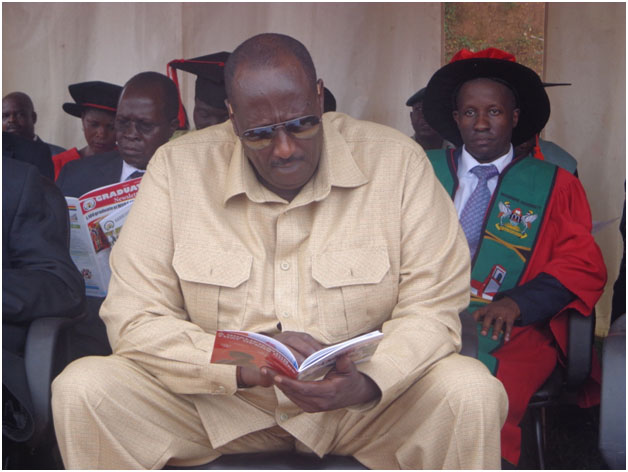
guest speaker, Gen. Salim Saleh
This year’s guest speaker, was Gen. Salim Saleh whose was theme ‘creating employment and wealth through agriculture as a business,’ advised universities to practically train students before sending them to the field. Gen. Saleh said that many of today’s graduates cannot go to villages to practice agriculture. “Make it attractive so that they can go and do it (agriculture.”
Seven best performing students walked home with Shs500, 000 prize and plaques commending them on their achievements. Three professors and Hajj Omar Mandela, proprietor City Oil were all awarded for their roles in promoting the education sector.
Midrand-South Africa-The Sixth Ordinary Session of the Pan African Parliament has adjourned, recommending dialogue to solve political problems on the continent.
In recommendations approved during the last sitting of the session held in Midrand, South Africa, on Friday, May 29, 2015, the Pan African Parliament is concerned about the growth of terrorism, violent extremism and transnational criminality including human trafficking in Africa.
Terrorist groups and crises highlighted during the two weeks session included the Boko Haram in Nigeria, Al Shabaab in Somalia, Lord’s Resistance Army in Central Africa region; and the conflicts in Burundi, Mali and Saharawi Republic.
PAP noted that despite the considerable progress in democracy in the last two decades, conflicts in Africa are still caused by factors such as political and socio-economic exclusion, lack of democratic governance, poor organization of elections, human rights violations, inequitable distribution of wealth and terrorism.
The continental body recommended that “the African Union invite all member states to strengthen their capacity in the fight against illegal arms trafficking which continues to fuel wars in Africa.”
“The current peace efforts deployed by the African Union with the support of the United Nations and other institutions be intensified with a view to eradicating terrorism on the continent,” read part of the recommendations.
PAP also recommended that the AU strengthen the capacity of all organs and mechanisms in place to enable them play a bigger role in the prevention of conflicts in Africa.
AU member states were also asked to sign, respect and implement all the AU instruments relating to peace, security and good governance, in particular the African Charter on Democracy and Elections.
Today’s sitting marked the end of the Third Pan African Parliament, during which Mr Roger Nkodo Dang (Cameroon) was elected to replace Mr. Bethel Nnaemeka Amadi (Nigeria) as President.
Similarly, Mr Eduardo Joaquim Mulembwe (Mozambique/Southern), Mr. Suilma Hay Emhamed (Saharawi/Northern), Dr. Ashebir Gayo (Ethiopia/Eastern) and Dr. Bernadette Lahai (Sierra Leone/Western) were elected as Vice Presidents from the four African regions.
In the Committees, the Leader of Uganda’ s delegation Mr. Onyango Kakoba was re-elected to chair the Committee on Justice and Human Rights while Ms. Jacquline Amongin was elected to chair the Committee on Rural Economy, Agriculture, Natural Resources and Environment.
Uganda’s other representatives to PAP are Beatrice Barumba, Sam Amooti Otada and Elijah Okupa.
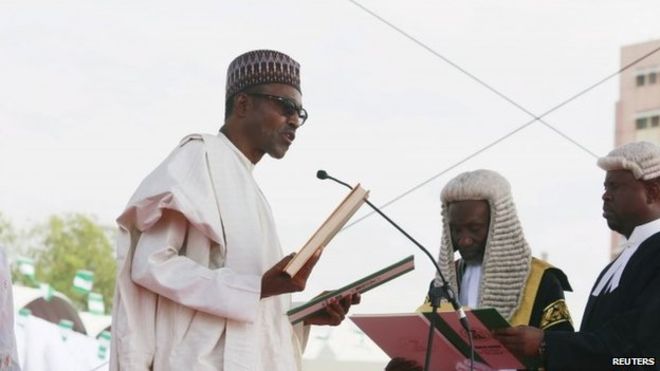
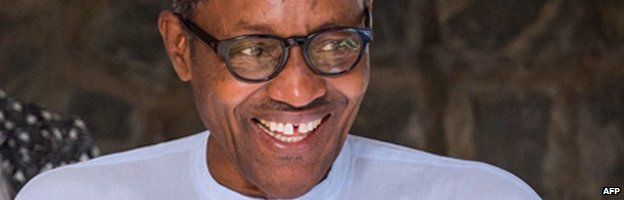
President Buhari said Nigeria now had "a window of opportunity to fulfil her potential"
President Buhari said Nigeria now had “a window of opportunity to fulfil her potential”
The winner of Nigeria’s presidential election in March, Muhammadu Buhari, has been sworn in as leader of Africa’s most populous country.
Mr Buhari is the first opposition figure to win a presidential election in Nigeria since independence in 1960.
“I belong to everybody and I belong to nobody”, he told cheering crowds at the inauguration in the capital, Abuja.
He vowed to tackle “head on” the issues of corruption and the insurgency from militant Islamist group Boko Haram.
Mr Buhari, a former military ruler, has taken over from Goodluck Jonathan, who had been in office since 2010.
Will Ross, BBC News, Abuja:
As soon as Muhammadu Buhari was sworn in the invited guests in Eagle Square rose to their feet, danced and sang their new president’s name. As he was then driven around in an open vehicle, people rushed forward to record the moment on their phones.
This was a time for celebration not just for supporters of the new leader but also for Nigerians who are proud that their country has witnessed this historic transition. By conceding Goodluck Jonathan steered the country away from violence. We will never know how close Nigeria was to the precipice.
Moments after Muhammadu Buhari was sworn in thousands of excited young men ran through the security barriers to Eagle Square and pressed up against the perimeter fence cheered their new leader. It was a stark reminder that so many in Nigeria are expecting change, including jobs, from President Buhari.
As Mr Jonathan is driven away I would not be surprised if he has a sense of relief and feels an almighty weight has just been lifted off his shoulders.
At the inauguration ceremony at Abuja’s Eagle Square – Mr Jonathan handed over the constitution and national flags before Mr Buhari took his oath of office.
“I will discharge my duties to the best of my ability, faithfully and in accordance with the Constitution of the Federal Republic of Nigeria and the law,” he said to cheering crowds.
The announcer declared to the audience afterwards: “Change has come to Nigeria.”
Muhammadu Buhari in focus:
Muslim from northern Nigeria, aged 72
Military ruler of Nigeria from 1984 to 1985, deposed in a coup
Seen as incorruptible
Poor human rights record
Survived apparent Boko Haram assassination attempt
Among the guests at the ceremony was US Secretary of State John Kerry and African leaders including Zimbabwe’s President Robert Mugabe.
Mr Buhari comes into power as Nigeria faces significant economic as well as security challenges with an Islamist insurgency having devastated towns and villages in the north-east.
Besides tackling the Boko Haram militants, Mr Buhari has promised to stamp out corruption.
For many of our Ugandan celebrities, the road to stardom wasn’t an easy one, but they had to forge ahead with determination, hard work, consistency and God’s help, and were able to make it despite all the challenges they faced.
For many of them, their stories are that of transition from grass to grace but these days, our youths are no longer patient as they wanting to be stars over night.
Here are my top five entertainers who moved from humble beginnings to the top and have affluence and might keep on rocking for years to come.
Abby Mukiibi Nkaaga
He has acted and directed over 30 local plays and owns a group known as The Afri-Talent. He is currently the most sought after Ugandan actor internationally known for his major roles in internationally acclaimed blockbuster movies like,The Last King of Scotland (2006), Sometimes in April (2005) and The Silent Army (2008). He is also a celebrated TV and Radio personality.
Anne Kansiime Kubiryaba. She is born on April 13, 1987. She is an entertainer, comedian and actress. She has been referred to as “East Africa’s Queen of comedy” by most East African entertainment gurus.
Kansiime has continued to perform and touring abroad as a standup comedian and her comedy style tends to focus on aspects of her personal life. Some of the awards she has won include, Airtel women of substance awards 2014, Beffta 2013 (best comedian) winner, Lagos International Festival 2013 (best actress) winner, social media awards (favorite celebrity) winner and African social awards Malaysia (ASAM) – 2013.
Patrick Idringi (Salvado) Patrick Idringi is a man of many hats; a telecommunications engineer, comedian, actor, father and radio presenter.
Many people don’t deviate from what they studied in schools but when he decided to resign his job at MTN to pursue a career in comedy many people thought he was running mad. The man who only dreamt about flying (Boarding the Plane) is now a regular traveler and sought after comedian abroad.
Jose Chameleone (Joseph Mayanja) –He is an Afro-beat and Reggae musician. He is one of the most popular Ugandan musicians and enjoys strong popularity in many countries throughout Africa. He sings in Luganda, English and Swahili.
Several of his songs have yielded popular catchphrases, including Basiima Ogenze, Shida Za Dunia, Nekolera Maali and Badilisha. True to his stage name Chameleon, he indeed acts like one. He is a Moody person who will not hesitate walking away from a planned show if the quality of the sound output is poor and trust me, when he gets to that stage he truly rocks.
Bebe Cool. (Moses Ssali) He is s a top African Reggea and Ragga musician. A true entertainment “warlord” the man has been shot and seriously wounded in the past, survived the July 11, 2010 Kampala bomb blasts that killed 74 people and was involved in a nasty car accident in 2011.
Bebe Cool was winner of the artist of the year award (Uganda) at the prestigious Pearl of Africa Music Awards (PAM Awards). He was nominated for the Kora All-African Awards in 2003 and 2005. He has toured in the UK and the US. I once visited a studio with him, and was surprised to know that he has over 50 unreleased songs.