Stanbic Bank
Stanbic Bank
20.1 C
Kampala
Stanbic Bank
Stanbic Bank
Home Blog Page 513

How door-to-door delivery links PLHIV with care

By Juliet Nabulime

During the lockdown, Livingstone Kazibwe, aged 32, biked several kilometers to different locations every week to deliver anti-retroviral therapy to the doorsteps of People Living with HIV (PLHIV).

Depending on the demand from PLHIV, for instance, from Zzinga island to Bussi island in Wakiso district, Kazibwe drove 14.7 kilometers to not meet some of their clients who were referred to him, but also deliver ARVs to PLHIV referred from other organisations.

After the confirmation of the first case of Covid-19 on March 21, President Yoweri Museveni imposed a total lockdown on March 31, which included a ban on public transport, closing of schools, suspension of church services, and educational institutions among others.

Because of the movement restrictions, a number of people living with HIV could not access health facilities to get their refills or to get treatment meaning, there were interruptions in other related services at the expense of ‘fighting an epidemic.’

For one to travel then, one had to first get a letter from the Resident district commissioners (RDCs), office to grant them a movement permit to pass the heavily manned roadblocks. The roadblocks were operated by law enforcers such as police and army officers.

When Florence Namale (not her real names), a resident of Nansana Masitoowa in Wakiso district, ran out of antiretrovirals, she had to trek six kilometers to the RDC’s office to get a movement permit. Due to the long queue, she had no choice but to leave without getting a permit.

“I inevitably skipped three days without taking my medication. Skipping my medication scared me most than acquiring coronavirus. I was terribly worried about the effect of that, the main one being the drug resistance,” expresses Namale.

According to the executive director of Positive Men’s Union, (POMU), Richard Serunkuuma, the failure to suppress HIV viral loads was one of the greatest challenges that PLHIV experienced during the total lockdown.

Viral load is the amount of virus in someone’s blood. An overwhelming amount of clinical evidence shows viral suppression is the key goal of HIV treatment and to achieve and maintain an undetectable viral load.

Namale sought assistance from a trusted friend who referred her to Livingstone Kazibwe, a program officer working with Coalition for Human Rights Education in Kajjansi.

Ali, a member of POMU

To support PLHIV during the lockdown, Kazibwe and volunteers rode bicycles and motorcycles to different health facilities to pick ARVs for clients and drop them off at their preferred locations.

“Working in partnership with other community-based organizations, (CBOs), we almost operated in the entire country to deliver ARV drugs to locations where PLHIV lived. Basically, most of the clients we supported were not our clients but members of other CBO’s across the country,” explains Kazibwe.

Besides that, Kazibwe reveals that, because they monitor their clients on a monthly basis, during the lockdown, they knew clients whose refills were due. To effectively deliver the medication, Kazibwe says they had to get the appropriate directions of the clients.

“We had to know the whereabouts of the clients. I was so discreet that someone else could not tell what we were delivering. I personally used a motorbike to deliver ARVs to about 100 PLHIV residing in districts such as Kampala, Wakiso, Mukono, and Mpigi.” He said.

According to the 2020 Uganda Population-Based HIV impact assessment, (UPHIA), the current prevalence of HIV among adults of reproductive age 15 to 49 years was 5.5 percent (7.1% among women and 3.8% among men) reflecting a slight decrease from 6.0% in UPHIA 2016-17 (7.5% among women and 4.3% among men).

Outcomes from the total lockdown for PLHIV and their community

Stella Kentutsi, CEO for the National Forum of Network of people living with HIV, (NAFOFONA), an umbrella organization of PLWH in Uganda says the only positive outcome of the pandemic is the fact it made a number of people, especially in Karamoja, who did not want to associate with their peers to disclose their status. Adding that, in Moroto, about 50 people willingly disclosed.

On the issue of the community’s reaction to disclose, Kentutsi, says, the numbers were relative because they are many people living with HIV without their knowledge.

“When we supplied food, the number of people, especially in Karamoja, who had been in hiding and dint want to associate with the peers, came out and said, we are also living with HIV. That was a positive gesture because we would wish so many people to come out so that they are supported,” explains Kentutsi.

For instance, with support from the Embassy of Ireland, Kentutsi discloses that they reached about 1300 people living with HIV in Karamoja. With support from UNAIDS, they supplied food to over 1000 PLHIV in Kampala Metropolitan.

Because of the stigma given the fact that some people could not go to health centers, Kentutsi says, peers came in handy and delivered the ARVs to PLHIV. For people who were free to disclose and say they are stuck and needed help, IDI reached a point of using the police patrol vans to support them.

For many PLHIV, survival meant compelled disclosure. By then, the declaration of HIV-positive status accompanied by clear displays of HIV treatment cards became normal.

How CSOs linked PLHIV with doctors.

With the launch of online Helpline services, POMU supported 367 clients with HIV, TB, and COVID-19 information, referral, and advice. Besides that, POMU also connected several Helpline clients with other HIV experts such as Dr. Stephen Watiti and Dr. Marilyn Crawshaw to support and answer their ‘hard’ questions. 

“We also supported those due for routine viral load testing with travel documents to make it to the ART clinics. For instance, Robert received his ARVs from TASO in Masaka, but lockdown found him in Luweero district and he could not travel because of inter-district travel restrictions. Though he had missed his treatment for five days, POMU connected him with an expert client who gave him his treatment,” Sserunkuma said.

To reach out to the peers, Kentutsi says: “We had a toll-free line and also created a WhatsApp group both at NAFOFONA and ministry of health level to get in touch with all the partners who were supplying ARVs. So, anybody who didn’t access ARVs, peers would come in handy and deliver.”

This publication was produced with the financial support of the European Union. Its Contents are the sole responsibility of Juliet Nabulime and do not necessarily reflect the views of the European Union.

Stories Continues after ad

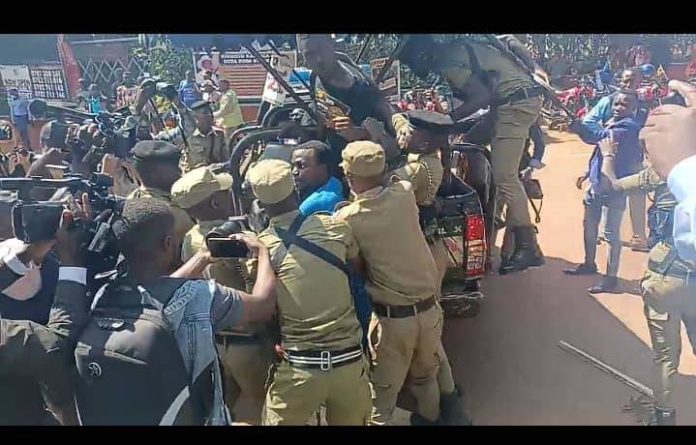
EACOP: Police nabs activists at EU offices

Several student activists have been arrested as they made their way to the European Union (EU) offices to deliver their petition about the East African Crude Oil Pipeline (EACOP).

Led by Nabuyanda John Solomon, a Forum for Democratic Change (FDC) Youth League Member, the group backs the EU parliament resolution calling for stopping the implementation of the EACOP project.

According to the petitioners, there are legal irregularities in the EACOP project. There are no members of parliament involved in the project and the Ugandan companies involved are listed in the UK.

“There is a gross violation of human rights in Uganda and that was also evidenced at the EU offices as we delivered our petition. Our colleagues have been arrested,” Nabuyanda said.

The activists claimed that there is public anxiety that several people have been displaced from their land without compensation to pave way for the EACOP project.

“There are potential risks as far as this project is concerned. The companies involved in the construction of EACOP have not insured Uganda that is going to be affected by the pipeline,” they said.

“We want the government of Uganda to reinstate the Civil Society Organizations that was recently closed by the government for allegedly investigating the EACOP project.”

Last month, the EU parliament passed a resolution calling on TotalEnergies to take one year before launching the 1445-kilometer East African Crude Oil Pipeline (EACOP) project to study the feasibility of an alternative route to better safeguard protected and sensitive ecosystems and the water resources of Uganda and Tanzania.

According to the resolution, EU parliament claimed that the project will generate up to 34 million tonnes of carbon emissions per year yet the International Energy Agency (IEA) warned in a 2021 report that limiting global warming to 1.5 °C to prevent climate change’s most destructive impacts would require new oil and gas development to stop immediately.

They also said nearly 118, 000 people are affected by the oil projects. Their homes were destroyed to facilitate the construction of access roads; their land was requisitioned without prior payment of fair and adequate compensation. The compensation paid is often far too low to allow farmers whose land has been expropriated to buy comparable land on which to continue farming.

“EU Parliament asks the authorities in Uganda and Tanzania to ensure human rights advocates, journalists, and civil society groups are free to carry out their work in at-risk communities and called for all arbitrarily arrested human rights defenders to be released immediately,” they said.

Stories Continues after ad

Widen civic space in South Sudan, CSOs tell Jonglei state authorities

Civic space call_photo

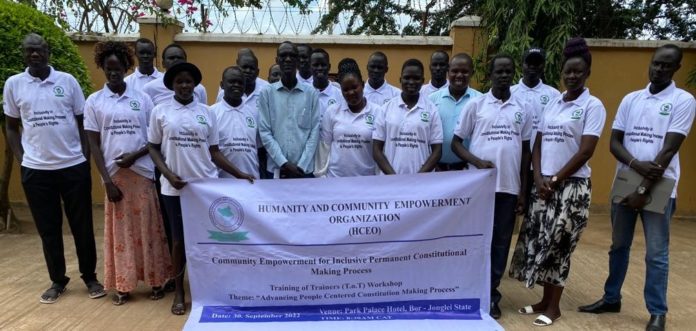
South Sudan’s Jonglei state authorities should widen the civic space to enable civil society actors sensitize citizens on their roles and obligations towards peace building, governance and a democratic society.

The follows a workshop on inclusive permanent constitutional making process for civil society entities and community based organizations held in Bor last week.   

“The permanent constitution making process is one of the most important provisions of the peace agreement and the Transitional Constitution of South Sudan 2011, as amended. Humanity and Community Empowerment Organization (HCEO) stands for full implementation of the agreement in letter and spirit,” Moses Gizam, the Executive Director of HCEO said at the workshop.

“Without an informed citizenry, there cannot be a democracy,” he stressed.

The state human rights advisor, Simon Manyok Deng lauded the organizers of the training workshop for advancing a people-centered constitution making process.

“Constitution making process is a huge task to all of us. The civil society is a common ground for both government and the community to operate,” said Deng.

He added, “Please do not mix your vision and mission with your party colours”.

Bol Deng Bol, the chairman of Jonglei State civil society network said the workshop provided an opportunity for citizens to openly express their opinions.

“This is our constitutional right. There is no way we can make an inclusive constitution without enabling citizens’ participation in the process,” explained Bol.

He urged lawmakers to expedite enactment of bills vital for constitutional making.

The one-day workshop on the theme, “advancing a people-centered constitution making process”, aimed at empowering CSOs and CBOs in Jonglei State with knowledge and skills essential for a permanent constitution for South Sudan.

A decade after South Sudan attained independence, restrictions to human rights and fundamental freedoms have led to shrinking civic space as the environment in which citizens organize and participate in governance has remained hostile.

This is despite provisions contained in the Transitional Constitution of South Sudan, regional and international treaties that guarantee respect for human rights.

Stories Continues after ad

Museveni to announce changes in the army – Muhoozi

First son Gen Muhoozi Kainerugaba, President Museveni

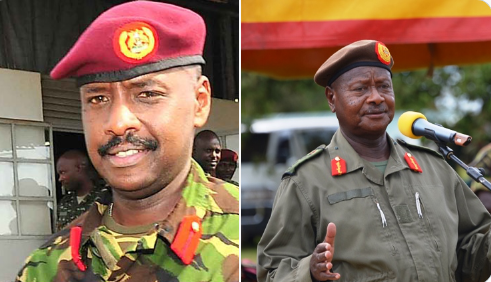
The Commander of the land forces of the Uganda People Defence Forces (UPDF) and First Son Lt. Gen. Muhoozi has said that President Museveni will make changes in the army.

This is after Muhoozi on Monday went on a Twitter meltdown, warning that he would only need two weeks with his army to capture Kenya’s capital, Nairobi.

“Had a good discussion with my great father this morning. Apparently, my tweets scared Kenyans too much? He will announce the changes. There is a special prayer I shall make for our army,” he tweeted.

He started by blaming Uhuru Kenyatta for not contesting for a third term in the August polls, adding the retired president could have easily won the election.

This has not gone well with several Kenyans including one Kenyan Senator who said Uganda’s High Commissioner to Kenya should be summoned over Muhoozi tweets.

Stories Continues after ad

Ruth Nankabirwa in South Africa for Africa Oil Week Summit

Nankabirwa in South Africa for Africa Oil Week Summit

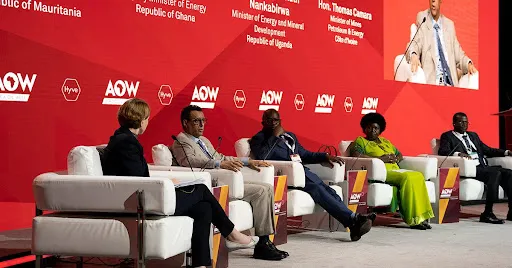
Uganda’s Minister for Energy and Mineral Development Hon. Ruth Nankabirwa is in Cape Town, South Africa, where she arrived yesterday to participate in the Africa Oil Week Symposium.

The Symposium, which is known as The Green Energy Africa Summit kicked off yesterday and will run up to October 7th. It opened with a closed event convened by honorable ministers to discuss Africa’s energy transition and domestic market, which mirrors a clean energy sector for Africa’s future.

Hon. Nankabirwa is among the delegates from oil rich countries, who received a warm welcome at the Ministerial and VIP Symposium in Cape Town.

The event is taking place at Cape Town International Convention Center (CTICC2). During yesterday’s session, an incredible line up of honorable ministers convened to discuss ways to open up markets for Africa’s energy resources, and Uganda’s Nankabirwa participated.

Hon. Nankabirawa said through her Twitter handle that she flew to South Africa to represent Uganda at the Summit, and that her main task will be exploring more avenues for Uganda’s energy transition, on top of creating more opportunities for the nation’s domestic energy market. 

“I am in Cape Town, South Africa CapeTown for the Ministerial and VIP AFRICA OIL WEEK SYMPOSIUM! I am ready to discuss the Government of Uganda’s and Africa’s Energy Transition and Africa’s Domestic oil and Gas market,” Hon. Nankabirwa tweeted.

Organized under the auspices of Hyve Group, South Africa, the summit is being attended by over 1, 800 senior delegates, over 30 ministers, 25 oil companies, with over 80 countries being represented, and over 150 government representation.

The Symposium will provide the leading figures in Africa’s oil and gas industry an opportune moment to gather, build relationships and make deals.

It is also a forum for businesses of all sizes in Africa and beyond to meet with government officials and prospective partners, to make contacts and broker deals that will define Africa’s energy transition over the years.

The summit has also attracted 100 keynote speakers from across Africa and beyond, with sessions covering all aspects of challenges facing countries and companies in addressing Africa’s energy transition.

South Africa’s Minister for Tourism Hon. Mmamoloko Kubayi-Ngubane hailed the Symposium saying it will explore several avenues for the social and economic development of Africa, as well as keeping the spirit of Pan Africanism alive.

“It is worthy to note the continued commitment of Africa Oil Week to the social and economic development of South Africa and the wider Pan African community. The event has put Africa at the heart of every decision, and we are proud to call Africa Oil Week partners of Africa in every sense of the term.”

“The opportunities of international visitors remain as strong as ever and we very much look forward to welcoming all delegates once again for a safe and inspired visit to our beautiful country,” Kubayi-Ngubane said.

The summit will also provide a fertile ground to discuss modalities on how African National Oil companies can evolve and adapt to a low carbon future, major focus being the key technologies companies should adapt to that end.

“Creating a low carbon future must be prefaced with assessing where carbon is produced and simply looking at reducing the amount produced,” Andrew Laven, the Chief Operating Officer, Sahara Energy Resources, Dubai said. He will be one of the Keynote speakers.

Worth noting, the summit is also tailored towards the need to stimulate the intensification of research into energy resources, which are in perfect harmony with the related recommendations in terms of sustainable development.

Stories Continues after ad

Pesapal upgrades core system to accelerate payment security

Pesapal has upgraded its Application Programming Interface (API) to Pesapal 3.0, allowing for the delivery of enhanced security features as well as an improved user experience for merchants and consumers across all markets.

As part of the API upgrade to Pesapal 3.0, Pesapal has adopted the 3-D Secure processing for card payments and introduced Sim Tool Kit (STK) for mobile money payments. These new components of Pesapal 3.0 have improved the UI/UX for not only end-users but also developers. Additionally, these changes specify the use of multiple options for step-up authentication eliminating instances of fraud and chargebacks.

Commenting on the upgrade, Pesapal Executive Director Agosta Liko said as e-commerce booms in East Africa, Pesapal continues to invest in innovative technologies to maintain a high level of confidence among consumers and merchants.

“With the explosive growth in e-commerce, it has become more critical than ever for businesses of all sizes to have robust protection and a clear view of their API suite. We are excited about the promise offered by Pesapal 3.0, and the new features enable us to bring value-added services to the market,” Mr. Liko said.

“By meeting the global standard for electronic payments, we are able to materially deal with the risk, leading to an increase in consumer confidence in using credit and debit cards or even mobile money on eCommerce platforms.”

3-D Secure (3DS) is a payment protocol designed to provide an additional layer of protection to help prevent fraud by enabling consumers to authenticate themselves with their payment card issuers when making purchases on digital channels. It also provides merchants and issuers with a seamless way to authenticate cardholders for eCommerce transactions before authorizing them.

Pesapal is committed to providing an integrated and advanced payment experience, ensuring it offers solutions that meet its customers’ day-to-day needs.  Since 2009, Pesapal continues to offer a secure payment environment while complying with the highest safety standards.

Stories Continues after ad

Kabuleta launches new political party

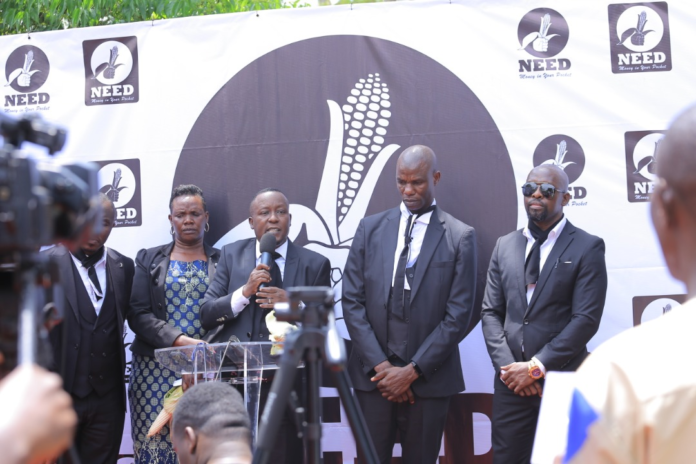
Former presidential candidate Joseph Kiiza Kabuleta, has launched National Economic Empowerment Dialogue (NEED) as a political party in Uganda.

Last year, Kabuleta launched NEED as a political organization that would carry an ideology in a bid to take over the leadership of this country. NEED is transitioning from the People’s United Movement (PUM), a political party that was established in October 2005. The party symbol, a cow has since been changed to maize. The party colors have remained black and white.

During the delegate’s conference which was held yesterday at NEED offices in Bugolobi, Kabuleta was elected the party president. He will be deputized by Evelyn Rakel. Kabuleta named Asuman Odaka as the party Secretary General, and Mulangira Juuko Nakibinge as the Secretary of publicity.

According to Kabuleta, in 2020, he was approached by Shadrach Ogemba, the president of PUM who persuaded him to join the party because they had the same ideology, which he did.

Speaking at NEED offices in Bugolobi, Kabuleta said they chose economic empowerment as their creed because it is the truest form of empowerment and we know that our oppressors have built a population that is dependent on them for sustenance and is therefore easy to subjugate.

“One year later we are taking one bold step forward launching NEED as a political party,” Kabuleta said.

 “I know that the love we have for this country is shared by millions of Ugandans. We meet them every day and they express their dismay at the direction the country is taking. But the one thing we do not share with many is the despondency, the sense of resignation that I see in many quarters,” he said.

Kabuleta said them plunders know that their time is up. In public, they speak like they are tightening their grip on power but in private they hope that they can be allowed to retain their loot after Ugandans have reclaimed their country.

“I know there are many people in diverse sectors who choose to hold onto the system and even oil it not because they don’t see its evil but because of an unknown future. They don’t know what it holds for them.”

He said the change that NEED proposes will be to the benefit of everyone. It is not the kind of change that causes disruption, disorder, or that seeks to settle old scores. That is not who we are. We are not vindictive people. In our relentless pursuit of a bright future for all Ugandans, we shall have little time to indulge in the past.

“Some people from the forces; army police and intelligence have intimated to me that they signed up to protect their nation but found themselves serving the interests of one family. We shall give them an opportunity to do exactly what they signed up for with an appreciation, better remuneration and improved working conditions.”

As the Party, Kabuleta said their priority will be the millions of destitute people dispersed across the country. We believe that is possible to empower people and put money in their pockets without giving them handouts.

Stories Continues after ad

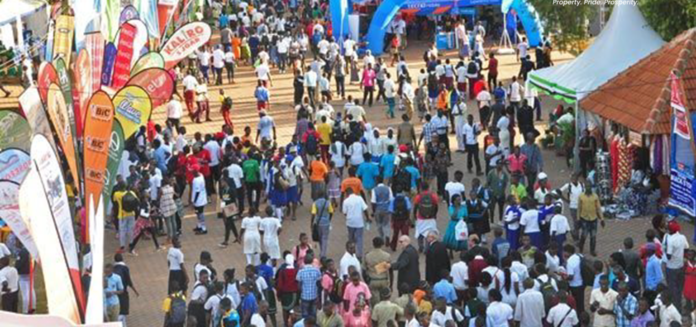
Thousands of Exhibitors arrive at UMA Lugogo for International Manufacturers Expo

Thousands of local and international manufacturers, traders and distributors from various sectors have converged for the annual Uganda Manufacturers Association Trade Expo which started on Monday at Lugogo at UMA exhibition grounds in Kampala.

The theme of the trade fair according to organizers is “Business recovery by harnessing local sourcing and deepening value chain integration”

This will be the 28th Uganda International Trade Fair (UGFT) and it will take place for the first time after 2 years, following disruptions of COVID-19 pandemic.

The organizers say, this year, the Trade Fair is expected to attract an average of 300,000 visitors, including high profile individuals such as Heads of State, Politicians, Executives and celebrities.

The Uganda Police have said that although there are no specific threats directed towards the event, it can however, be a magnet for serious security concerns and reassured the organizers and the public that security and safety at the Trade Fair is guaranteed.

The Expo will end on 10th October 2022 and President Yoweri Kaguta Museveni is expected to be the Guest of Honor at the closing ceremony.

It is one of the biggest calendar events in which manufacturers showcase their goods and services to more than 300,000 people from within and beyond Uganda who visit the UMA show ground in Lugogo, Kampala. 

A number of companies have leveraged on the trade fair over the years to enhance their product category graduating from startups to large companies. 

Mr Daniel Birungi, the UMA executive director, said the theme seeks to cast a spotlight on industrialists, who, even as they have been impacted by Covid-19, have exhibited resilience and progressive recovery.  

“This theme doubles as a call to the government and the general public to support local companies as a catalyst for full economic recovery,” he said. 

UMA also noted that such trade fairs are one of the ways through which Uganda can expand its industrial capacity to create employment and expand government revenues. 

Stories Continues after ad

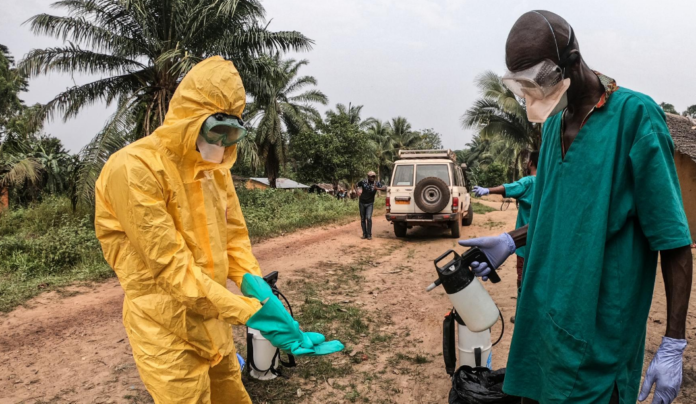
Uganda defines priorities and needs in Ebola Response Plan

Health partners visiting Ebola-affected areas

The Ministry of Health and health development partners in Uganda, including the World Health Organization (WHO), have launched the country’s Ebola response plan at the Sheraton Hotel in Kampala, highlighting planned activities, priority needs and gaps.

Bringing together the country’s health diplomatic corps, the high-level meeting discussed the current status of the outbreak, the country’s preparedness to respond and contain the outbreak, and outlined the priorities and needs of the Ebola response as outlined in the national response plan.

“The national response plan we have presented today will serve as a blueprint for all partners, donors, and stakeholders to engage and contribute to the detection, response, and immediate containment of the Ebola outbreak in Uganda,” said Dr. Jane Ruth Aceng Acero, Uganda’s Minister of Health.

Dr. Aceng explained that the plan was developed in line with the guidance provided in the Emergency Preparedness and Response Standard, to develop core capacity to prevent, detect and respond to public health emergencies, building on country experience and current best practices.

“The increase in the number of Ebola cases in the country is of concern. Increased resources and sustained and coordinated actions among all stakeholders are essential to fight this pandemic. I call on all health development partners to mobilize additional resources to help Uganda fight this epidemic.” Dr Yonas Tegegn Woldemariam, WHO Representative to Uganda.

Since the Ebola outbreak was declared by Ugandan health authorities on 20 September 2022, the country has so far recorded 31 cumulative confirmed cases and 6 deaths, with a case fatality rate of 19.4% as of 28 September 2022.

In response to the outbreak, the country has taken immediate measures at both national and sub-national levels to strengthen all pillars of the response. The country activated the incident management system and the National Multi-Stakeholder Task Force (NTF) chaired by the Ministry of Health and co-chaired by WHO to effectively coordinate the response.

The NTF enabled the immediate mobilization and deployment of technical, financial, and operational resources to the affected districts, including Mubende, Kassanda, and Kyegegwa.

With support from its health partners, including the United Nations System, Uganda activated District Task Forces (DTFs) in ten high-risk districts, trained and deployed Rapid Response Teams (RRTs) and Village Health Teams (VHTs), and provided the Mubende Regional Referral Hospital with infection prevention and control equipment, including three Ebola kits capable of handling more than 300 Ebola patients.

“The efforts made so far are important but need to be intensified if we are to end this pandemic today. I count on each of you to mobilise more resources in your respective capacities to end the Ebola pandemic in our country,” Dr Jane Aceng added.

There have been seven previous outbreaks of the Sudan ebolavirus, with four occurring in Uganda and three in Sudan. Uganda last reported an outbreak of Sudan ebolavirus in 2012. In 2019, the country experienced an outbreak of Zaire ebolavirus. The virus was imported from the neighboring Democratic Republic of the Congo which was battling a large epidemic in its northeastern region.

There are at least six candidate vaccines against Sudan ebolavirus which are in different stages of development. Three of them have Phase1 data (safety and immunogenicity data in humans) and the remaining are in the preclinical evaluation phase.

Stories Continues after ad

Sylivia Mulinge, MTN Uganda’s first female CEO assumes office

Mulinge Sylivia, MTN Uganda CEO

MTN Uganda’s new and first female Chief Executive Officer (CEO) Sylivia Mulinge, who was appointed in June 2022, has officially started work today. She joins MTN Uganda from Safaricom PLC, a leading provider of converged communication solutions in Kenya, where she served as Chief Consumer Business Officer for the Group. 

Mulinge takes over office from Andrew Bugembe MTN Uganda CEO who has been in an acting capacity since August when Vim Vanhellepute left to take up a new assignment in West Africa as the MTN Group’s Chief Operations Executive, a newly created role to oversee Liberia, Guinea-Conakry, Guinea-Bisau and Congo-Brazzaville.

She inherits an MTN that is Uganda’s largest telecom and largest company by revenue. She however, has to deal with a relentless Airtel Uganda which although second in market share has been profitable for over five years in a row.

Shareholders who have had a taste of some good dividends after MTN’s first year of listing will be very anxious to see if Mulinge can keep their pockets happy.

MTN Uganda staff have welcomed the new CEO Mulinge Silvia at the new company headquarters along Jinja road. Where staff showcased the diverse Ugandan cultures as they welcomed her to the Pearl of Africa.

“It is a great pleasure to be at MTN Uganda. Thanks to MTN Staff for showcasing the beautiful pieces of Ugandan culture this morning. I am looking forward to being in Uganda. Asante Sana,” Mulinge appreciated.

She joins MTN Uganda to support the accelerated execution of its Ambition 2025 strategy which is through selective partnerships and leveraging the MTN brand as the most trusted and valued in Africa and will be supported and funded through enhanced cost and capital expenditure efficiencies.

At her appointment in June, Ralph Mupita the MTN Group president and CEO described Mulinge as a seasoned executive who brings with her a passion for transforming customers’ lives using technology.

Stories Continues after ad