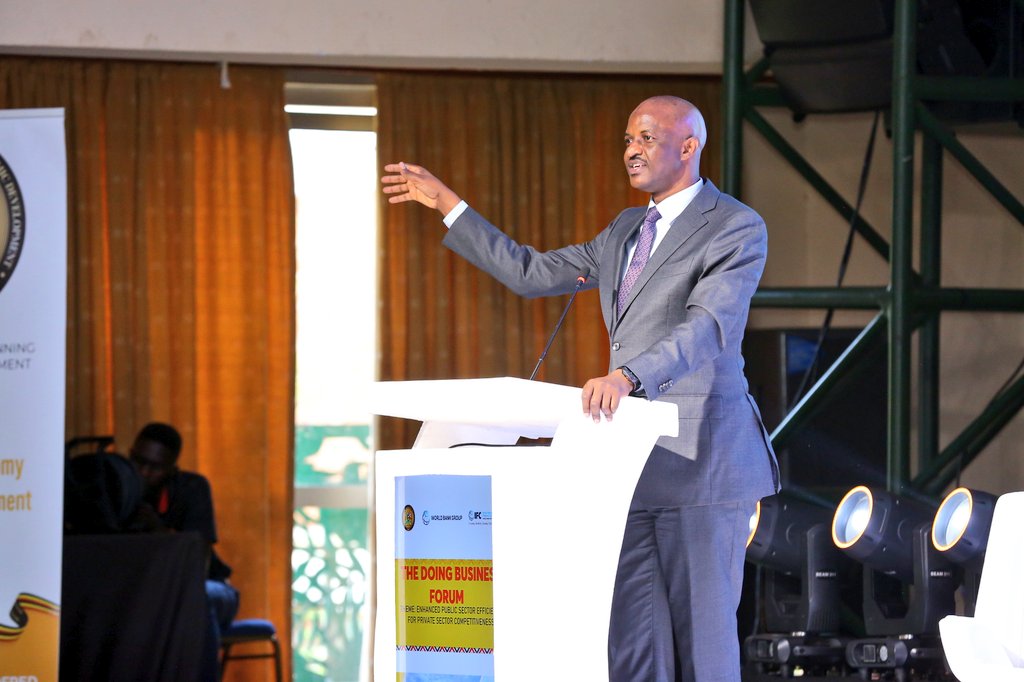
The Permanent Secretary and Secretary to the Treasury (PSST), Ramathan Ggoobi, has said Uganda stands at a decisive turning point in its economic transformation journey with ambitions to expand its GDP tenfold to $500 billion by 2040.
Speaking at the 2nd Annual Doing Business Forum held at Golf Course Hotel in Kampala on Thursday, November 6, 2025, Ggoobi said the country’s growth path is guided by the National Development Plan (NDP) IV and the Tenfold Growth Strategy, both aimed at positioning Uganda as a competitive, export-driven middle-income economy.

“Our shared goal is simple and urgent: make the public sector work better so the private sector can create more jobs, add more value, and attract more investment,” said Ggoobi.
He said under the Public Sector Transformation Programme of the NDP IV, the government seeks to build an efficient and responsive service system that fosters accountability, inclusivity, and innovation. The targets include raising transparency and accountability in service delivery from 70% to 90%, improving staffing levels from 55% to 85%, and increasing local government fiscal sustainability from 34% to 50%.
Ggoobi further noted that government aims to ensure that at least 80% of Ugandans up from the current 50% have access to efficient public services by 2030.

To enhance business competitiveness, Ggoobi revealed that the Uganda National Bureau of Standards (UNBS) has opened new regional offices in Gulu, Mbarara, and Mbale to ease access to standards and certifications.
“Its budget has increased from Shs58.1 billion in FY 2024/25 to Shs133.8 billion this financial year to allow an increase in staff numbers and standards aligned to regional needs,” he said, adding that the government is reviewing the funding model to ensure faster service delivery to businesses.
He also pointed to major reforms in public procurement, noting that the e-Government Procurement System (e-GP), now operational in 62 ministries and 134 local governments, is reducing delays and improving transparency. Additionally, efforts are underway by the National Information Technology Authority (NITA-U) to expand broadband access, making the internet more reliable and affordable for businesses.
Opening the forum, the Head of Public Service and Secretary to Cabinet, Ms. Lucy Nakyobe, underscored the need for a disciplined and efficient public sector to drive Uganda’s competitiveness and investment climate.
“To achieve the much-needed efficiency, discipline, integrity, frugality, time management and empathy must be embraced,” said Nakyobe.
She directed all Ministries, Departments and Agencies (MDAs) to ensure their service delivery standards, client charters and strategic plans are aligned with the NDP IV by December 30, 2025, warning that non-compliance will affect the performance of respective Permanent Secretaries.
Despite ongoing reforms, Nakyobe acknowledged persistent bottlenecks facing the private sector.
“Licensing procedures remain lengthy, infrastructure approvals are fragmented, and access to serviced industrial parks or reliable utilities is often unpredictable,” she said.
She added that exporters continue to struggle with high compliance costs, excessive documentation, and delays at border points, challenges she said undermine Uganda’s competitiveness and discourage both local and foreign investors.
“Efficiency is non-negotiable. Public services must be delivered quickly, transparently, and at minimal cost,” Nakyobe emphasized.
She added, “Whether registering a business, obtaining a construction permit, acquiring land, or connecting to electricity, efficiency must be the standard across all institutions.”
The Doing Business Forum, now in its second year, brings together key government officials, private sector leaders, and development partners to deliberate on practical solutions for improving the business environment in Uganda.