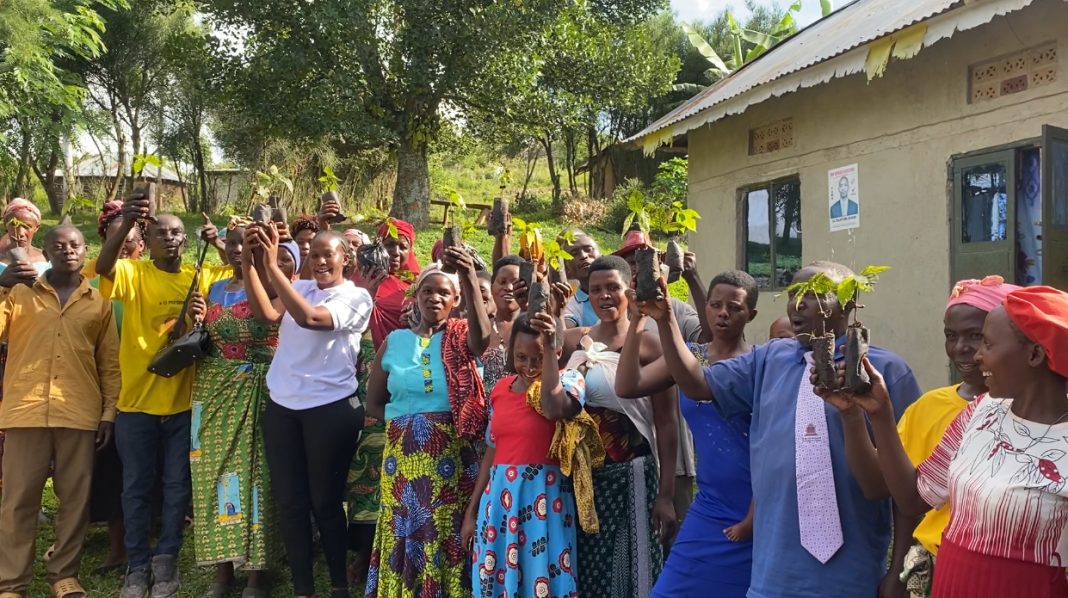
EcoSkills Initiative intensified its efforts in Kyegegwa District by distributing cocoa seedlings and training farmers in sustainable agricultural practices to improve livelihoods and promote climate resilience.
During a community outreach held in Kiguya Village, Kyegegwa District, the organisation distributed cocoa seedlings to over 60 farmers, targeting improved household incomes through the adoption of high-value cash crops.

The outreach also focused on equipping farmers with practical knowledge, including financial literacy, family planning, environmental conservation, and small-scale farming techniques.
Speaking during the engagement, the Founder of EcoSkills Initiative, Maxiline Kansabe urged farmers to shift their focus from subsistence farming to more profitable ventures.
“Farmers should begin to think about the value of what they plant. It is not just about farming, but about the output and income it can generate,” she said.

Kansabe noted that the initiative was informed by reports indicating that Kyegegwa is among the poorest districts in the Tooro region, despite having a largely agricultural population.
She emphasized that crops like cocoa, which currently fetch between Shs30,000 and Shs35,000 per kilogram at maturity present a viable pathway to improved livelihoods when properly managed.
The training session on small-scale farming was led by Sserunkuma Venansio, an expert in crop seedlings, who encouraged farmers to make productive use of limited land and available resources.
“You don’t need a large piece of land to farm successfully. With proper planning and use of available materials, even small-scale farming can be profitable,” he explained.
Farmers were also encouraged to adopt environmentally friendly practices, including recycling materials like bottles for planting instead of allowing them to pollute the environment.
The training further addressed environmental challenges affecting the district, particularly deforestation and poor waste disposal. Participants were guided on alternative eco-friendly practices, such as using maize residues for cooking instead of cutting down trees.
Philip Alihika, a project coordinator, emphasized the importance of planning in farming and household management.
“Everything begins with proper planning. Decision-making within families should also be inclusive to improve overall welfare,” he advised.
Local leaders welcomed the initiative, with Rukanga Asiimwe, Chairperson of Kiguya Village, expressing gratitude.
“We thank EcoSkills Initiative for supporting our farmers. We request more trainings like this to help uplift our community,” he said.
In addition, the initiative extended support to vulnerable households by donating clothes to community members, particularly single mothers and families in need.
In her speech, Kansabe also expressed gratitude to all individuals and well-wishers who contributed clothes and other forms of support, noting that their generosity played a key role in restoring dignity and hope within the community. She further advised farmers to put into practice what they were taught during the training for the good of the community and environment.
“Real change begins when knowledge is put into action. What we practice today will shape the future of our families, our community, and our environment,” she said.