Stanbic Bank
Stanbic Bank
18.9 C
Kampala
Stanbic Bank
Stanbic Bank
Home Blog Page 1082

Museveni still wants killers hanged, pledges to fight for bibanja holders in Buganda

President Yoweri Museveni

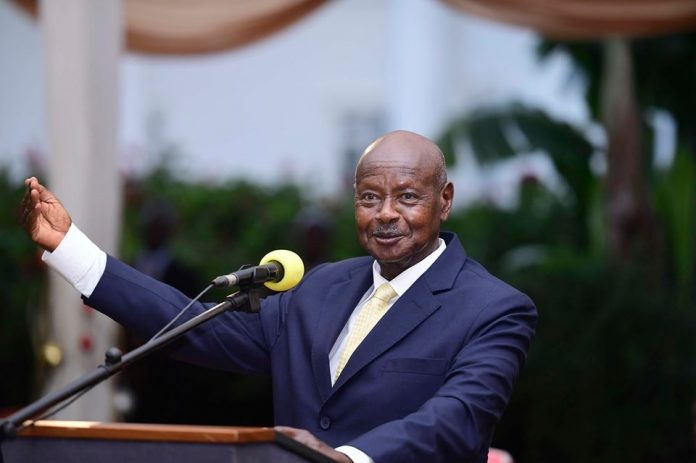
President Yoweri Museveni has once again said murderers in Uganda should face the old age law of an eye for an eye, which simply means those who kill others must also face the same instead of being granted life imprisonment or many years in jail.

Museveni posted today on his Facebook page after yesterday presiding over the swearing in of newly appointed Judges of the Court of Appeal and the High Court at State House Entebbe.

“On the offenses of murder, rape, and defilement, we have very strong views in line with the old age rule of an eye for an eye in the case of murder, and the strongest and unrelenting punishment for the latter two. A dog that steals, must pay with it’s back. This is not to mean that we are vindictive, but the wrongdoer must apologize and rectify it. What we cannot accept is impunity,” he wrote.

Museveni also pledged to fight for bibanja holders especially in Buganda, saying he will not stand aloof as people are chased away from their land.

“On land; especially the bibanja holders here in Buganda because much of the suffering is concentrated here, where you have people who claim they love Baganda and they cause them so much trouble, supporting a system where the villagers have no rights and can be chased around. It is going to be difficult for people who think that I will stand aloof while bibanja holders get expelled from their land. It is my duty, to shout as loudly as possible, to all and sundry, that this is not acceptable. The security of persons and property is very crucial to our struggle.”

Museveni in his message urges courts to expedite commercial justices, saying that businesses cannot grow when justice is slowed. “To safeguard the competitiveness of Uganda, commercial justice must be expended expeditiously. Business cannot grow with slow justice, it is not fair,” he wrote.

Museveni said Ugandans are gaining an appreciation for engaging in production and as such, the economy is growing. “As a result of conscious economic decisions and security, we are also witnessing a boom in manufacturing, putting us well on our way to getting into good money economics. I am now enjoying myself because of the nature of “problems” we are running into now. In some parts where the people are listening to our message of wealth creation, the problem is now excess milk, bananas, sugar, maize, etc., but remember that for long, we have told our people to shun all manner of sectarianism; tribal, religious, all of it.”

The president also talked of the importance of regional integration, especially the integration of Africa.

“Prosperity comes with thinking about Uganda, not just tribes, thinking about East Africa above Uganda, thinking about Africa and the world. So, the next most important effort is going to be the integration of Africa, to realise prosperity in the modern sense. The judiciary must play its part in this process, bearing in mind that we are also dealing with a changing society from a pre-capitalist system, to a modern money economy.”

On remuneration, Museveni said the interests of the Judiciary and the executive are aligned. The recent salary enhancement can be considered as a teaser, as we continue to improve our economy.

Museveni said he was happy the judiciary is recruiting young people into active roles. “On behalf of elected leaders and the freedom fighters, I am pleased to witness a shift in the Judiciary and other government institutions, beefing up the expansion of our base of cadre-ship, with the young people taking an active role. I remember when I used to swear-in Judges who were all much older than myself, progressively, that has changed over the years,” he said.

Museveni warned that village thieves, along the way, distort development efforts, and that they should not be looked at as a small matter, as it affects the momentum towards the transformation of society.

Stories Continues after ad
Billions lost in payment of retirees as IGG fears investigating mess in the BoU

IGG-Irene-Mulyagonja

A sources in Bank of Uganda has revealed that the country could have lost close to Shs150 billion in the retirement scam that is rocking the central bank. Accordingly this scam started over ten years and it involved bigwigs who had either falsified age who either wanted promotion or recommendation to international jobs.

“It is a known practice here that age falsification has been real and they do it openly given that one suites the interests of the supervisor. However, we are also meant to understand that upon falsifying age and one gets a promotion, there is percentage shared between HR officials and the supervisor.” said a source.

However, what is intriguing is the silence by the country’s top investigative organs like the Inspectorate of Government, Criminal Investigation Department, Economic Monitoring Unit in Internal Security Organisation (ISO) with none of those organisation ever picking interest in this matter or else be other matters that have recently happened at BoU.

Instead to the contrary, reports indicate some of these agencies are in bed with BoU knowing that they control the economy and hence money. who remembers the scandal involving printing of money? How about the scandal involving smuggling of old currency notes at currency centres across the country? And the shs600 billion which was kept in un-gazetted centre in Masaka? the list is endless.

So why would the country’s ombudsman in the name of IGG who has been running around small teachers and other local government employees for same reason of falsifying age fail to run after ‘big’ fish? Isn’t it strange and that is why that office has been reduced to only participating in corruption talks and walks that are either organised by powerful city pastors or State House Anti Corruption desk.

The first time the Inspector General of Government tried to investigate the Bank of Uganda (BoU) was when the former executive director of commercial banking Ms Justine Bagyenda was sacked on February 7, 2018 by her boss Emmanuel Tumusiime-Mutebile for unknown reasons, though the governor said staff changes at the time were carried out in order to advance the mission of BoU, and to enhance operational efficiency and effectiveness.

The intervention of the IGG into BoU over Bagyenda’s sacking would lead to a public spat between Tumusiime-Mutebile and IGG Justice Irene Mulyagonja with each official claiming to be doing their work as provided for by the laws establishing them. President Yoweri Museveni would come in to settle the misunderstanding between the two senior public officials.

That aside, BoU continues to be engulfed with scandals including violating its own Administration Manual that among others, guides on recruitment of staff.

Days ago BoU board was once again on the wrong side of the law by declining to sack 12 staff who were found guilty of falsifying their age at the time of entry. Instead the board allowed the officials to retire voluntarily, meaning Ugandan taxpayers will lose money in terms of retirement benefits to the affected officials. The irregularity was identified after BoU management asked all staff to submit copies of their national identification cards, where it was found out that 12 staff had their dates of birth not matching with those on their national IDs. For that crime they were supposed to face outright dismissal as put in the BoU Administration Manual (April 2018).

The staff that should have been dismissed by BoU Board outright include; Modesto Auka-Director of the National Payment System Department, Stephen Ssemugga-Director Administrative Services and Solomon Oketcho-Executive Director of Administrative Services. Others are; Patrick Opio-Assistant Director Security and Peter Rumanzi I van-Assistant Director of the Petroleum Fund.

More others include; Sophie Odongo Ekuka (Currency Department), Julius Enyasu (Security), Adonia Mpora (Administrative Services), Fred Olonga (Non-banking institutions Department), Patrick Simon Katamba (Commercial banking), Stella Kaitesi Lubega (Statistics) and Peter Musai Wamurumba (Banking).

The board decided that the affected individuals retire voluntarily but the decision was against BoU’s own Administration Manual April, 2018. It should be mentioned that the board is headed by Tumusiime-Mutebile and his deputy Dr Louise Kasekende as Chairman and Vice Chairman respectively.

Despite the above two officials holding positions on BoU board, parliament’s Committee on Commissions, Statutory Authorities and State Enterprises (COSASE) recommended that the guidelines changed so that they don’t hold both management and supervisory roles, as the current situation makes them to report to themselves, hence the inefficiencies at the central bank, like the failure to sack 12 staff that falsified their age.

ON THE FIRING LINE: Governor Mutebile and his deputy Kasekende.

Confidential report blames Tumusiime-Mutebile for illegal staff changes

A confidential report of the presidential tripartite committee, authored in February this year, blames Tumusiime-Mutebile for personally recruiting five senior staff without subjecting them to any interviews as required by the Bank of Uganda Act, which he is supposed to adhere to. Worse still, most of the staff head picked by the governor did not meet the qualifications and experience required for the jobs at BoU.

For instance, Dr. Twinemanzi Tumubweine (Executive Director Bank Supervision) does not have any experience in commercial banking, according to the committee’s findings. BoU’ other board members faulted Tumusiime-Mutebile on most of staff changes at BoU, saying he never consulted them and that it was illegal. One would expect that the IGG investigate such matters and make recommendations that strengthen BoU as an important institution in the country.

With this reports of bad governance at the country’s central bank, one would be left to think that it is worse with commercial banks that are supervised by BoU.

Stories Continues after ad
Youth MP wants external labour payments probed

MP Mwine Mpaka

The Youth Representative for Western Region, MP Mwine Mpaka, has asked Parliament to investigate payments by firms involved in external recruitment of labour to an account of the Uganda Association of external recruitment agencies.

Mpaka prayed that government immediately suspends any further payments to the recruitment agencies monitoring fund until investigations are done by the House. The member also prayed that the Labour Liaison/Consular Assistant at the Ugandan Embassy in Saudi Arabia, Yassin Abdulaziz Musoke, into whose personal account the money is transferred be suspended.

Mpaka, who moved a motion during the House sitting on Tuesday 10 December 2019, said that the Ministry of Gender has not carried out its oversight role over the fund leading to funds being deposited in a personal account.

“The external recruitment companies on behalf of the domestic workers remit US$70 per Ugandan to the account of the Uganda Association of External Recruitment Agencies (UAERA), held in Stanbic Bank. The money is then transferred by cheque to Yassin Abdulaziz’s personal account held in Stanbic Bank Metro Branch,” he said.

Mpaka added the while the funds are used as an emergency for the external workers, it has been misused by a public servant to items of personal effect.

The Minister of Gender, Labour and Social Development, Janat Mukwaya in response, said that UAERA is a private and none public entity and registered as a company.

“The recruitment agencies were created to complement government efforts to monitor migrant workers abroad, and they decided to establish a fund that would monitor the migrants,” she said.

MP Lucy Akello (Amuru District) said that the staff at the foreign missions look for money to cater for Ugandans outside the country yet the same people have already paid money for this purpose.

“This fund is supposed to cover uncertainties that come up with the external labour recruits. They pay the money here and when they get there they suffer without any coin. These monies should be investigated,” she said.

The Deputy Speaker of Parliament, Jacob Oulanyah in his ruling referred the motion to the committee of Gender, Labour and Social Development.

“We need an urgent intervention on this matter. We shall refer this motion to the Committee who should consider it and return with seven days,” he said.

Stories Continues after ad
Appointments Committee meets three Supreme Court nominees

Justice Chibita, one of the nominees to the Supreme Court, appearing before Parliament’s Committee on Appointments. (Right) is Speaker Kadaga and members who sit on the Committee

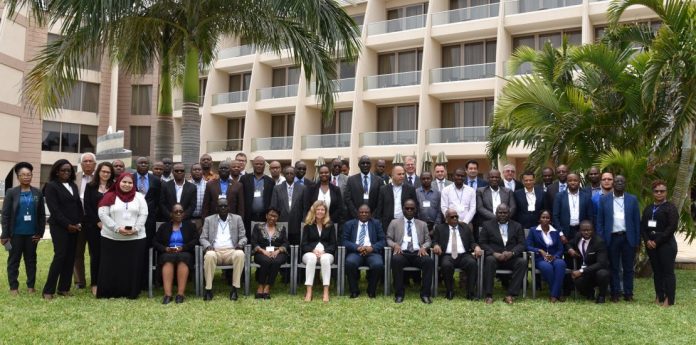
The Appointments Committee on December 9, 2019 met and interacted with three justices nominated to serve on the Supreme Court, the topmost and last court of appeal in Uganda.

Presided over by the Speaker of Parliament, Rebecca Kadaga, the Committee interacted with Justices: Mike Jim Chibita, Ezekiel Kurabiraho Muhanguzi and Percy Night Tuhaise on 9 December 2019.

The Supreme Court is headed by the Chief Justice, who is supported by 10 Justices.

Before being nominated to serve on the Supreme Court, Justice Chibita has been serving as the Director Public Prosecution (DPP). He holds a Masters Degree in International and Company Law from University of IOWA, USA and served as a Judge of the High Court in Masaka before becoming the DPP.

Ezekiel Kurabiraho Muhanguzi currently serves as a Justice of Court of Appeal/Constitutional Court. He holds a Post Graduate Bar Course and Bachelors Degree of Laws from Makerere University.

Prior to her nomination to the Supreme Court, Justice Percy Night Tuhaise has been Justice of the Court of Appeal/Constitutional Court. She holds a Master of Laws degree from Makerere University.

The Committee on Appointments also interacted with Justice Flavian Zeija, who was appointed Principal Judge. If approved, Justice Zeija, will replace Yorokamu Bamwine who retires next year.

Before his nomination as Principal Judge, Justice Zeija served as the Senior Resident judge of Mbarara High Court circuit, the biggest circuit in Uganda, a position he has held since 2016.

He is renowned for his tremendous work in reducing backlog in the Mbarara High Court circuit which had cases dating back as far back as 1990. Zeija holds a Doctorate in Law from University of Dar es salaam, School of Law.

The Appointments Committee also interacted with Emmanuel Katongole, the founder Chief Executive Officer and Shareholder Quality Chemicals Industries Ltd. Katongole was nominated Chairperson Board of Directors of the Uganda National Oil Company (UNOC).

Katongole will lead a Board of six comprising Francis Nagimesi, Stella Marie Biwaga, Irene Pauline Batebe, Godfrey Andama, Francis Twinamatsiko and Zulaiks Mirembe Kasaija.

The National Oil Company is a government owned Petroleum company established under the 2013 Petroleum (Exploration, Development and Production) Act. UNOC’s board of directors was inaugurated on 23 October 2015 by President Yoweri Museveni.

The Appointments Committee also interacted with Doreen Babasindi Wandera, appointed as Board member of the Petroleum Authority of Uganda.

The Report of the Committee on Appointments is submitted to the President.

Stories Continues after ad
Turkish Airlines flies 5.7 million passengers in November 2019

Turkish Airlines

Turkish Airlines, which has recently announced the passenger and cargo traffic results for November 2019, recorded 82.3 percent load factor in that month.

According to the airline’s November 2019 traffic results, total number of passengers carried increased by 3.7 percent to 5.7 million. Domestic load factor increased from 84 percent to over 85 percent and international load factor increased from 81 percent to around 82 percent, compared to the same month of the last year.

International-to-international transfer passengers (transit passengers) increased by 6.3 percent and international passengers excluding international to international transit passengers increased by 11.5 percent compared to the same period of last year. The total number of international passengers increased by 8.5 percent in November compared to same month of last year.

In November we realized increases in the number of passengers in Far East, Europe, Africa and North America by 11. 5 percent, 8.9 percent, 8.2 percent and 6.8 percent, respectively, it says.

In November, cargo/mail volume increased by 9.5 percent compared to the same period of 2018. Main contributors to this growth in Cargo / mail volume are Far East with 14.8 percent, Europe with 10.1 percent and North America with 4.7 percent increase.

The total number of passengers carried was around 68.8 million. Total load factor reached 81.7 percent. International load factor reached 81.0 percent, domestic load factor reached 86.3 percent.

International-to-international transfer passengers carried increased by 4.6 percent and International passengers excluding international to international transit passengers increased by 2.2 percent reaching 18 million passengers. Cargo/mail carried during this period increased by 9.5 percent and reach to 1.4 million tons.

Stories Continues after ad

We continue to support efforts to sustain fight against HIV – UNDP

Elsie Attafuah

The Resident Representative of United Nations Development Programme (UNDP), Elsie Attafuah, has pledged to continue supporting all efforts to sustain the fight against HIV, Malaria and TB in Uganda.

Ms. Elsie pledged during the high-level national dialogue on HIV health and the law organised by Uganda Network on Law, Ethics and HIV/AIDS (UGANET) alongside others partners at partners Pearl of Africa Hotel in Kampala

Uganda has registered major milestones in the HIV/AIDS response in the period of eight years and New HIV infections have significantly reduced by 51 per cent to an estimated 50,000, and deaths too have reduced by 45 per cent to approximately 25,000. An estimated 1.38 million adults and children are living with HIV in Uganda and 1,000 new infections are averred to have been registered every week in Uganda.

Despite the progress made in combatting HIV the country still has significant service delivery gaps in HIV and Health. Sustainable financing and partnerships also remain a major challenge. There is still stigmatization and discrimination, which are major human rights barriers in the AIDS response.

Held under the theme ‘Leaving No One Behind: Working in Unison to Address Human Rights Barriers to Ending the HIV/TB and Malaria Epidemics’, Ms Elsie it rhymes with this year’s theme for the International Human Rights Day; ‘Youth Standing Up for Human Rights.’

“We aim to celebrate the potential of youth as constructive agents of change, amplify their voices, and engage a broad range of global audiences in the promotion and protection of rights.”

Uganda is a young country with the youth making up 75 per cent of the population. The youth must be better engaged to accelerate progress in combatting HIV, promoting healthy lifestyles and influencing the development and implementation of important legislation on HIV and Health.

She said youth participation is essential to achieve sustainable development for all. Young people’s voices need to be listened to, to inform more effective decision-making and achieve sustainable development for all.

For over three decades now, Uganda’s HIV response has been built on human rights-based approaches to prevention, treatment, care and support. The country has established enabling legislation to safeguard rights which helps reduce people’s vulnerability to HIV.

She commended the Government of Uganda for organizing this dialogue as part of the commemoration of the International Human Rights Day.

“Uganda’s HIV response has been built on human rights-based approaches to prevention, treatment, care and support. The country has established enabling legislation to safeguard rights which helps reduce people’s vulnerability to HIV.” She said

“I call upon all leaders of Uganda; from the central and local governments, the traditional and religious leaders, Members of Parliaments, and medical staff to uphold and sustain achievements made in the HIV and Malaria response so far. We should therefore invest more in building partnerships for sustainable health financing, with an emphasis on promoting a Human-Rights-Based-Approach for HIV and Health. An HIV free generation begins with you.”

Stories Continues after ad

Museveni proposes cash compensation for landslides and flood victims

President Yoweri Museveni

President Yoweri Museveni has said government may consider giving cash as compensation for people living in disaster prone areas so that they quickly relocate “instead of the protracted process of resettlement which involves the allocation of planned farms, permanent houses.”

Museveni proposed the new approach of resettlement of people affected by landslides and floods in his condolence message to families that have lost their loved ones in the mountainous Elgon and Rwenzori regions that have of recent had heavy rains that have caused havoc in both areas.

“This is to express condolences to the families of the nine Ugandans that died in the Elgon area and the seventeen Ugandans that died in the Rwenzori area. Condolences also to all Ugandans as a whole,” Museveni said in the message posted on his Facebook Page.

“In order to expedite the evacuation of threatened People, we may have to look at only cash compensation instead of the protracted process of resettlement which involves the allocation of planned farms, permanent houses, These losses, on account of floods and landslides, are, mainly, due to the mistake of insisting on settling (living) in areas that logic and God did not intend for human habitation. “With cash, people can, then, go and fend for themselves,” he said.

Bududa landslides

The president however urged people to stop living and carrying out dangerous activities in areas like swamps, wetlands, river-banks, and lakeshores) and steep mountains.

“All people in such areas should accept resettlement as we have done with the previous Bududa victims that are now settled in Bulambuli. Those cultivating in the wetlands should accept our plan of changing to fish-farming as we have done in Limoto wetland, Pallisa District,” he said.

The swamps and steep mountains are not for crops and human settlements, he said. “The swamps are for water, and papyrus Undisturbed swamp water is for irrigation and the swamp grasses are for mulching crops.”

He said swamp grass also helps in the manufacture of rain through transpiration. “You normally see mist … along these swamps early in the morning. That is part of that transpiration that, eventually, helps with rain formation.”

Bududa-landslides

Museveni said the swamp grass also filters the water of soil and impurities and, therefore, protects the Lakes from silting filling with soil. Forests and vegetation along steep mountains use their roots to hold the soil and also act as cushion for raindrops hitting the soil so that rain and the run-off water … does not sweep the soil, causing soil erosion and, eventually, landslides. The tree-leaves and canopy also break the force of the raindrops.

The tree-roots and the dropping leaves, also form a soft bed on the forest floor and slows down the speed of …run-off water and forces the water to sink in the soil, thereby replenishing the water-table underground. Instead of water running on the surface and causing destruction, it sinks in the soil, Museveni said.

The president said he would intensify the campaign for the Environment Resettlement Fund so that those who were misled by the Government to go to the wetlands in the 1960s are compensated to get out. “The recent encroachers should simply get out. Condolences, again,” he said.

Stories Continues after ad

Why NRM and People Power must desist from abusing national currency

Full Figure writing on bank notes

On December 8, 2019, newly appointed presidential advisor on ghetto youth affairs Jennifer Nakanguubi aka Full figure, took to Facebook where she posted a number of photos where she could be seen scribbling the names Yoweri Kaguta Museveni across several bank notes of the Ugandan currency as well as a few United states dollars.

Although it has not been confirmed as to the source of the new found wealth, sources within the local artiste’s camp can confirm that the money is part of the NRM mobilisation funds that are released in anticipation of the upcoming 2020/2021 general elections.

Full Figure’s actions inevitably sparked a mixture of reactions from the public who believed that the artiste was sell out while others called out against the disrespect she had shown towards the Ugandan currency besides nullifying the dollars.

This further forced some members of the opposition to counteract by writing the names of Bobi Wine across other bills of their own money. Although this was all done in a show of strength and influence amongst both parties.

 The actions of the two opposing groups forced the Bank of Uganda to come out to chastise citizens taking part in the mishandling of the Ugandan currency as well as other bills.

‘This is wrong, deliberately writing on Banknotes is a disrespectful way of handling money. Writing on Banknotes is called graffiti and it can get you into trouble with the Police.’ This was a statement issued earlier by the bank on its official twitter page after it was brought to their attention.

Other citizens aired their sentiments concerning the appointment of unqualified persons to lead the country; this was in reference to Full figure and the ignorance with which she tackled her mobilisation task.

Bobi Wine supporters have also written on bank notes

By abusing the national currency, the two sides, according to political analysts, have indicated that the upcoming elections will be driven by money as they solicit for votes across the country, which is not good for the development of democracy in Uganda.

They analysts have criticised both the NRM and People Power for allowing the abuse of the Ugandan currency. “This people are saying that they have the money to buy the voters,” a political scientist teaching at a major university in Kampala said, adding that the abuse of the notes should not be happening under the NRM government since it converted it from that of former Obote’s regime in 1987 and it has undergone various transformations to be where it is now.

The NRM, according to one analyst, NRM should check the activities of Full Figure, whose seems to do things without second thought even when she could as well seek advice from the party’s top gurus. “It is a shame that Full Figure can abuse our bank notes in the name of promoting the NRM. Where are the leaders of NRM? What are they doing?” The analyst said.

Another analyst said People Power diehards must not copy what the NRM does but instead concentrate on issues that will attract supporters to their camp. “If your opponent abuses the Ugandan currency, it does not mean you do the same. You condemn it in the strongest terms and capitalise on that,” he said.

Another one said it was wrong for both parties to play around with money when majority of Ugandan citizens don’t have money to maintain their families. “It becomes worse when citizens across the country are being hit by natural disasters yet NRM is playing around with money,” he said.

Stories Continues after ad

EC extends deadline for updating of national voters’ register

Voting in past election

The Chairman of Electoral Commission, Justice Simon Byabakama Mugenyi, has extended the period for the general update of the national voters’ register for more five days to enable more eligible Ugandans to register as voters for 2020/21 general elections.

The general update exercise commenced on November 21, 2019 and was scheduled to close tomorrow.

According to a statement released by Byabakama, the extension is due to higher numbers of applicants at the update centers since the beginning of this week, and requests from key stakeholders in the electoral process, the Electoral Commission has found it necessary and taken a decision to extend the update period, for five more days, starting from Thursday 12th and ending Monday 16th December 2019.

“This exercise will continue to be conducted at update stations in each parish throughout Uganda, starting from 8:00am to 6:00pm, throughout the extended period, including weekends,” he said.

He urged the public that this is not a fresh registration of voters but an exercise to enable Ugandan citizens who have attained the age of 18 years and above and who have not yet registered to register as voters in order to participate in elections.

“A registered voter who wishes to transfer to new voting locations shall be able to do so during this period. We have availed the National Voters’ Register for each polling station at the Update center in each parish, so that existing voters check and confirm their registration status, that is, whether their particulars are well-captured,” he wrote.

He noted with concern, the reports of alleged extortion of money by some local leaders and update officials from applicants in order to sign on their applications before processing the applications. The Commission has provided all necessary forms free of charge.

The Commission called on all officials involved in this update exercise to desist from any acts that may frustrate eligible applicants from exercising their constitutional right to apply for registration as voters.

Justice Byabakama urged all eligible persons who are not yet registered as voters, and those who wish to apply for transfer of voting location, to use this opportunity, and do so, in order to participate in the general elections.

“We also appeals to eligible public servants and other persons in formal employment to take advantage of this extension, particularly the weekend.”

Stories Continues after ad

Govt to amend Act governing Nakivubo War Memorial Stadium

An artistic impression of redevelopment of Nakivubo Stadium

The government of Uganda plans to amend the Nakivubo War Memorial Stadium Trust Act, 1953 in a bid to allow its redevelopment to required standards, officials say.

The main objectives of amending the Nakivubo War Memorial Stadium Trust Act as stated by Cabinet, 1953 include; strengthen the legal framework for re-development and upgrading the Stadium to meet the required modern and Global Standards, prohibit the Board from selling, leasing, disposing of or otherwise dealing in the scheduled (Trust) property or any part thereof (of it) as stated in the current Act and  provide for robust and proactive stadium management by providing for and guaranteeing good Corporate Governance Principles.

The stadium that was initially established in 1926, was improved and modernised in 1954 by the British colonial government to commemorate the lives of Ugandans killed during the Second World War following the passage of the “Nakivubo War Memorial Act” by the Parliament of Uganda.

In early 2013, the stadium was closed by the Uganda Revenue Authority for a period of about one month, over “accumulated debts.” It was re-opened after payment arrangements had been agreed upon.

The stadium was also shut down in May 2011, but re-opened after only a week after payment plans were negotiated.

The stadium was reopened and hosted the third round, second leg of the CAF U-17 Championship, a game between Uganda and Zambia, on 27 September 2014.

In 2017, major renovations began at the stadium, involving improvement to the grounds, increasing seating from 30,000 to 35,000 and the construction of retail shops inside the outside walls of the facility.

The renovations are a joint venture between the government of Uganda and Ham Enterprises, a local enterprise, headed by Ham Kiggundu.

ROKO Construction are carrying out the work, began in June 2017 and expected to conclude in 2019, at an estimated cost of US$49 million. SC Villa and Police SC moved their games as a result of the renovation.

Stories Continues after ad