Stanbic Bank
Stanbic Bank
17.4 C
Kampala
Stanbic Bank
Stanbic Bank
Home Blog Page 1119

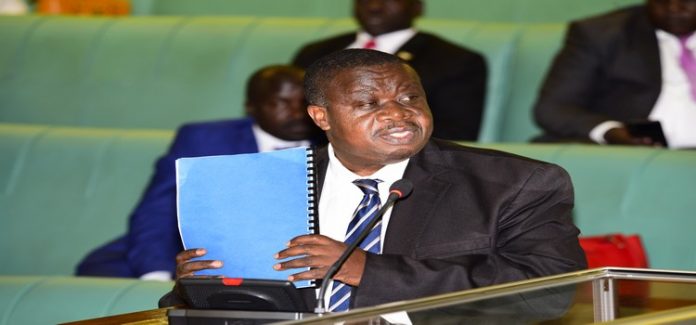
Gen. Otafiire tables documents of contested Njeru farm

Minister Otafiire


The Minister for Justice and Constitutional Affairs, Gen. Kahinda Otafiire, has presented documents to Parliament showing rightful ownership of Njeru Stock Farm.

The farm, located in Njeru Municipality is also claimed by government of Uganda.

Reading from the documents, Otafiire said the land in question was purchased from the late Fredrick Kato Lukwajju and Christopher Lule, who were administrators of the estate of the late Enock Ssebowa and Gusta Sseruro respectively.

He added that available documents indicate that the land in question did not belong to government, but it was a private mailo, and that he obtained it under a willing buyer-willing seller mode of payment.

“Government was wrongly superimposed on my land and I want government to quit those pieces of land which I purchased, because the seller is not complaining and neither am I,” Otafiire said

Nwoya district MP, Lilly Adong, told the House that the Committee on Agriculture, during its visit to Njeru Stock Farm had observed that the land on which the farm sat was private land for which government entered an agreement to rent it, after which the Minister came to engage the land owners, on expiry of the lease of land.

However, the Minister’s position was disputed by the former Leader of the Opposition, Nandala Mafabi, who claimed that Otafiire misused his office to fraudulently acquire the land.

“Otafiire used his office as a Minister in charge of Justice and Constitutional Affairs and wrote to the Minster for Lands and Housing on the estate of the late Sir Daudi Chwa II and was given 50 acres of that land,” Nandala-Mafabi said, adding that “Otafiire went with armed men to invade the farm yet they had been stopped by the Commission of Inquiry into Land Matters.”

Nandala-Mafabi also told the House that failure by government to pay ground rent for the farm for 30 years prompted the minister to write to the Lands Ministry to open the boundaries, thus giving him a share of the land.

Mafabi challenged the Otafiire to present his receipts of payment, the purchase agreement and also show how he transferred the money for the 120 acres of land.

“This stock farm was shared using offices,” Mafabi said.

Speaker Rebecca Kadaga said she needed to study the documents laid by the minister and would give her ruling next week.

“We need to study the papers that have been laid and decide on if we want an investigation into the matter and I will give my ruling on the way forward on Tuesday” said Kadaga.

Stories Continues after ad

AfDB celebrates historic $115 billion capital increase

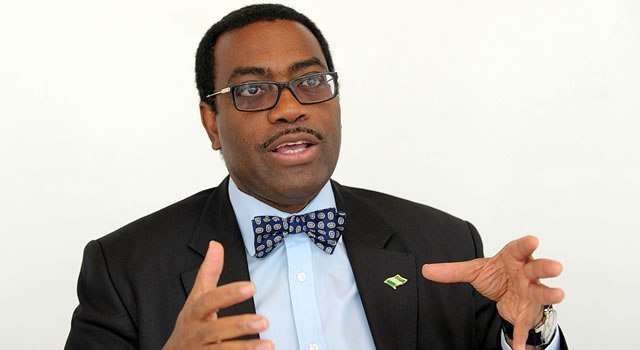
ADB President, Dr. Akinwumi Adesina


The African Development Bank (AfDB) is celebrating a historic $115 billion increase from its shareholders, the largest in the bank’s 55-year history.

Applause rang through the stately auditorium of the Sofitel Abidjan, Hotel Ivoire, around 5.30 in the evening after the decision was announced.

“Today is a day of joy for Africa because the shareholders of the African Development Bank trust the Bank and have provided this financing,” Bank President Akinwumi Adesina told journalists later at a press conference.

Adesina said the capital increase showed that the shareholders had “tremendous faith” in Africa and the Bank.

At an extraordinary shareholders’ meeting held in Abidjan earlier, Governors of the African Development Bank, representing shareholders from 80 member countries, approved the landmark capital increase. The Bank’s capital base now stands at $208 billion.

Adesina said the shareholders had endorsed the Bank’s climate change strategy.

“We as a Bank had said we are going to double our financing for climate change…so the shareholders strongly supported that direction…They are asking that we do a lot more on climate,” Adesina said.

He also cited the recently launched Desert to Power initiative, which will help supply electricity to 250 million people in 11 countries across the Sahel by tapping into the region’s abundant solar resources.

Questions from the journalists centered around what the increase would mean for a continent which despite having some of the world’s fastest growing economies, has significant challenges, such as a bulging youth population and a large infrastructure gap.

Adesina said the Board had also called for more investments in regional integration projects and in fragile states affected by a combination of challenges, including conflict, environment challenges and poverty.

“We’re going to focus on all countries Countries have development strategies, those strategies inform their requests for loans to us,”Adesina said. “We don’t dictate.”

Senior Vice President, Charles Boamah, reminded the group of around 50 journalists that the Bank was not the only player involved in Africa’s development.

“It is very important to also think what is going to come from the private sector…Most of the resources for the development of Africa have to come from the private sector. What we are going to do, is to improve business and investment climate,” Boamah said.

Adesina said, the general capital increase calls for greater efficiencies in operations and delivery in order to meet the high expectations of shareholders


Stories Continues after ad

Makerere Guild President: ‘I am in safe hands of security agencies’

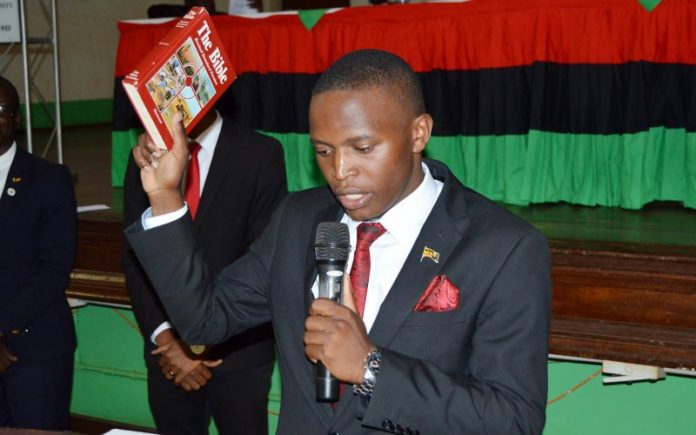
Julius Kateregga

Makerere University Students ‘Guild President, Julius Kateregga, has said he is in safe hands of security officers and will soon narrate his ordeal of what transpired before and after being kidnapped.

However, Eagle Online couldn’t established why Kateregga who is under detention in a safe house would write such a message or it is due to external pressure being mounted on the state by envoys accredited to Kampala.

Kateregga was picked last Wednesday by unknown people averred to be security officer’s moments after he had just left NBS TV where he was discussing issues affecting the university alongside, Dr Muhammad Kiggundu, Manager Communications and international relations of the university.

The kidnapping reports were confirmed by his deputy Judith Nalukwago and his where about has not been established.

Since then Kateregga, had not communicated, however earlier today he took to his twitter account and said “I am in safe hands and I will tell you what happened. Our fight is alive until we have been heard.”

“From east, west, north and south, all voices singing arise Makerere rise up and rise, high up and high all voices singing arise Makerere. This is our solemn inspiration to build for the future therefore the struggle continues.” he wrote on twitter.

Before being kidnapped, he received a call from president Museveni directing him to meet with the university council and deliberated on the scandalous 15 percent cumulative tuition policy and others issues affecting students. The meeting however did not bear all required fruits after the council resolved to maintain the tuition policy.

The protests that have ensued for over 10 days were spearheaded by Mollie Siperia, the Guild Representative Councilor for School of psychology and one Frank Bwambale who were later nabbed and suspended by the university vice chancellor Prof. Barnabas Nawangwe.

Students leadership has since declared that to dialogue with the university council, they must release all detained students, call back all suspended students, release their guild president and discard the cumulative tuition policy.


Stories Continues after ad

URA to co-host international conference on taxation

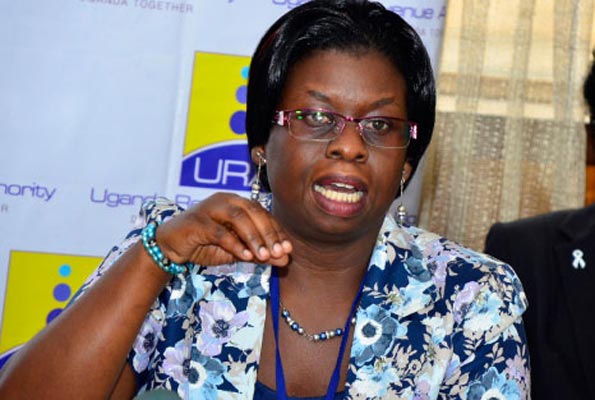
URA Commissioner General, Doris Akol


The African Tax Administration Forum (ATAF) this year celebrates its first decade as an international organization, serving 38 member countries and championing the interests of African countries in international taxation.

In the 10 years since its inception in November 2009, at a conference in Kampala, Uganda, ATAF has made significant progress and boasts of achievements, which have cemented its position as the leading organisation on tax matters.

To mark its 10th anniversary, ATAF will celebrate the achievements of our first decade, reflect on and learn from our history and map out our future path at a number of regional events and finally at an International Conference on Tax in Africa, which will take place in Kampala, Uganda from November 19-22, 2019.

This biennial conference, organised by ATAF and hosted this year by the Uganda Revenue Authority, will consider the theme: Innovation – Digitalisation and Harnessing Technology to Improve Tax Systems.

This theme will cover innovative solutions to the policy challenges that countries face in dealing with the taxation of the digital economy, an issue that will inform the global tax debate over the next decade.

It will also look at innovation through the use of technology in Africa to strengthen tax systems and develop solutions that will broaden the tax base, deal with high net worth individuals and improve assessment and collection to increase tax efficiency and effectiveness.

ATAF’s regional celebrations will coincide with the hosting of key events which are scheduled to take place as follows:

North African region – 4 and 5 July 2019: The inaugural meeting of a Master Class for the heads of African Tax Administrations will be held in Rabat, Morocco. Heads of Tax Administrations from all 54 African states have been invited to attend the meeting.

Southern African region – 30 and 31 July 2019: High Level Policy Dialogue meeting of policy makers and tax officials to be held in Victoria Falls, Zimbabwe. This meeting aims to promote an understanding of the nexus between tax policy and tax administration and strengthen the relationship between policymakers and tax administrators.

West African region – 2-6 September 2019: The 5th ATAF African Tax Research Network Congress to be held in Ouagadougou, Burkina Faso.

East African region – 19-22 November 2019: This region will host the main celebration at the International Conference on Tax in Africa in Kampala, Uganda, as ATAF returns to its birthplace to celebrate its 10th anniversary.

ATAF key achievements are; 

ATAF has provided Technical Assistance through 20 country programmes (12 on cross border taxation and eight on exchange of information). The country programmes have led to:

The  reviewing  of  business  structures  and procedures;

·         The training of 500 auditors;

·         Implementation of Automatic Exchange  of Information (EoI) and EOI units and trans- fer pricing units in over 15 countries;

·         The revision of transfer pricing legisla-  tion, new interest deductibility legislation, and new permanent establishment rules de- signed to reduce tax avoidance and evasion;

·    The enactment of new transfer pricing  laws and regulations in more than 12 countries (including Zambia, Uganda, Senegal, Botswana, Kenya, and Nigeria) based on the ATAF Suggested Approach to TP Legislation.

·         Increases in tax collected due to these interventions now totals USD194 million. In addition, USD1.1 billion has been raised in assessments as at the end of 2018.

ATAF has improved the capacity of African tax administrations (over 15 000 policy makers, officials and parliamentarians have been trained) on tax audits and tax treaties; compliance risk management and fraud detection; tax and development; revenue forecasting and analysis to mention but a few topics.

ATAF has played an active role in the global tax agenda over the last decade. To date, the organisation has participated in 72 regional, continental and global fora to promote African perspectives on tax issues and represent the views and interests of its members. ATAF is a key player in the OECD Inclusive Framework and the UN Committee of Experts. The organisation has significant regional and international visibility and was recognised by the African Union in 2018 as the leading organisation on tax in Africa.

ATAF works collaboratively with  regional and global platforms such as the United Nations Economic Commission for Africa, the High-Level Panel on Illicit Financial Flows, The Global Forum on Transparency and Exchange of Information for tax purposes, Trust Africa and the Tax Justice Network. These collaborations are aimed at countering abusive tax practices by multinational enterprises and combatting of illicit financial flows from the continent.

ATAF established an African Tax Research Network (ATRN) in 2015, a platform for African inspired dialogue, research and collaboration. The network has held a congress aimed at promoting an African-based thought leadership on tax matters  annually  since  2015,  drawing  a told of nearly 350 participants. The 2019 ATRN  congress is scheduled to take place  in Burkina Faso in September.

Through the ATRN, ATAF.

  • Provides support to junior and middle career researchers with the aim of increasing the research capacity in Africa
  • Promotes the development of home-  grown solutions to African tax challenges and enhances debate and cooperation amongst tax officials, academics, policy makers, tax practitioners and civil society.

ATAF launched its African Tax Outlook (ATO) in 2016 featuring data from 15 African countries. Since then the number of countries participating in the ATO has grown each year, to 34 countries for the 2019 and 37 countries for 2020 editions. The ATO assesses and compares data of an African countries against indicators in four broad categories: tax bases, tax structure, revenue performance, and tax administration. The annual publication is now regarded as the leading reference point on continental tax data providing valuable, practical and relevant descriptive and analytical work on tax issues.

ATAF established an Executive Masters Programme in Taxation (EMT) in 2014 to strengthen the capabilities of tax officials, tax policy makers, and tax practitioners from across the African continent. To date, 87 participants (both English and French speaking) from 20 countries have graduated and have designed, implemented  and  steered  reform   processes in the fields of public finance, tax legislation, applied tax policy, and tax administration in their countries.


Stories Continues after ad

Commodity prices revised down as global growth weakens and supplies remain ample


Energy and metal commodity prices are expected to continue to fall in 2020 following sharp declines in 2019 on a weaker outlook for global growth and consequent softer demand, the World Bank said in its October Commodity Markets Outlook.

“Slowing demand for commodities presents a challenge for exporters and an opportunity for importers,” said Ceyla Pazarbasioglu, World Bank Group Vice President for Equitable Growth, Finance & Institutions. “As both of them switch from using one commodity to another due to price fluctuation and technological advance, it will be important that these resources be produced and consumed in an environmentally sustainable way.”

Crude oil prices are projected to average US$60 per barrel in 2019 and weaken to US$58 per barrel in 2020. These forecasts are US$6 per barrel and US$7 per barrel lower than anticipated in the April Commodity Markets Outlook. In line with the slowdown in global growth, oil consumption is now expected to rise at a much slower pace than earlier forecasts and increase only modestly next year. A sharper-than expected economic downturn poses the greatest risk to the oil price forecast. More broadly, energy prices, which also include natural gas and coal, are expected to average almost 15 percent lower in 2019 than in 2018, and to continue to decline in 2020.

Metal prices are also projected to fall 5 percent in 2019 and continue to slide next year as slowing global demand weighs heavily on the market. Precious metals, which have risen sharply this year, are anticipated to make further gains in 2020 in response to heightened global uncertainty and accommodative monetary policies. Agriculture prices are anticipated to decline this year but stabilize in 2020.

A resolution of trade tensions could push up the prices of some agricultural commodities, such as soybeans and corn, while lower energy prices could lower fuel costs and fertilizer prices, reducing prices of energy-intensive crops such as oilseeds.

A special section in the report looks at what drives consumers to substitute one commodity for another, such as natural gas for coal, or paper instead of plastic. These substitutions are driven by technological innovation and changes in commodity prices. This phenomenon highlights the risks to the long-term growth prospects of countries that rely heavily on a narrow group of commodity exports.

“Depending on export revenues from a small set of commodities makes commodity-exporting developing economies vulnerable because demand surges and higher prices could induce innovation and facilitate substitution among commodities,” said Ayhan Kose, Director of the World Bank’s Prospects Group.

Another special section looks at the impact of the September 14 attacks on oil production facilities in Saudi Arabia. The market response was short-lived by historical standards because of the swift restoration of production, increasingly diversified sources of oil supplies, including shale oil, and weakening demand. However, it was a reminder that the global oil market remains dependent on several critical infrastructure and transport bottlenecks that may be vulnerable to disruption.


Stories Continues after ad
Cabinet agrees to pay Basajjabala Shs85b over city abattior

Mr. Basajjabalaba

Cabinet chaired by President Museveni has agreed to pay Shs80 billion to city businessman Hassan Basajjabala over his interests in the abattior.

Eagle Online has learnt that the move by cabinet was endorsed after report of parliament recommendation the payment.

According to cabinet sources, Mr Basajjabala could wait a bit longer as it has been established that President Yoweri Museveni informed his cabinet and Ministry of Finance officials to halt the payment as they verify the whether the treasury has enough money before they consider paying Basajjabala.

“You Muhakanizi (Kieth) do you have  enough money before you release this money to this rich man? wait because we need to be certain that other needs of government are catered for. We don’t want to have shortfalls” Mr. Museveni is quoted to have told the meeting before he asked his handlers to get him Mr Basajjabala on phone.

Bassajjabala acquired city abattior from the then Kampala Capital City council after he emerged as the best bidder to manage the market and subsequently sold it to him.

Last year, MPs on the Presidential Affairs Committee recommended that government through KCCA should compensate Mr Basajjabalaba Shs85 billion for failure to assure him of vacant possession of the facility.
The first instalment of the compensation will be paid to Mr Basajjabalaba in the 2019/2020 financial year budget.

How management row started

On March 1, 2000, Kampala City Council (KCC), the predecessor of KCCA, gave a one-year contract to Basajjabalaba Hides and Skins Company Ltd (BHS) owned by Basajjabalaba to manage the abattoir.
According to the contract, Mr Basajjabalaba was supposed to be remitting a monthly fee of only Shs20 million to KCC. On June 4, 2001, KCC offered a 49-year lease to BHS at a fee of Shs600 million.

Mr Basajjabalaba was supposed to be remitting a ground rent of Shs2.7 million annually, payable by two equal half yearly instalments in advance on the first day of January, and the first day of July in every year.
Mr Basajjabalaba, documents show, was also supposed to redevelop Kampala’s biggest slaughter house into a modern structure, and manage the entire facility on behalf of KCC.
However, KCC later realised that he had sub-leased the same facility to Travellers Coaches Ltd of Mr Daniel Kwatampora Katarihwa in 2008 without their consent.

Mr Kwantampora allegedly increased fares at the facility, something the butchers protested and asked the city authority to kick him out.
When KCC was rebranded into KCCA in 2011, butchers seized the opportunity and petitioned Lord Mayor Erias Lukwago over the controversial giveaway of the slaughterhouse to Mr Kwantampora.

Mr Lukwago, who had pledged to weed out all manipulative forces from the city’s public working spaces during his campaigns, intervened in the wrangle and halted Mr Kwantampora’ s operations in the facility hence court battles ensued.
Although Mr Basajjabalaba repossessed the facility back from Mr Kwantampora in 2011, traders under their umbrella body of City Abattoir Traders Development Association (Catda) rejected him.


Stories Continues after ad

2019 oil demand forecasts cut as economies slowed

The global forecast for oil production in 2019 has been repeatedly revised downward over the last year and a half amid weakening demand for oil. Growth in demand  is now around 1%, or 1 million barrels per day – the weakest growth rate since 2012, according to the October 2019 Commodity Markets Outlook.

Oil prices are projected to average $60/bbl in 2019 and are forecast to weaken to $58/bbl in 2020, $7/bbl lower than the previous forecast. The downward revision reflects the weaker outlook for global growth and therefore for oil demand. Oil consumption growth is expected to increase slightly next year at a level usually associated with global downturns. If economic growth deteriorates further, oil demand could be substantially weaker, says the report.

Stories Continues after ad

‘When journalists are targeted, societies as a whole, pay a price’: UN chief

Ugandan journalist being beaten by soldier not long ago


“When journalists are targeted, societies as a whole pay a price”, added the UN chief. “Without the ability to protect journalists, our ability to remain informed and contribute to decision-making, is severely hampered”.

Killings and attacks on the rise

A new study from the UN Educational, Scientific and Cultural Organization, UNESCO, underscores the risks that journalists face, showing that almost 90 per cent of those found responsible for the deaths of more than 1,100 of them, between 2006 and 2018, have not been convicted.

The report, “Intensified Attacks, New Defences”, also notes that killings of journalists have risen by some 18 per cent in the past five years (2014-2018), compared to the previous five-year period.

The deadliest countries for journalists, according to the statistics, are Arab States, where almost a third of the killings took place. The Latin American and Caribbean region (26 per cent), and Asian and Pacific States (24 per cent) are the next most dangerous.

Journalists are ofen murdered for their reporting on politics, crime and corruption, and this is reflected in the study, which reveals that, in the past two years (2017-2018), more than half of journalist fatalities were in non-conflict zones.

In his statement, the Secretary-General noted the rise in the scale and number of attacks on journalists and media workers, as well as incidents that make their work much harder, including “threats of prosecution, arrest, imprisonment, denial of journalistic access and failures to investigate and prosecute crimes against them”.

A high-profile example is the murder of Maltese journalist Daphne Caruana Galizia in 2017. The case is being followed by independent UN human rights expert Agnès Callamard, among others, who has suggested that too little has been done by the Maltese authorities to investigate the killing.

On Friday, as Haiti continued to face a protracted, violent crisis that has led to the deaths of some 42 people, and 86 injured, UN human rights chief Michelle Bachelet called on all of those involved in the violence to refrain from targeting journalists, and respect the freedom of the media to do its job: at least one journalist is among those killed, and nine other reporters have been injured, according to Ms. Bachelet’s Office (OHCHR).

Keep Truth Alive

This year UNESCO has launched the #KeepTruthAlive social media campaign, which draws attention to the dangers faced by journalists close to their homes, highlighting the fact that 93% of those killed work locally, and featuring an interactive map created for the campaign, which provides a vivid demonstration of the scale and breadth of the dangers faced by journalists worldwide.

The Day is being commemorated with a flagship event in Mexico City next week on 7 November – an international seminar entitled “Strengthening regional cooperation to end impunity for crimes and attacks against journalists in Latin America” – and events are also taking place in 15 other countries, including an exhibition of press cartoons, under the headline: “Draw so as not to write them off”, at UN HQ in New York, which honours the memories of French journalists Ghislaine Dupont and Claude Verlon, murdered in Mali on 2 November 2013.

This article is from the UN website


Stories Continues after ad

UN envoy on children and armed conflict commends AMISOM on child protection efforts

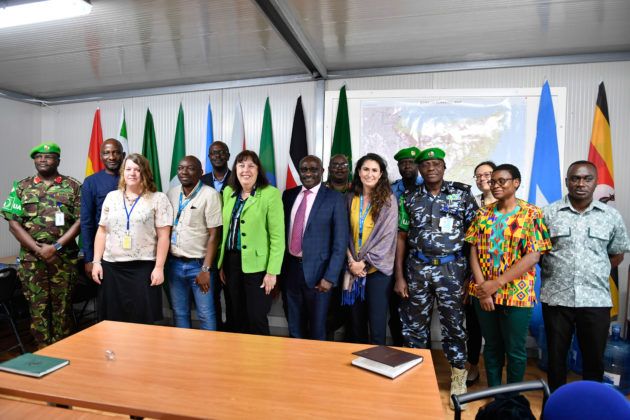
Virginia Gamba, the Special Representative of the Secretary-General for Children and Armed Conflict, poses a a group photo with Simon Mulongo, the Deputy Special Representative of the Chairperson of the African Union Commission (DSRCC) for Somalia and other senior officials from AMISOM at the AMISOM Mission Headquarters in Mogadishu, Somalia on 28 October 2019. UN Photo / Omar Abdisalan


The UN Secretary-General’s Special Representative for Children and Armed Conflict, Virginia Gamba, has commended AMISOM for ensuring the protection of children in conflict.

On Wednesday, Ms. Gamba concluded a three-day working visit to Somalia to assess efforts to protect children from conflict-related violations.

As part of the visit, she held discussions with child protection focal persons in the AMISOM military, police, and civilian components, including the Deputy Head of AMISOM, Simon Mulongo.

During the meeting, Mulongo, who is the Deputy Special Representative of the Chairperson of the African Union Commission for Somalia (DSRCC), briefed her on AMISOM’s programmes and activities.

“We train our troops on child protection at pre-deployment, induction and in-mission levels, to remind  them of their obligations. We monitor compliance, and troops in violation are held accountable. We also mentor, advise and support the Somali security forces,” the Deputy SRCC said.

Ms. Gamba noted that some of AMISOM’s child protection approaches could be adopted as best practices for the protection of other children in conflict situations.

“If you don’t mind, we would like to explore your expertise and see how it could work for some of our other operations,” said Ms. Gamba.

An AMISOM Human Rights expert, Ms. Ulrike Kahbila Mbuton, briefed the UN top official on AMISOM’s efforts to uphold the rights and welfare of children in the mission’s area of operations.

“AMISOM has been carrying out child protection activities both within the mission, and other activities in support of the Federal Government of Somalia and the member states. AMISOM holds vocational training programmes for disengaged child fighters to support their reintegration into society, she Kahbila.

She also revealed that AMISOM has instituted standard operating procedures on handling child detainees and internally displaced people’s camps and established a toll-free line to report incidents of violence against children.


Stories Continues after ad

AMISOM hails Uganda police officers for professionalism

Police contingent in Somalia


The Deputy Special Representative of the Chairperson of the African Union Commission for Somalia, Simon Mulongo, has lauded the professionalism of Ugandan police officers serving under the African Union Mission in Somalia (AMISOM).

Mulongo, on Wednesday, met the Director of Peace Support Operations in the Uganda Police Force, AIGP Grace Turyagumanawe, who was on a visit to assess the status of equipment and welfare of personnel.

He noted that the Uganda police contingent, which includes Formed Police personnel and Individual Police Officers, continue to be instrumental in AMISOM’s gains against terrorism.

“We are satisfied with Uganda Police’s contribution to peacebuilding, especially their contribution to maintain law and order and enhancing the capabilities of the Somali Police,” Mulongo told Turyagumanawe.

During the visit, Turyagumanawe inspected the condition of the contingent-owned equipment at the Jazeera Forward Operating Base outside Mogadishu.

Under the Somalia Transition Plan, AMISOM Police ensure that the Somali Police Force is adequately capacitated in preparation to assume full responsibility of maintaining law and order in the country when AMISOM leaves in 2021.

The UN Security Council authorised AMISOM to deploy up to 1,040 police personnel under the police component, which includes Individual Police Officers and five Formed Police Units (FPUs).

The Formed Police Unit (FPU) personnel provide operational support such as VIP escort and protection, while the Individual Police Officers (IPOs) train, mentor, and advise the Somali Police officers.

Uganda is one of AMISOM Police contributing countries. The other countries include Ghana, Kenya, Nigeria, Sierra Leone, and Zambia.

Additionally, Nigeria, Sierra Leone, and Uganda have deployed FPU contingents. Recently, Ghana agreed to deploy an FPU contingent under AMISOM.

Turyagumanawe also revealed that plans are underway for Uganda to deploy more police personnel to serve under the AMISOM Formed Police Unit.

“Preparations are underway to ensure that we deploy a second formed unit as was agreed on recently. We are working on acquiring the necessary equipment,” added Turygumanawe.

Turyagumanawe led a delegation that included the Police Deputy Director of Fleet Management, Eng. Franklin Kugonza, Police Accountant, Richard Katongole, and Staff Officer for Peace Support Operations, Herbert Wondo.


Stories Continues after ad