His Excellency the Vice President;
Rt. Hon. Speaker of Parliament;
His Lordship the Chief Justice;
Rt. Hon. Deputy Speaker;
His Lordship the Deputy Chief Justice;
Rt. Hon. Prime Minister;
Rt. Hon. Deputy Prime Ministers;
Rt. Hon. Leader of Opposition;
Their Highnesses the Traditional Leaders;
Hon. Ministers;
Hon. Members of Parliament;
Hon. Members of EALA;
Members of the Diplomatic Corps;
Distinguished Guests;
Ladies and Gentlemen.
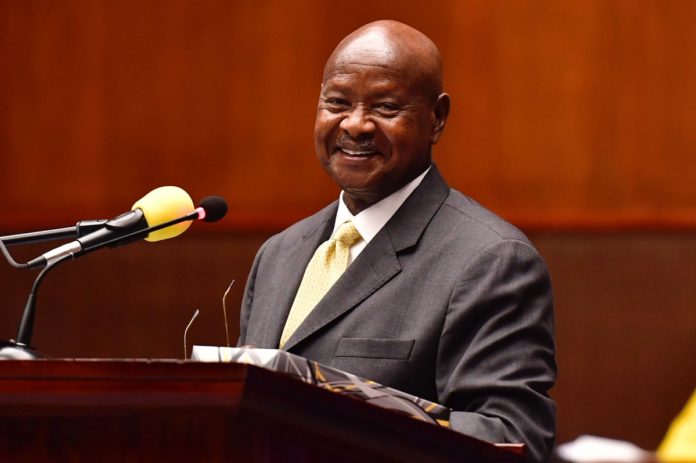
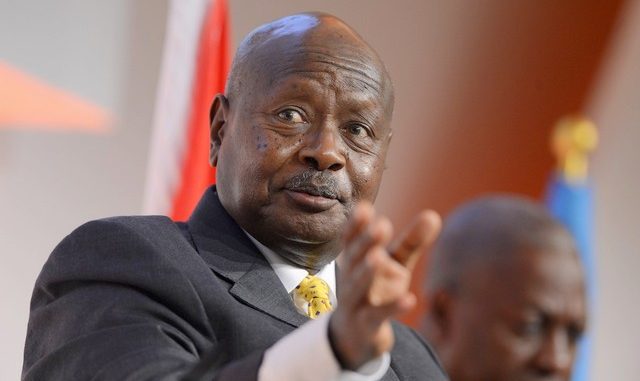
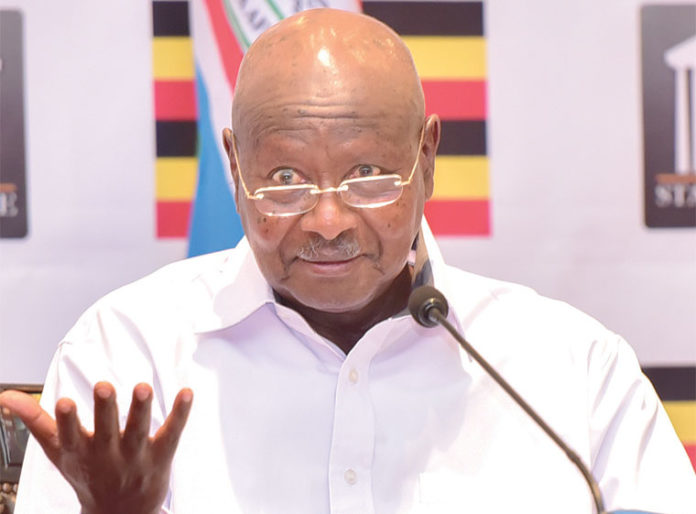
Madam Speaker, in fulfilment of the Constitutional requirement under Article 101 (1) of the Constitution of the Republic of Uganda, I am here to deliver the State of the Nation Address, 2019.
Madam Speaker, since my last Address, a number of Ugandans have departed from this earth. Some of whom are:
The Late Prof. Apollo Nsibambi, the former Prime Minister of Uganda;
The Late Hon. Col (Rtd) Ibrahim Abiriga, Member of Parliament, Arua Municipality;
The Late Rt. Rev. Cyprian Kikunhi Bamwoze, Bishop Emeritus of Busoga Diocese;
The Late Rt. Reverend. Augustine Arapyona Salimo, Bishop Emeritus of Sebei Diocese;
The Late Assistant Superintendent of Police, Muhammad Kirumira;
The Late Ambassador Julius Onen, the Permanent Secretary – Ministry of Trade, Industry and Co-operatives;
More than 31 people who died when a party boat capsized on Lake Victoria;
The 4 Kenyan Pilgrims who were knocked by a hit and run car when coming to Uganda for Martyrs Day;
Bududa people that lost lives in the mudslide; and more others.
Madam Speaker, I request that we all stand up and observe a moment of silence in memory of the departed persons. May the Almighty God rest their souls in eternal peace.
Today is the 6th of June, 2019. The 6th of June, 1944, was the date on which Allies in the 2nd World War executed an amphibious landing in German occupied by France at Normandy beaches. This was 3 months before I was born.
The 6th of June, 1981, aged 36 years and leading the PRA (Popular Resistance Army), I departed Matugga by car, passed through Buwama trading centre and embarked into a boat at Katebo landing site to cross the more than 200 miles Lake to Kenya to proceed to Libya to look for the weapons of the struggle. Today, the 6th of June, 2019, here we are on the occasion of the State of the Nation Address. There is something interesting about the 6th of June.
SECURITY
The NRM Government remains committed to ensuring a secure and peaceful Uganda. This has come about by promoting and upholding patriotism, democracy and good governance as core values for National socio-economic transformation. Significant focus has been placed on professionalizing and modernizing the Uganda People’s Defence Force (UPDF) and building the Uganda Police Force (UPF) capabilities.
Some months ago, killers, robbers and rapists had intensified their activities. They were committing these crimes with impunity because the Police had been infiltrated by criminals and people who had been compromised in some ways.
The National Security Council reviewed the situation and came to some conclusions. I addressed a special sitting of Parliament on the 20th of June, 2018, where I outlined the measures we had decided to take to cope with the heightened crime. A number of those measures are being implemented. As I assured the country, that crime wave will be defeated.
UPDF works with other security agencies to deter or curtail any acts of lawlessness. The recent peaceful holding of the Martyrs Day, where an estimated 3 million people turned up, shows that Police and the UPDF already have good capacity.
ECONOMY
Between 1986 and 2015, the economy grew at an annual average rate of 6.92% while per capita income grew at an annual average rate of 3.6% over the same period.
No European country, not even the USA (except West Germany between 1950 and 1980 which did 3.8%) has grown its per capita income at the same rate as Uganda over a period of three decades. Only East Asian Tigers sustained per capita income growth of 5.6% during their intense period of transformation between 1960 and 1990.
The growth of the per capita income at such high rate was in spite of the high rates of population growth of 3.3% per annum. In order to put this issue in perspective, Ugandans should be informed that between 1951 and 1961 during the colonial system, GDP per capita grew by 0.14%; between 1962 and 1970, it grew by 1.4%; between 1971 and 1980, it declined by -2.9%; and between 1982 and 1985, it grew by 0.8% and between 1986 -1995; it grew by 2.8% and between 1996-2009, it grew by 3.6%. All this in spite of the strategic bottlenecks such as shortage of electricity and high transport costs that were not yet addressed that time. Note that per capita income is GDP growth minus population growth.
To put it in a global context, between 1986 and 2015, Uganda was the 17th fastest growing economy in the world, the 4th in Africa. If we remove mineral-rich countries from the sample (because they were enjoying God’s or nature’s bounty), Uganda was 11th in the world, 1st in Africa.
This achievement is the more impressive because Uganda was in civil war from 1986 to 2005. The country is surrounded by Sudan to the north, which was in civil war for the first 20 years of Uganda’s growth (1986 to 2005). To the west is DR Congo, which has been in civil war between 1996 to now. To the south is Rwanda, which was in civil war between 1990 and 1994. To the east is Kenya, which was stagnating economically between 1986 and 2002.
Performance of the Economy
The size of the economy is Shs 109.738 trillion in FY 2018/19 equivalent of USD 29.5 bn. The income per person is now equivalent to US$ 800. Although this is below the level required to the attainment of the Middle Income Status, the renewed impetus of the economy and the large economic base being created will catapult the economy to prosperity within a short period in the future.
By the Purchasing Power Parity (PPP) method of computing GDP, the economy now stands at US$88.6billions which translates into US$2,400 per capita.
If this method was used, Uganda would already be a middle income country. However, we are not going to use short cuts. We shall use the export promotion and import – substitution routes to storm across the medium income barrier, not just the purchasing power route on account of our low cost of living advantage, but by the exchange route method. It is now within reach.
Expanding the Economic Base
Uganda’s economic growth and development outlook is positive, with the economy projected to grow at, at least, 7 percent in the medium term, but could even be higher given that we have now sorted out the key constraints to growth. The basis for this very positive outlook is the following:
i. Industrialization to promote exports using primarily agriculture as the base; this includes industrialization along the agricultural value chain, light manufacturing and processing our minerals into finished products; and further diversification of the manufacturing sector to increase exports.
ii. Increasing production and productivity in the agricultural sector by investing in quality inputs, extension services, storage facilities, access to markets by improving standards and quality of agro-processing. Government is also boosting the capital base of UDB to be able to lend to agriculture as well as small scale industry. In addition, Government is implementing targeted interventions in the Coffee Sector (Coffee Roadmap 2020), Tea and fruit processing e.g. the Soroti Fruit Factory and supporting agricultural zoning and out grower model around the nucleus farmers. We are also working on stabilizing agriculture through irrigation.
iii. The commencement of oil and gas production and work on the Oil Pipeline and the Refinery will be starting soon.
iv. Strengthening local content so that Ugandans can be integrated into wealth creation as the economy expands, including improving local production and supply capacities.
v. Improving efficiency in the execution of public investment, to improve the returns on investment especially in the areas of energy, transport, agriculture, tourism, water for consumption and production, and in education.
vi. Harnessing the benefits of regional integration through trade and strengthening intra-African trade.
vii. Improving labour productivity through skills development tailored to labour market demand.
Therefore, a firm foundation for industrialization and especially manufacturing has been laid. We now have the fruit industry in Teso and Luweero; Dairy industry in Ankole; Vegetable Oil industry in Kalangala; and Tea industry in Toro and the Kigezi sub-regions; etc., etc. Government is providing financial support to tea factories in Western Uganda including Kigezi Highland Tea Co. Limited, Kayonza Growers Tea Factory and Mabale Growers Tea Factory Limited.
In addition, Operation Wealth Creation (OWC) has increased the supply and distribution of tea seedlings in the region. In the North, Government has taken up a 32% stake in Atiak Sugar Factory which has a nucleus farm and an outgrowers scheme which will create jobs and promote agro-industrialization in this region.
Government is prioritizing investment in Industrial parks to support industrialization and create jobs. Notable progress has been made in Kapeeka Industrial Park where manufacturing of tiles and other products is already on, Kampala Industrial and Business Park where construction and provision of various utilities is soon starting, Kabaale and Mbale Industrial Parks where work is on-going, etc. So far, there are 284 new factories already in the Industrial Park at Namanve; 11 in Luzira industrial and Business Park; 10 in Bweyogerere industrial estate; 8 in Jinja industrial and Business Park; 10 in Soroti industrial and Business Park; 16 in Kasese industrial and Business Park; and 42 in Mbarara SME Park. The total factories in Uganda are today 4,900.
International Trade
As regards international trade, our exports revenue of goods and services grew at 8.2 % in 2018/19, amounting to USD 7.012 billion (US$3.8billion being earnings from trade in goods, US$1.89billion from services and US$1.312billion from remittances). The total Import Bill for goods and services stood at US$8.8billion, creating a trade deficit of US$1.86billion. Under the 2020 Coffee Road map which I launched a few years ago, the volume of coffee exports reached 4.5 million bags in FY 2017/18 earning the country US$ 492 million. Light industrial goods exports fetched us US$ 382 million, while tourism revenues amounted to US$ 1.0 billion in the same year.
If we can increase production per hectare of coffee as an example from the current 0.67 tonnes to 2.2 tonnes per hectare like in Brazil and Vietnam, Uganda would be earning about US$ 2 billion from unprocessed Coffee alone. At 2.2 tonnes per hectare, Uganda will produce 21 million bags of green coffee and if this coffee was roasted here (roasting alone), Uganda would fetch US$6.7billion. But if it was transformed into soluble – instant coffee, we would then generate US$16.8billion for the country. This is possible.
We just need to be better organized and focused on distribution of better seedlings, better harvesting, post-harvesting methods and storage. We are going to process much of this coffee. By processing 60,000 tonnes of coffee, per year, by Ms. Henrica Pinetti’s factory, Uganda will earn US$330million.
The acceleration of the economic growth is partly due to the correct decision we took in 2006 of prioritizing roads and electricity, the details of which I will give later in this speech.
Although full rationalization of the results of this prioritization has not been fully realized, especially in connection with lower transport costs and costs of electricity, the more awareness that there are better roads and more abundant electricity is already causing a flood of investments.
Our efforts to promote regional integration and intra-Africa trade are yielding the desired benefits. Uganda now exports more to Africa than the Rest of the world, with 63% of exports to Africa in FY 2017/18 compared to only 27%, 10 years ago. Exports to Asia have increased to 18% now compared to only 13%, 10 years ago.
Fiscal Performance
Domestic revenue in FY2017/18 amounted to Ushs15.5 Trillion. This is about 15% of GDP. Next financial year 2019/20, we plan to collect Ushs 19.6.Trillion, equivalent to 16.1% of GDP. The Government is implementing a plan to boost our domestic revenue collection to about 18% of GDP. This will narrow the gap between what we spend and what we collect in domestic revenue and in the process reduce the need for Government to borrow from the domestic market and also externally. This will allow Government to finance a larger share of its investments using our domestically generated resources.
Strategic Challenges
High cost of Capital
The high cost of capital remains a major challenge to the economy as a whole. To address this challenge, Government is capitalizing Uganda Development Bank. So far, we have capitalized UDB up to Ushs 272 billion, of which Ushs 53 billion has been provided this financial year. Next financial year, 2019/20, Government is providing an additional Ushs 103 billion to bring the total to Ushs 375 billion. On top of this, Government has guaranteed loans of USD 15 million and USD 5 million from African Development Bank (AfDB) and Exim Bank of India, respectively for SMEs. We should borrow less domestically because this increases interest rates and crowds out the private sector when Government domestic borrowing is excessive.
High cost of doing business
The cost of doing business is still high in Uganda. To address this challenge, the Government will continue to prioritize infrastructure investment in Energy, Transport, water, and ICT. The cost of electricity per unit used to be US cents 10.62; it is now US cents 7.91per unit. I intend to bring it down to US cents 5 per kilowatt hour for manufacturing.
The modernization of the railway system by building the Standard Gauge Railway will bring down the cost of transport per 40ft container from US$3,456 by road to US$1,800per container using the Standard Gauge railway. Even by repairing the old meter gauge railway, the cost of transport goes down to US$2,016.
AGRICULTURE
Agriculture remains the main thrust of Uganda’s economic growth. The sector contributes 25% of national GDP and employs over 70% of Uganda’s population.
In my zonal tours, I have been telling Ugandans that there are only four sectors for wealth and jobs creation. The four sectors are: commercial agriculture; industries (big or small); services (hotels, transport, professional services, shops, etc.); and ICT (Business Process Outsourcing ─BPOs); etc.
Achievements
In order to regionalize the delivery of Water for Agriculture Production services across the country, Government has opened up Regional Mechanization Centers in South Western Region (at Buwama) and North Eastern Region (at Agwata). Using the acquired heavy earth moving equipment, Government constructed and rehabilitated valley tanks in the drought and cattle corridor Districts country wide.
The number of valley tanks increased by 83 from 155 in December, 2017 to 238 in December, 2018 with a total holding capacity increasing from 8,000,000million cm3 to 9,245,000million cm³ in the same period. This has improved the number of farmers accessing and utilizing water for irrigation, aquaculture and livestock from 5% to 8%.
List of Irrigation Schemes Constructed/Planned by Government
District
Project Name
Irrigation Area (Ha.)
Status
Butaleja
Doho I Irrigation scheme
1,000
Completed
Kasese
Mubuku I Irrigation scheme
550
Completed
Lamwo
Agoro Irrigatioin Scheme
675
Completed
Lira
Olweny Irrigation Scheme
600
Completed
Butaleja
Doho II Irrigation Scheme
500
Physical works progress is at 48.6% cumulative progress
Kasese
Mubuku II Irrigation Scheme
480
Physical works progress is at 29.92% cumulative progress
Pakwach
Wadelai Irrigation Scheme
1,000
Physical works progress is at 182% cumulative progress
Oyam
Tochi Irrigation Scheme
500
Physical works progress is at 57% cumulative progress
Kween
Ngenge Irrigation Scheme
880
Physical works progress is at 54.1% cumulative progress
Kabarole
Rwengaaju Irrigation Scheme
250
Physical works progress is at 50% cumulative progress
Bulambuli/
Kween
Atar Irrigation Scheme
750
Feasibility studies completed
Bulambuli/
Sironko
Sironko/Acomai Irrigation Scheme
1,250
Feasibility studies completed
Kanungu
Matanda Irrigation Scheme
1,000
Feasibility studies completed
Amuru
Pabbo Irrigation Scheme
500
Feasibility studies completed
Nakapiripirit
Namalu Irrigation Scheme
1,000
Feasibility studies completed
Serere
Labor Irrigation Scheme
500
Feasibility studies completed
Aleptong
Ongom Irrigation Scheme
500
Feasibility studies completed
Buliisa
Biiso Irrigation Scheme
500
Feasibility studies completed
List of big Earth Dams Constructed by Government
District
Project
Storage Capacity (CM3) Cubic metres
Kumi
Kodhukul dam
85,000
Omatenga dam
30,000
Katakwi
Ongole dam
1,000,000 Nakapiripirit
Nakiloro dam
55,000
Kotido
Kailong dam
162,000
Moroto
Kobebe dam
2,300,000
Napak
Arechet dam
2,100,000
Kaabong
Longorimit Dam
1,400,000
Abim
Kawomeri dam
1,200,000
Kiruhura
Kimiranjoga dam
60,000
Isingiro
Kagango dam
120,000
Mbarara
Mabira dam
1,020,000
Otuke
Akwera dam
1,070,000
Apac
Aculawic dam
72,000
Alango dam
72,000
Kole
Leye dam
1,200,000
Sembabule
Kakinga dam
2,000,000
Mayikalo dam
125,000
Total
14,071,000
To boost agriculture mechanization, 280 tractors were procured and distributed to farmer groups. The Government intends to procure an additional 100 tractors in FY 2019/20.
Government has enhanced the production of key strategic commodities for Exports and Domestic Value Addition.
Oil Palm
As an import substitution commodity, oil palm production in Kalangala has increased and steadily improving farmers’ incomes and livelihoods. In FY 2016/17, farmers harvested 24,278 MT valued at UGX 13.4 billion while in FY 2017/18 farmers harvested 37,802 MT valued at UGX 21.4 billion (36% increase in production and 37% increase in value). On average, the 1,199 oil palm farmers with mature gardens earned UGX 1.9 billion each month in 2018, up from UGX 1.3 billion each month in the calendar year 2017.
Cotton: lint bales increased from 151,071 in 2016/17 to 202,357 bales in 2017/18. As a result, the contribution of cotton to household incomes rose from about UGX 136 billion in 2016/17 to UGX 188 billion in 2017/18.
Lint exports have also risen from about US$ 42 million in 2016/17 to US$ 54 million in 2017/18. However, we intend to convert all this cotton to fabric weaving, earn more dollars and create more jobs.
Milk: Milk annual production increased from 2.08 billion litres in 2015 to 2.5 billion litres in 2018 and is projected to increase to 3.35 billion litres by the end of 2019. The value of marketed milk has increased by 15% from USD 716 million in 2015 to USD 850 million 2018.
The export earnings of milk and milk products now stand at US$ 79 million per annum. This increase in milk production is in in spite of still using the old method of free-range grazing (Kusetura). I am launching a campaign to change this. We must go from free range to zero-grazing so that the planted pasture is not disturbed by the cattle trampling on it. With free range, as square mile supports 213 Friesian cattle and 320 Ankole cattle. With zero-grazing, a square mile will support 1,280 Friesians and 6,000 Ankole cattle. Zero grazing and the selection of only high milers is the only way to go.
Beef: To improve production of quality beef, Government has constructed a modern holding ground (5 square miles) and an Animal Quarantine station (4 square miles) to fatten bulls. These bulls will be supplied to the modern export abattoir in Bombo.
Fish: The fisheries subsector has through implementation of fisheries management reforms, registered increase by 31% in Nile Perch fish stocks and the fishery is recovering on Lake Victoria. The support to fisheries enforcement interventions has led to the opening of 4 factories part of the 16 which had closed, bringing the total to 12 fish factories now in operation.
NAADS/ Operation Wealth Creation (OWC) initiative: Government has continued to distribute key planting, breeding and stocking materials including: tea seedlings in Kigezi, Ankole, Rwenzori, Mubende, West Nile and Bunyoro Sub Zones, where over 21,915 acres have been established; citrus/ orange seedlings establishing 109,439 acres; mango seedlings establishing 143,803 acres; cocoa seedlings establishing 16,459 acres, among others.
Disease Control: Government continued to enforce quarantines to curtail uncontrolled movement of animals which has reduced spread of diseases between regions of Uganda. Vaccine and acaricide trials in various disease control zones of the country have been conducted. As a response to the tick resistance to acaricides, Government continues to carry out trials of three molecules including Vectoclor, Bantick, Eprinometim to deal with the resistant ticks in the country.
The acaricide zoning strategy and implementation plan to manage movement of acaricides across zones after cleansing was rolled out in the 27 affected Districts. The anti-tick vaccine and other measures are in progress.
Phosphate Fertilizer Factory: The government has successfully attracted the Sukulu factory in Tororo district. The Phosphate fertilizer production plant is expected to produce 50,000 tons which are projected to grow to 100,000 tons as the demand continues to grow both locally and beyond our borders. This is in line with the government campaign to cut down on the importation of products that can be made in the country. A comprehensive update of the national soil suitability maps is in the process to help farming communities to understand exactly what kind of fertilizer is suitable for each farming region in Uganda.
Land Fragmentation: The bad practice of land fragmentation is equivalent to disabling the land. Government continues to encourage families to desist from this retrogressive habit. The family land which was 4 acres in one generation becomes half an acre per family because it was shared by eight children (mainly males) on the death of their parents (especially the father). What the four acres can do, half an acre cannot do.
Government, instead, strongly advises families to start companies where inheritance should be by shares (emigabo).
With shares, you divide what comes from the land but the land itself or even the property (the cattle, the pigs, the houses, etc.), should not be fragmented. The good news is that a new science of growing crops without soil is being developed. This is called hydroponics. In fact soil is seen as a spoiler because it harbours alot of plant diseases. You only need water. What I have not grasped is whether all crops can be economically grown in this way.
Priorities
Government will provide post-harvest equipment to farmer groups at Sub-County level in order to boost the quality of the produce on-farm and also avoid the increasing and harmful levels of aflatoxins. The Government is already undertaking strategic programs to increase pasture production and will partner with the private sector for production of quality and sufficient quantities of animal and poultry feeds. More human and financial resources will be put in enforcement of quarantines in order to stop uncontrolled movement of animals. This will reduce spread of diseases between the different regions of the country.
LANDS, HOUSING AND URBAN DEVELOPMENT
Social transformation entails access to decent shelter by the population in both rural and urban settings and land as a factor of production, is a crucial resource for transformation.
Achievements
To save people from the cumbersome and time wasting process of travelling to Kampala for land transactions, Government has decentralised the Lands Ministry services. There are 21 Ministry Zonal Offices in different Districts within the Country. This has greatly benefited the public by taking services closer to them. The Ministry Zonal Offices offer all services previously provided only at the Ministry Headquarters.
With the computerization of land records, forgeries and graft in the land registration system will be reduced and eliminated; problems of missing land records have been eliminated and land transactions are more efficient and speedy thus reducing the cost of doing business.
ENERGY AND MINERAL DEVELOPMENT
Government took a strategic decision to prioritize the development of the energy infrastructure because it plays a crucial role as a major catalyst for social and economic development.
Electricity Generation Capacity: Over the last one year, a total of 206.6MW was added to the power generation system. Of the new capacity, 183MW was from Isimba Hydropower project commissioned on 21st March, 2019; and 23.6MW was from the GETFiT (Global Energy Transfer Feed in Tarrif) projects.
The GETFiT Projects completed are: Nyamwamba (9.2MW) commissioned August 2018; Nkusi (9.6) and Waki (4.8MW) commissioned in October, 2018. In total, Eight (8) Renewable Energy Projects with total capacity of 87.2 MW have been commissioned while nine (9) projects with a total of 69 MW are still under construction.
Karuma HPP (600MW): The project was 93% complete as at the end of March, 2019. This project is scheduled to be completed by end of December, 2019.
Agago – Achwa (42MW): The plant will be commissioned in September, 2019.
Muzizi Hydropower plant (48MW): This project is expected to commence in the last quarter of 2019.
Nyagak III (6.6 MW): This project commenced in May, 2019 under a Public Private Partnership (PPP) Framework. When all these projects are completed, our generation capacity will stand at 2,300mgws. This is merely endozo (appetizer). In the medium term, we are aiming at 17,000mgws.
Nuclear Power Development: Government has completed pre-feasibility studies for a 2000MW Nuclear Power Project following the identification of eight (8) potential sites for nuclear power plants in the Districts of Buyende, Kiruhura, Lamwo, Mubende and Nakasongola.
The use of various applications of Atomic Energy in Uganda continues to rise in the medical, industrial and agricultural applications. To this effect, government has established a national register of radiation sources and facilities. Currently, 850 radiation sources in 419 facilities using nuclear technology in their operations have been registered and put under regulatory control/supervision.
The expansion of the transmission and distribution network is in progress. The system power demand has grown by 10% from 605MW at the start of the FY 2018/19 to the current 670MW.
With the new generation plants and transmission lines and substations constructed to supply new areas, the system will evacuate and deliver more power to consumers.
During the FY2018/2019, Government commissioned the following electricity transmission line projects totalling to 630km. This brings the total length of High Voltage grid coverage to 2,258km.
The projects completed are:
132kV Mbarara – Nkenda 160km Transmission Line and associated substations project completed and the line was successfully switched-on, on 19th February, 2019.
220kV Kawanda-Masaka transmission line and associated substations, 137km, (Masaka, Kawanda and Mbarara) project was switched-on, on 19th December, 2018.
220kV Mbarara- Mirama hill 65km power transmission line and associated substations project was completed and switched-on, on 7th December, 2018.
220kV Nkenda-Fort Portal- Hoima, 226km, power transmission line and associated substations (Nkenda extension, new Hoima and Fort Portal extension) project was completed and the project was commissioned on 14th August, 2018.
Upgrade of Queensway 132/33kV substation The station was switched-on, on the 31st of May, 2017 and officially commissioned on 17th August, 2018.
132kV Isimba- Bujagali 42km transmission line was successfully switched-on on 26th November, 2018. Official commissioning took place on 21st March, 2019.
Industrial Parks substations works have been completed for Namanve, Luzira, Mukono and Iganga.
Significant progress has also been registered on other on-going projects in various parts of the Country as follows:
Karuma-Kawanda 400kV – 264km; Karuma-Lira 132kV -75km; and Karuma-Olwiyo 400kV – 60km lines and associated substations. Construction is on-going and is at 70% completion. The projected completion is December, 2019.
Industrial Parks and associated substations (Namanve South-Namanve 132kV transmission line 10km; Namanve-Luzira 132kV transmission line 31km; Nalubaale-Namanve 132kV transmission line, Mukono T-off (5km); Nalubaale-Tororo 132kV line; Tembo Steels Ltd T-off (12km).
132kV Mutundwe-Entebbe Transmission Line, 35km. Works have startedand the project is projected to be completed by February, 2020.
132kV Opuyo-Moroto- Transmission Line, 168km and associated substations. Works have started and the project is expected to be completed by February, 2020.
Opuyo substation upgrade (in Soroti). Works are ongoing at 40%. Planned completion is September, 2019.
The construction of Kawanda-Kapeeka, 132kV Project is on-going.
vii) 132kV Lira-Gulu-Nebbi -Arua Transmission Line, 293km and
associated substations, works have started and will be completed within 2 years after commencement of the project.
viii) Procurement of contractors is ongoing for the following lines: 132kV Mirama-Kabale transmission line, 80km; 400kV Masaka-Mbarara Transmission Line, 135km; and Gulu – Agago – Agago HPP 132kV Overhead Transmission Line and associated 132/33kV Substations Project.
Completion of the projects above will make additional 1,300km of transmission lines, bringing the total power grid coverage to over 3,550km of High Voltage (HV) power lines from the current 2,258km. The primary substations will increase from the current 25 to 42. These will enable delivery of power to the existing and newly identified load centers.
Grid based Rural Electrification: Government Rural Electrification Programme focus has mainly been on grid extension projects and project prioritization criteria putting into consideration other factors of social equity and equitable regional distribution.
Government has consequently implemented over 10,000 km of Medium Voltage (MV) power lines and approximately 9,000 km of Low Voltage (LV) distribution power lines. This has translated into the connections of over 1.3 million customers onto the national grid and the increment of the rural electrification access rate from 1% in 2001 to over 13% in 2019. This means that a total of about 7.8 million Ugandans are now linked to grid power. Additionally, another 500,000 customers are connected to power off the grid. This means that a total of about 3million people access power off grid.
With nearly all the District Headquarters supplied with electricity, the agenda is now to connect all the Sub-Counties by 2022. Government is promoting use of renewable energy technologies in the Country that include solar system for lighting rural homes and for the national grid. The Country now has 40MW of solar grid connected systems.
Improved Minerals Trade Regulation Framework and Jobs Creation: In line with the new mineral policy and mining legislation, Government developed a mechanism for biometrically registering all artisanal and small-scale miners (ASMs) in the country. In this regard, biometric registration for ASMs in Uganda commenced in January, 2019.
Mineral Production and Non Tax Revenue: The value of Minerals produced was worth UGX158.75 billion and revenue amounting to UGX16.70 billion was generated as Non Tax Revenue. The investor, M/S Guangzhou Dongsong Energy Group Co. Ltd installed a phosphates processing plant in Tororo and is already developing the Sukulu phosphate resource into phosphates, steel, glass, cement and brick products.
Priorities
The following Hydro Power Projects will be commissioned:
i) Karuma HPP; 7 GET FiT projects: Waki (4.8 MW), Kyambura SHPP (7.6 MW), Sindila SHPP (5 MW), Ndugutu SHPP (5.9 MW), Nyamugasani I SHPP (15 MW), Nyamugasani II SHPP (5 MW), Kikagati SHPP (16 MW); etc.
ii) Government will commence operation and maintenance for the Karuma & Isimba Hydropower Stations, achieve 60% implementation of activities in the Community Development (CDAP) for Karuma and Isimba HPP and Commence construction of the Muzizi hydropower project, achieve 20% construction of 5.5MW Nyagak III.
iii) Complete (100%) construction of the following transmission lines and substations: Karuma Interconnection lines; 400/132kV, Mutundwe-Entebbe, Opuyo substation upgrade and Opuyo-Moroto 132Kv.
iv) Completion of Mirama – Kabale 132kV at 70%,Lira-Gulu-Nebi-Arua 132Kv at 50%, Gulu-Agago 132kV and Kampala Metropolitan Transmission Project at 20%, Electrification of Industrial Parks and Free Trade Zones (Kapeeka, Sukulu, Mbale, Wobulenzi, Nakasongola, Kaweweeta & Associated Transmission Lines) and Masaka – Mbarara 220kV at 30%.
v) Construction works totalling to 3,200km of Medium Voltage and 2,100km of Low Voltage
vi) Commence construction works targeting connecting 287 (out of 603) Sub-county, Division and Town Council headquarters.
WORKS AND TRANSPORT
One of the most dynamic ways to expand an economy is for the Government to invest in the construction of roads, airports, schools, hospitals, railways, government offices, waterworks and power dams using labour-intensive technology to absorb some of the unemployed youth.
Financing infrastructure development is a tested method to increase employment; accelerate growth; increase incomes; and increase savings and investment.
Achievements
The key results under roads on both the National and District Urban and Community Access Road (DUCAR) network are summarized below:
National Roads
Government substantially completed the upgrade of Mukono-Kyetume-Katosi/Nyenga (74km) while, Olwiyo-Gulu Road (70.3km), Bulima-Kabwoya Road (66 km); Akisim-Moroto (50.3km), Kanoni-Sembabule and Sembabule-Villa Maria (110km) and Kashenyi-Mitooma (11.5km) are expected to be completed by end of FY 2018/19.
Government completed the rehabilitation of 18km part of Nansana-Busunju road, while the progress of Fort-Portal-Kyenjojo (50km) is at 89%.
Government commissioned the New Source of the Nile Bridge (525m) in Jinja.
Government completed the construction of three Bridges i.e. Nalakasi and Kaabong bridges in Kaabong District and Lopei bridge in Moroto/Kotido Districts.
Government also awarded the civil works contracts for the under-listed roads totalling to 308km and implementation has commenced/ is expected to commence soon;
Kampala Flyover construction and road upgrading project.
Upgrading of the Rukungiri-Kihihi-Ishasha/Kanungu road (78.5Km) to bituminous standards
Upgrading of Masaka-Bukakata road (41Km) from gravel to bituminous standard.
Pallisa-Kamonkoli Road (44km) Government funding using a loan from AFDB
Upgrading of Kapchorwa-Suam (73km) using a loan from ADB (African Development Bank).
The following works have been done on the District Urban and Community Access Roads (DUCAR):
100km of Inter connectivity roads rehabilitated in various Districts (including Moroto, Adjumani, Bulambuli, Kasese, Ntoroko, Buhweju, Serere,Kween, Dokolo, Aleptong, Luwero, Tororo, Mayuge, Wakisoetc)
272km opened and 132 km of District roads were fully graveled under Force Account in the Districts of Kayunga, Mityana, Mayuge, Isingiro, Amuru, and Mbale.
Completed civil works construction of Saaka Swamp crossing, Kaguta Bridge in Lira and Okokor Bridge in Kumi District.
Constructed four suspended cable foot bridges including Namakhokolo Bridge connecting Mbale and Bududa Districts, Kama Bridge linking Mbale and Bududa Districts, Namawukulu in Bukalasi Sub-County Bududa District and Tongole cable footbridge in Manafwa District.
Procured and distributed 1,151pieces of district road equipment to district Local Governments, UNRA, KCCA, NEC and Ministry of Works and Transport Force Account /Zonal Centers and 928 equipment operators and mechanics from all the Local Governments have been trained.
Rehabilitation works on Entebbe International Airport are in progress.
Revival of the National Airline: the two Bombardier CRJ900s were received on 23rd April, 2019. Government revived the National carrier which had ceased operations. Commercial operations are expected to commence in July, 2019. The other two Bombardier CRJ900s are expected in July and September and recruitment of key staff for the National airline is completed. In the transport sector, we moved to solve the issues of air-transport.
Ugandans like travelling. Each year, they were donating US$450million to other countries through foreign travel. Besides, there was alot of inconvenience to travelling Ugandans by not having direct flights and even being charged discriminatively air fares. Since Banks were wasting our time, we paid cash. Two air-crafts, bombadiers, are ready here and another two will come in the month of July and September, 2019. These will be for regional travels. We shall, straight away, go for inter-continental flights to a few high volume destinations of travellers to and from Uganda. We are acquiring 2 Air-buses for that purpose. Those will come in December, 2020 and another one in January, 2021.
The Standard Gauge Railway (SGR): Government continues to fast track the development of the Standard Gauge Railway with the expectation to improve the quality of the transport system and provide a globally competitive quality service.
The key achievements so far, under the Standard Gauge Railway and Meter Gauge railway are:
Standard Gauge Railway (SGR): Acquiring 93.9Acres of land for the Right of Way and 376 Project Affected Persons (PAP) were compensated. The Uganda Railways Cooperation (URC) re-instated freight services across Lake Victoria (central corridor) and passenger train services on the Namanve-Kampala passenger line. Averages of 18,000 metric tons of cargo per month and 2,000 passengers per day were moved using the freight and passenger train services respectively.
Under the Meter Gauge operations, management and development the following were achieved:
Resettlement Action Plan (RAP) for the rehabilitation of Tororo-Gulu railway line was approved and procurement of Contractor for rehabilitation works is in final stages (negotiation stage). Rehabilitation works are planned to commence during the first Quarter of FY 2019/20.
Maritime Safety: 170 water vessels were inspected; of which 131 Inland vessels were approved and licensed to provide transport services mainly on lakes Victoria, Kyoga and Albert. Also, 12 locations for the establishment of Search and Rescue facilities have been identified on lakes Victoria, Kyoga and Albert.
Priorities
400km equivalent of roads will be upgraded to bitumen standard; 332.4km equivalent rehabilitated/reconstructed and 58 bridges constructed on the national road network. This will include completion of on-going projects, commencement of construction of new projects and undertaking/completing preliminary works for other projects as summarized below:
Nyenga-Njeru (10km), Mpigi-Kabulasoke-Kanoni Town Roads-24km, Kyamate Town Roads, Kashenyi-Mitooma (11.53km), Section 2 of Nansana-Busunju (18km), Fort Portal-Kyenjojo (50km), Rehabilitation of Hima-Katunguru Road (60km) and Rehabilitation Ishaka-Katunguru Road (58km).
New Projects: 514 km construction projects have commenced. These are: Luwero-Butalangwa Road (29km), Muyembe-Nakapiripirit Road (92km) and Rwenkunyu-Apac-Acholibur (191km); Construction of Busega-Mpigi (32km) Expressway; Design and Build of Najjanankumbi-Busabala-Munyonyo Spur Interchange and Service Roads-11km; Design and Build of Kira-Matugga (22km) and improvement of five (5) Junctions; Nakaseke- Singo Road (26km), Atiak-Laropi (66km) and Moroto-Lokitanyala (45km).
The following critical Oil Roads are expected to commence in FY 2019/20:
Karugutu-Ntoroko and Kabwoya-Buhuka (98km),
Masindi-Biso; Hohwa-Nyarongwa-Kyarusheshe-Butore and Kabale-Kiziramfumbi (97km),
Lusalira-Nkonge (97km),
Under the District Urban and Community Access Roads (DUCAR) network, the Sector Plans to, among others, achieve the following:
Rehabilitation of 600km of DUCAR under interconnectivity programme and rehabilitation of 400km of DUCAR under Force Account in selected Districts including in Butaleja, Buyende, Luwero, Kamuli, Mayuge, Serere, Kyenkwanzi, Buhweju, Dokolo, Hoima, Kapchorwa, Moroto, Kasese, Arua, Adjumani, Sironko, Bulambuli, Rubanda, Kayunga, Mukono, Kaliro and Rakai. Construction of 30km of LCS and 100km of Probase.
Upgrade/ rehabilitate selected urban roads in Gulu, Mityana Municipal Council, Lyantonde Trading Center, Kabarole Municipal Council, Fort/Portal Municipal Council, Kapchorwa Trading Center etc.
TOURISM
Tourism has increasingly become important to Uganda’s economy. It is a driving force in propelling economic growth and continues to be the leading foreign exchange earner for Uganda generating US$1.45 bn foreign exchange earnings in 2017 compared to USD 1.37 bn in 2016.
Achievements
In 2018, the sector registered increased performance as reflected in the visits to Uganda’s National Parks and other sites such as Uganda Wild Life Education Centre (Entebbe Zoo) and the Source of the Nile. Visitors to National Parks increased by 39,674 from 285,671 in 2017 to 325,345 in 2018.
Although the proportion of leisure visitors to total visitor arrivals is still relatively small, it increased from 18 % in 2016 to 20.1 % in 2017 and Tourist arrivals into Uganda have steadily increased from 850,000 in 2008 to over 1.4 million arrivals in 2017.
The direct contribution of Tourism to GDP in 2017 was UGX 2,699.1bn (2.9% of GDP) while the total contribution including wider effects from investment, the supply chain and induced income impacts, was UGX 6,888.5bn in 2017 (7.3% of GDP), up from UGX 6,171.5bn in 2016.
In terms of contribution to employment in the economy, Tourism generated 229,000 jobs directly in 2017 (2.4% of total employment). This includes employment by hotels, travel agents, airlines and other passenger transportation services (excluding commuter services).
The overall goal for the Government is to attract 4 million tourist arrivals and increase the contribution of tourism to GDP from Shillings 7.3 trillion to Shillings 14.68 trillion at the end of the year 2020. To achieve this goal the following has been done and will be pursued further:
Boundary management and surveillance has been enhanced.
Tourism infrastructure and products are essential in improving visitor experience and hence have huge influence on length of visitor stay and expenditure.
During the FY 2018/19, a total of 1,165kms of trail network and 90 bridges were maintained and 67kms of trails opened in the protected areas.
Priorities
Government will continue to focus on Human-Wildlife Conflict; Community engagements; Resource Conservation; Research and Ecological monitoring and the general management of Uganda’s 10 National Parks and 12 Wildlife Reserves.
Maintenance of museums, cultural heritage sites and conservation of artefacts will be prioritized.
Government plans to promote Uganda’s tourist attractions and reach out to more domestic and potential international tourists through;
Participation in international tourism marketing exhibitions and regional marketing events to consolidate the gains so far realized in promoting Destination Uganda.
Hire 7 Market Destination Representation (MDR) firms to aggressively promote Destination Uganda in the International, African and Domestic Markets.
Design and construct the equator monument in Queen Elizabeth National Park; complete and furnish the Visitor Information Centre at Sheraton.
CORRUPTION
The tempo of Uganda’s development is, however, interfered with by the action of corrupt public servants and political actors. That is why corruption is now public enemy no. 1. Hence, the Government has put in place a number of strategies to eliminate corruption and promote the principle of zero tolerance to corruption. These strategies are intended to create an even more conducive environment for good governance and the rule of law to flourish in Uganda.
Achievements
Government has provided more funding to the Inspectorate of Government to increase their capacity to verify the Leaders’ Declaration. The verification exercise will be increased further to crack down on Public Officers who have illicitly acquired wealth at the expense of effective service delivery to the citizens.
Prevention of corruption has been enhanced by increasing citizen participation in the monitoring of Government programs and encouraging citizens to report cases related to abuse of public funds. In this regard, the Government implemented the Transparency, Accountability and Anti-Corruption (TAAC) component in NUSAF II (Northern Uganda Social Action Fund) by engaging citizens in monitoring Government programs.
A new Unit was created headed by Lt. Colonel Edith Nakalema. There is a 24 hours Call-Centre where people can report bribery cases, embezzlement, land evictions, crime, etc. The Unit, then, contacts the Police and the IGG so that they handle the cases.
HUMAN CAPITAL DEVELOPMENT
On the side of human capital, I would like to comment on education and health. Since the elections in 2016, a total of 256 new classrooms for Government Primary Schools have been added. This brings the total number of classrooms in permanent materials for Government Primary Schools to 102,557.
The Government Primary Schools are now 12,437 in total. Out of 9,096 old parishes in Uganda, there is, at least, one Primary School in 6,167 parishes. The only parishes without Government Primary Schools are: 1,100. The total enrolment of pupils in Government Primary Schools is 7,107,202millions. The enrolment of pupils in Private Schools is 1,733,387millions. The total enrolment in Primary Schools, therefore, in government and Private Schools is 8,840,589millions. In the Government Primary Schools, the teacher-pupils ratio is: 1:43.
Since 2016, a total of 48 new classrooms in permanent materials have been added to the stock of classrooms for the Government Secondary Schools. The total number of classrooms for Government Secondary Schools is now 12,696. There are 1,194 Government Secondary Schools with an enrolment of 679,215 students. The Private Secondary Schools are 8,269 with an enrolment of 778,062 students.
Out of a total of 1,167old sub-counties, a total of 856 sub-counties have, at least, one Secondary School. The sub-counties without a Secondary School each are 311. The total enrolment of students in Government and private Secondary Schools is now 1,457,277millions.
There are 99 Government Technical and Vocational Schools with a total enrolment of 70,248 students. The Universities in Uganda are today 50; 11 of them being Public Universities.
The total enrolment in Universities is 186,412 (96,305 in public universities and 90,107 in private ones). In Public Universities we have been rationalizing courses and also emphasizing Science subjects, Mathematics, Accountancy and Auditing, Quantitative Economics and Management. The school, tertiary and university systems must create wealth and job creators, not just clerical job seekers. The total Public-Service jobs are 470,000.
These do not mean much for a population of 41 million people that, moreover, will be 81 million people by 2040. It is the private sector, in the form of the four sectors (commercial agriculture, industry, services and ICT) that will create jobs and wealth. Already, the strategic bottlenecks still around notwithstanding, industry is employing 700,000, services 1.3million people and ICT companies employing 170,000 people.
On the issue of health, there is a total of 19 referral hospitals including Mulago. Mulago is trying to be a super-specialized Hospital.
With some partners, we are building super-specialized hospitals in Lubowa and another one by HH the Aga Khan. The aim of this is to stop the haemorrhage of money to the outside. Each year, Uganda has been losing US$ 187million to the outside (India) for medical reasons. However, health is not in treatment but in prevention. The ways of prevention are well known and cost effective. They are: immunization, hygiene, nutrition, behaviour change, life-style discipline, safe-water and vector control. If you address all those aspects, 80% of the sicknesses will be eliminated.
By immunizing against the 13 diseases, we have eliminated polio, measles etc. By killing the mosquitoes with indoor spraying, killing the tsetse flies, we eliminated malaria and sleeping sickness. By just clean water, you get rid of cholera, intestinal worms, bilharzia and the guinea worm. Prevention has been achieved through the HCIIIs. There are 1002 HCIIIs in the whole of Uganda. 331 have HCIIs to be upgraded to HCIIIs and money is already found for that purpose. 132 Sub-counties are still lacking, at least, one HCIII.
As pointed out above, safe water is part of the preventive medicine. There are now 65,000 boreholes in Uganda. My team will go to audit these boreholes. Are they working and if not why? Somebody must account. We are aiming at having, at least, one safe water source per village ─ bore-hole, protected spring or pipe-water. A total of 11.3million Ugandans are now using piped water. Hitherto, we have been putting more emphasis on budgeting on the roads and electricity.
This year, we spent Ug. Shs. 4,786.6 billions on the Ministry of Works & Transport and Shs. 2,438.2 billions on the Ministry of Energy. Yet, on the Ministry of Water we spent Shs.907.73 billion for both safe-water for drinking and water for production. This must be understood because there is no other way. You cannot do all things at a go. The discipline of one by one makes a bundle is indispensable if we are to succeed. Kamwe Kamwe nugwo mugaanda.
Water for drinking, water for production, water for hygiene, water for industry comes from one main source: rain. Rain itself comes from water. Which water? Water of the Lakes, swamps, forests, rivers and oceans (the distant ones – such as the Indian Ocean and the Pacific). According to our Scientist, Mafaabi, 40% of our rain comes from our local water bodies and wetlands and 60% comes from the Oceans.
In ignorance, some of our people have been destroying the wetlands and forests. Hence, the erratic rains like the ones we saw recently. This must be stopped and it is easy to stop.
People in the wetlands and encroaching on the Lake-shores, river-banks, etc., should peacefully leave these bodies and we help them with alternative livelihood ─ especially fish-farming which is even more lucrative than rice growing and growing yams.
Besides, the good news is that we can even do agriculture without soil (hydroponics). Apart from interfering with the rain, cutting the tree cover also causes violent, windy down pours (eihuunga and even eshato) as well as landslides. It also causes soil erosion and the silting of water bodies such as Lakes.
Uganda should not be a country of the uninformed. It should be a country of the enlightened. The other day, at Namugongo, I challenged religious leaders to extend what Christianity has been saying since 1877 when they set foot in Uganda. In Runyankore, they say: “Ediini ekareeta Omushana; ediini ekabiinga omwirima”. Christianity brought light (omushana) to Africa and chased darkness (omwirima). Indeed, religion brought light in some aspects. My mother, an uneducated woman, rejected alcohol and the indiscipline that goes with it, learnt how to boil milk instead of drinking it raw which was the tradition, learnt how to knit sweaters, learnt how not to share cups and plates (okunywererana, okuririraana), appreciated education, etc.
All this was on account of religion. The Christians, the Moslems and the others have all contributed in some of these areas. However, there is still darkness in some crucial areas such as: land-fragmentation on inheritance; continuing with subsistence farming instead of doing commercial farming; when some do commercial farming, they do it without ekibaro (cura, aimar, otita); and attacking the environment contrary to what God had arranged. Let the religious people preach for the preservation of the environment. It is, indeed, a biblical commandment. In the Book of Genesis, God commands man to look after the environment and not to destroy it. When you come to Kisozi, you find the huge preserved rufuunzho (papyrus swamp) with its brown (rusty brown) ferric oxide (ebirooro) water.
If the Christians and the Moslems do not look after the environment well, they will be in darkness (omwirima) worse than that of the traditional worshippers that are wrongly and arrogantly called Abakafiiri. These Bakafiiri were aware of God (Ruhanga, Rubanga, Katonda, Kankya, Kibumba) but they were also “worshipping” the Mountains (Kangave, Kampindi; Lubwa
…
Stories Continues after ad