Stanbic Bank
Stanbic Bank
18.9 C
Kampala
Stanbic Bank
Stanbic Bank
Home Blog Page 1284

Mutabazi mistreating private broadcasters in effort to revive boring channels

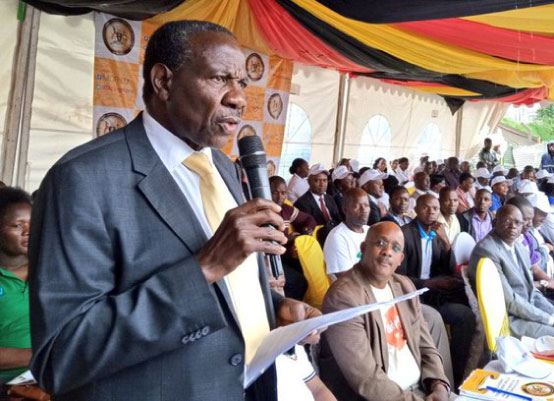
UCC boss Geoffrey Mutabazi, the man at the centre of the controversial letter asking editors to be sacked.

The Executive Director of Uganda Communications Commission (UCC) Eng. Godfrey Mutabazi is making headlines in the local media, social media following his directive to a number of private broadcast media houses that they suspend their senior staff on account of allegedly failing to adhere to the set minimum broadcasting standards.

The affected media houses include; NTV, NBS TV, BBS TV, Bukedde TV, Kingdom TV and Salt TV. Others are; Akaboozi FM, Beat FM, Capital FM, CBS FM, Pearl Fm, Sapientia FM and Radio Simba.

The above media houses are regarded by the Ugandan audience as some of the best information providers as they employ top-notch journalists including producers, editors and others. As such most Ugandans tune in to the above stations especially NTV, NBS, Bukedde TV, Capital FM, Akaboozi Fm and Radio Simba. This development seems to be a blow to Mr. Mutabazi who is paid by taxpayers to do his work.

The above broadcasters which launched in different years have ensured that the Uganda Broadcasting Corporation which runs different radio Uganda channels and UBC TV, remain unpalatable to the Ugandan audience due to poor organisation and poor programming.

The broadcast stations under attack by UCC have invested in infrastructure, human resource to deliver the quality programmes that have become popular with Ugandans to the extent that most Ugandans don’t really see any relevance of having a national broadcaster UBC, which despite being spent on billions of shillings by the taxpayers remains among local broadcasters with less audience. You only have to move across the country to realise that.

One wonders whether Mr Mutabazi is working to kill the creativity that the private broadcasters are introducing to the Ugandan audience. That he has asked for the sacking/suspension of journalists speaks volumes. In any profession workers make mistakes and sacking them is not the best option. Other remedies can be employed and Mutabazi who seems to be working tirelessly for the NRM regime in expectation of a future reward, cannot think of alternatives apart from firing the scribes.

UCC is also blamed slow pace ICT in rural areas where majority Ugandans leave. It has failed to do their major job and only seems to be focussed on media that UCC thinks is not in the good books of the current government.

UBC is on record for not availing presidential candidates equal time during campaigns in the recent past polls which is a violation of the electoral law. Dr Kiiza Besigye and his FDC party are on record for having dragged UBC to court on this issue even after paying fees for that work. In 2016 Supreme Court directive that UBC provides coverage to all candidates during campaigns. Unfortunately the public never saw Mutabazi reign on UBC for this unprofessional conduct. He kept quiet. It would be a different story for Mutabazi if a private broadcaster did the same.

Mutabazi fails to condemn harassing of journalists

In the past many journalists including broadcast journalist have been hit, beaten, and brutalised by both state security agents and other individuals but we have never heard UCC come out to condemn such acts on the journalists. In fact for Mutabazi, it appears his role is to see the private media erased from Uganda as it does not please his boss.

The UCC top officials has failed to recognise that he is also obliged to help the Ugandan media grow. Instead he appears to be working to kill them all, probably in favour of the boring UBC channels which government now wants to boost with an extra Shs18.5 billion despite the fact that they failing to attract audience. A few years back UBC got about Shs4 billion for revamping but that money was misused and as such UBC channels cannot compete with private ones which sink money in arrears that attract audience and as such attract advertisements.

We know that government has deliberately denied some private media houses advertisements just because they seem them as opposition linked channels. They would rather give them to those they see as mouthpieces of government. Government forgets that the private media houses employ Ugandans, pay taxes, use utilities but also co Parliament approves Shs18.5 billion to revamp national broadcaster that remains unattractive to the Ugandan audience. Parliament has approved a recommendation to provide up to Shs18.5 billion to complete the revamping of contribute to corporate social responsibility.

UBC failing to adhere to electoral reforms

UBC is on record for not availing presidential candidates equal time during campaigns in the recent past polls which is a violation of the electoral law. Dr Kiiza Besigye and his FDC party are on record for having dragged UBC to court on this issue even after paying fees for that work. In 2016 Supreme Court directive that UBC provides coverage to all candidates during campaigns. Unfortunately the public never saw Mutabazi reign on UBC for this unprofessional conduct. He kept quiet. It would be a different story for Mutabazi if a private broadcaster did the same.

Stories Continues after ad

Local sribes working under ‘critical’ conditions- CCEDU

CCEDU Coordinator Crispin Kaheru

Journalists in Uganda are working under ‘critical conditions’ but must also work hard to avoid interference from state actors and other agents, according to the civil society organisation-Citizens’ Coalition for Electoral Democracy in Uganda (CCEDU).

The organisation’s Coordinator Crispin Kaheru in his May 3rd message on the occasion to mark World Press Freedom Day (WPFD) 2019, says local journalists are being targeted; in some cases harassed, attacked or restricted from doing their jobs as 2021 general election approaches.

“Our journalists are working under critical conditions and in a stressful environment. Such a context makes it difficult for the media to ensure effective transparency and accountability during political processes including elections,” Kaheru says as Ugandan journalists prepare to join the rest of colleagues in the world to mark this year’s World Press Freedom Day.

The main celebration of World Press Freedom Day 2019 is taking place in Addis Ababa, Ethiopia from May 1-3 under the theme; ‘The role of media in elections and democracy’. The event will provide a platform for multiple actors to exchange on current issues, threats and achievements concerning freedom of the press. Some 100 national events around the world are expected to complement the main celebration.

“This year’s World Press Freedom Day theme speaks directly to Uganda’s current times.

The media needs both access to information and the freedom to freely and safely communicate that information. In Uganda, that space seems to be getting more and more constricted,” he says.

He urges the media in Uganda to decisively stand up for itself, fight fake news, disinformation and report fairly without fear or favour. “Whereas civil society reiterates its unwavering commitment to free press, the media itself is going to be its own savior,” he says, wishing the entire media fraternity, a rewarding World Press Freedom Day, 2019.

Mr. Kaheru’s comments come at the time when the Ugandan Communications Commission (UCC) has directed some top media houses in the country to fire their producers, editors and senior reporter for alleged nonadherence to UCC broadcast guidelines. The affected media houses are; NTV, NBS TV, BBS TV, Bukedde TV, Kingdom TV and Salt TV. Others are; Akaboozi FM, Beat FM, Capital FM, CBS FM, Pearl Fm, Sapientia FM and Radio Simba.

However, the event in Ethiopia will also host an academic conference on the safety of journalists which will allow researchers from different disciplines to share and discuss recent research. This will be the fourth edition of the conference, aimed at bridging the gap between academic research, policy-making and journalism.

As in the previous years, WPFD will host a Youth Newsroom, which will bring on board young journalists and journalism students to cover the event and expand their reporting skills.

A number of cultural events and performances will be included in the programme.

Stories Continues after ad

Hilton Garden Inn joins Ugandan market as it expands footprint in Africa

Hilton Garden Inn-Kampala

Hilton Garden Inn Hilton’s globally recognized midscale hotel brand, is celebrating strong growth in Africa with four open properties and an additional 14 in the pipeline just three years after opening its first hotel on the continent in 2016. Many of these properties represent first-in-country openings for Hilton Garden Inn and for the Hilton enterprise as a whole, including Botswana, Zambia and Uganda.

Speaking from Africa’s Travel Indaba, John Greenleaf, global head, Hilton Garden Inn said, “We have positioned Hilton Garden Inn for success in Africa with a prototype developed specifically for the region. This prototype has been curated to meet the expectations of both travelers and owners throughout Africa, while maintaining the brand’s signature light, bright and airy design as well as the consistent, core guest offerings and amenities that the brand is recognized for around the world.”

Each hotel is built in the Hilton Garden Inn tradition featuring modern guest rooms perfect for work and comfort. Guests may unwind in a relaxing social setting, enjoying handcrafted cocktails, light bites or dinner. The Shop, a 24-hour, grab-and-go retail space, offers an upscale mix of healthy, indulgent and fresh foods, varietal beverages and a self-serve specialty coffee bar.

To date, Hilton Garden Inn has four properties and nearly 800 rooms open in Africa, including:

Morocco: Hilton Garden Inn Tanger City Center (Opened March 2016) – Hilton Garden Inn’s initial entry into Africa, this property is steps away from the beach and the famed Tanger City Mall with stunning views of the city and Mediterranean Sea

Kenya: Hilton Garden Inn Nairobi Airport (Opened February 2018) – Hilton Garden Inn’s first property in Kenya is a welcoming oasis close to Nairobi’s international airport with a rooftop infinity pool

Zambia: Hilton Garden Inn Lusaka Society Business Park (Opened August 2018) – Zambia’s first Hilton hotel, this Hilton Garden Inn property is centrally located in the heart of Lusaka City, perfect for business travelers

Botswana: Hilton Garden Inn Gaborone (http://bit.ly/2vxo17N) (Opened February 2019) – Hilton’s first hotel in the country, this Hilton Garden Inn property is centrally located in the city’s new Central Business District.

“Countries such as Botswana and Uganda are some of the fastest growing economies in the world, with impressive visitor offerings. The Hilton Garden Inn brand appeals to the rise of middle-class travelers into and across Africa, providing an opportunity for us to open hotels and meet guest demand in key destinations,” said Jan Van Der Putten, VP Operations, Africa and Indian Ocean, Hilton.

With 14 hotels and nearly 2,400 rooms in the Africa pipeline, Hilton Garden Inn Kampala in Uganda and Hilton Garden Inn Mbabane in Eswatini are in the pipeline to open this month as first-in-country properties for both Hilton Garden Inn and the Hilton enterprise. The pipeline also projects Hilton Garden Inn Windhoek in Namibia to open later this year, another first-in-country for Hilton Garden Inn. Other African countries in the Hilton Garden Inn pipeline include Malawi, Uganda, Ghana, Egypt, Democratic Republic of Congo, Ethiopia, Ghana, Nigeria and South Africa.

As Hilton Garden Inn expands in Africa, the Hilton enterprise as a whole is also expected to double its footprint across Africa from 44 hotels today to almost 100 over the next several years. Hilton, which is celebrating its 100th anniversary this month, has a rich legacy of hospitality leadership in the region. As shared in The Hilton Effect, Hilton was the first international hotel brand in the newly created capital of Abuja more than 30 years ago. Hilton produced infrastructure, created sewage and electric systems, built factories, paved roads and recruited team members from around the world to quickly teach locals – many of whom had never set foot in a hotel – to deliver five-star service to nearly 1,000 government officials.

Stories Continues after ad

Local cancer testing IT tool in continental innovation challenge finals

The setup of BreastIT equipment. Image credit, PCTech Magazine

BreastIT, a Uganda health firm employing artificial intelligence (AI) in diagnosing breast glitches, including cancer will this coming week face off with other seven companies at the regional finals of the 2019 ASME ISHOW in Kenya.

Also known as ASME Innovation Showcase (ISHOW), the global innovation competition whose 2019 edition was rolled out in January, islooking for hardware-led ventures that can tackle problems in the environment, education, health, safety, energy, water & sanitation, economy & community, and agriculture sectors.

For the 2019 ASME ISHOW, organizers earmarked US$ 500,000 (about Shs1.9 billion) and it will be given out to nine winners in cash and in-kind services “based on individual need for scaling their respective hardware solution.”

However, for the Kenyan competition, the eight startups that made it to finals will compete for the final grand prize of US$30,000 (about Shs112.0 million). It will be divided among the best three, with each walking away with US$10,000 (roughly Shs37.6m).

Aside from, BreastIT, the other contenders are E Tuk Tuk (Kenya), hearX Group (South Africa), Safi Organics (Kenya), Savanna Circuit Tech (Kenya), SAYeTECH (Ghana), Sesi Technologies Ltd (Ghana), and Solar Freeze (Kenya).

The first regional 2019 ASME ISHOW was held in India on April 4 and after Kenya, the competition will be in the USA on June 14.

The best teams will then proceed for the ISHOW Bootcamp in New York. In this competition, Uganda has been previously represented by Matibabu (which Moris Atwine, one of three co-founders of BreastIT [others being Alvin Kabwama and David Mwesigwa] is also part of), Lumenda, Musana Carts, and PedalTap.

BreastIT is a portable AI-powered diagnostic tool for screening breast cancer. It’s composed of a Glove for screening and software for image analysis. The tool is a handheld, pocket-sized ultrasound imaging system that empowers radiologists to make focused assessments and accelerate treatment decisions at the point of care.

With real-time cloud processing that offers quick and accurate analysis, radiologists are able to take decisive action, refer patients quickly, optimize the course of treatment, and reduce the overall cost of care in low-resource settings.

Stories Continues after ad

Abbott receives WHO prequalification approval for breakthrough HIV point-of-care test

The approved tool

American health care company, Abbott announced Thursday that m-PIMA™ HIV-1/2 VL, the world’s first point-of-care viral load diagnostic test, has received the World Health Organization’s Prequalification approval (WHO PQ). The test received CE Mark in December 2018.

“m-PIMA HIV-1/2 VL is the only truly portable molecular point-of-care test designed specifically for use in resource-limited settings such as in sub-Saharan Africa,” said Damian Halloran, vice president, Infectious Disease – Emerging Markets, Rapid Diagnostics, Abbott. “With WHO PQ, global funders and ministries of health can now confidently expand access to viral load testing, reaching more people who need the test, with the most compact and efficient point-of-care HIV diagnostic platform available anywhere in the world today.”

To provide the most effective HIV treatment and care, the WHO recommends that everyone receiving antiretroviral therapy (ART) undergoes a viral load test at 6 months and 12 months, and annually thereafter, if the individual is stable on ART. Viral load testing is the gold standard for monitoring ART treatment failure. Unfortunately, very few people in resource-limited settings, such as select countries in sub-Saharan Africa, Asia and Latin America, have access to the necessary level of care.

Abbott’s m-PIMA HIV-1/2 VL is a quantitative nucleic acid amplification test for viral load measurement of HIV type 1 groups M/N and O, and HIV-2 in plasma samples. The platform is portable so it can be brought into the most remote locations. It’s easy to use, deployable at the point of care and designed to measure viral load in under 70 minutes, while the patient is still present. This allows people to receive results during the same visit and enables immediate treatment decisions, thereby reducing the number of people lost to follow-up. The test’s quick turnaround time is particularly valuable for monitoring the viral load of HIV-positive pregnant women and in cases of suspected HIV treatment failure.

The m-PIMA HIV-1/2 VL is part of Abbott’s comprehensive portfolio of diagnostic solutions for HIV screening, monitoring and viral load management. From the core lab to the point of care, Abbott provides critical tools to help healthcare providers make informed treatment decisions for people living with HIV.

WHO Prequalification (PQ) aims to ensure that diagnostics, medicines, vaccines and immunization-related equipment and devices for high burden diseases meet global standards of quality, safety and efficacy, to optimize use of health resources and improve health outcomes.

The prequalification process consists of a transparent, scientifically sound assessment, which includes dossier review, consistency testing or performance evaluation and site visits to manufacturers. This information, in conjunction with other procurement criteria, is used by UN and other procurement agencies to make purchasing decisions regarding diagnostics, medicines and/or vaccines.

Stories Continues after ad

Gov’t impounds medical items worthy Shs490m

Minister Aceng and NDA board chairman, Dr. Merdard Bitegyerezo.

The Minister of Health, Dr. Jane Ruth Aceng, has revealed that in the joint operation of National Drug Authority (NDA), Police and Health Monitoring Unit (HMU), they have impounded 981 boxes of assorted medical items valued at Shs490 million of which some boxes had medicines intended for public health facilities.

The operations begun in Eastern Uganda and Kampala where teams conducted operations in five major shift markets in the districts of Bukedea, Soroti, Bulambuli, Manafwa, Serere, Budaka, Ngora, Mbale, Kaberamaido and Soroti.

The minister said the operations are aimed at intercepting dealers in medicines intended for public health facilities with intentions of selling them to the private sector or export them to other countries. The clampdown on a racket involved in deliberate alteration or re-labeling of expired medicine and prevent its use by the population and crack down on dealers in substandard, and counterfeit medicines.

“This pilferage compromises the quality of health service delivery hence discrediting government programmes and yet government continues to increase the medicines budget annually and improve the supply chain.” She said at Media Centre.

In the next financial year 2019/2020, the medicines budget has been increased by 24 per cent from Shs300 billion to Shs396 billion. Government has also ensured that there is no funding gap for ARVs and anti-malarial.

She expressed her concern over hawkers of medicine who have no knowledge in handling medicine, exposing the unsuspecting population to health risks with their unverified claims, “Such individuals sell substandard, fake, and counterfeit medicines.” She added.

“We call upon the public to join efforts with the Ministry of Health and NDA to eliminate this vice in shift markets, in parks, buses and other public places. If you stop buying drugs from hawkers, they will abandon the vice.” She noted.

She appealed to all stakeholders and the wider public not to steal or sell medicines meant for the population of Uganda and called on the public to guard medicines supplied by government so that they are accessed by the population at no cost as indicated on the packages, “Not for Sale”.

Stories Continues after ad

Uganda media attacked as 39 TV and radio managers are asked to be sacked

Uganda Communications Commission (UCC) Executive Director Eng Godfrey Mutabazi.

Uganda Journalists Union (UJU) on Thursday condemned in the strongest terms possible the directive by the regulator Uganda Communications Commission (UCC) to sack 39 Editors that include Head of News, Producers and Heads of Programs at 13 radios and television channels.

UCC Executive Director Mr Godfrey Mutabazi said they have concerns over the nature of content aired on the broadcast stations particularly during live programs, breaking news and main news bulletins which do not comply with minimum broadcasting standards. The affected media houses include NBS TV, NTV, Bukedde TV, BBS TV, Salt TV, CBS radio, Akaboozi radio, Kingdom TV, Pearl FM, Radio Sapientia, Capital radio and Beat FM radio. NBS TV has been directed to submit to UCC within three days, recordings of all live programs and news bulletins aired on April 29, 2019, failure of which would lead to punitive sanctions by commission. The concern of Ugandan government is the manner in which independent Television channels and radio stations cover live news in which opposition politicians or people with divergent views are given undue prominence.

Uganda Journalists Union President Ms Lucy Anyango Ekadu said the UCC directive should be condemned in the strongest terms possible and with all the contempt it deserves. She said the latest developments are just reminiscent of the draconian laws by past dictatorial regimes that aim at intimidating journalists, suppressing freedom of expression, stifling voices of dissent, and in a long run muzzle media freedom.

‘’The directive by the UCC is a deliberate move to intimidate journalists, stifle voices of dissent, and suppress divergent views while muzzling media freedom in the country‘’, She said. Ms Lucy said as a watchdog of society the media has a duty to communication to the public independently, objectively and responsibly using a multiplicity of sources at their disposal without fear or favour.

‘’ We have noted growing cases of press freedom violations in Uganda with impunity where many journalists are intimidated, beaten, tortured, arrested and detained sometimes incommunicado by security agencies,” she said.

Uganda Journalists Union calls on President Yoweri Museveni to rescind the UCC decision which has been condemned by global journalists with Uganda ranked among worst Press Freedom violators in the world. The International Federation of Journalists (IFJ), International Observatory of Human Rights, Committee to Protect Journalists (CPJ), International Media Support (IMS), the Federation of African Journalists (FAJ). Kenya Union of Journalists (KUJ), Kenya Editors Guild, Al Jazeera Media Network, BBC World Service, Freedom House, Article 19, Centre for Media Ethics, among others have shown solidarity with Ugandan journalists. Globally journalists will mark World Press Freedom Day on May 3, 2019 with the main event taking place at the African Union headquarters in Addis Ababa.

Stories Continues after ad

SC Villa survive relegation

SC Villa team

Just like Express FC last season, there is always a big club that sleepwalks through the season and this time, with only one win from the opening 10 league games of the season and continuous administrative turmoil within the club, SC Villa looked like they were set for relegation.

But the 16-time record Ugandan league champions have managed to survive the red zone with one game left to play after the Ndejje University vs Onduparaka result went their way.

Possibly the worst season for the Jogoos they’ve had, having accumulated only 31 points from 29 games, for a team that came third the previous season.

SC Villa will now seek to rejuvenate themselves next season, recruit better players that will help them search for a league title they last won in 2004 under the guidance of former Uganda Cranes manager Micho.

The Jogoos will play Nyamityobora in the final game of the season on Saturday 4th May.

Ndejje University have been relegated to the second tier, Fufa Big League after just one season in top flight football having lost 1-0 to Onduparaka on Thursday afternoon. Viane Ssekajugo scored the only goal two minutes from time.

The Students have got 26 points from 29 games, which means they cannot overtake Villa, who are five points ahead of them.

KCCA FC were confirmed 2018/19 StarTimes Uganda Premier League champions and await to lift the trophy in their last game at the StarTimes stadium in Lugogo on Saturday, 4th May against Maroons.

All the three clubs that were promoted to The UPL last season, have been relegated back to the Fufa Big League; Ndejje University FC, Nyamitobora FC and Paidha Black Angels SC.

ed.

Stories Continues after ad

Court releases Bobi Wine, tells him to stop taking part in protests

Bobi Wine in court.

The Buganda road Magistrate Court, has granted bail of Shs1 million cash bail to Kyadondo East MP, Robert Kyagulanyi aka Bobi Wine after spending three days on remand at Luzira prison.

Mr. Kyagulanyi, was on Monday arrested at Kalerwe market on his way to Kibuli Police Criminal Investigation Department (CID) where he was summoned over allegations of breaching of police guidelines and traffic rules.

He was produced before Buganda Road Court Magistrate, Esther Nahirya and charged with disobedience of statutory duty contrary to section 116 of the Penal Code Act, committed in July 2018 and subsequently remanded to Luzira prison.

Through his layers led by Bugiri Municipality MP, Asuman Basalirwa, bobi Wine did not relent, applied for bail a constitutional right to every citizen of Uganda.

The bail application was heard through teleconferencing, a service which doesn’t require inmates to physically appear before court for their cases to continue. Bobi wine is the first inmate to be tried under teleconferencing since it was launched last month. The fully packed court was presided over by Esther Nahirya.

In his submissions, self-proclaimed Ghetto president told the presiding judge that, “whatever you decide is not my business, I stand for the truth and what is right for you, me and those persecuting me. If standing for what is right is going to keep me in prison then be it so, after all, I have a lot of what do here.”

He presented former Minister of Ethics, Miria Matembe, Kasambya county MP, Gaffa Mbwatekamwa, he was granted Shs1 million cash bail as his sureties were ordered to pay Shs10 million not cash.

The MP was restricted from participating in protests and told to report back to court on the May 23, 2019.

Stories Continues after ad

We haven’t let Bagyenda off the hook, we are still investigating her wealth- IGG Mulyagonja

Embattled former Executive Director in charge of Supervision at Bank of Uganda Justine Bagyenda.

The Inspector General of Government (IGG), Justice Irene Mulyagonja, has said that the investigations and verification process into the property of the former Bank of Uganda (BoU) Executive Director in charge of Supervision Ms. Justice Bagyenda is under way and soon a report will be released.

Mulyagonja said while briefing journalist at the Uganda Media Centre on the forthcoming 9th Commonwealth Regional Conference for heads of anti-corruption agencies in Africa. Uganda is the host of the conference.

The IGG’s investigations followed a petition that was filed by a whistle blower questioning the accumulated wealth of Bagyenda who was a key player in the closure of Global Trust Bank, National Bank of Commerce and Crane Bank Limited.

The investigations are also based on the report of the of the Financial Intelligence Authority (FIA) that did also handle issues to do with money laundering against Bagyenda as well as possible tax evasion.

The IGG said if Bagyenda is found culpable, she will be tasked to explain the accumulation of her wealth in relation with her salary she was receiving from in BoU before she retired and as well other sources of income that will be verified by the inspectorate. She said the report will be handed over to parliament and the petitioner.

She said Bagyenda stands to be prosecuted in courts of law if she fails to explain the source of her wealth that includes various properties in Kampala and money on various accounts in billions of shillings.

“You are aware that parliament decided that any person investigated and found culpable is taken to court. If that person is innocent, the report is directly handed over to him or her, so wait for us to finalise the process and it is the findings that will determine the way forward,” She said.

Since 2018, IGG’s office has always claimed it is almost done with the investigations that include verification and that the report will soon be given to the petitioner and parliament that was carrying out a wider inquiry into BoU over seven defunct banks that were closed by BoU without following proper procedures.

Asked by this reporter whether her office is still relevant since she has failed to hand in the report on Bagyenda, she said her office is still important since it is established by the law and that will continue to handle all the cases received.

She also said they her office is digging deeper to establish and verify the findings of the FIA report to see if Bagyenda did not disclose certain properties of hers.

Stories Continues after ad