Stanbic Bank
Stanbic Bank
28.6 C
Kampala
Stanbic Bank
Stanbic Bank
Home Blog Page 1419

Becoming a Papal awardee: Professor Noble Banadda’s story

Prof. Noble Banadda receiving the Pius XI medal from Pope Francis at the Vatican on November 12, 2018.

Professor Noble Ephraim Banadda grew up dreaming of becoming a medical doctor like some of the close relatives he grew up admiring. Born in May 1975, his early childhood was spent around doctors of the Mulago National Referral hospital in Kampala (Uganda). He vividly remembers afternoons spent in the doctors’ cafeteria surrounded by doctors in pristine white lab coats, discussing difficult cases of the day around a white table while taking tea from white teacups.

The young Noble admired these intelligent folks and wanted to be like them. This attraction towards medicine was cemented by his cousins and brothers who later studied human and animal medicine.

During his mid-teens, in the 1980s, however, Noble decided he was not cut out for the field of medicine after all. The allure of prestige associated with being a doctor was surpassed by the horrendous scene of HIV/AIDS patients he now saw at the hospital. HIV/AIDS was a new disease then and patients experienced dire symptoms and stigma. It did not help matters that he feared the sight of blood. That marked the end of his medical dream.

Starting his career

Even though Noble now knew he did not want to be a medical doctor, his general interest in the sciences did not wane. His passion shifted to engineering and for his first degree he applied to join Makerere University from Kyambogo College School where he had completed his high school education studying Physics, Chemistry and Mathematics. He eventually joined Sokoine University in Tanzania as an exchange student for a Bachelor’s Degree in Food Science and Technology. At the time (1994), all engineering courses and practicals were conducted at University of Dar-es-Salaam so he spent time in both universities. Studying in Tanzania also helped him fulfill his ambition of travelling at an early age and gaining exposure to the world.

For his master’s and PhD degrees, he attended the prestigious Katholieke Universiteit Leuven, Belgium, a university established in 1425 and colored with a rich scholarly and theological history including training philosophers that later became Popes. Noble was the first black student to be admitted to study a PhD in Chemical Engineering at the university. Upon completion of his studies, he was offered a job at BASF, one of the biggest chemical engineering companies in the world, but he turned it down to return home to Uganda even though he had no job there. Uganda was home and he loved his country. In 2007, Noble undertook post-doctoral training in chemical engineering at Massachusetts Institute of Technology (MIT) in the USA.

Back in Uganda, finding a job was not easy for him, for although he had impressive academic credentials, he lacked work experience. He eventually got a job at Makerere University through one of his former lecturers at Sokoine University of Agriculture who knew the then-head of Department of Food Science and Technology, H.E. Professor Joyce Kikafunda, now Uganda’s High Commissioner to the United Kingdom.

Noble started out as a part-time lecturer at Makerere University’s Department of Food Science and Technology on 1 June 2006, and was only confirmed a full-time lecturer in 2012 when the college system was instituted and he was subsequently elected head of the newly created Department of Agricultural and Bio-systems Engineering. In the same year, he was fast tracked to the position of Professor at just the age of 37. In 2016, he was also appointed a visiting Professor at Iowa State University in the USA.

Among the many feathers in his cap, Noble is a Next Einstein Fellow, fellow of the Uganda National Academy of Sciences, Co-chair of the Uganda National Young Academy, registered Engineer with the Institute of Engineers Tanzania, alumnus of the Global Young Academy, registered member of the American Society of Agricultural and Biological Engineers, member of the Malabo Panel of Experts, and member of Makerere University Senate.

Receiving the Pius XI Medal from Pope Francis

How he came to be selected to receive the Pius XI medal, Noble has no clue. The selection process is a well-kept secret, but is done by a team from the Pontifical Academy of Sciences, headquartered in the Vatican City. The Pontifical Academy of Sciences is one of the oldest academies in the world and is comprised of strictly 80 members. Membership is for life.

Award of the medal was done by Pope Francis himself during a meeting held in the Papal wing at The Vatican on 12 November 2018. For Noble, meeting the Pope was an unforgettable moment. He described it as, “an experience I had never had before and perhaps never will again”. Noble was awarded for his outstanding scientific research and publication, but was himself amazed at the caliber of researchers at the Pontifical Academy of Sciences. He aspires to one day join the prestigious academy whose alumni include Galileo Galilei and a number Nobel Prize winners in the fields of medicine, physics, space engineering, mathematics and stem biology.

Research profile

With 104 peer reviewed journal publications in 2017 alone, Noble is competitively one of the top ranked researchers at Makerere University where he is still serving. His research profile includes research awards from RUFORUM which he first won in 2011 through the RUFORUM Competitive Graduate Research Scheme. His research was to investigate contamination risks associated with wrapping indigenous foods in plastic bags during cooking. In 2015, he won a second grant to carry out research on producing ethanol from low cost agricultural biomass. Outside RUFORUM funding, Noble has engaged in other researches that have resulted in innovations such as the Makerere University MV Mulimi a multi-purpose farmer’s tractor capable of threshing maize, pumping water for irrigation, charging phones, hauling agricultural produce up to one tonne, and ploughing fields; a new technology of making diesel from heavy plastics; an organic pesticide from agricultural waste; and a low cost solar-powered Irrigation pump.

Ingredients for Success

Noble accredits RUFORUM for having contributed significantly to his research profile acknowledging that sometimes as a scientist, one can have great research ideas, but miss out on funding because of poorly written proposals, non-compliant budgets, or failure to secure partnerships. He is grateful to RUFORUM for stepping in to fill this role through organizing scientific writing workshops, brokering partnerships and other support.

His first interaction with RUFORUM was when he first applied for a grant and he has never looked back. One of the greatest benefits he considers from this engagement is international exposure which he would like to see RUFORUM continue to do through activities like mobility grants, exchange programmes and internationalization of research teams. He also enjoys working with Prof Adipala whose tenacity and dynamism he admires. “The first time we met, we hit it off immediately at a personal level. I like working with people who are tenacious and dynamic. Prof Adipala is that and more.”

Although he has won many research awards over the years, Noble is quick to point out that this comes neither easily nor by accident. Three key ingredients stand out for him for one to succeed as a researcher: working with winners, mentorship, and internationalization. He is particularly passionate about internationalization of one’s education and networks and encourages researchers to seek international exposure. “Even it is a 2-day training and there is no per diem for participation, attend, for you will not return the same.” He adds that for young researchers who want to follow in his footsteps, they should be focused, exercise self-discipline and start young, noting that the average age of achievers is now below 30 years.

Stories Continues after ad

Contribute to restore hope, dignity and lives of inmates- Jennifer Musisi

KCCA ED Jennifer Musisi

The Executive Director of Kampala Capital City Authority , Jennifer Musisi Semakula, has appealed to Ugandans to always make a contribution for restoration of hope, dignity and improving lives of inmates at various detention centers.

Musisi remarked during Corporate Social Responsibility (CSR) drive at Luzira Maximum Security Prison aimed at supporting, sharing love and a word of encouragement with prisoners at the facility.

“During my earlier visit in June this year, I learnt that the Prison school system has unique challenges, is resource constrained, and that, the learning environment and facilities have a negative effect on their academic achievement,” she said

The team donated school furniture, coupled with other amenities which include water systems to access clean water, stationery, cleaning equipment, scholastic materials among other supplies peddled at making their learning experience and environment conducive to subsequently improve grades for a chance to give them a better life once they are out of prison.

“The people at the facility are part of us and we should not forget them. It’s in our interest as Citizens to contribute to the welfare of the Prison Community. We are happy to make a contribution to their education, give them the support they need to thrive as they get reformed to enable them attain their Life dreams,” she said.

Stories Continues after ad

KCB, partners commit to ensure transparency, responsible banking

The KCB logo

The Kenya Commercial Bank (KCB) Group with outlets in Uganda and the rest of East Africa said Monday it partnered with 28 other global banks to launch the Principles for Responsible Banking in Paris, France.

Over 12 CEOs attended the launch of the Principles to initiate public participation during the first day of the Global Roundtable meeting, the bank said in a statement sent to newsrooms.

The Principles will define the banking industry’s role and responsibilities in shaping a sustainable future. The six principles selected (alignment, impact, customers and clients, stakeholders, governance and culture, transparency and accountability) speak to banking business and culture aligned to Climate Change, Sustainable Development Goals (SDGs), and relevant national and regional frameworks themes.

The Principles set the global standard for what it means to be a responsible bank and will ensure that banks create value for both their shareholders and society. They provide the first global framework that guides the integration of sustainability across all business areas of a bank, from strategic, portfolio to transaction level.

KCB said it has been actively involved in the drafting of the Principles alongside other global banks over the last eight months.

Speaking at the launch of the principles, KCB Group CEO Joshua Oigara said that his organisation believes in responsible business which according to him is about establishing and nurturing the foundation of growth for the next generation.

By signing the Principles for Responsible Banking when they are launched in September 2019, banks will commit to being publicly accountable for their significant positive and negative social, environmental and economic impacts. They agree to set public targets on addressing their most significant negative impacts and scaling up their positive impacts to align with and contribute to national and international sustainable development and climate targets.

“We believe responsible business is about establishing and nurturing the foundation of growth for the next generations. To succeed, banks need to bring their written policies into action through strategy for creating long-term value through sustainable banking. KCB Group believes that these principles will create a path towards achieving sustainable financial success and widen the door to financial freedom,” he said.

By developing the set of principles, the banks set out a clear purpose for the banking industry itself aimed at enabling investors, policy makers, regulators, clients and civil society to compare banks and hold them accountable for their environmental, social and economic impacts and their contribution to society’s goals.

Stories Continues after ad

Battle lines drawn at Dfcu Bank as pro-Kisaame staff scorn new MD, Sekabembe

William Sekabembe Dfcu-Bank-Uganda’s-Chief of Business and-Executive Director-William-Sekabembe

All is not well with new Dfcu Bank Managing Director, William Sekabembe, who faces resistance from some of the staff that didn’t want his predecessor and now Chief Executive Officer (CEO) Juma Kisaame to leave the bank.

Kissame officially leaves in the first quarter of 2019, according to a recent statement from the bank. He will be succeeded by Mathias Katamba. Katamba will take over the leadership role at Dfcu Bank as CEO starting from January 2, 2019. He formally worked with Housing Finance Bank as a MD.

On the other Sekabembe was Chief Of Business & Executive Director at Dfcu Bank but is now expected to work closely with Katamba.

An inside source says about six senior staff have tendered in their resignation letters because they don’t want to work under Mr. Sekabembe, who denied to join Kenya Commercial Bank (U) Limited, as MD.

The source says the stubbornness of the pro-Kisaame staff is making things difficult for Sekabembe who has been given targets that he must achieve.

Dfcu Bank has not had a smooth running since it took of Crane Bank Limited in a controversial transaction with the Bank of Uganda (BoU). Committee on Commissions, Statutory Authorities and State Enterprises (Cosase) is probing BoU top officials over the controversial sale of seven commercial banks

Kisaame has had notable achievements some of which include playing a key role in assisting Dfcu Limited, the holding company, realign the shareholding that brought on board strategic partners like Arise Investments BV that include Rabobank, Norfund (later NorFinance) and FMO. He also led the most successful acquisitions in the banking industry in Uganda when Dfcu Bank acquired some assets and took over some liabilities of Global Trust (U) Ltd Bank (In liquidation) in 2014 and later in 2017 acquired some assets and assumed some liabilities of Crane Bank Limited (In Receivership).’

The Chairman went on to express his appreciation to Kisaame for his professional and personal commitment during his tenure as CEO and his extraordinary leadership that increased shareholders value; saw Dfcu Bank rise to become the second largest bank in the country; resulting in three-fold balance sheet growth to over three trillion Uganda shillings, a customer base of close to one million and a network of 65 branches.

Stories Continues after ad

Uganda’s export receipts hit US$300 in September

Uganda’s export receipts in September 2018 amounted to US$ 300.12 million compared to USD 298.84 million in August 2018, according to the latest Performance of the Economy Report, published by the Ministry of Finance Planning and Economic Development (MFPED).

The report attributes the increase majorly to increased volumes of gold and tobacco by 36.9 percent and 55.1 percent respectively compared to the previous month.

“Compared to the same month in 2017, the improvement in export receipts in September 2018 was on account of increased volumes of gold, tobacco, fish and sugar,” the report reads.

However, according to monthly the report, export receipts from coffee Uganda’s main export earner, declined both in value and volume compared to the previous month and the same month in 2017. The decline is due to mainly low international prices following higher production in Brazil; as well as lower production volumes especially from Masaka and South-Western regions which are the main coffee growing regions.

Destination of Exports

The East African Community (EAC) remained the major destination for Uganda’s exports in September 2018, followed by the Middle East and Rest of Africa. Exports to the EAC region grew by 11.6 percent from US$ 104.94 million in September 2017 to US$ 117.09 million in September 2018. Kenya took the largest share of EAC exports (48.3 percent), followed by Rwanda (19.4 percent) and South Sudan (18.3 percent).

Merchandise Imports

Meanwhile Uganda’s value of imported merchandise declined to US$ 462.4 million in September 2018, from US$ 501.60 million recorded in the previous month. “The decline was driven by a decrease in the values of both Government and private sector imports Volumes and prices of non-oil imports dropped by 6 percent and 2 percent, respectively, partly explaining the decline in the value of imports,” the report reads.

Compared to the same period the previous year, the value of imports declined by 3.2 percent. Whereas the value of private sector imports increased by 19.4 percent, the decline in the value of Government imports more than offset the increase.

Origin of Imports

Asia remained the largest source of imports during the month, contributing 42 percent of the total merchandise imported. Middle East and EAC contributed 20 percent and 15 percent respectively of the total imported merchandise, making them the second and third largest sources. Of the imports from Asia, 77 percent was from India, China and Japan while of the merchandise imported from the EAC, 89 percent was from Kenya and Tanzania.

Stories Continues after ad

Uganda’s economic activity improves in October

Construction attracted biggest share of private sector credit.

During October 2018, economic activity is seen to have improved as indicated by the high frequency indicators of economic activity, according to the latest performance of the economy report published by the Ministry of Finance, Planning and Economic Development (MFPED).

According to the report, the composite indicator of economic activity (ciea) increased by 0.9 per cent in the month compared to a 0.8 per cent improvement in August 2018. The business tendency index (BTI) and Purchasing Managers Index (PMI) were above the 50.0 threshold at 56.7 and 56.6 in October 2018, up from 56.5 and 54.2 respectively in the previous month.

The report shows that annual headline inflation declined to 3.0 per cent in October 2018, from 3.7 per cent recorded in September 2018, largely on account of a deceleration in food crops and related items inflation. Food crops and related items inflation dropped due to lower prices of fruits as a result of increased supply. Annual Core and annual Energy, Fuels and Utilities (EFU) inflation also declined to 3.5 per cent and 6.9 percent in October, 2018 from 3.9 per cent and 10.1 per cent in September 2018, respectively.

On the other hand, The Ugandan Shilling appreciated by 0.6 per cent against the US dollar; recording an average midrate of Shs3,777.98/US$ in October 2018, compared to an average midrate of Shs3,800.68/US$ in September 2018. This was on account of higher supply of the US dollar due to increased inflows to NGO’s, coffee export receipts and offshore players.

According to the report, the stock of total outstanding private sector credit continued to expand in September 2018, recording a growth of 2.5 per cent compared to the previous month. Total stock of PSC in September was Shs13.89 billion which was higher by Shs338.68 billion compared to August 2018, due to pick up in economic activity.

By sector, the largest holders of private sector credit stock were: building, mortgage, construction & real estate; and trade- each of which accounted for 20 per cent share of outstanding private sector credit. The other sectors with big shares are personal and household loans (18 per cent), agriculture and manufacturing each with 13 per cent shares.

Meanwhile, Interest rates on treasury bills edged upwards across all tenors. The average weighted yields to maturity for October were 11.5 per cent, 13 per cent and 13.7 per cent for the 91, 182 and 364 day tenors higher than 10 per cent, 11.9 per cent and 12.3 per cent respectively in September 2018.

Uganda`s merchandise trade deficit narrowed both compared to the previous month and the same month in 2017, owing to simultaneous reduction in value of imports and increase in export receipts, says the report.

The merchandise trade deficit improved to US$162.3 million in September 2018 from US$202.8 million registered in August 2018.

Stories Continues after ad

Germany boosts African continental trade deal

African Continental Free Trade Area

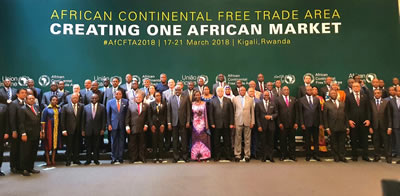
Germany has donated 1.6 million euros to United Nations Conference on Trade and Development (UNCTAD), to help the agency work with African partners to implement the landmark African Continental Free Trade Agreement (AfCFTA) meant to commerce across borders.

“This is a big new step forward in the economic development of Africa,” said Ambassador Hans-Peter Jugel, Germany’s deputy envoy to the United Nations in Geneva, adding that the African Union had sought UNCTAD’s support to meet the aims of the AfCFTA.

“We trust in UNCTAD’s competences and expertise in making trade facilitation operational,” Jugel said.

“Germany is already a leading supporter of UNCTAD’s work. This fresh funding is a clear sign of the country’s commitment not only to making trade work for development, but also to multilateralism. That sends a strong signal in challenging times,” UNCTAD Deputy Secretary-General Isabelle Durant said.

“The projects that Germany is backing will play a key role in helping Africa meet the new trade objectives that the continent has set itself,” she said.

UNCTAD provides policy advice and technical cooperation to help poorer countries reap more benefits from the global economy, and regional integration is a key part of that process.

The German funding, which runs from November 2018 to December 2020, focuses on enhancing trade by building the capacity of African stakeholders to address the key objectives of the AfCFTA’s Protocol on Trade in Goods.

Among the areas in the UNCTAD projects are non-tariff measures (NTMs). While tariffs make headlines and are generally recognized as a blunt instrument used by protectionists, they are far from the only phenomenon influencing trade flows across borders – and not even the most important, some analysts say.

Regulations on imported goods and products, either with the intention of limiting them, like quotas, or controlling them, like health and safety requirements, comprise a broad category of measures which can impact the scale and shape of trade with and between developing countries.

Helping the authorities and firms in developing countries to understand NTMs and adapt to them in order to trade across borders is an important part of UNCTAD’s work.

NTMs are estimated to be three to four times more restrictive than current tariffs. This importance has been reflected in the ambitious AfCFTA Appendices on Non-Tariff Barriers, Sanitary and Phytosanitary Measures and Technical Barriers to Trade.

The German-funded project will scale up the existing, UNCTAD-supported NTM reporting, monitoring and elimination mechanism of the Tripartite – a grouping formed by the Common Market for Eastern and Southern Africa, the East African Community and the Southern African Development Community. It uses an online tool to enable private sector operators to report trade barriers, which are then addressed and resolved in an intergovernmental mechanism.

Furthermore, the project aims to increase transparency about all NTMs, in particular regulatory and behind-the-border measures, through comprehensive data collection and dissemination to the public and private sector.

The project aims to help African countries increase their capacity to trade knowledge-based products and handle intellectual property rights, thus assisting them to become less dependent on commodities and raw materials.

Stories Continues after ad

Eight steps to assembling the most talented startup team

Martin Zwilling

By Martin Zwilling

With the pace of change ever escalating, entrepreneurs today can’t afford to acquire talent through traditional hiring alone, and need to revise the perception that “talent” is only full-time employees. At the same time, more people in the workplace don’t want to be “employees.” According to an Intuit study, that number is quickly rising and will approach 40 percent by 2020.

The answer to both is a new fast and flexible talent strategy based on freelancers, consultants, experts, and specialists, who are part of the new “1099 economy” including Baby Boomers and Millennials. For the full picture, see the classic book, “Navigating the Talent Shift,” with convincing arguments by Lisa Hufford, Founder of Simplicity Consulting talent solutions.

The author outlines eight necessary steps for every business and entrepreneur to capitalize on this movement to on-demand project teams, versus permanent hires. These steps are the new keys to driving business innovation, controlling costs, staying nimble, and getting better results:

Build teams to meet goals rather than organization charts. Too many entrepreneurs, as they grow their business, are focused on hiring to fill a traditional organization chart, rather than acquiring skills and talents to meet their current goals and needs. They use generic job descriptions and plan for long-term business stability, which rarely happens.

Focus on deliverables and skills required right now. Conventional hiring strategies usually follow a vanilla approach to talent acquisition. It’s a numbers game of filling positions, without clarity on the expertise needed to deliver now. With contract players, you assume a project duration, with easy transition to new players for the next campaign.

Prioritize objectives and seek expert talent to match. For example, if your first scaling effort is a global one, you should be prioritizing “global launch experience.” The notion of holding out for the “expert in all domains” wastes too much time, effort, and money. In fact, you will never predict required pivots, and generalists rarely outperform specialists.

Build an on-demand team of strategic do-ers. The most effective people to execute strategic initiatives are likely ones who have recently led similar activities in multiple related environments, not ones who have been grown and trained inside. This team of specialist consultants is then easily tuned as your strategy evolves based on the market.

Think in terms of projects to keep up with an evolving strategy. Each strategic priority should be managed as a project. Some projects are big and long-term, while others are small and more tactical. Projects need not be constrained by organizational boundaries, long-term budgeting, or conventional staffing and training practices.

Stay nimble by quickly filling gaps in the existing team. When you identify a skills gap or feel you need additional expertise or insight, signing up on-demand help is the only timely solution. Assigning an existing team member who isn’t qualified, or is already overloaded, will likely delay both projects, and kill existing team member motivation.

Leverage the broadest possible network. The on-demand specialized talent pool already includes 65 million people not interest in being full-time employees. By leveraging this broader network, you will improve your probabilities of finding the right skills and experience for your current project, and bring fresh ideas and solutions into your team.

Maintain budget flexibility as the business changes. By leveraging on-demand experts, you pay only for the vital work you need immediately, not the overhead and ongoing costs (development, training, severance, benefits) that go along with hiring full-time employees. It’s the best way to handle budgetary restrictions and cuts.

This on-demand talent model, dubbed SPEED by the author (Success, Plan, Execute, Evaluate, Decide), is good for the company, and good for all specialized, dedicated, and high performing people in the workforce today. Your company gets the flexibility to adapt quickly to the needs of a rapidly changing marketplace, and workers get to broaden their experience in the work they love.

We are living in an on-demand world and an on-demand economy, ranging from the movies we watch, to manufacturing and delivery, to the computer resources we need. Welcome now to the on-demand workplace. It’s here to stay.

The writer is a veteran startup mentor, executive, blogger, author, tech professional, professor, and investor. Published on Forbes, Entrepreneur, Inc, Huffington Post, etc.

Stories Continues after ad

Independent Geoffrey Wandera declared winner of Busia LCV amidst bribery allegations

Geoffrey Wandera being declared unopposed.

The race for Busia LCV seat has been cut short with the Electoral Commission declaring independent candidate, Geoffrey Wandera unopposed winner.

This follows the pulling out of the race by the other two independent candidates; Tonny Ojambo and Chrispus Bwire this morning.

Wandera, a former district speaker has been declared by the district returning officer, Umar Kiyimba. Kiyimba said: “The law providea that when all other candidates pull out of the race, the remaining ine is declared unopposed and sworn in.”

Initially five candidates were nominated for the race but the two leading candidates; Boniface Paul Oguttu (NRM) and Deogratius Njoki (DP) were last Friday pulled out of the race by the electoral commission on technical grounds.

The opposition was the first to run to the Electoral Commission seeking disqualification of the NRM candidate from the race. Later, the NRM did the same. The NRM candidate is reported to have lacked the required academic qualifications.

The electoral commission later realised that, the DP candidate was nominated under the names Hasubi Deogratius Njoki, yet on the national voters register as well as his national ID his names are Hasubi Deogratius.

Although Njoki had formally changed his names with the National Identification and Registration Authority (NIRA), he did not present the papers from NIRA to the EC on time.

“In view of the above, the commission resolved that the person nominated under the names Hasubi Deogratius Njoki is not a registered voter under the National Voters Register and thus over turned the Returning Officer’s decision to have you nominated for the position of Busia District Chairperson,” EC boss, Byabakama stated in a letter.

On the other hand, the NRM candidate was removed from the race because his names, Oguttu Boniface Paul didn’t match the names on the requisite academic documents accompanying his nomination papers.

The three who remained in the race, campaigned at the weekend as rumour spread in Busia town that Wandera was persuading his two rivals to pull out of the race in his favour. Sources allege that ruling National Resistance Movement party through its deputy Secretary General, Richard Twodong lured the two with promises that the party would give them jobs on top of refunding all the funds used in the campaigns.

The Electoral Commission has denied knowledge of such talks. The district Returning Officer said he only recieved Ojambo and Bwire’s official withdrawal from the race.

“When a candidate chooses to withdraw from the race, you don’t ask them why. Because it is their constitutional mandate,” Kiyimba told this Eagle Online.

The seat fell vacant in May this year after the Court of Appeal nullified the election of the incumbent, Mr. Ouma Adea, on grounds that he had been convicted of corruption in 2013.

Stories Continues after ad

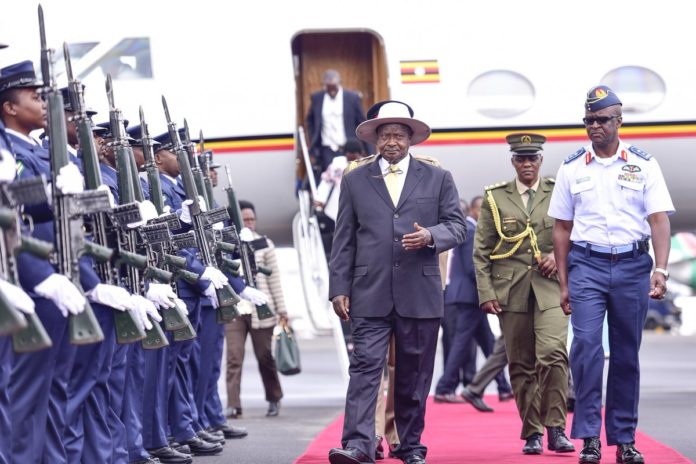
Museveni in Nairobi for first global conference on the sustainable blue economy

President Museveni has jetted into Kenya to attend the first global conference on the sustainable blue economy that is aimed at harnessing the potential of oceans, seas, lakes and rivers to improve lives of people in developing states.

The Sustainable Blue Economy Conference builds on the momentum of the UN’s 2030 Agenda for Sustainable Development, the 2015 Climate Change Conference in Paris and the UN Ocean Conference 2017 ‘Call to Action’.

The three days conference is slated to end of Wednesday and is expected to attract over 4,000 participants from around the world to learn how to build a blue economy that Leverages the latest innovations, scientific advances and best practices to build prosperity while conserving our waters for future generations.

The conference will capture concrete commitments and practical actions that can be taken today to help the world transition to the blue economy. Kenya with its co-hosts Canada, Japan, south Africa, china European union, UK are rallying around the enormous pressures facing oceans and waters, from plastic pollution to the impacts of climate change.

The meeting will also identify how to harness the potential of the blue economy to create jobs and combat poverty and hunger, Show how economic development and healthy waters go hand in hand, Capture commitments and practical actions that can be taken today.

Stories Continues after ad