Stanbic Bank
Stanbic Bank
27.3 C
Kampala
Stanbic Bank
Stanbic Bank
Home Blog Page 1424

BoU officials fail to account for Shs478b-Cosase

The ground can no longer hold for BoU officials.

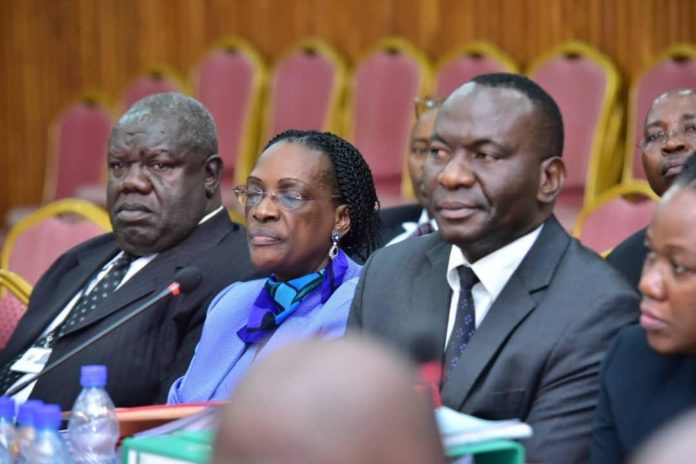
The Bank of Uganda has failed to account for Shs478.8 billion, the officials say they sank in Crane Bank Limited as liquidity support among other costs before finally transferring it to Dfcu Bank at Shs200 billion, Anita Among, the Vice Chairperson of parliament’s committee on Commission Statutory Authorities and State Enterprises (Cosase), said on Monday.

MP Among while speaking to the press said BoU officials were sent back to bring valid documents related to the closure and sale of Crane Bank Limited to Dfcu Bank which also ironically bought off assets of Global Trust Bank.

She said BoU officials on Monday tendered in documents that could not convince the committee members on how Shs478.8 billion was spent. She said some of the documented were duplicated by BoU officials.

She said the loan book of Crane Bank was an irony as there are instances where two clients are attached to the same loans. At the time of takeover by BoU, CBL loans amounting to Shs768 billion constituted 65 percent of the total assets. Shs529 billion worth of net loans were transferred to Dfcu Bank except the insider loans.

She said what BoU officials presented on Monday as documents ‘were mere stationery’ which is not helpful to the committee, the reason she said the committee had to send officials back to bring proper documents on Crane Bank sale.

BoU took over management of Crane Bank Limited (CBL) in October 2016 and sold it off to Dfcu Bank in January 2017 even as owners wanted the transaction dropped. The bank at the time needed Shs157 billion to stay afloat but instead BoU closed it on account of being grossly insolvent. BoU officials would later sink in the bank Shs478.8 billion as they managed it before selling it to Dfcu Bank at Shs200 billion.

According to the Auditor John Muwanga’s special report of BoU on seven defunct banks, BoU did not show accountability of the Shs478.8 billion. “I observed that BoU did not have a documented process of injection of funds to support CBL operations during the statutory management,” he said in August this year while releasing the report.

Cosase has been probing BoU top officials over irregular closure of seven commercial banks including Teefe Trust Bank, Crane Bank Limited, Global Trust Bank, International Credit Bank, Cooperative Bank, Greenland Bank and National Bank of Commerce.

Tomorrow the committee resumes in a closed session where BoU Governor Prof. Emmanuel Tumusiime-Mutebile are expected to bring valid documents if any.

Meanwhile the deputy governor Bank of Uganda, Louis Kasekende has written to the chairperson of the parliamentary committee on Commission of Statutory Authorities and State Enterprises (Cosase) Abdu Katuntu to provide with documents relating to his wealth.

Katuntu said on Friday he had received a letter from Kasekende dated December 14 requesting for information allegedly related to his wealth presented to the committee Aruu South MP Odonga Otto.

Katuntu said he directed the clerk attached to Cosase to avail the information to Kasekende by Monday this week. Katuntu did not say out the reasons given by Kasekende in his letter as to why he requires the documents.

Thursday last week, a sub-committee of Cosase MPs was set up to look into documents of assets allegedly owned by Kasekende and report back to the entire committee tomorrow Tuesday.

The committee comprise Bukedea Woman MPs Among, Uganda People’s Defence Forces (UPDF) representative Brig. Francis Takirwa and Kiruhura Woman MP Sheila Mwine.

The copies of 70 pieces of land and property allegedly owned by Kasekende and his proxies including driver and wife were tabled by Otto as the committee proceeded with investigations into the closure of seven commercial banks between 1993 and 2016 as highlighted in the 2017 forensic audit report by the auditor general.

MP Otto accused Kasekende of engaging in profiteering, presented a list of 17 properties and land linked to Kasekende. He also accused the deputy governor of transferring 18 properties into the control of his driver Moses Musitwa and 35 others into the names of his wife Edith Kasekende.

Otto also laid before the committee, bank statements of Edith, showing transfer of US$1.6 million (about Shs6 billion) from China Railway Corporation and another transfer into her account of Shs1.9 billion from MMAKS advocates. MMAKS advocates were the lawyers retained by BoU to provide transactional advice on the resolutions of Crane bank.

Stories Continues after ad

Comesa: Uganda, six others harmonise seed regulations

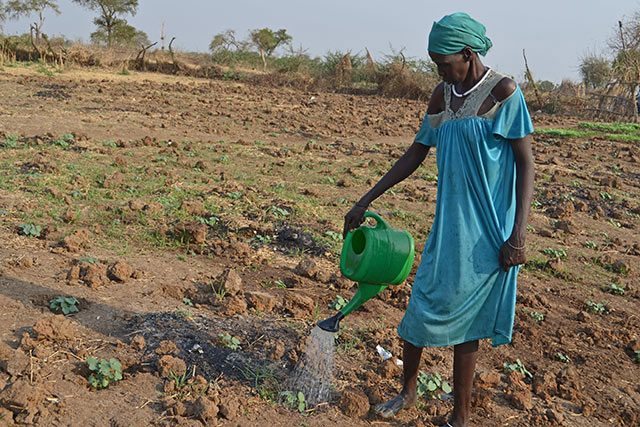
FAO seeds increase the availability of fresh vegetables in conflict-hit Akobo, South Sudan. Photo: FAO

Uganda is among the seven Comesa countries out the 21 States that have so far harmonized their national seed regulations with the regional seed trade harmonization regulations. Others that have harmonised their seed regulations are; Burundi, Kenya, Malawi, Rwanda, Zambia and Zimbabwe.

The harmonization of seed laws under the COMESA Seed Harmonization Implementation Plan (COMSHIP) was adopted by the COMESA Council of Ministers in 2014, as a strategy to trigger seed trade, which is currently low across the region and a cause for food insecurity.

Presenting the status report during a two-day High Level Consultative Workshop on The Implementation of Harmonized Seed Regulations in Eastern and Southern Africa, 13 – 14 December 2018, in Nairobi, Kenya, COMESA Seed Expert Dr John Mukuka said the framework was intended to address the lack of quality seed in the region which has led to food insecurity.

“Within the agricultural sector, access to improved or quality seed by our 80 million small-holder farmers in the COMESA region is low at 23 percent,” he said. “This has resulted in low productivity especially on cereals like maize, sorghum and pearl millet.”

He noted that despite the COMESA countries having most of the global arable land the region, food production was not rising in tandem with population growth.

“The population in the COMESA countries is increasing at 2.3% while food production was at 2%, a situation that has brought about food insecurity to 130 million out of 600 million people in the region,” Dr Mukuka told the delegates who comprised of seed experts from 16 COMESA Member States.

COMSHIP is one of the component in the entire value-addition chain; from agro-inputs, to output markets and financial markets with potential to spur regional seed trade. The other components that COMESA has lined up for harmonization from 2019 are: fertilizer standards; grades and standards for staple foods (maize, beans and rice); warehouse receipt system; implementation of the Regional Food Balance Sheet including Informal Cross Border Monitoring and Livestock Feed Sector.

In addition to the seven countries that have completed the harmonization process, an additional six have launched the COMSHIP and development/ alignment of their domestic seed laws with the regional regulations and are expected to join the list of compliant States by end of 2019. They are Djibouti, DR Congo, Egypt, Ethiopia, Mauritius, and Eswatini.

Others that have launched the seed harmonization plan and preparing to begin the alignment process are: Comoros, Eritrea, Madagascar, Seychelles and Sudan. Only three COMESA States are yet to launch the plan. They are Libya and the new member States (that joined COMESA in July 2018) Tunisia and Somalia.

At the close of the meeting, delegates endorsed COMESA decision to embark on testing the COMSHIP in the countries that have completed harmonization of seed regulations so that seed companies, with varieties on the COMESA Seed Variety Catalogue can trade as soon as possible.

COMSHIP is implemented by the Alliance for Commodity Trade in Eastern and Southern Africa (ACTESA), a specialized agency of COMESA and provides a framework of implementation plans and modalities at national and regional level to facilitate regional trade in the seed sector.

Meanwhile, COMESA has developed Seed Labels and Certificates to facilitate regional seed trade. Dr Mukuka told the delegates that 4.5 million COMESA Seed Labels and 2,500 Certificates will be ready by the first quarter of 2019 for use by major seed companies in the region.

Stories Continues after ad

Shock as over 85% fail LDC exams

The Law Development Centre (LDC) released results for the academic year 2017/2018 showing over 85 percent failures. The results shocked candidates as only 135 students out of over 900 passed the exams that would have enabled them to attain certificates for legal practice in Uganda.

Some 596 students failed one, two or three core course units and must as required by the institution sit supplementary exams and pass them before they are cleared to graduate with the other 135 students.

To help students finish the course and graduate in time, LDC caries out supplementary exams where students that fail in not more than three course units are allowed to sit the exams again before graduation is held. Those who pass supplementary exams graduate with those who passed main exams.

However, another 35 students that failed in more than three core exams will be repeating the course next academic year.

The group will also not be subjected to fresh pre-entry exams and will have automatic admission into the course again as long as they still be interested.

LDC was established in 1970 by the Law Development Centre Act as a government-owned institution of higher learning responsible for research, law reform, publications, law reporting and community legal services. Due to high failure rates and persistent public outcry, the centre opened a branch in Mbarara to boost service delivery and admit more students. The centre is expected to open campuses in towns of Mbale and Arua.

Stories Continues after ad

We won’t release your passports-Cosase tells Bagyenda

Embattled former Executive Director in charge of Supervision at Bank of Uganda Justine Bagyenda.

Parliament’s committee on Commissions Statutory Authorities and State Enterprises (Cosase) Chairman Abdu Katuntu, has told former Bank of Uganda (BoU) executive director for bank supervision, Ms Justine Bagyenda that the committee will not release her passports to allow her fly abroad for the Christmas holiday.

This follows after Bagyenda requested through writing that she needed to travel abroad for Christmas. The passports were confiscated two weeks ago after she flew out of the country without letting the committee know in time.

Bagyenda and other BoU officials including Governor, Prof. Emmanuel Tumusiime-Mutebile and Deputy Governor Dr. Louis Kasekende have been appearing before the committee over closure of seven defunct banks, which the Auditor General John Muwanga in his report says were closed without following guidelines as provided in the Financial Institutions Act (FIA) as well as the Bank of Uganda Act.

“Ms Bagyenda has written to me and she was requesting us to release her passports to enable her arrange her Christmas travel,” MP Katuntu told the committee on Friday.

Katuntu told Bagyenda that the BoU inquiry will continue even during Christmas period to complete the matter in time. Katuntu said Bagyenda is part and parcel of the probe. “You are a very critical witness and the whole bank transactions were based in your office. What takes precedence? Is it your Christmas or committee?” Katuntu said.

Katuntu told Bagyenda that probe would continue even after the Christmas break and that she needed to respect the committee program which takes precedent.

“We can’t refuse anybody to go for Christmas but then, whether she goes for Christmas, she must be here when we need her. She will tell us when she is leaving and she has to reconcile her program to travel with the Committee program where they conflict, the Committee program prevails over her travels because we aren’t going to stop this process because Bagyenda is on holiday, that we will not do. She will take advantage of only her Committee program,” Katuntu said.

On December 3, 2018, Katuntu told Bagyenda to deposit both her passports to parliament after she dodged the committee to attend to her errands abroad. Bagyenda played a critical role in the sale of Global Trust Bank and Crane Bank Limited.

Stories Continues after ad

AMISOM starts process of handing over military academy to Somali army

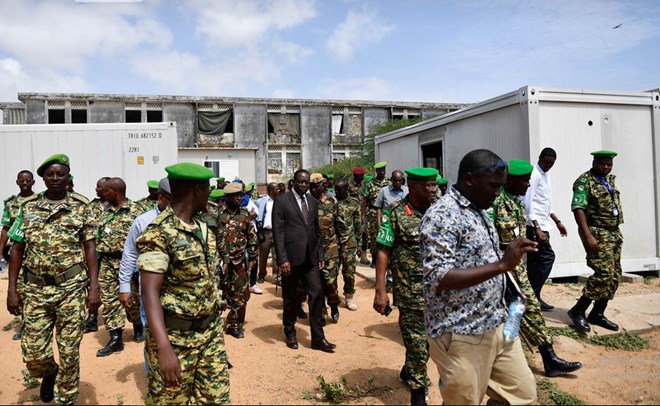
A cadet training school occupied by African Union troops for the last eleven years will soon be handed over to the Somali national army

A cadet training school occupied by African Union troops for the last eleven years, will soon be handed over to the Somali National Army (SNA).

Jaalle Siyaad Military Academy in the Somali capital Mogadishu, served as a key operations base for the African Union troops at the height of the war against Al-Qaeda affiliated Al-Shabaab militants and a Forward Operating Base from which the troops waged a fierce war against the militants, leading to the liberation of Mogadishu in 2011.

The handover process of the institution is being undertaken within the framework of the Somalia Transition Plan and the United Nations Security Council Resolutions, which call for a gradual and conditions-based transfer of Somalia’s security responsibilities to the Somali security forces.

The African Union’s Special Representative for Somalia, who is also the Head of AMISOM, Ambassador Francisco Caetano Madeira did an inspection tour of the academy today, to assess rehabilitation works currently underway at the military institution.

“We thank the Somali government for allowing us to occupy this place at a time when the war against Al-Shabaab was at its peak,” Ambassador Madeira said. “At that moment, we needed to liberate Mogadishu from the occupation of the Al-Shabaab,” added the AU Special Representative, who was accompanied on the assessment tour by senior Somali National Army and AMISOM officials.

“The handing over of the (Mogadishu) Stadium and of the Academy is the second step forward,” stated Madeira, referring to the sixty-thousand capacity Mogadishu National Stadium, which was vacated by AMISOM troops and handed over to the Federal Government in August 2018.

The United Nations Support Office in Somalia (UNSOS) is spearheading refurbishment works at the military academy ahead of its handover to the government. At least forty-eight (48) prefabricated buildings, a hospital, water treatment and power plants will be fully restored before the formal handover in 2019.

“We value the spirit of brotherhood from AMISOM and appreciate the rare sacrifices you have made to bring peace to Somalia,” Brig. Gen. Mohamed Sheikh Madobe, the Somali National Army (SNA) Head of Operations told the delegation from AMISOM.

Burundian troops currently occupying the institution are due to relocate to a Forward Operating Base in the outskirts of Mogadishu. This will be the third key institution handed over to the Somali government by the AU Mission since 2017. In July 2017 the Mission relinquished control of the Somali National University, which it had used as a military base for ten years, and handed it back to the Government.

Stories Continues after ad

Belgium appoints envoy to EAC

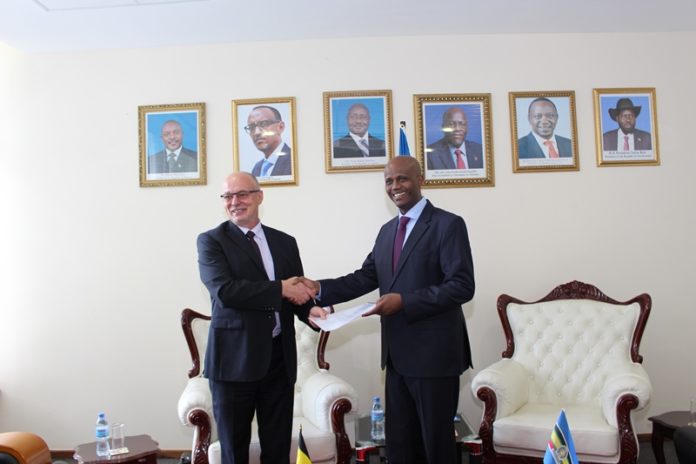
Amb Van Acker presented his letter of credence to EAC Secretary General, Amb Liberat Mfumukeko

The Kingdom of Belgium has appointed, Ambassador Peter Van Acker to United Republic of Tanzania and will also serve as Belgium’s Permanent Representative to the East African Community as an observer.

Amb Van Acker presented his letter of credence to EAC Secretary General, Amb Liberat Mfumukeko, during a brief ceremony held at the EAC headquarters in Arusha.

Amb. Van Acker said that his appointment was out of his government’s commitment to deepen its cooperation with the EAC, noting that the significance of regional integration is not only for East Africans, but also an important source of growth for the continent as well.

The Belgium envoy expressed delight at the accreditation commenting that Belgium has very good relations with the EAC member states.

In his remarks, the EAC Secretary General, Amb. Liberat Mfumukeko warmly welcomed the Belgium Envoy to the EAC and briefed him on the current achievements in the pillars of the regional integration and development process.

He noted that Belgium has an intimate knowledge of the region and added that the EAC is looking forward to scaling up cooperation with the country.

Meanwhile, the EAC Secretary-General Amb. Mfumukeko received the Mission Director for the United States Agency for International Development (USAID) Mr. Mark Meassick who paid a courtesy visit to him at the EAC Headquarters. The Kenya and East Africa USAID Director was accompanied by Program Advisor, Regional Intergovernmental Organization, Ms Mimi Steward.

In receiving the Mission Director, Amb Mfumukeko thanked USAID for its continued support and strong partnership. Reiterating on the importance of regional integration as a means to access regional markets and gain competition advantages in efficiency and productivity outputs.

“These elements can only be realised by having no restrictions on the movement of goods, services, labour and capital within the East Africa,” noted Amb. Mfumukeko

Speaking during the discussion Director Meassick acknowledged the efforts that the Community has made to access trade, adding that “this has not only promoted prosperity in those regions, but has also delivered better livelihoods to their communities, thus putting EAC in the forefront as a model for Integration“.

The United States of America through USAID has been a key Development Partner of the EAC integration process to different Project and Programmes including; Assistance Agreement for Comprehensive Regional Development (AA-CRD) to the tune of US$23,230,800 from Oct. 2011 to Sept. 2019 and Regional Development Objectives Grant Agreement (RDOAG) to the tune of US$30,000,000 from Sept. 2016 to Sept. 2021.

Stories Continues after ad

AfDB to borrow US$7.24b next year

ADB President, Dr. Akinwumi Adesina

The Board of the African Development Bank (AfDB) has approved the institution’s 2019 borrowing program to the tune of US$7.24 billion to be raised from the capital markets.

AfDB accesses a wide array of capital markets with the majority of its borrowing in US dollars and Euros as well as issuances in other public markets such as Australian dollars and Pound sterling.

The Bank maintains an active presence in the socially responsible investment arena and continues to be a regular issue of Green and Social Bonds. These products serve to satisfy increasing demand for impact investment but also allow the Bank to highlight its development mandate and promote sustainable and inclusive growth.

The Institution has also used its ‘High 5’ operational priorities as a platform to continue the issuance of theme bonds, including an inaugural ‘Integrate Africa’ bond, a ‘Feed Africa’ bond awarded Asia Pacific Deal of the Year by mtn-i, more than forty ‘Improve the Quality of the Life for the People of Africa’ bonds, and two taps of its ‘Light Up and Power Africa’ bond.

The Bank is keen to innovate to diversify its product range and, as the financial markets continue to look to a future after Libor, was able to combine innovation with its social responsibility program and issue the first ever Green SOFR-linked bond, in November.

The African Development Bank will continue to promote the development of African Capital markets with the issue of local currency denominated debt to facilitate the financing of its local currency operations, alongside other initiatives.

“We continue to raise our profile in the capital markets to provide cost-effective resources to finance projects and programs on the African continent. We have a strong track record, a diversified funding profile, investors across the world and the benefits of a AAA rating to strongly support the African Development Bank mandate,” the Bank’s Treasurer, Hassatou N’Sele said.

The African Development Bank is rated triple-A by all the major international rating agencies and enjoys several solid ESG (Environmental Social and Governance) ratings.

Stories Continues after ad

Former Rwampara County MP Muzoora dead

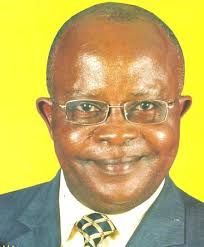
Amon Muzoora

Amon Muzoora, former Rwampara County MP (2001-2006) and Entebbe Municipality MP contestant (2016) has died today morning in the wee hours due to cardiac problems. He has been on oxygen life support for a week.

Muzoora held several positions in the government including being Entebbe Town Clerk. He is renowned for the Amon Muzoora loan scheme which aided many university students before collapsing. “He has been a great man, and a very generous one, the country has lost a very great man who has invested all he has in helping other people. May his soul rest in eternal peace,” read a post on Facebook.

Muzoora was father to Kampala socialite Doreen Kabareebe.

Stories Continues after ad

FAO and WFO to help farmers drive global agricultural agenda

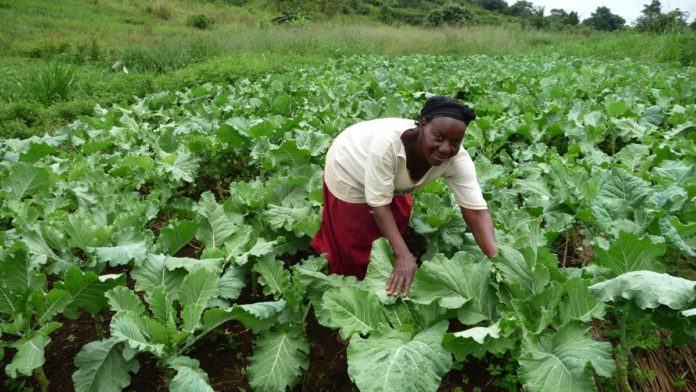
Ugandan farmer in her vegetable garden

The World Farmers’ Organisation (WFO) and the UN’s Food and Agriculture Organization (FAO) on Friday reaffirmed their commitment to help farmers become the drivers of the global agricultural agenda.

The new FAO-WFO agreement will focus on supporting and promoting the key role that farmers and their organizations play in efficient, inclusive and sustainable agriculture and food systems; reducing rural poverty; reaching food and nutrition security; and achieving the 2030 Agenda for Sustainable Development.

It will do so by building farmers’ capacity to lead decision-making processes on agricultural policies at all levels, based on best sustainable agricultural practices that farmers are already applying.

“This agreement will help build a farmers-driven agricultural agenda to bolster global Zero Hunger efforts, and better support the interests of millions of farmers worldwide. Farmers can bring a range of innovative solutions to the complex challenges we face today,” said Maria Helena Semedo, FAO Deputy Director-General for Climate and Natural Resources.

“We, as farmers, rely very much on the support of FAO for the creation of a global political environment in agriculture, which is favourable to our farming systems, our families and our communities. As economic actors, our expectation is to increase productivity, tackling climate change, and contribute to global sustainable development. We are ready to do our part and we are deeply grateful to organizations like FAO that support us in this ambitious agenda,” said Theo De Jager, WFO President.

The agreement will support joint initiatives aimed at:

strengthening collaboration on tackling climate change, responsible management of natural resources, sustainable livestock production, and safe and effective use of antimicrobials;

enhancing the capacities of farmers’ organizations that are inclusive of women and youth to deliver quality services to their members;

increasing farmers’ technical capacity and sharing of practical, workable solutions on climate change mitigation and adaptation, sustainable agriculture and responsible natural resource management;

enhancing farmers’ advocacy capacity and impact on global political dialogues on agriculture;

supporting family farmers and their organizations to have better access to markets and services; and implement guidelines and principles such as Voluntary Guidelines on the Responsible Governance of Tenure of Land, Fisheries and Forests (VGGT), Responsible Investment in Agriculture and Food Systems (CFS-RAI) and Small-scale Fisheries (VG-SSF).

FAO and WFO have a strong history of collaboration, and share common goals to support sustainable agricultural development, climate change mitigation and adaptation, and food and nutrition security.

FAO and WFO are also working closely together for the preparation and implementation of the UN Decade of Family Farming (2019-2028).

Stories Continues after ad

EU earmarks Shs150b for SMEs to boost coffee and cocoa exports

Uganda coffee for export

The European Union (EU) has agreed to provide Shs150 billion (EUR 35 million) to support Ugandan small and medium agri-businesses in the coffee and cocoa sector under the EU-EAC Market Access Upgrade Programme (MARKUP).

MARKUP aims to assist small and medium-size enterprises across the region to improve access to the EU market and increase interregional trade.

The programme is meant to address supply side constraints and help increase exports, especially to the EU. Interventions will target selected value chains and cover quality assurance and certification, value addition, trade facilitation and business promotion. In Uganda the focus is on coffee and cocoa vale chains in line with the current National Export Development Strategy.

According to EU data, in 2017 coffee exports from Uganda to the EU market increased to over Shs 1.3 trillion (EUR 312 million) and have more than doubled in 10 years. Cocoa exports from Uganda to EU countries peaked Shs153 billion (EUR 36 million) in 2015. The cocoa sector presents strong potential for further development.

Coffee and cocoa are predominantly grown as smallholder cash crops, providing income for thousands of households in Uganda. There is increased demand in specialty coffees from the region and, overall, long term global coffee demand is expected to outstrip global supply. The demand of cocoa is also constantly on the rise, as the EU accounts for over 60 percent of the world’s cocoa bean imports and more than 40 percent of the cocoa powder and butter import.

Currently any Ugandan product except for arms and ammunition can access the EU market duty-free, quota-free under the EU’s “Everything but Arms” preferential regime offered to all Least Developed Countries. In the long term Uganda can secure free access to the EU market under the EU-EAC Economic Partnership Agreement concluded in 2016 and waiting to be signed and ratified by all EAC countries.

“MARKUP supports Uganda’s and East African Community’s regional integration agenda. It aims to improve the competitiveness of SMEs based in EAC countries and assist them in increasing productivity, adding value and benefiting from preferential market access opportunities– said Attilio Pacifici, Head of the EU Delegation in Uganda. He added: “With growing demand in the EU for coffee and cocoa products, MARKUP will help create stronger market linkages between Europe and the EAC, and further contribute to job creation and sustainable investments in Uganda and the region.”

Stories Continues after ad