Stanbic Bank
Stanbic Bank
19.2 C
Kampala
Stanbic Bank
Stanbic Bank
Home Blog Page 1437

BoU sold banks without minutes of board meetings

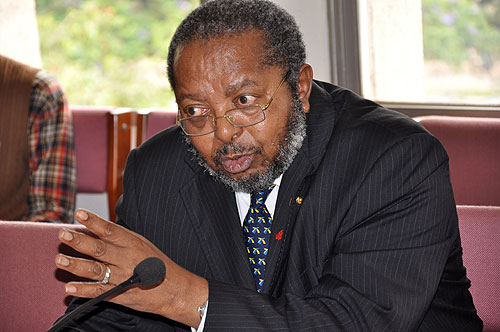
BoU Governor Emmanuel Tumusiime Mutebile

By Our Reporter

The Bank of Uganda sold Crane Bank (CBL) and others like Global Trust Bank (GTB) without holding a board meeting and therefore, there was no minutes upon which the transactions were based, inside sources have said.

BoU Governor Emmanuel Tumusiime-Mutebile heads the board as Chairman while his deputy Dr. Louis Kasekende is his vice. However, it is said some of the members who made up the board at the time when the banks were being sold left at the end of their term.

Sources at BoU now say there is a plan to have those members back so that the issue of not having minutes is resolved. Thus there is likely to be some kind of forging the meeting and its minutes subsequently.

Yesterday parliament gave BoU officials up to Monday to avail procedures, manuals and the list of the then board members who presided over meeting about all defunct banks starting from Teefe bank in 1993 to Crane bank in 2016.

Members of parliament’s committee on Commissions, Statutory Authorities and State Enterprises (COSASE) chaired by Bugweri County MP Abdu Katuntu tasked the officials to produces inventory report, customer deposits, loan schedules and other supporting documents before and after the closer and sell of these banks.

Katuntu said, the process is aimed at seeing that in case any other bank is to close in the future, the processes are handled better and with accordance to the law.

“This process is therefore, equally good for the past and future. The committee is going to consider all the banks in order of how they were closed, from Teefe bank in 1993 to Crane bank in 2016, “I see a lot of misconception that this is about one specific bank,” He said.

Alluding to page five of the Auditor General’s report, Kasilo County Member of Parliament, Elijah Okupa implored BoU officials to provide reports from bank supervision departments for at least two years before the closer of these banks.

Citing page 12 of the Auditor General’s report, Okupa said, BoU should also produce an Interim order that restrained the supervision body of banks leading to the closer of National Bank of commerce (NBC).

COSASE Vice Chairperson and Woman Member of Parliament for Bukedea District Anita Among, said officials should also come along with the minutes of all previous meetings under the subject to matter for closer and selling of the banks.

Governor of the Bank of Uganda, Emmanuel Tumusiime Mutebile, said they have all the alluded copies answering all the queries raised by committee members and asked for two working days to table them before committee which was accorded to them.

The Auditor General (AG) John Muwanga also in his recent special audit report of BoU on seven defunct banks says BoU transferred Performing Loans and Overdrafts transferred worth Shs22,630,112,656 representing 80o/o of the book value of Shs28,287,640,820 which meant that that Dfcu acquired the loan portfolio at 20 per cent discount.

“Interviews with BoU management indicated that the transfer price was agreed upon after negotiations with the purchaser, however negotiations minutes of the P&A were not provided,” Muwanga says. Furthermore, Muwanga adds, the evaluation of the alternatives and assumptions on which the evaluation was based were not provided for verification. “Therefore I could not determine the Justification for transferring the Performing loans at a 20 per cent discount,” he says.

CBL was placed under statutory management from October 20, 2016 to January 20, 2017. During this period. The Statutory Manager did not prepare a plan detailing efforts to return the bank into compliance with prudential standards despite BoU injecting Shs478.8 billion to support the operations of CBL. “In absence of any documented assessment to revive the bank, I could not provide assurance as to whether Sections 89(5) and 90(a) (c) of the FIA 2004 was complied with,” he says.

Relatedly, he says the Statutory Manager prepared CBL annual report and financial statements for the year ended December 31, 2016 but these were neither signed by BoU nor the auditors.

Furthermore, he says the Statutory Manager did not provide financial statements for the period January 1, 2017 to 25th January 2017 (P&A completion date) and therefore the AG was therefore unable to ascertain the financial performance of CBL during statutory management and its financial position as at January 25, 2017. “As such, I was also unable to establish the details and values of assets and liabilities transferred to Dfcu,” he says.


Stories Continues after ad

Kampala MP balloons housemaid, wife runs berserk

All isn’t well with one of the horny Kampala male Members of Parliament as the legislator in question has impregnated his housemaid.

According to sources, the said legislator’s wife has gone berserk because her husband who she has stayed with for many years and whom they have children with, hasn’t officially married her in Church and neither introduced before her parents.

Upon discovering that husband had impregnated the housemaid, the frightened woman threatened to expose the opposition legislator to his colleagues among whom is the Lord Mayor and the media.
The legislator who formerly was a teacher and worked for a prominent local radio station is said having sleepless nights given that the housemaid hasn’t bought the idea of abortion.

The legislator who of late has gained prominence on a vital committee at parliament is chest fallen running up and down looking for money to make sure he weds and introduces here to her parents. Meanwhile, the housemaid has been relocated from the legislator’s home to another division of Kampala for fear that she be attacked by the wife.

Stories Continues after ad

KCCA has rebooted its policy of enforcing laws- Kamya tells street vendors and hawkers

The minister for Kampala Betty olive Namisango Kamya has warned vendors and hawkers saying Kampala capital city authority (KCCA) has rebooted its policy of enforcing law against street vending and unregulated businesses in the city center.

In 2010, Parliament passed the KCCA Act tailored towards finding a solution to the many challenges in the City. Part A section 3 (a) of the KCCA Act 2010 prohibits, restricts, regulates and licenses the sale or hawking of wares or the erection of stalls on any street, or the use of any part of the street or public place for the purpose of carrying on any trade, business or profession.

Since 2012, KCCA, using law enforcement officers, has been evicting these street vendors off the streets of Kampala. The penalties for street vending include being fined up to sh600, 000, serving a three months sentence or serving community work.

“I ask them to respect the space they have been given and allow some for pedestrians. Vendors shouldn’t be selling from paths to shops,” she added.

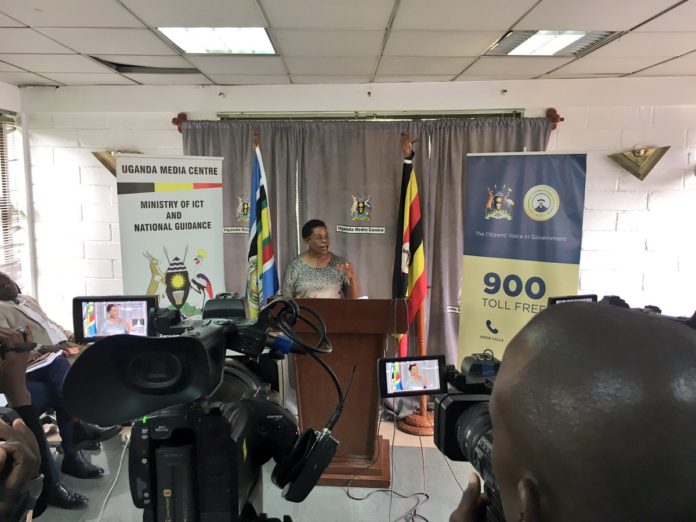
“Laws guiding KCCA on street vendors and hawkers should be respected and I ask KCCA to enforce them. Enforcement officers will retaliate with force, if any on the perpetrators try to resist arrest,” she remarked at Media centre

“Street vendors shouldn’t wait for KCCA to remove them off the streets but go away voluntarily. The person who sold to you that space did it illegally. In our cause to fight corruption we shouldn’t support it,” she noted.

Kamya warned people carrying out construction works without instructions from regulators. She said the habit should noting that Buildings must be constructed under parameters of KCCA.

“Constructing buildings must get permits for the safety of Ugandans. They must reach the KCCA standards even old buildings will be revisited. Building under construction will be destroyed if the owners have no authorization,” He said.

Stories Continues after ad

Uganda to hold the 1st Symposium on disability and Media

East Africa Center for Disability Law and Policy (EA-CDLP) is set to hold the 1st Symposium on disability and Media, peddled at discussing the factors influencing the position of the media on disability in the Uganda.

The Symposium is expected to attract stakeholders of disability rights advocates and representatives of disabled people’ organizations, individual journalists and media practitioners, editors, media house owners and station managers, the academia, policy makers and implementers and the general public.

Being the first of its kind, the Symposium will take place on November 9, 2018 at hotel Africana and will focus on highlighting the challenges that remain outstanding on both ends, response actions taken by different stakeholders and the future prospects and opportunities.

EA-CDLP has for over the last 18 months worked towards addressing the scant coverage of disability issues in the mainstream and alternative media, the negative portrayal of Persons with Disabilities (PWDs) in the media and lack of a concerted and coordinated approach to media engagement by disabled people’s organizations (DPOs).

This process started with a baseline survey that sought to establish the state of media coverage on disability issues in Uganda and was subsequently followed by virtual trainings for journalists and persons with disabilities to address the capacity gaps identified during the survey.

With the establishment of the Uganda Media Caucus on Disability (UMCD), EA-CDLP has currently set a framework for information flow from DPOs to the public through the media and a platform to monitor and evaluate developments in the media related to disability issues.

According to EA-CDLP, increased interest and appreciation to identify and include disability issues in news broadcasts, publishing and daily programming by individual journalists and media houses as well.

Stories Continues after ad

Gen. Mbadi flags off a contingent to Tanzania

Lt.Gen. Mbadi handing over the flag.

Deputy Chief of Defence Forces Lt. Gen. Wilson Mbadi has flagged off a contingent of 219 Ugandans to participate in the 11th Field Training Exercise in Tanga region in Tanzania.

The function was held at Gaddafi military cantonment headquarters in Jinja district.

In his remarks, Gen. Mbadi said the training will be conducted on between November 5-21, 2018 by EAC partner states of Burundi, Kenya, Rwanda, South Sudan, Tanzania and Uganda, pursuant to Article 2 of the EAC protocol on cooperation on Defence Affairs.

He said the model is based on peace support operations (PSO), disaster management (DM), counter terrorism (CT) and counter piracy (CP) themes are aimed at joint training exercise of the military, the police and civilian components from the six participating EAC partner states on joint planning and conduct of operations necessary to resolve arising crisis.

He emphasized discipline, hard work, and professional conduct during the exercise, “maintain their Pan Africanist spirit, exhibit exemplary performance and be good Uganda ambassadors during the EAC Forces Field Training Exercise in Tanga Tanzania,” he added.

The Chief of Training and Recruitment (CTR), Brig. Wills Byarugaba observed that some notable security challenges faced by Uganda and the EAC region can be addressed through such joint military exercises that help armed Forces build the required capabilities.

He noted that EAC Forces have gone beyond exercises and are already operating together in regional missions like AMISOM in Somalia.

“This is in line with the decision of the EAC sectorial council and in line with a designed elaborate program of activities that include Joint training, Joint Operation, Technical Assistance, cultural exchanges and sports and games to enhance the spirit of comradeship and interoperability among the EAC Armed Forces and other stakeholders,”

At the end of the Field Training Exercise, all participants are expected to have enhanced in interoperability between the EAC partner state Armed Forces police component, Civilian component, state of readiness of the EAC partner states’ Armed Forces and other skills.

Stories Continues after ad

Erisa Ssekisambu joins Gor Mahia

Erisa Ssekisambu

Kenyan Premier League reigning champions Gor Mahia have completed the signing of Ugandan striker Erisa Ssekisambu.

The former SC Vipers player has signed a two-year deal with the 17-time record Kenyan champions.
The Ugandan international has been a free agent after deciding not to renew a deal with reigning Ugandan champions Vipers after three seasons. He was initially set to join Gor Mahia in June but the contract talks collapsed.

SC Vipers tweeted “Wishing our former player Erisa Ssekisambu all the best in his move to Kenya with @OfficialGMFC. Your efforts in leading the line to our third League title will never be forgotten.”

Gor Mahia continue strengthening their attacking department ahead of the season that starts in December after the departure of Rwandan target man Meddie Kagere mid last season to Tanzania’s Simba.

Ssekisambu has also previously played for URA FC, Express FC and SC Villa in Uganda.
He joins Kenneth Muguna (FK Tirana), Shafik Batambuze (Singinda United), Nicholas Kipkirui (Zoo FC) and Pascal Ogweno (Kariobangi Sharks) who have been signed by Gor Mahia this transfer window.

Stories Continues after ad

MPs insists BoU must avail list of board members, documents of defunct banks

Parliament has given Bank of Uganda officials up to Monday to avail procedures, manuals and the list of the then board members who presided over meeting about all defunct banks starting from Teefe bank in 1993 to Crane bank in 2016.

Appearing before parliamentary committee on Commissions, Statutory Authorities and State Enterprises (COSASE) chaired by Bugweri County MP Abdu Katuntu, officials were tasked to produces Inventory report, customer deposits, loan schedules and other supporting documents before and after the closer and sell of these banks.

Katuntu said, the process is aimed at seeing that in case any other bank is to close in the future, the processes are handled better and with accordance to the law.

“This process is therefore, equally good for the past and future. The committee is going to consider all the banks in order of how they were closed, from Teefe bank in 1993 to Crane bank in 2016, “I see a lot of misconception that this is about one specific bank,” He said.

Alluding to page five of the Auditor General’s report, Kasilo County Member of Parliament, Elijah Okupa implored BoU officials to provide reports from bank supervision departments for at least two years before the closer of these banks.

Citing page 12 of the Auditor General’s report, Okupa said, BoU should also produce an Interim order that restrained the supervision body of banks leading to the closer of National Bank of commerce (NBC).

COSASE Vice Chairperson and Woman Member of Parliament for Bukedea District Anita Among, said officials should also come along with the minutes of all previous meetings under the subject to matter for closer and selling of the banks.

Governor of the Bank of Uganda, Emmanuel Tumusiime Mutebile, said they have all the alluded copies answering all the queries raised by committee members and asked for two working days to table them before committee which was accorded to them.

Katikamu County North MP, Eng. Abraham Byandala asked for some days for committee Members to go through BoU documents saying if bank officials asked for two days to photocopying materials, then we need more days.

The committee resolved to meet on November 12, to scrutinize and verify them as per the allegations fraud and acquisition, closer and selling of the defunct banks.

Stories Continues after ad

Evidence: Bagyenda ordered Dfcu to keep Crane Bank bad loan book after takeover

Embattled former Executive Director in charge of Supervision at Bank of Uganda Justine Bagyenda.

As a parliamentary committee starts to quiz top Bank of Uganda officials on the closed banks, more information has surfaced indicating former Executive Director in charge of Supervision Justine Bagyenda at the central bank ordered Dfcu executives to keep Crane Bank’s bad books off the record.

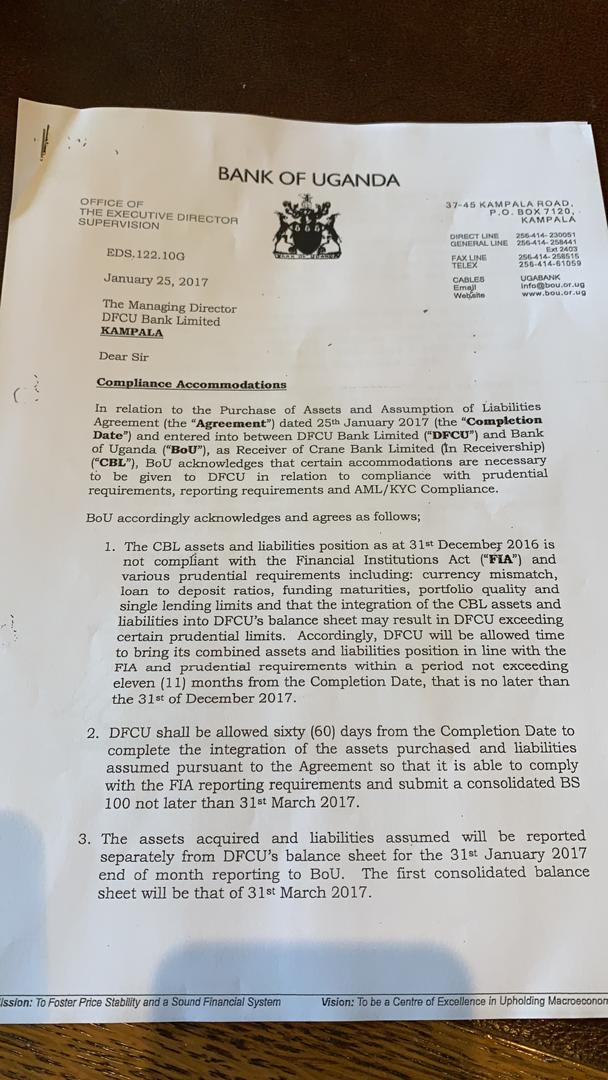
According to January 25, 2017, letter written by Bagyenda to the Managing Director Dfcu Bank Limited, titled compliance accommodation, she says that in relation to the purchase of asserts and assumption of liabilities agreement dated January 25, 2017 which was the completion date and entered Dfcu and Bank of Uganda as a receivership of Crane Bank Limited, BoU acknowledged that certain accommodations are necessary to be given to Dfcu in relation to compliance with prudential requirements, reporting requirements and AML/KYC compliance.

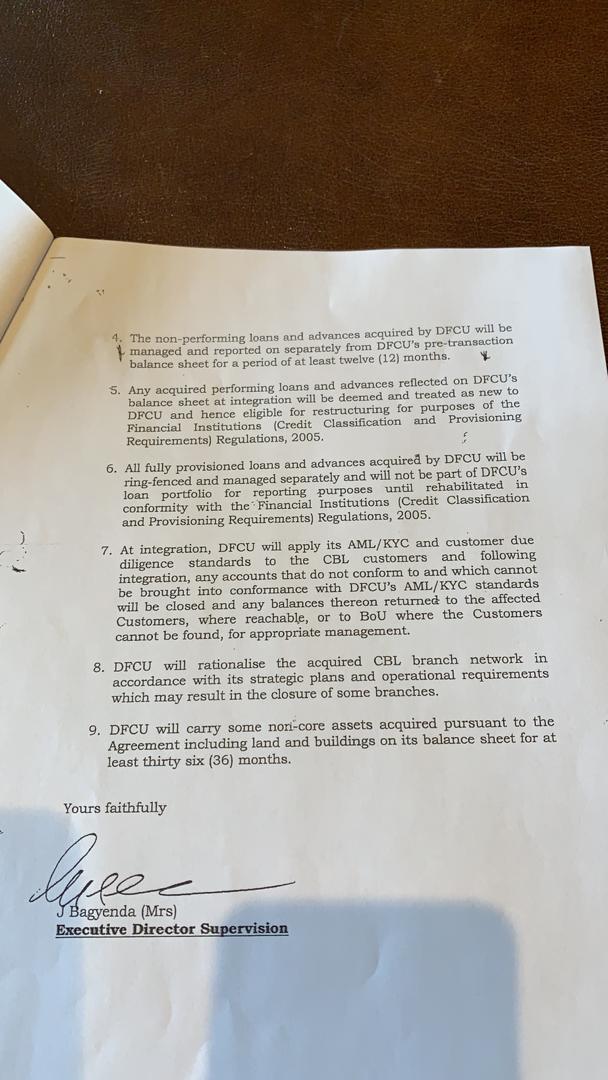
“The asserts acquired and liabilities assumed will be reported separately from Dfcu’s balance sheet for the 31th January 2017 end of month report to BoU. The first consolidated balance sheet will be that of 31th March 2017. The non- performing loans and advances acquired by Dfcu will be managed and reported on separately from Dfcc’s pre-transaction balance sheet for a period of at least twelve months.” Bagyenda wrote.

The bad books are records indicating details and securities of people that take loans from any lending institution. However, despite Dfcu being given CBL by BoU, it wasn’t mandatory for them keep bad books because they belong to shareholders of CBL.

She explained that any acquired performing loans and advances reflected on Dfcu’s balance sheet at integration will be deemed and treated as new to Dfcu and hence eligible for restructuring for purposes of the financial Institutions (credit classification and provisioning requirement. She also directed that all fully provisioned loans and advances acquired by Dfcu will be ring-fenced and managed separately and would not be part of Dfcu’s loan portfolio for reporting purposes until rehabilitated in conformity with the Financial Institution Act.

“At integration, Dfcu will apply its AML/KYC and customer due diligence standards to the CBL customers and following integration, any accounts that do not comform to and which cannot be brought into confomance with Dfcu’s AML/KYC standards will be closed and any balance thereon returned to the affected customers, where reachable, or to BoU where the customers cannot be found for appropriate management” she wrote.

She further emphasized “Dfcu will rationalize the acquired CBL branch network in accordance with its strategic plans and operational requirements which may result in the closure of some branches. Dfcu will carry some non-core assets acquired pursuant to the agreement including land and buildings on its balance sheet for at least 36 months.
According to sources, the said directive was done in connivance between Deputy Governor Louis Kasekende, outgoing Dfcu MD Juma Kisaame Dfcu bank limited board chairman Jimmy Mugerwa and the two conflicted lawyers (David Mpanga of Bowmans and Timothy Masembe of MMASK Advocates).

Stories Continues after ad

Ecobank introduces quick money transfer mobile application

Ecobank has said it is harnessing its digital expertise and innovation to bring efficiency and convenience to the international and intra-African remittance markets, while significantly reducing the costs of the service.

The launch of the Rapidtransfer mobile application will enable Africans around the world to easily and instantly send money to bank accounts, mobile wallets and cash collection in, and across, 33 African countries.

As well as being intuitive, easy to navigate and multi-lingual with English, French, Spanish and Portuguese variants, the application provides simple and secure digital onboarding.

Users can choose how and when funds are delivered to the intended beneficiary, with transparent foreign exchange rates prior to each transaction. Charges range from nothing to 3 percent depending on the options the customer selects.

“Historically the cost of sending cross-border remittances in Africa has been far too high. Similarly, the process to send funds has long been inefficient and burdensome, with customers forced to physically go to an agent, and yet still have little or no clarity as to when the money will reach the recipient,” said Ade Adeyemi, Ecobank’s Group CEO.

Adeyemi added, “The Rapidtransfer app remittance solution is a quick, easy and reliable digital solution that removes all of these issues. It is a game-changer for Africans with its sustainable and standout affordability.”

He further stated that the application further demonstrates Ecobank’s commitment to enhance the economic development and financial integration of the African continent. “We know that remittance flows into and across Africa from migrants working away from home has an enormously beneficial impact in powering Africa’s domestic economies,” the Group CEO noted.

“By reducing the costs to send the money, Rapidtransfer ultimately enables the beneficiary to receive more of the funds originally sent to them, which in turn will have a multiplier effect on national economies by boosting demand and driving business growth,” he pointed out.

In the first quarter of 2018, the average cost of sending US$200 was 7.1 percent and remittance services in Sub-Saharan Africa were the costliest in the world at an average cost of 9.4 percent.

A substantial proportion of migrants financially support their dependents back home and the potential size of this remittance market is illustrated by the United Nations’ estimate that the number of international migrants, including refugees, was 258 million in 2017.

Money transfers from migrant workers and others to all countries worldwide were US$613 billion in 2017 and those into Sub-Saharan Africa grew by US$4 billion to US$38 billion in 20173.

The importance of the inflow of remittances into many African countries cannot be underestimated. Remittances play a hugely important part of many national economies and their inflows represent 27 percent and 21 percent of Liberia and The Gambia’s Gross Domestic Product respectively, the Lome based group

Stories Continues after ad

Cheaper smart phones expected on Ugandan market next year

Officials display the prototype of the smart phones to be assembled here in Uganda.

The price of new brand smart mobile phones in Uganda is expected to come down next year following government’s decision to allow an American company CTI Africa to start assembling its phone products in Uganda.

The CTI Africa arm-LifeMobile- was unveiled yesterday by the Minister of State for Investment and Privatisation, Evelyn Anite, at the National Enterprises Corporation (NEC) headquarters in Bugolobi, Kampala.

“We are very excited that CTI Africa is going to start assembling mobile phones in Uganda. Ugandans are carrying so many mobile phones but none is manufactured here. So, if Ugandans buy these phones, we will diversify our economy because the dollars that would be spent on importing smart phones will be used here,” minister Anite said.

She said NEC, has already allocated LifeMobile a site on 6th Street in Industrial Area where the assembling plant will be built.

Anite said President Museveni would launch the first LifeMobile smart phones early next year.
The CTI Africa chief executive officer, Michael Landau, said during the assembling of the phones they would also help develop specialised applications to improve healthcare, mobile banking, insurance, microfinance and education services.

The company is expected to invest US$10million (about Shs40 billion) into the venture and create at least 400 jobs in the first phase of operation.
He said LifeMobile already has prospective partnerships with Jubilee Insurance for insurance services, Jumia Uganda for e-commerce, Ecobank and Microfinance Support Centre for e-banking, Medical Concierge and Uganda Protestant Medical Bureau for healthcare services.

“Our applications will be very important in improving people’s lives. We want LifeMobile to be a lifeline to all the digital services available,” he said adding that, “LifeMobile is about using a smart phone as a tool for life as it will have Apps for healthcare, insurance, e-commerce and banking”.

Landau said the firm’s first phones assembled in Uganda would be released between January and March 2019, stating that so far the firm has received orders for at least 75,000 smart phones.
He said they would introduce the hire purchase arrangement to enable Ugandans access smart phones easily.

Maj. Gen. James Mugira, the managing director of NEC, which was tasked by President Museveni to act on behalf of government in the partnership, said the LifeMobile’s presence in Uganda is a symbolic moment. He appreciated CTI for choosing to invest in Uganda.

Stories Continues after ad