Stanbic Bank
Stanbic Bank
28.7 C
Kampala
Stanbic Bank
Stanbic Bank
Home Blog Page 1457

The Wealth of Nations: Governments can better manage what they own and owe

By Vitor Gaspar and Agencies

What is the state of your personal finances? You probably think first about your debts: your mortgage, your credit card balance, and your student loans. But you probably also think about how much cash is sitting in the bank, the value of your house, and the rest of your nest egg.

Surprisingly, most governments do not approach their finances this way.

Our research in the new Fiscal Monitor shows that few governments know how much they own, or how they use those assets for the public’s well-being. Knowing what a government owns and how they can put their assets to better use matters because they can earn about 3 percent of GDP more in revenues each year and reduce risks, all at once. That’s as much revenue as governments make from corporate income tax receipts in advanced economies. Governments can put this money toward better schools, hospitals, or other priority spending.

These assets consist of public infrastructure such as roads, bridges, and sewer pipes, as well as the money governments have in the bank, their financial investments, and payments owed to them by individuals and businesses.

Natural resource reserves in the ground are also part of assets, something that is particularly important for natural resource-rich countries. But assets also include state-owned enterprises such as public banks and, in many countries, utilities such as public electricity and water companies.

We also show that total liabilities are much larger than debt alone. They come to about 198 percent of GDP, less than half of which is general government public debt. Pension obligations to civil servants are a large part of the remainder, yet few countries record them as such.

Another part is debt owed by public corporations. Most standard measures of general government debt do not include this, meaning that significant amounts of public debt are classified as private debt.

Emerging markets’ debts and assets

In emerging market economies private debt has risen much faster than public debt, as shown in the chart below. Take China, for example. Total debt is 247 percent of GDP. But the dividing line between what is public and private debt in China is blurry. This blurriness reflects the very large number of public units and corporations, the complex layers of government, and widespread subnational off-budget borrowing.

As a result, estimates of 2017 public debt vary considerably: the official government debt figure is 37 percent of GDP, while the data reported in the latest World Economic Outlook show it at 47 percent of GDP, and the ‘augmented’ debt measure, which includes more off-budget borrowing by local governments, stands at 68 percent of GDP. As China works to compile a full general government balance sheet, this picture will come into clearer focus.

So, how resilient is China’s government balance sheet?

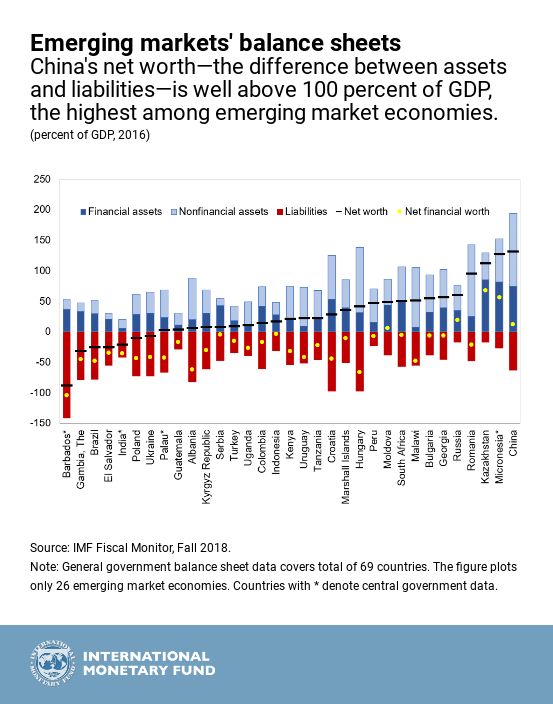
China has substantial government assets, reflecting years of high infrastructure investment. These assets are larger than its liabilities, putting net worth—the difference between assets and liabilities—well above 100 percent of GDP, the highest among emerging economies.

This is a significant buffer when compared to total debts of public corporations, particularly considering that public corporations also have assets. So, while debt-related risks in China are large, there are also buffers. Moreover, the government is taking steps to contain risks by reining in off-budget borrowing and strengthening oversight, resulting in a slowdown in the buildup of debt.

However, most of China’s government assets are nonfinancial, like buildings, roads, and railways. While they can generate revenues through fees and rents, they are not easily available to cover liquidity needs. Also, the valuation of these assets is surrounded by uncertainty. With no official estimates available, we use an estimate from our capital stock database. Net financial worth, which excludes these nonfinancial assets, is much smaller. It still positive and higher than the emerging market average, although it has declined in recent years, mainly due to developments at the subnational government level.

Improve resilience

More generally, our research illustrates that public sector assets could act as a buffer that allows governments with high public wealth to weather recessions better than those with low public wealth. Stronger balance sheets—a statement of what you owe and own at a given point in time—allow governments to boost spending in a downturn.

This cushions the impact of the shock and results in shorter and shallower recessions. Take Kazakhstan in 2014, when it faced a halving of oil prices and a slump in external demand. The government responded by using part of its financial assets in the National Fund to ease the downturn.

Doable for all

All governments can better manage their resources. They should start by bringing data together to come up with a rough estimate of public sector assets, liabilities, and wealth. Over time, better accounting and statistical collections can improve the accuracy of these estimates. Governments can use them to do basic balance sheet risk and policy analysis, using the framework presented in this report.

Once this exercise is completed, governments will be able to show their citizens the full extent of what they own and owe, and better use public wealth to meet society’s economic and social goals.


Stories Continues after ad

World coffee market ends 2017/18 in surplus

coffee-in-uganda

World coffee production in coffee year 2017/18 is estimated 5.7 per cent higher at 164.81 million bags as output of Arabica increased by 2.2 per cent to 101.82, and Robusta grew 11.7 per cent to 62.99 million bags, according to the latest World Coffee Report.

According to the report, the larger supply in coffee year 2017/18 is reflected in increased shipments in August 2018, as global exports increased 6.3 per cent to 11.1 million bags compared to August 2017. In coffee year 2017/18, world consumption is estimated 1.8 per cent higher at 162.23 million bags, but coffee production exceeds this by 2.58 million bags. This surplus has contributed to the low prices this season.

Meanwhile, coffee prices continued their downward trend as the monthly average of the ICO composite indicator fell to US $98.17 cents/lb in September 2018, 4.1 per cent lower than in August 2018. This represents the lowest monthly average composite indicator since October 2006 when it reached US $95.53 cents/lb. In September 2018, the daily composite indicator remained below 100 US cents/lb until 28 September when it reached 100.83 US cents/lb.

World production in coffee year 2017/18 includes part of the new crop for producers with crop years commencing in April and July. Production of both Arabica and Robusta increased in 2017/18, though most of the increase came from Robusta, which grew 11.7 per cent to 62.99 million bags compared to coffee year 2016/17.

The increase above comes primarily from Vietnam where its Robusta output is estimated 15.5 per cent higher at 28.03 million bags and Brazil, where Robusta production continues to recover, increasing by 16.1 per cent to 13.46 million bags in coffee year 2017/18. In India, which produces both types of coffee, Robusta is estimated to have grown by 12.3 per cent to 4.09 million bags due to adequate rainfall and greater availability of irrigation water.

Arabica output is estimated 2.2 per cent higher at 101.82 million bags. While Colombia’s production is estimated at 14 million bags, 4.3 per cent lower than in coffee year 2016/17 due to unfavourable weather conditions, production in the other four largest Arabica producers increased. Brazil’s Arabica production in coffee year 2017/18, which includes part of its new crop, is estimated 3.5 per cent higher at 44.23 million bags. Production in Honduras is estimated at 7.7 million bags, 3.3 per cent higher than in 2016/17, which marks the fourth consecutive year of increase.

Ethiopia harvested 7.65 million bags, an increase of 4.8 per cent compared to last coffee year. Peru’s Arabica output is estimated 0.8 per cent higher at 4.29 million bags. The larger supply in coffee year 2017/18 is reflected in increased shipments. In August 2018, global exports of all types and forms of coffee increased by 6.3 per cent, to 11.1 million bags, compared to August 2017.

Arabica shipments grew by 6.7 per cent to 6.95 million bags, and Robusta by 5.7 per cent to 4.16 million bags. The increase in Arabica shipments consisted largely of Brazilian Naturals, which rose by 14.7 per cent to 3.3 million bags in August 2018 while exports of Colombian Milds decreased 11.6 per cent to 1.11 million bags. In the first 11 months of coffee year 2017/18, world coffee exports are 1.6 per cent higher than in the same period for coffee year 2016/17.

Arabica shipments for October 2017 through August 2018 are 0.2 per cent higher than in 2016/17, as increased exports of Other Milds offset decreases in both Colombian Milds and Brazilian Naturals.

Shipments of Robusta grew 3.9 per cent to 42 million bags for October 2017 to August 2018. Total exports of green Robusta have increased in each month since May 2018. Brazil’s green Robusta exports for June to August 2018 are 1.19 million bags, 17 times greater than the same period one year ago and accounting for 78.8 per cent of shipments for October 2017 to August 2018.

Although Vietnam is nearing the end of its crop year, green Robusta shipments have remained high, reaching an estimated 6.43 million bags for June to August 2018, 21 per cent greater than in 2017. Indonesia is the third largest exporter of green Robusta for June to August 2018, with shipments reaching 0.77 million bags.

However, this is 62.9 per cent lower than the same period in 2017, as increasing domestic consumption and flat productivity levels reduced the volume available for export. During the same period, Uganda shipped 0.88 million bags of green Robusta coffee and India exported 0.73 million bags. While coffee consumption is estimated 1.8 per cent higher in coffee year 2017/18 at 162.23 million bags, coffee production exceeds this by 2.58 million bags.

This surplus has contributed to the low prices this season, with the composite indicator averaging 111.51 US cents/lb for October 2017 to September 2018. In comparison, the average for the composite indicator in 2016/17 was 132.43 US cents/lb, reflecting the 3.43 million bag deficit that coffee year. Additionally, exports in coffee year 2017/18 have increased compared to 2016/17, a year in which record export volumes were recorded.

This has put further pressure on prices as the market was well-supplied at the start of the coffee year even with growing consumption. Stocks of green coffee in importing countries, including free ports, have remained at high levels in the last two years. After reaching 17.94 million bags at the end of December 2010, stocks grew to a record level of 26.44 million bags at the end of June 2017. Stocks in importing countries declined to 24.64 million bags at the end of June 2018, but this is the third highest volume at the end of June in the last eighteen years.

Stories Continues after ad

Commonwealth Finance Ministers explore new strategies to manage disaster risk

Finance Minister Matia Kasaija

Finance Ministers from the 53 member countries of the Commonwealth including Uganda will meet in the margins of the International Monetary Fund (IMF) and World Bank annual meetings this week in Bali, Indonesia, to discuss financing solutions to help counter the risk of natural disasters in their countries, says the latest press release.

Under the theme ‘Enhancing national capacity to reduce disaster risk’, the Commonwealth Finance Ministers Meeting will consider Commonwealth proposals including an online portal to simplify access to disaster finance and placing long-term advisors in member countries to develop funding applications for disaster risk management. Ministers will also discuss Commonwealth work on defining and measuring vulnerability.

The meeting on 11 October will be chaired by Nauru’s Minister of Finance, David Adeang. It will feature a keynote address by the Special Representative of the UN Secretary-General on Disaster Risk Reduction, Mami Mizutori.
“Natural disasters are increasingly inflicting massive negative economic and environmental impacts on Commonwealth countries,” the Commonwealth’s Secretary-General, Patricia Scotland, says in a media statement.

“There are dreadful human and social costs resulting from the loss of lives and livelihoods they cause. We have seen rising levels of frequency and intensity in the devastating disasters that have affected countries in many regions of the world in recent years, including fatal hurricanes, landslides, earthquakes and tsunamis,” he adds.

He however says finding the means to respond to disaster risks can be complicated. “The measures to be discussed by ministers directly address the obstacles linked to mobilising disaster finance, in order to assist member countries with reducing, managing, and adapting to disaster risk,” he says.
The proposed Commonwealth Disaster Risk Finance Portal will serve as a ‘one stop shop’ for streamlined access to the numerous financing tools already available. It would include guidance on navigating the complex funding processes and broad range of providers, each with differing eligibility and access criteria, and challenging terms and conditions.

Ministers will consider extending the Commonwealth Climate Finance Access Hub’s advisory and technical support to cover disaster finance more widely, especially for smaller and more vulnerable Commonwealth countries. That would broaden the success of the of the programme, which already has been instrumental in helping to mobilise more than £4 million for climate projects in various parts of the Commonwealth, with a further £140 million in the pipeline.

Ministers will also discuss the concept of a new universal economic vulnerability index to focus on the economic, environmental, socio-political causes of vulnerability. The meeting of finance ministers is the longest established annual ministerial meeting in the cycle of intergovernmental Commonwealth gatherings, and provides an opportunity for ministers collectively to consider approaches to emerging global issues and the economic development work programme of the Commonwealth.

Senior officials and Commonwealth central bank governors will meet on 10 October, prior to the ministerial meeting to discuss disaster risk reduction and financial technology issues respectively.
The Commonwealth is a voluntary association of 53 independent and equal sovereign states. It is home to 2.4 billion citizens, of whom 60 per cent are under the age of 30. The Commonwealth includes some of the world’s largest, smallest, richest and poorest countries, spanning five regions.

Thirty-one of its members are small states, many of them island nations. Commonwealth countries are supported by an active network of more than 80 intergovernmental, civil society, cultural and professional organisations

Stories Continues after ad

Central Bank Credibility Pays Off in Times of Stress

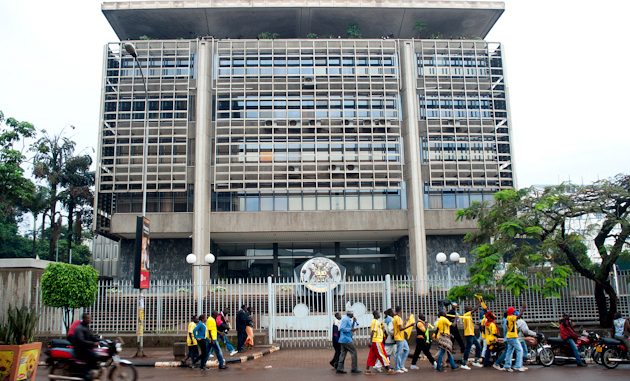
Bank of Uganda

By Rudolfs Bems and Agencies

Since the mid-2000s, inflation in emerging market economies has been remarkably low and stable, in sharp contrast to the 1990s. But rising interest rates in advanced economies like the United States have triggered currency depreciations in emerging market economies over the past few months—quite sharp in some cases—and are testing their ability to fend off inflationary pressures.

In Chapter 3 of the October 2018 World Economic Outlook, we analyze the recent improvements in inflation performance in emerging economies and show that these gains can be maintained if central banks’ commitment to low inflation is credible and expectations of future inflation remain under control.

Expectations of future inflation are key
Our study looks at 19 emerging market economies from 2004 to 2018 and finds that inflation remained low and stable despite sharp swings in commodity prices, periods of sustained U.S. dollar appreciation, and the global financial crisis. However, this recent inflation performance is not uniform, as some countries continue to struggle to keep inflation under control.

The main driver of inflation in emerging market economies during the past decade and a half is changes in longer-term inflation expectations. We find that longer-term inflation expectations were particularly important in exerting inflationary pressure in countries where inflation has remained above the target. Other commonly explored drivers of inflation—such as excess capacity in economic activity and external price pressures—also matter but played less of a role.

Motivated by these findings, our analysis explores how the extent of anchoring of inflation expectations in emerging markets—a proxy for the credibility of their monetary policy—has evolved over time and differs across countries. The concept of anchoring of expectations is measured using several indicators, such as the impact of inflation surprises on expectations and the extent of agreement among experts about future inflation. The data shows that longer-term inflation expectations have become increasingly anchored in emerging economies over the past two decades. At the same time, there are sizable differences across emerging economies and relative to advanced economies. The extent of anchoring in, for example, Chile and Poland is comparable to the average of advanced economies, but expectations are much less anchored in Russia and Argentina.

Building greater resilience to external shocks
External shocks that depress economic activity while also triggering temporary increases in inflation pose a dilemma for policymakers in emerging economies. But we find that this dilemma is less pronounced when inflation expectations are well anchored.

A good example of that kind of shock is what happened during the taper tantrum in 2013—when the United States suddenly announced it was thinking of beginning to increase interest rates.
During the taper tantrum, countries with more-anchored inflation expectations saw larger short-term exchange rate depreciations than those with less-anchored expectations. Interestingly, however, sharper depreciations in the former group did not translate into higher (imported) domestic inflation. As the impact of the exchange rate on inflation was substantially larger in less-anchored countries, which also faced worse output prospects, central banks in less-anchored countries could not afford to pursue looser monetary policies.

These findings have implications for the period of monetary normalization in advanced economies. A temporary increase in inflation rates in emerging economies is to be expected if global financial conditions tighten and emerging market currencies depreciate. But, if expectations are well anchored, price stability would not be jeopardized.

Improving fiscal and monetary policy frameworks
How can central banks improve the extent of anchoring of inflation expectations? Our analysis as well as the evidence in the literature indicate that the soundness of both monetary and fiscal policy frameworks is key for well-anchored inflation expectations. Policymakers should therefore keep improving the long-term sustainability of public finances, including by adopting rules that limit the scope for policies that threaten debt sustainability and building fiscal buffers in good times that can then be relied on during bad times. Equally important is their commitment to improving the credibility of central banks, by consolidating and enhancing their independence, as well as through improvements in timeliness, clarity, transparency, and openness in their communications.

Anchoring inflation expectations takes time, so continuous effort is needed even in countries that have already made significant progress. In countries where the credibility of monetary frameworks is relatively low, the emphasis should be on ensuring that fiscal sustainability is not a threat for their monetary objectives and on communicating clearly the reasons for their monetary policy actions, including those taken in response to global developments.

Stories Continues after ad

Dangote urges deepening of African economy through free trade

Aliko Dangote

Foremost businessman, Aliko Dangote has called for conscious efforts at deepening African regional market by African investors and governments to aid rapid growth and development of the Continent’s economy.

Speaking during “One to One Conversation” at the on-going 5th annual Financial Times African Summit, the Nigerian entrepreneur said the key to Africa’s economic growth and strength is in the development of the regional market, saying “Regional markets in Africa must work.”

Dangote said Africans must patronize African markets which is why the free trade agreements by African nations is the direction to go to strengthen African markets.

Citing an instance of his own experience, the president of Dangote group referred to the case of neighbouring Benin Republic where the country continues to import cement from China while his Nigerian factory is only 35 miles away from the border.

“We need to trade with ourselves”, Dangote stated as he spoke glowingly about the prospect of African economy, the free trade agreement and the availability of huge raw materials to attract investors.

Asked about when the much touted listing of Dangote cement on the London Stock Exchange, he told his audience comprising of investors, business magnates, captains of Industry and African Heads of Government which included President Akufo-Addo of Ghana and Ali Bongo of Gabon, that the listing might happen in 2019.

According to him, all hands are on deck to complete the process of listing, the development which he said is being looked towards for by the business community.

Prompted by the Editor of the Newspaper, Lionel Barber to speak about difficult markets like Tanzania and Ethiopia, Dangote dismissed the issue difficulty and re-affirmed “our aim is to always provide jobs and worth. As an African investor I don’t want any investor anywhere in Africa to have a bad experience.”

Dangote repeated his central mantra for African growth urging the reduction of exports of raw materials to other continent but create greater wealth within African economies.

Said he: “We need to continue to transform the structure of African economies”. He alluded to his company’s entry into the Ghana Sugar market, pointing that he is further expanding his sugar business to Ghana for the main reason of helping to revitalize its economy. “We are going to help Ghana grow its own sugar for the first time.”

Stories Continues after ad

Top ISO director suspended

Joseph Aliganyira

The Director General of Internal Security Organisation, Col. Kaka Bagyenda has suspended a senior director in charge of Kampala region, Lt. Col. Joseph Aliganyira.

Sources, within security circle told Eagle Online Col. Kaka last week wrote to Security Minister, Gen. Elly Tumwine communicating the suspension. Col. Kaka is reported to have copied in the Commander in Chief, Chief of Defence Forces, Internal Affairs Minster among others.

Col. Aliganyira has already left office pending investigation on the wide range of issues.
However, sources say Col. Aliganyira’s suspension was triggered by fights of groups of people in front President in the recent tour of Kampala city. It is said that as Director Kampala, Col. Aliganyira didn’t foresee what befell in front of the president.

ISO is charge with compile intelligence that is relied on by the president and government in implementing programmes and for this case, had he captured the scenarios of the different bickering groups, perhaps President Museveni shouldn’t visited such places.

Aliganyira has served in ISO for long and has been credited being loyal and hardworking. He previously served as director political.

Stories Continues after ad

Bank of Africa backtracks on Juma Kisaame’s $40m account

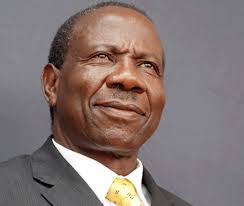
Juma Kisaame

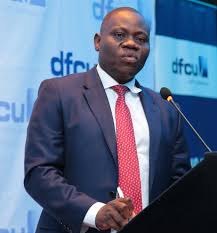
Bank of Africa has backtracked on its earlier statement and now the financial institution says the $40 million account belongs to Dfcu Managing Director Juma Kisaame.

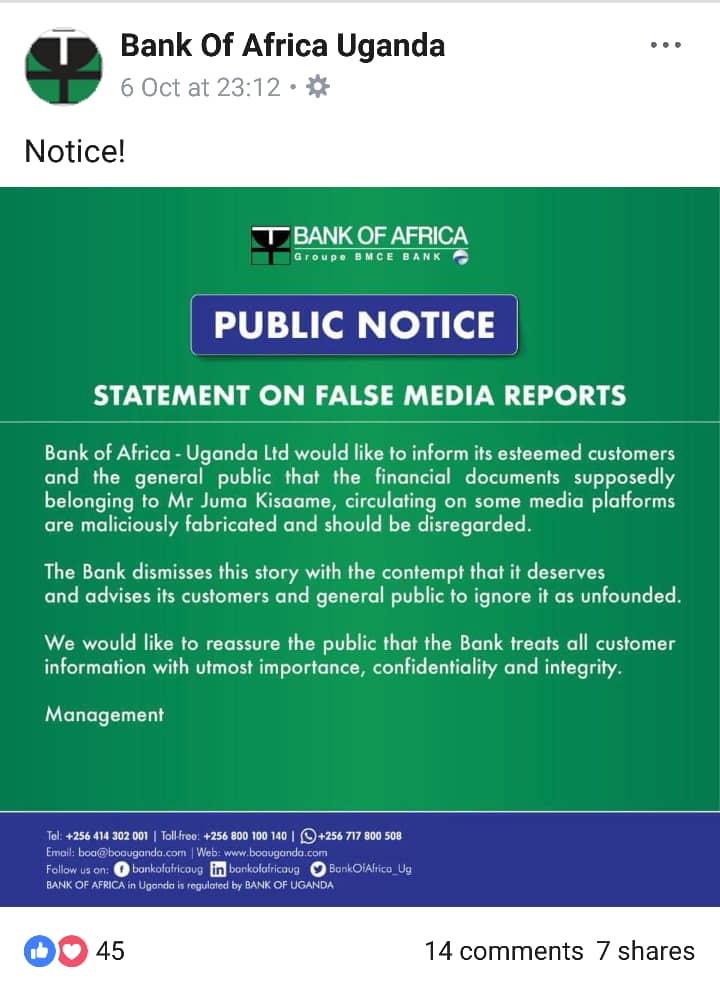
The bank on Saturday night released a press statement denying that the said account wasn’t for Mr. Kisaame.

“Bank of Africa-Uganda Limited would like to inform its estimated customers and the general public that the financial document supposedly belonging to Mr Juma Kisaame, circulating on some media platforms are maliciously fabricated and should be disregarded. The bank dismisses this story with the contempt that it deserves and advises its customers and general public to ignore it as unfounded. We would like to reassure the public that the bank treats all customers’ information with utmost importance, confidentiality and integrity.” Reads the early communication the bank released on Saturday night.

However, last night again, the same bank released another acknowledging the said account to be Mr. Kisaame’s. The bank says that through internal they found that an employee could have been compromised to leak the account details.

“On 6th of October 2018, it came to management’s attention that various online publications were publishing articles about Mr. Juma Kisaame’s account/deposit details of Bank of Africa. Management carried out an extensive investigation and established that one of the staff was compromised to access Mr.Juma Kisaame’s account. Confidential details relating to the account were leaked to the outsiders and apparently used to create distorted allegations about Mr Juma Kisaam’s account details. The bank disassociates its self from the unprofessional and illegal actions of the staff and those who may have corruptly procured them to carry out this misdeed. The bank has initiated necessary disciplinary proceedings against them and will make a formal criminal complaint. The bank wishes to apologise to Mr Juma Kisaame for the inconvenience and any damages caused by this regrettable incidence” reads the second statement.
bank of africa jum statement (2)
Eagle Online has learnt that Mr Kisaame used part of the $40 million to construct his state of the Viva school in Jinja. Also as of yesterday, Financial Intelligence Authority and Economic Monitor Unit in Internal Security Organisation had picked interest in the said account and soon both Kisaame and Bank of Africa are likely to be summoned to give more light on what was the purpose of the money.

Stories Continues after ad

Final Cranes squad for Lesotho doubleheader named

The final Uganda Cranes squad has been named after three days of rigorous training that included a trial match between the Uganda Cranes local based players and a select team of U17, U20 and U23 players at Lugogo.

The trial match ended in a 4-1 victory for the Cranes 4-1 against the select team (U17, U20 and U23). Goals were scored by Patrick Kaddu (2), Allan Kyambadde and Saddam Juma. David Owori scored for the select side
Eight locally based players made the cut while the rest are foreign based. Ibrahim Saddam Juma, Tadeo Lwanga, Allan Kyambadde and Patrick Kaddu are some of the locally based players called up.

Uganda will host Lesotho in the third match of the 2019 Afcon qualifiers at Mandela National Stadium, Namboole on 13th October.
The second leg will be played in Setsoto Stadium, Lesotho on Tuesday, 16th October, three days after the first leg in Kampala.
Cranes still top Group L with 4 points from two matches played. Lesotho are second with two points, on level with Tanzania while Cape Verde are bottom with no point.

Tanzania Taifa Stars will be playing Cape Verde in the other group fixture on the same days.
The 2019 AFCON tournament will be hosted in Cameroon. The competition will be held in June and July 2019 to move it from January/February for the first time. It will also be the first Africa Cup of Nations expanded from 16 to 24 teams.

The final 24 man Squad;
Goalkeepers: Denis Onyango, Jamal Salim, Charles Lukwago.
Outfield players: Murushid Juuko, Isaac Isinde, Timothy Awanyi, Denis Iguma, Nicholas Wadada, Godfrey Walusimbi, Isaac Muleme, Joseph Ochaya, Hassan Wasswa, Ibrahim Sadaam, Taddeo Lwanga, Moses Waisswa, Khalid Aucho, Allan Kateregga, Faruku Miya, Emma Okwi, Edris Lubega, Derrick Nsibambi, Milton Karisa, Allan Kyambadde and Patrick Kaddu.
AFCON 2019 Qualifier
Uganda Vs Lesotho
Saturday, 13th October 2018
Mandela National Stadium (4pm)
Return Leg
Lesotho Vs Uganda
Setsoto Stadium, Maseru

Stories Continues after ad

Investigate Dfcu MD‘s $40m BoA account

Kagenyi Lukka

By Kagenyi Lukka
Under fire DFCU’s Managing Director Juma Kisaame was in the news from Friday last week after it emerged that he had $40 million stashed on his account in bank of Africa.

The copies of the statement which made rounds on social media and other news outlets triggered off peeved reaction from many who questioned the source of money on Kisaame’s fat account.
Another irritated audience didn’t dither to ask if there was a connection between the fraudulent purported buying of crane bank and Kisaame’s monies.

The viral news of Julius Kisaame’s fat accounts came after a recently released special audit report on defunct commercial banks.
The report dated August 27, 2018 by Mr. John Muwanga, the auditor general exposed traits of shoddiness in the deal that saw Dfcu acquire crane bank at an unconvincing price of a paltry credit of Shs200 billion shillings payable till 2020.Crane bank limited belonged to city tycoon Dr Sudhir Ruparelia.
The special report in particular chronicled how there was no independent valuation of the assets and liabilities of crane bank which would have helped bank of Uganda to establish the value of crane bank before donating it to crane bank.

Could Kisaame be a beneficiary of this deal where he determined how much he paid for CBL?
“On April 10, 2018, I requested for P&A agreement, including details of the assets and liabilities transferred after taking into account the requisite valuation. I noted that BoU did not carry out a valuation of the assets and liabilities of CBL. In the absence of the valuation, I could not establish how the terms for the transfer of assets and liabilities in the P&A were determined.”

In a meeting with the BoU’s outgoing executive director of supervision held on June 13, 2018, at BoU offices, the directors admitted that the BoU did not carry out a valuation of the CBL assets and liabilities but relied on inventory report and the due diligence undertaken by Dfcu to arrive at P&A agreement, Mr. John Muwanga noted.

Bank of Africa should not panic but let police and FIA to investigate.
This is not the first time that Banking officials are in such scandals.
Recently, beleaguered former executive director for commercial bank supervision at BoU Justine Bagyenda’s Shs18 billion accounts caused uproar and some banks dismissed as fake news of her leaked bank statements.

In the same vein, Bank of Africa came up with a dry and panicky statement dismissing the authenticity of the account Kisaame’s account statement, ‘Bank of Africa would like to inform its esteemed customers and the general public that the financial documents supposedly belonging to Mr. Juma Kisaame, circulating on social media platforms are maliciously fabricated and should be disregarded, “the statement read in part.

This is understandable because every institution would want to always remain free of dirt but a mere statement of apology/clarification to a client doesn’t exonerate him/her.
And as the old adage goes that, ‘there is no smoke without fire’. Responsible institutions have an onerous task of investigating the source of smoke-Kisaame’s healthy account.

That Kisaame holds an account at Bank of Africa is sufficient enough for the Financial Intelligence Authority and police to get interested commence an investigation to prove the validity of such reports.

Kagenyi Lukka is a current affairs analyst
Lukka.kagenyi@gmail.com

Stories Continues after ad

Uganda at 56: What is the way forward?

By Nabendeh Wamoto

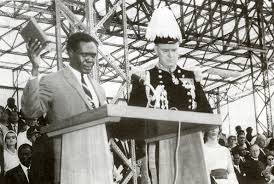
9th October, 2018 Uganda would turn 56 years old and independent save for abnormal events in the country such as a Cabinet Minister for Defense’s recent claim in the National Assembly that there exist occupational forces (militants) from as far as West Africa to be specific Nigeria battering Ugandan citizens with impunity on the streets of Kampala in broad daylight making independence of Uganda a far cry.

At 56 years, independence would mean transparency, self-rule, self-determination, accountability, love for the country (patriotism), free of corruption and exploitation but where is this in Uganda where managers and administrators take government organizations they work for as their own family businesses?

Uganda was the site of several powerful kingdoms notably Buganda and Bunyoro before the arrival of European colonialists in the late 19th century; she became a British protectorate in 1894 with her present borders established in 1926 who managed themselves very well.

Uganda’s approach to independence was unlike that of most other colonial territories where political parties had been organized to force the reluctant white rulers for independence.

There had been demands for greater autonomy, but these were mostly expressed by local nationalists surrounding the then five constituent kingdoms of the Colony. National demands for independence began with the formation of the Uganda National Congress (UNC) in 1952 based on the patterns of the Congress party of India by nationalists such as Ignatius Musazi and Abu Kakyama Mayanja whose small organization never won much support and was quickly suppressed by the British rule. Deep religious divisions had developed, the British liked and supported elites who had largely been converted to Protestantism but the majority of the populations however, were catholic and they were excluded from power by the Protestants.

Ethnic divisions were just as important then as it is presently. Baganda catholic chiefs and educated urban professionals formed Democratic Party (DP) in 1954 and in 1960 Milton Obote formed the Uganda People’s Congress (UPC) by joining Northern Uganda branches of the UNC and representatives from Western Uganda mainly who had been elected to the Legislative Council in 1958. The DP and UPC became the major National parties, each gaining influence by winning the support of local notable personalities with rural ethnic followings in their home areas.

(Note: The same rural and tribal based parties still exist today coupled with selfishness, sectarian tendencies almost in all sectors and institutions.)UPC was dominantly protestant as opposed to Buganda based Democratic Party most of whose members were catholic.

As one of the first generation cadres, I have been evaluating and reflecting on the salient issues in the NRM 10 point program which I vibrantly preached all over the greater Bugisu (now seven districts) in the mid 80s and 90s and realized very serious challenges and questions of the revolution that remain to be answered.

• How do we effectively and thoroughly fight and eliminate the rampant corruption and abuse of office (stealing with impunity), create a vibrant micro-economic environment to match the immensely improved macro-economy?
• How can we participate in the global ORDER, world environment and climate change when a government minister is insisting that plastic bags (buveera) are okay, gainfully increase per capita incomes in a planned time frame and tackle the unprecedented, dangerous graduate/youth unemployment head-on?

• How can the people’s power (constitutional framework) and democratic gains for effective, good governance be actualized and perpetuated at all levels, at all times in the whole country to avoid chaotic regression?
• Can’t government and or the president have the ability and willingness to bend a little and seriously advocate for a serious national dialogue with opposing political forces for peaceful resolutions for it costs less than war?

Nabendeh Wamoto S.P (0776658433)
simonwamoto@yahoo.co.uk

Stories Continues after ad