Stanbic Bank
Stanbic Bank
21.4 C
Kampala
Stanbic Bank
Stanbic Bank
Home Blog Page 1573

UN agency warns 400,000 children in DRC’s Kasai region ‘at risk of death’

Children attend class in a temporary tent school in Mulombela village, Kasaï region, Democratic Republic of the Congo.

About 400,000 children in the Democratic Republic of the Congo (DRC) “are at risk of death” in the Kasai’s region from food shortages caused by conflict and displacement, a senior UN official who has just returned from the area, has expressed shock following his visit to that area.

The UN Children’s Fund (UNICEF) has issued the warning on Friday, as it scales up its response to those in needs.
Before violence flared in mid-2016 between government forces and tribal militia across the vast region, the people of the Kasais had little experience of conflict, according to UNICEF Spokesperson Christophe Boulierac.
“What I saw really shocked me at a personal level…The situation there is absolutely scary, in the sense that people had to flee in the bush (with) family, children”, he said.

“They had to stay a few months because of the violence. They had no proper food, they had no proper water to drink. And now that the violence has decreased they come back.”
The UNICEF official who has worked in the field in Asia, African and the Caribbean countries said: “Often we say that children are at risk of dying; no, that’s not what we are saying in Kasai. We say that children are dying; I saw that.”
Some 3.8m people are in need of humanitarian assistance in the Kasais, including 2.3m children. At least half of all children under-5 years of age in the region – that’s 770,000 – are suffering from acute malnutrition, including 400,000 who are severely malnourished, according to a UNICEF report published this week.

UNICEF says that many families driven from their homes have been unable to plant and harvest their crops for three successive seasons. It also warns that thousands of children have been recruited into armed groups and militias and that hundreds of schools and health centres have been looted, burned or destroyed.
To support its programmes for the children of Kasai in 2018, UNICEF has appealed for $ 88m, which to date is only 25 per cent funded.

Stories Continues after ad

Regional women traders to benefit from support programme

TMEA CEO Frank Matsaert

At least 350,000 women in East Africa are to be supported to become import and export traders to take advantage of the region’s common market, according to an official of TradeMark East Africa.

Frank Matsaert, the chief executive officer of Trade Mark East Africa (TMEA), said days ago in Nairobi that the extra support comes as the 5,000 and 25,000women targeted in the phase one and two of the project respectively had doubled their income since 2010 when the project was first launched.

“This is a commitment we are making today to ensure that women of East Africa fully benefit from the common market “Women play a crucial role in growing trade and therefore economies within East Africa,” he said, adding that there was need to find ways of supporting women in business through partnerships with various organizations.

Matsaert said that his agency’s initial focus was on reducing the cost of doing business especially at the borders where small traders were being harassed even though it now focuses also on helping women participate effectively in the intra-regional trade. Our target is to work with one million women in the next eight years,” he said.

Matsaert urges the regional governments and development partners to focus on addressing systematic challenges that continue to slow women’s participation in business, which he says include; access to adequate financing, lack of access to assets, and cultural effects on women’s property rights.

TMEA is a non-profit body that works with various partners to grow potential or intra-East Africa and the region’s potential to export. It has been instrumental in modenising the region’s border posts to ease business environment.
The One Stop Border Posts established now facilitate joint processing of documents to reduce transit costs incurred in cross border movement.

Stories Continues after ad

Why tax avoidance is illicit

Prof. Sol Picciotto

By Sol Picciotto
In a recent paper, revised and published as a blog post, I argued that tax avoidance by multinationals should be included in the official definitions of illicit financial flows (IFFs).

I argue that a broad definition of IFFs is essential, since they all use the offshore tax haven and secrecy system, which indeed multinationals helped to construct, for the purposes of avoidance of tax as well as financial regulation. This system is used for three types of financial flows:

criminal, e.g. storing the proceeds of crime or corruption, and evading tax;
unlawful, e.g. facilitating tax avoidance schemes, many of which are unlawful;
immoral, e.g. concealing assets from family or business associates.

The argument generally made for excluding the latter two categories from the definition of IFFs is that they are ‘perfectly legal’. The term ‘illicit’ is etymologically much wider than ‘illegal’. Regardless of this, in my view it would be unsound, and lead to bad policy, to adopt a restrictive definition.
Tax avoidance is not ‘perfectly legal’ – it can be challenged by tax authorities, if they have the political backing and resources to do so, and may be found unlawful. As perceptions of tax avoidance have changed, there has been both strengthened enforcement and greater efforts to reform and improve the legal rules.
A key part of these efforts is to remove the justifications advanced for using offshore structures. It is often hard to draw lines between activity which is criminal, unlawful, or merely immoral.

Restricting the efforts to improve regulation to criminal activities alone would allow them to be used for dubious activities, and so lend legitimacy to these offshore structures and facilities. As in other areas of law enforcement, a policy of zero tolerance is important in fostering a culture of compliance, instead of one which considers that anything is allowed which is not clearly criminal.
What is offshore?
In my paper I explained ‘offshore’ as follows:
‘Offshore devices or structures all involve using the laws or facilities of another country to obtain an advantage not possible under the law that should apply. Private persons’ bank accounts, financial information and other aspects of their personal affairs are generally protected in all countries by laws on confidentiality and privacy, which can only be overridden in specified circumstances, when there is a public interest.
There is a network of tax treaties aimed at preventing double taxation, and in any case countries wishing to attract investments generally provide inducements, not excess taxation. Resorting to an offshore arrangement always involves trying to get around an inconvenient law – dodging the law.’

I could have gone further, to explain in more detail (as I have elsewhere, going back to the extensive discussions in my book published in 1992) that these offshore structures generally involve exploiting definitions of residence, often taking advantage of facilities specifically aimed at non-residents, or at foreign-source income. Many of these structures are highly complex, but ordinary people have no difficulty in grasping that there is something ‘dodgy’ about setting up a double-Irish Dutch-sandwich.

The term offshore is by now widely understood, and since the 1970s regulators have been trying to deal with the problems it creates by improving regulatory coordination. This requires coordination not only between countries, but also of different types of regulation. For example, until recently, the main efforts to deal with the problems caused by offshore finance were led by financial regulators, who naturally focused on dealing with money-laundering and banking prudential requirements.
While this helped to improve financial security, it also allowed jurisdictions to claim a stamp of international approval, while maintaining levels of banking secrecy that thwarted the efforts at tax cooperation.
Following the great financial crisis, the G20 leaders in 2009 declared that ‘the era of banking secrecy is over’. Much has been achieved since then, but more is still needed to deliver on this pledge. This includes improving exchange of information and cooperation between bank regulators, financial information units and revenue authorities.

The drive to introduce greater transparency about beneficial ownership of companies and other legal entities is also a common objective. These regulators all share also the concern to find ways to strengthen the standards of professional responsibility of the corporate service providers, to ensure that they do not act as facilitators or enablers of evasion or avoidance.
The arguments for a narrow definition
A different view has been argued in a paper by Maya Forstater, published by the Center for Global Development (CGD). The paper objects that the term offshore is ‘overly sweeping’, since ‘[e]verywhere is “offshore” to everywhere else’. This is indeed true: offshore is a technique or system for choosing a suitable jurisdiction to avoid another country’s laws.

This is why it is better to use the concept of the ‘offshore system’. It is now widely understood, for example, that high standards of transparency should apply not only to the small island jurisdictions generally targeted as havens, but also to leading financial centres notably the USA, which maintains unacceptable levels of secrecy for legal entities.
The paper by Forstater also finds difficulty with my defining offshore by reference to avoiding the law which ‘should’ apply to a person or a transaction. It argues that:
‘A wealthy international family which owns properties in several countries, a multinational enterprise managing risk, assets, and inventories across borders, or a joint-venture involving investors from several different countries all face choice of jurisdictions to use for legal structures and financial assets in the ordinary course of their affairs—and whichever they choose will be “offshore” to some parties.’

It is hard to see how creating a complex structure involving intermediary entities formed in jurisdictions such as the British Virgin Islands or the Bahamas, and taking advantage of loopholes such as differences in the definition of residence, is just a simple matter of making a ‘choice of jurisdictions to use … in the ordinary course of their affairs’.
Such structures are obviously designed for the clear purpose of avoiding inconvenient rules, especially tax. I am however pleased that the paper does not deploy the other argument made by defenders of the offshore system, that regulatory competition creates a desirable pressure on countries to relax regulation seen as oppressive, such as high taxation. This more clearly shows the intention of the unscrupulous wealthy to obtain benefits by legal trickery rather than straightforward administrative and democratic political processes.
The paper further argues that:

‘The role that international financial centres play in mediating investment, enabling people to diversify their assets, and supporting global commerce are also critical benefits to society. Too little is known about how much of what takes place offshore is beneficial, defensible, or objectionable, and bundling these categories together under the “illicit” umbrella will not support greater clarity and understanding.’

This statement suggests scant knowledge of the extensive academic research into the phenomenon of offshore, and the history of policy initiatives towards it. Little credibility can be given to an argument for a narrow definition of IFFs which rests on the view that ‘too little is known’ about how these flows move through the financial system, and what is needed to try to prevent its use for objectionable purposes.
Avoidance and Morality
Underlying my argument for a wide approach to defining what is ‘illicit’ is the understanding that law is fuzzy, or in more academic terms indeterminate.
Hence, elements of morality and politics inevitably come into its interpretation. Attitudes to regulation are not value-free, law is normative, as is its interpretation and enforcement. Lawyers should understand this, as they spend their time debating the meaning of legal rules, although others perhaps can be excused for thinking legal rules have a fixed and accepted meaning. Those designing or using complex avoidance structures work in the grey areas created by the inevitable indeterminacy of legal rules (see my paper here).

They should be aware when they are pushing the boundaries of valid or legitimate interpretation. The argument that everything is legitimate that is not clearly criminal is an attempt to validate such techniques. Professional practice must have an ethical underpinning, a responsibility to the public not just a duty to the client. This has regrettably been greatly weakened in the past few decades.
The great financial crisis woke politicians up to this problem, and policymakers must now deliver on the necessary reforms. Civil society, including academics and independent researchers, should play an important part in this. The Forstater paper’s response to this perspective is that it ‘begs the question who holds these morals or ethics, and whether they are universal and well defined’. I find it surprising that she should take an agnostic position on the need to strengthen professional ethical standards to ensure the strong culture of compliance essential to the proper functioning of markets.

Debate in this area is important to policy formation. However, I think we should recognise that such policy debates are not innocent; they are generally to some extent and in some ways partisan.
In this context, it is important that all professionals accept ethical responsibilities. This includes researchers, especially in development studies, who should subject all policy arguments to critical evaluation. This should include, perhaps even focus mainly on, the assumptions behind orthodox opinion. Civil society campaigners perform an important role in challenging the orthodox consensus. Tax justice campaigners at least make their aims explicit, which I think is preferable to claiming a spurious objectivity, as do professional providers of tax avoidance schemes.

Of course, campaigners sometimes get things wrong. They typically have inadequate resources with which to investigate very well-embedded systems supported by strong vested interests. Nevertheless, scrutiny of the conceptual underpinning and evidence basis for policy prescriptions is important. For example, there has been some confusion about the transfer pricing problem, caused by use of the term ‘transfer mispricing’ (which I think is misleading), and the attempts to use customs data to quantify its scale. My paper and blog included an attempt to clarify this issue.

Development agencies and think-tanks also have a responsibility to ensure that the work they publish takes a rigorous and even-handed critical approach in these important policy areas. Indeed, if anything, stronger scrutiny should be applied to justifications given by economically and politically powerful institutions. This is particularly difficult when it might affect the prospects of funding from such institutions. Researchers fail in their responsibility if, in their eagerness to uncover the weaknesses in the policy proposals of campaigners, they readily accept trite arguments in favour of the status quo.

I fear that this has occurred in this paper, which has too easily accepted the claims that practices such as tax avoidance are ‘perfectly legal’. There is also other similar published research which in my view has failed to ensure rigorous scrutiny of arguments defending the use of tax havens and the offshore system.

As the debate has progressed, it now seems that the responsible international organisations are beginning to accept the need for a wide approach to the definition and measurement of IFFs. This seems borne out by the approach adopted in the Background Paper to the expert consultation last December by the UN Office on Drugs and Crime (UNODC). In my view, this is to be welcomed. Reverting to a narrow definition limited to criminal activity would be a retrograde step.
Sol is an emeritus professor at Lancaster University, a Senior Adviser of the Tax Justice Network, coordinator of the BEPS Monitoring Group, and a member of the UN Tax Committee’s subcommittee on dispute resolution.

Stories Continues after ad

Motocross’ Van Pee back in action

Uganda MX Team Captain, Maxime Van Pee (MVP) returns to active competition this weekend

Kampala: Uganda MX Team Captain, Maxime Van Pee (MVP) returns to active competition this weekend for Round 3 of the Motocross (MX) National Championships which will be held at Busika Motorsport Arena this weekend.

MVP has been out of action for 8 months following the injury he sustained during the FIM Africa Motocross of African Nations Championships in Botswana last year.

After undergoing reconstructive surgery on his knee, he has been on medical recovery until last month when he tested his fitness during FIM CAC Enduro Round 1 championship that was held on Kalangala Island.

“The track is ok and I am ready to gauge myself against the rest of the MX 1 riders although I will take it easy to avoid aggravating my injury at this stage of my recovery,” said MVP after practicing on the Busika track on Thursday.

He also added, “My target will be to give as much challenge to the National contender’s and collect as much points as possible but not chase down our guest riders like I always do”

The Event that will he held on Sunday 13th May will also feature Coby Gilmore from USA , Shahar Balulu from Israel and Jae Min from South Koreas a guest riders in the MX 1 category which will be a good addition to the thin number of riders in that category.

A good challenge is also expected in the 85cc where Fortune Sentamu will face off with nemesis Alon Orland.

Stories Continues after ad

Makerere touchy administrator granted bail

: Makerere University Senior Administrative Assistant Edward Kisuze has today been granted shs2 million cash bail by Buganda road magistrate Eremye Mawanda

Kampala: Makerere University Senior Administrative Assistant Edward Kisuze has today been granted shs2 million cash bail by Buganda road magistrate Eremye Mawanda.

Mr. Kisuze was arrested in April following a photo that went viral on social media, with him allegedly sexually molesting Rachel Njoroge, a student who graduated in January and had reportedly gone to have her academic credentials certified.

Through his lawyer Kenneth Munungu, Kisuze applied for bail however his application was last week turned down on grounds that he will interfere with the then ongoing investigations.

However appearing before court, Mr. Kisuze was fled on a Shs2 million cash bail as his sureties Dickson Ndaga (his brother) Robert Semanda, Steven Semugela, Jonathan Muyingo were instructed to pay Shs20 million non-cash.

Before adjourning the matter to May 28 2018, court instructed prosecution that led by Viola Tusigwiirwe to produce key witness in the matter for hearing.

Prosecution averred that Ms. Njoroge was on April 13, 2018 forced into illicit act after she had gone to pick he transcript.

The accused is said to have locked the office and suddenly started harassing her in the due process Njoroge picked out her phone and started taking picture after realizing that there were no cameras in the office.

Thereafter she reported the case to university administration and recoded a statement with university police leading to suspended of the Kisuze from carrying out university related activities and accessing senate building for stepped-up investigations to thrive.

Stories Continues after ad
Fortebet cashes Arua’s winner Shs49m for Shs1000 bet

Acidri with his money at Fortebet head office in Kololo

Fortebet, biggest betting company has paid out to the winner of Shs49 million, all the way from Arua.

On Thursday morning, the winner, Kasul Acidri jetted in straight from Arua to Fortebet head offices in Kololo to pick his money.

As usual, whenever a customer wins, he is paid out without any delays, and this is what happened with Acidri, he received all his money, cash.
It should be remembered that just a few days ago, Acidri selected 12 games, on which he bet with just Shs1000. If this ticket won, it would bring 49,186,284 and indeed it won.

This wonder winner went for just 12 soccer games and mostly selected away wins (8 in total) plus only two draws and two home wins. Most importantly however, the big odds that Fortebet offers made the real difference because this slip generated a total odd of 57,866.22.

The money was handed over to Acidri by Fortebet’s Media manager, John Nanyumba. Smiling from ear to ear, Acidri said, immediately after the handover, that, “I feel extremely proud because my betting dream has come true. I have been betting but not winning. But inside me, I kept my hopes alive, hoping that one time, I will win some big money. This dream has now become a reality.”

Acidri, told us that this is not the first time he is winning, the other being a win of Shs5 million after staking the same amount of Shs1000. “I have lost so many times, and I know many out there go through the same. However, you can never get your chances come to pass if you never continuously try out. Just keep trying, one time you will smile like me,” Acidri added.

The winner said that he is going to use this money for construction of a house in his plot of land that he bought earlier and also adding more money in his hotel business which is located in Arua town. Congratulations Acidri.

Stories Continues after ad
Onyango’s Mamelodi Sundowns to face FC Barcelona

The last time barcelona played sundowns in 2007.

Spanish giants Barcelona will travel to South Africa to play a friendly match against newly crowned ABSA Premiership champions Mamelodi Sundowns on Wednesday, 16 May.

The friendly match has been organised by the Nelson Mandela Foundation and is part of the events to commemorate what would have been Nelson Mandela’s 100th birthday.

Uganda Cranes Captain Dennis Onyango is Sundown’s first choice goalkeeper and will be in contention to start against some of the world’s best players in Messi, Suarez and Coutinho.

It will be the second time the Masandawana have brought the Spanish champions out for a friendly match. The first was in 2007 which the Catalan side won 2-1 after being a goal down at half-time.

Barcelona will reportedly bring their star players including Lionel Messi, Luis Suarez, Andres Iniesta, Gerard Pique and Philippe Coutinho as part of the agreement.

Barcelona have two games left this season as they aim for an unbeaten La Liga campaign, they play away at Levante on Sunday and Real Sociedad a week later with the South Africa trip in between.

The match will be played at Fest National Bank Stadium in Johannesburg

Stories Continues after ad

PM launches Manifesto Week 2018, says more remains to be done

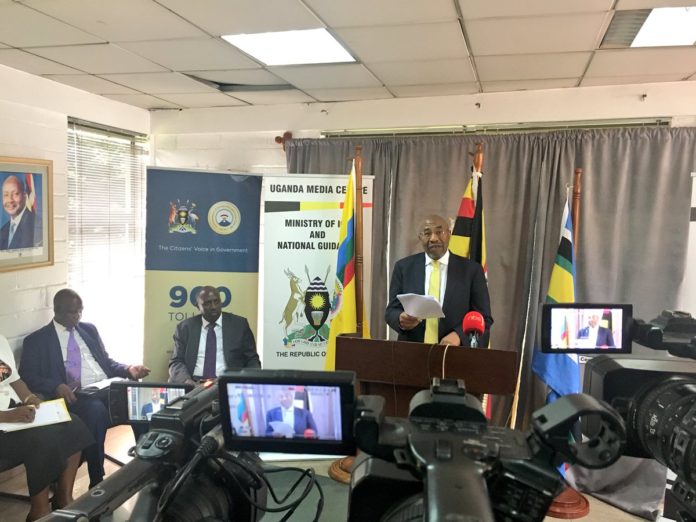
PM Dr Ruhakana Rugunda addressing the press in Kampala at the launch of Second Manifesto Week 2018.

The Prime Minister, Dr Ruhakana Rugunda on Friday launched the Second Manifesto Week at the Uganda Media Centre in Kampala, highlighting key government achievements since President Yoweri Museveni assumed power for his fourth term on May 12, 2018.

Speaking to the media Dr Rugunda said: “Through the manifesto we entered an agreement to give Ugandans the best services and take it to a middle income status. I would like to assure Ugandans that we are on the right track towards this. There are steps being undertaken to address challenges.”

Among the achievements, Dr Rugunda said that the Uganda Heart Institute is now fully operational with sound equipment and well-trained personnel.

The construction of standard gauge railway was also underway. “By July this year the financial agreement made will be implemented and work will commence but as we talk, compensation of citizens for places where it will pass is on and in other areas, it is complete,” he said.

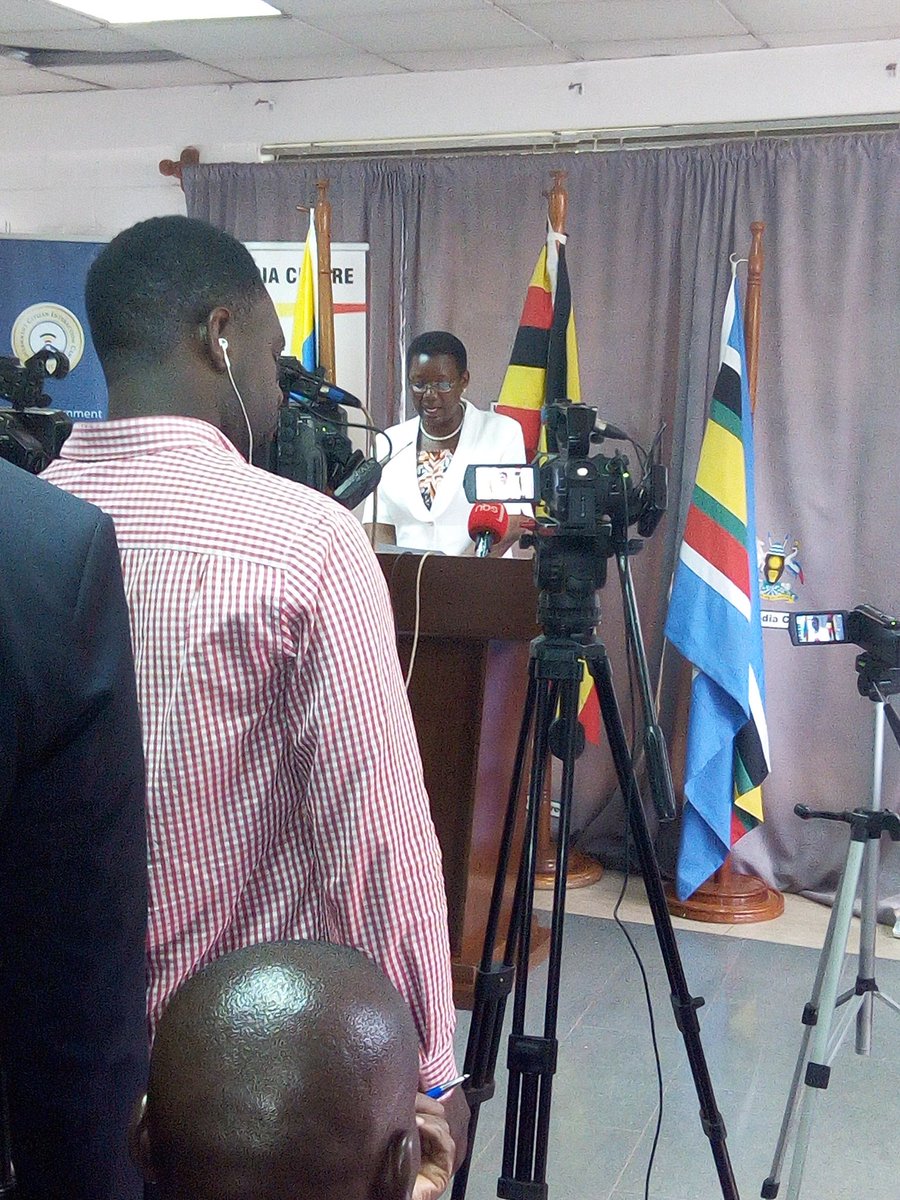
Minister of the Presidency Esther Mbayo addressing the media during the second launch of the Manifesto Week

The Prime Minister said that connection of any part of Uganda to power, affirmative action, maintenance of peace and security has remained government’s primary achievement. “On a regional perspective, we maintain a good relationship with international bodies like the UN among others,” he said.

He said government in the last years, has expanded the roads, constructed, upgraded and maintained some, adding that road equipment were procured and distributed to different districts.

Rugunda assured Ugandans of their security and safety, saying it still remains government’s and NRM’s top priority. He urged the public to remain vigilant and work hand in hand with all security agencies.
The Minister of the Presidency Esther Mbayo while addressing the press said that Esther Mbayo said: This year’s Manifesto Week will be dedicated towards analysis and presentation of work so far done by the Government as President Museveni promised in the manifesto. Different ministers will be speaking to the media and the public about where implementation has reached.”

Minister Mbayo: appealed to all Ugandans to embrace the manifesto week proceedings and inform the different authorities where implementation is being abused but also urged the Ugandan media to disseminate all information to the population.

NRM Secretary General Justine Lumumba while speaking to the media said: “As we launch the Manifesto Week, I remind all players in implementation of the 2016-2021 manifesto to attach a deserving importance to the cause.”
She said the Manifesto Week allows the NRM/government to give Ugandans accountability of work done in the short term, “unlike in the past years where we used to account only at the end of a term.”

Saturday May 12, marks two years since NRM Government won back political under the Leadership of Museveni who campaigned under the theme, ‘Taking Uganda to Modernity through Job creation and inclusive Development.

Starting May14-18 2018, line ministers shall be coming to Uganda Media Centre to give an account of the implementation of the manifesto by their ministries.

Stories Continues after ad
Online dating: Ugandan man involved in fleecing Australian lover of Shs.1.6b

Godfrey Kyzungo shares a cake with his wife Suzie after wedding.

A heartbroken grandmother who lost $480,000 approximately (Shs1.6 billion) over the course of three separate online relationships-including that with a Ugandan named ‘Godfrey Kyzungo’ is now warning others about the dangers of cyber love, Daily Mail Australia has the story.

Suzie admits to being ‘gullible’ and ‘brainwashed’ in the past – having sold her home and parted with close to half a million dollars in order to continue transferring money to her romantic partners overseas.
‘Maybe that’s what I was doing: buying love,’ she reflected in conversation. ‘When I think back now I think that’s what I was doing.’

But despite still being married to one of her scamming suitors, Suzie seems to be waking up to the sobering realisation that ‘Men aren’t all they’re cracked up to be.’
It just took three particular men to do it.

The first one called himself David Fisher: a charming British gentleman, by all online appearances. David sweet-talked his way into gaining access to Suzie’s bank account so that he could buy a laptop he wanted – and eventually rorted the Australian grandmother out of her father’s $76,000 inheritance before disappearing from her life entirely.

The next man appeared on the scene shortly thereafter: this time, in the form of an American, Taliban-fighting soldier by the name of Johnson Williams.
When Johnson started asking for money, Suzie sold her house to fund it.
‘I went along with it because I felt: ‘Wow, I’ve actually got somebody in my life now, and I’m committed to this man,’ she said.

Of course, that man too turned out be an extortionist in disguise – and when Suzie’s bank looked deeper into the transactions, they found that at least five other women were also sending him money under the false pretense of a relationship.
The funds were being wired to Ghana, as it turned out.

The third time Suzie found love was with a man named Godfrey Kyzungo, from Uganda, whom she met on Facebook. This time Suzie went to Africa to meet her courtier in person, and even went so far as to marry him in the flesh before regularly sending him bank transfers.
But Suzie has since confessed that she believes Godfrey’s motives were simply to marry her for the money and move to Australia.

Now, she’s looking into having her marriage to him annulled, and speaking up to let others know that the internet dating scene is rife with scam artists.
Her hope is that other men and women don’t fall for the same tricks that she did.
‘These people are evil how they manipulate your mind,’ she says.

Stories Continues after ad

EAC and ILO sign MoU to improve work environment in region

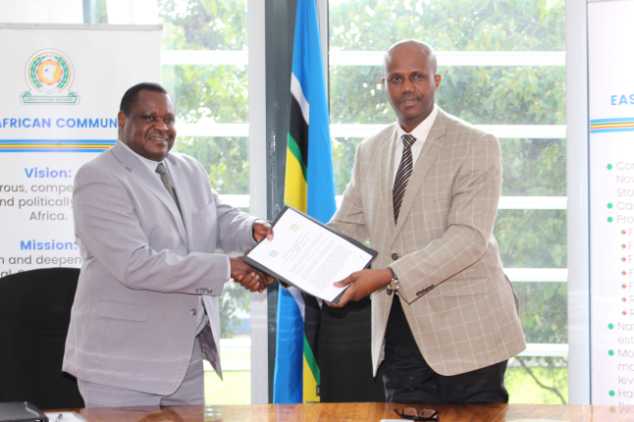
Officials signed the MOU

The East African Community and the International Labour Organization (ILO) on Thursday signed a Memorandum of Understanding (MoU) aimed at improving the work environment in the region.

The MoU which was signed at the EAC Headquarters in Arusha, Tanzania by EAC Secretary General Amb. Liberat Mfumukeko and Mr. Wellington Chibebe, the Director of the ILO Country Office in Dar es Salaam, Tanzania will, among other things, address issues such as youth employment, extension of social security, and Gender Equality and Empowerment of Women at the work place.

The MoU is a follow up to another one that was signed between the two organisations in 2001. The 2002 MoU enabled the EAC and ILO to develop and launch a five-year East African Decent Work Programme (2010-2015).
Amb. Mfumukeko said that the revised MoU provides for the development of a framework for the harmonisation of the EAC Partner States’ policies on social security in line with the ILO Convention on Social Security (Minimum Standards) No. 102 of 1952.

“The MoU further provides for the expansion of micro, small and medium enterprises for employment creation. Also included is the development of an EAC labour migration policy as one of the facilitators of labour mobility in the Community,” said the SG.

Amb. Mfumukeko said the Community was striving to address youth unemployment as a matter of priority, adding that having well educated but unemployed youth out of work was a time bomb.
He disclosed that EAC Partner States were addressing the issue by seeking to make agriculture as an attractive income generating venture for the youth.

Noting that matters of Entry/Work Permit/Residence Permit have an impact on the immigration function in the Partner States, the EAC Secretariat would convene a joint meeting of the Chiefs of Immigration and Directors of Labour before June 2018to finalize the harmonization of Entry/Work/Residence permits.
A meeting of technical officers from EAC and ILO held from April 30 to May 2, 2018 agreed to enhance collaboration in the implementation of a two-year project towards the extension of social security benefits to migrant workers in the EAC.

In his remarks, ILO Country Director Wellington Chibebe said that his organisation would work with the EAC to accelerate regional integration and at the same time ensure that the drivers of integration, that is the free movement of labour, goods and services enhance livelihoods of the millions of working women and men and their families.
“We welcome the signing of this new Memorandum of Understanding, which will be based firmly on a new DWP for East Africa, addressing strategically prioritized areas agreed upon by the ILO on one side and the EAC and the East African social partner organisations on the other side,” said Mr. Chibebe.

Mr. Chibebe said that giving financial assistance to the needy instead of equipping them with vocational skills was akin to creating culture of perpetual dependency.
Also represented at the two day forum were the East African Trade Unions Confederation (EATUC) and the East African Employers Organisation (EAEO).

Stories Continues after ad