Stanbic Bank
Stanbic Bank
18.5 C
Kampala
Stanbic Bank
Stanbic Bank
Home Blog Page 1619

High transaction costs, risks responsible for high interest rates-Kasekende

BoU Deputy Governor Dr. Louis Kasekende

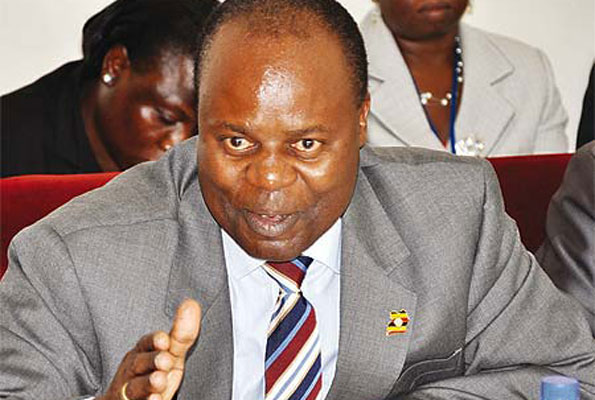
The Deputy Governor of Bank of Uganda Dr Louis Kasekende has said that the average lending rates in the country are high because of the high transaction costs and the risks involved when commercial are dealing with enterprises in the informal sector, the largest segment when compared to the formal sector.
“…Because of the high transaction costs and credit risks involved, it is only commercially viable for banks to serve this segment of the credit market if they charge high interest rates,” he said Wednesday in Kampala at the launch of Standard Chartered Bank’s Social Impact Assessment Report.
He said firms in the informal sector apply for small loans which are very costly per unit value but that it is also costly to evaluate their loan applications and monitor their borrowing.
Banks in Uganda which have a large retail clientele of small scale borrowers incur much higher operating costs and must, therefore, charge higher lending rates than banks which focus on a relatively small base of large and medium scale corporate borrowers, he emphasised.
The informal small and micro enterprises, he said, pose “very different challenges for the banks”. He said revenues for enterprises in this category are volatile and that their long term probability of survival is low. “Most do not keep proper financial records. There is often no separation of business expenses and the personal expenses of the owner. Banks face severe informational problems in evaluating the creditworthiness of these enterprises,” he said.
On the other hand, he said, the medium and large scale formal sector enterprises in Uganda have access to bank credit and that many of them can borrow funds at interest rates which are well below average for all borrowers and that in some cases even below the posted prime lending rates of banks. The current average lending rate is tagged at just over 20 per cent.
“Many of these borrowers can also access offshore finance. The reasons why these borrowers can access credit relatively cheaply are straightforward to understand; these enterprises have established track records of profitability, are well managed and run according to strict commercial principles, they prepare detailed financial accounts and they can often provide guarantees from affiliates abroad,” he said, adding that credit risk for this segment is low and that the transactions cost incurred by the bank per unit of loan value is also low.
He said that reducing intermediation costs will benefit from government’s continuous efforts in improving the business environment such as investment in infrastructure and efficacy of commercial justice system. “Most importantly for banks, he said, lowering costs will probably require employing information technology to replace traditional banking methods of delivering loans and other financial products and for assessing loan applications.
Kasekende commended Standard Chartered Bank for investing in digital technology with the aim of enabling 80 per cent of its customers to transact business online without visiting branches. The Bank recently launched its first digital-only retail bank in Ivory Coast and will assess this to launch in other countries.
The independent socio-economic impact assessment of Standard Chartered Bank’s operations in East Africa, addresses the contribution of the bank to the economy and to social welfare.
It highlights the contribution which Standard Chartered Bank’s operations, especially lending to the private sector. It stresses it contribution to GDP and employment in Kenya, Tanzania and Uganda in 2016.
In Uganda, the Bank extended domestic credit to the private sector, through both onshore and offshore financing, of just over $900m in 2016, which amounts to about 3.6 per cent of GDP.
The report estimates that Bank’s lending supported value addition of 3.5 per cent of GDP and almost half a million jobs. The report says Bank’s operations in Uganda have their largest impact on the agricultural sector, which accounts for 46 per cent of all of the jobs supported.

Stories Continues after ad

UNRA evicts Kalerwe residents for expansion of Northern Bypass

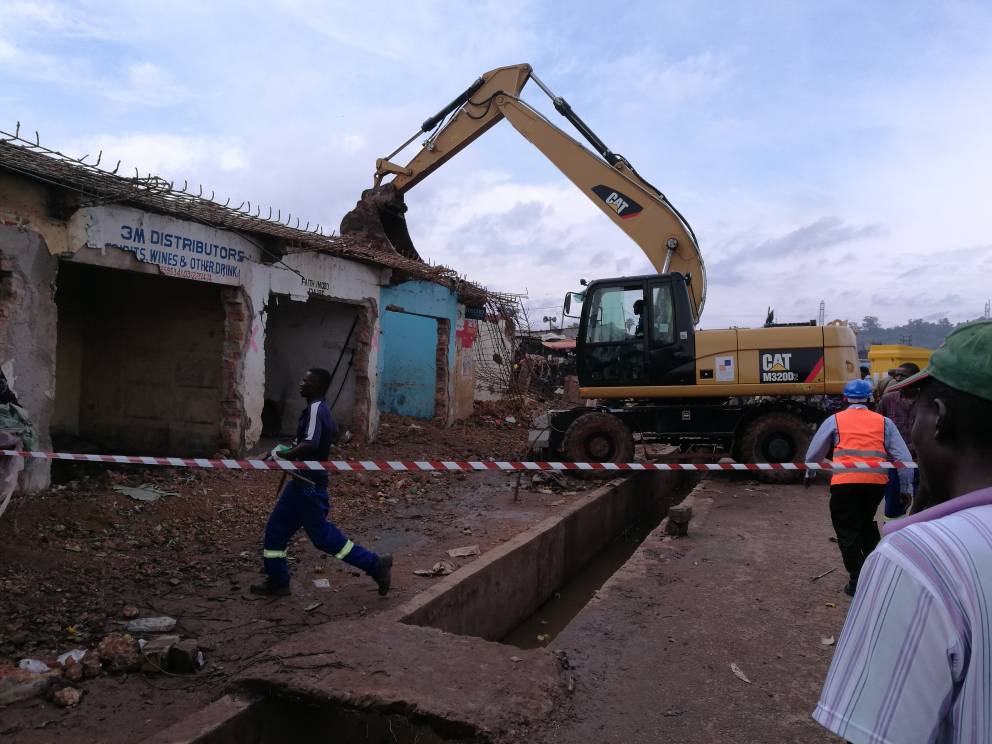
Uganda National Roads Authority enforcement team has demolished structures at Kalerwe Bivamuntuuyo Market to pave way for expansion of Kampala northern bypass.
In 2013 government of Uganda acquired grant of 67 million Euros (Shs246b) from European Union to facilitate the expansion of the 17.5 Kilometer road to a dual carriage removing roundabouts and replacing them with flyovers and traffic lights at various areas of Namboole and Kalerwe, Busega, Ntinda, Kisaasi and Namungoona/Lubigi, widening of road junctions at Ssentema.
Speaking to this website, communications manager of UNRA Allan Ssempebwa said, the construction company allocated Shs 19 billion compensation to all land owners where the project is expected to go through.
“The during the demolition process, all the affected parties had been fully engaged, compensated and informed about the exercise.” He said in an interview with Eagle Online.
Upon completion, Northern Bypass will be help in the reduction of traffic congestion in the city since heavy tracks trekking to Eastern Uganda; Congo Burundi will be using that route.

“Kampala is mainly congested due to the narrow roads, and absence of flyovers, UNRA is yet to introduce flyovers on Kampala road.”
The first phase of Kampala Northern Bypass was constructed by Salini Construction Company in 2004 at an estimated budget of Shs87 billion, however the project ended up costing over Shs 100billion and three years behind schedule.
Currently the expansion of the bypass was awarded to Portuguese Company, Mota Engil however the project is behind schedule to due to the delayed process of acquiring land. It is this year that the project expected to be executed.

Stories Continues after ad

Insecurity still looms as a Kyambogo University female student goes missing

Missing Kyambogo student-Nabuti

Despite the recent changes in the security hierarchy in the in country, there are still cases of murders and disappearances in the city.
Following the numerous kidnaps and murders of especially women, attacks of homes in the great Masaka region which started last year, President Museveni recently made changes in security, dropping the Security Minister Lt. Gen. Henry Tumukunde and Inspector General of Police, Gen. Kale Kayihura.
This was prompted by the kidnap and murder of Susan Magara who was later to be murdered by her captors before dumping her dead body on Entebbe road.
After the changes, President Museveni stated that there had been lapses in the old security leadership.
Referring to some of the police officers as bean weevils, the Museveni argued the new leadership work together to improve the wanting security situation especially in the city and its suburbs.
However this has not happened as disappearance of women in Kampala is still taking place.
The latest is the sad news of the disappearance of a Kyambogo University student which took place this week.
The girl who has been identified by relatives as Elsie Nabbuti has been a third year student pursuing a Bachelor’s degree in Development Studies. She went missing since Saturday the March 17, 2018.
According to information from relatives and close friends to the missing Nabutti they last heard from her on Saturday.
They further state that when her friends tried calling her, all her phones were off but kept getting on in intervals but still no one was picking them up,”
“Nabutti has not surfaced to her home in Namboole where she stays with the cousin since Saturday and this has got her whole family worried,” says a friend who spoke on condition of anonymity.
The family has made a report at police station has mounted a search for this student.
Both police and family are requesting anyone who may have useful information leading to Nabutti’s whereabouts should report to the nearest police station or
The missing student is the second in just week after another Makerere University Business School student Sheila Igoe went missing last week on Wednesday and was found yesterday Tuesday dead in the city mortuary at Mulago.
This has left a lot in the minds of Ugandan whether the security situation in the country is improve or will continue deteriorating.

Stories Continues after ad

Opposition representation not possible in ACP-EU Assembly – Oulanyah

Deputy Speaker Jacob Oulanyah attending the ACP-EU assembly in Brussels

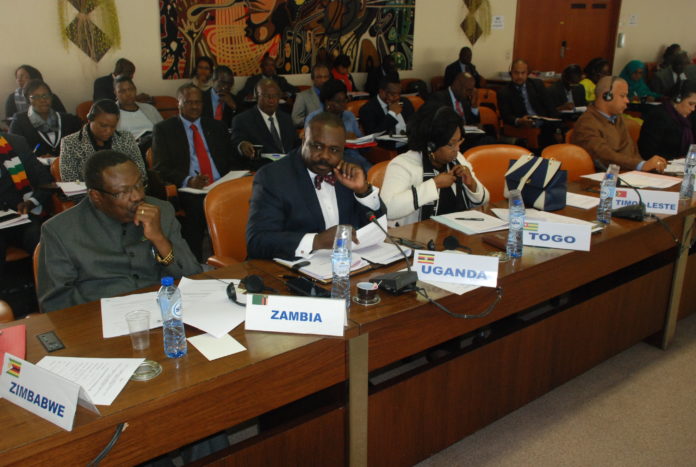
The Deputy Speaker of Parliament, Jacob Oulanyah, says it is practically impossible for opposition African, Caribbean and Pacific – European Union (ACP-EU) to be represented in joint parliamentary assembly.
Oulanyah who is leading Uganda’s delegation to the 49th ACP-EU joint parliamentary assembly in Brussels, Belgium from 19 to 24 March 2018 notes that European Union has proposed that the ACP side have representation of the opposition parties to the assembly, which he says is problematic.
“We are not saying there should be no opposition but we are only asking the basis of it and how do you arrange it,” he said.
The Deputy Speaker further added that unlike the European Parliament, the ACP members come from assemblies and that some of the members leading the delegations were from the opposition.
“If we are going to make it a system, how will we select which country should represent the opposition and opposition to what. I propose that on this point, we raise strong objections and when it comes to voting, we vote against it,” Oulanyah added.
He said this while presenting a report as a co-rapporteur on the ACP-EU relations post-Cotonou; a strong parliamentary dimension, Tuesday, 20 March 2018 at the ACP House in Brussels, Belgium.
Oulanyah called for the ACP Assembly to have legislative powers in order to berelevant and not just be a forum for discussions without any impact.
He added that these legislative functions should facilitate the oversight and representative roles of an assembly.
“The European Parliament represents their parties but the ACP is different. We are directly elected by our people and sent to our assemblies and these have sent us here,” he said. Adding “Our foot rests on the people we represent. How do we make these relevant to them?”
He said that the ACP-EU Assembly should not be equated to international NGOs arguing that the Pan African and East African Parliaments should be examples to be emulated in the post 2020 era.
“I am conscious of the difference that this particular framework had with national assemblies but how close can we go to what happens in national assemblies? This has already happened in other regional Parliaments. How do we begin thinking of having such legislative powers,” Oulanyah said.
The ACP-EU Partnership Agreement, signed in Cotonou on 23 June 2000, was concluded for a 20-year period from 2000 to 2020 is set expire on 29 February 2020.
The fundamental principles of the Cotonou Agreement include equality of partners, global participation, dialogue and regionalisation.
The Cotonou Partnership Agreement (CPA) between the EU and 79 African, Caribbean and Pacific countries (ACP) 0. Negotiations on the ‘post-Cotonou’ partnership shall officially begin before 1 September 2018.
Oulanyah also called for unity in the course of the negotiations with the European side stating that there is need to approach it as a block and not as the three regions as is being proposed by the ongoing African Union Summit in Kigali, Rwanda.
“The African block is in a meeting in Kigali right now and we are getting feelers from their statements and they are beginning to affect the context of our negotiations,” he stated.
Following his presentation, the ACP Committee on Political Affairs, chaired by Hon Agnima Alain Michel Lobognon, asked the Deputy Speaker to draft a diplomatic statement to be sent to the African Union Summit stating that there is need for unity in the post-Cotonou negotiations.
Uganda’s delegation to the Assembly also has William Nokrach (PWD, Northern) and Suubi Kinyamatama(Rakai District).

Stories Continues after ad

Muslims protest ban on veils for female health workers

The letter by Mustafa Mutyaba

The Muslim community has written to government, challenging a ban against Muslim nurses and midwives wearing veils while on duty in government health facilities.

Through their umbrella organisation, the Muslims contend that the policy is discriminatory in nature on religious grounds.

In the letter signed by Muslim Peace Building Network Uganda Chief Executive Officer (CEO) Mustafa Mutyaba and addressed to the health ministry, Muslims want to the decision that was recently announced by Hospital Directors and Principal Nursing Officers to be repealed.

“I am writing to express my concern over the ban on veils for Muslim nurses and midwives in government health institutions and to draw your attention for immediate action by the MOH toward addressing the above,” reads the letter in part.

Mutyaba, who gave the ministry a one-week ultimatum before considering industrial action, further says he is disturbed by the directive which denies the Muslim health workers the freedom of expressing their religious beliefs.

‘Uganda has a fundamental right to allow its citizens carry out their without discrimination there making it illegal for some on to have a rule or policy or practice that puts some one of a particular religion at a disadvantage including Muslim nurses and midwives to veil while on duty yet the veil is regarded as part of their faith,’ Mutyaba stated.

‘I urge you there to take immediate action to adopt a policy of equality that explicitly prohibits discrimination on the basis of religion as well as allow room for Muslim nurses and wives to take up the veil while on duty’, Mutyaba adds.


Stories Continues after ad

Bryan White faces court over failure to pay debt

Brian Kirumira aka Bryan White

Upcoming musician Simon Mukasa aka Lucky Costa has threatened to drag socialite Brian Kirumira aka Bryan White and DJ Michael to court for failing to pay for his services.

In a notice with an intention to sue, Mukasa through Muwada and Company Advocates indicates that he was hired by the duo to perform at their function but that they failed to pay for his services as earlier agreed. The artiste now wants the self-styled millionaire to pay him Shs20 million as compensation or the matter be taken to court.

‘On or around 9 February, 2018, our client and you (Brian Kirumira alias White) at Front Page Zaana Entebbe met and agreed to purchase the copyright of his publication song titled Heroe-Basiima Bagenzi and his physical performance of the same song. It was agreed that you Kirumira Brian aka Bryan White was to pay Shs10, 000,000 for the song, and in addition you made several other promises like buying him land and constructing him a house as a gesture of application,’ reads part of the notice by Muwada and Co. to Brian White and DJ Michael.

The notice adds: ‘However, efforts to secure payment of the agreed Shs10, 000,000 are all in vain “yet our client’s song has been played on several Bryan White Foundation functions and at some you required and secured physical performance of the song by our client”.

‘You have engaged our client to perform the same song on various Bryan White programs including performances at Auto Spa, Munyonyo and Kakyeeka stadium, Mbarara at the launch of the Bryan White Foundation,’ the law firm further charges.

‘Pay us Sh20m as compensation in a lieu of image damage/slander caused on our client’s name by media’, the lawyers tersely assert.


Stories Continues after ad

World marks International Day of Forests

A section of Mabira Forest in Uganda

The international community today celebrates the International Day of Forests with a call on citizens to make their cities greener, healthier and happier to live in.


To be celebrated under the theme, ‘Forests and Sustainable Cities’, this year’s event will provide a platform to increase awareness on the role of forests in storing carbon, which helps mitigate the impacts of climate change in urban areas. Last year’s theme was Forests and Energy.

“By 2050, six billion people or 70 percent of the global population is expected to live in urban areas. Rapid urbanization does not need to result in polluted urban sprawl. Trees and urban forests can make our cities greener and healthier places to live,” the UN says.

By 2035 about half of Africa’s population will be living in urban areas. Officials say this population trend presents considerable demands for employment, services and infrastructure, of which forest resources will play a key role.

The International Day of Forests was established on March 21, 2012 by resolution of the United Nations General Assembly on November 28, 2012 and each year, various events celebrate and raise awareness of the importance of all types of forests, and trees outside forests, for the benefit of current and future generations.

Key messages this year include:

  • Forests and trees store carbon, which helps mitigate the impacts of climate change in and around urban areas.
  • Trees also improve the local climate, helping to save energy used for heating by 20-50 percent.
  • Strategic placement of trees in urban areas can cool the air by up to 8 degrees Celsius, reducing air conditioning needs by 30 percent.
  • Urban trees are excellent air filters, removing harmful pollutants in the air and fine particulates.
  • Trees reduce noise pollution, as they shield homes from nearby roads and industrial areas.
  • Local populations use the fruits, nuts, leaves and insects found in urban trees to produce food and medicines for use in the home, or as a source of income.
  • Wood fuel sourced from urban trees and planted forests on the outskirts of cities provides renewable energy for cooking and heating, which reduces pressures on natural forests and our reliance on fossil fuels.
  • Forests in and around urban areas help to filter and regulate water, contributing to high-quality freshwater supplies for hundreds of millions of people. Forests also protect watersheds and prevent flooding as they store water in their branches and soil.
  • Well-managed forests and trees in and around cities provide habitats, food and protection for many plants and animals, helping to maintain and increase biodiversity.
  • Forests in cities and surrounding areas generate tourism, create tens of thousands of jobs and encourage city beautification schemes, building dynamic, energetic and prosperous green economies.
  • Urban green spaces, including forests, encourage active and healthy lifestyles, improve mental health, prevent disease, and provide a place for people to socialize.


Stories Continues after ad

CAF champions League draws: KCCA seeded in pot 3

The CAF Pots

Ugandan CAF Champions League representatives on the continent, KCCA FC, have been placed in Pot 3 alongside fellow debutants Algerian club MC Alger, Horoya of Guinea and Mbabane Swallows from Swaziland.

Members of the KCCA team to CAF

In effect KCCA stands in line to be drawn with some of Africa’s big clubs like the defending champions Wydad Casablanca, eight time record holders Al Ahly of Egypt and Tunisian side Esperance.

The qualified teams were ranked according to their performances in the last five editions of the CAF Interclubs competitions from 2013 to 2017.

For the Total CAF Champions League, the points allotted are winner – 6, runner-up-5, semi-final – 4, quarterfinal – 3, third in group – 2 and fourth in group – 1, multiplied by a co-efficient of 5,4,3,2,1 for the editions 2017, 2016, 2015, 2014 and 2013, respectively.

The draw will start with Pot 4, with the first ball drawn directly going to Group A. Another draw will be held to determine its position (A1, A2, A3 or A4). The teams in the same pot don’t face each other.

The same procedure will repeated for Pots 3, 2 & 1 to complete the groupings.

The first group stage matches will be played on May 4, 2018.

The winners qualify as the CAF representative at the 2018 FIFA Club World Cup in the United Arab Emirates, and also earn the right to play against the winners of the 2018 CAF Confederation Cup in the 2019 CAF Super Cup.

The draw will be held today at the Ritz Carlton Hotel in Cairo at 8pm Ugandan time.


Pot 1:

TP Mazembe (DR Congo)

Al Ahly (Egypt)

Etoile du Sahel (Tunisia)

Wydad (Morocco)


Pot 2:

Mamelodi Sundowns (South Africa)

Zesco (Zambia)

Esperance (Tunisia)

ES Setif (Algeria)


Pot 3:

MC Alger (Algeria)

KCCA (Uganda)

Horoya (Guinea)

Mbabane Swallows (Swaziland)


Pot 4:

Primero de Agosto (Angola)

Township Rollers (Botswana)

Difaa El Jadidi (Morocco)

AS Port (Togo)

Stories Continues after ad

Kadaga urges donors to fund women entrepreneurial projects

Speaker Rebecca Kadaga

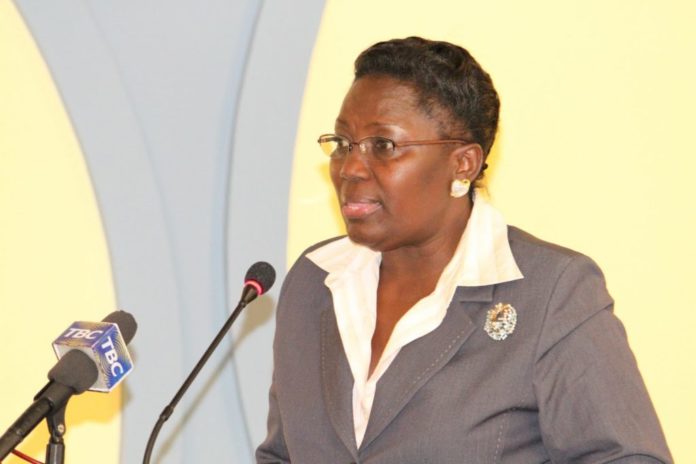
The Speaker of Parliament Rebecca Kadaga has urged western donors to fund women entrepreneurial projects especially in developing countries.

Kadaga, who is in New York leading the Ugandan delegation for the 62nd Session of the United Nations Commission on the Status of Women (CSW62) said the Word Bank and other agencies should instruct governments to spend part of donor funds on projects that support women empowerment initiatives.

“If they are talking about supporting women in this world, energizing them, giving them capacity, let them come with specific instructions to our governments that part of this must go to the women,” she said at the a session held under the theme: ‘Challenges and opportunities in achieving gender equality and the empowerment of rural women and girls’.

Kadaga said since budgeting is now programme based, it is better for donors to bias their financing to women projects, adding that women make up a majority of the rural workforce in developing countries like Uganda.

Kadaga also met with Americans of Ugandan descent on the sidelines of the conference and said they should be helped to participate in economic activities back home.

“As a government we need to provide the necessary environment so that they can operate economic activities in both worlds,” she said.

Uganda’s Permanent Representative to the United Nations in New York Ambassador Adonia Ayebare said that supporting the Diaspora to invest in Uganda will help the country to benefit from their contributions.

“When we have grassroots movements like this bringing people together about the issues that affect them in the Diaspora…once you have these movements in the coming years, you will have a genuine Diaspora community,” said Ayebare.

The annual two-week session of the Commission brings together representatives of the United Nations, the UN Member States, as well as organizations and advocates from around the world to discuss the status of women. The Commission also assesses progress in implementing the 1995 Beijing Declaration and Platform for Action, an important global policy document on gender equality, and takes up other issues involving the rights and welfare of women and girls.

The session will also address; participation in, and access of women to the media, and information and communications technologies and their impact on, and use as, an instrument for the advancement and empowerment of women.

The session will be focused on making resolutions on how governments can best engender economic empowerment and entrepreneurship of women, agriculture and food security and governance especially on political decision making. Other areas are finance and gender budgeting.

Other Ugandan officials at the session include the Minister of Gender, Labour and Social Development, Janat Mukwaya, the Permanent Secretary in the Ministry of Gender, Pius Bigirimana, among other officials.


Stories Continues after ad

PPP dialogue needed to enhance Arabica coffee value chain – UCDA boss

Roasted Arabica coffee beans

If players are to reap more from the Arabica coffee value chain, there is need to enhance Private Public Partnership (PPP) dialogue, the Managing Director of Uganda Coffee Development Authority (UCDA) Dr. Emmanuel Iyamulemye, has said.

“We need to enhance dialogue between the public and private sectors, the academia and development partners to take advantage of the Ugandan Arabica Coffee value chain opportunities,” he said Tuesday in Kampala during a workshop to explore opportunities for development of Uganda’s Arabica coffee value chain.

The workshop was jointly organised by UCDA in partnership with the International Growth Centre.

According to Dr. Iyamulemye, coffee impacts on about 85% of Uganda’s population, and consequently presents a huge rural development opportunity.

Latest figures show that both the volume and value of Uganda’s exports at the international market increased. In terms of volume, Uganda contributed to the global coffee exports market in the month ending January a total of 401,930 -60kg bags.

The exports during this period, which is the fourth month on the coffee calendar, earned the country foreign exchange revenue worth US$43.66m (Shs158b) up from $42.2m (Shs153) earned the previous month.

Dr. Iyamulemye attributed the increase in coffee exports to the new crop and said that more than 500 million seedlings which were planted three-four years ago have started fruiting.

Latest  UCDA report shows that  coffee exported from February last year until January 2018 hit 4.77m bags worth US$549m (Shs1.9tn).There was an  increase of about 2.1 percent from the 4.6m bags exported the previous year.

Robusta comprised 3.75m bags, which fetched the country US$413m (Shs1.5 trn). Arabica fetched the country US$136m (Shs459b) from 1.02m kg bags the country exported.
Estimates for February are tagged at 350,000 60-kg-bags as the main harvesting season in Central region ends.

Government last year launched the Coffee Roadmap, targeting to export 20m bags of coffee per year of by 2025.

On April 13, 2017 President Yoweri Kaguta Museveni launched the Coffee Roadmap, and ordered the coffee stakeholders to ensure that Uganda achieves its coffee production target 20 million bags annually by 2025.

Subsequently, government through the Coffee Lab, identified nine key transformative initiatives that focus on putting Uganda on the path to achieving the target. They hinge on three pillars which will catalyse the transformation of the coffee sector in Uganda namely; Demand and Value Addition, Production and Enablers. These are further broken down into specific initiatives:

  • Building structured demand through country to country deals, especially with China.
  • Branding Ugandan coffee to drive demand and improve value by up to 15%.
  • Supporting local coffee businesses for value addition, including primary processing and a soluble coffee plant.
  • Strengthening farmer organisations and producer cooperatives to enhance commercialisation for smallholder farmers and ensuring broad access to extension, inputs, finance and aggregation.
  • Support joint ventures between middle-class owners of underutilised land and investors to develop coffee production
  • Providing and promoting concessions for coffee production on large underutilised tracts of land.
  • Improving the quality of planting material (seeds and seedlings) through strengthened research and multiplication of improved varieties
  • Improving access to quality inputs by reducing counterfeiting (fertiliser, pesticides, herbicides) from current 40-60%.
  • Developing a coffee finance programme with the Central Bank and Treasury to provide financing to farmer organisations (including on-lending) to smallholders, coffee businesses and investors.


Stories Continues after ad