Stanbic Bank
Stanbic Bank
18.5 C
Kampala
Stanbic Bank
Stanbic Bank
Home Blog Page 1651

Gen. Aronda sister passes on

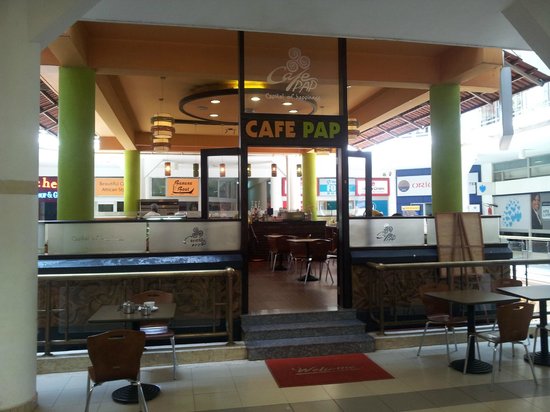
One of the Cafe Pap outlets

The proprietor of popular the Café Pap chain Jolly Ngabirano, the wife of former Managing Director of the Uganda Coffee Development Authority (UCDA) Henry Ngabirano, is dead.

According to sources, Ms. Ngabirano, a sister to the late Minister of Internal Affairs General Aronda Nyakairima, died of cancer of the pancreas at a hospital in Germany.

Stories Continues after ad

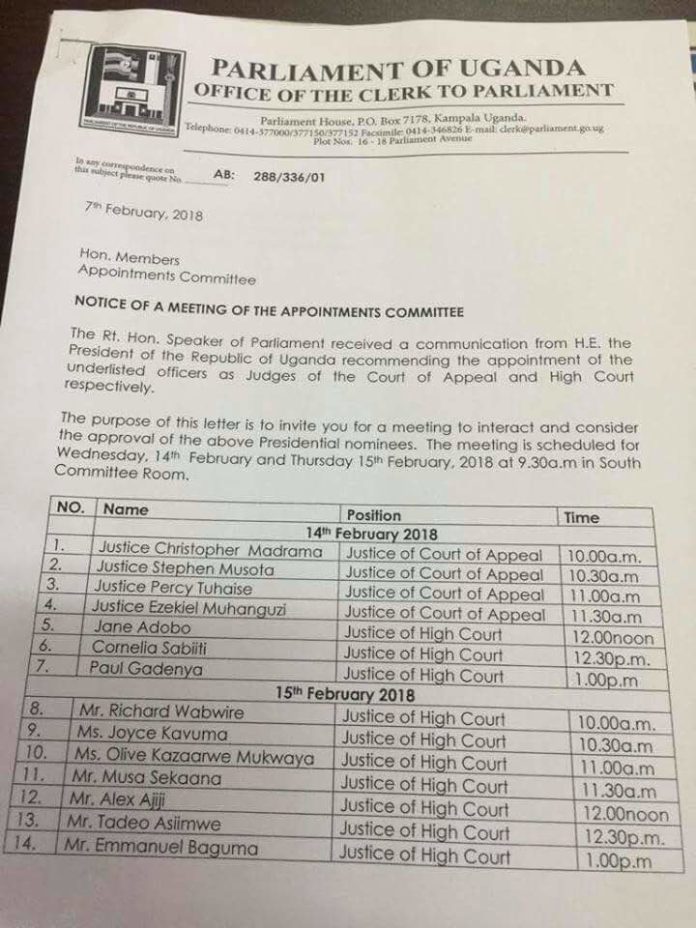
Museveni appoints 10 new High Court Judges

President Yoweri Museveni has appointed ten new Judges to the High Court and four others to the Court of Appeal.

In a February 7 communication by the Speaker Rebecca Kadaga, she told Members of Parliament that Mr. Museveni had named Richard Wabwire, hitherto the Corporation Secretary of the National Social Security Fund (NSSF); Joyce Kavuma; Jane Abodo; Cornelia Sabiiti and Paul Gadenya; Olive Mukwaya Kazaarwe; Musa Sekaana; Alex Ajiji; Emmanuel Baguma and Tadeo Asiimwe as high court judges.

In the same communication Ms. Kadaga told MPs that Mr. Museveni had also elevated Justices Christopher Madrama; Percy Night Tuhaise; Stephen Musota and Ezekiel Muhanguzi as Court of Appeal judges.

The 14 appointees will appear before Parliament for approval on Feb. 14 and 15.

If all the nominees are approved, the High Court will have 63 judges, while the Court of Appeal will have 15 judges.

Stories Continues after ad

Witness pins businessman Sebuwufu over murder

A photo montage of Betty Donah Katusabe (R-RIP) and Pine car Bond boss Muhammad Sebuwufu (R)

Pine Car bond proprietor Mohammed Sebuwufu and nine other suspects have today appeared in court on charges of causing death to businesswoman Donah Betty Katushabe.

According to the deceased’s lawyer, one Tumusiime of Tumwebaze and Atugonza Advocates, he saw Sebuwufu kicking Ms. Katushabe on the breasts and in her genitals.

According to the lawyer, this was after his client called him on October 21, 2015 to come to her rescue from the Pine Car bond at Lumumba Avenue where she was illegally being held.

Tumusiime further told court that he was led to see Katushabe by Sebuwufu, who warned her of death if she didn’t pay a debt of Shs9 million, owed to the businessman. The next day, Tumusiime told court, he received information that Katushabe had died.

Sebuwufu’s arraignment before court comes hot on the heels of the Director of Public Prosecutions (DPP) clearing Aaron Baguma, a former District Police Commander at Central Poilce Station (CPS) of charges linking him to the gruesome murder of Katushabe.

Last week High Court Judge Flavia Anglin Senoga threatened to cancel Sebuwufu’s bail after his lawyer sought an adjournment.


Stories Continues after ad

Kirumira appears before police tribunal

CAGED: The police van that brought Kirumira to Naguru

Former Buyende District Police Commander Muhammad Kirumira has today appeared before the Police Tribunal to answer to a raft of charges against him while he worked in Nansana, Wakiso district.

Assistant Superintendent of Police (ASP) Kirumira was arrested on Feb 1 after he called a conference and announced he was ‘resigning’ from the police.

ASP Kirumira in the ‘caged’ police van

According to ASP Kirumira, the police has persistently regarded him as a criminal, adding however, that the force is only trying to find ways of undermining his reputation.

‘I want to leave the police since it’s clean and I am branded dirty; this is my decision, I shall not change permanently’, Kirumira wrote, and added that the police administration decided to charge him with old and trumped up criminal charges.

Further, he vowed to hand in his official retirement application, ‘to earn my discharge letter in case court delivers its verdict’.

‘Therefore, as a senior officer who has labored to wipe out crime without any special facilitation, I have realized that my image before the administration shall never change given the fact that I am still a young man’, Kirumira added.

By press time it was not possible to contact Police spokesperson Emilian Kayima about the developments, but Kirumira’s ‘resignation’ might prove a gargantuan task, given that there are stringent laid down procedures on how one can join or leave the police force.

ASP Kirumira came to the limelight after reports emerged that he was carrying out various operations in Nansana to crack down on hard core criminals that were terrorizing Kampala.

However, sections of the populace instead implicated him in various crimes, leading the police administration to suspend him pending investigations.

His suspension was however, short-lived as the President Yoweri Museveni reportedly accorded him an ear, something that prompted his return to the force and subsequent deployment for training.

On completion of the course, ASP Kirumira was deployed to Kasese and then transferred to the Old Kampala Police Station as Officer in Charge, before being posted to Buyende as District Police Commander.

It should be recalled that while serving as DPC Old Kampala, ASP Kirumira displayed over 1000 phones he said had been stolen by criminals in his operational areas.

Interestingly, after his transfer to Buyende, nothing much was heard of the phones.


Stories Continues after ad

Government ought to invest more in rural education

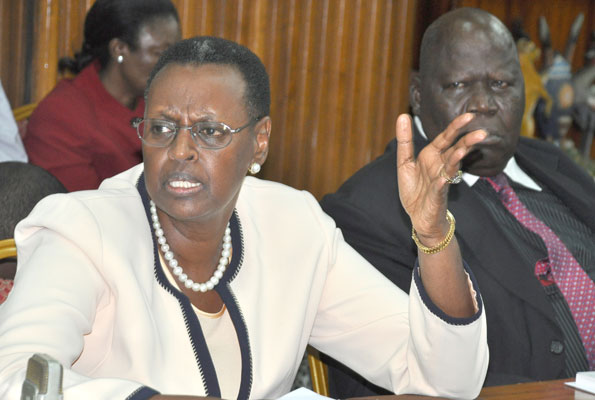
INVEST MORE IN EDUCATION: Education Minister Janet Kataha Museveni

On Wednesday February 7, the Uganda National Examinations Board (UNEB) released Uganda Certificate of Education (UCE) results for the 2017.

While handing over the results to The Minister of State for Higher Education John Chrysostom Muyingo, the UNEB Executive Secretary Dan Odongo noted a decline in performance in upcountry schools.

Notable among them are  schools in the eastern Uganda districts of Bukwo,Butelaje, Kween, Kapchrwa, Bulambuli, Pallisa, Sironko, Busia, Bududa and a few others like Bulisa, Kasese and Bundibugyo in western Uganda.

This is in contrast with the shining performance of schools around Kampala and other neighboring central districts like Mukono, Wakiso, and Mpigi, among others.

Among the challenges cited by Odongo is language deficiency, where English as a subject is one of the most poorly-performed, registering a steady decline over the last three years. This decline has hit hard children in rural schools as compared to their counterparts in urban areas who are at least able to learn English at an early stage.

That noted, English is not only a subject but also a language of instruction in our institutions of learning and the official language which our pupils and students are supposed to use as a means of communication in future when they begin work.

Meanwhile, much as the gap in gender parity is improving as more girls are enrolling for school and able to sit for final examinations, this is not the picture in the villages as it is being painted.

This therefore, means that the policies be reviewed with a view of attracting and retaining the girl child in school, and one of the ways of doing this is by providing free sanitary pads for them.

Also, in her speech, much as the Minister of Education Janet Museveni promised that government is to recruit more teachers especially for sciences to boost the education sector, emphasis should be put on village schools.

There must be allocation of enough teachers in both the sciences and arts disciplines that the ratio of teacher to students improves.

This would enable the teachers easily interact with students, learn their weaknesses and challenges and find solutions.

There is also need to improve on the laboratory facilities by setting up buildings, providing equipment, chemicals and providing training to teachers.

The government also ought to improve library facilities by providing the necessary books and training human resource to assist village students improve their reading skills and acquire knowledge.

Teachers in village schools should be given incentives so as to improve their standards of living like their counterparts in urban areas so as to be motivated to do their work with commitment.

The issue of providing meals to the children while at school should be taken seriously; parents should be encouraged to feed their children in order to improve their concentration.

It is very saddening to learn that in many village schools as some pupils and students go for their meals others disguise by playing football to pass time.

I really wonder how one can concentrate in class or grasp what he or she is being taught when they are on an empty stomach

These are but some of the many measures that government needs to put in place so as to register improvement in performance in village schools and better the quality of education in the country.


Stories Continues after ad

How URA worked to collect USD 11m from high net worth individuals

A new study by tax experts under the International Centre for Tax and Development has revealed how the Uganda Revenue Authority (URA) increased the proportion of High Net Worth Individuals (HNWI), filing personal income tax  returns by 65% and collecting over US$11.4m more in revenue from them in only two years.

The tax analysts say URA collected the US$11.4m after setting up an HNWI unit as part of the large taxpayer office in the Domestic Taxes Department.

‘Before the unit was established, the LTO collected only about USD390, 000 from wealthy individuals in FY 2014/2015. Within less than a year of its establishment (by June 2016), the unit had collected over USD5.5 million in rental tax, personal income tax, VAT and stamp duty. In total, as at June 2017, the unit had collected USD11.4 million’, says the latest ICTD Summary Brief 14.

In 2015, URA established the HNWI Unit as part of the Large Taxpayer Office (LTO) in the Domestic Taxes Department. To begin their work, officials in the unit generated a list of 117 potential HNWIs, comprising directors of large companies under the LTO and individuals whose wealth was publicly known.

And the list was scrutinized by top management in the Domestic Taxes Department, who made revisions on the basis of their knowledge. “Since most of the individuals selected were not filing income tax returns, the URA did not at that point have records that it could use to ascertain the accuracy of the list,” the Summary Brief says.

The HNWI unit gathered as much information as they could from the URA databases about the economic transactions of the 117 individuals. They then contacted them by telephone and set up appointments to talk about their tax affairs. At the meetings, the URA was often represented by the supervisor of the unit and a tax officer. In some cases, the Commissioner General and the Commissioner of Domestic Taxes accompanied the team. The meetings were intended to serve two broader purposes: to educate taxpayers on their rights and obligations, and to signal that the URA was looking into their tax affairs.

The Summary says that because the HNWI list also included politicians, the URA approached the Electoral Commission before the 2016 presidential and parliamentary elections and requested that the EC make tax clearance certificates a prerequisite for vying for political office.

‘While the Electoral Commission had no legal authority to make such a request, the URA made public announcements to the same effect. As a result, many political candidates went to the URA to file tax returns and, in the process, made some payment towards their tax obligations’, it says.

Also in a bid to deal with the political sensitivity of taxing these individuals, in 2017 the HNWI unit was moved from the LTO to the Public Sector Office (PSO), which has experience in dealing with politicians. After being transferred to the PSO, the HNWI unit was merged with the VIP unit that had been established to deal with individuals who are considered to be politically influential. 

Who is a High Net worth Individual in Uganda?

The URA classifies HNWIs using multiple income and wealth thresholds, comprising both core and non-core parameters. A core parameter is an indicator that is individually sufficient to trigger classification as an HNWI. It targets those who have land and building.

“Land and buildings are the most common assets used to amass and retain wealth. A person is classified as an HNWI if they generate more than USD142, 000 annually in rental income or if they engage in the buying and selling of land over the value of USD285, 000 in a five-year period,” the analysts say in their report.  Others in this group are shareholding in large companies or groups of companies with a high turnover: companies that are managed by the URA’s LTO are controlled by a small group of individuals.

According to analysts, shareholders in private companies whose annual turnover is more than USD14.3 million or shareholders in multiple companies with a turnover between USD4.3 million and USD14.3 million are considered HNWIs for URA’s purposes. In establishing the interests of these individuals, the URA also considers shares held by their associates (including children, spouses and business partners).

The analysts in their Brief say that while the wealthy individuals in Uganda rarely declare their wealth and income to the URA and other government agencies, many of them provide the information to commercial banks. “Loans thus serve as a useful proxy for income and assets,” they say. Similarly, large deposits in bank accounts are a useful indicator of wealth. A person is classified as an HNWI if they have a loan portfolio of over USD1.5 million in a five-year period or have bank transactions of over USD1 million annually.

A minimum of two non-core parameters are required for one to be classified as an HNWI. The non-core parameters include:  Publicly known wealthy individuals, the identity of many HNWIs is publicly known. This information, they say, can be gleaned from URA officials, members of the public, newspapers and lifestyle magazines.

Further, all those importing or exporting goods exceeding USD142,000 annually are potential HNWIs. Others are Individuals maintaining commercial forests, plantations and huge ranches.

Achievements of the HNWI/VIP unit since its establishment in 2015

There is now a register of wealthy individuals. Before the unit was established, wealthy individuals were managed as part of the LTO, with no separate register for them. There were only 17 individuals, most of whom declared only employment income. The current register has 117 HNWIs and 239 VIPs covering all tax heads.  “There has been great improvement in the filing of income tax returns. Only about 13 per cent of the individuals on the LTO register were filing returns,” analysts say.

By FY 2015/2016, at least 78 per cent of HNWIs and 65 per cent of VIPs were filing returns.  The revenue collected from HNWIs has increased significantly. Before the unit was established, the LTO collected only USD390, 000 from wealthy individuals in FY 2014/2015.

The analysts report that the URA has observed some improvement in the attitudes of HNWIs/VIPs towards paying taxes. This has largely been as a result of the tax education that is provided to the individuals.

What can the URA learn from other tax authorities?

There are two main lessons that the URA can learn from other tax authorities.  Staffing requirements: currently, the HNWI/ VIP unit has 6 staff members serving 326 individuals. This puts the staff to taxpayer ratio at 1:54, and it is certain to increase given the newly developed criteria. Other revenue authorities have not only a lower staff to taxpayer ratio, but also have relationship managers.

URA also needs to invest in the professional development of its staff members through a mixture of short courses, on-the-job training, secondments to other tax authorities and informal networking events.

Lastly, it should learn from other tax authorities how to strike a balance between staff continuity, and guarding against compromising the independence of staff members.

Tax authorities, such as the UK’s Her Majesty’s Revenue and Customs, the South African Revenue Services and the Australian Tax Office, encourage compliance of their HNWIs using a number of strategies, including educating the HNWIs, engaging with them before they submit their tax returns and resolving points of disagreement. When this fails, they assess the individual to determine whether they are low-risk or high-risk. High-risk individuals are audited and/or investigated. 

Lessons that can be drawn from URA’s experience

According to the analysts, a number of lessons can be drawn from the URA’s experience:

To tax a segment of the population that is economically and politically influential, they say it is important to have support from top management of the revenue authority. “Both the URA’s Commissioner General and the Commissioner for Domestic Taxes have been committed to ensuring that the decision to tax HNWIs is implemented,” they say.

They add that in a country where the majority of HNWIs engage more in tax evasion than avoidance, and where they wield a lot of political influence. Officials in the HNWI should be chosen for their ability to balance between being assertive and being respectful. They are also able to communicate tax matters in a simplified manner.

Identifying HNWIs requires close collaboration between the research function and the operational function. This allows for research findings to be tested in real time, and for the research, in turn, to be informed by what is happening in practice.

The tax experts argue that since Government is one of the biggest consumers of goods and services. “HNWIs are likely to be engaged – directly or through their associates – in the provision of goods and services to government.” They commend URA’s Public Sector Office, which monitors the award of government contracts for a good source of information on contracts entered into between the government and these individuals.

However, they claim that much as HNWIs who are politicians are more likely to pay their taxes during election periods, payments after election periods cannot be guaranteed.


Stories Continues after ad

Kabila not to stand for re-election – DRC Minister

LISTEN: Pope Francis I meets with DRC President Joseph Kabila. The Catholic Bishops in the country have demanded that elections be held

Joseph Kabila, the president of the Democratic Republic of the Congo, whose refusal to step down at the end of his mandate in 2016 resulted in ongoing, bloody street protests, will not stand in elections due to be held this year, a key aide has said.

Lambert Mende, the minister of communications, said Kabila, who has been in office since 2001, had never intended to seek a third term and would not seek to appoint a candidate to represent his interests in the polls, currently scheduled for December.

“This is not a kingdom, where the king appoints an heir. It is a democratic republic,” Mende said yesterday.

Kabila’s second term as president expired in December 2016 and he has been accused of deliberately delaying preparations for a new poll. The central African country is in the grip of a worsening humanitarian crisis fuelled by inter-ethnic conflict and food insecurity.

A series of demonstrations calling for Kabila to step down have been brutally suppressed in recent weeks. Security forces killed seven people during protests on 31 December and six people while dispersing an anti-Kabila protest on 21 January.

The protests have been led by the Catholic Church. Last month Cardinal Laurent Monsengwo, the most senior church official in DRC, described the country as ‘an open prison’.

The political instability and an escalation of inter-ethnic conflict have raised fears of Congo sliding back into wars like those of the 1990s when millions died, mostly from hunger and disease.

At least 30 people have been killed in two days of clashes between Hema herders and Lendu farmers in the north-eastern Ituri province. Aid agencies say violence in the east has forced thousands of people out of their homes and into neighbouring Burundi and Tanzania in recent weeks.

It is estimated that almost 8 million people – about 10% of DRC’s population – are affected by extreme hunger and more than 4 million children under the age of five are at risk of acute malnutrition.

There was repeated speculation that Kabila might seek to change the constitution and seek a third term or find an ally who could stand on his behalf.

According to the schedule set by the election commission, declarations of candidacy are due in July.

Analysts say Kabila and his close advisers may have decided to commit to elections. A new electoral law has received rapid parliamentary approval, voter registration has been completed without major disruption, and large sums have been allocated to the electoral commission.

Jason Stearns, an expert at the Congo Research Group at New York University, said government officials had begun to speak in clearer terms about Kabila’s departure.

“There is a sense that there has been a shift from a strategy of buying time to one of holding elections and making sure they turn out in [Kabila’s] favour. It’s a risk but a good strategy in some ways because holding elections is the one thing everyone can agree on, even if they are flawed,” Stearns said.

The shift follows significant international pressure. Nikki Haley, the US ambassador to the UN, met Kabila in Kinshasa in October and told him Washington would not accept elections later than December this year.


Stories Continues after ad
Machar’s release to be decided by parties, says AU chief

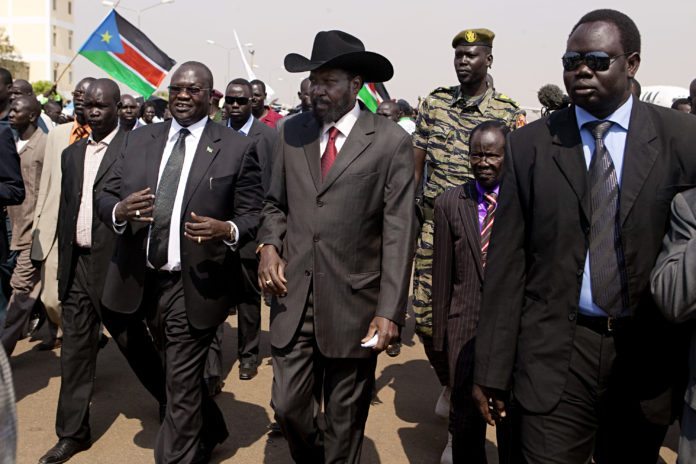
DURING THE 'GOOD TIMES': President Salva Kiir Mayardit and Dr. Riek Machar

Exiled South Sudanese rebel leader Riek Machar’s release from his forced confinement in South Africa won’t be decided by the region – but by parties at the ongoing peace talks in Addis Ababa, African Union chairperson Moussa Faki Mahamat said.

“Everything is left to the parties. It is our hope that this peace will be inclusive and final,” Mouss Faki, chairman of the AU commission said in Addis Ababa.

He stressed the importance of a breakthrough in the ongoing talks to end the civil war that has led to millions fleeing to neighbouring countries.

Machar signed a peace accord in 2015 with President Salva Kiir, but the deal fell apart in July 2016, leading to deadly clashes in the capital Juba.

Machar fled to Congo and then went to Sudan for treatment. He then travelled to South Africa where he is being held to prevent him from going back to his country.

The decision was reportedly reached by IGAD countries in order to keep him away in the hope of preventing fighting in the world’s youngest nation.

Inter-Government Authority on Development (IGAD), is an 8-member economic bloc that brings together Ethiopia, Djibouti, Somalia, Sudan, Eritrea, South Sudan, Kenya and Uganda.

Stories Continues after ad

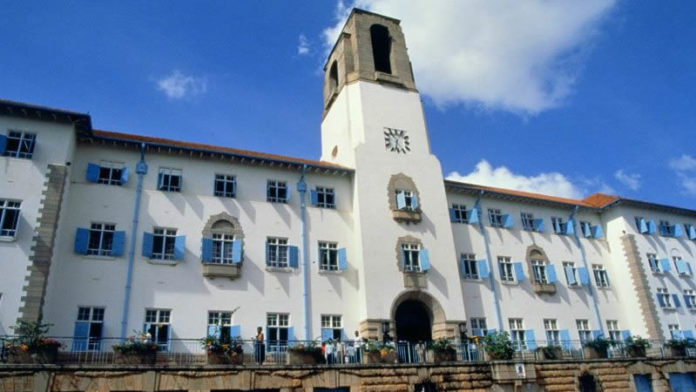
Makerere remains top in Uganda, performs fairly in Africa

Makerere University Administration Building

Makerere University remains the number one institution of higher learning in Uganda but it has failed to move into the top ten in Africa for the second time, according to Webometrics rankings for 2017/18.

In the latest rankings, Makerere is ranked 11th of the 100 universities considered in Africa, trailing the University of Cape Town, University of the Witwatersrand, Stellenbosch University, University of Pretoria, University of KwaZulu Natal, Cairo University, University of Nairobi, University of Johannesburg, University of Western Cape and University of Ibadan, respectively.

Mbarara University of Science and Technology (MUST) is ranked second in Uganda after Makerere though the former is ranked 55th in Africa’s 100 top universities.

University of Nairobi leads the rest in East Africa, having been ranked 8th. It is followed by Makerere University. Egerton University and Kenyatta University are ranked 23rd and 24th respectively, while Jomo Kenyatta University of Agriculture and Technology is ranked 61st.

Tanzania’s University of Dar Es Salaam and Muhimbili University of Health Sciences are ranked at position 32 and 56 respectively.

Each year, Webometrics, the largest web academic ranking of Higher Education Institutions, does the global ranking twice, based on criteria such as the number of citations, presence, visibility and excellence. University ranking continues to remain the common means of informing the public about the relevance and value for investment in education.


Stories Continues after ad

Guidelines to Assure two-way customer communication

By Martin Zwilling

Entrepreneurs and business executives seem to be even more focused on their technology than the rest of us, and less inclined to listen to the voice of the customer, even if they remember to ask. Real two-way conversations with real customers, including the all-important body language, are unheard-of these days. Being connected to the Internet many hours a day is not enough.

In fact, being connected on the Internet has taken on a whole new meaning to me, since I noticed a study commissioned a while back by PC tools, which found that more than a quarter of people using the Internet have no problem with staying online during sex. Others admit to surfing the web even during religious services. I doubt if any of these are really listening to their customers.

If you are looking for a way to get a competitive edge, now is the time to start building a relationship with your customers, which includes active listening. In a business context, here are some old-fashioned guidelines for effective listening, for you and the members of your staff who have been distracted by all the things you can now do online:

Forget selling while asking for customer feedback. It’s easy to focus first on selling, and to treat all customer input as objections to be overcome. It’s harder, but necessary, to resist the response urge and actively listen to customers, while logging their input for later analysis. Customers will sense the relationship being built, and both of you win.

Observe customer body language, as well as words. Whether it’s while listening or talking, some studies show that as much as 60 to 90 percent of the communication is nonverbal. This means meeting personally with real customers, in an environment friendly to them. Email surveys and voice response units are not effective listening.

Eliminate pride and ego from the equation. If your customer senses your ego is talking, they know you won’t be able to listen. Pride is good, but can easily be heard as selling. You can’t listen if the customer isn’t talking, so make sure more than half of the conversation is input rather than output.

Always ask open-ended questions. Questions that start with “why” invite a defensive response, and usually don’t lead to a productive dialog. You are not looking for one-word responses. More effective questions usually start with “what,” and focus on that person as a customer, rather than you, your product, or your service.

Pause thoughtfully rather than reply immediately. People sense that you are not listening, when you respond too quickly. Even with the best of intentions, responding on the spur of the moment often results is something we wish we had not said, or said differently. Always listen carefully for nuances, and think before you speak.

Respond to general comments with focused questions. Forget the script, and think on your feet to go where the discussion leads. This requirement for effective listening is why customer satisfaction online and phone surveys may identify big problems, but don’t really address customer needs for future of your business.

Make social network contacts into two-way conversations. Social network streams that are all output, or all input, are not effective. You need to post non-defensive responses to all inputs on a timely basis, to show you are accessible and listening. Requests for input that are thinly disguised sales pitches won’t work.

Customers want and expect two-way personal relationships with their providers, and they know that the technology now allows for this. “Push” marketing messages are perceived as clutter, and are often simply ignored. Business relationships build loyalty, in the same way that personal and peer-to-peer ones do.

My final message is that you need to be listening online and offline to what customers are saying about your competitors. Listening more effectively to current customers will maintain their loyalty, and listening more effectively to the customers of your competitors will bring you the new ones you need to grow. Talking too much can cost you both.


Stories Continues after ad