Stanbic Bank
Stanbic Bank
27.6 C
Kampala
Stanbic Bank
Stanbic Bank
Home Blog Page 1661

Wakiso to get free mosquito nets this Saturday

Mosquito nets are essential in homes to prevent malaria

Under the on-going Chase Malaria campaign, Long-Lasting Insecticide treated Mosquito Nets (LLINs) have successfully been distributed in most parts of the country, and this Saturday residents of Wakiso District will benefit from programme, the health ministry says in its latest media statement.

According to the health ministry a total of 598,486 households were registered in Wakiso District to receive the nets, and a total of 1,644,016 nets will be distributed to protect 3,012,048 people from Malaria in the district.

‘Distribution of mosquito nets in Wakiso District is set to take place this Saturday 27th January 2018 and will be followed up by a mop-up exercise on Sunday 28th January 2018 to cater for households that may have missed out,’ the statement indicates.

The statement indicates that the distribution exercise to be conducted by Local Council One Chairpersons and Village Health Teams (VHTs), will be conducted at designated distribution points in the villages at points like polling stations, schools, community grounds and places of worship among others.

Further, the ministry indicates over 25 million nets will be distributed countrywide, with one net given for every two people in a household.

The Chase Malaria campaign has so far achieved over 95% coverage, with a total of 23,743,822 nets distributed, protecting over 35 million Ugandans from Malaria in 109 districts countrywide, the ministry says.

This campaign is premised on the background that large-scale LLIN distributions are a key component of the national malaria prevention initiative and are highly effective, user-friendly and low-cost intervention to protect communities against malaria.

“The Ministry of Health appeals to all residents of Wakiso District to pick their mosquito nets on Saturday 27 January, 2018. Only registered residents will receive the free Government mosquito nets,” the statement indicates.

“Ministry of Health wishes to thank all our partners who have tirelessly worked with us to ensure smooth running of the campaign,” it says.

Officials says that  without spending on mosquito nets or other methods of malaria prevention, deaths from malaria in Uganda would be much higher than the current annual 100,000 deaths. The average cost of malaria drugs in Uganda is about $5 per dose.

Stories Continues after ad

Uganda and Tanzania open talks on joint border re-demarcation

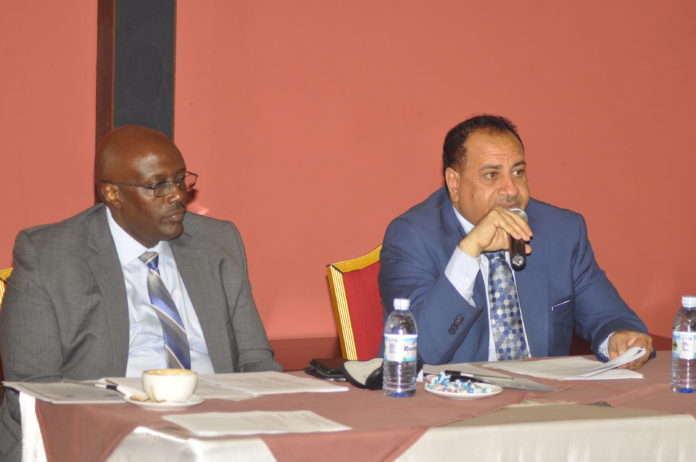
Amb Richard Kabonero (left) and a Tanzanian official at the meeting

Ugandan and Tanzanian officials have opened talks aimed at reaffirming the borders of their two countries as directed by presidents Yoweri Museveni and John Pombe Joseph Magufuli.

The meeting on Thursday was in line with the directives of the two presidents during their meeting in March 2016 in Arusha, Tanzania as well as the decisions of the of the ministerial sessions on Uganda-Tanzania cross border issues which was held on July 29, 2017 in Bukoba, Tanzania.

Uganda’s High Commissioner to Tanzania Richard Kabonero, who opened the meeting at LAICO Lake Victoria Hotel in Entebbe, led the Ugandan delegation, while the Tanzanian delegation was led by Suleiman A. Saleh, Assistant Director-Africa Department in the Ministry of Foreign Affairs.

The Entebbe meeting reviewed  progress in the implementation of the directives of the two Heads of State on border reaffirmation, discussed and adopted a budget for the exercise and drew up a work plan as well as developed guidelines for the reaffirmation exercise which is to be jointly undertaken by experts from both Uganda and Tanzania.

The two countries also agreed to use the International Terrestrial Reference Frame (ITRF) 2014 datum system to coordinate the existing boundary pillars in order to obtain the most accurate coordinates of Border Points.

Once accomplished, the border reaffirmation exercise will result in clear border markings, reduction/elimination of cross border conflicts, joint planning and development of border areas. At the end of the exercise, a Protocol will be signed by the two countries and deposited with both African Union and the United Nations in accordance with the African Union deadline of 2022.


Stories Continues after ad

Museveni woes Chinese investors to Uganda

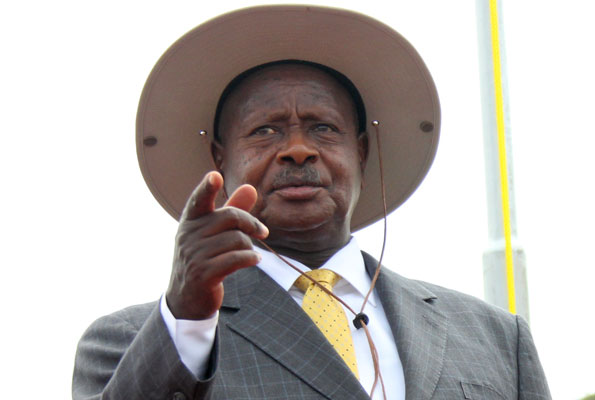
President Museveni

President Yoweri Museveni has held a meeting with Chinese investors from two conglomerates, who called on him at State House Entebbe.

According to the media statement  by the Uganda Media Center, the investors are Mr. Zhao Xinrun  Mr. Dai Quanhe the  General Manager of Kunming Pharmaceutical Corporation (KPC) Overseas Division, and Mr. Dai Quanhe the Vice President of Henan Senyuan Electric Company Ltd.

The statement indicates that President Museveni welcomed Kunming Pharmaceutical Corporation (KPC) to invest in Uganda in a bid to provide medicine at affordable charges for Ugandans.

“We want to have a vertically integrated industry so that raw materials such as starch from maize and cassava are used to make tablets and refined sugar to make syrups,” Mr. Museveni said.

The KPC Overseas Division specializes in research, development and sale of pharmaceuticals and has been in the market for 20 years exporting its products to over 30 African countries.

Meanwhile, Henan Senyuan Electric Company Ltd, that is in the business of developing, manufacturing and distribution of high and low voltage electric devices, also expressed interest to invest in Uganda.

In response President Museveni told Mr. Quanhe that government is in the process of repairing and restarting the copper mines in Kasese district so as to get the needed material to make transformers and cables.

“In Uganda, the electric company seeks to manufacture transformers and cables and also work with the Rural Electrification Agency (REA) to scale up rural electrification,” reads the statement.

The State House meeting was also attended by Uganda’s Ambassador to China, Dr. Crispus Kiyonga.


Stories Continues after ad

Kitatta wife drags Kayihura to court

CHARGED IN COURT MARTIAL: Abdallah Kitatta

The wife of the detained Boda Boda 2010 patron Abdul Kitatta has today dragged both the Inspector General of Police General Kale Kayihura and the Uganda People’s Defence Forces (UPDF) Commander (CDF) General David Muhoozi to court, seeking orders to compel them to produce her husband in court.

Through her lawyers led by Joseph Kiryoowa, Sumayiya Ninsiima, a resident of Rubaga division, says her husband has been detained beyond 48 hours without trial.

Ms. Ninsiima says she heard of the news of Kitatta’s arrest, she now wants UPDF and police to either produce her husband in court or release him.

However, the matter has not been allocated because judicial officials are attending a conference in Munyonyo.

Kitatta was arrested over the weekend by a joint force of the police, UPDF and Internal Security Organization (ISO) that led to arrest over 30 Boda Boda 2010 members on allegations that they were terrorizing the city.


Stories Continues after ad

Travel industry bookings gross $1.6 trillion in 2017

Global travel industry gross bookings reached US$1.6 trillion in 2017, making it one of the largest and fastest growing sectors in the world, the 2018 Travel and Hospitality Industry Outlook published by audit firm Deloitte, says.

“Factoring in indirect economic contributions, travel and tourism now accounts for a staggering 10.2 percent of global GDP,” says the report that has the US travel market among the leading beneficiaries of a swelling global traveler pool.

According to the report, a strengthening global economy lies at the heart of industry growth. It says each year, the global traveler pool is flooded with millions of new consumers from both emerging and developed markets, many with rising disposable incomes and a newfound ability to experience the world. “A sleeping giant has truly awakened—the impact of which cannot be underestimated,” it says.

Over the past two decades, the report says, the number of international travel departures across the globe has more than doubled from roughly 600 million to 1.3 billion. The report says many travelers from emerging countries are leaving domestic borders for the very first time, injecting billions of dollars of new growth into the travel economy and helping the industry outpace global GDP. Growth appears poised to continue, lifting the industry to new heights in 2018 and beyond, the report says.

The report urges industry players to unlock the power of adjacent spaces to earn big.

“While hotels and airlines represent the bulk of industry gross bookings, most travelers do not take trips to sit on airplanes and spend time in hotel rooms,” it says.

It urges travel suppliers to think outside the box, and find ways to be more relevant to their customers across their travel journeys. “For many, this means looking outside their core competencies like flights and hotels, and exploring the power of adjacent spaces,” it urges.

According to the report, tours and activities represent another big opportunity for travel brands to leverage adjacent spaces. It says while the travel industry often gets preoccupied with the big sectors (hotel and air), spending on activities is often overlooked even as  it’s projected to reach US$183 billion by 2020. It says hotels and online travel players have an enormous opportunity to integrate tours and activities into their digital ecosystems.

According to the report, tours and activities has the potential to give travel brands an entirely new lens on their travelers’ preferences and interests even though the sector has largely been dismissed. The reasons being; the market is incredibly fragmented, lacks standardization, and is digitally inept.

“It’s comprised of a long tail of small suppliers, more than half generate less than $250,000 in annual revenue.

It adds players in the sector still power their businesses with phone calls and paper ticketing.

“In fact, more than 80 percent of gross bookings are made offline,” it says, adding that the sector has yet to undergo the digital transformation needed to centralize inventory and make online distribution possible on a global scale.

But the report allays fears, saying that these market conditions are changing quickly.

“Digital tours and activity aggregators are taking on the problem, with a select few making some very good progress,” it says.

For travel brands, the right partnerships in the tours and activities space could be a key stepping-stone to bigger ecosystems and driving experiences for their guests beyond the walls of their properties and core offerings, it states.

Stories Continues after ad

FUFA gets US$3m for local tournaments’ broadcasting

Federation of Uganda Football Associations (FUFA) has today received US$3 million sponsorship deal from Sports Broadcasting to air the Uganda Premier League (UPL), FUFA Big League and Uganda Cup.

The development follows the withdraw of former broadcasting sponsors Azam, effective this year and part of the Sports Broadcasting US$3 million will be distributed for airing the tournaments is as follows: UPL $600,000; Big League $70,000 and Uganda Cup $80,000.

Sports Broadcasting Managing Director Dennis Mbidde said 240 games in the UPL, FUFA Big League will be televised with financial support from sports broadcasting.

‘’Sports Broadcasting will rely 99 percent of local football (Ugandan content) on Television. We shall change the face of football broadcast in Uganda; we are experts in marketing football and sports personalities,” Mbidde said.

Addressing the media at the launch of the Sports Broadcasting sponsorship, the chairman for Uganda Premier League Arinaitwe Rugyendo said that the development is a milestone for Ugandan football.

‘’When I took over the leadership of the board. I preached three pillars upon which our football was to be driven – Stability, Harmony and Integrity. Stability has reached us thus far,” Rugyendo said.

He lauded Sports Broadcasting, a Ugandan company, for coming on board to ‘dive at the deep end of Ugandan football’.

Zubair Galiwango, who represented the State Sports Minister, Charles Bakabulindi said government of Uganda has already approved Shs 17 billion for sports development from January to June 2018 and part of this money will be used by FUFA for AFCON 2019 qualifiers.


Stories Continues after ad

Ugandans to pay more taxes in financial year 2018/19

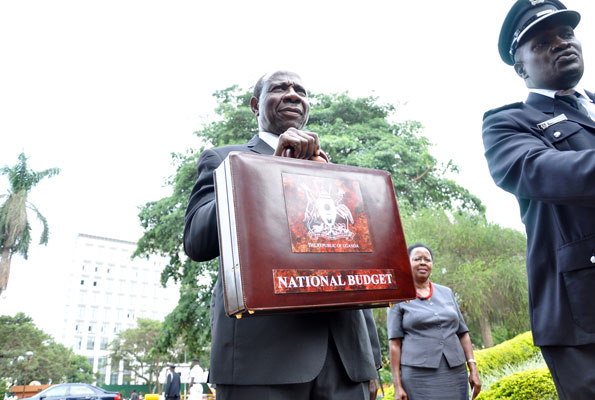
Finance Minister, Matia Kasaija with the briefcase that contains the Budget

Government has set a higher revenue collection target in the 2018/2019 financial year, estimated at about Shs 30 trillion.

According to the National Budget Framework Paper (NBFP) government estimates to collect Shs 15.547 trillion from domestic sources, Shs 15.1trillion from tax revenue while Shs 418 billion is expected from non-tax revenue. This means Ugandans will pay more taxes, The Uganda Debt Network says in its latest analysts.

UDN is a national NGO that scrutinizes how the government of Uganda spends the money it borrows to implement development projects such as construction of roads among others.

The NBFP shows that domestic revenue target is an increase from Shs 15.062 trillion in the current 2017/2018 financial year budget. Out of this, Shs 14.6 trillion is tax revenue while Shs 376 billion is non-tax revenue.

Tax revenue during the 2018/2019 financial year is expected to come from improvement in compliance of taxpayers and strengthening of tax administration through expansion of the scope of withholding tax agents, strengthening the business intelligence function of Uganda Revenue Authority (URA) to detect noncompliance and implementing valuation controls among others.

Despite the increase in the URA tax revenue projection of Shs15.547 trillion for the financial year, the analysts say there are no new revenue sources highlighted apart from administrative areas that seek to further strain the existing narrow revenue sources.

To achieve its domestic revenue target, government intends to undertake revenue reforms that will ensure closure of loopholes in the tax laws, and enhance tax administration efficiency and facilitate tax payer compliance.

Meanwhile, UDN) has proposed a merger of the tax identification number and national identification number as a measure to widen the tax base. Whether this will bring significant results is a matter of debate.

Of concern is that domestic revenue collections still remain low and a challenge to the country’s expenditure and development. URA has continuously been challenged by tax administration and compliance, finding alternative sources of revenue to widen the tax base and taxing the informal sector.

Based on this, the Authority is in the process of completing a Medium-Term Revenue Mobilization Strategy to guide the country’s revenue collections for the next five years.

However, UDN says preparation of this strategy has not been consultative with the different stakeholders, and there is limited transparency for data management on revenue collections both at the national and local level.

Analysts say a collaborative strategy should be extended beyond presumptive tax to property tax and a mechanism for implementing the local revenue and strengthening local revenue data management systems. Also analysts say there need to harmonize mobile money platforms between countries to ensure that transactions undertaken contribute to revenue generation.

Stories Continues after ad

Kagame, Netanyahu hold talks over African asylum seekers in Israel

FLASHBACK: Rwanda President Paul Kagame welcoming Israel Prime Minister Benjamin Netanyahu to Rwanda

Prime Minister Benjamin Netanyahu met with Rwandan President Paul Kagame on Wednesday at the World Economic Forum in Davos, Switzerland, where the two discussed the issue of African asylum seekers facing deportation from Israel and shared an understanding that migrants can only be deported according to rules dictated by international law.

Netanyahu’s bureau stated that during the two leaders’ meeting, “Prime Minister Netanyahu agreed with President Kagame, who emphasized that he will only accept a process that meets the demands of international law.”

The prime minister congratulated Kagame for his new position as the chair of the African Union, and the two discussed a myriad of topics, including the extension of cooperation between Israel and Rwanda.

Earlier Wednesday, Rwanda firmly denied a report that it had signed a secret deal to take in the aforementioned refugees being expelled against their will.

Olivier Nduhungirehe, the minister of state in Rwanda’s Foreign Ministry, tweeted Wednesday that ‘Rwanda will never receive any African migrant who is deported against his/her will’.

“Our open doors policy only applies to those who come to Rwanda voluntary, without any form of constraint. Any manipulation of women, men and children in distress is appalling,” he wrote, sharing Haaretz’s report about the Rwandan government denying the deal.

On Tuesday, Rwanda’s government said that: “In reference to the rumors that have been recently spread in the media, the Government of Rwanda wishes to inform that it has never signed any secret deal with Israel regarding the relocation of African migrants.”

“In this regard, Rwanda’s policy vis-à-vis Africans in need of a home, temporary or permanent, within our country’s means, remains ‘open doors,'” it added.

Some 2,000 asylum seekers gathered earlier this week before the Rwandan embassy in Israel to protest government efforts to deport them.

In recent days, the Population and Immigration Authority has begun telling Eritrean asylum seekers at the Holot detention center that they must leave for Rwanda or be imprisoned indefinitely at the Saharonim prison.

“From refuge in Rwanda to trafficking in Libya, expulsion to Rwanda – a death sentence,” “Black lives matter – not in Israel” and “Refugees are not for sale”, the refugees protested.


Stories Continues after ad

Questions to ask before selecting a search firm

By Martin Zwilling

I started out in business as a techy geek, so I understand why technologists starting a new venture spend so much effort getting the product just right. Yet I’ve learned over time that building the business is all about having the right team members. Thus I’m frustrated when I see founders pushing off recruiting, or jumping to quick and cheap solutions, like Craigslist and free job sites.

I’m fully convinced that you get what you pay for with people. That doesn’t mean you need to hire an expensive recruiter for every position, but it does mean that you must put the same time and effort into finding rockstar people, as you do in building a rockstar solution. I believe the quality of your employees becomes more and more critical to survival and growth as the business matures.

In fact, according to a new book, ‘Recruit Rockstars’ by Jeff Hyman, ninety percent of business problems are actually recruiting problems in disguise. Hyman started his career at the preeminent search firm Heidrick and Struggles, and has built four companies, so he knows the ropes. He and I both believe the right people are the most competitive advantage you can have in business.

He provides some great guidance from his experience, which I learned the hard way, on how to select the right recruiter, when you do decide to get some professional help finding the right people. Here are ten key questions you should ask in selecting any recruiter or firm:

What are your search successful completion metrics? Competent recruiters should be willing to share the percentage of searches that they actually complete. Numbers in the 80 to 90 percent range indicate market-leading efforts. Other measures to gauge process efficiency include the interview-to-offer ratio, and the offer-to-close percentage.

What percentage of your hires have stayed two years? This is often referred to as the “stick” rate for new hires. Eighty percent or higher is a good starting point, since twenty-four months is the current national average for job tenure with a company. Low numbers here may indicate poor vetting of candidates, or an inadequate search.

On average, how long does it take to complete a search? The national average is 90 to 120 days. An efficient recruiter who isn’t overloaded with searches can often do it in half that time. The longer the search takes, the more money you are losing by not having the position filled and productive. This cost can far exceed any search firm retainer.

How many searches are they working on concurrently? You want to know if your search will be one of fifteen they’re working on, or one of three. Good recruiters limit the number of concurrent searches, so they can give each one the proper personal attention. You want efforts to contact ideal candidates, rather than a total reliance on tools and lists.

How involved is the recruiter in the search process? Some search firms hand off all the real work to interns or call centers. Good recruiters develop their own candidate list, are creative and smart about how to message your opportunity, and are persistent in their follow-up. This can make all the difference in attracting the right candidate.

What is their vetting process for candidates? Make sure the recruiter fully understands your expectation of competency and culture, and is able to integrate that into their selection process. Find out who will be doing the interviews, how many rounds are expected, and whether the process will be done in person, by phone, or Skype video.

What are the rules and size of off-limits list? Usually a recruiter doing a search for a company will agree not to recruit anyone out of that company for another client for a certain period of time, usually a year or two. Thus larger search firms with large clients in your niche may not have access to the candidates you need to fill a specific role.

How will they position your company and opportunity? To attract the best candidates, they need to differentiate your company and your opportunity. Ask the potential recruiter to prepare a draft of the message they will be using, and make sure you agree that it will be compelling. Create job invitations, rather than job descriptions.

Will they provide complete visibility to the pipeline? Just because you intend to use a recruiter doesn’t mean you can totally delegate the hiring process. You should ask for a report on progress weekly, and take the time to review who has been contacted, vetting progress, and interview results. Only then can you provide timely input and adjustments.

What are the terms of any replacement guarantee? Most firms will recruit a new candidate for no additional fee, if the first one leaves or fails to perform. A guarantee of one month is not worth much, since this barely covers the honeymoon period. The best will offer a year, since poor fits and failures will certainly be evident by that time.

With these questions, and the commensurate work on your part, you too can attract rockstars who can really make your winning technology a leading business in the marketplace. Life is too short to get halfway there, and be held back by team members who don’t share your drive and commitment.


Stories Continues after ad

The Barclays Africa Group African financial markets Index can make valuable contribution

Dr. Lious Kasekende

By DR LOUIS KASEKENDE

The Barclays Africa Group African Financial Markets Index can make a valuable contribution.  It provides data for each of the 17 African economies covered by the index pertaining to capital market development and depth, the size of the domestic investor base, the macroeconomic situation and the institutional, regulatory and legal environment facing investors in financial markets. The economies of the 17 countries in the index together comprise approximately three quarters of Africa’s GDP.

The report on the Index provides a wealth of valuable data and analysis which I believe will prove to be of great benefit both to investors and to economic policymakers in Africa. I would like to comment on some interesting points which emerge from the data incorporated into the Africa Markets Index and which are detailed in the Report.

There is a vast difference between South Africa and all of the other 16 African countries covered in the index in terms of size and liquidity of the capital markets. South Africa has $1,247 billion of locally listed assets (bonds and equity). None of the other 16 countries in the index have locally listed assets which reach even a tenth of the size of that of South Africa, and the median of locally listed assets for the other 16 countries is only $16 billion (figure 4.3 on page 25 of the report).

A similar picture emerges with respect to the size of the domestic institutional investor base. South Africa has pension and insurance fund assets of $627 billion, whereas the median for the other 16 countries is only $6 billion (figure 4.3). It is clear that, with the exception of South Africa, capital markets play only a very small role in Africa as a source of financing for investment by the private sector, although capital markets have become more important for the financing of government debt.

Why is the South African capital market many times larger than those on the rest of the continent? It is not simply because the South African economy is larger than those of most of the other economies covered by the index. Valued in terms of US dollars, South Africa’s GDP comprises slightly less than 20 percent of the combined GDP of the 17 countries in the index, but it accounts for nearly three quarters of the total listed assets of the countries in the index and nearly 80 percent of the funds of pension and insurance companies.

It is also difficult to explain the dominance of South Africa’s capital markets in the region by macroeconomic factors (pillar 5 of the index). South Africa’s real GDP growth has been mediocre for many years and most of the other countries covered in the index have consistently recorded much higher rates of real economic growth. Three of the four economies which rank at the bottom of pillar 1 of the index, which pertains to market depth – Rwanda, Ivory Coast and Ethiopia – have been among the fastest growing African economies in recent years. The attractiveness of a financial market to foreign investors depends in part on the regulatory and institutional framework. Therefore, the African Financial Markets Index includes a number of pertinent regulatory and institutional factors, especially in pillars 2, 3 and 6 of the index. Although South Africa ranks highest amongst the 17 countries in the index with respect to each of these three pillars, the differences between South Africa and other top performers are not vast.

For example, Botswana and Uganda both have scores close to that of South Africa in terms of access to foreign exchange while the scores of Mauritius and Nigeria are very close to that of South Africa in respect of market transparency, tax and regulatory environment. As such, it is difficult to attribute the huge difference in capital market depth between South Africa and the other countries simply to a better regulatory and institutional environment for investors in South Africa.

The primary reason why South Africa’s capital market is many times larger than those of all the other countries in Africa relates to the structure of the economy. The South African economy is characterised by large and medium sized companies, many of which have been operating for many years. These companies have the financial credibility to mobilise capital by issuing equity and bonds to investors on capital markets.

In addition, a large share of the labour force in South Africa is employed in the formal sector and is required to make regular contributions to pension funds, which explains why South Africa has a relatively large pensions and insurance industry. In contrast to South Africa, the economies of most other countries in Africa have a very different structure. They are dominated by informal micro and household enterprises and contain far fewer large and medium sized enterprises.

Consequently the number of companies which can credibly issue securities to raise capital is relatively small in these countries. To issue securities on the capital market, companies must have a solid track record of profitability and meet minimum standards of governance, with properly audited accounts and tax returns, but there are relatively few companies which meet these criteria in most African countries.

Furthermore, the vast majority of the labour force works in the informal sector with often irregular and precarious earnings and as such does not make regular contributions to pension funds. This is why their financial systems are dominated so heavily by banks rather than capital markets. The financing needs of small scale and micro enterprises cannot be met through market based instruments; instead these enterprises require loans from financial institutions, especially those which can specialise in serving this sector of the market.

Consequently, I would argue that the primary constraints to the development of capital markets in Africa, outside of South Africa, are structural in nature. On the supply side of the capital market, the main constraint is the paucity of large and medium scale companies which can credibly issue capital market securities. On the demand side of the market, the main constraint is the dominance of informal sector employment which impedes the growth of pension funds. These two constraints are linked, in that the relatively small share of large and medium sized companies in the economy accounts for the very limited scale of formal sector employment. This has important implications for financial sector policy. It suggests that, until these structural constraints can be alleviated, especially boosting the number of companies which can credibly issue capital market instruments to investors, policies which aim to improve the financial infrastructure and regulatory environment, or the taxation of financial instruments, to reduce the cost of capital market transactions and facilitate market entry, are unlikely to be effective in terms of stimulating rapid growth of the capital markets.

In many important respects, FDI is much more valuable than portfolio investment because the former can enable new, large and medium sized companies to be created in economies where these types of enterprises are relatively scarce. Most of the large and medium sized enterprises in Uganda which are surveyed by the Bank of Uganda in the annual Private Sector Investment Survey have foreign shareholders. Large and medium scale enterprises are the main vehicles through which sustained productivity growth is attained in developing economies.

FDI can also contribute to the development of the domestic private sector, offering a market for inputs and through spill-overs of business, managerial and technical skills to domestic companies. Consequently, I would argue that the policy priority for Uganda, and for most other African counties, should be to mobilise much more FDI, especially in labour intensive sectors of the economy.

We also need to develop programmes to assist domestic companies to strengthen their management, governance and technical capacities so that they might expand and become more competitive and eventually be able to raise finance on local capital markets. In addition, we need to harness the potential in regional capital markets through integration of national bourses and harmonisation of laws and policies.

Finally, there is often a misleading narrative that African countries need to fix all distortions before receipt of capital flows. On the contrary, incremental changes benefit countries and an index such as this, is useful in prioritising policy and areas for correction.

The Writer is the Deputy Governor Bank of Uganda


Stories Continues after ad