Stanbic Bank
Stanbic Bank
18.3 C
Kampala
Stanbic Bank
Stanbic Bank
Home Blog Page 1714

NSSF boss tips SME operators on business skills

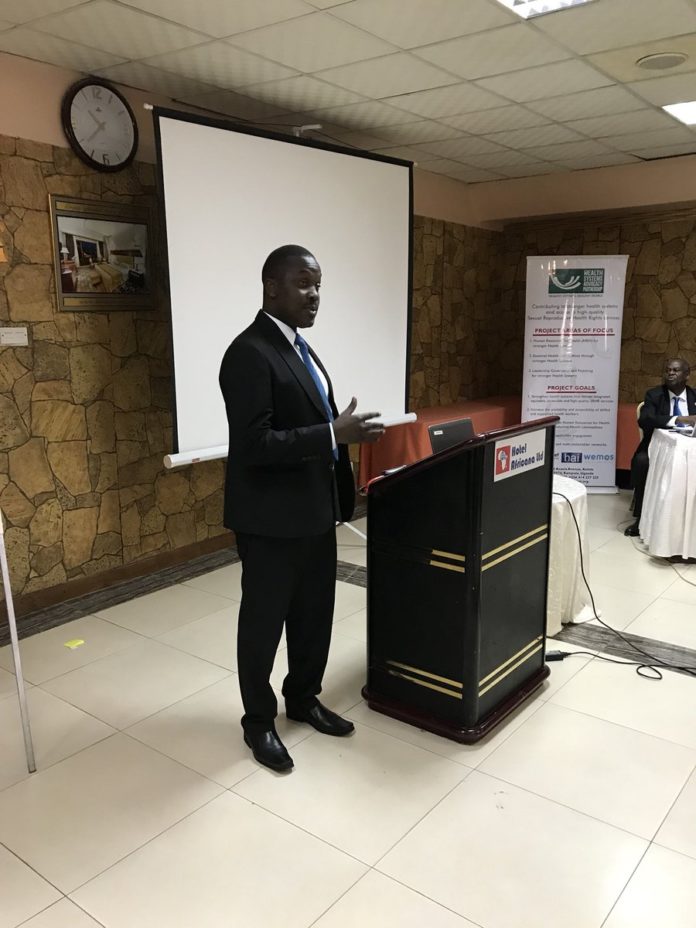
NSSF MD Richard Byarugaba makes the keynote address at the SME forum

Global audit firm KPMG in partnership with Monitor Publications Ltd hosted a panel discussion of renowned business management experts to analyse the Top 100 Mid- Sized companies’ survey report 2017 at the Sheraton Hotel in Kampala.

Keynote speaker Richard Byarugaba, the Managing Director of  the National Social Security Fund (NSSF) noted that raising capital and cashflow management are some of the challenges that fail SMEs in the first 5 years of existence.

“Lay a strong foundation for your business by developing good cash management practices and increase your revenue to increase profits,” Mr. Byarugaba advised.

Harry Mugisha, the head of SME’s at Vodafone, exposed SMEs to connectivity solutions answering today’s business challenges of affordability, scalability and reliability.

He recommended the ‘Group Pooled Accounts’ which enables sharing of data of 4 to 16 people across different routers; “Dedicated Internet Access(DIA)”, which offers a high quality internet service with equal upload and download speed on a fully dedicated bandwidth for business; and “Affordable Portable Hotspots” which connect multiple devices via WiFi.

“Mobile applications have enhanced customer experience but also enabled businesses to take advantage of internet-enabled options like Safe Boda, Jumia, OLX which have lowered operational and fleet management costs. Big data and insights for product development and marketing have set tech-driven SMEs apart, and Customer experience options are not immense and yet offer cheap real-time feedback on product and services,” Mugisha emphasized.

SMEs were also encouraged to adopt a saving culture in order to grow their businesses.

Top 100 Mid-sized companies’ survey is an initiative by Monitor Publications Limited and KPMG aimed at identifying Uganda’s fastest growing medium sized companies in order to show case business excellence and highlight some of the country’s most successful entrepreneurship stories.


Stories Continues after ad
City Oilers prevail over Betway Power

City Oilers team poses for a group photo last year.

Temperatures were high last night as City Oilers claimed Game One of the five semi-final basketball series against Betway Power at Lugogo Indoor Stadium.

Oilers were in the lead in the first two quarters; 20-15 and 20-17, before Betway claimed the third quarter with a 22-12 win.

In the fourth quarter Oilers hyped the game and finished with 28-16, a total of 80-70 points.

In other games that were played KCCA Leopards beat A1 Challenge 63:57, while Pemba Warriors won over KIU Titans with 76-72 points.

Stories Continues after ad

Uganda readies to host high-level Exim Bank conclave

Dr Ruhakana Rugunda is expected to be the guest of honour

Uganda is left with just over a week to host the CII Exim Bank Conclave on India and East Africa in Kampala, making the country the first in the region to host the event.

A source who talked to Eagle Online said the Office of the Prime Minister in collaboration with Uganda’s High Commission in New Delhi are coordinating the preparations that will see Indian investors, led by Commercial Secretary Ms Rita Teaotia, arrive for a two-day event scheduled for November 20-21,2017.

Premier Dr Ruhakana Rugunda requested for Uganda to host the event when he participated in the March 2017 Conclave in New Delhi, and countries from eastern and central Africa are expected to send delegates including ministers and CEOs to the event that will also host delegates from countries outside Africa such as Japan UAE, UK, among others.

Delegates at the gathering will focus on business deliberations, Business to Government (B2Gs) and Business to Business (B2Bs) engagements. It will be an opportunity for the Indian and African industry to identify priority areas and key projects for Indian investment and partnership, with a long-term commitment to the East African region.

The government of India and East African Business Council are some of the partners organising the event that will see 42 Indian delegates attend the event. They will represent sectors such as automobile, finance, and healthcare, among others.

The project opportunities presented by East African companies and organisations would form an important component of the B2B discussions. The conclave will also serve as a critical platform for key dialogues between the Indian and East African business leaders, as well as between Governments from the two regions.

The focus will be in sectors such as agriculture, infrastructure, manufacturing, mining, healthcare and pharmaceuticals, power and energy, tourism among others.

Representatives from international organisations like United Nations Commission for Africa, International Trade Centre, African Development Bank, East African Community and East African Business Council will attend the meeting.

Uganda and East African region general is of direct interest to India, both politically and economically. India has enjoyed historically enjoyed close economic ties with Eastern African countries and much of it is through investment-led trade.

“Even though Indian companies have an established footprint in these countries, huge potential exists in increasing Indian project exports to the region,” reads part of the statement by Exim Bank.

Some of the reasons for the Indian investors to choose the region are: The region has Market access to more than 145.5 million people and combined GDP size of about US$ 147.5 billion and it is the world’s fastest reforming region in terms of business regulation.

Despite being the most promising trading partners for India on the African continent, the eastern Africa region has abundant labour force – educated, trained, mobile, skilled and enterprising.


Stories Continues after ad

Ways of thinking to put your innovation into Orbit

By Martin Zwilling

Real innovation in the business world is still rare. As I’ve said before, everyone talks about innovation, but the majority of new business plans I see still reflect linear thinking – one more social network with more features, another smartphone app for marketing, or one more platform for faster e-commerce. Historic changes and great successes don’t come from linear thinking.

What does it take for more dynamic transformations? I like the recommendations in the classic book ‘Orbit Shifting Innovation’ by Rajiv Narang and Devika Devaiah. They summarize twenty years of breakthrough research initiatives and innovation strategy they have led with many of the most dynamic global organizations large and small, including Unilever, Walt Disney, and Intel.

They define ‘orbit-shifting’ innovation as something that happens when an area that is ripe for transformation meets an innovator with the will and the desire to create history, not follow it. The breakthrough innovation creates a new orbit. Beginning with the Macintosh, Apple succeeded in doing this time and time again, transforming the lives of millions, with Steve Jobs at the helm.

Every entrepreneur and every company I know has orbit-shifting intentions. But there is a big difference between orbit-shifting intentions and orbit shifting results. According to Narang and Devaiah, the people who accomplish real innovation results seem to exhibit a higher set of attitudes and motivation:

Personal growth relates to the size of the challenge, not the size of the kingdom. What motivates real innovators is the more exciting challenge, not the number of people reporting to them. The ‘size of the difference’ they will make is more inspiring than the ‘size of the business.’ They relish getting out of their comfort zone, and into the unknown.

The new direction is the challenge, not the destination. The challenge is the transformation vehicle for true innovators, and not a performance goal. They focus on legacy creation, not legacy protection. They ignore failures and are constantly looking at the progress made. They treat innovations reviews like performance reviews.

Be an attacker of forces holding people back, not a defender. Real innovators start by questioning the world order rather than conforming to it. They begin by confronting the forces holding everyone back, rather than living with it. The forces include mindset gravity, organization gravity, industry gravity, country gravity, and cultural gravity.

New insights come from a quest for questions, not a quest for answers. This discovery mindset searching for new questions drives real innovators away from more of the same. They fundamentally become value seekers; they look for value in every experience, in every conversation. They don’t seek prescriptions, they seek possibilities.

Stakeholders must be connected into the new reality, not convinced. True innovators tip stakeholders into adopting and even co-owning the orbit-shifting idea. They go about tipping the heart first, assuming the mind will follow. They seek smart people, who openly express their doubts, and then collaborate to overcome them.

Work from the challenge backward, rather than capability forward. Overcoming execution obstacles is combating dilution, not compromising, for these innovators. Their mindset is not ‘if-then’ but ‘how and how else?’ They convert problems to opportunities, and often the original idea grows far bigger than the starting promise.

Overall, what is different about these innovators is their mental model of romanticism in vision and realism in execution. They expect challenges, and when problems do arise, they are not surprised or let down or disappointed. They face them head on, handle them and move on. Most of the rest of us are the reverse; realistic about the vision and romantic about execution.

Entrepreneurs and startups are in the best position to find and run with orbit-shifting rather than linear innovations. They don’t have to start by overcoming the choking gravities of an existing organization and product set. That’s why most large business and government entities are resigned to buying innovation, rather than birthing it. Is your best startup idea and mindset really orbit-shifting, or just linear thinking that stakeholders won’t buy?


Stories Continues after ad

Filling the infrastructure financing gap

Otaviano Canuto

By Otaviano Canuto

There is a sizeable gap between the world economy’s infrastructure needs and available financing. The shortfall is especially pronounced in emerging markets.

Infrastructure investment has fallen short of what is needed to support potential growth. At the same time, financial resources in world markets have contended with low long-term interest rates, while opportunities for greater returns from potential infrastructure assets are missed.

The development of properly structured projects, with risks and returns distributed in accordance with stakeholders’ incentives, will help to close the gap between private sector financing and infrastructure. Worldwide infrastructure investment, including from international financial institutions, public investment and public-private partnerships, amounts to around US$1.7 trillion per year. This leaves a funding gap of more than US$1trillion.

Global infrastructure financing has fallen short of its potential. Institutional investors and other private sector players could increase allocations under appropriate conditions. Private sector investment and institutional investor capital are often raised as possible solutions for filling the infrastructure funding gap. According to data from the World Economic Forum, institutional investors managed assets exceeding US$50 trillion in 2015, compared to US$30 trillion in 2007.

Institutional investors must consider their own incentives, constraints and objectives when it comes to selecting countries, types of projects and at what stage of the investment project cycle to invest in. Inadequate coverage of risks is one of the most common reasons projects do not reach financial close. Defining attractive investment opportunities and matching investors to these prospects in a more systematic manner is one key way in which the shortfall in infrastructure funding should be addressed.

Heterogeneity in the set-up of projects is often named as a key barrier to pushing greater allocations of capital towards infrastructure investment. A lack of data, varied contractual structures and differing regulatory environments are all part of this puzzle. However, focusing on improving the breadth of products tailored specifically for different types of institutional investors is likely to reap greater near-term rewards.

Currency risk is a major factor which international investors face in emerging markets. Export credit agencies can help with that challenge, although often only at great expense. Other challenges frequently named are the scarcity and complexity of financial instruments and their high cost. Fixed income instruments such as bonds – including project bonds, sub-sovereign bonds, green bonds and sukuk – as well as loans are likely to be a better fit for the appetite of a broad range of institutional investors in emerging economies.

Development finance institutions are important catalysts for investment. They can draw private capital to long-term projects in countries and sectors in which, although the market may perceive higher risks, significant development results can be expected. Those institutions contribute their own funding and guarantees, providing improved creditor status. Bringing partners into specific deals through syndications can likewise generate additional financing. Furthermore, development finance institutions can support the advancement of longer pipelines of investable projects. Non-banking financial institutions frequently highlight the scarcity of such pipelines as an impediment to greater infrastructure investment.

Development banks are trialling various mechanisms which can distribute risk among third parties through risk transfer and credit enhancement instruments. These include guarantees, insurance policies and hedging mechanisms under which, for a fee, the provider will agree to compensate the concessionaire in case of default or loss due to some specified circumstance.

The contrast between the dearth of investments in infrastructure and the savings-liquidity glut in the global economy must be confronted. Lowering legal, regulatory and policy risks are essential steps. Improving the availability of sophisticated, developed financial markets and instruments will help facilitate partnerships between different financial agents. Increasing private investor involvement and designing rational financing structures will both boost funding and improve the efficiency of infrastructure projects. Building such bridges is well within reach for resourceful financial actors.

Otaviano Canuto is an Executive Director of the World Bank


Stories Continues after ad

Uber loses employment case in UK

Using Uber on the phone handset

Taxi service provider, Uber, with an affiliate in Uganda, has lost a major case in the UK after it failed to overturn a tribunal ruling that it should treat its drivers as ‘workers’ who are entitled to the minimum wage and holiday pay. The decision by the employment tribunal in London to uphold the original judgment is another blow to San Francisco-based Uber, which has been embroiled in several battles in the UK, its most important European market.

The ride-hailing app is also fighting to keep its licence to operate in London after Transport for London, the city’s transport regulator, threatened to remove it. “I am satisfied the employment tribunal did not error either in its approach or in its conclusions” by rejecting Uber’s argument that it was simply connecting independent drivers with customers, the appeal judge Jennifer Eady wrote.

However, her judgment is unlikely to be the end of the story. Uber is able to appeal again to the Court of Appeal and possibly to the Supreme Court. Lawyers say it could take years for the process to be exhausted. Tom Elvidge, Uber UK’s acting general manager, said: “Almost all taxi and private hire drivers have been self-employed for decades, long before our app existed.

The main reason why drivers use Uber is because they value the freedom to choose if, when and where they drive and so we intend to appeal.” The ultimate outcome of the case is critical for Uber: if it was forced to treat its 40,000 UK drivers as “workers”, it would have to guarantee them minimum wage and holiday pay. Uber says this would probably mean it would have to schedule drivers for shifts rather than allowing them to “log on” to work when they wanted to.

Uber could also face a substantially higher tax bill, because it may then have to pay employers’ national insurance contributions and value added tax. There are also wider implications for the so-called gig economy. The Uber case is the most high-profile test in the UK of the premise that people who work on “gig” apps are independent and not employed by anyone. James Farrar, one of the two Uber drivers who brought the case, said: “Uber cannot go on flouting UK law with impunity and depriving people of their minimum wage rights.”

Paul Jennings, a partner at Bates Wells Braithwaite, which acted for the drivers, said: “We are delighted with today’s judgment, which is ethically and legally the right outcome.” Mr Jennings said he now expected tens of thousands of drivers to seek backdated claims. Deliveroo, a food delivery gig platform, is also facing a legal challenge from a group of couriers who say they are not truly self-employed.

The “contractor” model is being challenged in other sectors too, with cases going through the courts against Pimlico Plumbers, taxi firm Addison Lee and courier company CitySprint. Speaking before the judgment, the chief executive of one gig economy app said that it would “be tough for the on-demand economy as a whole”, if Uber lost.

“I think it would be a shame if the politicians and courts together ignore what is the will of the hundreds of thousands of people who sign up for this kind of work, which is increasing week on week on week, all around the world,” said the chief executive, who declined to be named. The original tribunal found in October last year that Uber drivers were its “workers” because the company exerted too much control over their work to class them as truly independent. But Dinah Rose QC, the barrister who acted for Uber in the appeal hearing this September, had argued that the gig company was not doing anything unusual by treating drivers as independent contractors. She said many traditional minicab companies also acted as the intermediary connecting self-employed drivers to customers.


Stories Continues after ad

Goods cleared at Mutukula customs hit Shs617bn

The Mutukula One Stop Border Post facility

Customs initiatives like the One Stop Border Post (OSBP) and the Single Customs Territory (SCT) have catapulted growth in volumes of goods cleared through Mutukula from sh384 billion in 2013 to sh617 billion in 2017.

Over the same period, exports through Mutukula have shot up from sh93 billion to sh251 billion, the Uganda Revenue Authority (URA) Assistant Commissioner for Public and Corporate Affairs, Ian Rumanyika, has said.

Presidents Yoweri Museveni and John Pombe Magufuli launched the Shs19.1 billion facility yesterday, and Rumanyika says Tanzania collected US$12 million in revenue from August 2016 to June 2017, the time during which the Mutukula OSBP has been operational, compared to the 2014/2015 when US$8.1 million was collected.

“Customs initiatives like OSBP, SCT, Regional Electronic Cargo Tracking System (RECTS) and the Uganda Electronic Single Window have increased revenue collection and earned Uganda international recognition,” Mr. Rumanyika says.

According to Rumanyika, OSBP is an integrated border system that leads to improved efficiencies through streamlined, coordinated and harmonised procedures under one roof/structure.

“In Mutukula, Uganda Revenue Authority (URA) and Tanzania Revenue Authority (TRA) officials jointly serve importers, exporters and travellers. This facilitates trade and quick movement of passengers,” he says.

Already, the Mutukula OSBP has reduced transit time by more than 50%. Records show that an average of 542 vehicles (310 of those cargo trucks) pass through Mutukula border every month, showing how important the border post is in handling cargo.

And Rumanyika says as a result of the initiatives, Uganda won a bid to host the Fourth World Customs Organisation Global Authorized Economic Operator (AEO) conference scheduled for March 2018, the first to be held in Africa.

In a related development, speaking at the launch of the Mutukula facility Museveni urged East Africa Community member states to put emphasis on agriculture, industrialisation, information communication technology and public service as tools of economic growth. Trade facilitation, he said, would lead to prosperity for all by enabling border communities to do business. President Magufuli concurred.

“The centre is expected to enhance efficiency of customs service and ensure increased trade between our two countries, ultimately making our people more prosperous,” Museveni said.

Other OSBPs in Uganda are Mirama Hills connecting Uganda to Rwanda and, Busia and Malaba connecting Uganda to Kenya, with TradeMark East Africa, a not-for-profit agency injecting over $117m OSBPs in the region.


Stories Continues after ad

Cranes arrive in Brazzaville for WCQ match against Congo

Uganda Cranes coaching team in Brazzaville

Uganda Cranes delegation of 20 players and 13 officials arrived safely in Brazzaville ahead of Sunday’s FIFA World Cup Qualifier with Congo on Sunday and the team will be accommodated at Hotel Saphir.

Brazzaville_Kintele-stadium

The team is consisted of mainly local based players and will hold their training session at the venue tomorrow.

More locally based players will be given a chance to boost their confidence ahead of the upcoming CECAFA Senior Challenge Cup to start later this month in Kenya and CHAN tournament is for early next year in Morocco.

Uganda are second of Group E with 8 points, four points behind leaders Egypt and two above Ghana who are in third, Congo are bottom of the log with just one point.

Mohammed Hussein El Fadhil from Sudan will be the referee and will be assisted by Ibrahim Mohammed Abdallah and Egueh Yacin Hassan from Djibouti. Ismail Mahmood Ali Mahmood will be the fourth official.

The game which will be played at Unite de Kintele in Brazaville at 5:50 pm Ugandan time.

The squad:

Goalkeepers: Denis Onyango, Watenga Isma, Ochan Benjamin.

Outfield players: Wadada Nico, Iguma Denis, Walusimbi Godfrey, Muleme Isaac, Isinde Isaac, Juuko Murushidi, Awanyi Timothy, Senkatuka Nelson, Wasswa Hassan, Masiko Tom, Mutyaba Muzamiru, Mucurezi Paul, Nsibambi Derrick, Karisa Milton, Serunkuma Geofrey, Kyambadde Allan and Muwanga Bernard.

Head coach: Moses Basena

Assistant coach: Mathias Lule

Goalkeeping coach: Fred Kajoba

Stories Continues after ad

Stanbic Bank, NSSF dominate Financial Reporting Awards

The NSSF team at the FIRe Awards ceremony

Stanbic Bank and the National Social Security Fund (NSSF) dominated this year’s Financial Reporting (FiRe) Awards held Thursday at Serena Hotel.

The Stanbic team at the awards ceremony

Held under the theme, ‘Moving beyond numbers: Unlocking the value through reporting’ the night saw different institutions awarded in 13 categories, with Stanbic Bank winning the Annual Report of the Year, for the second time in a row. Stanbic Bank also won the Best Banking services category, Best Listed Entity award and Sustainability Reporting of the Year award.

NSSF, the other big winner at the awards, won the Best Corporate Governance award, Best Communication award and Best Public Sector award.

The UMEME team at the awards ceremony

The other winners included UMEME, KCCA, Bank of Uganda, NIC Holdings LTD and FINCA, and speaking at the event, the Deputy Governor Bank of Uganda, Louis Kasekende noted that a lot of Small and Medium Enterprises (SMEs) never expand to become large firms due to limited capital.

Other winners

However, he advised that for firms seeking to mobilise capital by issuing equity or corporate bonds on the capital market, a history of financial reports is a prerequisite because the institutional investors, who are the main customers for corporate stocks and bonds, rely heavily on financial reports to evaluate prospective investments.

Other winners

“To maximise the benefit of financial reports for all stakeholders, it is essential that they be prepared according to international best practise, such as the IFRS 9, which will become mandatory in Uganda, as in the rest of the world, from the beginning of 2018. A common set of internationally recognised standards for financial reports allows everyone to understand precisely what the information contained in them means,” Dr. Kasekende said.

He added: “We also require high calibre professional accountants with the requisite expertise to prepare financial accounts to the highest standards. In this regard, I would like to commend the Institute of Certified Public Accountants of Uganda for their efforts to uphold the highest standards of accountancy and financial reporting in this country.”

In his remarks, the president of Institute of Certified Public Accountants of Uganda (ICPAU), Protazio Begumisa said that they had received 19 new entrants this year “and to us, every new entrant is celebrated for the growing usage of International Financial Reporting Standards in our country”.

“We note that a number of entities skip subsequent years after their first participation. We encourage such organisations to always stay in touch as a way of learning better ways on how to implement the evaluator’s report which is given to each participant,” Mr. Begumisa said.

“The Institute of Certified Public Accountants of Uganda (ICPAU) being the national professional accountancy organisation in Uganda pledges its continued promotion and support of good financial reporting for the growth of businesses in particular and Uganda’s economy in general. We therefore call upon more organisations to embrace the drive to improve financial reporting and unlock the value beyond numbers for the development of our nation,” he added.


Stories Continues after ad

Debt-to-exports ratio a big challenge to Uganda

UDN Director of Programmes Julius Kapwepwe

By Julius Kapwepwe

Uganda has undergone a series of debt repayment challenges before. In 2000, shortly after having been declared eligible for substantial sup-port under the Enhanced HIPC Initiative, Uganda experienced a sharp and unexpected rise in its Net Present Value (NPV) of debt-to-exports ratio, exceeding the HIPC threshold of 150% by some 50 percentage points (IMF, 2003). While this did not necessitate Uganda’s debt being un-sustainable, due to relatively low debt service ratios, it demonstrated the fragility of the country’s debt dynamics. This was at a time when the country was accessing highly concessional loan (cheaper loans).

 Uganda’s NPV of debt-to-exports ratio           

According to the IMF study in 2003, indicated that although Uganda had been receiving aid and Foreign Direct Investments (FDI) of nearly 12% of GDP, its residual financing gap of about 3½ percent of GDP contributed some 10 percent-age points annually to its NPV of debt-to-exports ratio.

In addition, when export earnings fell by more than 11% in 1999/00 (which is just one-third of the standard deviation over the past 10 years), the endogenous debt dynamics added an-other 20 percentage points to Uganda’s NPV of debt-to-exports ratio in that year.

While these developments clearly illustrated the volatility of Uganda’s NPV of debt-to-exports ratio, they did not suggest a worsening debt position, since the effective average interest rate of less than one percent. Uganda’s debt ratio was trending downwards from the high levels in 1999/00, since the aver-age export growth did not fall much below 7% compared with a 10-year historical average of nearly 17%.

Divergence between debt and growth

In the recent past borrowing decisions especially to finance infrastructure projects in the NDP were premised on returns on growth, although this has not materialized, due to their longer term nature to register significant economic re-turns. Some of the specific factors explaining the divergence between debt and growth have been;

(i) vulnerability to exogenous shocks, such as adverse terms of trade or weather;

(ii) waste of resources due to policy deficiencies, poor governance, and weak institutions (iii) inadequate debt management reflected in unrestrained borrowing at unfavorable terms (on less concessional terms

(iv) refinancing policies of creditors.

The temporary increase in borrowing is intended to finance public investment, with an objective of enhancing economic growth. However, risks to debt sustainability have increased, as the temporary breach under an export shock scenario illustrates.

To mitigate these risks, it is important to ensure efficient project selection and implementation to achieve growth dividends, and improve domestic revenue mobilization. Significant vulnerabilities related to fiscal policy are a source of concern for the overall risk of debt distress. Sticking to the fiscal charter targets remains fundamental in minimizing risks of debt distress.

Mr Kapwepwe is Director of Programmes – UDN


Stories Continues after ad