TheNational Social Security Fund (NSSF) Deputy Managing Director Geraldine Ssali Busulwa has been fired.
According to a letter, the NSSF Board led by Patrick Byabakama Kaberenge, who is the chairman found Ms Ssali’s performance wanting and decided not to renew her contract that ends this October.
“That Ms Geraldine Ssali Busuulwa 43, Deputy Managing Director should not be renewed but allowed to exist from the fund. Her performance over the last three years has been just good enough between (A and C) even though she contests that assessment for some period, and most of it alluded to good performance of her direct reports/subordinates” a letter dated a three page letter dated September 26 and addressed to the Minister of Finance, Planning and Economic Development, Mr Matia Kasaija reads in part.
The letter also says contracts for the top three NSSF managers be extended from three to five years and the board approves the renewal of the NSSF Managing Director Mr. Richard Byarugaba, and that of Mr. Richard Wabwire, the Corporation Secretary.
“As per our board request and ministerial approval dated July 18, 2016, the new contract period has now been revised to five years. The board of directors resolved and recommends for your approval as follows, (a) That Mr. Richard Wejuli Wabwire 52, Corporation Secretary who has had a consistent very good performance (rated A throughout the balance scorecard performance rating tool) be reappointed to a new five year contract with the fund, he is a very good resource to the fund. His high sense of maturity and attitude complement this assertion).
on Mr. Byarugaba, the board wrote, “That Mr. Richard Patrick Byarugaba 56, Managing Director (who has had a consistent A rating) be renewed and reappointed for a new five contract”.
The contracts of the top three bosses at the Fund ends this October and in November, the board was supposed to start the search process to replace them.
However, the board saw it fitting to retain the best and through a letter, has recommended to the Minister of Minister of Finance, Planning and Economic Development, Mr. Matia Kasaija, to retain Byarugaba and Wabwire while Ms. Ssali has been left out.
“During the meeting where the three managers were appraised, Wabwire and Byarugaba were found to have performed excellently and therefore, they have been recommended to retain their job. For Ms Ssali, during her three year contract, she didn’t impress the board and more so, she was abrasive,” the sources, speaking on condition of anonymity, told EagleOnline.
Efforts to contact all parties involved were futile by press time.
Meanwhile, the decision by the NSSF Board means is that search process for the top bosses is not taking place like in 2014 and therefore, Mr. Byarugaba and Mr Wabwire will return to the fund for three more years while Ssali exits.
Ms Ssali was appointed NSSF Deputy MD in 2011 by the then Finance Minister, Syda Bbumba. However, this was after a final interview report of June 2014 by PriceWaterHouse Coopers (PWC), which indicated that Mr Patrick Ayota had emerged top in the interviews for the position, after scoring 85 per cent in the final interview before the board.
Mr. Ayota was followed by Ms Monica Rubombora with 82 per cent, while Ms Ssali, who was at the time outgoing Deputy MD, came third with 77 per cent.
However, Mr Ayota was never given the job as Ms Ssali was reappointed by Ms Maria Kiwanuka the Finance Minister who succeeded Ms. Bbumba.
Mr Ayota was however, retained by the fund as Chief Finance Officer to date.
Mr. Byarugaba is the longest-serving NSSF MD and has been at the Fund since 2010 since he moved in to replace the then troubled David Chandi Jamwa.
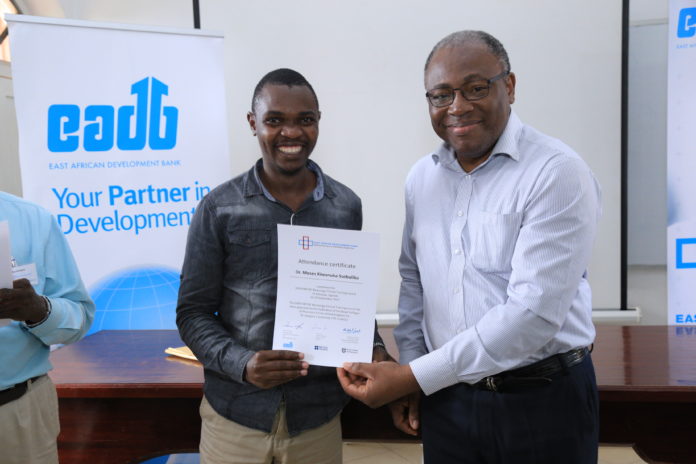
One of the participating doctors being given a certificate of merit
Twenty-two Ugandan physicians recently completed a 5-day residential neurology clinical training course at Nsambya Hospital, aimed at stepping up the fight against non-communicable diseases and in particular, cancer.
The Medical and Training Fellowship programme is part of East African Development Bank’s long-term plan to equip doctors in district hospitals across Uganda and East Africa with the skills to effectively and promptly diagnose cancer and neurological disorders and facilitate early interventions either at the point of contact or by referral for advanced medical care.
The training, delivered by a mixed faculty from the United Kingdom and East Africa comprised of The Course Convener Professor Elly Katabira, Local Faculty Dr. Abdu Musubire, Dr Steven Matovu in addition to Dr. Jonathan Partridge and Dr. Ogunrin Olubunmi from the London Royal College of Physicians, was managed by the British Council in partnership with the London Royal College of Physicians.
“We hope that the programme will lead to better health for the people of East Africa and ease the growing burden that non-communicable diseases put on the economies of East Africa”, she added.
So far, over 70 physicians have participated in the Neurology and Neurology Training and Fellowship programme across East Africa this year, with another 150 scheduled to undergo the training before the end of the year.
EADB plans to train 600 physicians in four years leading to a rich exchange of skills, expertise and experience between the people of the UK and East Africa.
According to the EADB Director General Vivienne Yeda, the training will boost the medical fraternity’s capacity in Uganda and the region by availing qualified professionals who will tackle various cancers.
The World Health Organization estimates that 8.2 million people die annually from cancer, an estimated 13% of all deaths worldwide.
Despite an estimated 456 000 deaths caused by cancer in sub-Saharan Africa in 2012 and a cancer burden that is predicted to double by 2030, the region accounts for only 0·3% of worldwide medical expenditure for cancer.
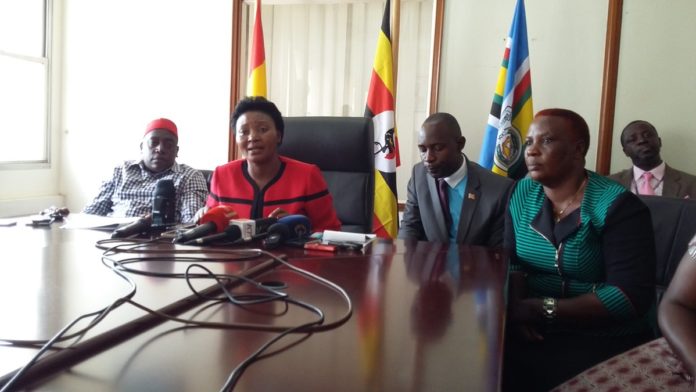
Leader of Opposition in Parliament (LoP) Winnie Kiiza addressing a presser at Parliament
The Leader of Opposition in Parliament (LoP) Winnie Kiiza has warned the Inspector General of Police (IGP) General Kale Kayihura, telling him not to disrupt their consultative meetings over a bill tabled by Igara West Member of Parliament Raphael Magyezi that is aimed at lifting the presidential age limit constitutionally capped at 75 years.
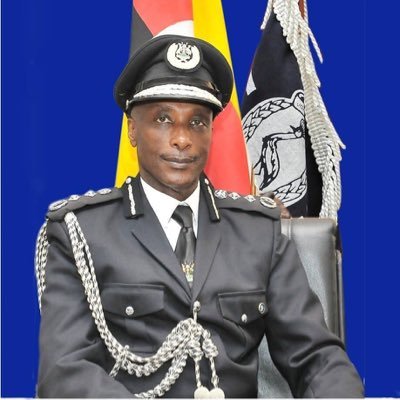
‘WARNED’: IGP Gen. Kale Kayihura
Yesterday the Speaker Rebecca Kadaga met with all parliamentary whips and directed them to send their members to their respective constituencies for the consultative meetings and, in a press statement issued today at Parliament LoP Kizza said Gen. Kayihura had been informed about the Speaker’s directive by the opposition.
“We want to let Gen. Kale Kayihura know that we have designed our consultative meetings; it’s up to him to mobilize us security rather than interfere with us as we commence our meetings about the bill,” Kizza said, adding: “The IGP has been informed and we hope he doesn’t play like he always does; if he continues disrupting us, we shall find other ways to deal with him.”
According to Ms. Kizza, by seeking views on Magyezi’s ‘private members bill’ the MPs including those in opposition are carrying out their constitutional mandate and should not be hindered.
Many in the opposition say Magyezi’s bill is aimed at paving a leeway , for president Museveni to contest for presidency in 2021 when aged 77 years, two above the constitutional cap.
“Removal of the age limit is like taking us to a vehicle without brakes, yet we all know the consequences,” Ms. Kizza said and called upon the general public to shun MPs who lure them to support the bill.
Currently, the Magyezi bill is before legal and parliament affairs committee for scrutiny followed by the consultations, after which the committee will vote to refer it to the house for debate.
Since the issue surfaced, it has caused anxiety, reaching a crescendo recently when Ms. Kiiza, the Kasese Woman MP, walked out of the parliamentary chambers after being denied a chance to comment on the private members bill shortly after its mover Magyezi, tabled it before legislators.
On the same day there was chaos, forcing Speaker Kadaga to suspend 25 MPs including the State Minister for Water Resources Ronald Kibuule, who allegedly sneaked a gun into the parliamentary chambers in contravention of the rules.
In the ensuing chaos, officers from the Special Forces Command (SFC) stormed the chambers to throw out the MPs, in the process injuring among other MPs Angelina Osegge, Betty Nambooze and Francis Zaake Butebi.
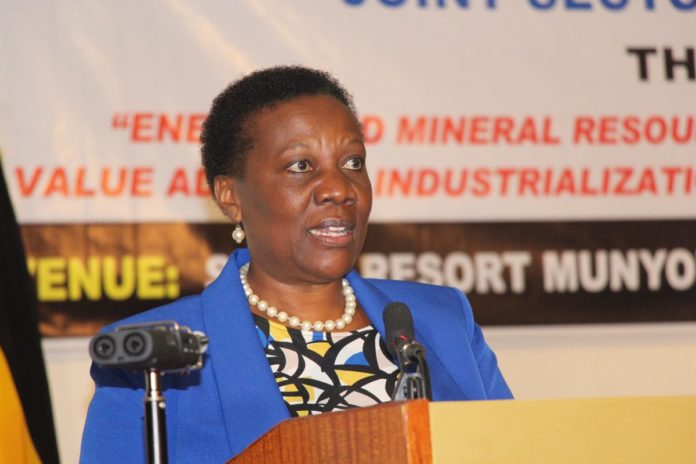
Energy and Mineral Resources Minister Eng. Irene Muloni
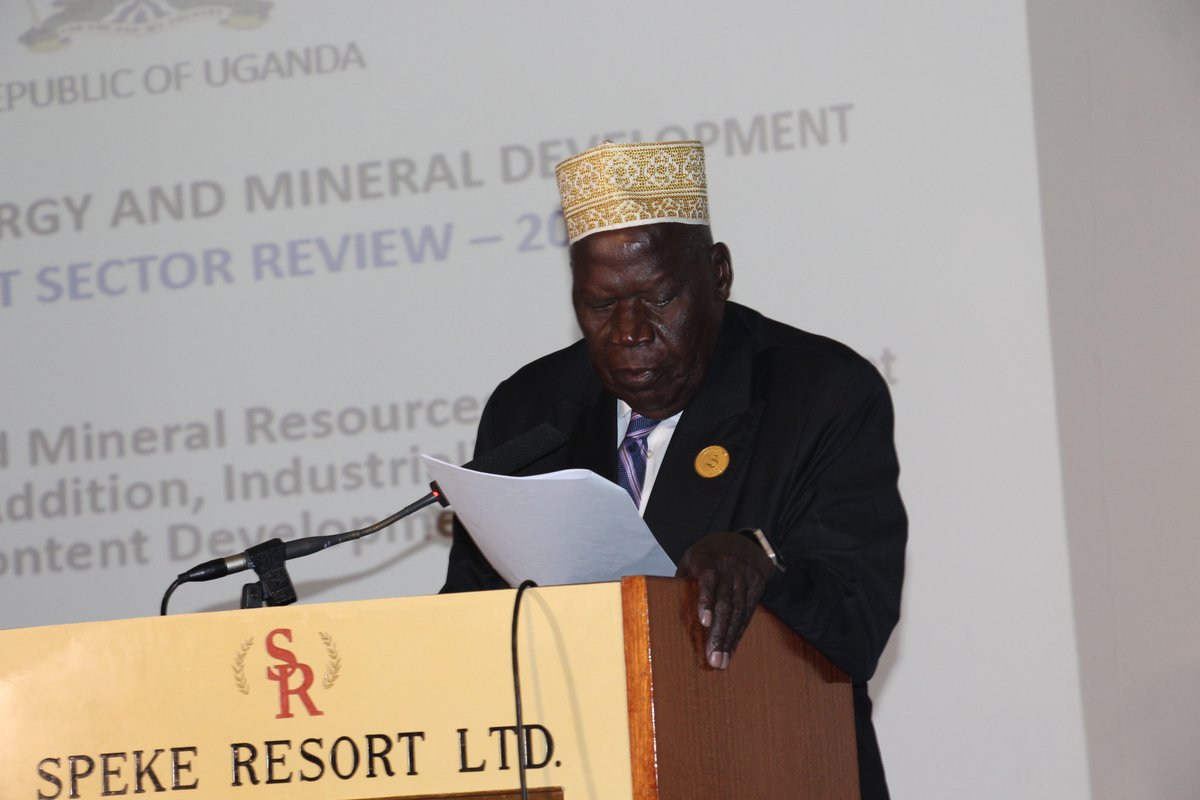
The Minister for Energy and Mineral Resources Eng. Irene Muloni has implored government to synchronize power generation with transmission and distribution, in a bid to shore up electricity production to support industrialization.
The Minister, speaking at the 7th Ministry of Energy Sector Review 2017 held at Speke Resort Munyonyo, said the move to double the generation capacity from the current 900MW will lead to the development and deliver Uganda to the middle income status.
“Our focus is to ensure all sub counties are connected to the grid; 117 of 121 districts are now connected hydro power, however by the end of 2018, we will double our generation capacity from the current 900MW and expand power transmission and distribution,” she said.
According to Eng. Muloni, government is promoting private sector investment in Mini-Grids to accelerate electricity access in all areas of Uganda including industrial parks and mining areas to enable the procession of minerals and goods with a common motive of adding value to products.
Further, according to the Minister, the government is using a multi-pronged approach to reduce the tariff for power from Bujagali Energy Limited. This, she said, includes acquiring loans to clear debts and to transmit power to Ugandans and, export to neighbouring countries such as Rwanda.
She also said her ministry will emphasise on environmental preservation measures as oil exploration starts
‘’Armour Energy and Oranto Petroleum have received three oil and gas exploration licenses therefore Uganda has taken important steps in securing and developing local content in the oil sector without restricting investment,” she added.
First Deputy Prime Minister Gen Moses Ali, at the Energy Review Week
Speaking at the function, the First Deputy Prime Minister Gen Moses Ali, who flagged off Energy Review Week, said that the energy and minerals sector will enable the development of other sectors “since more funds is expected out of Oil that will start flowing in Uganda by the year 2020.”
“Infrastructural development will be enhanced when government saves and allocate funds for their development rather than relying on donors,” Gen Ali noted.
He also revealed that the government is developing the National Suppliers and Talent Database in preparation for the Oil works, adding that Uganda is on its development stage of the petroleum value chain.
On September 24 this year, Kenya were stripped of the right to host the 2018 African Nations Championship (CHAN) during a Confederation of Africa Football (CAF) executive committee meeting in Accra.
The decision was made after an investigation by CAF revealed there was lack of adequate preparations and also that the political situation in Kenya was not conducive.
Since then Morocco, Equatorial Guinea and Ethiopia all bid to substitute Kenya and now CAF will decide the new CHAN host on Saturday 14, 2017.
Despite CHAN matches only featuring locally-based footballers, the games have full international status and count toward the monthly FIFA rankings.
Previously, Uganda has played in the CHAN competition in Sudan 2011, 2013 in South Africa and Rwanda 2016, every time failing to leave the group stages.
The tournament involves 16 teams including the host nation and will take place from January 11 to February 2 next year.
Meanwhile, CAF President, Ahmad Ahmad, who was present at the Wednesday meeting, reaffirmed that Cameroon are still set to host the 2019 Africa Cup of Nations.
Some of the locally-based players expected to take part in CHAN 2018
With Uganda’s hopes for qualifying for the 2018 World Cup buried, the team may decide to give a chance to the local based players in their last World Cup qualification match against Congo Brazzaville.
Sources indicate Cranes interim coach Moses Basena may give opportunity to the local based players as he aims to help them build confidence ahead of the 2018 CHAN tournament.
Only two local-based players started in the goalless draw against Ghana on Saturday, Derrick Nsibambi and Nicolas Wadada. Muzamiru Mutyaba later replaced Farouk Miya in the 60th minute.
The Cranes consisting more locally-based players than foreign-based players is scheduled to travel to Brazzaville on 6 November and according to officials, the match will help Uganda’s CHAN team (which consists of Azam Uganda Premier League players) get exposure to international matches before their friendly matches.
The 16-team tournament for locally-based players only is scheduled to take place between January 12 and February 4 2018.
Kenya was stripped of hosting rights for CHAN 2018 last month and CAF is yet to decide the country to host the tournament.
After a qualification process involving 209 national football teams and lasting for more than two years, the list of 32 sides to take part in the FIFA World Cup 2018 in Russia is beginning to take shape.
Each continent gets to be represented at the tournament with 5 teams from Africa, 13 form Europe, 4 from Asia, 5 from South America, 1 from Oceania, 3 from North and Central America and Caribbean and the host nation.
Twenty three out of the 32 of those have already been confirmed in the tournament and the remaining nine will be known by November. Only four places remain in Europe, three in Africa, one in Oceania and one in South America.
Nigeria and Egypt are the two African sides that have already qualified and the remaining three teams will go all the way to the final day of the qualification campaign.
Morocco lead their group, one point ahead of second placed Ivory Coast, and the two face-off in the decisive match on November 11. The Moroccans only need a draw while the Ivorians need a win to qualify.
Morocco last competed at a World Cup in 1998 and are banking on former Ivory Coast coach Herve Renard to end a run of four failed qualifying campaigns.
Tunisia need one point from a home fixture against North African neighbors Libya to secure a fifth World Cup appearance and their first since 2006, while DR Congo will need a win against Guinea to qualify, should Tunisia lose.
Algeria, Cameroon and Zambia in Group B all have a chance to qualify and will be settled on the final day.
Meanwhile, elsewhere the USA failed to qualify for the first time since 1986 after a shocking 2-1 defeat to 99th ranked Trinidad & Tobago.
The Netherlands, 2010 runners-up, also missed out on a second successive major tournament despite beating Sweden 2-0 in their final game of the qualifiers.
Argentina needed Messi’s hattrick to book a place in a 3-1 comeback against Ecuador.
Europe gets 13 places but they will be 14 due the hosts Russia. 10 nations are already confirmed and the other 4 slots will be determined by paly-offs.
Switzerland, Italy, Denmark, Northern Ireland, Sweden, Republic of Ireland, Greece and Croatia still have a chance to qualify through the play-offs.
The play-off draw will take place on Tuesday 17 October. The first legs will be played on 9-11 November, with the second legs on 12-14 November.
Australia will face Honduras next month in a final two-legged playoff tie to confirm a team from the Oceania region.
The final draw for the tournament will be held in Moscow on Friday 1 December.
Qualifiedteams:
Africa: Nigeria, Egypt.
Europe: Russia (hosts), Belgium, Germany, England, Spain, Poland, Serbia, Iceland, France, Portugal.
South America: Brazil, Uruguay, Argentina, Colombia.
North, Central America and Caribbean: Costa Rica, Mexico, Panama.
Comedian Alex Muhangi’s comedy outfit, Comedy Store returns today, following a week’s hiatus after his departure from his former ‘home’, Diners Lounge.
However, the good news is, he has found a new home; 400 Bar & Restaurant is his new home and he is set to launch his fun-filled show today.
Among the artistes lined up for his ‘new maiden’ show include MC Mariach, T-Amale Mirundi, Ssenga Justine Nantume, Godi Godi, Dhikanio among others.
There will also be performances from the undercover brothers and Winnie Nwagi. The show, as always will kick off at 6pm.
Speaking out on why he left his former home, Muhangi said he had outgrown the venue.
“The venue was no longer enough for us. We had to shift to this spacious 400 bar which commands a nice ambiance and enough parking space,” Muhangi intimated to EagleOnline.
Muhangi also laughed off reports that he parted ways with the management of his previous home due to mismanagement of funds.
“How could that be?! All funds I was handling were my funds. And I duly paid my rent for using the venue, so what do they mean I mismanaged funds…they were all my funds.”
Esther Namazzi, not real name, graduated five years ago with a bachelors degree in community psychology from one of Kampala’s universities but has since then failed to find to work because her qualifications are currently not so marketable in Uganda.
Needless to mention, Ms Namazzi is just one of the many Ugandan graduates who have failed to find jobs because their training did not equip them with the necessary skills demanded on the local and regional markets. Such a scenario has put Uganda’s higher education institutions on the spotlight, with some parents questioning why they have to spend on courses that are not rewarding.
ICT is an important ingredient of learning at the Victoria University
And this is where Victoria University Kampala, a dynamic Institution of higher learning comes in to make a difference. The university provides market-oriented training to its students in a conducive environment characterised by fully-fledged ICT equipment.
Located in the heart of Kampala, Victory University (VU) is licensed by the National Council for Higher Education. It is an internationally recognised institution that is committed to excellence in research and education, and offers an outstanding campus-based student experience.
Indeed, over the past three years the university has registered exponential growth while maintaining a supportive social and academic community, making VU a great place to study, research and work.
Success around the world
“Our graduates are successful around the world and in East and Central Africa in terms of securing and creating employment. This is due to the dynamic, employment-facing learning experience facilitated by dedicated and committed lecturers and modern, fully equipped facilities,” says one of the officials at the campus.
Diverse culture
As a cosmopolitan university with students of diverse nationalities, VU prides itself in in being the only university located right in the heart of Kampala, a hub for a good night life, amazing food, access to stress-free shopping and several options for recreational activities, all important ingredients of social life, which is part of the learning experience.
The university also offers an exciting cultural experience for many foreign visitors, making it easy for all the non-Ugandan students to study, stay and live comfortably within Kampala.
“Well being a student at VU has had a bigger impact compared to any other ever received. And place is so conducive however much in the heart of Kampala,” says one of the students, Andrew Marvin Wavamuno.
VU has endeavored to ensure that all facilities, whether educational or recreational, are set up to provide its students with the most conducive environment in terms of learning, recreation and relaxation.
“We understand that it is a combination of all these factors, and the opportunity to engage fully with other students, that create a fully holistic environment for learning, self-development and social interaction,” he adds.
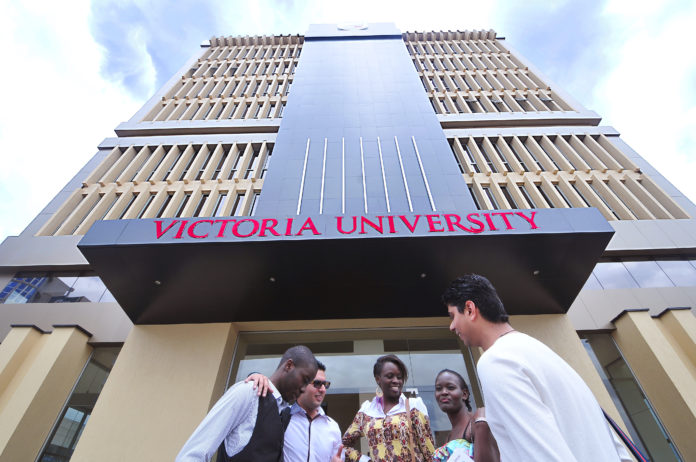
Victoria University students sharing experiences, while learning from each other
The university provides such facilities because officials there expect a lot from the students and continue to invest in an academic environment which will help them succeed.
The Computer lab is well-quipped and spacious
Meanwhile, students benefit directly from a range of learning technologies, including among others the virtual learning environment.
According to one of the lecturers, VU admits talented students to take up world class degrees and diplomas. The university, he says, sources for mature students who possess good matric results, portray positive attitude and willing to give back to the community. As way of keeping the standards, the admitted students must maintain a GPA of minimum 3.5 throughout the programme, the lecturer adds.
The Victoria University Library is well-equipped
As one of the top universities in Uganda, Victoria University stands out as a pivot of academic excellence offering fresh and intellectually thriving environment that nurtures critical and progressive thinkers and pushes pedagogical boundaries. The university offers a wide range of marketable courses tailored for the market.
The University is also committed to the advancement of higher education in the country and the East African region by establishing exemplary, specialized and employment-oriented education.
Career choices
The university does not only admit students; it also gives them tips on making career choices to get them started. The tips relate to personal values, interests, soft skills and aptitudes, goals, occupations and action plans among others.
Girl child
IMPORTANT: Girls groomed by Victoria University
VU pays special attention to women and girls in particular and provides special incentives to the girls at the campus. During the recent celebration of the International Day of the Girl Child, one of the officials at the university had this to say: “Girls are the pillars of the society. Life is not possible without them. A small girl child can be a good daughter, a sister, a wife and a mother in future. Education is the key. We encourage you to grow every girls’ spirit and hunger for knowledge to build tomorrow’s future; as we celebrate the International Day of the Girl child.”
In-takes
Dr Sudhr Ruparelia Scholarship Grant
The university management realises the economic situation in Uganda and as such has extended a helping hand to parents by establishing a grant – The Dr. Sudhir Ruparelia Scholarship Grant aimed at enabling students from low income homes access higher education. For those interested, details can be accessed at the university’s website.
Academic programmes
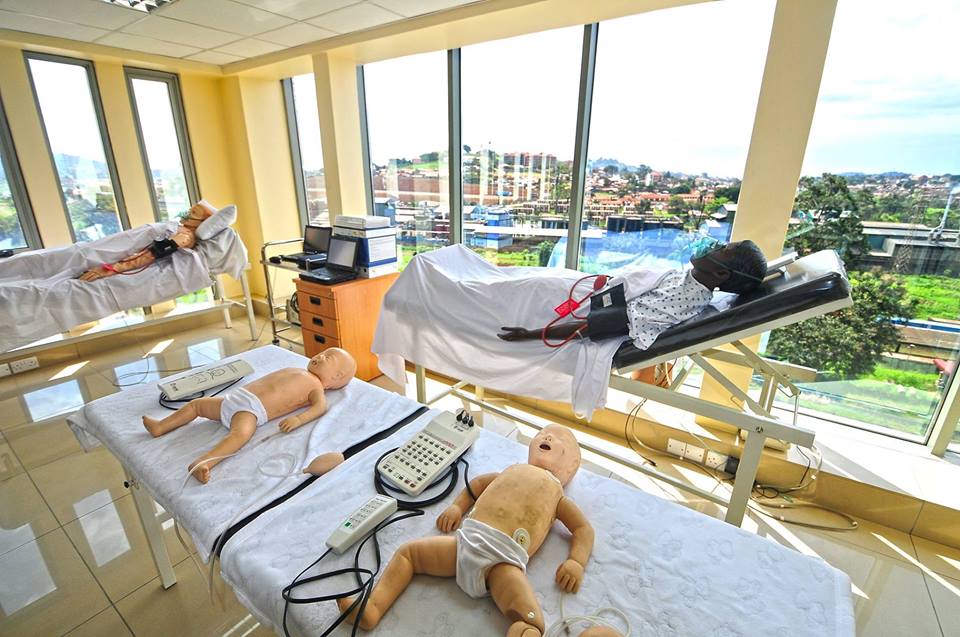
At Victoria University health training is accorded priority status to allow students gain the relevant experience in handling patients
The university offers dynamic courses at diploma and degree levels under themes such as: Business and Management, Humanities and Social Sciences, Science and Technology as well as Health Sciences. Other courses include Business Administration, Banking and Finance, Computer Science, Information Technology, Business Information Systems, Journalism and Media Studies and Tourism and Hotel Management. There is also training in Oil and Gas management, an important course as the country prepares to produce oil in the near future.
Intakes
Students wishing to join the university can opt for October or January intakes. The arrangement is flexible and allows students to engage in other important activities or look for school fees and other necessities. Further, it also brings onboard more students than if it were only one intake.
Research-led teaching
Victoria University Vice Chancellor Dr. Sharma Krishna
According to the Vice Chancellor Dr. Krishna N Sharma, the university takes research-led teaching seriously and staff are encouraged to research and teach with dedication.
“Our curriculum is regularly updated by the latest research and our students undertake research themselves. Because our University is on a human scale, there is also a very strong sense of community,” he says.
Enhancing university’s intellectual community
Further, Dr. Sharma says students enhance the university’s intellectual community through contributions in lectures, conferences and research symposia.
“It is immensely gratifying that they are proud to be associated with Victoria University,” he adds.
According to Dr. Sharma, management is determined to achieve its mission of being a research-driven University motivated by societal needs, whilst creating scholars who are empowered to provide cutting edge solutions.
“The best way to truly appreciate that Victoria University has a lot to offer is to visit, but until you are able to do that I hope our website will give you all the information you need; whether you are looking for a place to study or work, want to find out more about our research and Public engagement, or reconnect with our alumni community,” the Vice Chancellor says.
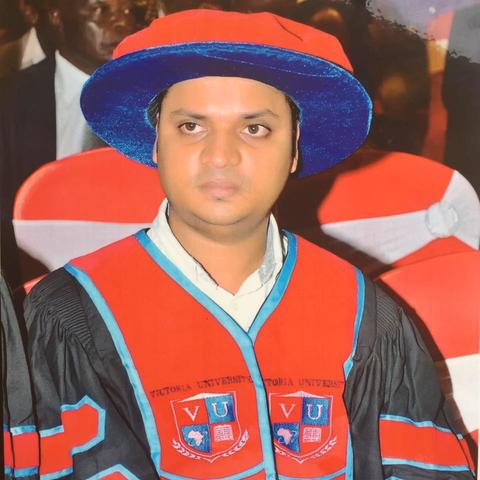
Victoria University graduates are successful around the world
Recognising the Alumni
Whether you’ve just arrived on campus or you’ve been VU for years, the university is the place to connect with all professional and career stakeholders.
At VU students can socialize, network, share news, and get involved with fellow alumni, students, parents, faculty, staff, and friends. The University community is also very strong and it comes together through an online community free and open to all.
“You can get access to the people, events, ideas, and resources that matter to you, and help strengthen the University,” the VC notes.
WANTS 'SMART AGRICULTURE PRACTICES': Agriculture Minister Vincent Ssempijja.
The Minister of Agriculture, Animal Industry and Fisheries Vicent Sempijja has implored Ugandan farmers and other land users to adopt practices of smart agriculture.
In a statement issued ahead of the 35th National World Food Day on October 16 2016, the Minister said that on that day Uganda, just like other countries, will focus on the status of food security, hunger, malnutrition, poverty and agricultural development.
To be held under the theme: ‘Change the future of migration, invest in food security and rural development’ the celebrations at Kachwekano Zonal Agricultural Research Development Institute in Rubanda district, will be graced by President Yoweri Museveni.
The theme, Sempijja said, recognizes the negative effects on migration on food security and rural development, adding that over the medium term his ministry will continue pursing policies and interventions that promote increased value addition in order to improve our foreign exchange base.
To augment his statement, Sempijja, listed soil and water conservation, conservation agriculture, agro-forestry, manure management, irrigation, mechanization of production systems and integrated nutrient and pest management, aquaculture development, forestation, wetland, sustainable pasture and rangeland management as some of the practices that will boost Uganda’s agricultural output.