Stanbic Bank
Stanbic Bank
21.2 C
Kampala
Stanbic Bank
Stanbic Bank
Home Blog Page 174

Opposition vows to defend coffee farmers amidst threats of arrest as parliament debates bill to dissolve UCDA

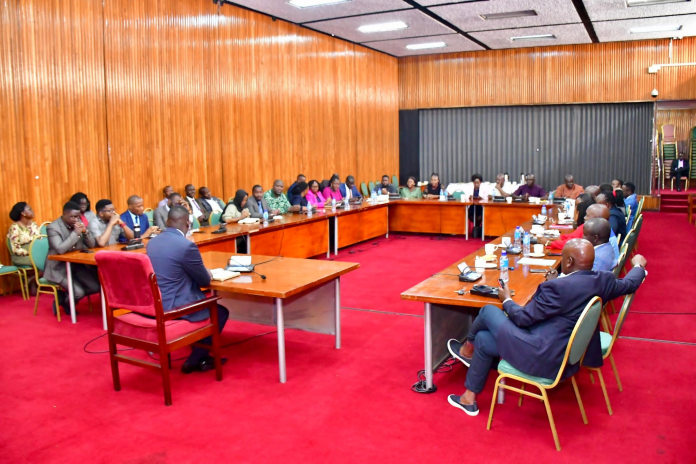
Opposition legislators plotting on how to counter the coffee bill.

Legislators from the Opposition Caucus have vowed to fight for the economic empowerment of coffee farmers, despite reports of the looming arrest by security forces, during tomorrow’s debate on the National Coffee Amendment Bill, 2024 that is seeking to abolish Uganda Coffee Development Authority (UCDA).

The proclamation was made by Leader of Opposition, Joel Ssenyonyi, while addressing journalists at Parliament today, where he castigated the Government for ridding the debate of UCDA merger with tribal and partisan sentiments, in an attempt to divide Ugandans.

“Tomorrow, we are going to start from where we stopped. We are determined to defend the economic empowerment of the people of Uganda. There have been many threats, as you entered the Parliament, you saw the whole building cordoned off, we have heard that tomorrow will be worse, they are going to deploy all manner of military, in uniforms, plain clothes including inside the building, that is okay,” said Ssenyonyi.

“No one is going to intimidate us, because no one wrote us an invitation and said, I would like you to come and sit in this House, no. Each of us here has been sent by the people who sent us, and those people are happy with the work that we are doing. So, if anyone has got ideas to try and intimidate us, because we hear they are planning to arrest some of us, we have been arrested so many times, that isn’t something you can use as a threat to some of us. So, we shall be here tomorrow, to defend economic empowerment,” he added.

He also warned the Executive to stop interfering with the operations of the Legislature, arguing that all the three arms constitutionally are supposed to be independent, but of late, there have been incidents where the Executive arm has been rough shouldering over the legislature, actions he deems improper, unconstitutional and unacceptable.

“President Museveni, I think, imagines that Parliament is supposed to be in his pockets, for it to do whatever he wants at his whims and fancies. We are in 2024, and in this era, there is no room for that. So, the way Parliament is being rough shouldered severally, MPs being called and we have been seeing communications on our platforms as MPs from the Government Chief Whip saying Cabinet sat and these are the instructions for MPs to make sure the Coffee Bill passes. But how? Parliament is supposed to be independent,” said Ssenyonyi.

Ssenyonyi also castigated the Government for tainting the Coffee debate with tribalism, arguing that the issue of coffee is an issue of Uganda, not Buganda, and he went on to list several districts outside Buganda, whose inhabitants are heavily invested in coffee growing.

“So, all those who are trying to divide the people of Uganda to make it seem it is them against you, no, this is for all of us. If you look at some of the districts that produce a lot of coffee, a good number of them aren’t necessarily in Buganda. So, it is very problematic for anyone to try to make this one a Buganda issue. This is an issue of Uganda because coffee is a cash crop that is benefitting many districts in Uganda. So why are you trying to make it like it is a Buganda issue? Let us stop dividing the people of Uganda,” he said.

The Opposition further accused the Government of being against the prosperity of Ugandans with Ssenyonyi stating, “This Government isn’t interested in the people of Uganda prospering, we saw what happened to vanilla, we saw what happened to cotton, we saw how this Government ran down Cooperatives. Cooperatives had empowered the people of Uganda, they had money to take their children to school, they had money to pay for health care, their lives were getting better and all of those sunk under this Government watch.

“So Government has made it, as if their policy that Ugandans should not be empowered economically because they will be complicated, they will speak out for themselves and that is why they are fighting coffee now, because coffee has empowered Ugandans. They are making a good living out of it and now, they want to go after it, that is their plan,” he added.

“If the President is serious about cutting down on government expenses, why does he always create new districts and new constituencies as we head for elections? Why does he have a bloated cabinet? Why are there so many Presidential Advisors? Why do we have so many RDCs, Deputy RDCs and now Assistant Deputy RDCs? That isn’t true, that is a lie, stop fooling the people of Uganda. I want to challenge the President, stop preaching water and then you drink wine,” he wondered. 

Stories Continues after ad

Cabinet resolves to disband coffee authority

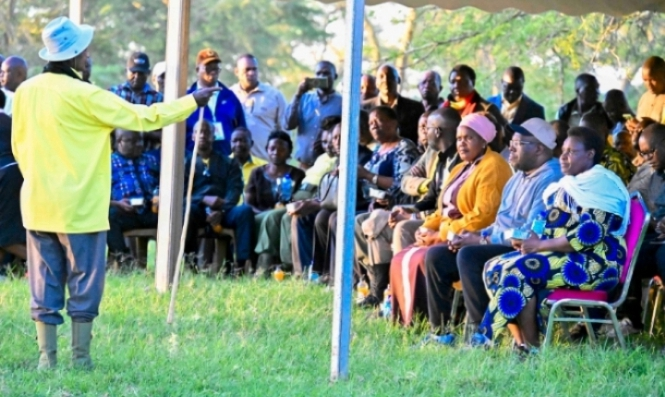
Ministers and Members of Parliament subscribing to NRM listening to President Museveni at his Kisozi farm.

Cabinet has reconsidered and resolved that the National Coffee (Amendment) Bill 2024 be supported and passed into law without the three-year transitional period.

The decision followed a series of meetings held by both the National Resistance Movement (NRM) parliamentary caucus and NRM caucus in Kisozi.

In February 2021, cabinet chaired by President Yoweri Museveni resolved to rationalise 38 agencies. The arguments forwarded for the rationalisation was to stop duplication and wasteful expenditure and realign service delivery.

Earlier this year, Frank Tumwebaze, the Minister of Agriculture, tabled the National Coffee (Amendment) Bill, 2024, to mainstream and rationalise the functions of the Uganda Coffee Development Authority (UCDA) into the Ministry of Agriculture. The committee on Agriculture, Animal Industry, and Fisheries took up the matter.

A report by the Committee on Agriculture indicated UCDA plays a pivotal role in overseeing coffee quality to ensure compliance with export contracts and international food safety standards. Quality management spans from seed to cup, which includes regulating planting materials, production, harvest, post-harvest practices, and processing to meet international standards.

The Committee noted that there is no duplication of UCDA’s mandate with MAAIF or any other government agency recommended that UCDA be rationalised subject to a three-year transition period to enable MAAIF to build capacity to execute the mandate that is under UCDA.

While defending the rationalisation, Museveni said he is the vision bearer of UCDA; he however, argued that by 2013, UCDA and NAADS had no impact, and 68% of the homesteads were still outside the money economy.

“It’s fraudulent for NAADS and UCDA to claim that the big boost in agricultural production is because of their efforts. The high yielding clonal coffee seeds were developed by the late Dr. Sebunya Kibirige, not the irrelevant and opportunistic UCDA and NAADS,” he said.

He claimed that it is irrational to have agency or authority for coffee, malakwang, piggery, etc. The government came up with rationalisation to stop irrationality.

He said it is criminal for agencies (UCDA) to interfere with our mandate as the elected leaders to propose adjustments to achieve the goals of social-economic transformation. The parasitic UCDA, NAADS, etc. are incapable of understanding the mass line of prosperity for all.

However, those opposed to the disbanding of UCDA claim it has performed far well and its push into mainstream docile mother ministry would disadvantage the achievement of the coffee industry. Others claim there is a hidden agenda by those behind the move to hand over coffee to private individuals that are central to power and have all along developed the appetite for coffee as it gains on the world market.

Stories Continues after ad

Bridging the digital divide: A new era for Uganda’s education

By Bryan Mbasa

Last month, Dr. Chris Baryomunsi, the ICT Minister, announced an exciting and ambitious plan to set up computer labs in all public secondary schools across Uganda. This initiative, revealed during the launch of a computer lab at San Giovanni School-Makiro in Kanungu District with the support of our partners, American Tower Corporation, marks a transformative milestone in the country’s educational landscape.

This effort underscores the government’s commitment to promoting digitalization through favorable policies such as Uganda’s Vision 2040 and the Digital Transformation Roadmap. The Uganda Communications Commission has already established over 1,000 computer labs in various schools nationwide over the past few years, setting a strong foundation for this new initiative.

The timing of this step is particularly significant, especially given that 75% of Uganda’s population is under the age of 30 and currently facing high unemployment rates. By integrating computers into educational institutions, we can empower students with essential digital skills vital for today’s modern workplace. This initiative will facilitate their transition into productive employment, ultimately benefiting our economy.

Thus, access to computers not only enhances information availability but also fosters collaboration and critical thinking—skills crucial for success in fast-evolving fields such as technology, engineering, and innovation. By equipping our students for careers in these sectors, we can lay a solid foundation for sustained economic growth and global competitiveness.

At MTN Uganda, we recognize the transformative potential of digital education. Our strategic initiatives include establishing over 57 ICT labs nationwide and supporting technical institutes like Amelo Technical Institute in Adjumani and St. Simon Peter’s Vocational Training Centre in Hoima. These efforts provide students with hands-on learning experiences, equipping them for success in a digitally driven world. Our Ambition 2025 strategy aligns seamlessly with these initiatives, aiming to bridge the digital divide and empower young Ugandans through technology.

Moreover, introducing computers in public schools extends benefits beyond the classroom. By equipping teachers with modern tools, we enhance lesson delivery and improve educational outcomes while expanding their professional capabilities. This initiative also empowers community members to acquire valuable digital skills, fostering socio-economic development in underserved regions.

However, while the promise of this initiative is immense, challenges remain—particularly concerning the affordability of internet access. To fully realize the benefits of computer-equipped schools, it is crucial that students, educators, and communities have access to affordable and reliable internet services.

By making internet access more affordable, we can accelerate Uganda’s digital transformation agenda, empowering citizens from all backgrounds to fully participate in the digital economy and reap the benefits of enhanced connectivity.

As such, we urge all stakeholders—students, educators, government entities, and private sector partners—to unite behind the government’s initiative to equip secondary schools with computers. Together, we can empower a digitally literate generation ready to tackle challenges and seize opportunities in the digital era. MTN Uganda remains steadfast in supporting this vision. By collaborating with stakeholders and leveraging our expertise in digital solutions, we can build a digitally inclusive Uganda where every individual has the tools and skills needed to thrive.

Let us rally together under the banner that “Together, We’re Unstoppable,” ensuring that Uganda’s digital future is bright and prosperous for all. As we embrace this new era of digital education, we pave the way for a generation of innovators and leaders ready to shape the future.

Bryan Mbasa is senior manager at MTN Foundation

Stories Continues after ad

UAP Old Mutual and My Tree Initiative partner to engage 5,000 students to plant, protect and nurture 10,000 trees by 2025

UAP Old Mutual, in collaboration with My Tree Initiative Organization, launched a groundbreaking Schools Greening Program, aimed at growing 10,000 trees in 10 schools across Uganda and engaging more than 5,000 students in conservation activities.

This Program is a critical step in addressing Uganda’s climate change challenges and promoting environmental education across school communities.

The Program was officially launched at Kisaasi Muslim Secondary School in Kampala District where key influential leaders from government, private sector and development partners gathered to emphasize the importance of environmental conservation in schools.

“We believe that addressing climate risk is both a responsibility and a necessity for businesses. Through this Program, we are contributing to the preservation of Uganda’s natural resources, supporting a sustainable future for our communities and the economy,” stated Patrick Kimathi, Old Mutual Life Assurance Managing Director.

“Nature is a critical enabler of our economy and conserving it is integral to our corporate strategy. As a financial institution, we are committed to incorporating sustainable practices that not only protect Uganda’s natural resources but also ensure long-term economic growth,” added Patrick Kimathi.

Through the Schools Greening Program, UAP Old Mutual and My Tree Initiative are planting indigenous, medicinal and fruit trees to restore degraded land and contribute to the Ecosystem’s sustainability.

In his remarks, My Tree Initiative Organization, Executive Director, Enjer Ashiraf said, “We are thankful to UAP Old Mutual Uganda for their generous partnership to spearhead this Schools Greening Program, supporting us on planting trees in schools across Uganda. The main aim of this Program is to integrate environmental education into the school curriculum, engage students in hands-on tree planting activities, improve students diet and educate, empower and support the future generations to be champions of our planet.”

UAP Old Mutual’s dedication to sustainability extends beyond this initiative. Over the past three years, the company has contributed to the planting of 20,000 trees in Mabira Forest and the Albertine region and donated nearly 40,000 seedlings. These actions align with a broader strategy to address Africa’s disproportionate exposure to nature-related risks and the need for African financial institutions to respond effectively to the continent’s vulnerability to environmental challenges.

The Program is part of UAP Old Mutual’s larger commitment to sustainability, recognizing environmental conservation as essential for economic stability and societal well-being. With Uganda’s economy and livelihoods heavily reliant on natural resources, UAP Old Mutual continues to be an active force in environmental sustainability.

Uganda faces significant environmental degradation, with alarming rates of deforestation and soil erosion that threaten not only the economy but also food security and poverty reduction. Statistics from the Uganda Economic Update by the World Bank Group in 2021 revealed that over 41% of Uganda’s land was degraded, with the country losing approximately 2.6% of its forest cover each year – one of the highest rates globally. These environmental challenges were estimated to cost Uganda over $9 million in lost ecosystem services annually. Climate risks only compound the impact, with projected economic losses between $2.3 to $4.2 billion by 2025 due to reduced agricultural productivity, water shortages, and diminished exports.

The UAP Schools Greening Program aims to drive environmental sustainability and inspire young Ugandans to take an active role in environmental conservation, showcasing that collective effort can effect positive change.

Stories Continues after ad

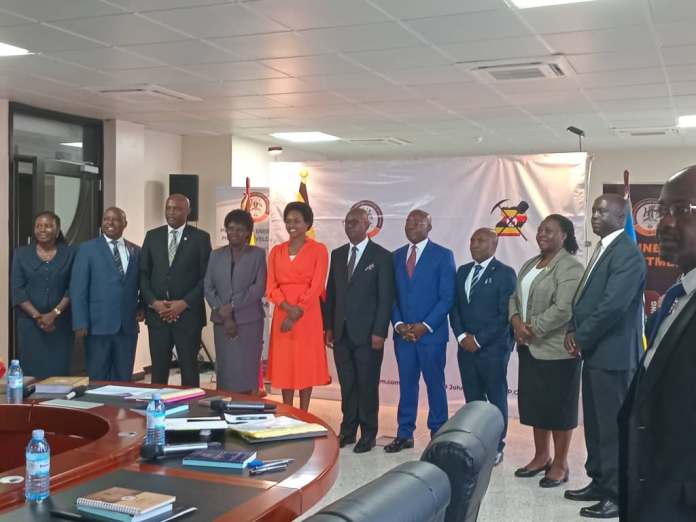
Energy Ministry inaugurates new board to oversee National Mining Company

The Ministry of Energy and Mineral Development (MEMD) has inaugurated a new Uganda National Mining Company board at the Petroleum Authority of Uganda House in Entebbe.

The nine-member board, chaired by James Mukasa Ssebugenyi, is tasked with overseeing the country’s equity interests in the mining sector. Eng. Irene Pauline Bateebe, Permanent Secretary in the Ministry of Energy and Mineral Development, emphasized the board’s critical role in achieving new targets to enhance mineral exploitation and value addition for economic transformation, industrialization, and job creation.

The Ministry’s strategic vision includes increasing exploration and quantification of at least 58 priority minerals and geothermal resources across the country. Additionally, the board aims to promote the adoption and use of affordable technologies throughout the supply chain.

James Mukasa Ssebugenyi, the board chair, highlighted mineral development as a key driver of revenue and government plans. He expressed confidence that the Uganda National Mining Company can play a transformative role in the economy.

Phiona Nyamutoro, Minister of State for Energy and Mineral Development, underscored the mineral sector’s importance as one of five critical areas the government has identified to achieve economic growth over the next decade.

The board members bring a diverse range of expertise, including law, accounting, geology, and economics. James Mukasa Ssebugenyi is a seasoned lawyer with experience in high-profile environmental and mineral resource cases.

James Byagaba is an experienced accountant and managing director of Gabas Investments Ltd.

Other members include Kevin Aanyu, a geologist and lecturer at Makerere University; Agnes Alaba, commissioner in the Department of Mines; Francis Twinamatsiko, assistant commissioner in the Tax Policy Department; Maria Kiwanuka Nabasirye Kiwana, special presidential advisor on finance; Dr. Alex Binego Zentaro Kwatampora, geoscience expert; Wilfred Kokas Aupal, senior lecturer and dean at Uganda Technology and Management University; and John Fisher Kanyemibwa, advocate with expertise in oil and gas law.

Historically, the mining sector contributed significantly to Uganda’s GDP, but its contribution has declined over the years. The National Development Plan aims to increase Uganda’s economic output, with the mining sector playing a crucial role in achieving this goal.

Stories Continues after ad

Former BoU Official sentenced to 3-years in prison over theft of old bank notes

Kampala, Uganda: Bank of Uganda building, the Central Bank of Uganda, Jinja Road - photo by M.Torres

Former Bank of Uganda official has been sentenced to three years in prison for abusing his position to steal old currency notes meant for destruction.

The Anti-Corruption Court in Nakasero sentenced Charles Kasede Ochieng, former Head of Verification at the Bank of Uganda (BoU), to three years in prison on October 31, 2024. Grade One Magistrate Esther Asiimwe convicted Ochieng of abuse of office but acquitted him on the embezzlement charge due to lack of evidence.

Magistrate Asiimwe clarified that although Ochieng was initially accused of stealing Shs474 million, this amount was later revised to Shs62 million. However, the prosecution failed to provide concrete evidence proving that BoU experienced a financial loss. Despite this, the court found sufficient proof of abuse of office, particularly through CCTV footage that showed Ochieng pocketing old currency notes intended for disposal.

The footage presented by the prosecution showed Ochieng carefully looking around before taking the notes. He was seen placing bundles of money into his pocket and discreetly walking away. The court determined that these actions violated his role, classifying it as an arbitrary abuse of his official position.

From November 2018 to August 2019, while working as Head of the Verification Unit at the BoU’s Mbale branch, Ochieng engaged in actions that led to his conviction. Magistrate Asiimwe stated that the prosecution had proven beyond reasonable doubt that Ochieng abused his office. “This court finds that the ingredient of the offence of abuse of office has been proved and hereby convicts the accused as charged,” Asiimwe declared.

State Attorney Nicholas Kawooya, representing the Office of the Director of Public Prosecutions (ODPP), called for a sentence of three and a half years, citing a breach of trust by Ochieng. Kawooya emphasized the seriousness of the crime, noting that as a verification officer, Ochieng held a role of integrity in a crucial institution that upholds the country’s monetary system. Kawooya argued that Ochieng’s act of taking old notes designated for destruction demonstrated corrupt intent and damaged BoU’s trust in its employees.

According to Uganda’s sentencing guidelines, the offence of abuse of office carries a maximum penalty of seven years, with three and a half years as the starting point. Kawooya noted that a significant sentence was warranted to reflect the gravity of the offence.

Ochieng’s lawyer, Arthur Mwebesa, requested leniency, suggesting a non-custodial sentence. He argued that as the main provider for his family, a prison sentence would impose hardship on Ochieng’s dependents. However, Magistrate Asiimwe aligned with the prosecution’s position, underscoring the importance of deterring similar abuses of office through appropriate sentencing.

Stories Continues after ad

Former KCCA officials granted bail over Kiteezi landfill tragedy 

Former KCCA Executive Director, Dorothy Kisaka, her deputy, Eng. David Luyimbazi and former director of health and environment Daniel Okello appearing before Kasangati court.

Court has granted bail to three embattled former officials of the Kampala Capital City Authority (KCCA); Dorothy Kisaka, David Luyimbazi, and Daniel Okello following charges linked to the August 10, 2024, Kiteezi landfill disaster. The tragedy claimed 35 lives and left 21 others injured.

The court set cash bail of Shs5 million Ugandan for each of the accused, while their sureties are to execute a non-cash bond of 100 million shillings. Additionally, the former KCCA officials are required to surrender their original passports and are prohibited from leaving Uganda without prior court approval. The case has been adjourned until November 26.

Prominent media analyst Andrew Mwenda has criticized the arrests, suggesting that they serve more as a placatory measure than a genuine effort to address underlying issues.

Mwenda contends that the real cause of the disaster lies in the government’s persistent underfunding of waste management and its neglect of Kampala’s infrastructure.

According to KCCA, the Kiteezi landfill had long exceeded its capacity. Despite repeated requests from the authority for funds to decommission the site, no action was taken, leaving the landfill in a critical state.

However, a report by the Committee on Commissions, Statutory Authorities and State Enterprises (COSASE) implicated two Kampala ministers and the Permanent Secretary to the Treasury (PSST), Ramathan Ggoobi, in the Kiteezi Landfill disaster. The report attributed part of the blame to the ministers, citing lapses in oversight and poor management of the waste disposal crisis at Kiteezi, which has put residents’ health and safety at risk.

The COSASE report specifically highlights the ministers’ failure to address the longstanding waste management issues at Kiteezi, allowing the situation to escalate into a disaster. Furthermore, PSST Ggoobi is held accountable for withholding funds necessary for decommissioning the Kiteezi Landfill, a critical step in resolving the waste management problems. Despite repeated calls for intervention, the funds were allegedly withheld, causing delays in closing the site and exacerbating the hazardous conditions.

The Kiteezi Landfill disaster has been a ticking time bomb, with the site reaching its capacity as far back as 2015. The tragedy has claimed dozens of lives and highlighted the grave shortcomings of the government’s waste management and governance.

The former KCCA officials have since been arrested, charged, and remanded to Luzura prison until November 4, 2024. They face allegations of mismanagement, corruption, and environmental regulation violations contributing to the disaster.

The COSASE report’s findings sparked widespread outrage, with many calling for greater accountability and urgent reforms in Uganda’s waste management sector. As the investigation continues, the nation awaits justice for the lives lost and affected by the Kiteezi landfill disaster.

Stories Continues after ad

Court dismisses 26-year-old case against NSSF

The High Court in Kampala has dismissed a case in which Alcon International was seeking compensation from the National Social Security Fund (NSSF) for allegedly confiscating its machinery, equipment, and building materials used to construct the Workers House.
Alcon sued NSSF after the latter terminated its contract in 1998, claiming it was unfairly blocking them from retrieving its equipment and machinery at the Workers House site. When the matter went into arbitration, Alcon was awarded $2.78m.

However, the Supreme Court sent the case back to the High Court for retrial after NSSF rejected the award to Alcon. NSSF argued that Alcon International Kenya Limited had taken over the contract from Alcon International Uganda Limited without its knowledge, which was tantamount to fraud.

According to available court records, the retrial included matters which are claimed under this very suit. The Court also heard that NSSF entered into a contract for the construction of the Workers’ House with Alcon International Ltd, a company incorporated in Kenya and was under the impression that it was dealing with such.

However, NSSF said it only became aware that it was dealing with a different company upon a 2007 decision of the Court of Appeal where it established that Alcon International Limited had fraudulently assigned the building contract to the plaintiff without its knowledge and consent which was illegal and fraudulent.

Last Thursday, Justice Musa Ssekaana ruled that Alcon International had not established a cause of action in retinue against NSSF. Justice Ssekaana in his decision dated October 31st 2024 also said that the claim was time-barred under the Limitation Act, having risen twenty-six years ago.

“It is indeed true that the plaintiff [Alcon] was fraudulent when it entered onto the defendant’s [NSSF] premises well aware that it .. had no contract … as stated by the defendant, an illegality once brought to the attention of court overrides all questions of pleadings including any admissions made thereon. The plaintiff cannot seek to recover from a transaction in which he was illegally performing,” he said.

“Having upheld all preliminary objections raised by [NSSF] in respect of [Alcon’s] suit … this suit is dismissed with costs to the defendant,” he added.

Stories Continues after ad

NAGRC&DB aims at boosting animal feed and production with mechanization

Minister Rwamirama.

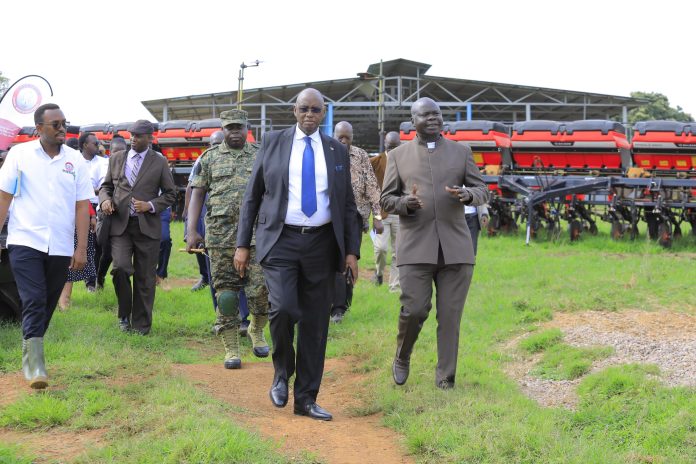
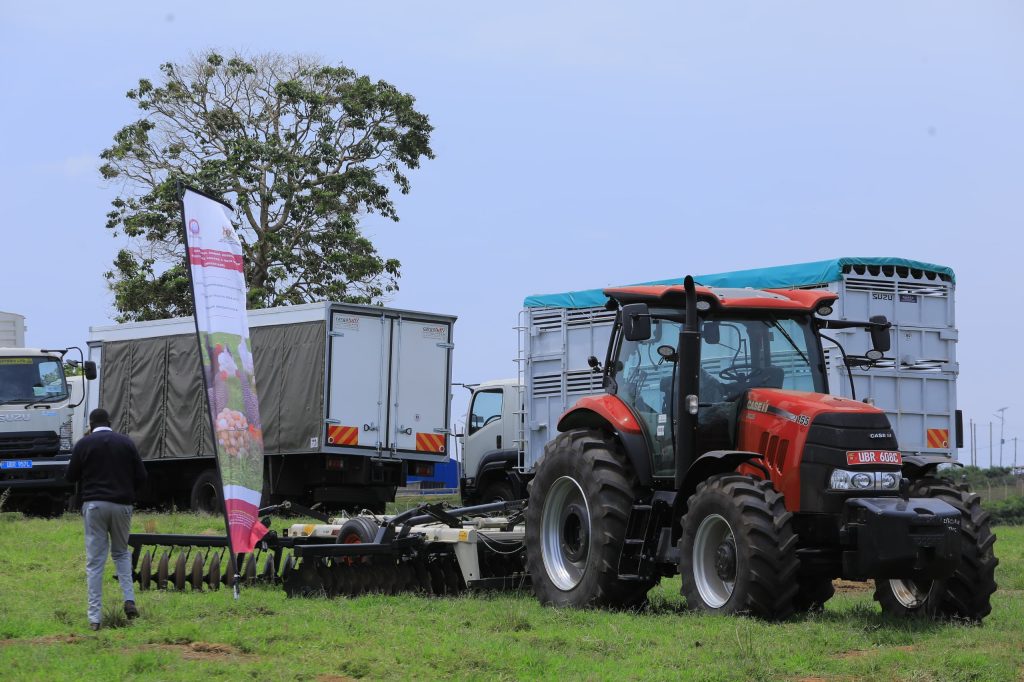
The Minister of State for Animal Industry  Bright Rwamirama has today  launched the state-of-the-art heavy-duty animal feed production, harvesting and manufacturing machinery at NAGRC&DB’s Entebbe-based livestock experimental station (LES ).

The machines include heavy-duty agriculture tractors, tipper trailers(10-tonne) capacity, heavy-duty primary disc harrows, heavy-duty secondary disc harrows, heavy-duty precision low planters, long-range boom sprayers, forage harvesters, poultry haulage trucks, animal feed distribution trucks, and animal haulage trucks among others. 

Uganda currently faces a growing high demand for quality pasture and value-added animal feed. This demand is fueled by a growing population that majorly depends on livestock as a source of food and income. 

The new machinery comes as a stitch in time when the agency is implementing the presidential directive on  Food and animal feed security. In 2022, the cabinet tasked NAGRC&DB with boosting the production of maize and soybeans using 30,000 acres of land that makes up a fraction of the agency’s land.

However according to the agency’s management, , among the key challenges they have been previously grappling with is hiring expensive machinery to use in  bush clearing which has always been costly especially during rainy seasons. 

Government through its various programs such as the Parish Development Model, envisions having a competitive, productive, and sustainable agriculture sector through agricultural commercialization. 

NAGRC&DB management hopes that with the help of the launched modern machinery, the agency will be able to leverage modern agricultural technologies over traditional means that will assist it in value addition and boosting production of animal feed benefiting not only the agency’s farms and ranches but also the neighboring communities. 

Through consistent and sustainable agriculture innovation and mechanization, the government will be making agriculture more attractive to youth that  make up the majority of Uganda’s population making them key players under the Parish Development Model.

As a government agency charged with livestock development and breeding activities, NAGRC operates fifteen regionally distributed center farms and ranches, including Rubona Stock Farm in Bunyangabu, Maruzi Ranch in Apac, Aswa Ranch in Pader and Lamwo, Got Apwoyo Ranch in Nwoya, Kasolwe Stock Farm in Kamuli, Njeru Stock Farm in Buikwe, Lusenke Stock Farm in Kayunga, Bulago Stock Farm in Bulambuli, the Livestock Experimentation Station, and the National Bull Stud in Entebbe, Ruhengyere Ranch in Kiruhura, the National Poultry and Piggery Development Centre in Wakiso, Nshaara Ranch in Kiruhura, and Sanga Stock Farm in Kiruhura. Each of these facilities has specific livestock production and breeding objectives aimed at producing superior breeding stock accessible to farming communities at subsidized rates. 

The above facilities have been instrumental in the progress of the NRM manifesto as they facilitate the use of AI and other assistant reproductive technologies for better breeding outcomes in communities. 

Since genetic improvement can not succeed without animal nutrition, nagrc&db is heavily producing animal feeds (silage, hay and compounded animal feeds) for subsidized access by farmers across the country. To ensure effective adoption of Technologies, Innovations and Management Practices (TIMPs), all the 15 animal breeding centers serve as skilling and training centers designed to equip  farmers with all the know-how needed to succeed at whichever livestock enterprise they choose. 

Stories Continues after ad

Central Bank records over 1.3t from treasury bonds in October

Government of Uganda through the Central Bank has raised over Shs1.3 trillion in the sale of treasury bonds for October 2024.

According to the results of the Treasury Bond Auction done on Wednesday, October 30, the Bank of Uganda collected over Shs330 billion from the bonds maturing in two years, about Shs550 billion from the 5-year bonds and about Shs480 billion from those maturing in 15 years.

The two-year bond is trading at 15.7% while that of 5 years is at 16% and is currently trading at around 15.5% in the secondary market.  The 15-year bond has reached 16.75% in the primary market, reaching levels of the 20-year bond in recent months. In the secondary market, it’s currently trading at 16.2-16.3%.

This comes after the government of Uganda through the Bank of Uganda generated Shs5.4 trillion from the sale of treasury bills and bonds in the three months of July, August and September.

Treasury auctions are designed to minimize the cost of financing the national debt by promoting broad, competitive bidding and liquid secondary market trading.

According to the Bank of Uganda’s Monetary Policy Report for October 2024, the Shs.5.4 trillion in the three months to September 2024 is about 69% higher than the Shs.3.2 trillion generated in the three months to June 2024.

According to the report, yields in the primary market for treasury bills and bonds rose across all tenors in the three months to September 2024, even with administrative cutoffs relative to the three months to June 2024, due to an increase in domestic financing of fiscal deficits.

Stories Continues after ad