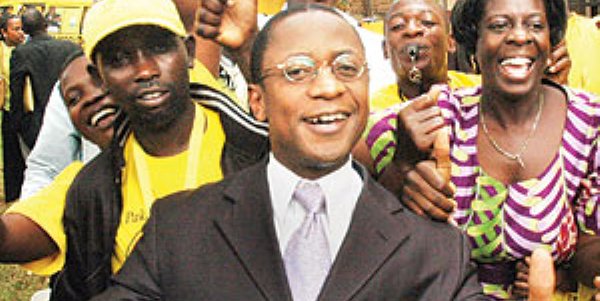
Busiro South Member of Parliament Peter Sematimba has retained his seat in Parliament after the Court of Appeal pronounced itself on a petition filed by Stephen Sekigozi, challenging the validity of Sematimba’s election in the 2016 elections.
According to the petitioner, he did not expect to lose.
“In Uganda’s court, everything is possible. We expected to win this case but someone without academic documents has won,” Sekigozi said.
Previously, Sematimba, a Disc Jockey-turned-politician, has had to contend with questions about his academic documents, after he declared intentions to contest for the Kampala City mayorship.
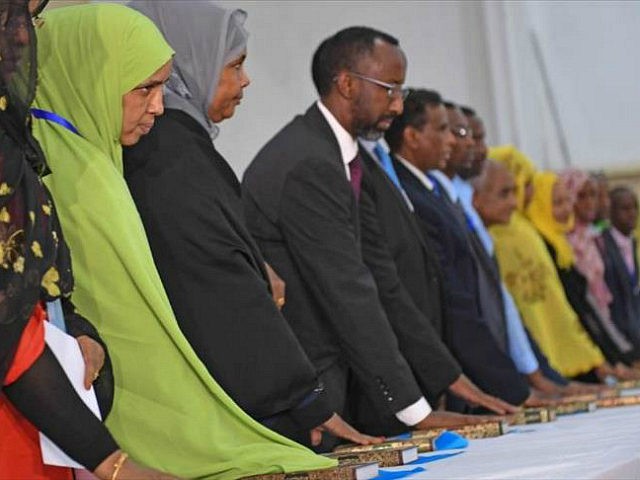
Somali legislators from the Federal and State Parliaments will attend five-day training on gender equality in Entebbe, Uganda, from September 18 to 22.
A release by the UNDP indicates that over 40 MPs including Anab Ahmed Isse, Deputy Speaker of the Hirshabelle State Assembly; Faduma Farah Aden, Chairperson of Women and Human Rights Committee, Jubaland State Assembly; and Mohamed Nur Iftiin Shanbaro, Whip, Federal Parliament of Somalia, will attend the conference to be held under the theme ‘Transformative Leadership’.
According to the release, the conference, supported by UNDP Somalia with funding from the UK, Sweden, Norway, and the European Union will allow the MPs to enhance their leadership skills, and develop strategies to further address gender inequality.
Participants will also receive training on how to promote inclusivity in legislation that will make a sustainable difference for both men and women in Somalia.
During the 2016 electoral process, Somali women secured 25% representation in the 10th Federal Parliament (66/275 MPs in the House of The People and 13/54 Senators in the Upper House).
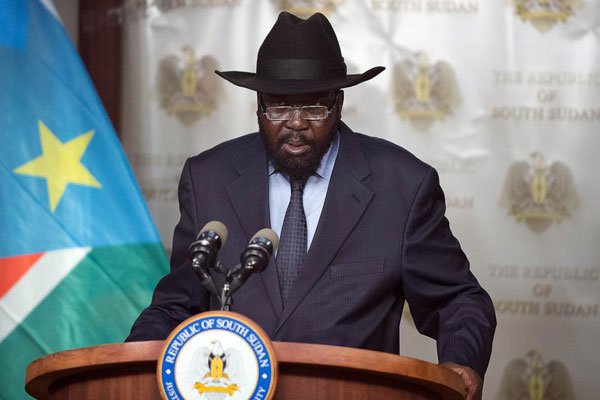
DECLARED THREE DAYS OF NATIONAL MOURNING: President Salva Kiir
Most members of IGAD back a proposal to allow free movement of citizens within the East African bloc – but are facing resistance from South Sudan, where officials remain cool to the measure.
Diplomats and government officials from the eight-nation bloc discussed the free movement proposal in Juba this week, along with trade, customs and communications issues.
But those from South Sudan, which is mired in a conflict between pro- and anti-government forces that has displaced four million people, are less enthused about the proposal, with South Sudan’s ambassador to the African Union and IGAD, David Buom Choat saying open borders raise defense concerns.
“Because when you have the citizen of the region, moving within the region, any country will also make sure that their national interest is [protected] and your national interest will be to protect the national security of your country,” Choat said.
Interior Minister Rier Gatlier said 70 percent of South Sudan’s population would not take advantage of the proposal because they cannot read or write.
“They will not go to Uganda to work, to look for job. They will not go to Kenya, they will not go to Ethiopia, they will not go to Sudan. They will remain in our country. It’s only thirty percent will be engaging with our member states,” he said.
However, according to Abdelrahim Ahmed Khalil, acting head of the IGAD liaison office in South Sudan, waiving visa fees across the bloc would promote economic growth.
“With this protocol, people will have the opportunity to move freely from country to country, to … own properties and to engage in other activities,” Khalil said.
The EU’s head of delegation in South Sudan, Stefano De Leo, said free movement would unite all IGAD states.
“Imagine, you can work in the biggest cities of the region, being respected as the citizens of the country. Your children may study as the children of citizens of other IGAD countries in the same school with the same rights,” said De Leo.
Despite the officials’ reservations, William Barriga, the chief of mission for the International Organization of Migration in South Sudan, insists the free movement proposal makes economic sense.
“A lot of the goods we consume here in South Sudan are imported from the neighboring countries. For these goods to reach us the movements of people who are moving these goods need to be facilitated,” Barriga said.
FRONT RUNNER: Zimbabwean President Emerson Mnangagwa
The top brass of Zimbabwe’s security services, have reportedly agreed to back political artful dodger, Vice President, Emmerson Mnangagwa, as the second republic president of the land, to replace President Robert Mugabe, “come what may”, as the ruling Zanu PF succession battle matrix, will now it seems, be resolved in all but a military solution, Spotlight Zimbabwe reported on Friday (today).
The development might result in the complete cancellation and/or delay of the much anticipated 2018 presidential and parliamentary polls government insiders pointed out this week, amid a vow by war veterans led by former minister and diplomat, Christopher Mutsvangwa, to decampaign Mugabe and make sure that he loses next year, as the fall-out between Mugabe and ex-combatants appears to be now irreconcilable.
Prominent publisher and political analyst, Ibbo Mandaza, last week gave credence to suspicion that the 2018 plebiscite might be called off, when he told a media stakeholders conference in Harare, that the country’s elections are controlled by the military at their KG6 barracks, and that there are two reasons why next year’s poll is unlikely, namely Mugabe’s failing health and a possible formation of another inclusive government.
An international media report on Mnangagwa allegedly planning to seal a deal for a Governement of National Unity, with former prime minister, Morgan Tsvangirai, that would run for a couple of years to manage a post-Mugabe transition, while stabilising the political and economic environment in the country to avoid chaos went viral on social media a fortnight ago, with Tsvangirai categorically denying the existence of such a pact.
High ranking army sources said the daring move by the security apparatus to support a Mnangagwa presidency ‘come what may’ is reminiscent of the 2008 elections ordeal, where the army’s top lieutenants came to Mugabe’s rescue after he had suffered a shock first round defeat to Tsvangirai.
“The media has eyes, but it cannot see,” said a Brigadier who asked not to be named due to the sensitivity of the matter. “Zimbabwe is enjoying peace and stability because of the army. I don’t see a scenario whereby this country will be ruled by someone without endorsement from the military. Our president was almost booted out in 2008, but we became the last line of defence and ensured it did not happen. It is in the same vain that the security leadership have settled for our vice president, who has been our minister on numerous occassions. Watch and see.”
Mugabe, according to the Washington Post, summoned his top security officials to a government training center near his rural home in central Zimbabwe on the afternoon of March 30 2008, to inform them that he had lost the presidential vote held the previous day. The Zanu PF strongman told the gathering “he planned to give up power in a televised speech” to the nation the next day, but the country’s military chief, General Constantino Chiwenga, responded that the choice was not Mugabe’s alone to make.
The paper citing two firsthand accounts of the meeting, said Chiwenga told Mugabe his military would take control of the country to keep him in office or the president could contest a runoff election, directed in the field by senior army officers supervising a military-style campaign against the opposition. Mugabe eventually won a landslide victory during a run-off.
National security chiefs, according to the army sources are said to have consented to Mnangagwa’s takeover ahead of any other Zanu PF contender, during a security meeting held in the capital last month under the auspices of the Joint Operations Command (JOC), when Mnangagwa was in South Africa receiving treatment in Johannesburg, following a poisoning scare after allegedly making an “adverse reaction” to a milkshake drink served at a ruling party rally in Gwanda.
JOC is a shadowy quasi military organ, bringing together the country’s military-security complex which includes the army, and its military intelligence wing and Presidential Guard, Air Force, police, prisons and the Central Intelligence Organisation (CIO) to manage homeland security affairs.
Two other candidates have now emerged as hot favourites to replace Mugabe when he steps down, apart from Mnangagwa, and these are; First Lady, Grace Mugabe said to be viciously pushing for the vice president’s ouster before the 2018 poll with support from the G40 faction composed of young turks inside the party, and defence minister, Sydney Sekeramayi, who has been praised for his humility and loyalty to Mugabe by G40 masterminds. However some say Sekeramayi is only being thrown into the ring to act as a political buffer for Grace, while denting Mnangagwa’s prospects.
The first lady only last week during another so called Youth Interface rally with the President in Bindura, stunned Zanu PF supporters when she insinuated that Sekeramayi is likely going to be Mugabe’s successor, after disclosing that her husband had some time ago called for the defence minister at his bedside in Borrowdale “to give him instructions on what to do” upon suffering a terrible diarrhoea for about two weeks, as he feared he was about to die.
“I can confirm that it is now official that VP Mnangagwa is going to be the next leader of this country,” said one senior army official based at Defence House in Harare. “This has been agreed upon by the leaders of JOC. A meeting was held last month when both the vice president and president were away in South Africa. From their (security chiefs) point of view, the president’s succession issue is now a matter of national security, therefore it cannot be left to Zanu PF alone. The Zimbabwe Defence Forces Commander himself is convinced that our country is still under outside aggression, and only someone like the vice president will not compromise national security.”
Mugabe was also coincidentally in South Africa during Mnangagwa’s hospitalisation, attending to a Sadc meeting and diplomatic storm, after Grace had been slapped with assault charges by a South African citizen, Gabriella Engels, a twenty year old model and nightclub hostess, who accused her of assaulting her with an extension cord at a Johannesburg hotel where her party freak sons rented oppulent flats. Grace claims to have been in South Africa to seek medical attention for her sore leg.
Spotlight Zimbabwe has since reported that Mnangagwa now has considerable backing from influential foreign powers such as China, India and Britain. The British Ambassador to Zimbabwe, Catriona Laing, has been accused of sympathising with the vice president’s faction in Zanu PF, a charge she has dismissed vehemently.
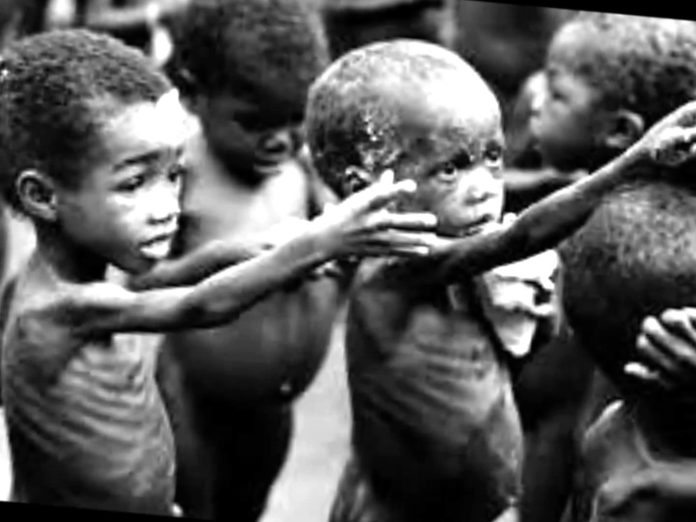
After steadily declining for over a decade, global hunger is on the rise again, affecting 815 million people in 2016, or 11 per cent of the global population, says a new edition of the annual United Nations report on world food security and nutrition released today. At the same time, multiple forms of malnutrition are threatening the health of millions worldwide.
The increase – 38 million more people than the previous year – is largely due to the proliferation of violent conflicts and climate-related shocks, according to The State of Food Security and Nutrition in the World 2017.
Some 155 million children aged under five are stunted (too short for their age), the report says, while 52 million suffer from wasting, meaning their weight is too low for their height. An estimated 41 million children are now overweight. Anaemia among women and adult obesity are also cause for concern. These trends are a consequence not only of conflict and climate change but also of sweeping changes in dietary habits as well as economic slowdowns.
The report is the first UN global assessment on food security and nutrition to be released following the adoption of the 2030 Agenda foe Sustainable Development, which aims to end hunger and all forms of malnutrition by 2030 as a top international policy priority.
It singles out conflict – increasingly compounded by climate change – as one of the key drivers behind the resurgence of hunger and many forms of malnutrition.
“Over the past decade, conflicts have risen dramatically in number and become more complex and intractable in nature,” the heads of the Food and Agriculture Organization of the United Nations (FAO), the International Fund for Agricultural Development (IFAD), the United Nations Children’s Fund (UNICEF) the World Food Programme (WFP) and the World Health Organization (WHO) said in their joint foreword to the report. They stressed that some of the highest proportions of food-insecure and malnourished children in the world are now concentrated in conflict zones.
“This has set off alarm bells we cannot afford to ignore: we will not end hunger and all forms of malnutrition by 2030 unless we address all the factors that undermine food security and nutrition. Securing peaceful and inclusive societies is a necessary condition to that end,” they said.
Famine struck in parts of South Sudan for several months in early 2017, and there is a high risk that it could reoccur there as well as appear in other conflict-affected places, namely northeast Nigeria, Somalia and Yemen, they noted.
But even in regions that are more peaceful droughts or floods linked in part to the El Niño weather phenomenon, as well as the global economic slowdown, have also seen food security and nutrition deteriorate, they added.
Hunger and food security
Overall number of hungry people in the world: 815 million, including:
– In Asia: 520 million
– In Africa: 243 million
– In Latin America and the Caribbean: 42 million
Share of the global population who are hungry: 11%
– Asia: 11.7%
– Africa: 20% (in eastern Africa, 33.9%)
– Latin America and the Caribbean: 6.6%
Malnutrition in all its forms
Number of children under 5 years of age who suffer from stunted growth (height too low for their age) : 155 million
– Number of those living in countries affected by varying levels of conflict: 122 million
Children under 5 affected by wasting (weight too low given their height): 52 million
Number of adults who are obese: 641 million (13% of all adults on the planet)
Children under 5 who are overweight: 41 million
Number of women of reproductive age affected by anaemia: 613 million (around 33% of the total)
The impact of conflict
Number of the 815 million hungry people on the planet who live in countries affected by conflict: 489 million
The prevalence of hunger in countries affected by conflict is 1.4 – 4.4 percentage points higher than in other countries
In conflict settings compounded by conditions of institutional and environmental fragility, the prevalence is 11 and 18 percentage points higher
People living in countries affected by protracted crises are nearly 2.5 times more likely to be undernourished than people elsewhere
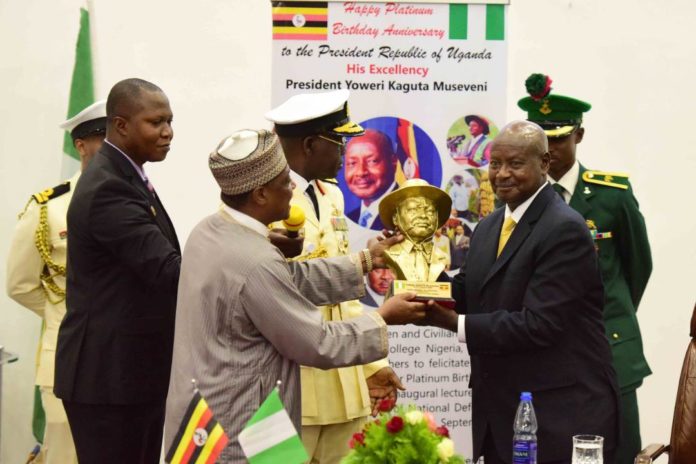
President Museveni receives birthday gift from Nigerian military officers
President Yoweri Museveni has been treated to a surprise 73rd birthday fete in Nigeria, with the Defense Minister Mansur Muhammad Dan Ali and the Commandant of the National Defence College Rear Admiral AA Osinowo, presenting the President with a sculpture made in his image.
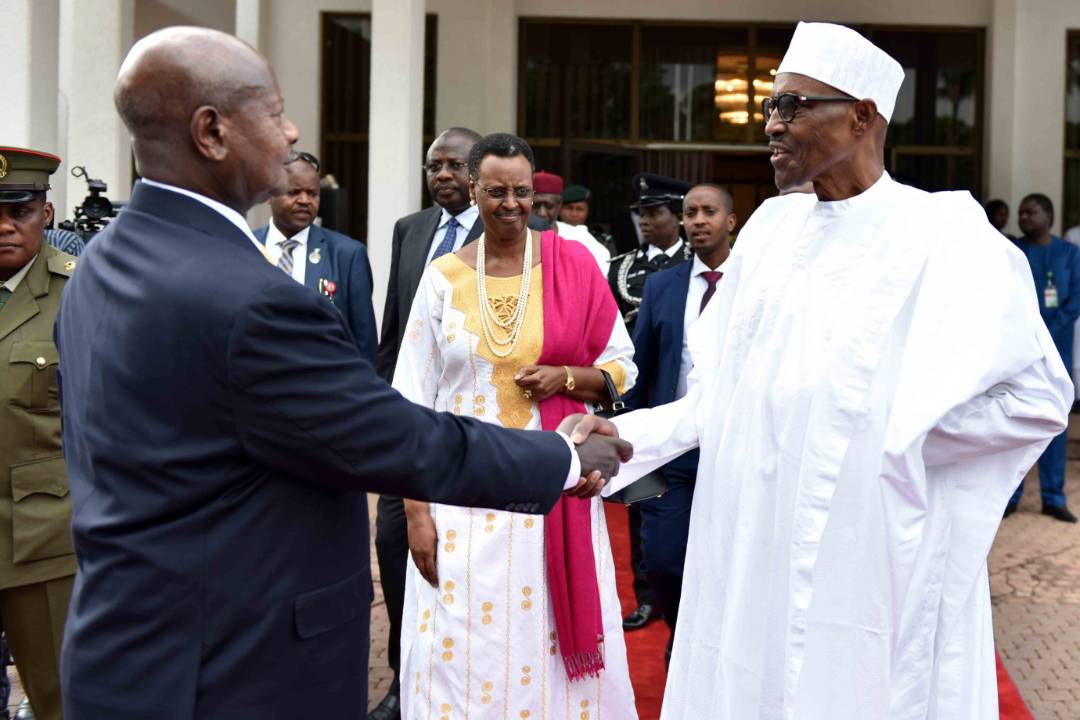
President Museveni with his Nigerian counterpart Muhammad Buhari
President Museveni, accompanied by his wife Janet and Uganda’s High Commissioner to Nigeria Nelson Ocheger, was offering a lecture during the inauguration of the institution’s 26th class, after which he was hosted to a luncheon by President Muhammad Buhari.
Earlier during the lecture Museveni told his audience that the Uganda and Nigeria would strengthen their relationship through collaborations in institutions like the National Defence College, adding that trade and bilateral relations would become even stronger once Uganda establishes an airline and begins plying the West African route. The elite senior officers’ class of 140, has students from 19 countries—including the host, Nigeria.
In his address the President also said Africa must work for prosperity through integration but more importantly, dedicate resources to ensuring strategic security, President Museveni has said.
Museveni, who was accompanied by First Lady Janet on the two-day working visit, was invited to deliver a lecture on the theme “Sub-regional cooperation and the stability of member states…Economic Community of East African States in Perspective.”
Giving a synopsis of Africa’s political and economic problems, Museveni said poor political organisation was to blame.
Africa, he noted, had been the cradle of man, pioneer of civilisation and saviour of all modern religions, yet it had fallen to a host of afflictions which had ensured the continent was the most backward now.
“In the last 500 years, Africa has gone down. It has suffered all manner of afflictions, slave trade, colonialism, genocide, marginalisation, diseases,” he said.
“We should examine how the first became the last in the last 500 years. How could former Africans come and colonise us?” he asked. “Our academicians must answer that question. Except for Ethiopia, the whole of Africa had been colonised by 1900.”
Offering an answer, Museveni said, “The problem was poor political organisation. Colonialists found us badly organised—as tribes, clans, a segmented society. It was easy to attack us one by one. We were at a disadvantage—of inadequate political integration.”
He also dismissed the notion that colonial masters had better military technology, pointing out that some of machines they used like muzzle-loaders were less efficient than weapons like spears.
Museveni also cited examples of other groups like the Chinese, Japanese and even Ethiopians who were better organised politically and therefore fended off colonial aggression.
A case for markets
Noting that Africans are similar and linked through the four major linguistic groups (Niger-Congo, Nilo-Saharan, Afro-Asiatic and the Koisan), President Museveni said the solution now lies in exploiting these linkages to foster integration and prosperity.
“The anti-colonial struggle was three-pronged, independence, democracy and prosperity,” he said. “We asked, how can people be prosperous in the modern sense?”
The President said prosperity is driven by production and sale of goods and services, supported with availability of market.
“With no market, you can’t prosper. We therefore need a bigger market, explaining our push for integration,” he said. “Many Africans thought occupying administrative positions left by colonialists was enough. Permanent secretaries, undersecretaries, all types of secretaries—but that is not wealth. Where is the production?”
It is on that basis that he commended African leaders, who in 1980, came up with the Lagos Plan of Action that led to creation of the key regional blocs.
To stress the importance of large markets, President Museveni cited the example of China which by 1978 had a GDP of $218 billion but has shot up to $11,202 billion now after it opened up to the rest of the world.
“What has stimulated this? Chinese leaders realised that a big internal market alone was not enough, they had to trade with other countries.”
Are we secure?
Alongside prosperity, the continent must ask if it is secure, added Museveni.
“If we become prosperous, are we secure? You can be prosperous but not secure. How can Africa ensure strategic security?” he asked.
The President pointed out that the first victims of the World War 2 were the prosperous but weak countries like Holland, Belgium and France.
“Prosperity, therefore, does not always guarantee security. What then is the strategic security anchor for Africa? If we get problems, who will stand for us?”
This question, he said, is what is pushing the quest for both political and economic integration to achieve strategic security.
“We are convinced that without political federation of East Africa, we have no strong individual country to anchor East Africa,” he said.
The push for an economic federation, he noted, had also bore fruits of prosperity, citing Uganda’s excess 1.2 billion litres of milk and three million tonnes of maize that are consumed by its neighbours.
Federating, said Museveni, was also key in negotiating with third parties for markets, as EAC can front its 170 million people as a factor for fair trade.
The President also encouraged Africans to preserve their culture and avoid misusing human resources by pushing for identity above interests.
Siemens, a global technology company, has made positive strides in collaboration with the Ugandan government and key stakeholders to identify opportunities to support some of the country’s immediate and long-term energy and infrastructure ambitions.
Speaking today on the opening panel at Future Energy Uganda, Sabine Dall’Omo, CEO of Siemens Southern and Eastern Africa commented that since the signing of the Memorandum of Understanding in May this year at the World Economic Forum in South Africa, there has been significant progress to pinpoint areas of collaboration.
“At a high-level we have identified priority activities to strengthen the transmission grid and create innovative business-driven solutions that are practical, affordable, reliable and sustainable to electrify Uganda’s rural households,” said Dall’Omo.
Uganda has one of the lowest electricity access rates by global and regional standards, with national access to grid electricity of less than 22% and only 7% of the rural population is currently electrified. Increasing electrification is a major drive to achieve national social and economic development objectives under Vision 2040.
The country has embarked on a massive grid expansion plan and according to the Electricity Regulator Authority, Uganda will require approximately USD2.5bn by 2026 to invest in both the transmission and distribution system.
“We know that a reliable and extensive power supply system is the fundamental pre-requisite for economic growth, while infrastructure and oil sector investments are likely to support growth in Uganda over the medium term. The potential exists for Uganda to diversify its economy and create opportunities for industrialization that will increase electricity demand, create sustainable revenue streams and opportunities for job creation,” added Dall’Omo.
Uganda’s energy mix is currently generated from three main sources; hydro power contributing the bulk at close to 80% while thermal (+/-22%) and biomass (+/-3%) contribute the balance. The country has the potential of generating power from other renewable sources like peat, solar PV, bagasse cogeneration, wind and natural gas, all of which can be supported by Siemens technologies.
The energy system worldwide is dramatically changing and becoming more agile. It is more open, transparent, adaptable, manageable, and lean systems, structures and strategies enable utilities to stay ahead of the challenges. Siemens is able to bring tried and tested technologies and years as a global leader in the field of energy and building management, we deliver end-to-end energy management – from consulting and planning to installation, software, services and financing.
The country has in recent years implemented the regulatory framework to boost private sector participation and investment in the generation and distribution space. Gaining access to low interest rate finance and deploying the best innovative and reliable technologies remain critical to sustainable infrastructure development.
Siemens is a company that invests for the long term and is optimistic about the long-term fundamentals of the Ugandan market. “We want to support sustainable development – with solutions and projects in Africa, for Africa and are actively reviewing the requirements for the organization to open an office in Uganda taking into consideration business sustainability,” Dall’Omo said.
They came in disguising to be arriving for a routine day at Parliament.
But when, they chose to take the left, to the conference hall, instead of taking to the main chambers, the lobby journalists knew something was amiss.
They planned it to be an off camera event but it is not usual that MPs from one colour shed- yellow- converge and they fail to catch the media’s eye. It couldn’t have been any different with the removal of age limit conclave.
They were 246 and there, in a hot stuffy hall without air conditioning, the NRM MPs resolved to bring a private members bill to scrape the presidential age limit clause from the constitution.
Mr Raphael Magyezi, infamously known for doctoring a committee report in the last Parliament was gracefully picked to lead the doctoring of article 102(B) of the constitution.
Others on the morticians table will be Minister Adolf Mwesigye, commissioners Peter Ogwan (Usuk County) and Arinaitwe Rwakajara (Workers MP), and back benchers Jackson Kafuuzi, Simeo Nsubuga, Margaret Komuhangi (Nakasongola Woman MP)and James Kakooza.
To justify his actions, Mr Magyezi hid under the cloak of a one man research he had conducted on the constitution that had to be amended.
He said the constitution had unacceptable lacunas and time has never been ripe to have things put right— the discriminatory age limit.
The proposal if adopted by Parliament will see the age cap for one to contest as LCV lifted and scrap off the 75age cap.
“The proposal is meant to make Parliament compliant with the Supreme Court deadline that gave the Executive 2and half years to put in place all the court’s provisions.
“With just six months left to the deadline there couldn’t be a better time to bring the amendments,” Mr Magyezi spoke with tremendous confidence.
Adolf Mwesige, Minister of Defense, kicked off his support for Magyezi by saying havig a presidential age cap in the constitution will be robbing people of their powers to choose their leaders as highlighted in Article 1 of the constitution.
He said Uganda should behave like its counterparts across the world.
“There is no constitution in those model democracies where there is age limit,” he said.
Said he, further, “If we can’t have age limitations anywhere in the European laws, on that, I support the idea of private member’s bill because members of Parliament are the representatives of the people, so we have a right to move the bill in Parliament because we are the representatives and the constitution is clear.”
Jackson Kafuuzi Kyaka South MP simply said the current provisions in the constitution in regard to age are simply rubbish.
“We remove what you don’t want and replace with what you desire. We are moving forward. The time when the constitution was made in 1995 was different and this is 1997.
“The dynamics on the ground have changed, we require an all inclusive constitution. That is an abnormality that needs to be cured,” he argued reminding those in the room that he, actually, is a learned lawyer.
He added,“The older you grow, the more you are treasured. There is no scientific justification as to why we should have age cap in our constitution.”
By this time, the House was yelling “lets pass the motion” a la the biblical “crucify him and give us Barabbas” when Pontius Pilate asked the crowd what they wanted him to do with Jesus.
Arinaitwe Rwakajara (Workers) was quick to remind Ugandans that what they were doing has less to do with President Museveni.
“We aren’t amending the constitution for President Museveni. For us, we aren’t concerned with President Museveni’s contest, we haven’t consulted him whether he wants to contest or not. For us, we want to deal with the constitutional mandate and that is our main job,” he said.
As expected the opposition was caught flat footed.
On hearing what was happening at Parliament, many rushed in panting, vowing to fight the mischievous plot, the tyranny of numbers notwithstanding.
“We are fed up with age limit. We shall not wait until a ruler dies in his seat. What they did is a shame to the world. Their argument is so lame, flimsy and bogus.
“You can’t say it isn’t all about Museveni, so who is it all about? Why now? Of all the things that are hurting Uganda, why would 200 MPs sit to talk about lifting the age limit? Is that all they can do?” said Kampala Central MP Muhammed Nsereko. His pronouncements, though should be taken with a pinch of salt as he is known for bulking and making a no show at the eleventh hour when needed most on such controversial issues.
He however took a dig at his yellow counterparts calling them idle folks living in denial.
“They are betraying the nation, but they will live to pay for it. We instructed cabinet to come up with an omnibus bill of all the amendments? Why do they think they should bring a private member’s bill? Most of them were not sane enough,” he said.
NRM’s John Baptist Nambeshe, Manjiya County MP, however walked out of the meeting in protest of the agenda of the meeting.
He said he will save his dancing for the tunes that benefit the majority.
“I remained completely opposed to removal of age limit from our constitution because it would be like dancing to the tunes of the selfish intentions of an individual.
“This time, these fellows would be making off with a whooping Shs1billion because I have over heard from reliable sources that fellows promoting this are hired mercenaries at a huge pay,” he said.
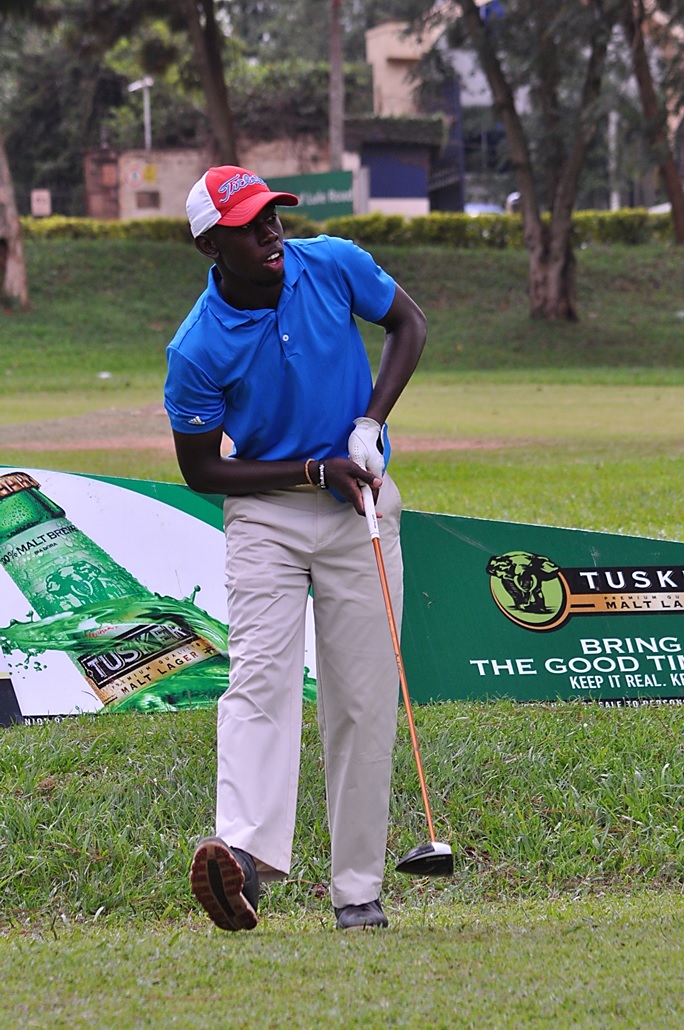
The table has turned on day two of the Tusker Malt Uganda Amateur Open Golf championship as Richard Baguma took the lead ahead of Ronald Otile who now sits in 4th position below Daniel Baguma and Denis Asaba.
Richard Baguma returned a score of 73 to take the lead on day two. Deniel Baguma registered a score of 74 whereas Denis Asaba had a score of 76 and 79 for Ronald Otile.
As it stands, Richard Baguma leads with a gross of 147, followed by Daniel Baguma with 149, Denis Asaba with 150 and Ronald Otile with 151.
The leading four will be playing alongside each other on day three of the Tusker Malt Uganda Open in the first pressure group. The second pressure group will include; Rwanda’s Alloys Nsabimana, Uganda’s Mahmood Ismail, Joseph Mawejje and Herman Deco Mutebi.
Despite the having had a good start on day two, Otile the defending champion, faulted along the way and now faces an uphill task of trying to regain the lead on day three.
Speaking before the tee off, Grace Namutebi, the Uganda Breweries Limited Brand Manager for Premium beers said; “The amateur category is considered as the main event of the Tusker Malt Uganda Open. The players are putting up a good game and there is plenty more to come.”
The final day of the Tusker Malt Uganda Amateur Open Golf championship will be on Saturday and the best players will be crowned this year’s champions at a dinner at the Uganda Golf Club.
Tusker Malt Lager injected over Shs500 million into this year’s tournament as assurance to show its support for the development of the game golf in Uganda. There has been an increase in the cash sponsorship from Shs230 million to Shs250 million.
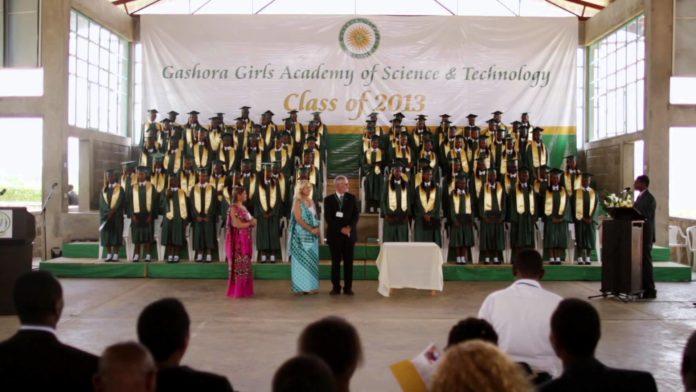
Gashora Girls Academy from Rwanda has merged the conquering heroes of the first season of African Debate Championship of 2017 that was hosted by Mengo Senior School in Kampala.
Gashora Girls Academy is among the 300 African schools that participated in the just concluded four days African debate championship that kicked off on September 11-15 Mengo Senior School with the motive of securing Pan African future.
Under the motion “This house believes Pan Africanism is racism”, Gashora Girls Academy from Rwanda thumped other Ugandan schools and hosts Mengo SS by a spilt vote of five to two hence becoming the winners.
On getting to final, Gashora Girls Academy out competed Tembisha High School of South Africa as Mengo Senior School eliminated Ntare School in semifinals.
The grand finale that was held at the Parliament of Uganda has been graced by the outgoing Deputy Chief Justice Steven Kavuma who lauded all schools that took part in the championship.
‘’In 1967 we sat under a tree at Mengo SS and started a debate club’’ he recalled adding that when I look at you I see leaders of different strengths derived from debating like judges, lawyers, nurses etc.
However, the Head Teacher for Mengo Senior School John Fred Kazibwe applauded the Stanbic Bank, Ethiopian Airlines, and Urban TV among others
“We are proud to be the hosts of the first African Debate Championships though we came second”. Said Mr. Kazibwe.