Stanbic Bank
Stanbic Bank
24.5 C
Kampala
Stanbic Bank
Stanbic Bank
Home Blog Page 1766

Police officers assault journalists, confiscate their gadgets in Entebbe

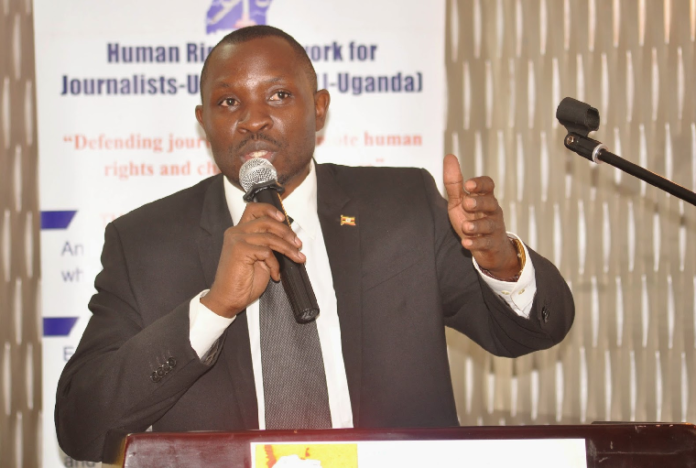
Robert Ssempala wants errant police officers punished.

The Uganda police poor human rights record continues to worsen instead of improving; the latest is yesterday’s assault of journalists on duty by officers of Kigungu Post Police who also confiscated gadgets of journalists.

The journalist were on duty at Kigungu landing site in Entebbe to cover the sensitization campaign of Democratic Party dubbed “Kogikwatako” against the Constitutional amendment of the Age Limit clause.

Ssebalamu Kigongo of Bukedde television was manhandled while Sande Ssebagala of NBS Television was assaulted, his shirt torn and his camera was confiscated. The journalists implicated Wambete Cuthbert, the Officer in Charge of Kigungu Police Post, Ambrose Mugenyi, the Community Liaison Officer and other police officers of being responsible for the assaults and confiscation of gadgets.

“I was stopped from recording the views of the people about the said campaign by the Officer in Charge of Kigungu Police Post Wambete Cuthbert insisting that I had to first seek permission from the police and a scuffle ensued as he and other officers tried to confiscate my camera.” Ssebalamu Kigongo said.

Sande Ssebagala on his part said that he was recording the scuffle between Ssebalamu Kigongo and the police officers when he was suddenly attacked by the OC Kigungu police post Wambete and he confiscated his Sony camera and tripod stand. “I was then manhandled, roughed up and had my shirt torn by Mugenyi Ambrose.” he said. This information was corroborated by Evie Muganga of Radio One and Diana Kibuuka of CBS Radio who gave accounts of how the two journalists were assaulted.

The journalists yesterday reported their ordeal to Human Rights Network for Journalists (HRNJ)-Uganda, a national non-governmental organisation that promotes and defends rights of Uganda’s journalists.

Robert Ssempala, the Coordinator HRNJ-Uganda condemned the brutal act, urging the force’s bosses to correct the undisciplined officers.

“As an Organization, we strongly condemn the acts of these police officers and call on the Professional Standards Unit of the Uganda Police force to investigate and bring these errant officers to book,” said the HRNJ-Uganda National Coordinator, Robert Ssempala.

However speaking on behalf of the police, the OC Kigungu Police Post Cuthbert Wambete acknowledged that there had been a scuffle but he denied assaulting and confiscating the journalists’ gadgets but pledged to help the journalists recover their gadgets.

Over the years police has had running battles with journalists as the latter do their reporting work. Police brutality has led to some journalists disabled and loss of equipment.

The highlight of the police brutality against journalist was the beating of the former WBS (defunct) Journalist Andrew Lwanga in 2015 by the former District Police Commander of Old Kampala Police Station Joram Mwesigye. Lwanga and other journalists were at the time covering a scuffle between police and the Unemployed Youth activists last year on Namirembe Road in Kampala.

Despite the establishment of the Professional Standards Unit to discipline errant officers, the Uganda Police Force officers continue to harass and beat citizens, an act that violets the constitution from which the officers derive their responsibilities.


Stories Continues after ad

CSOs urge Museveni to “stop intimidating citizens and media” over new land law

As President Yoweri Museveni traverses the country educating citizens on the proposed Land Amendment Bill, 2017, eight national civil society organizations including Africa Institute for Energy Governance (AFIEGO), National Association of Professional Environmentalists (NAPE), Centre for Constitutional Governance (CCG) and five others have urged President Yoweri Museveni to stop what they say is “intimidating citizens and the media, saying it is undemocratic.”

The CSOs, including World Voices Uganda (WVU), South Western Institute for Policy and Advocacy (SOWIPA), Guild Presidents’ Forum on Oil Governance (GPFOG), Kanungu Youth Initiative for Environment (KYIE) and the Oil Refinery Residents Association (ORRA) were meeting in Buliisa district where they discussed what they called President Yoweri Museveni’s threats and directives to radio station owners and managers to deny airtime to those opposed to government’s efforts to amend Article 26.

Through the Land Amendment Bill, 1 2017, the government wants to amend the Constitution to avoid the legal requirement for prompt payment of fair and adequate compensation to land owners prior to possession or acquisition in all cases of compulsory land acquisition.

During the radio talk show on Voice of Kigezi on September 4, 2017, the president is alleged to have asked radio station owners to stop giving airtime to those opposed to the amendment. Following the alleged directive, former presidential candidate, Dr. Kiiza Besigye was barred by Mr. Darius Nandinda, the Resident District Commissioner (RDC) of Kabale district from appearing on Voice of Kigezi for a talk show that Dr. Besigye had already paid.

“The President has issued the same threats to all radio talk shows across the country. During their civil society meeting on September 11, 2017, with grave concern, the participants discussed the social, economic and political implications of the President’s undemocratic and unconstitutional actions,” the CSOs say.

The Participants noted that while Ugandans should appreciate the president’s efforts to traverse the country to educate them on land, they should remind him that as the “Fountain of Honour”, he can do better by leaving small talk shows to his ministers, RDCs and other government officials so that he can concentrate on the bigger challenges facing the country.

Furthermore, participants at the meeting noted with disappointment at the huge sums of money the President spends to appear on local radios. They alleged that Museveni has a budget of an estimated Shs700 million for this exercise they say can be done by other junior government officials at a very small cost.

The participants noted that the president is wasting tax payers’ money on unnecessary radio talk shows yet is the same person who put in place a Commission of Inquiry into Land Matters headed by Justice Catherine Bamugemereire to investigate and make recommendations to enable government address land challenges in the country.

“This commission is spending billions of tax payers’ money yet even before the commission completes and makes recommendations for government’s action, the president is already working with his ministers to amend the Constitution,” they said, arguing that government should not gain more powers over private property. They accused Museveni for alleged failure to build strong institutions of governance.

The CSO leaders at the meeting noted that the President is talking about land tribunals to solve land compensation cases when he knows that his own government destroyed the same institutions that were established under the Land Act 1998 as amended. They further pointed out that as a Head of State with more than 100 advisers and 80 Ministers, the president should know very well that you don’t need to amend the Constitution to create a tribunal.

Section 20 of the Land Acquisition Act 1965 already gives government and parliament powers to make a law on the assessment and payment of compensation that can include establishment of land tribunals from the district level to the village level, the leaders noted adding that there is no need to amend the Constitution.

Participants at the meeting also noted that it a shame that in a democratic country like Uganda, government is threatening media houses and opposition to stop talking about land issues.

They noted that it was ironic that the President who has utilised over 25 radio and two TV stations to popularize his land campaign was stopping other Ugandans from using the same mediums! Why does the president want to debate alone, does he own this country? They questioned?

The participants pointed out that if President Museveni is genuine about solving land issues, he should allow diverse debate so that the citizens are able to make their own conclusions.

Furthermore, the groups at the meeting expressed disappointment at how President Museveni is spending a lot of time running all over local radio stations at a time when the country is facing the hardest challenges including people in Bududa being buried by mudslides, killing of over 20 women in Wakiso district.

The CSO leaders also noted that President Museveni is talking about environment conservation yet since 2014, his government has failed to put in place the new National Environmental Act, Environmental Impact Assessment (EIA) Regulations as well as Strategic Environmental Impact (SEA) Regulations. They noted that oil and other developments that highly degrade the environmental are being developed without these laws in place to ensure the environment and communities’ livelihoods are protected.

Lastly, they noted with grave concern at how President Museveni has time to move around local radios threatening the citizens yet for over 30 years, his government has failed to help at least 50 per cent of the citizens get land titles for their land. The participants at the meeting questioned How the president and his government expect this country to attain middle income status when over 80 per cent of the available land is still based on customary practices that emphasise subsistence farming over commercial farming.


Stories Continues after ad

All lawyers corruptible, unethical-BOU counsels tell court

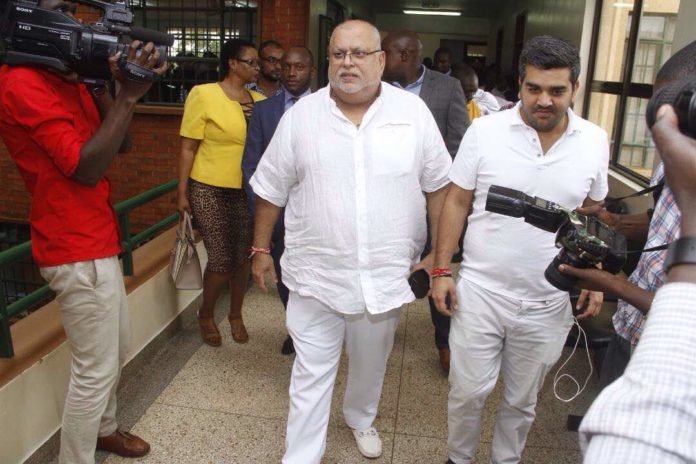
Sudhir and his son Rajiv at Commercial Court.

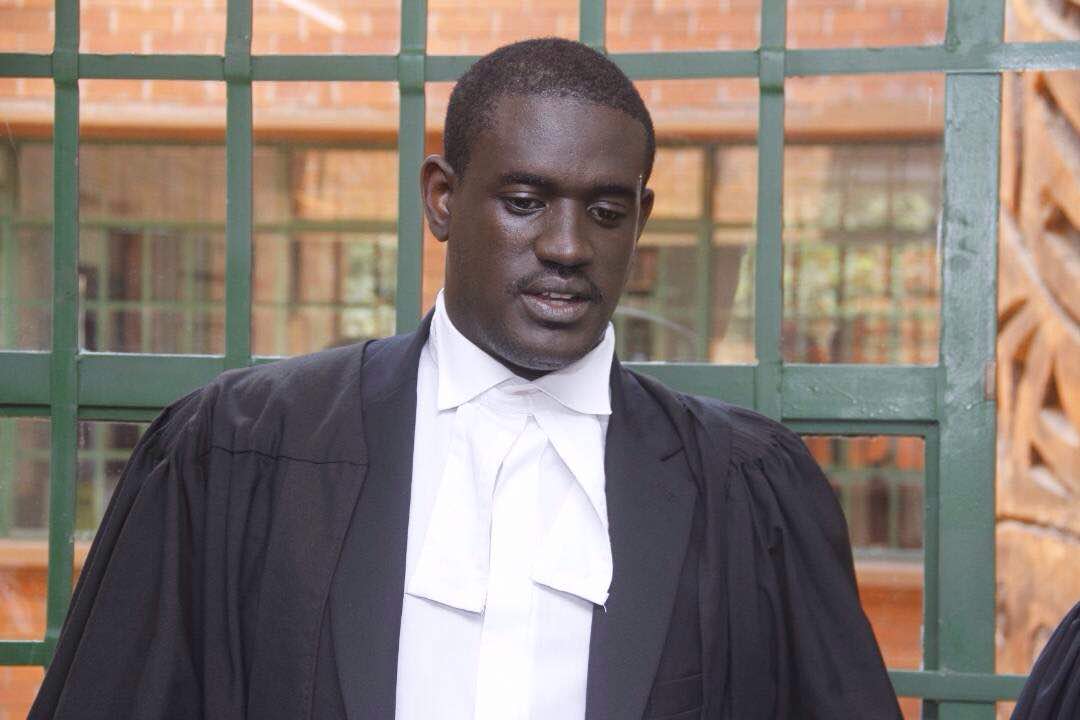
Lawyers representing David Mpanga of AF Mpanga Advocates and Timothy Masembe Kanyerezi from FK Mpanga and Company Advocates (MMAKS), representing Bank of Uganda (BOU) in the main suit against tycoon Sudhir Ruparelia and Meera Investments have  reportedly today told court that all lawyers are corruptible and unethical.

The two lawyers are battling it out with Sudhir over conflict of interest as the two are attorneys for Bank of Uganda that dragged Sudhir and Crane Bank to court. Sudhir wants the two to be his witness in the case.

Through his lawyers of Kampala Associated Advocates Sudhir told court that on several occasions, companies in which he was a shareholder gave instructions to MMAKs Advocates and sought legal assistance from them.”

One of Sudhir’s lawyers Bruce Musinguzi asked court to consider a confession where counsels from MMAKS advocates admitted to getting instructed to look into the shareholding of Crane Bank as well as holding various trainings for Crane Bank Directors.

Some of the lawyers for the respondents are quoted to have said told court that all lawyers are corruptible and unethical.

The two lawyers were arguing their case before Commercial Court Judge Justice David Wangutusi who has set November 14, 2017 as date to deliver a ruling on the application filed in court where Sudhir objects the two lawyers to represent Bank of Uganda in the main suit against him and his Meera investments.

Ellison Karuhanga of KAA

Ruparelia took Mpanga Masembe to Court last week. He accuses the two for professional breach of trust and conflict of interest when they accepted to represent Bank of Uganda in a case where BOU is the complaint against Ruparelia. He says that the two lawyers know all the confidential information of the bank and that letting them represent BOU will prejudice the case.

Rather than Central Bank and Crane Bank lawyers, Sudhir wants lawyers Mpanga and Masembe to appear in this case as witnesses because they know more about the operations of Crane Bank.

In reply to these submissions, Counsel Masembe from MMAKS argued that his firm never represented Sudhir as an individual but his companies.

He added that Sudhir’s claims that MMAKS acted on his behalf while purchasing plots in Kawempe has nothing to do with this case which entails extraction of huge sums of money from Crane Bank.

“We the lawyers are independent people; we are not mouthpieces of our clients,” he stressed.

Mpanga on the other hand, asked Justice Wangutusi to maintain them as Crane Bank lawyers saying that the evidence adduced by Sudhir is not sufficient enough to prove they have in any way breached the professional code of conduct, having not even come across any information regarding the current case in which Bank of Uganda accuses Sudhir of fraudulently obtaining US$400m from his former Crane Bank.

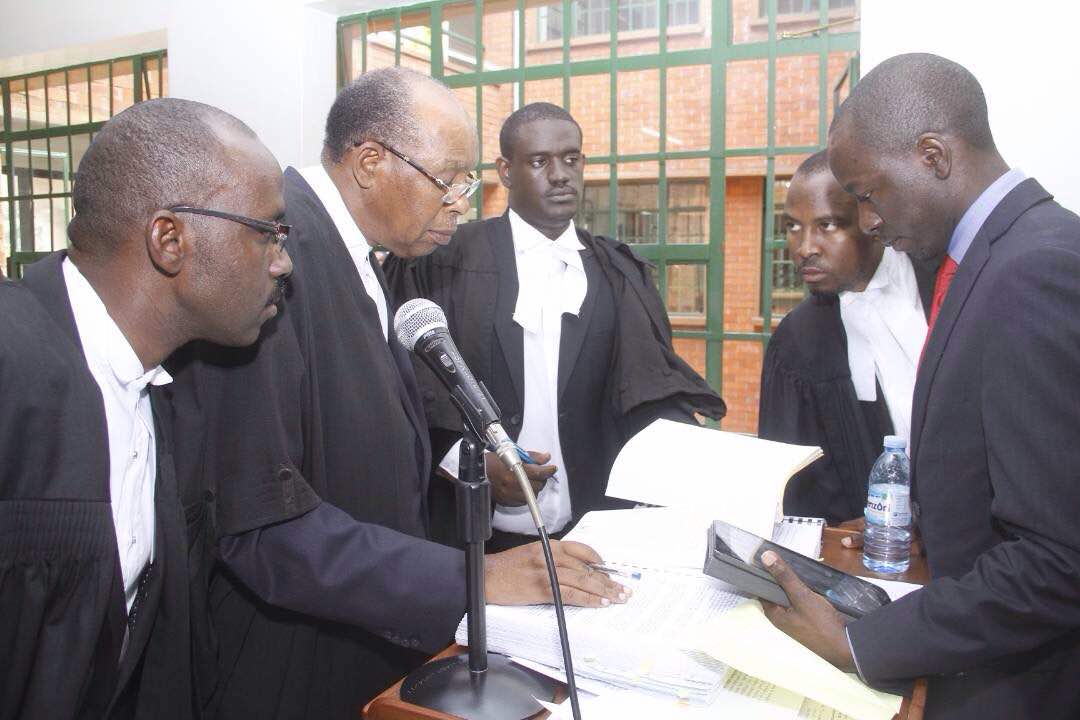
Lawyers consulting

However, as he set the date the November 14 ruling, Justice Wangutusi urged the two sides in the suit to have mediation meetings before his ruling.

“You settle the matter before November so that you can maintain the relationship you have been having” Justice Wangutusi advised the two parties.


Stories Continues after ad

SGR to lower cost of transport, attract FDIs

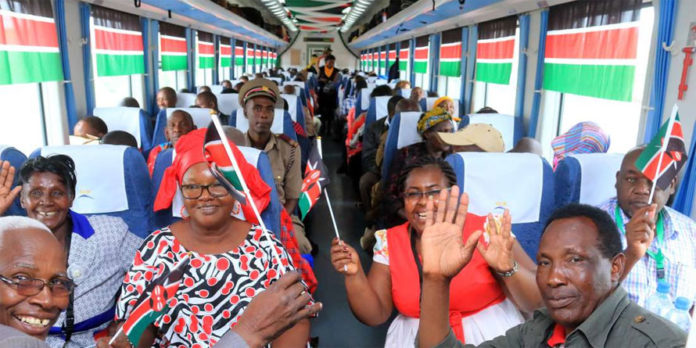
Kenya has already commissioned its Mombasa-Nairobi SGR, cutting down transport fees.

The planned Standard Gauge Railway (SGR) system will be affordable, competitive and attract foreign investment into Uganda, an official from the Ministry of Works and Transport has said.

“The cost of transportation from Uganda should be globally competitive and able to attract FDIs. SGR Uganda will be Chinese Class One. We want our railway to be globally competitive,” said its coordinator Kasingye Kyamugambi.

Global competitiveness has been a major driving factor in the implementation of SGR, Kyamugambi said and that “We cannot industrialise our country without the Standard Gauge Railway.”

He said financing negotiations with the Chinese Exim Bank have been underway for the last 18 months to kick start the project. He said the bank has sent in a team to assess the project. “The Appraisal team is assessing the engineering, technical, economic and financial readiness of the project. We are on track,” he said.

“We hope within three weeks we shall be done with the process and later interface with Exim Bank. The project has a life cycle and we can’t dodge any process! We have to give it time. We are designing for 100 years so I don’t think we should panic,”

The consultants hired by Exim Bank will inspect the key construction points along the line including kilometer 00 (the starting point of the SGR), the Super Bridge in Jinja, Kampala East station in Namanve, swamp bridges, Tororo station and the Access Road Flyover.

He said it is really a great milestone that after their evaluation they give a report to the bank, adding that they have put efforts to conclude the financing discussions to pave way for construction. “We are putting all efforts to conclude the financing discussions and start construction,” he said. We already see the signs that construction is happening soon, he added.

He said the project will attract local content and that they already have held discussions with manufacturers like Roofings, Madhvani Steel and Tube. “We want to ensure Ugandans can supply up to 40 per cent materials into construction of SGR.”

The biggest SGR station will be in Namanve, Jinja and Tororo will have the next biggest station

The US$ 3.2 billion modern railway line from Nairobi will join Kampala through Malaba to Nimule in South Sudan. This will be in part of the Standard Gauge Railway construction project already underway to connect East African countries.

The railway project in Uganda received a major boost following the signing of Engineering Procurement Construction (EPC) agreement. China has approved to finance the 476 kilometers line, which include catering for the detailed designs of the railway.

Standard Gauge Railway was launched when Presidents Yoweri Museveni, Paul Kagame, Salva Kiir and representatives from Kenya and Burundi met in Uganda in 2014.


Stories Continues after ad

Rebel MPs vow to thwart age limit

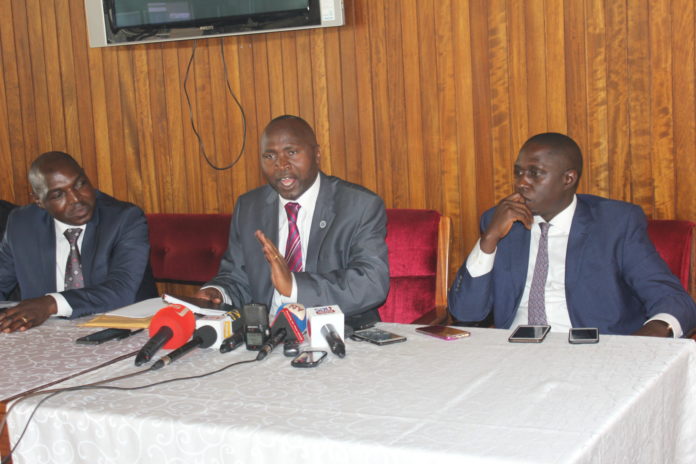
Tinkasiimire, Niwagaba and Nsereko while addressing the press.

The rebel Members of Parliament from the National Resistance Movement party have threatened to do whatever it takes to thwart the Presidential Age Limit Bill.

The team of six MPs both former and current members of NRM made the revelation this morning during a press briefing at Parliament.

Led by Barnabas Tinkasiimire, the team also comprised of; Felix Okot (Dokolo South), Theodore Ssekikubo (Lwemiyaga County), Wilfred Niwagaba (Ndorwa East) and John Baptist Nambeshe (Manjiya County).

The move followed a plan by NRM MPs who agreed to table a private member’s bill to lift the Presidential term limits yesterday.

In retaliation, the rebel MPs have threatened to come out in full force to fight the controversial bill if the NRM team goes ahead with their planned move.

While detailing what actions the opponents to the bill intend to do, Nsereko noted:

“If it demands that we shall disrupt, try to bring it on Thursday and you are going to see. We are ready for a battle within Parliament. No one will read that bill. Unless is going to be surrounded by all of you, we shall grab it, we shall tear it,” Nsereko warned.

The Kampala MP added: “We shall do everything that is possible not to let you speak on that floor of Parliament. You have seen Parliaments go rowdy; this one will be the rowdiest. Let them come prepared, we are going to the gym.”

In his remarks, Ssekikubo termed the move by his fellow NRM MPs treason stating; “I don’t know that members are aware that they are acting treasonably. But what they are doing is treason to this country because they believe they can use underhand methods. They want to use treachery, deception to hoodwink MPs into saying that amending the constitution is a national cause, whereas it’s not.”

A


Stories Continues after ad

Uganda Premier League returns with goal drought

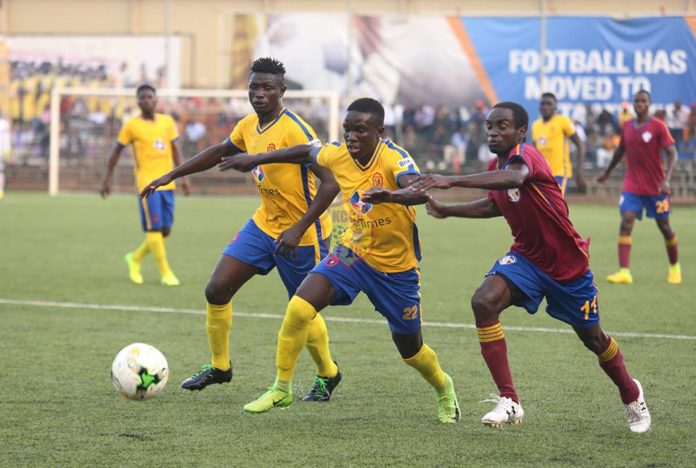
KCCA against maroons

The 2017/18 Azam Uganda Premier League season officially kicked off yesterday with six games that were scheduled to take place at different grounds.

Only five games were played and one game was postponed. The match between newly promoted club Masavu FC and Police FC was called off because the Masavu FC players had no licenses on the match day.

SC Villa were the only side that managed to win in the 5 matches played on the opening day while the rest ended in stalement goalless draws.

Second half Substitute Abdulmalick scored the first goal of the season in Villa’s 1-0 home victory against Soana at the Masaka Recreational stadium.

Bright Stars played with 10 men after a red card in first half but still managed to hold SC Vipers to a goalless draw.

Onduparaka and Proline were in Arua, BUL played Mbarara City in Jinja and champions KCCA faced Maroons at Lugogo.

Match day two will take place on Saturday 16, September 2017.

Match day one results:

  • Bright Stars 0-0 SC Vipers
  • SC Villa 1-0 Soana
  • Bul 0-0 Mbarara City
  • KCCA FC 0-0 Maroons
  • Onduparaka 0-0 Proline
  • Masavu vs Police – Postponed

Today’s matches:

  • URA FC vs UPDF FC – Namboole 4pm
  • Express FC vs Kirinya Jinja SS – Wankulukuku 4.30 pm.


Stories Continues after ad

President’s nationwide land campaign exposes an inefficient system

By Jacky Kemigisa

President Yoweri Museveni is holding a nationwide radio talk-show to address discontent around the Constitutional Amendment Bill, which once passed, will make government compulsorily acquire land. The amendment raises several other issues, so I will limit myself to the President’s activism for the Bill.

On 4 September, President Museveni kicked off his radio activism in Kabale where he spoke on Voice of Kigezi at 7 p.m. He was joined by Prime Minister Ruhakana Rugunda and Attorney General William Byaruhanga. The president will hold similar talk-shows across the country.

His campaign follows land-related clashes across the country – the most reported being nude protests by Amuru women against the forcible demarcation and allocation of land for a sugarcane plantation and factory.

Earlier on December 2016, a land commission led by Court of Appeal judge Catherine Bamugemereire was tasked to look into the rampant land issues.

However, with growing push for the Constitutional Amendment Bill, further discontent among the population is being stoked. The Bill seeks to amend Article 26 of the Constitution to provide for compulsory acquisition of land for government projects. Article 26 of the Constitution provides for the right of persons to own property and decrees how the government can acquire it: with fair and adequate compensation that may be challenged in a court of law. However, government argues that this provision has slowed down the implementation of key projects whenever court halts the activities over compensation disputes.

President Museveni now claims his countrywide effort is meant to highlight the advantages of the Bill and to “remove toxins from the masses”, adding that “some people have been misusing radios to tell lies”. By appearing on radios across the country, the president hopes to generate support for the government Bill. From Voice of Kigezi, the president went to Radio West and Voice of Tooro.  He was also scheduled to be in Hoima (Spice FM), Mubende (Point FM) and Masaka (Radio Buddu).

Aren’t we better off firing all the ministers so that the president can do all the work, and therefore save tax payers’ money? I am sure many taxpayers would appreciate this development.

It is a busy week for the president. Interestingly, Uganda has one of Africa’s largest cabinet. The president is supported by 108 presidential advisers, a fully constituted communications team, plus representatives like Resident District Commissioners, among others. Ideally, one of these officials – who are fully paid by taxpayers – should be spreading the message that the president wants shared with the public. That way the president, his Prime Minister and Attorney General would not be hopping from one district to another but running the country.

In the president’s campaign, we are again seeing symptoms of a system that is centered on and around the President. There have been media reports about different groups – the poor youth, religious leaders, opposition MPs and local elders – all queuing at State House for a chance to share their issues with the nation’s topmost leader.

One might argue that this is a sign of a plugged-in President who has an open-door policy for his citizens; but if the local government is fully functioning with land commission, committees or boards, why are elders traveling from as far as Amuru to meet the President to solve their problems?

Why should the president be regarded as the chief problem solver without whom nothing moves? Isn’t it worrying that those appointed to carryout tasks the president is now doing, are simply taking home a salary without any work done?

The government could have rolled out a nationwide campaign to promote the Bill, spearheaded by Lands minister Betty Amongi. But as it stands, you can call into a radio station from your home area and talk to the President, Prime Minister and Attorney General – at the same time!

Aren’t we better off firing all the ministers so that the president can do all the work, and therefore save tax payers’ money? I am sure many taxpayers would appreciate this development.

MS Kemigisa is the Head of Content at Center for Policy Analysis


Stories Continues after ad

Tanzanian Parliament ratifies oil pipeline treaty

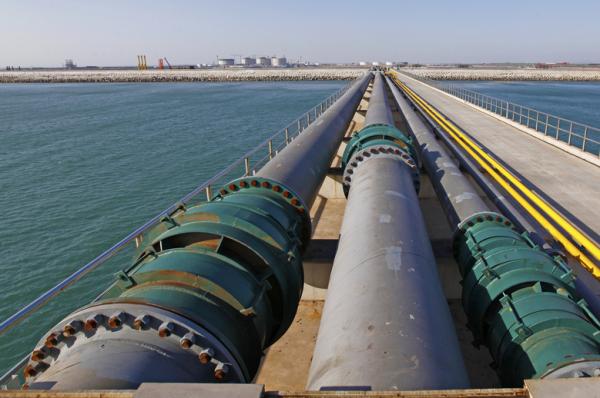
Uganda advancing on oil pipeline developments

Tanzania Parliament has ratified the treaty concerning the crude oil pipeline between Tanzania and Uganda ahead of the construction expected to start early 2018.

The National Assembly passed the agreement on Monday afternoon, September 11, 2017, after comments from the energy and minerals committee, opposition and a short debate that demanded fine-tuning of some issues before and during the implementation of the project.

The Ugandan cabinet approved the ratification of the Inter-Governmental Agreement (IGA) between Uganda and Tanzania for the East African Crude Oil Pipeline (EACOP) Project in mid-August.

Known as the Intergovernmental Agreement between the United Republic of Tanzania and the Republic of Uganda concerning the Pipelines System of EACOP Project, it stipulates areas of cooperation, rights and freedoms to the project operators as well as the concessions the government provides for the project.

The other is the security issue where governments have agreed to provide for the safety and security for the project. Also in the treaty is the national content issue where the two states will cooperate with each other and with the pipeline project company in order to identify, develop and agree in a timely manner national content plans, national content obligations and procurement plans.

Energy ministers from the two countries signed the EACOP agreement in May this year where the countries agreed to construct the 1,445km pipeline from the oilfields in west Uganda district of Hoima to Chongoleani village in Tanga. The  contract aims at promoting efficiency, protecting and addressing the ownership structure of the US$3.5 billion project.


Stories Continues after ad

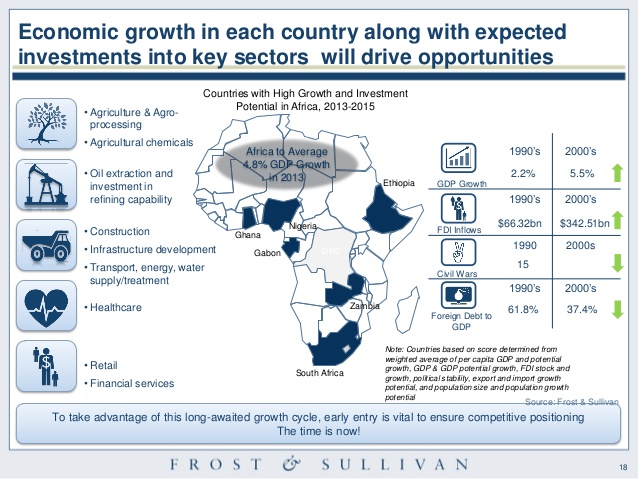
Africa: From ‘hopeless’ to the growth frontier

The world doesn’t address Africa as ‘hopeless’ continent anymore. The big nations, the multi-national companies, economists all have remolded their opinion on Africa to the next investment destination after Asia in the coming decades.

A decade ago one of the leading financial magazines had called Africa as a ‘hopeless continent.’ The winds started blowing in favour of Africa in a bigger way, and 10 years later all are queueing up for Africa as it is the second fastest growing region after Asia. This trend, all believe, will continue in the foreseeable future. The World Economic Forum (WEF) in one of its reports highlighted that “Africa is home to seven of the 10 fastest-growing economies in the world.”

Green shoots in African economy in 2017 after a sharp decline in 2016 is a clear indication that the continent is getting back on the track.

The untapped potential in the Sub-Saharan African region came to the forefront when the multi-national companies started focusing on Africa more. The sudden surge in investments in infrastructure development (road, rail and transport connectivity) from China, clubbed with conducive regulatory and policy support and regaining momentum in economy have brought Africa into the global centre stage.

The advancement in economy trickles down to all segments of the business. The latest Logistics Performance Index (LPI) by the World Bank shows that the African countries have moved itself to the upward trajectory. South Africa continues to lead the pack by positioning itself at 20 in the world ranking. Countries like Tanzania and Mozambique significantly improved its performance in comparison to the 2014 ranking.

World Economic Forum report painted a different picture on the ground reality when the African economy plunged into slumber in 2016, “An environment where private sector-led investments is starting to flourish, in large part thanks to government-led far-reaching economic and political reforms.” That means the adversities gave birth to new opportunities.

Investment attractiveness

Multinational consulting firm, Ernst & Young’s (EY) ‘Attractive Programme Report 2017’ which was released in May 2017 is very bullish on Africa. “Even as Sub Saharan Africa’s (SSA) three largest economies — Nigeria, South Africa and Angola — saw sharp downward revisions in growth forecasts, a diverse group of the second tier economies in Africa — including Cote d’Ivoire, Senegal, Ethiopia, Kenya, Tanzania, Mozambique and Egypt — are expected to sustain high growth rates over the next five years.”

They attributed it to the increased regional mobility, rapid urbanisation and population growth. EY report also says “The flow of foreign direct investments (FDI) into Africa registered an upward trend. During 2016, capital investment into Africa rose 31.9 percent. Investment per project averaged $139m, against $92.5m in 2015. This surge was driven by several large, capital intensive projects in the real estate, hospitality and construction (RHC), and transport & logistics sectors. The continent’s share of global FDI capital flows increased to 11.4 percent, up from 9.4 percent in 2015. That made Africa the second fastest growing destination when measured by FDI capital.”

Global transport and logistics providers see an opportunity to act as “connectors” for Africans and markets, considering the relatively underdeveloped state of infrastructure. In 2016, automotive FDI projects increased 6.5 percent. With 14 FDI projects Morocco retained the top spot for investment, followed by South Africa, Algeria, Tunisia and Nigeria.

By registering a 20.9 percent increase in FDI projects, transport and logistics became the fifth largest sector in 2016. The sector also ranked second by FDI investment and was the fourth largest contributor to FDI jobs.

Setting the stage

Especially in the past decade, Africa witnessed a sizable development in transport and logistics infrastructure segment. New airports, opening up of skies for international carriers with supporting aviation policies, inter country and intra-country rail networks, construction of road networks with cross border access, and larger sea ports.

Dedicated efforts are put into further accelerate Africa’s trade potential. Initiatives like MoveAfrica by NEPAD (New Partnership for Africa’s Development) aimed at the free movement of goods across the continent, establishment of the CFTA (Continental Free Trade Area) by December 2017; preceded by the Tripartite FTA launched by Heads of State and Government of COMESA (Common Market for Eastern and Southern Africa), EAC (East African Community) and SADC (Southern African Development Community) in June 2015 are the steps in this direction.

Open skies

Economists are upbeat about the African aviation segment as it will be one of the fastest-growing aviation regions over the next 20 years, with annual expansion averaging nearly 5 percent. Currently its contribution to the economic activity of the continent is $80 billion annually.

Five African countries lead international air trade to/from Africa – South Africa contributing 16.1 percent, followed by Egypt with 15.9 percent, Kenya holding 12.9 percent, Nigeria 10.7 percent, and Ethiopia with 10 percent in 2015. African carriers’ posted the largest year-on-year increase in demand of all regions in March 2017 with freight volumes growing 33.5 percent.

The growth of air cargo segment in Africa mainly depends on technological innovation, regulatory reforms and investment in infrastructure. To fuel the growth further the International Civil Aviation Organisation (ICAO) had called for a faster implementation of the Lome Declaration. The primary objective of the Lome Declaration is to promote the unobstructed flow and rapid release of goods through enhanced trade facilitation and custom clearance frameworks.

Air freight is key enabler of international trade, especially the high value and time-sensitive goods. Interestingly air freight carries around 35 percent of world trade by value.

“The growth in African freight traffic outpaced the global average last year and that cargo capacity offered by African carriers in the region surged by over 20 percent in 2016. And the implementation of the Lomé Declaration in total will drive the air cargo further,” said the president of the ICAO Council, Dr Olumuyiwa Benard Aliu while addressing the Second Meeting on Air Cargo Development in Africa.

According to IATA, Africa’s share of world air freight market is only 1.6 percent as against the whopping 37.5 percent in Asia Pacific. But this drastically will change as soon as more countries within the continent liberalise the sky.

Europe accounts for 60 percent of the African cargo and commands the majority of international air trade. In the recent past Africa has become the largest contributor to the global flower exporting market. Kenya accounts for about 38 percent of cut roses sold in the European Union making it the third largest exporter of cut flowers in the world. Ethiopia and Tanzania are other East African countries with significant share in global cut flower export.

Keeping pace with the demand growth in cargo segment most of the operators are building new capabilities. Kenya Airways (KQ) opened a state-of-the-art cargo express centre at Jomo Kenyatta International Airport in April. Ethiopian Airlines joined the bandwagon by opening Africa’s largest cargo terminal recently in pursuit to offer its customers the best.

Mrisho Yassin, CEO, Swissport Tanzania, spoke about Tanzania emerging as logistic hub in the region. “There are a number of factors which makes Tanzania as one of the emerging logistics country in Africa. That includes investment needs (prospects in oil and gas and minerals deposits). For the satisfaction of internal consumables requirements, we are importing a number of products from abroad due to limited local manufacturing capacity. In Agricultural prospects – we have a potential to export horticulture products, animal products and in transit point – especially for sea freight for landlocked neighboring countries.”

On the civil aviation side, signing of a ‘Solemn Declaration’ by 21 African heads of state re-affirming their commitment to breaking down the artificial barriers obstructing air transport service expansion between African nations by implementing the Yamoussoukro Decision also a crucial step.

Store safe

Advancement in technology has put the warehousing management in an advantageous position. However to enhance efficiency and optimise the supply chain capacity addition in warehousing is essential.

Leading the pack is Agility which plans to set up a network of logistics hubs across Africa. It is building a 100,000 sqm logistics park on a 40 acre site at Tema Free Zone, east of Accra. PK24 industrial zone is on the northern outskirts of Abidjan, Côte d’Ivoire, covering 940 hectares. The first phase of 200 hectares is being constructed by China Harbour Engineering Company (CHEC), and Heineken has been announced as the first occupier.

Kenya is not too far behind. Africa Logistics Park (ALP) is Kenya’s first international standard modern logistics and distribution complex. It is of 50,000 sqm and currently under construction at Tatu Industrial Park. It is expected to be operational by October 2018.

The Momentum Africa Real Estate Fund that has announced plans to invest in the development of the Agbara Estate, an industrial andlogistics hub in Ogun State, west of Lagos, Nigeria.

Fortress Income Fund has begun the construction of a major logistics park on the former Clairwood Race Course in South Durban, South Africa. The park is planned to have 350,000 sqm of warehousing space, with completion expected in 2020.

The volume carriers

Like any other country, around 90 percent of Africa’s trade happens by sea, making its ports crucial points in logistics networks. Africa though known as a landlocked continent, one would be surprised with the number of ports in each region.  West Africa has 18 ports: East Africa has 3 ports and Southern Africa has 8 ports. According to the latest estimates, Africa’s ports need about $5 billion in investments every year to cope with the increasing container and cargo traffic.

Development in this segment is more visible may be because of the sheer size and the volume handled through the terminals. Transnet Port Terminals, one of the leading names in port development and managing entity in Africa, have made an investment totaling to Rand 17,304 million over the last 10 years.

In an email interaction Transnet Port Terminals elaborated on the major developments in the port infrastructure in the last decade. “Commissioning of the Ngqura Container Terminal in the Eastern Cape was a major achievement. And in 2011: Acquisition of 7 Ship-To-Shore Cranes for DCT Pier2, first tandem lift STS cranes in Africa. 2012 saw the delivery of a R70 million Liebherr crane in East London with a lifting capacity of 144 tonnes, a standard load operation of 77 tonnes and a spreader load operation of 63 tonnes. Arrival of a R140 million ship-loader in the Richards Bay terminal with a 2500-tonne per hour capacity happened in 2013. In the same year, took the delivery of 21 Hyundai forklifts in Richards Bay for break-bulk operations. And July 2017 witnessed the commencement of the assembly of 2 of 23 Straddle cranes at DCT Pier2.”

While looking forward, by 2020, 13m TEU new deepwater capacity is foreseen in West Africa; In Southern and East Africa, 23.2m TEU new deep water capacity projects is planned, of which 22m TEU are part of 3 mega multipurpose port complex projects.

APM Terminals is investing $1.5 billion for a new multi-purpose port in Tema and also has similar plans in Nigeria. Lamu Port is planned for construction about 300 km north of the existing port at Mombasa in Kenya. The China Communications Construction Company (CCCC) has won a contract to build the first three berths of the port.

Algerian government announced plans for a $3.3 billion investment into construction of a new deep water port at El Hamdania.

DP World Berbera complements its investment of $442 million in Djibouti. It had added 2.2 million TEUs of capacity in Africa over the past three to five years, bringing the total annual capacity to 6.2 million TEUs.

Railways

The shift in investments in Africa happened swiftly. The infrastructure development segment which was dominated by European investments once is now being handled by Chinese funding and companies.

The major achievement in this segment was the opening of the Mombasa-Nairobi SGR line this year. The 609 km long line cost $3.8 billion. This is part of the $13 billion line that eventually will link Kenya, Tanzania, Uganda, Rwanda, Burundi, and even South Sudanand Ethiopia.

Last year, the $4.2 billion railway line of 750 kilometres long, connecting Addis Ababa and Djibouti Railway was opened. In the 10-year period between 2004 and 2014, African countries borrowed nearly $10 billion for railway projects from China, facilitated by the China Export Import Bank.

Zambia-Malawi railway that is pegged at a cost of $2.26 billion will be constructed by China Civil Engineering Construction Corporation (CCECC). Lagos Rail Mass Transit System in Nigeria is another project that is handled by the CCECC. The Chinese company also handles the $876 million Abuja-Kaduna Rail Line in Nigeria. The $8.3bn contract for the Lagos-Kano standard gauge modernisation project is also in CCECC kitty.

Changing gears

According to a report jointly prepared by the Boston Consulting Group and the Africa Finance Corporation estimates that the annual infrastructure investment gap in Africa is at around $100 billion. Power accounts for 40 percent of total spending needs, followed by water supply, sanitation, and transport.

The report also listed out the key challenges faced in infrastructure funding in Africa and they are: limited public sector capabilities, insufficient political will, policy uncertainty, weak regulatory environments, shortage of man power with technical skills, financing complexities attributable to narrow financial markets, higher actual and provisional risks, longer project durations, significant cost overruns, and currency mismatches.

However in the past decade and a half the inter country and intra-country road network have improve tremendously.

“Although Sub Saharan Africa is rich in opportunities, it cannot fully unlock its potential unless it closes its significant infrastructure gap. Closing this gap and accelerating social and economic growth and development will certainly take time,” added the report.

Albert G Zeufack, World Bank Chief Economist for the Africa Region, in the LPI report says, “We need to implement reforms that increase the productivity of African workers and create a stable macroeconomic environment. Better and more productive jobs are instrumental to tackling poverty on the continent.”

While we see buoyancy in investments in Africa, many a times the lack of policy and regulatory support dampens the projects resulting in delays. The need of the hour for Africa is to encourage more private participation in projects as many of the countries are unable to fund their projects.

The Sub Saharan Africa region has nearly a billion people and by 2030 will have the world’s largest and youngest labor force. And if the SSA is able to connect the region with a stronger infrastructure network, then this generation would unlock Africa’s full potential and place the continent on par with any other world country.

Source: Logistics Update Africa


Stories Continues after ad

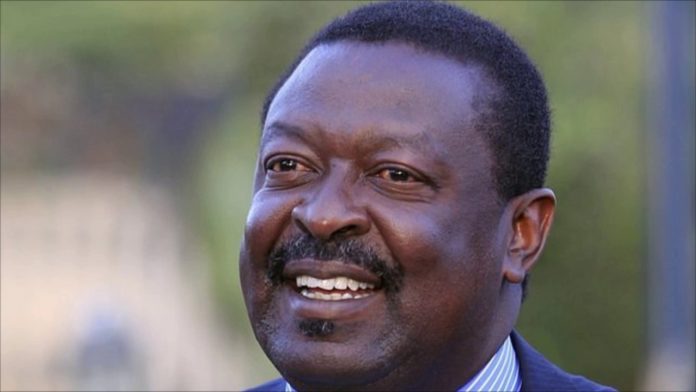
Mudavadi rumored to be out of Nasa

Mudavadi

Musalia Mudavadi, one of the leading members of Nasa coalition in Kenya is reported to have jumped ship.

However sources close to the principal say “it is not true and merely a figment of fake news imagination”

There is a two paragraph letter purportedly from Mr Mudavadi making rounds where he attributes his departure on “unavoidable circumstances.”

“Due to unavoidable circumstances and following our night meeting that ran through to this morning without reaching a consensus, I hereby tender my resignation as a NASA principal and supporter of the change coalition,” the letter reads in part.

The letter ends with, “I wish you all the best in the ongoing contest, with a hope that you will campaign and will not boycott the October 17th election as required by law and for your supporters’ sake.”


Stories Continues after ad