FLASHBACK: Airtel Uganda Head of Usage and Retention, Nellie Mwandha handing over the car keys to Deborah Nabukenya a farmer from Nakasongola during the Airtel Mega Masappe draw.
Airtel Uganda has been hailed for positively impacting on their lives of several Ugandan families and communities through the Mega Masappe promotion, in which seven people have so far won cars.
The telecom company has been handing out five brand new motorcycles and five million shillings to winners every week for the past eight weeks, with more than 50 Ugandans riding off brand new motor bikes or taking home Shs1, 000,000 each.
Shafiq Kizito, a teacher at Lowell Girls School in Mpigi thanked Airtel Uganda for giving him the push he needed to expand his transport business.
“I have been saving every month to expand my transport business. Thanks to Airtel, I have added a brand new motor cycle to my business simply by loading airtime. I’m really grateful,” Kizito stated while receiving the key to his motor cycle from Airtel Uganda Human Resources Director Flavia Lwanga.
Unlike Kizito, some of the lucky winners were excited to start riding to work and eliminating the high transport costs that they incur every day, while the self-employed winners like Herbert Ddamulira – a resident of Bombo – were excited about having a means to transport their goods to and from their shops.
Michael Katabira, a student in his senior six vacation and one of the first winners in the competition, was quoted saying: “I am so excited and really grateful to Airtel. I am going to use this 1 million to pay my first semester tuition at campus.”
Speaking during the 7th car handover held last week, Airtel’s outgoing Managing Director Anwar Soussa reiterated the company’s stand towards the promotion.
“When we started this campaign, our aim was not only to reward our subscribers for their loyalty and dedication to our products and services, but also to change their lives for the better. I believe we are already doing this and we intend to keep rewarding subscribers until the promotion comes to an end,” Soussa stated.
Launched at the start of this month, the 90-day recharge promotion requires subscribers to opt into it by dialing *162# and selecting option 1 to opt in, option 2 to check target and option 3 to redeem their data bonus – which will be broken down into Voice, SMS and Data at 50%, 10% and 40% respectively. This bonus however does not apply to social packs, quarterly, annual and free bundles.
Daily and weekly prizes will continue to be given away every Friday for the entire duration of the promotion.
In the past six months, 19 middle-aged women have been killed in gruesome circumstances in Entebbe and the Kampala suburb areas of Nansana and Makindye.
Indeed, currently 13 people are facing murder charges for allegedly killing the women in Nansana, though no tangible evidence seems to be coming from Entebbe, a place where security is expected to be very tight because of the presence of State House and several other sensitive institutions like the Entebbe International Airport.
The police, the lead law enforcement agency in the country have also been seemingly caught off-guard, with the arrest of the 13 suspects failing to deter the killings, the latest of the victims being 28-year old Jalia Nalule, whose body was found by a bricklayer in Kayirira Kyewagga in Nkumba Central about a week ago, and the other of an unidentified woman found over the weekend in Kitala.
Police boss General Kale Kayihura, who sometime back camped in Entebbe and held multiple security meetings to try and put a halt to the senseless misdeeds, has alluded to the killings as ritual sacrifice. However, for now it seems not much is there to support that assertion.
Anyhow, the killings have now turned on the throb and Security Minister Lieutenant General Henry Tumukunde, the man most remembered for containing the Allied Democratic Front (ADF) insurrection in the 1990s, has once again been called to the fore to try and stem the calamitous tidal wave that almost smirks of organized ‘serial murders’.
According to Lt. Gen. Tumukunde, preliminary findings indicate that some of the suspects arrested in connection with the murders in Entebbe do not hail from the area.
The General however noted that there is a pattern of sorts: all the women killed are aged between 18 and 25, and they are raped and killed, in almost similar fashion. He also says that there is still a puzzle as to whether the women are killed and dumped promptly, or whether the killers first hoard the bodies of their victims and then dump them afterwards.
With hindsight, the ‘Entebbe – Nansana’ killings tend to remind Ugandans of yore about other unresolved fatal paradoxes including the killing of academics and doctors between 1979 and 1980 and more recently, the killing of 12 Muslim clerics about two years ago. Indeed, investigations in both the above circumstances yielded little.
Needless to say therefore, in the case of the Muslim clerics, the police investigations that ensued and led to the arrest and charging of over 10 people including top Muslim cleric, Amir Sheikh Yunus Kamoga together with three others, yielded little or no result because some members of the group was recently convicted for treason and acquitted for the murder charges. This development left many Ugandans asking ‘who killed the Muslim clerics?’
Inevitably then, the current killings of the women have helped rekindle and deepen the issue of the paradoxical killings that have over the past couple of years sent shock waves in the Ugandan population, most times leading to selective opinions by various individuals. And, in the Entebbe-Nansana killings, one school of thought borders on talk of rivalry among the security agencies in a bid to control the huge budget that goes work of investigative nature.
However, be that as it may, will the entry of General Tumukunde, a seasoned spy chief who has headed both the Chieftaincy of Military Intelligence (CMI) and the Internal Security Organisation (ISO), help solve the Entebbe – Nansana killings?
Well, those who know him say Gen. Tumukunde has over the years spent as a spy chief of ISO and CMI mastered the art of maintaining good civil-military relations akin to his operations during the National Resistance Army (NRA) bush war that brought the current government to power.
‘We take long to understand how the women were killed so we have that gap… I want to assure you that we are going to get to the bottom of this matter,’ the General was quoted as telling journalists, after he held a meeting with security officials and civic leaders in Entebbe.
It is against such a background, they argue, that he has once again been called upon to evoke his prowess in pursuit of the Entebbe-Nansana killers.
“Using his skills acquired in intelligence gathering over the years General Tumukunde managed to infiltrate and destroy the ADF; people like the late Major Muhammad Kiggundu (RIP) and ‘Commander Benz’, who were staunch ADF rebels were recruited into the UPDF by him, and these later availed him with credible information that helped decimate the rebel outfit. I believe he will accomplish this task (Entebbe-Nansana killings) because his current assignment does not involve more sophisticated people than the ADF rebels,” a source told me.
Well, for now all eyes will focus on Gen. Tumukunde to provide the ‘final solution’ to those who have made it a habit of killing innocent women.
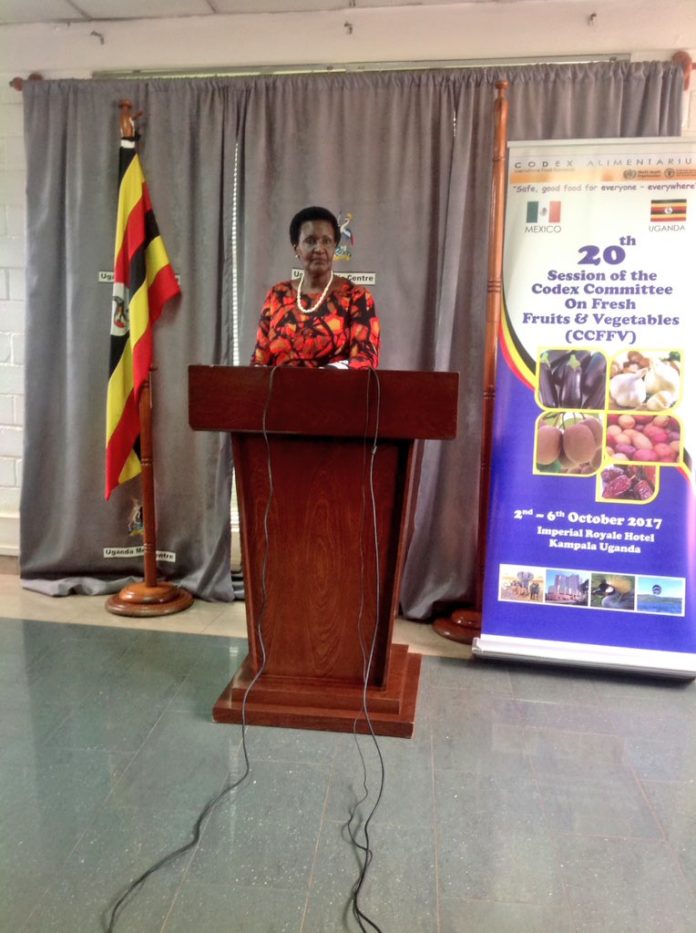
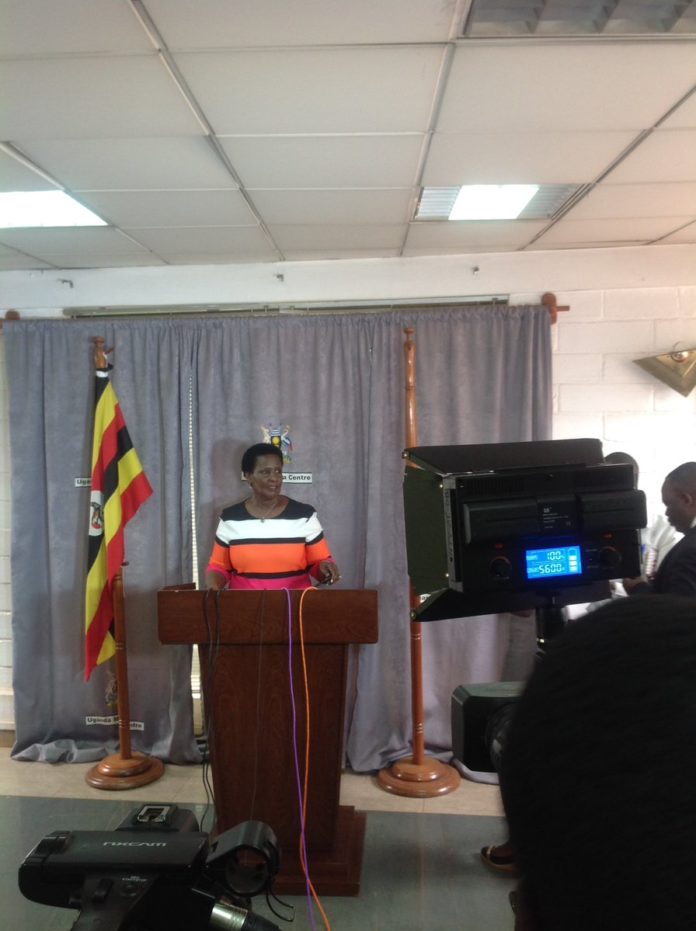
Trade Minister Amelia Kyambadde addressing the press at the Media Centre
Trade Minister Amelia Kyambadde has urged government to start giving interest free loans to farmers and small scale agro-processing industries, in a bid to promote the Buy Uganda build Uganda (BUBU) campaign, launched by Prime Minister Dr. Ruhakana Rugunda, in March this year.
Addressing the press at the Uganda Media Centre ahead of the 20th session of the Codex Committee on Fresh Fruits and Vegetables slated for October 2-6 at the Imperial Royale Hotel, Minister Kyambadde noted that agro processing industries tend to collapse due to high interest rates imposed on them by lending banks.
Organised by the governments of Uganda and Mexico, the Codex session is aimed at discussing the international standards that favor the produce of Ugandan farmers, ‘despite the reduction of quality fruits produced last season following the long spell of drought’. The session will also provide an opportunity to showcase the fruits and vegetables that Ugandan farmers produce.
Meanwhile, Minister Kyambadde says the BUBU policy is already yielding positive results, with local companies supplying 90 per cent of the cement used in the construction of the Karuma Bridge.
According to the Minister, the Hima Cement factory has also signed an Memorandum of Understanding (MoU) with the Chinese Communication Construction Company (CCCC) to supply 120,000 tons of cement for three major projects in the country.
LEAVING: Arsenal midfielder Alex Oxlade-Chamberlain
Arsenal midfielder Alex Oxlade-Chamberlain is on the verge of joining rivals Chelsea after both clubs agreed an initial fee of around £35m.
The 24-year-old midfielder joined Arsenal from Southampton in August 2011 and has made 198 appearances and won two FA cups at the club in the 6-year spell.
Chamberlain will become Chelsea’s third signing of the summer as the Premier League champions continue to push for a possible move for Leicester’s Danny Drinkwater.
The England international is currently with the national team and a medical could be carried out at England’s training centre before the deadline day on Thursday.
Chelsea manager, Antonio Conte hopes Chamberlain will challenge Victor Moses at right wing-back and bolster his midfield options for the defence of their Premier League title and with a Champions League campaign ahead.
Liverpool were also interested but relations between Arsenal and the Merseyside club have been tense since Wenger attempted to prize away Luis Suárez four years ago.
Like Oxlade-Chamberlain, forward Alexis Sanchez and midfielder Mesut Ozil are also out of contract next summer.
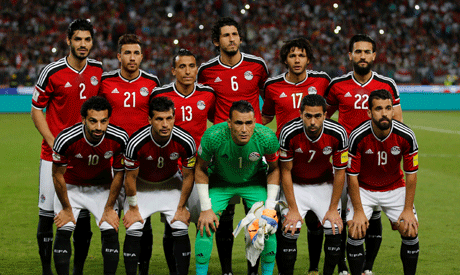
READY? Members of the Egypt national team pose for a group photo
The Egypt national team is set to arrive in Uganda today evening ahead of their 2018 Russia World Cup qualification match against the Cranes.
The Pharaohs are scheduled to arrive at Entebbe International airport at 9 pm and will be accommodated at Sheraton Kampala.
They will conduct a training session at Namboole stadium on Wednesday as per the FIFA rules which dictate that the away side trains on the pitch the where the match will be played.
Uganda faces Egypt on Thursday at the Mandela National stadium in the first leg before Cranes head to Alexandria to face-off again with the Pharaohs on September 5.
Egypt lead Group E with six points after earning two wins and will hope to go further on the top with a third victory over the second-placed Cranes who are just two points away from the Pharaohs.
The game will be officiated at by 42-year-old Mauritanian referee Ali Lemghaifry.
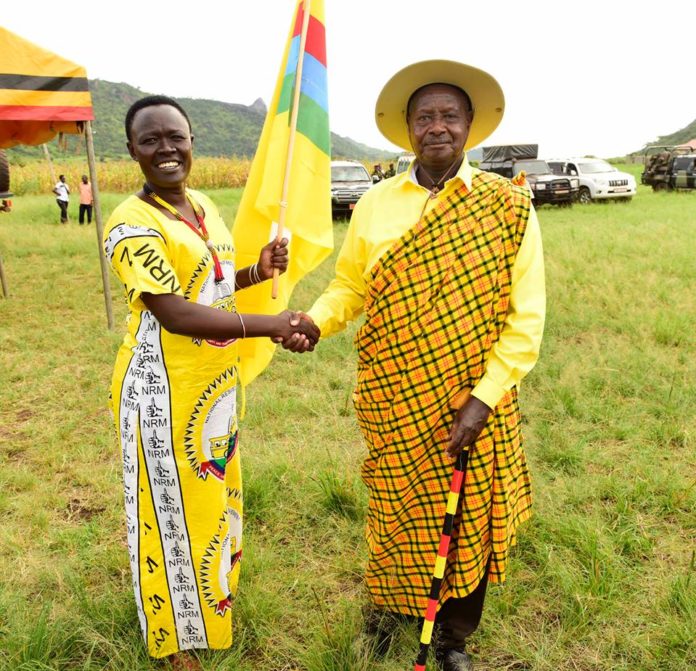
Roseline Akello (NRM) meets party chairman Yoweri Museveni
Roseline Akello of the National Resistance Movement has won the Kaabong Woman MP seat beating closest rival Christine Tubo Nakwang by a few hundred votes.
With an estimated total of 395,200 people, the district has a total of 59,082 registered voters with 158 polling stations and 64 parishes.
And, according to the District Returning Officer Sarah Iyolu, MP-elect Akello got 21, 814, while Ms. Nakwang got 21, 558. The Forum for Democratic Change (FDC) candidate Judith Adyaka Nalibe got a paltry 593 votes.
The Kaabong Woman MP seat fell vacant after the Court of Appeal led by Justice Richard Buteera ruled that the 2016 election in the district was marred with incidents of voter bribery alongside occurrences of non-adherence to the electoral laws.
Meanwhile, the Citizens’ Coalition for Electoral Democracy in Uganda (CCEDU), a civil society organization has said the by-election was held peacefully despite a delayed commencement of polling at some polling stations.
CCEDU, which has been observing national elections over the years, deployed 60 observers covering all the 19 sub counties of the district.
“The election was generally peaceful and calm. While the Electoral Commission (EC) was largely efficient at the delivery of polling materials to polling stations, the delay of polling officials to report to work delayed the commencement of polling at some polling stations,” said Crispus Kaheru, CCEDU’s Coordinator.
Kaheru, however, said some biometric machines used in the election didn’t work well due to the fingers of some voters.
“The biometric voter verification kits worked well, although in the rural areas, some machines could not read the voters’ fingers; which the presiding officers at the respective polling stations attributed to ‘dirty’ fingers,” he said, adding that voters whose fingers could not be read were advised to wash their hands and try again. “On the second attempt voters’ fingers were easily read by the machines,” he said.
Kaheru adds there was general voter enthusiasm – with long queues being observed at most polling stations. The elderly men and women turned up in large numbers to vote.
“There was little visible security deployment, save for the polling constables that were deployed at polling stations,” he said.
Kaheru lauded polling officials including polling constables who he said appeared knowledgeable with the polling procedures. “In some instances however, they assisted voters to cast their vote, which is against the electoral laws. In other cases, some polling officials forgot pin codes for the Biometric Voter Verification Kits,” he said.
The electorate, Kaheru said, demonstrated vigilance around the vote counting exercise – with many voters returning to their respective polling stations at 4:00pm to witness the counting exercise which he said transpired peacefully although in most sub counties it was disrupted by a heavy down pour.
The EC officials, he said, were organized in receiving and announcing results at the tallying centre.
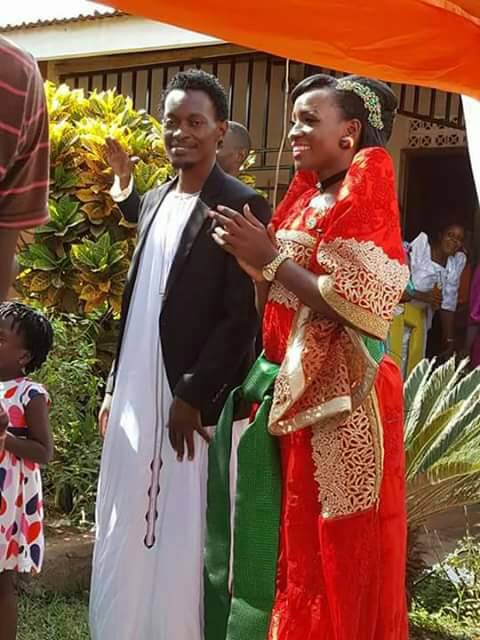
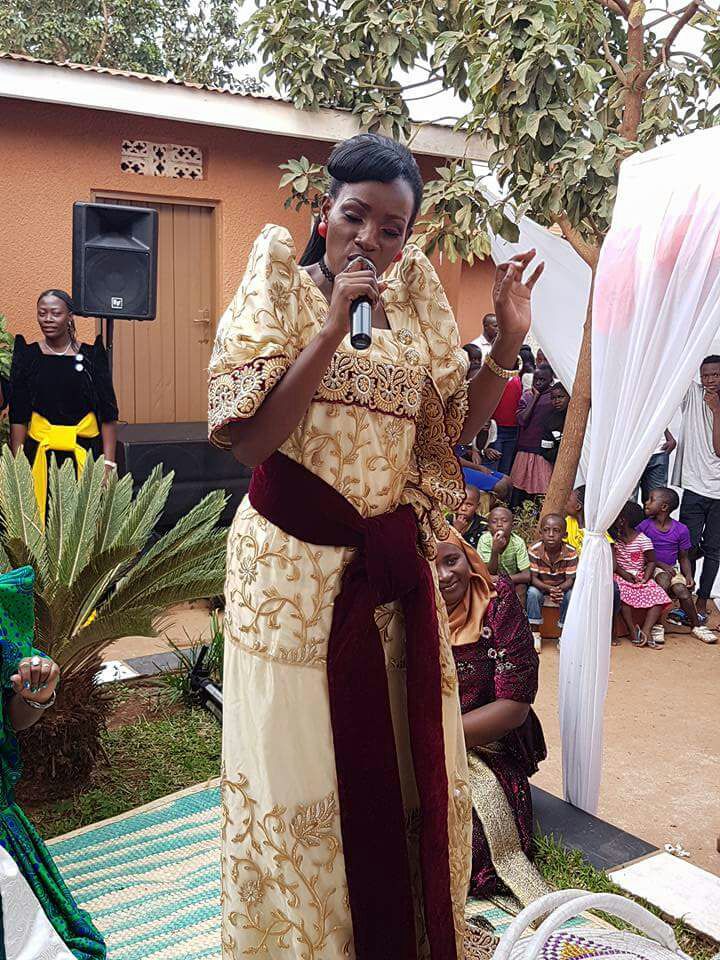
Bukedde TV presenter, Fiona Nabitengero aka Fifi da Queen, has edged closer to formalising her union with her boyfriend Abdallah Nsubuga.
This after she introduced Nsubuga to her parents as part of the traditional wedding. The event was Monday at her parents’ home in Nsambya and was mainly attended by close relatives, workmates and friends.
Some of the people in attendance included Pastor Wilson Bugembe, Rebecca Jjingo and Sophie Nantongo.
We have learnt that the two love birds are set to wed in January 2018. The couple is already blessed with a four-year old daughter.
Fifi presents ‘Kanayokya ani’ program on Bukedde Tv while Nsubuga is into music production.
Two columnists whose writings I respect published in a decent publication, ‘The Observer’ insightful articles, both of which, albeit one following the other or rather premised on events accruing from publication of the first, hinged on what the distinguished gentlemen writers aptly described as the rise of radicals in Uganda’s leading opposition party, the Forum for Democratic Change.
FLASHBACK: Dr. Kizza Besigye expresses a point to journalist Ivan Okuda during an interview
The impression created: These radicals, who are wont to throw stones at whoever questions Almighty Alpha and Omega (that is what they make him appear) Dr. Colonel Kizza Besigye, son of Kifefe of Rukungiri, are fast rising. We aren’t safe no more. Kampala is under attack. The bees are out of the political hive of Kasangati and more wasps from Katonga nests are out to sting anyone who dares question the brave Colonel. Run for dear life, sprint faster than Usain Bolt lest they call you a mole, and Photoshop pictures of you receiving monies from the emperor of Rwakitura’s errands girls and boys. Victims of their extremist politics know no bounds. Ssemujju who was with them yesterday is today, fast and furious, plunged to the alleys of ignominy. The radicals are on the loose and Dr. Besigye is to blame. House on fire! Bomboclat!
The other view: Both Dr. Moses Khisa, a robust academic with impressive intellectual rigour, and Kira MP Mr. Semujju Nganda, one of my favorite politicians, aren’t exactly breaking any news in their latest bemoaning about extremists in FDC aligned to Besigye.
If anything they are chewing cud on what has already been stated ably and in equal passion and persuasion, nay, dexterity of articulation by among others illustrious journalist Andrew Mwenda, and in an interview this year, by Mr. Abdul Katuntu, MP, and possibly one of the finest brains in our August House. Maj. Gen. (rtd) Mugisha Muntu, a polished politician and gentleman of impeccable qualities, too, has in his trademark measured speak pointed fingers at the nest of these radicals, who are hatching a dangerous breed of politics so corrosive that whoever doesn’t subscribe directly or indirectly is denied rites of passage into and by Pax Besigyenica. In other words, they are unwashed in their opposition to Gen. Yoweri Kaguta Museveni if they don’t sing the chorus from the hymn book of Ingrid Turinawe, Mubarak Munyagwa and choir master Nathan Nandala Mafabi. Part of the creed, that qualifies this group to be tagged, ‘radicals, extremists, fanatics’ and other words of derogatory flavor, including, ‘the most stupid people’ as Mr. Mwenda described them recently, is that they are intolerant to anyone anti-defiance, and who dares take on, even criticize Almighty Besigye and his approach to change. Worst of all, the critics say of this group, for which I speak not but merely comment about as an observer of politics of our beloved Republic, they are not even organized and are opposed to building structures (never mind that those who say so do so on the premise of structures built under the stewardship of the ordained cult leader of this fanatical group). Never mind also that defiance and party structure – building are not mutually exclusive or even contradictory. One can be organized in their defiance as Mr Yoweri Museveni and his NRA was (1981-1986). An impression is created to the public that there is an ideological contest in FDC. Of course that would be over rating FDC as it is not a party in the real sense of say, UPC, DP, CCM, ANC but for all intents and purposes a pressure group that mutated through law and paper work into a party but is largely a group of power seeking individuals to whom such ideals and high flying talk as ideology and God knows what else is utopian. Like father (NRM) like daughter (FDC).
Back to the Besigye radicals:
What is the sum total of all this? What Besigye’s critics or better still haters of radical politics say is largely true. Factually they are accurate in diagnosis of what’s happening at and to FDC. But life is not only about facts. It is also about issues, the reason why in criminal law, if you killed person X, (a fact), the court and indeed prosecution and defence are duty bound to go into and dissect the issues, among which, is whether this was premeditated, sometimes even delving into motive. So killing per say, factual as it is, isn’t enough to get you into Dr. Johnson Byabashaija’s safe custody. There are a host of underlying issues that must be addressed for the offence of murder to suffice. Similarly it is not enough to state a fact such as the existence of ‘radicals in FDC’ and bemoan the obvious danger that comes with and not delve into other issues such as ‘why’ and the context of the same.
So what are the issues? One of the issues articulated by critics of Besigye and his radical foot soldiers is that they are intolerant to criticism. I am not sure this is entirely true considering that a number of people of respectable opinion who have worked with Dr. Besigye actually say he is accommodative of divergent views and like Gen. Museveni, will coil his tail if that will help create harmony in the ship so it gets ashore. Mr. Wafula Oguttu, a known Besigye supporter, who despite being biased, is at least, on the basis of corroboration of his view, recently recounted to me several instances when Besigye has had to abandon positions in meetings, including when he passionately sought to have Ms. Cecilia Ogwal, MP, appointed as Leader of Opposition. He presented the name in the meeting and members disagreed, arguing she was new in the FDC waters, and the deputy LoP (not provided for in the structure but suggested by the Colonel) could as well do the job. The forces behind Ogwal’s nomination were powerful, some say including his wife, Ms. Winnie Byanyima, an FDC historical. Besigye swallowed humble pie and let go. Talk to young men and women in FDC’s rank and file and they will tell you how engaging Besigye is and amenable to other views, sometimes painfully abandoning his positions. So it is not entirely true that he has become a demi-god. Gods aren’t questioned. Their word is law. L’etat c’est moi!
May be they (supporters) adore him but you can’t fault someone for being popular and adoration isn’t necessarily blind loyalty when the likes of Ssemujju who hold Besigye in high regard can depart from his candidate of choice (albeit not publicly stated—Patrick Amuriat Oboi) and opt for Mr. Muntu and maintain cordial relations with him. Of course some members of the party, as Ssemujju stated, are fanatically supportive of Besigye, as there will be those fanatically supportive of Museveni, Mr. Amama Mbabazi (SC), Norbert Mao, Trump, Kony, Sejusa, Wayne Rooney or even Arsene Wenger with all the torment Arsenal is subjecting its fans to of late. It appears therefore that being fanatically attached to someone isn’t evil after all. We all have things/people/places/issues we can be accused of being fanatically inclined to and that should be fine. We are human. Not everyone shall be a moderate.
The challenge with the radicals?
The issue those opposed to these radicals have is intolerance that manifests in such crude political stunts like mudsling and defamation of those who disagree with them. Fair enough. The fact is stated. The issue though is, what is the context of this intolerance? First, I see no legal or moral issue with a politician or his supporter being radical as long as that extremism (as in the case of FDC) doesn’t border on criminality. The dangerous radicalism we should dread is the type exhibited by Besigye, Mbabazi, Muntu, Museveni and group when they took to the bushes (in an act of treason and terrorism) against the people and state of Uganda and waged what for all intents and purposes was an ethnic war (west vs north—‘badokolo’) sugar coated with such little niceties as captured in the 10 point program.
I am yet to see however, what is dangerous and criminal about the forms of what critics of Besigye and his supporters call extremism? What is intolerance anyone? Who defines it and what parameters are used? What you call intolerance could as well be gagging people from enjoying constitutionally and internationally guaranteed freedoms and rights (to wit—speech, expression, conscience and thought).
I find wisdom in this paragraph by Archibald Cox in Society Vol.24 p.8 No.1 Nov./Dec. l986 –
” Some propositions seem true or false beyond rational debate. Some false and harmful political and religious doctrines gain wide public acceptance. Adolf Hitler’s brutal theory of a “master race” is sufficient example. We tolerate such foolish and sometimes dangerous appeals not because they may prove true but because freedom of speech is indivisible. The liberty cannot be denied to some ideas and saved for others. The reason is plain enough; no man, no committee, and surely no government, has the infinite wisdom and disinterestedness accurately and unselfishly to separate what is true from what is debatable, and both from what is false.”
How can FDC be part of the efforts to foster democracy when some views held against some leaders are considered too radical that they should be thrown to the fire especially if radicalism offends no law or moral virtues of our society and is within the ambit of acceptable political propaganda which all political entities exercise?
Critics of the radicals in that party surely ought to appreciate that in bemoaning how intolerant their peers are, five fingers point at them too. I sense a latent fear for scrutiny and criticism among those who are quick to write derogatory words about ‘Besiggye radicals’ considering the wisdom in this statement, in this judgment in the Lingens Case, (No.12/1984/84/131), where the European Court of Human Rights said -“freedom of expression, constitutes one of the essential foundations of a democratic society and one of the basic conditions for its progress and for each individual’s self- fulfilment. It is applicable not only to “information” or “ideas” that are favourably received or regarded as inoffensive or as a matter of indifference but also to those that offend, shock or disturb. Such are the demands of pluralism, tolerance and broad-mindedness without which there is no “democratic society”.
Even more, in Muwanga Kivumbi vs Attorney General, Justice Constance Byamugisha (bless her soul) reminds us that to allow for enjoyment of the greatest possible freedom, democratic societies (like FDC—emphasis mine), should tolerate the greatest level of annoyance. Now, if members of the FDC are so weary of being annoyed by so called radicals, how shall they run affairs of the state where criticism is the order of the day, including lies and exaggerations? Don’t they make Museveni whom we lampoon on TV/radio/columns and cartoons by Chrisogon look like an angel as he often allows to be a punching bag of ridicule? The president tolerates some annoyance, why can’t those calling for radicals to be put to order pick a leaf?
The radicals should therefore have liberty to attack (VERBALLY) those they suspect to be moles or working against their course (even based on mere suspicion) and indeed those who detest radical politics should have the humility to recognize, as we see above in the cited cases, that democracy involves accommodating some annoyance. Sadly there is no room for this in FDC hence the tag, ‘radicals’ is thrown around to evade criticism.
Be that as it may, let’s also ask and seek answers to the question of context. There is context of history and culture to the conduct of these radicals. We live in a country where tomorrow you will wake up and see a politician (as we saw with Maj. (rtd) Rubaramira Ruranga who led a hostile and beastly campaign against Muntu when he ran against Mafabi, cross to the NRM, leaving those who always called him a mole licking their lips and winking, “we told you.” There are hundreds of ‘we told you’ ‘we always knew it was a matter of time’ in our political and media space. People are free to cross from FDC to NRM but the point is, the last 15 years have been characterized by supermarket politics. FDC is a huge supermarket from which Mr Museveni’s apparatus easily shops the next ripe vegetable so much so that the only people you can trust in that party are Mugisha Muntu, Kizza Besigye and by extension, Erias Lukwago. The rest? You surely can’t take their word to the bank. It could bounce. Listen to them, engage but keep your eyes open. Big brother could be listening. Uganda’s politics is so transactional that you cannot even trust your own shadow.
Therefore one understands why people treat anyone who attacks Muntu, Lukwago, Besigye, Mao or anyone else committed to the struggle for change with the vitriol the radicals spit. Is the problem then with radicals or the nature of our transactional politics that has built such a toxic atmosphere that even at family level if one member secretly met the president other members would be up in arms and start to watch their backs, calling the other a traitor? That doesn’t appear to me, as radicalism, it is, everything about and more to do with the nature of politics. To focus on why people in FDC act the way they do (out of mutual mistrust and suspicion for those who disagree with them due to a history of flip-flopping) is to cut the branches and spare the cancerous root.
At the risk of whataboutism? Let’s for argument sake ask if FDC radicals are the biggest worry to this country where you have the NRM that rose to power on the basis of participation in a civil war (conveniently called a liberation struggle) for five years. There was wanton killing and misery unleashed by both sides of the war. When NRA/M got power in 1986, they used radical methods to hold that power, including illegal arrests and torture, muzzling political space for DP and UPC, and mass murder in counter insurgency operations for which the president, to admit excessive force was used, has apologized and promised to bring the culprits to book.
Whenever the presidency has been threatened, NRM regime’s response has been terroristic so much as to, with least concern for human rights, release the gods of bloodshed as we saw in Kasese. NRM’s radicalism even gets worse with elections as we witnessed in 2001, 2006 and 2016. Read the 2001 and 2006 election petitions to appreciate how radical NRM is. When Mr Museveni’s power has been threatened peacefully, we have seen how the likes of Amama Mbabazi have been treated, like outcasts with political leprosy. People are jailed, testicles crushed, their businesses are frozen, for illustrious citizens like Olara Otunnu and Mzee Yona Kanyomozi they cannot be supported to get international jobs simply because they have a different outlook to governance. Those who break ranks suffer economically, business contacts are asked by ISO/CMI to cut links. Isn’t this the more worrying trend of politics, that has become near official in Uganda which we must all strive to contribute to change? How does FDC act when Besigye stands as flag bearer? We haven’t seen the radicals unleash violence on say Muntu supporters whenever the two bush war comrades have contested against each other for flag bearer. When Mafabi (call him a radical) stood against Mr Muntu (non radical) the two groups didn’t exhibit violent forms of radicalism. The only traceable evidence of radicalism in FDC is the use of words which as we have seen above, can be taken care of under the ambit of freedoms any democratic institution must bear with. Caricatures, false claims and even lies, as Archibald Cox has argued, could as well be excused, in the competition for political space, as part of the propaganda games. That cannot be radicalism.
So what is the hullabaloo about FDC radicals? It is healthy to caution ourselves every now and then that if FDC acts in ways that can potentially return Uganda to the dark days of NRM/Idi Amin/Milton Obote radical treatment of opponents that should be nipped in the bud. But so far what we call radicalism in FDC is mere freedom of expression, which though not absolute, is still within acceptable limits of ‘reasonable annoyance’.
It is being over played, in my humblest view, by people who want to be immune to scrutiny and criticism and are conveniently oblivious of the context of a muddled political environment where mutual mistrust is the order of the day.
By continually attacking this group as radical and therefore essentially criminalizing (mentally) the same, relegating them to the region of outcasts, we risk falling into the trap of gagging people, frustrating their enjoyment of constitutionally guaranteed rights of speech, freedom, expression and conscience. A political party like FDC should allow for cross pollination of all world views, including radical ones, especially before they get power.
Ivan Okuda is a Post Graduate Diploma in Legal Practice student at the Law Development Center and Special Projects/Investigations writer with the Daily Monitor
The Minister for Trade Amelia Kyambadde addressing a press conference
Uganda has secured one million Euros from COMESA to begin construction of at least one border market in the 2017/2018 financial year and, US$2 million from the World Bank to develop a border market at Mpondwe, in Kasese near the border with the Democratic Republic of Congo (DRC).
Addressing a press conference at the Uganda Media Centre today, the Minister for Trade Amelia Kyambadde said the government has also finalized the development of feasibility studies for construction of borders markets at Katuna, Elegu, Busia, Lwakhakha, Oraba and Kikagati.
According to Ms. Kyambadde, her ministry has already developed a Master Plan, an Environmental Impact Assessments, Documentation and Designs, Bills of Quantities and bidding documents, for the exercise.
The minister noted that her ministry is focusing on improving the trade environment to enable the private sector take advantage of the market opportunities on the domestic market, and consequently build capacity and competitiveness to join the export market.
Further, Ms. Kyambadde noted that the Buy Uganda Build Uganda (BUBU) policy is the springboard for increased export trade adding that her ministry will continue working with other ministries, the Private Sector and other stakeholders to ensure increased production in the priority sectors and compliance to the required standards of products and services.
“Domestic markets enable enterprises to harness competitiveness and build capacity, which then makes them competitive enough to export,” Ms. Kyambadde said, adding: “There are many students from abroad who study here, we have doctors in Rwanda, USA that means that we trade services.
Giving a brief overview of BUBU, which was launched by Prime Minister Dr. Ruhakana Rugunda in March 2017, Minister Kyambadde said the policy is yielding positive results, with 90 per cent of the cement used in the construction of Karuma Bridge being supplied by local cement factories.
She also disclosed that the Hima Cement factory had signed a Memorandum of Understanding (MoU) with the Chinese Communication Construction Company (CCCC), to supply 120,000 tons of cement for three major projects.
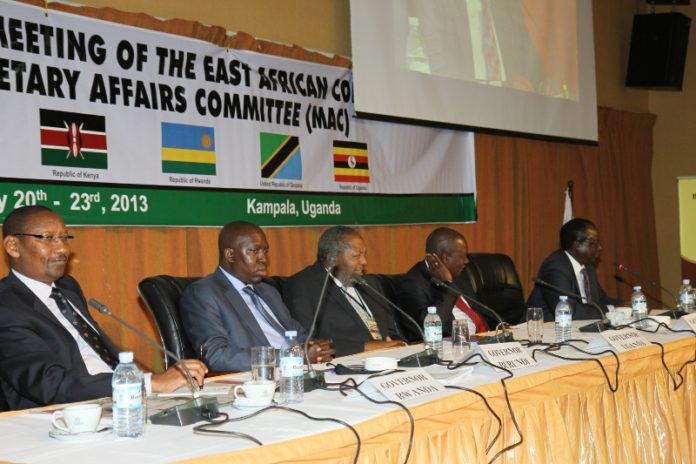
FLASHBACK: Members of the EAC Monetary Affairs Committee at a meeting in 2013.
Central Bank Governors from the East African Community (EAC) partner states meeting under the chairmanship of Prof. Emmanuel Tumusiime-Mutebile, the Governor of Bank of Uganda have resolved to work together to achieve a regional monetary union that should enable citizens of partners states use one currency.
The Governors who form the EAC Monetary Committee announced the resolution through a communique issued in Kampala, where they held the 21st Ordinary Meeting focusing mainly on the progress of the past commitments and the recent economic developments in the partner states.
‘Inspite of the challenges, governors reiterated their commitment to the harmonisation process and will continue working together to achieve regional monetary union’, part of the communique read.
The meeting was attended by other representatives from the EAC Secretariat, the International Monetary Fund (IMF) and Germany Society for International Cooperation (GIZ).
The EAC comprises countries of Uganda, Kenya, Tanzania, Rwanda, Burundi and South Sudan, each with its own currency, but this arrangement, analysts say, is partly responsible for the high cost of doing business in the region as traders have to convert their currencies into dollars so that they can trade easily across borders.
According to the communiqué, there is progress in the harmonisation of monetary policy frameworks, monetary and exchange rate operations, rules and practices governing bank supervision and financial reporting.
The Governors also noted that there has been modernisation and integration of the payment systems, among other developments.
They said the bills to establish the East African Monetary Institute (EAMI) and East African Bureau of Statistics (EABS) were before the East African Legislative Assembly (EALA) for enactment.
EAMI if, established will enhance cooperation between national central banks of the partner states with a view of establishing the conditions necessary for the realization of the monetary union while the EABS will be in charge of regional statistics for better planning.
They further pointed out the progress on the draft bill to establish the East African Surveillance, Compliance and Enforcement Commission, which they said was before the Sectoral Council on Legal and Judicial Affairs for consideration.
More so, they added that the drafting of the bill establishing the Financial Services Commission has commenced.
Other Governors at the meeting included Prof. Benno Ndulu (Tanzania), Dr Patrick Njoroge (Kenya), John Rwangomba (Rwanda), Othom Rago Ajak (South Sudan) and Dr Melchioe Wagara, the Burundi First Deputy Governor.