Stanbic Bank
Stanbic Bank
24.5 C
Kampala
Stanbic Bank
Stanbic Bank
Home Blog Page 178

National Census report to be officially released in December –Minister Lugoloobi

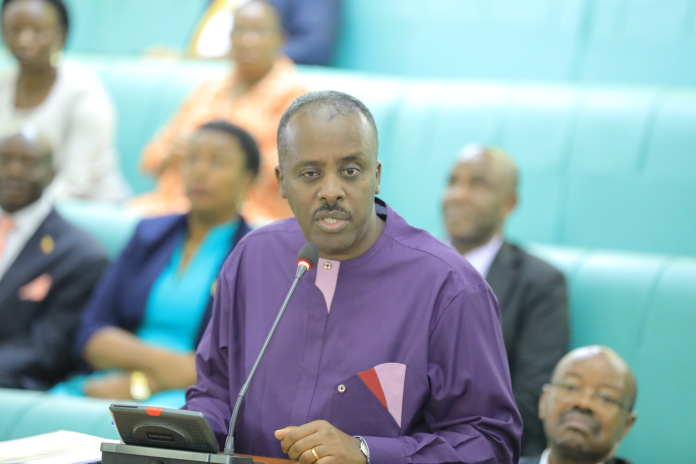
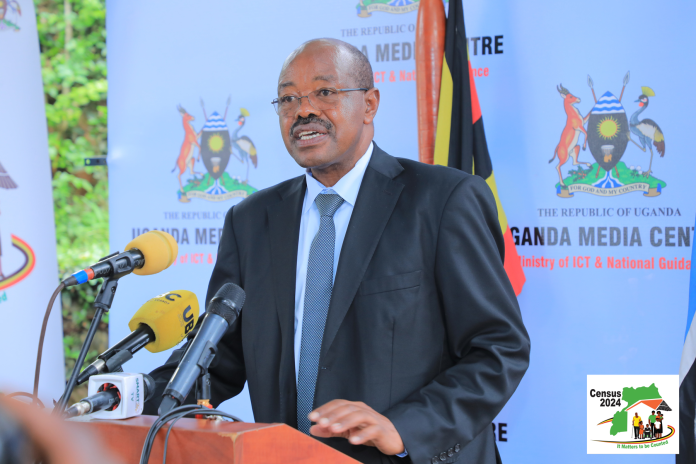
Minister Amos Lugoloobi.

Minister of State in charge of Planning, Amos Lugoloobi has reassured the public that the final National Census report will be officially released by December 2024.

Addressing concerns raised by members of Parliament, Lugoloobi emphasized that the current census data being utilized is only provisional and should not be treated as the final tally.

“In December 2024, we will present the final National Census report. The data we have now is provisional,” Lugoloobi confirmed.

The announcement came in response to questions regarding the accuracy and completeness of the preliminary figures that have so far been made available. Members of Parliament expressed concerns that some regions may have been undercounted and sought clarity on the timeline for the full report.

Minister Lugoloobi clarified that while the provisional figures provide a useful snapshot of the country’s demographic trends, they should not be viewed as conclusive.

Speaker Anita Among directed the government to provide Parliament with the full 2024 Census report, following public criticism regarding discrepancies in the provisional census data. She emphasized that Parliament needs to thoroughly review the official report to address the discrepancies highlighted by various stakeholders.

Although Amos Lugoloobi attempted to present a statement explaining the inconsistencies, the MPs raised concerns about whether a statement would sufficiently clarify the issues, instead calling for the full census report.

“First of all, we need to know the source of this document,” Speaker Among remarked. “The minister must have a report from which he is quoting these figures. We need an authentic document. This partial statement is not enough.”

Jonathan Odur (Erute South) opposed the Ministry of Finance’s plan to table a statement, arguing that the initial census report had been withdrawn following public allegations of data manipulation and inaccuracy.

“When you consider the legal framework guiding the census, it requires a thorough interrogation of 36 parameters. What we’ve seen so far indicates the census was conducted poorly, with claims of manipulated and cooked data. Many households were never even approached by the enumerators, and the provisional report has since been recalled,” Odur stated.

He further argued, “There is no foundation for Parliament to consider such a statement when what is needed is the official census report, not a mere explanation from the minister.”

In a statement released yesterday by the Uganda Bureau of statistics (UBOS), revealed that on Thursday October 3, 2024, the Provisional Report was disseminated and it provided more detailed statistical data and information on population, distribution and several socio-economic indicators.

UBOS noted that the figures for Census 2014 as published in March 2016 were correct. In addition, the data integrity of the Census 2024 is robust and of high quality. However, the Provisional Report published on October 3, 2024 misreported the tribes of Acholi, Bagisu, Bakiga and Lango for Census 2014 figures, which occurred during comparison of the tribal figures for 2014 and 2024.

“This has been corrected in accordance with the United Nations Fundamental Principles of official statistics with being Bakiga being 2,947,837, Lango2, 703,277, Bagisu 2,096,149, Acholi 1,941,913,” UBoS revealed.

UBOS added, “The Bureau would like to further clarify that all religions registered an increase in their followers between the two Censuses. Although all religions had a growth in their followers, some religions had a reduction in the share when compared to the total population.”

In compliance with the internally accepted practices and the approved Census Roadmap, the Bureau instituted an independent team of experts to conduct the Post Enumeration Survey 2024 to validate the scope and content of the National Population and Housing Census 2024. The findings from the Post Enumeration Survey will provide insights into the adequacy of the Census 2024.

“The Final Report containing comprehensive statistical data and information from the Census will be published in December 2024,” UBOS confirmed.

 
Stories Continues after ad

UN Secretary-General advocates for permanent Security Council seats for Africa

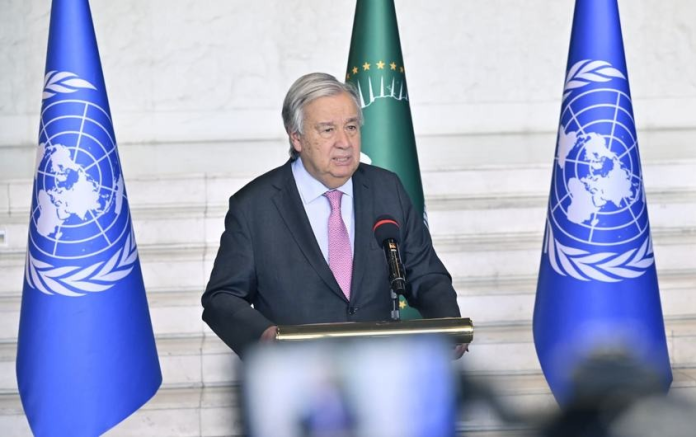
United Nations Secretary-General António Guterres.

The United Nations Secretary-General António Guterres has called for global institutional reform, focusing on the need for two permanent seats on the Security Council for Africa and stronger financial support to address the continent’s challenges.

In a speech delivered during the inauguration of the renovated Africa Hall in Addis Ababa, Secretary-General António Guterres celebrated the building’s historic and symbolic importance for Africa’s unity and progress.

 “This hall is where Africa came together to give life to the Organization of African Unity, now the African Union,” he stated, acknowledging the transformation of the continent from its early days of independence to the present. “I also see it as an invitation for everyone to cooperate in pursuit of a better future, for Africa and for the world,” he continued.

Mr. Guterres highlighted Africa’s hope and promise but stressed the challenges the continent still faces, such as climate change, conflict, and poverty, heightened by historical challenges and inequalities.

Moreover, he called for the reform of global institutions that remain outdated, especially highlighting the absence of a permanent African seat on the UN Security Council.

“Let’s hope it will be corrected soon,” he shared in his statement, especially as there is now a consensus between all Member States that installing “two African members as permanent members of the Security Council” is essential for reform.

Guterres also stressed the importance of the recently adopted Pact for the Future, which addresses the need for reform in the Security Council and international financial architecture. “We can only move forward if we also renew and update global institutions, by making them more effective, fair and inclusive.”

He also mentioned the Global Digital Compact which includes the first truly universal agreement on the governance of Artificial Intelligence, “giving every country a seat at the table, while supporting partnerships to bridge the digital divide and build AI capacity in developing countries and namely in Africa.”

“We must now move forward together in implementing these historic agreements without delay,” the UN Secretary-General noted, reaffirming the United Nations’ commitment to working towards peace, unity, and prosperity for Africa and the world.

Stories Continues after ad

Over 22,000 adolescents and young women contracted HIV/Aids

Dr. Nelson Musoba Director General of Uganda AIDS Commission.

At least 38,000 people contract HIV/AIDS every year, Dr.Nelson Musoba, the Director General of the Uganda AIDS Commission has said.

Currently, 1.49 million people live with HIV in Uganda, of whom 92% know their positive HIV status, and over 90% of these are on antiretroviral drugs (ARVs).

According to the Aids Commission, HIV prevalence reduced from 18% in the 1990s to 5.1% today. The new HIV infections have reduced from 68,000 to 38,000; and AIDS-related deaths reduced from 30,000 to 20,000.

The Prevention of Mother-to-Child Transmission (PMTCT) programs too have been effective, reducing the annual number of babies who acquire HIV from their mothers from 8,800 in 2017 to 4,700 this year.

“In 2024, 4,700 babies with HIV infection acquired it from their mothers, yet there is treatment available at the various health facilities in the country that can prevent mother-to-child transmission of HIV,” he said.

Despite this great success, the epidemic is still generalised, with pockets of concentration among key and vulnerable groups. The HIV prevalence is higher among adolescent girls and young women, almost four times higher than in their male counterparts.

Of the 38,000 new HIV infections mentioned above, 22,000 occurred among women, especially adolescents and young women aged 15-24 years. The country is unlikely to meet the 2025 target of 18,000 new HIV infections annually. Prevalence among sex workers is still high.

“There is a deteriorating trend in the behavioural and structural indicators, such as the increase in multiple sexual partnerships, suboptimal condom use at high-risk sex, as well as increasing sexual based violence—all these potentially increasing vulnerabilities to HIV,” he said.

In a bid to Fast Track Initiative to End AIDS as a Public Health Threat by 2030, the government is engaging men in HIV prevention and closing the tap on new infections, particularly among adolescent girls and young women.

“Accelerate Implementation of Test and Treat and attainment of the fast track 90-90-90 targets, particularly among men and young people; that is, 90% of all people who are HIV positive have been identified through HIV testing; 90% of all who test positive are enrolled in treatment; and 90% of all who are on treatment achieve viral suppression. This has been updated to a new target of 95-95-95,” he said.

Stories Continues after ad

16 NUP supporters sentenced over treachery

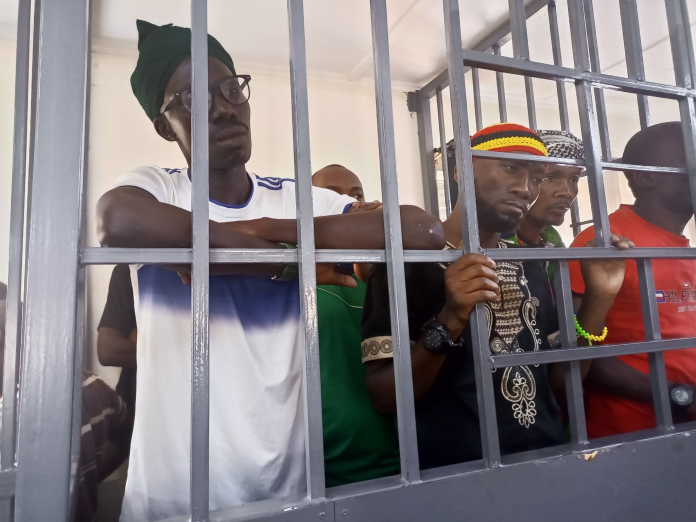
NUP supporters in dock at General court martial-Makindye.

The General Court Martial has sentenced 16 supporters of the National Unity Platform (NUP) political party to three months and 22 days over treachery and unlawful possession of ammunition.

The group including Olivia Lutayya and Muhydin Kakooza pleaded guilty to charges of possessing explosive devices and treachery, seeking leniency from the court.

Presided over by Brig Gen Freeman Mugabe, the court took into account the defendants’ time on remand of three years and eight months along with 16 months attending trial, their guilty plea, and their roles as sole breadwinners for their young families.

“This court hereby sentences each of you as follows; each of you is sentenced to three months, 22 days of imprisonment on counts to which each of you is sentenced to accusation. You have a right of appeal within 14 days if you are not satisfied with the decision,” Mugabe ruled.

The group was initially arrested in December 2020, during the presidential campaigns. They were charged with possessing 13 explosive devices, which is considered a monopoly of the defense forces. Later, an additional charge of treachery was added to their case.

Prosecutors alleged that the group possessed explosive devices in various locations, including Jinja, Mbale, and Kampala, between November 2020 and May 12, 2021.

Despite pleading guilty, the accused expressed dissatisfaction with the sentence, believing they would be released after spending over three years on remand. They plan to appeal the sentence and seek a presidential pardon.

This case has reignited concerns about the treatment of opposition supporters and the use of military courts to try civilians. NUP leader Robert Kyagulanyi, commonly known as Bobi Wine, has accused the military of coercing his party members into pleading guilty.

Stories Continues after ad

Prime suspect and accomplices arrested in Agnes Nantongo murder

Luke Owoyesigyire, KMP Deputy police publicist.

Security agencies have made progress in the investigation into the murder of Agnes Nantongo, which occurred on September 28, 2024, along the Northern Bypass in Kireka, Kira Municipality, Wakiso District. 

The prime suspect, Edward Kaweesa, along with his accomplices Jimmy Serunjoji, Robert Mwanje, Ali Muteesa, Juma Busulwa, and Pius Mugambe were arrested on October 21, 2024, at Dube Parking Yard after an analysis of Kaweesa’s call data led investigators to their location.

Kaweesa attempted to escape during the arrest but sustained a leg injury. Two motorcycles (UFQ 934K and UFB 788Z) and 174 SIM cards from various networks were seized, which are believed to be connected to his robbery and murder victims.

Kampala Metropolitan Police Publicist SSP Patrick Onyango stated, “The SIM cards are believed to be linked to his robbery and murder victims.”

As the investigation unfolds, two additional suspects were earlier taken into custody. One suspect, Brian Mungu, was found sleeping under a nearby flyover. 

Although Mungu initially denied involvement, he later directed police to another suspect, identified only as Mucunguzi, who had purchased plastic bottles from Mungu two weeks prior to the murder. 

Mucunguzi, however, denied any involvement beyond the sale of the plastic bottles.

“There are inconsistencies in their stories, and detectives are retracing Mungu’s steps to verify his whereabouts on the night of the murder,” said Luke Owoyesigyire, the deputy to Onyango.

Stories Continues after ad

Digital IDs to end confiscation of National IDs by money lenders –Minister Muhoozi  

Gen. David Muhoozi, State Minister for Internal Affairs.

The State Minister for Internal Affairs, David Muhoozi has revealed that the National Identification and Registration Authority (NIRA) is working on rolling out Digital Identity Cards (E-IDs) which will end the risk of physical ID confiscation as collateral in their transactions.

The Digital verification will allow citizens to authenticate their identity through electronic means, preventing money lenders from physically holding onto the cards.

“With digital verification, citizens will be able to authenticate their identity using electronic means, such as mobile apps or online platforms. This planned shift reduces the risk of physical IDs being used as collateral since digital identity verification does not require the physical handover of the card,” said Minister Muhoozi.

The Minister said that the use of national IDs as collateral for loans is a violation of citizens’ rights and a threat to national security.

“The confiscation of National Identity Cards as collateral for loans violates the rights and dignity of our citizens. This practice not only infringes on the rights of our people but also poses a serious threat to our national security and social stability,” said Minister Otafiire.

Many Ugandans, especially the poor and uneducated, have been left marginalized after losing access to their IDs. Without their IDs, citizens are unable to access essential services such as banking, healthcare, and even government welfare programs.

Muhoozi noted that the social and economic impact of this practice leaves borrowers vulnerable to exploitation, harassment, and financial extortion.

“When a National Identity Card is confiscated, it severely limits an individual’s ability to participate in basic livelihood activities. This practice disproportionately affects the most vulnerable in our society, leaving them trapped in cycles of poverty,” Muhoozi explained.

The government has also taken decisive steps to combat the illegal practice. These include legal provisions under the Registration of Persons Act and the Tier 4 Microfinance Institutions and Money Lenders Regulations of 2018, which strictly prohibit the use of national IDs as collateral. Under these laws, those found guilty of confiscating IDs face fines or imprisonment of up to three years.

In addition to legal measures, the government has launched public awareness campaigns aimed at educating citizens about their rights. Several arrests have already been made, and national identity cards recovered from money lenders in operations across the country. For example, in Lira City, 149 national IDs were recovered during a police operation in August 2024.

“We are working closely with law enforcement to ensure that anyone found guilty of this illegal practice is held accountable. Citizens are also encouraged to report any person or entity illegally holding their national IDs to the authorities,” said the Minister.

Muhoozi reiterated the government’s commitment to protecting its citizens and urged the public to refrain from surrendering their national IDs as collateral.

“The government is fully committed to ensuring that National Identity Cards remain in the possession of their rightful owners and are used only for their intended purpose. We will continue to engage stakeholders to find lasting solutions to this issue,” he said.

Stories Continues after ad

11 people burnt beyond recognition in fuel tanker accident

A devastating accident along the Kampala-Bombo road in Kigogwa Town has left 11 people dead, burnt beyond recognition, after a fuel tanker overturned and ignited a deadly blaze. The victims, which included 9 adults and 2 minors, were caught in the inferno after attempting to siphon fuel from the overturned vehicle.

The fuel tanker, with registration number UAM 292Q, was heading from Kampala to Gulu when the driver lost control, leading to the deadly crash. Eyewitnesses at the scene report that shortly after the tanker overturned, nearby residents rushed to collect fuel, unaware of the impending danger. Moments later, the vehicle exploded into a fireball, engulfing those around it.

Patrick Onyango, a police spokesperson, confirmed the tragic event and expressed deep regret over the loss of lives.

“The victims were burnt beyond recognition. Sadly, many were people who had gathered to siphon fuel from the overturned tanker,” Onyango said.

In addition to the human toll, the flames destroyed four buildings containing nine shops, causing extensive property damage. Goods and assets worth millions of shillings were lost in the blaze.

Emergency responders rushed the injured to nearby health centers, though the exact number of injured persons is yet to be confirmed. A fact-finding mission is ongoing to gather more details about those affected.

“This tragic incident serves as a reminder of the risks associated with fuel tanker accidents and the importance of exercising caution when dealing with hazardous materials. Further updates will be provided as more information becomes available,” he said.

The identities of the deceased have not yet been established, and authorities are working to notify families. Further updates are expected as the investigation continues, shedding light on the full extent of the tragedy.

Stories Continues after ad

MTN share price surge, as Mbire and NSSF reap big

MTN-Uganda Chairman, Charles Mbire who owns 4% of the giant telecom shares.

MTN share price surge, as Mbire and NSSF reap big

The price of mobile giant MTN share has gone up by Shs27.01 in less than five months.

Previously, the share price of MTN Uganda was Shs177.99 but as of today, the price is Shs205.00.

Top shareholders are MTN Group Limited which has 83.1% holding 18,593,811,989 shares. National Social Security Fund (NSSF) 9.53% holding 2,132,631,877 shares. Charles Mbire 4% holding 895,561,877 shares while minimal other shares are held by Bank of Uganda retirement scheme.

Based on the above statistics, Mr Mbire’s shares gained Shs35 billion while NSSF gained Shs93 billion. Mbire’s Shs35 billion from his 895,561,877 share whitewashes earlier claims that he had suffered $2.4 million loss from the decline MTN-Uganda stake.

The latest venture solidifies NSSF and Mbire as the leading local shareholders in the telecom.

Stories Continues after ad

CAA official could face probe for ‘money laundering’

Symbol of justice.

An official at Uganda’s Civil Aviation Authority is under the watch of International Police (Interpol) after it was revealed by authorities in Canada that the said official acquired two buildings in Ottawa.

Interpol believes that the official used proceeds of corruption to buy the two builds at same time. He is said to have acquired another property in London.

Back home, the official is also under probe by police for corruption and land related crimes.

Stories Continues after ad

 Uganda secures pardon for migrant workers in Saudi Arabia

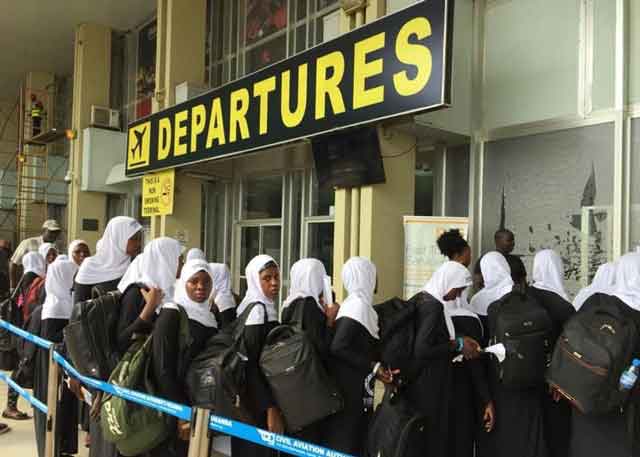
The Ugandan government has secured an agreement with the Kingdom of Saudi Arabia to pardon Ugandan migrant workers currently detained in deportation centers and prisons.

This was revealed by Esther Anyakun Davina, the Minister of State for Labour, Employment, and Industrial Relations, during a press briefing on October 21, 2024.

The minister, who led a government delegation to Riyadh between October 14 and 17, 2024, explained that the visit aimed to discuss the welfare and working conditions of over 150,000 Ugandan migrant workers in Saudi Arabia. Uganda and Saudi Arabia signed a bilateral agreement in 2023, placing responsibility on the host country to safeguard the rights of Ugandan workers.

“Many Ugandans have been languishing in prison centers across Saudi Arabia, and central to the discussions was Uganda’s request for clemency for its citizens, including women with children born in the Kingdom of Saudi Arabia and those detained for various offenses,” said Anyakun.

She added that the agreement excludes Ugandans serving sentences for capital offenses, such as drug trafficking and murder.

The bilateral talks also reviewed the significant economic contributions of Ugandan migrant workers, who send approximately $900 million annually back home. Saudi Arabia is Uganda’s top labor externalization destination in the Middle East, making this agreement a critical step towards ensuring the safety and well-being of Ugandans abroad.

“In a gesture of goodwill, the Saudi government further pledged to expedite their repatriation back to Uganda and support in their reintegration. This unprecedented move is expected to bring relief to numerous Ugandan families, many of whom have been living in uncertainty regarding the fate of their loved ones who travelled to Saudi Arabia with a hope of making a livelihood and supporting their families back in Uganda,” Anyakun noted.

The Ugandan delegation’s success in securing this pardon is a testament to the growing cooperation between the two nations in managing labour migration. The government of Uganda through the Ministry of Gender, Labour and Social Development as the regulator continues to pay keen attention to the issue of enhancing the protection of its migrant workers abroad and ensuring that labour migration is safe, secure, orderly and regular and, particularly in the Middle East and Saudi Arabia as the key destination for labour migration in Uganda.

In addition, the Ugandan delegation which comprised of the Ambassador of Uganda to Saudi Arabia, Uganda’s labour attaché to Saudi Arabia and other technical officers from the Ministry focused their discussions on addressing the key challenges affecting Ugandan migrant workers in Saudi Arabia, strengthening bilateral relations and documenting distressed cases in order to enhance their repatriation to Uganda.

With this development, Uganda’s Ministry of Gender, Labour, and Social Development reaffirms its commitment to improving the standards of labour externalization through strategic bilateral partnerships. 

Stories Continues after ad